
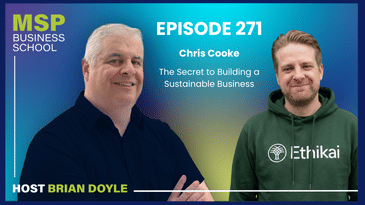

In this episode of MSP Business School, host Brian Doyle engages with Chris Cooke, founder of Ethikai, to explore innovative strategies for business growth, particularly within the world of Managed Service Providers. The episode introduces Chris's unique approach to operations consultancy that prioritizes understanding the core of business challenges instead of only addressing surface symptoms. Doyle and Cooke delve into topics such as pattern recognition, the importance of ethical business practices, and the Japanese concept of "Ikigai" which contributes to Ethikai's ethos.
The conversation highlights the importance of business self-awareness and strategic planning. Chris emphasizes the necessity of knowing one's business goals, likening the direction of a business to a road trip where knowing your destination is crucial. Discussions unfold around the six types of working genius, a model by Patrick Lencioni that Chris utilizes to help businesses ensure employees are in suitable roles to thrive. Through anecdotes and strategies, the episode provides insights into operating on the principle that personal and business growth stem from understanding and leveraging individual and collective strengths.
Key Takeaways:
- Leveraging Pattern Recognition: Chris Cooke highlights how identifying business patterns can prevent stagnation and foster growth, contrasting repetition with innovation.
- The Six Types of Working Genius: This model helps align team members with roles that fit their strengths and prevent burnout, enhancing productivity and job satisfaction.
- Aligning Business Goals with Personal Values: The discussion stresses the importance of defining whether a business should be a lifestyle or high-growth venture, and choosing a path that aligns with the owner's values.
- Importance of Self-awareness in Business Leadership: Knowing who you are and what you want from your business is crucial for effective leadership and strategic planning.
- Applying Pragmatism to Business Challenges: A pragmatic, root-cause analysis approach can provide effective solutions rather than sticking to traditional models or surface-level fixes.
Guest Name: Chris Cooke
LinkedIn page: https://www.linkedin.com/in/cookechris/
Company: Ethikai Consulting
Website: https://ethikai.co.uk/
Show Website: https://mspbusinessschool.com/
Host Brian Doyle: https://www.linkedin.com/in/briandoylevciotoolbox/
Sponsor vCIOToolbox: https://vciotoolbox.com
Listen to MSP Business School on the Fox and Crow Group Your IT Podcasts Network!
[00:00:10] Hey everyone, welcome to the latest installment of MSP Business School. As always, I'm your host, Brian Doyle. And today we're going to talk a little bit about kind of growing your business, right? Big shock that that's what we're talking about at MSP Business School. But we've got somebody that's got a little bit different slant on it, might talk a little bit differently than you're used to about some of those concepts. And I'm really excited to hear what he's willing to share. So I'd like to welcome Chris Cooke.
[00:00:36] He is the founder and lead builder for Ethikai. And he was introduced to me, and we have to say this out loud, right, Chris? Because he's such a great guy. Absolutely. From the incomparable James Steele, who just joined me a couple of weeks ago on the show. And James is one of the ultimate connectors out in the marketplace. And, you know, really excited that he brought me and Chris together. How are you today, Chris? I am fabulous. Yeah, glad we got that James thing in there because he's a good guy.
[00:01:05] I remember reading a book called Super Connector. I think it's by Scott Gerber. And he's exactly what they're talking about in the book. Yeah, connecting people, which is the way the world works. Yeah, I met James at CompTIA a couple of years ago. And he was, you know, sitting in the booth and we started talking before that. And then he pulled out his camera and started working the room. And that's when I understood what James was all about.
[00:01:33] Yeah, absolutely. He just does it so naturally as well. But, yeah, he's a good guy. Do you know what? Actually, I've just been to the MSP show in the UK. And it's amazing how many good people are out there. So many, you know, we talked about the go-giver before. And there's a lot of people out there that just want to help. And that's really what's good about this industry. I always like to say it's a community of servants, right? Most of us got in this to serve other people.
[00:02:01] And as a result, we want to help each other. And I think we all know that for us to be a successful company, we don't have to win the world. And if we can get our share and look at things from a viewpoint of abundance, it's amazing how we can all help one another to be better. And by proxy, help all of our customers cumulatively. Absolutely. Can't boil the ocean. Let's help each other. Yeah, they pay it forward. Big fun.
[00:02:28] But let's maybe kick off a little bit, Chris, for those that might not know you. And let's talk a little bit about who you are, your background, and how you came into the world of managed service providers. Yeah. Well, first and foremost, Brian, great to be here. Thank you for having us. Oh, of course. Chris, my kind of – I was born at a very young age, Brian. Sometimes that happens. It does happen sometimes.
[00:02:53] So, yeah, I arrived in this industry a little bit late, but I kind of have a – I did a degree in virtual reality design and multimedia design, and that was around kind of like Java and HTML. And I was not good at it. It was not my world. So I ended up in a very different world, moving into like retail management, some of the bigger companies. And just went from business to business and kind of did that for years and just kind of like worked out what I was good at and what I enjoyed.
[00:03:22] Spent quite a stint in recruitment as well, which leads into some of the work that we do now, which rightly so across the board doesn't maybe get the best reputation. However, not for me. I'm not a salesperson. Not very good at it, and it's all about numbers. But, yeah, over the course of time, I ended up helping a friend of mine's business
[00:03:46] because I always had this kind of natural – this kind of gravitational pull to operations and business. I always kind of liked business. And then about, I don't know, 12, 13 years ago or something like that, ended up helping a friend of mine run their business, and their goal was to sell the business. And we kind of did that way ahead of time and got more money for it. And I'm like, right, I really enjoy this. And then about that time, and everybody knows this name in the industry,
[00:04:13] Philip Morgan ended up hitting me up on LinkedIn because I so happened – like we sold phone cases at this business, and I so happened to be – I put on LinkedIn, first time I'd ever really created on LinkedIn, I put that I worked in tech. And he was like, right, we need an operations manager for tech – sorry, for the network group. So I ended up kind of joining the network group, working there, doing a few years there, moving into an MSP for a few years over at Liverpool.
[00:04:41] And then, yeah, everything kind of moved and ended up kind of pulling all these things together and building a management consultancy is the best way of explaining it. We prefer to be kind of more builders than consultants. But, yeah, that's kind of where we are and never look back. Love the industry. So, yeah. So let's talk a little bit about Ethicae and tell me a little bit about what you are trying to do and how you're looking to support the MSP community. Yes.
[00:05:11] Ethicae, which is pronounced wrong pretty much by everybody. Am I doing the right job with it? You're doing a good job. You're doing a good job so far. It's actually – you know, it's a hybrid of two words. It's portmanteau of ethical and icky guy. Ethical is – you know, my Myers-Briggs kind of says I'm kind of very morally and values-driven. I like things to be ethical. And so it kind of speaks for itself.
[00:05:38] And the icky guy, if you've not heard it, is a Japanese way of life. This is not a kind of framework or anything like that. It's a purpose. It's a reason for being. It's something that is just about the finite as much as it is the big. And it's putting things in perspective. Ethicae are really here. Because I've cut my teeth in operations, and I've never been technical despite me doing the degree in that. I'm not a technical person. I like kind of pragmatism.
[00:06:04] We kind of look at – look back and reflect on all the conversations that we've had with so many MSPs. Because the gateway to the industry being the network group was 100-odd MSPs. And we had all these patterns in conversations. And I realized that when I went through Prince two years ago as well, it was I like pattern recognition. I like understanding where the holes are. How do we fix it once and for all? So that's really what we're about as a business is we get really involved.
[00:06:32] And because we're all about the root cause analysis, perception is reality to people quite often. And we want to dig, you know, and as opposed to going like here's the symptom. Let's not fix the symptom anymore. So we kind of work with companies in a way where we dig and dig and dig until we find the root cause. We need to sometimes fix the symptom as well as we do the root cause. But this is not just operations.
[00:07:00] So when we start looking at the business, do we go in as an outsourced operator? Do we go in and try and help companies from that perspective? Is it helping them short term? Absolutely. You know, there's very much a requirement for this. But longer term, is it helping them build a sustainable business? And when I went through that root cause analysis of where's that common thread? That's where we ended up with Ethicae. And this is all about the foundation of the business.
[00:07:27] So how do we kind of understand who we are, what we stand for and where we're going? And that's kind of where a lot of our work starts. So, you know, I don't want to do, it's not about doing a pitch and a plug. It's just really, it's about, it's very visceral. You know, it means a lot to me. And the connections with the work that we do with all the clients that are more like partners, sounds a bit corny and cliche, but they are. They're kind of like extensions of the business. We're very involved in lots of stuff.
[00:07:58] It's all about that baseline connection. We're not going to be a fit for everybody and that's fine. But understanding where they're trying to get to helps us then build that path as to how they get there. And then overlaying that kind of like weekly tactical meetings and how we show up and how we communicate and how we hold people accountable and how we build clarity through the business is super important.
[00:08:26] So I could waffle on for this for a while, Brian. But yeah, very much so the end result of the work that we do is we afford a degree of clarity around the right people in the right seats. And that's not just about recruitment. That's how we help people and how we help companies build the right structure for them. It's all for them. It's not a framework that works for everybody. There are great frameworks out there.
[00:08:58] How do we take bits of different things and make it work for them and use their language? Yeah, I kind of like where you started this conversation with pattern recognition, right? Because one of the biggest things I see and certainly I've been guilty of in the past too is you can fall into a sense of complacency doing the same thing over and over every day, right? The old definition of insanity, doing the same thing every day expecting a different result. But we fall into those patterns and sometimes when we say, well, we're stuck.
[00:09:24] We're not growing as fast as we should or our people aren't expanding their knowledge as quickly as they can. You find out it's because we've kind of gotten into that trap of repetition and just kind of – I won't say going through the motions, but letting the day come to you as opposed to seizing the day, right? And that's really where you need an outside facilitator to kind of help look through a different lens in order to get those things back on track. Yeah.
[00:10:23] I think it's – you need to be at a certain point in your journey to be able to go, do you know what? That's not for me. There's actually – Andrew Allen and Troy Midwood from Abyss are really good examples of this because Troy Early Doors realized that he's got this really good business. It's working really well, but he doesn't love being in the CEO role. So we went and brought Andrew in, and they ended up working super well together, and now it's changed again.
[00:10:53] I mean, I think Andrew is now the chairman. So, yeah, it's changed, but it's worked really, really well for them. And I think that that level of awareness and self-awareness I think is really key in our own journeys, which is one of the reasons why when we start this business is like, well, how do we kind of add a degree of validity rather than it just being just trust me, just trust me?
[00:11:17] And there's this – there's a model called the six types of working genius, and it helps understand because not everybody is self-aware. Not everybody is aware of what fills their bucket up and empties their bucket. Yeah, things like that are super key. So let's talk a little bit about the working genius. You know, I know that's a big part of your approach to that model. For those that are not aware of it, maybe you can talk a little bit about what that's all about.
[00:11:43] I'm going to go – I mean, I do full-day sessions on there, so I'm going to keep this very, very top line for you. Not my skill in life, but I'll try. So the sixth type of working genius is a table group model. So Patrick Lencioni, if you've not heard of him, he's got lots and lots of good books, and he writes his books in fables with a bit of application at the end, really easily digestible. And he came out with this model maybe, I don't know, three years ago, something like that. So really, you know, pretty new.
[00:12:13] The problem with a lot of the other models, this isn't a psychometric test. And a lot of the other ones is they're great and they're accurate. It's just quite difficult to remember all of these things and then the application behind them. And the beauty of this is its simplicity. And it's basically – the sixth type of working genius is all about an acronym of six letters. So Wanda, Invention, Discernment, Galvanizing, Enablement and Tenacity. And Wanda being right at the top at 30,000 feet and Tenacity being right at the bottom at about 5,000 feet.
[00:12:43] And actually, this is the elevation of work. Now, everybody's got two of those that is their genius, which is what they love doing. This isn't about what you can and can't do. They've got two that is their competency, which is they can do, but they don't love it. But the other two is the frustration area. And the frustration is if I spend probably more than 20% of my time, so you can apply Pareto principle to this, then I'm going to burn out. I'm going to be wiped out. And actually, my tenure in this role is not going to be great.
[00:13:13] And I think you can probably understand the application behind this already, but it really helps us understand that kind of – the Jim Collins model in the 90s that came out, you know, the good to great, and let's talk about values, and let's talk about culture, and let's kind of push this. And everybody got behind it and then realized, actually, this is quite waffly and fluffy, and there's no tangibles, and let's move on from this. So it kind of had this fleeting five-year thing. And over the years, there's been more and more tangibles that have been added to it.
[00:13:40] And I feel that this is the one that actually helps with the right people, right seats once we've got the values for the business. Overlaying that with, okay, we can say you're the right fit for our business. So our bus is the business. Again, let's stick with Jim Collins' analogy. The bus is the business. And in order to get on the bus, you need to live our values. And once you're on that bus, which seat do I go and sit in? Well, that's what the six types of working genius is for.
[00:14:09] And whilst we're on the bus analogy, where's the bus going? Because that then talks to, again, another Jim Collins analogy, sorry, acronym of BHAG, the big, hairy, audacious goal. So all of these things are actually critical in understanding where we're going. And one of my favorite analogies, and I've gone on a bit of a tangent, so I'll rein it in. It's all good. It's all good. It's all good. It's all good. It's all good. When was the last time, Brian, that you sat in a car and you started driving and you had a passenger
[00:14:37] and the passenger said, where are you going, Brian? And you said, I don't know. I haven't worked it out. And they said, what do you mean? You've been driving for two and a half hours. And I was like, I'll work it out. When was the last time that happened? The answer is never right. Doesn't right. It's bonkers. But this is how we run businesses all the time. We just start driving. We start moving forward. And it's kind of like you look at the horizon and you go, do you know what? In a year, I'm going to be over there. That's where I'm going to be.
[00:15:06] And then you put your head down and you work away and you look up and where's the horizon? Exactly where it was a year ago. So when we put a pin in it and a flag in it, and this is the BHAG. This is the goal. Let's work out what that is and let's work it back. Like, you know, 15, 25 years is a really, really long way to get excited by.
[00:15:27] And I think, don't quote me on this, but I think the furthest away that we can get excited by, statistically, apparently, is three years, which is 12 quarters. And then you can go, okay, we're going to be, there's our milestone to get to that BHAG in three years. And then we're there in three years. Great. Well, how do we get there? Well, we're going to work that back into 12 quarters of projects. So EOS calls it rocks. You've got OKRs, objectives, key results.
[00:15:57] You've got milestone projects, whatever you want to call it. I don't care about terminology. This is about how do we break it down and make it tangible. But how do we make that connect to what it is that we're trying to achieve? So when we talk about the working genius, we can only achieve all of that if we know the people that we're bringing onto the bus and the people that are sat in the right seats. Perfect. And, you know, there's so much truth to that. You know, you've got to know where you're going.
[00:16:20] But working backward has historically been one of the best ways to kind of really break down a very big task that can feel overwhelming and get it into, you know, consumable bites that we can actually take action on. And while it's such a simple comment, I think you were spot on with your assessment of a lot of businesses just kind of wake up and keep driving, keep going, keep moving. I think it goes back to what I was sharing about pattern recognition. Let's just keep doing the same things over and over, expecting a different result.
[00:16:48] And even if we're getting good results, we might not be getting maximum results. And there's a big difference between those two as well. I think we're in this world with an absolute influx of information. It doesn't stop. And you have to stand out and you have to be different and do something different.
[00:17:09] So what we're seeing all the time is, I don't know, TikTok, well, not for me, but TikTok, Instagram, LinkedIn, all of these things that are saying this is the best version of me. Look at this dinner that I've just made. Look at this, look at me on a night out eating at this beautiful Michelin star place. And this is the world. This is how great I'm doing. That's what people want you to see. So a lot of the time what we do as business owners is we get this inferiority complex and we look at the world outside and say, I'm underachieving.
[00:17:39] I need to do more. Okay, well, more, more, more is not better, better, better. And we go and we look at somebody else's, what they want to show us as an output. And we go, okay, I want that. Well, there's an infinite amount of inputs that have made that output. So it's kind of like when we look at best practice, best in class. It's great to have benchmarks.
[00:18:07] I know that I was listening to one of your business school podcast from a few months ago when there was talk of this. And I'm more interested in the median, in the mean line than I am the best in class for that very reason. Because they're the outliers. They're the ones that have done something. And what we don't know is what's gone in. And the point I'm trying to make here is that we need to understand if we want a lifestyle business, not a problem.
[00:18:36] Do we want a business that we want to sell to a VC model? Do we want to invest into it? I mean, there's so many different kinds of businesses. But we need to understand what it is that we want and stop following other people's dreams. We will never... I mean, happiness is this... Is a state that where lots of people say, I just want to be happy. But there's no... There's a great book called Solve for Happy by Mo Gowdett.
[00:19:06] And he talks about the fluctuating states of happiness. And it's very interesting because in order to be happy, you unfortunately need to experience sadness. And there needs to be an up and down. There's never the flat state of happiness. But we need to understand what it is that we're working towards as a goal. And once we understand that, we can build the right business for us. And we can bring the right people into the business. And that is such a highly individual question too.
[00:19:33] And I think there's folks out there that have in the past felt like it was a bad thing to run a lifestyle business. Or you needed to be one of those folks. ConnectWise Service Leadership has kind of the four quadrants on this, right? And you need to be the maven, if you will. So, you know, it really... I think you've got to look into yourself and go, who am I? What do I care about? What do we go from there? And then you can work with somebody like yourself to actually build to that endgame, right?
[00:20:00] And when you look at the median versus the outlier, I think that's a great place to start too, right? Like, how do we get to be where the best in class across the board live? And then we can see, do we have the capacity capabilities to excel beyond and become one of those outliers? Yeah. Couldn't agree more. Couldn't agree more. It's just, again, goes back to self-awareness. Who do we want to be? What do we want to achieve? Because if I say that I want my...
[00:20:28] I'm currently at, I don't know, 300,000 as a business. And we're, you know, we feel like things are going well. But I actually want to be a 10 million pound business by, I don't know, three years. Okay, you can get there. Anything can happen. But it's going to come at a cost. And that cost is going to be your time and a bit of your sanity as well. And you need to work out how much it is that you want to sacrifice. It's really simple. Get to, you know, get to 3 million. Start there and build off of that again, right?
[00:20:56] And then do it at just a little bit longer term, right? So there's a number of opportunities. But I do want to, we're getting near the end of our time together. And I want to make sure that we cover everything that you want to share with our community. Is there anything else you want to contribute or share with the client, the listener today? So much. I like talking, you can probably tell. I like connecting with people.
[00:21:22] But I think the best way really to get a window into my mind, if you're crazy and you'd like to, is every two weeks we have a, called it the Untrapped Newsletter. And that is all about something over the last two weeks really that has kind of hit home. Something that I've seen and something that's drawn towards. Also a video that we record that goes into our YouTube channel. So if you want to sign up to that, I think you put the link below. There's no spam.
[00:21:52] We don't use it for anything other than that. We do it in email. And it's a little bit long form because, as you can tell, I like long form. But, yeah, fill your boots, as we say in Yorkshire. I think for those of you that are looking at potentially engaging with Chris, I think it will give you a good flavor for who he is and what the approach is for the organization in supporting you. So definitely sign up for that newsletter. Again, I'll show it a second time.
[00:22:18] For those that are watching this on YouTube, we've got the link right down below. And for those that are listening via podcast, just check out the show notes. We'll make sure that the link is included there as well. Chris, it's been awesome having you on this call. I almost called you James because I wanted to thank James again for putting us together. For those of you that want to get in touch with Chris directly, I've just put his LinkedIn address up on the screen. And, again, that will be part of the show notes. But I suggest connecting with him. He's active on LinkedIn.
[00:22:48] It will be great for you to, again, get together a spirit of who he is all about. Chris, I want to thank you for joining me today. It's always great to meet new people. And that's a big part of my world with doing this podcast. And I want to thank you for taking some time out of your day because I know it's at the end of the day for you to join me this afternoon. That's all good. I appreciate it. I feel like I've been watching your podcast for so long that I'm sorry. I appreciate that too.
[00:23:16] I'm in the presence of podcast royalty now. Please. Joe Rogan. We've got Brian Doyle. Yeah, they're exactly the same. Same person. But, yeah, I appreciate having you on. This is my labor love to bring great people to the forefront so other MSPs can discover them, right? I'm just the facilitator.
[00:23:40] Yeah, well, and thank you for doing all your go-giving and helping people kind of see that sometimes there's a different way and there's a different way of looking at things. I'd just like to add as well, we work with companies in the U.S. and the U.K. We are, I think, over in Salt Lake City in July, actually. But, yeah, we spend quite a bit of time out there. So, you know, yeah, hook us up. We're happy to jump. I love jumping on calls and just having random chats with people. I quite like that.
[00:24:08] And if there's any way that we can help, you know, that's what we're here for. So thank you. Chris, thank you. Again, everybody, if you want to connect with Chris, his LinkedIn address will be in the show notes. So jump in there, get to know him a little bit better. And, Chris, I want to thank you for joining me and letting me get to know you a little bit better. And I look forward to talking to you more in the future.