
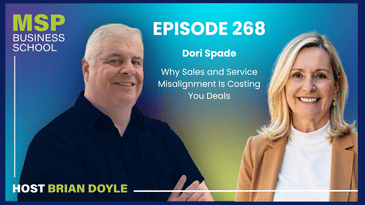

In this episode of MSP Business School, host Brian Doyle welcomes Dori Spade, founder of Call to Action, to delve into the intricacies of the MSP industry. Dori shares her extensive experience in the field, discussing the common issues of misalignment between sales and service teams and how she addresses these through her "Seamless Sales Delivery Model." With a rich background that spans both leadership and operational roles within MSPs, Dori provides insights into how organizations can improve their service delivery to boost client retention and enhance sales performance.
Dori emphasizes the significance of trust within teams and with prospective clients, pointing out how an integrated approach between sales and service sectors can result in higher close ratios and better client retention rates. She shares practical strategies like involving multiple team members in the sales process, which not only builds trust but also showcases a cohesive unit to clients. Additionally, Dori touches on the early stages of AI adoption within MSPs, likening it to previous shifts toward cybersecurity services. Her experience-backed advice is designed to equip MSPs with strategies for smooth transitions and enhanced performance, making this episode a must-listen for MSP leaders looking to innovate and grow.
Key Takeaways:
- Aligning Sales and Service: Creating a seamless connection between sales and service teams improves client retention and boosts sales close ratios.
- Building Trust: The importance of bridging the trust gap both internally and with clients through structured processes and team involvement.
- Innovative Sales Models: Introducing multiple team members into the sales process can demonstrate competency and foster client trust.
- AI in MSPs: Anticipate AI adoption similarly to earlier cybersecurity integration, focusing on strategic implementation and alignment.
- Scalability of Sales Models: Whether it's a small or large MSP, a defined process for roles and responsibilities can scale with the organization.
Guest Name: Dori Spade
LinkedIn page: https://www.linkedin.com/in/dspade/
Company: Call To Action LLC
Website: https://calltoactionllc.com/
Show Website: https://mspbusinessschool.com/
Host Brian Doyle: https://www.linkedin.com/in/briandoylevciotoolbox/
Sponsor vCIOToolbox: https://vciotoolbox.com
Listen to MSP Business School on the Fox and Crow Group Your IT Podcasts Network!
[00:00:09] Hey everyone, welcome to the latest installment of MSP Business School. As always, I'm Brian Doyle here to guide the ship. But as I always like to say, you're not here for me. You're here for my guest. And I'm really excited to bring a guest that I just recently got to know a little bit to the show today. I want to introduce Dori Spade, the co-founder or the founder, I should say, of Call to Action. How are you doing today, Dori? I'm doing great.
[00:00:36] Dori Spade, I know you've been in the industry a long time, but you and I only got to meet about a month, month and a half ago when we were out at GTIA. And it was really nice getting to meet you and learning a little bit about you. And definitely that intrigued me enough to say, hey, you need to come on our podcast. Well, I appreciate that. And I had heard so much about you before we had the opportunity to meet at GTIA and heard positive things about the VCIO toolbox.
[00:01:04] And so it was a pleasure meeting you as well. And thanks for having me on. Well, you know, I'm glad to have you here. And to kick things off, for those that don't know you, maybe you can talk a little bit about your background, some of the things that you've done throughout your career and what led you to this crazy space of MSP.
[00:01:21] Yes, yes, it is a little crazy. I like to say I'm a recovering MSP, but I was in the MSP space for about 17 years before I started my consulting practice a couple of years ago. During that time, I worked with MSPs ranging from around 8 million to well over 100 million in revenue. And I held various roles from service delivery, leadership, general management.
[00:01:51] And in my last role, I had the opportunity to be more entrepreneurial as an investor. And what I had seen across all those roles, and I know you, Brian, and anyone else from the MSP space knows that there's a lot of challenges within the space. It's a great space, but there's a lot of challenges. And it's just not an easy business, right?
[00:02:20] One of the challenges that I saw in each of the MSPs that I was with is that there was this just breakdown of alignment between sales and services. And the impact that that had was slow growth within current clients and low close ratios with organic sales. And I kept seeing this over and over whether I was running service delivery.
[00:02:48] So I was really responsible for client retention and growth or general management where I was also responsible for organic growth. I just kept seeing the same problem surface itself over and over. So in my most recent MSP, where I was brought on to an organization that had acquired an MSP in my area.
[00:03:13] And I think we've heard this story before, but the MSP that was acquired was now struggling to retain clients and retain staff. So we hear that over and over, unfortunately, in our industry, especially with all the consolidation that we're seeing. And so I was brought on to help.
[00:03:37] And actually, the situation was a little bit even worse than what I thought when I came on to the position. We were really losing clients. I was getting these resignation letters on my desk. And I'm like, oh, what's this? You know, I have this registered letter and I open it up and it's a cancellation. And so it was a very, very tough and challenging situation to start with.
[00:04:05] But I had this thought in my mind that we really need to focus to alignment between sales, service delivery and client success. So let's unpack that a little bit. So, you know, when we have that misalignment, I guess, between those two groups, did you find it to be more overcommitment from the sales teams or more from the service teams not understanding what the packages or what was being sold out in the marketplace and there wasn't a clean handoff?
[00:04:35] You know, what were you kind of finding to be the common thread that you were seeing most often between those things? So I think the common thread really boiled down to trust, a trust gap. So, yes, sales was selling things that service delivery didn't necessarily feel comfortable implementing.
[00:05:00] And, you know, let's face it, they were rewarded by, you know, bringing on sales and service delivery is rewarded by being safe and having low risk. And so these two things just pulled each other apart instead of working together. So I think that's really what I was seeing. And there was a lot of frustration with both teams.
[00:05:30] And sometimes it even caused retention issue with staff. Yeah. Yeah. And did you find, you know, where did you find the breakdown? Because I often found when there was a breakdown between sales and service and things were getting sold that shouldn't have been covered there, it was also a breakdown oftentimes in leadership and supporting, you know, kind of that straight line focus and allowing things to kind of get outside the box sometimes just for, you know, revenue capture.
[00:05:56] You know, did you see anything like that over time where, you know, that caused some of the dissension between sales and service? And I might be speaking a little too internally from pain I felt, so I apologize. No, I think your pain is a common pain. And yes, sometimes it's pressure, you know, it's just pressure to achieve the goals that you have to achieve.
[00:06:20] And if it's a sales leader who has, you know, a number they're trying to hit, yeah, they are going to stretch things. And I've been in that role as well. Before being an MSP, I was a sales leader with a Fortune 500 company, and I know what that pressure feels like. I don't, I want to always be careful about, you know, criticizing sales because if it weren't for them, we'd have no businesses.
[00:06:49] But on the other hand, we don't sell a product, we sell services. And if those services can't be delivered, you know, in a reliable way, then now we have a retention problem. But just going one step further on that, though, Brian, that's the internal struggle. What it actually looks like from the prospect is the trust gap.
[00:07:18] It's a trust gap internally, but it's also the trust gap with prospective clients that you're trying to work with. You know, they're not seeing everything that you love and believe in your MSP. They're not seeing that if they don't see that alignment and they don't see how sales and services works together. You know, it's tricky selling services, right? You don't, you can't demo it.
[00:07:48] So, you know. And I think, you know, when it does come to the prospect, it is feeling like the team is working cohesively on the other side and they can recognize very quickly when there's kind of a disconnect between parties. It comes out very quick because there's so much relationship that happens at the help desk as much as anywhere else in the company. And you can feel where that, where that changes. And then when you start talking about the size of the organizations you worked, it's only a compounding effect.
[00:08:16] Like, let's maybe touch a little bit about that. You know, there's many people that are probably listening today that have been in an $8 million company, but there's far less that have been in $100 million. Yes, that is true. And I guess the one thing I would say is the problems are the same because when you're working with $100 million plus MSP, it all still comes down to what happens at the local level.
[00:08:43] And most large companies, you know, MSPs, they're not one office, right? They're multiple offices. They're national. And so it really comes down to how are things working at that local level. So if you look at it from just that perspective, it's really not different. I'd say a big difference is the leadership.
[00:09:08] You know, a lot of times things are driven from the corporate level in a very large MSP versus at the local level with an owner. Perfect. Perfect. You know, I think that gives us a little understanding of who you are and what you've experienced, Dory. Talk a little bit about, you know, what was the thing that really defined and changed your thought process and really, you know, made your life a little bit different and, you know, catapulted you to where you are today helping other MSPs.
[00:09:37] So I think when I started developing this new model for sales to service delivery, we saw such a huge impact. We went from an average of about 25% close ratio on qualified leads to 70% close ratio. And that had a huge impact. And we also drove client retention up over 95%.
[00:10:06] Now, keep in mind, this was with an MSP that was really struggling at this regional level. And so fast forwarding to today, this is where I've brought this type of process to MSPs today. And the problem that it solves is, again, I hate to keep saying it, but this trust gap. So now we're going from an internal problem to how do we increase close rates?
[00:10:35] And a lot of MSPs think they have a lead issue. You know, we need more leads. We need more leads. But you have leads that you're not closing. So, you know, let's start there without increasing any more marketing spend. Let's increase the close ratio.
[00:10:54] And I guess what I find in sales and when you're going through the sales process, you're trying to, you know, customers will ask, well, what differentiates you from these three other proposals I have? And how many times, Brian, have you heard? Well, we have the best people. We have, you know, the best techs. They're very good. I'm glad you went there. Right? Yeah.
[00:11:19] And that all sounds very much the same to the prospective client. You have no real way you can prove it in that moment either because, you know, you could tout, hey, they got these certs. They got these skills. They came from where. But there's no way to actually feel that in the moment. That's right. That's right.
[00:11:38] And so in my sales to service delivery model, what I've done is I've incorporated sales, service delivery, executive leadership, and to some extent, even client success into the sales process. So guess what? You are demoing it. You are showing it. You're showing how organized you are. You're showing that. And, you know, we're always talking about, oh, you have to have this business conversation with your clients.
[00:12:07] It can't be a technical one. But it's very difficult to do that if you don't have somebody at the executive level to have that conversation. So, Doria, you're kind of advocating here for multiple people being part of the sales touchpoint with the customer. Exactly. And getting more people involved because I've been hearing, you know, when I do talk to some of the more excel, you know, the MSPs that are excelling at the greatest levels.
[00:12:35] I am finding this fascinating thing. And it's something I got to admit I wish I'd known a little bit better when I was an MSP where it was, hey, as you're going through the sales process, because I think we can all admit to this is not a one call close process. This is three to five sales calls on a good mission, right?
[00:12:52] And it makes sense that you may have that single thread, that account manager or sales rep that's kind of guiding it through this, but bringing in different personalities throughout that process to help them get comfortable with the team. It is so true.
[00:13:37] It's three key areas because this applies to all different sizes of MSPs, whether you're, you know, an owner, you know, sales led owner, or whether you're a large team is understanding roles and responsibilities very clearly. So that's super important. If you're owner led and you're, you know, you say, well, you know, I'm, I'm acting as the lead tech as well. That's great.
[00:14:07] But what is, what is that role? How do you define that role versus how do you define having the executive role with the, with your prospect, you know, CEO that you're working with, or, you know, I do all my own account management. Well, okay, but that's separate from the executive role. So really defining those roles and responsibilities is number one key.
[00:14:33] Number two is a clear, repeatable, scalable process. So if you're small, it's small. If you grow and you have more people engaged, that's fine too. It's still scales. So that's number two. And then number three is those all important client facing presentations and proposals. Are they really outcome focused? Are they really strategic?
[00:15:02] Or are they about the tools and the tech? So that's kind of where I think there, that alignment happens on a very consistent basis. That's definitely an interesting thing and a trend I'm seeing starting to uptick where people are building out those sales processes, bringing in other roles into the sales process, certainly with customers at least of a certain scale. And, you know, ensuring that they can really differentiate.
[00:15:33] Absolutely. And when I was an MSP, we had, for example, one prospect that we got through RFP. And we all, you know, don't really like RFPs, right? They're super competitive. They're a lot of work. And we followed this methodology that by now we had pretty much fine tuned it. And it was very competitive. They had about six MSPs competing for the business.
[00:16:01] And we ended up by winning that business, which was, you know, over the course of three years, it was, you know, certainly over a half a million or over a quarter of a million dollar agreement. And I still have a relationship with that previous client. And I've asked, you know, why did you choose us?
[00:16:24] And she said, I could just see through the organization as you went through the RFP process, I could envision what it would be like actually doing business with you. Yep. That is amazing. And, you know, and I think that's a big part of it because when you are selling something so intangible, the only thing you can do is really help people feel good in the gut, right? Because that's where a lot of those decisions are made.
[00:16:50] And it comes from feeling, you know, that sales process is your audition. It's your opportunity to show them what you're all about. And if they're not getting a warm fuzzy through that process, they're not going to make a move. And that's another huge part, you know, why is it so hard to, you know, to acquire new clients in the MSP because of the pain that's often felt with that conversion. A lot of times they, you know, they'll let you run over their cat nine times before they're going to make a move.
[00:17:19] So you really have to put your best foot forward to get them to kind of go, ooh, this feels better. Yes. Yes, it absolutely is. You know, their perception and our perception sometimes are two different things. And you're right. It's like, you know, you're showcasing everything that you're saying you're doing. You need to showcase that. So let's talk a little bit about how that translates to what you're doing at Call to Action. You know, you're now out there. You're helping MSPs be better.
[00:17:46] You know, you spoke a little bit before our call that you've kind of got a framework that you operate from. Would you like to talk a little bit about, you know, about how you're approaching the market? Yes, sure. Sure. So I call it my seamless sales delivery model. Hopefully that's a memorable title to it. And I bring it to MSPs either through workshops where I'm working with their team.
[00:18:15] So it could be an owner, sales, lead tech, whoever they have that can be part of that, what I call a dream team. Or it can be with a larger MSP where they have, you know, a VP of sales or something like that and a director of service delivery. So it can scale. And so that's a three series workshop that I do.
[00:18:42] And then in some clients, it's more just working one-on-one with CEO or COO to really, it really depends on where they'd like to do it. But I think because we're talking about building a team process, it's nice to have engagement with more than just one person from the MSP. Perfect. Perfect. And, you know, now we're going through these winds of change again as MSPs, right?
[00:19:12] And, you know, there's always buzzwords that we're working against at any time that we're an MSP. And the big one that these days is around AI. And I know another thing we were talking about earlier is, you know, how do you make an impact with AI? And, you know, how are you working with MSPs that are trying to figure this out? And I'm hearing all kinds of different things across the industry. You know, there's this huge hype engine and it makes you believe everything's been deployed.
[00:19:39] But most MSPs I'm talking to are still on their early stage, if any, project. So, you know, I'd love to get your perspective on that. Yes. Yeah, it's interesting. I do totally agree with you. This is early on for the MSP's AI journey. And I think that they are feeling a lot of pressure on adapting somehow and adopting AI.
[00:20:08] What I would say about that is I see bringing AI to your clients very similar to the process of bringing cybersecurity to your clients a few years back or several years back when that, you know, really became something that we had to have in motion. And a lot of MSPs really struggled with that.
[00:20:29] And I feel like this same framework or model is what's helped them and helped me and my MSP really have customers say yes to cybersecurity services. And I feel like it's the same framework that's going to help the customers say yes to when MSPs do have an offering that they want to go out and resell.
[00:20:56] So I don't see a difference there. I feel like it scales. I feel like, you know, we, you have to still have that engine, that sales motion where you're not going to just go out and tell a customer, oh, you should, you know, we can bring this AI tool to you and it's going to do this, this and this. How are they going to trust that? They really, you know, you really need to have some depth and breadth around you.
[00:21:23] So really just in short, Brian, it's really the same process that I really believe in that I think is going to help MSPs with their go-to-market strategy. And that's a, you know, that's a big thing that you say their process. You know, MSPs always talk about their process on the service side of things and how they're bolstering, you know, that. And how they're making things very repeatable and SOPs are written everywhere. And then there's sales.
[00:21:51] And it usually comes with a little bit of an afterthought in our, you know, our industry is so steeped in technical founders too. Yes. They can only go so far. Really, they went as far as their Rolodex in most cases. And when the Rolodex kind of hit the end, sales kind of slowed down. So, you know, it's great that there's folks like yourself out there trying to kind of help them understand the process they need to put into play up front. But then take it one step further. How that process has to play into the downstream. Now you've won. Oops. Now what? Right?
[00:22:22] Right. Right. Exactly. And though, key point, if you've engaged service delivery, you know what you've won. Yeah. They feel comfortable with it and they'll stand behind it with their teams. Yes. Absolutely. You've got that buy-in. You've got that rapport. And, you know, it's not like, oh, you know, what did you sell? You know, you don't have that. Yep. And I've been on both sides of that. I've definitely been asked, so what did you sell?
[00:22:51] And what made you think that we could do that? And I'm like, well, Frank said we could do it. That kind of thing, right? So, you know, those things happen in life and certainly you don't want them to happen often, but it can, you know, happens too much. It really can create a culture that just becomes disastrous. And culture is such an undervalued part of the MSP, especially when you're in an acquisition mode. Matching cultures, matching clients, you know, keeping things very transparent become the
[00:23:20] things that allow you to retain both employees and customers. And oftentimes it's not one of the biggest things looked at on day one. Yeah. I'm so glad you brought that up, Brian, because culture does make a huge difference. And one of the things that probably will always stick with me and make, you know, really give me a warm and fuzzy is one of my, what I considered an MVP on my team. You actually know him, but I'll leave his name out.
[00:23:50] But, you know, was a VCIO and definitely an MVP on my team. And, you know, he once said to me, this was the only place he worked where he really felt that sales and services worked really well together. And so the alignment isn't just about more sales. It's also about culture and people relying on each other and knowing exactly where they
[00:24:18] can rely on each other and what they can rely on each other for. And it has a profound effect on the culture within an organization as well. It does. And, you know, the more the teams are in alignment on what they're doing, we used to hold meetings where it was just a weekly meeting where we brought people in from the technical team. Basically, each leader would bring two people from their team in and say, now we're having a meeting.
[00:24:44] This is not meant to be a full airing of the grievances, but tell us where you're seeing disconnects from your seat because we don't see down that far sometimes. And granted, you might have to be at 10 million, you know, five to 10 million before you were able to get to that conversation. But it was so eye opening when you were working the help desk going, hey, man, people come in and we didn't know we sold this. And it could just be data entry, right? You know, during the onboarding process, not even a sales to service issue.
[00:25:12] But these little gaps get surfaced when you start bringing other people in and the culture becomes so much stronger because they feel like they're actually being heard, too. Which they are. Yes. And that's so important. And, you know, I noticed this with techs a lot. Like, they want to be successful. They do not want to go and disappoint a client. You know, as a rule. I'm speaking very generally.
[00:25:41] No, but I think it's a safe rule. I mean, look, this is an industry full of servants, right? I mean, by the nature of what we do, we're all trying to help. And, you know, and we want success for our customers almost sometimes to a fault, right? Right. It absolutely can be. Yes. And so we need to give them the tools and the confidence to be able to go out. If you find, if you, a little side note, if I found a tech wasn't responding to a client,
[00:26:10] it was almost always because they didn't have the answer and they didn't want to tell the client they didn't have the answer. So, you know, really having that, building that confidence is super important as well. Well, we're getting near the end of our time, Dory. I wanted to, you know, ensure that we cover everything that you wanted to talk about today. Any other topics that you want to bring to light before we wind down and say goodbye for today? Yeah.
[00:26:32] I think the one thing that I just want to reiterate too is this type of a model can be used with very small MSPs. My smallest customer that I've worked with was a $2 million MSP with a team of, a total team of about eight to 10 people. And it's made a big impact for them. So don't feel like, oh, I don't have all these roles here.
[00:26:59] So this won't work for me because it scales up or down. So, you know, I'd love to help out with anybody. If they have any questions, I'm always happy to have, you know, phone conversations with people. So let's be very clear at the $2 million Mark II, you've got a lot of owner-led sales, which means a lot of everything stays in between one ear and the other ear and doesn't make it to the team. And that's a big reality at that stage too. So that's exactly right. That communication piece is needed at any size, I will say.
[00:27:29] But perfect. Well, you know, Dory, I want to thank you for joining us today. You know, listeners, Dory's LinkedIn will be in the show notes as will be the link to her website as well. So, you know, certainly reach out, ask questions and get to know her. Dory, I want to thank you for joining me. It's been great getting to know you a little bit better and I look forward to further conversations as we move down the road. For all you listening, as you know, you can get this podcast either on YouTube.
[00:27:55] Please subscribe if you do and get notified anytime a new episode comes out or just get us anywhere that you download your podcasts. I want to thank you all for joining us again this week and we'll see you again next Tuesday. Take care. Thanks, Dory. Thank you, Brian.