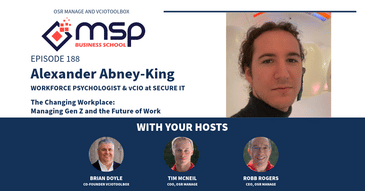
[00:00.000 --> 00:29.000] Welcome to MSP Business School, led by our deans of business development, Brian Doyle, Tim McNeil, and Rob Rogers. Each week MSP Business School is committed to delivering you proven strategies, tips, and tactics for MSPs to accelerate their business growth and revenue through better sales, better marketing, and true account management. Classes start now, so let's get started. Let's start.
[00:29.000 --> 00:34.000] Let's throw it to the deans.
[00:34.000 --> 00:50.000] Hey, everyone. Welcome to the latest edition of MSP Business School. I'm Brian Doyle. You may be maybe noticing I'm without my counterparts today. Robin Tim are traveling today, so I am taking this one alone, but I'm really excited about this episode.
[00:51.000 --> 01:03.000] Today I have a gentleman joining me that I've gotten to know over the last few weeks and learned some interesting things about his background and some of the things that he's in the process of studying right now.
[01:03.000 --> 01:10.000] And it addresses some of the concerns that I know many of you viewers have expressed to us as a community.
[01:11.000 --> 01:23.000] And certainly I've talked about with other folks that have been guests on our on our show before, you know, really about the workplace and managing people within the workplace and we'll get a little bit more specific than that.
[01:23.000 --> 01:28.000] But I'd like to welcome Alexander Abney King to the show. How are you today, Alexander?
[01:28.000 --> 01:31.000] I'm good. Thank you so much for inviting me on, Brian.
[01:31.000 --> 01:45.000] You bet. And before we kick in, I just want to share a little bit about your background with some of our listeners. So you've been in technology a long time, right? And, you know, if you've got had a 15 year career, you've worked at places like Apple.
[01:45.000 --> 02:00.000] You've been an IT director in a manufacturing organization. You know, you've worked at HP. So you've got some big company experience. And now you're working in concert with secure IT of Tulsa. So now you've crossed over to the MSP space.
[02:00.000 --> 02:16.000] And you know, you've got a lot of colleges might want to talk to you about that too. And, you know, and, you know, this, this great rounded IT background, but a few years ago, you decided to kind of layer on that and became a psychologist.
[02:16.000 --> 02:26.000] So I find that amazingly interesting. It's kind of an interesting career. Well, especially since it's not a career turn.
[02:26.000 --> 02:45.000] I think it's a sense, I think, as we get into the discussion today why you chose to go in this direction. But maybe share with our listeners a little bit about, you know, what drove you to deciding that heading down the path of psychology might be something that you want to do and more specifically workplace psychology.
[02:46.000 --> 02:53.000] But IT was what I was really naturally good at. And it was just where I ended up fitting in the workplace.
[02:53.000 --> 03:01.000] Over the years of working and getting into management, you start to deal with workplace and employee challenges in your workforce.
[03:01.000 --> 03:10.000] It was through different conversations. I eventually found out about workplace psychology here in the US. It's usually called industrial organizational psychology.
[03:10.000 --> 03:29.000] I hate that name. I always reminds me of input output. It's horrible. So I tend to use workplace psychology and it was an interesting field because it was all about the science aspects of how to make changes in the workplace based off of scientific research.
[03:30.000 --> 03:40.000] I know psychology had actually started from World War I. And it had very fascinating history on it. It was everything from standardizing controls and airplanes.
[03:40.000 --> 03:48.000] I didn't realize that a lot of our airline pilots in World War I were dying, not because they were dying in battle, but because airplane controls weren't standardized.
[03:48.000 --> 03:58.000] And you might get in a plane and up was down and down was up and you'd crash your plane. And that was very fascinating to me.
[03:58.000 --> 04:03.000] So fascinating is one of the pilots not in a positive way.
[04:03.000 --> 04:20.000] And you had to be a really good, very quick thinker to be a pilot back then. And so it was those aspects I started realizing that part of what they're trying to get people to understand is what I was trying to understand and implement when I was doing change management for technologies in the workplace.
[04:21.000 --> 04:32.000] One of the big ones that I always loved was communication systems. It's a fundamental human trait of communication, but it's very hard to almost get companies and people to adapt new technologies.
[04:32.000 --> 04:41.000] We see that with like SharePoint. How many SharePoint rollouts? It's SharePoint's a great technology, but we haven't got the people to buy into it and to adopt it fully.
[04:41.000 --> 04:49.000] We're still seeing tons of emails. And so it was those aspects. I was like, there's this real key here that I could go to school and learn this aspect.
[04:49.000 --> 04:54.000] So that's really what drove me into IO psychology.
[04:54.000 --> 05:05.000] You know, and it's funny you talk a little bit about that. I mean, obviously, as a human species, we don't like change, right? Change is something that we tried to avoid at all costs.
[05:05.000 --> 05:14.000] Yet we know all good things come out of what's uncomfortable, right? You look at, you know, emails, an example, when it became mobile and the blackberries came on the play.
[05:15.000 --> 05:21.000] It took some time for people to adjust to that, but my God, there's a period where you couldn't pry that thing out of my hand.
[05:21.000 --> 05:27.000] You know, and you look at other technologies, chat took time to really become acceptable.
[05:27.000 --> 05:42.000] But it also changes how we communicate. And I think that's almost a great segue into a little bit of what we're going to talk about today, which is really the changing workplace and the emergence of the next generation, the Gen Z coming into the workplace
[05:42.000 --> 05:53.000] and how management styles need to change and adapt much like, you know, we're accustomed to changing and adapting to new technology that really rolls in every three to five years.
[05:53.000 --> 05:55.000] Correct.
[05:55.000 --> 06:07.000] So a big part of it's for me has been realizing that over the years, we tend to see certain cohorts of age groups. They're very Microsoft based.
[06:07.000 --> 06:19.000] I think it's a little cohort that was very kind of Mac OS base. It was really good at it. They would literally send me tons of emails if I was decommissioning a Mac. I want that Mac, you know, spam of that.
[06:19.000 --> 06:27.000] And then we got to this younger generation that's just now starting to enter the workforce that didn't know Microsoft and they didn't really know Macs either.
[06:27.000 --> 06:32.000] And it was Chromebooks that they were really understanding more so.
[06:32.000 --> 06:44.000] So I mean, a researcher, I didn't understand this. And so I had to do some research on to it. I don't have children. So I didn't really realize that schools had transitioned into Chromebooks.
[06:44.000 --> 06:51.000] Now I realize that 83% of schools in the US teach Chromebooks and Google workspace.
[06:51.000 --> 07:03.000] I just started doing interviews with not only my existing workforces but just high school graduates and college graduates or in college students trying to understand what was going on here.
[07:03.000 --> 07:14.000] And so that's when I started realizing in researching those aspects of people and realizing that for me locally, we actually have the second largest Google data center.
[07:14.000 --> 07:26.000] So we have over a thousand people most employed here with Google. And so I started realizing that there's actually little pockets in and around that group of people because a lot of their parents work there.
[07:26.000 --> 07:31.000] Google is actually painted on like the high school walls in the buildings.
[07:31.000 --> 07:41.000] They would actually report sentiments that I would consider quite hostile to employers who were not running micro or Google workspace.
[07:42.000 --> 07:53.000] And I found that fascinating. They wouldn't want to accept jobs from companies that were running like Microsoft products. They felt that they were out of date that they weren't good employers.
[07:53.000 --> 08:00.000] And that was a really interesting take on how IT has to be handled.
[08:00.000 --> 08:08.000] Coming from the psychology side, we know now that Gen Z especially is very highly susceptible to stress.
[08:09.000 --> 08:13.000] In the APA's own words which is American Psychological Association.
[08:13.000 --> 08:22.000] They're overwhelmed by stress right now. That's a very big topic. We can make a whole podcast out of that.
[08:23.000 --> 08:38.000] I think that'll be proliferation of anxiety that has hit them. Hit all of us as humans right as we're moving forward. But, but there's truth to it. Right. I mean, you know, things move faster now expectations are a lot larger.
[08:38.000 --> 08:47.000] You know, as a guy that's, you know, generation and a half probably older than you Alexander, you know, we used to be able to go to bed at night not knowing the answer to a question.
[08:48.000 --> 09:01.000] And that's very hard for a lot of our kids today. And, you know, when you think about the immediacy of our culture now, that just, you know, that can lend to stress without even getting into the other characteristics there.
[09:01.000 --> 09:13.000] So it's not a shock when you say that, you know, Gen Z is a generation that's been prone to more stress. But I also think there's some factors in Gen Z that cause them not really to know how to manage stress too.
[09:13.000 --> 09:19.000] Now, that's, of course, a personal opinion. So I'll leave it there. But, you know, I'll pass it back to you to tell us some more.
[09:19.000 --> 09:26.000] There's research to back that up. There's a really good book by, I think he's a social psychologist.
[09:26.000 --> 09:33.000] It's called The Cuddling of the American Mind. If anyone wants to read into that, that goes into parts of those reasons why.
[09:34.000 --> 09:42.000] Anti fragility is what that goes into. But yes, we've kind of taught our kids to not be as resilient as they really need to be.
[09:42.000 --> 09:46.000] And that goes into our future parts of stress.
[09:46.000 --> 09:57.000] Just kind of quit a bridge of some of those key stresses, certainly someone like my age and your age, we didn't have to worry about all the gun violence that we have to worry about now.
[09:57.000 --> 10:02.000] These kids are having to go through, especially since COVID.
[10:02.000 --> 10:13.000] Deep fakes on like pornography bullying. I actually just saw like a 14 year old girl just committed suicide not too long ago because of how she was being bullied by these types of things.
[10:13.000 --> 10:25.000] So these are new aspects that previous generations just haven't had to deal with that are really very impactful for these young kids and we don't know exactly how it's going to fully affect them until later.
[10:25.000 --> 10:27.000] We'll find out.
[10:27.000 --> 10:33.000] And so that's kind of where we've started to look at it from a managerial perspective.
[10:33.000 --> 10:40.000] We know that they want to look at jobs as a safe space and I don't think that's an unreasonable expectation.
[10:40.000 --> 10:48.000] In research, you'll see this called the psychological contract. This is basic stuff. When I work for you, I expect to have fair pay.
[10:48.000 --> 10:57.000] I expect to have fair treatment. I don't expect to be worrying about my physical safety. Sexual harassment shouldn't be addressed in there.
[10:57.000 --> 11:11.000] So those aspects of it that you want to see your employer do. We have decades of research on this that when you breach that psychological contract with your employees, it does increase them to not be as productive.
[11:11.000 --> 11:24.000] More likely to leave your company and other aspects within it. So it's something that we really want to address as management to make sure that we're meeting those psychological needs and commitments that our employees have.
[11:24.000 --> 11:34.000] Now, each generation and kind of person is different on what their psychological contract is. That's where we should be having those conversations with our employees.
[11:34.000 --> 11:38.000] But that's kind of where we're looking at more and more now.
[11:38.000 --> 11:49.000] But really, when you're talking about a baseline there that is just really saying, open your office, be nice, be supportive, be caring, but of course, get the job done.
[11:49.000 --> 11:57.000] I mean, I don't think it's a real heavy duty ask, but it's obvious that not all marketplaces are adhering to that.
[11:57.000 --> 12:04.000] There was an old statement that I used to hear all the time. People don't quit companies. They quit managers, right?
[12:04.000 --> 12:21.000] It's really, we're leaving that person. So I think when you start thinking about workplaces, it's almost not the macro. It's more in the micro, what division or department they're in, and how us as leaders can be better at fostering that secure workspace for lack of a better term.
[12:22.000 --> 12:38.000] I just saw on LinkedIn this morning, one of my cohorts was publishing or resharing a published article where it was linking that health benefits are actually more impacted by your direct manager than they are by your doctor. So you're absolutely correct.
[12:39.000 --> 12:58.000] And part of that goes into making sure that we can try to help those generations have the tools that they need to work with. This goes into one of those interesting changes within Gen Z specifically of how we've taught them and how they are taught to be able to be successful.
[12:58.000 --> 13:01.000] And that's a very collaborative environment.
[13:01.000 --> 13:21.000] We talked about this a lot, me and other workplace psychologists on a podcast called CBOT, the Society of Evidence-based Consulting, and we are always kind of fascinated by how much differences there are for this collaborative environment that's really successful for the younger generations.
[13:22.000 --> 13:36.000] And so when we look at this from an IT standpoint, we know across thousands of applicants of survey takers and countries that they do report that they feel like Google Workspace is better for collaboration by a pretty high margin.
[13:36.000 --> 13:50.000] And so that's been one of those aspects where for me personally, I tried to help companies get on to Google Workspace so that we can help those future employees have the tools that they're used to so that we're not having to try to get learning and development.
[13:51.000 --> 14:01.000] And so we put into companies that might not have those resources or want to incur those costs and that be able to move forward with that.
[14:01.000 --> 14:16.000] The interesting aspect, though, is that we're actually a very critical time because one of the biggest keys to being able to really be successful with this is baby boomers and kind of Gen X at the kind of mid to high range of that.
[14:16.000 --> 14:25.000] So basically baby boomers, though, because baby boomers haven't to go through so many different changes in their lives. They've had the internet come around.
[14:25.000 --> 14:28.000] Baby boomers are actually really good with AI.
[14:28.000 --> 14:34.000] They teach me a lot and different times when I talk to them about different AI stuff that I haven't heard about yet.
[14:34.000 --> 14:43.000] So they have these skills that other generations just haven't developed over the years yet, especially something like Gen Z.
[14:43.000 --> 14:48.000] We combined that with at their age range. They're actually wanting to be mentors.
[14:48.000 --> 15:02.000] And so they're the perfect generation to come into a generation that is overwhelmed by stress and teach them how to have these skills that they've developed over their careers to be more resilient to be able to handle changes coming up.
[15:02.000 --> 15:07.000] So that's really quite where we're looking at right now.
[15:08.000 --> 15:16.000] You know, that's interesting because, you know, when, you know, obviously people take potshots at the boomer generation quite a bit of the world of technology, right?
[15:16.000 --> 15:23.000] So your statement about them actually having a proficiency towards, you know, AI is amazing to hear.
[15:23.000 --> 15:29.000] But I think, you know, part of it is too, right? There's different levels of stress that have hit every generation, right?
[15:30.000 --> 15:33.000] And you learn different coping skills, you know, each way.
[15:33.000 --> 15:43.000] But one thing I think that, you know, I'm a Gen X or probably on the top end of the, or getting to the top end of the Gen X generation too in terms of timeline.
[15:43.000 --> 15:47.000] And what I've come to realize is what comes with age is wisdom too.
[15:47.000 --> 15:52.000] So when you talk about mentoring and how to deal with stress, that's because you can compartment mentalize stress.
[15:53.000 --> 16:00.000] What was incredibly stressful to you at 22 and 23 at that stage of your career now is just something that happened today.
[16:00.000 --> 16:05.000] And you really, you know, you get a bigger sense of one, I think the bigger picture.
[16:05.000 --> 16:10.000] And two, you get a better sense of, hey, the sun's going to come up tomorrow with me or without me.
[16:10.000 --> 16:16.000] So, you know, I can only worry so much about this. I can only do so much within what's in my span of control.
[16:17.000 --> 16:26.000] And having a couple of kids that are Gen Zers, kids that are in college right now, I see them struggle with everything is life or death right now.
[16:26.000 --> 16:29.000] And I remember being that way too when I was, you know, at that age.
[16:29.000 --> 16:45.000] So I could see where, you know, the boomers in the Gen X can certainly maybe teach at least how to react more calm and be more efficient in troubleshooting those moments of stress, but, you know, then they can also be the ones that bring stress into the environment too.
[16:46.000 --> 16:53.000] They can. There's a lot to be learned from both generations. And it's a really good spot to start building those bridges.
[16:55.000 --> 16:59.000] You've got people that really are dying almost to be mentors right now.
[16:59.000 --> 17:08.000] And they don't want to leave their company that they've put a lot of work into usually without knowing that they can almost leave a bit of an impact on it, even after they're gone.
[17:09.000 --> 17:16.000] And that's almost what you're offering at that point is to help shape that future generation and have a strong input into it.
[17:16.000 --> 17:19.000] As I always say, we hire younger, not older.
[17:19.000 --> 17:33.000] Ironically though, I've actually been seeing increasing research coming, but they're actually refusing to hire Gen Z and trying to get baby boomers to extend not going into retirement.
[17:33.000 --> 17:38.000] So you're kind of fighting evolution at that point that's going to end eventually.
[17:38.000 --> 17:52.000] But it's definitely a good time period where you see companies almost struggling with those aspects and they can really tackle this to make good changes right now if they just kind of grab that opportunity.
[17:53.000 --> 18:02.000] Alexander, can you maybe expand on that? You know, where do you see as researchers some of the hesitancy to go with Gen Z really originating from?
[18:02.000 --> 18:07.000] Because, you know, eventually the boomers and the Xers are going to retire, right?
[18:07.000 --> 18:13.000] So we need to equip as a society that Gen Z folk with the skills are going to need to carry us forward.
[18:13.000 --> 18:19.000] But I, you know, I would love to hear your opinion on why that slowdown would say of hiring Gen Z is occurring.
[18:22.000 --> 18:31.000] So next year Gen Z is predicted to make up a quarter of our entire global workforce, so it's not a small size by any measure.
[18:31.000 --> 18:36.000] Why do managers not want to hire them currently?
[18:36.000 --> 18:44.000] From self recording, there's a few things that I think is a bit of a disconnect from the reality of our situations right now.
[18:44.000 --> 18:51.000] One is a fairly good percentage are bringing their parents to interviews.
[18:52.000 --> 19:00.000] That is amazing. I don't want to go out over that bringing their parents to interviews, but anyway, go on there.
[19:00.000 --> 19:07.000] I think this one interesting because currently we're at the highest percentage, about 50%.
[19:07.000 --> 19:17.000] The metrics vary. I just, your easiest bad is to just say 50% of your kind of Gen Z workforce is going to either live on their own or live with their parents.
[19:17.000 --> 19:27.000] So you've got a high percentage. We haven't seen this since I believe it was right after the Great Depression, the 1920s, I believe it was our 30s is right at the start of the 30s.
[19:27.000 --> 19:36.000] And so we're at an interesting time where you've got about half of your population that are going to be literally right there with their parents.
[19:36.000 --> 19:43.000] So it doesn't make a whole disconnect to understand why their parents would be involved.
[19:43.000 --> 19:48.000] The next bits though are just how we've kind of raised our kids nowadays.
[19:48.000 --> 19:53.000] A lot of them don't want to turn on their video like we're doing right now for the people who want to view.
[19:53.000 --> 19:56.000] And that's making hiring managers uncomfortable.
[19:56.000 --> 20:03.000] And there's other aspects of just, they're not wanting to prioritize working hours as much or even pay.
[20:03.000 --> 20:07.000] They want more flexibility in their free time working locations.
[20:08.000 --> 20:13.000] Ironically, as this kind of battle between are we working remotely or are we coming into the office?
[20:13.000 --> 20:22.000] Actually, you're seeing a huge increase of Americans who are just getting jobs with European companies and working from home.
[20:22.000 --> 20:27.000] That's one of those interesting aspects where that's just kind of going to be the future.
[20:27.000 --> 20:31.000] The technology's there, we've all known this in IT for years.
[20:32.000 --> 20:35.000] It's just waiting for those managers to get up to it.
[20:35.000 --> 20:38.000] When I talk to HR people, it's interesting.
[20:38.000 --> 20:45.000] A lot of it kind of is that the management hasn't learned the skills to actually manage remotely.
[20:45.000 --> 20:46.000] I'm kind of odd.
[20:46.000 --> 20:50.000] I did most of my work remotely all the years.
[20:50.000 --> 20:53.000] And so I am very attuned to working remotely.
[20:53.000 --> 20:55.000] I would dread going into an office.
[20:55.000 --> 20:57.000] That's probably where I would fail.
[20:58.000 --> 21:03.000] And so it's quite interesting how we have those aspects.
[21:03.000 --> 21:08.000] And that's kind of where we've got to be able to start upskilling our employees.
[21:08.000 --> 21:16.000] We know that, unfortunately, the reports this year, I think it was put by Deloitte show that companies aren't going to prioritize that,
[21:16.000 --> 21:19.000] even though they know it's the high priority list.
[21:19.000 --> 21:23.000] Some of the things you were just saying there are really interesting to me as well,
[21:23.000 --> 21:28.000] because when you talk about the fact that a lot of the Gen Z, they don't want to turn on their camera.
[21:28.000 --> 21:32.000] They want flexibility in a schedule up front.
[21:32.000 --> 21:38.000] It's a great example, though, of where the older generations like myself need to adapt a little bit as well.
[21:38.000 --> 21:40.000] Now, I think there's a happy median.
[21:40.000 --> 21:46.000] I don't think if I'm an employer interviewing you, Alexander, and let's say you were my Gen Z interviewee,
[21:46.000 --> 21:50.000] me asking you to turn on the camera should be at that outrageous.
[21:50.000 --> 21:56.000] And I joke about it a little bit just as a daughter of girls that are late teens, early 20s,
[21:56.000 --> 22:00.000] that they spend their whole life behind the machine, right?
[22:00.000 --> 22:08.000] The keyboard and the phone that it does kind of limit their social or add social anxiety to really having one-to-one interactions,
[22:08.000 --> 22:11.000] especially with somebody different, a little bit different and strange.
[22:11.000 --> 22:16.000] When I was kids, we would conflict, or we would go through conflict resolution pretty quick.
[22:16.000 --> 22:19.000] Being in my buddy, we'd get in a fight about something. We would argue a little bit.
[22:19.000 --> 22:22.000] Maybe it would turn into a little bit of wrestling and then it would be over.
[22:22.000 --> 22:26.000] And I see now my kids really don't know how to really resolve conflict
[22:26.000 --> 22:29.000] because the easiest thing to do is just stop replying, right?
[22:29.000 --> 22:32.000] And now the other person's doing on the other side.
[22:32.000 --> 22:37.000] So as interviewers, we got to understand these are real things that these kids are going with,
[22:37.000 --> 22:41.000] accept a little bit of it, and then demand where we need to demand.
[22:41.000 --> 22:44.000] You know, the flexibility part becomes the other side of the question.
[22:44.000 --> 22:47.000] If the job's nine to five, the job's nine to five.
[22:47.000 --> 22:52.000] And, you know, for some jobs, it really is nine to five, like even in my own company.
[22:52.000 --> 22:56.000] My developers can work really any eight hours they want to, right?
[22:56.000 --> 22:59.000] Because, you know, as long as they're hitting their deadlines, it's great.
[22:59.000 --> 23:05.000] Some of my back-of-the-office staff, especially since we kind of follow the sun, can do things at a different time.
[23:05.000 --> 23:11.000] But me as kind of the primary revenue lead, I really have to be on the clock for me to five eastern time every day
[23:11.000 --> 23:15.000] to help globally the people that we need to handle.
[23:15.000 --> 23:19.000] So, you know, there is a little bit of, you know, the gen Z needs to understand.
[23:19.000 --> 23:22.000] Sometimes it's the role, it's not the want.
[23:22.000 --> 23:29.000] And for us gen Xers and boomers, we got to know, hey, you have to change the way it used to be.
[23:29.000 --> 23:32.000] There is, there's give and take on both sides.
[23:32.000 --> 23:38.000] Both sides need to kind of stretch their empathy skills across the board to be able to put themselves
[23:38.000 --> 23:44.000] in their other shoes and start to understand why is the other coming at it in those perspectives.
[23:44.000 --> 23:46.000] Hopefully, we'll start to see that.
[23:46.000 --> 23:52.000] That's actually one of those great spots where the mentorships help you be able to get your staff
[23:52.000 --> 23:55.000] to be able to do those flexing of that empathy skills.
[23:55.000 --> 24:02.000] And build bridges not have those two generational divides that are fighting against each other.
[24:03.000 --> 24:10.000] Now, you know, in terms, have you seen anything in terms of studies about actual gen Z performance?
[24:10.000 --> 24:16.000] Because one of the things that, you know, I hear from folks is once they get people into the cycle,
[24:16.000 --> 24:19.000] they generally get good performance. You know, these are digital natives.
[24:19.000 --> 24:22.000] So they really understand the tools they're working with.
[24:22.000 --> 24:28.000] But if you've seen any, you know, anything that reflects that as well, you know, more scientifically, I guess.
[24:29.000 --> 24:33.000] So a couple of things there.
[24:33.000 --> 24:41.000] Gen Z wants to be a lot more loyal. They almost are a bit more like boomers on their scoring of wanting to stay with a company.
[24:41.000 --> 24:49.000] They'd really love it if a company says, you know, we want you to be here for quite some time and invest in them.
[24:49.000 --> 24:53.000] We're still in this awkward phase of job hopping.
[24:53.000 --> 24:56.000] It's unclear how that's going to really pan out yet.
[24:56.000 --> 25:02.000] So hopefully that'll make it where Gen Z can have that in the future.
[25:02.000 --> 25:07.000] For the technology native bit.
[25:07.000 --> 25:13.000] I'm quite high degree. Gen Z is reporting that they feel shame feelings from technology.
[25:13.000 --> 25:19.000] They don't feel that they have the capabilities to work with all these technologies, which then drags them down.
[25:19.000 --> 25:25.000] They don't want to engage with it. That's exactly like you've kind of just talked about the conflict, right?
[25:25.000 --> 25:31.000] And just kind of ghost it. I don't have to respond to it. It's not there.
[25:31.000 --> 25:49.000] Part of that's where you in it part we're getting into almost that shadow it like I work with other either schools or organizations that are 365 and I'll get Google drive links with all their files and they'll just be people just putting them on a personal drive and this is where people work.
[25:49.000 --> 25:53.000] And of course, I'm the other trying to find the security guy and he's already.
[25:53.000 --> 25:59.000] You hear that right? You know, and that shadow because shadow it is the real problem in the corporate world.
[25:59.000 --> 26:06.000] Yeah, there was some years ago, probably four years ago now. I loved it. I actually set up my desk laughing.
[26:06.000 --> 26:12.000] It was what were the most common communication tools and I message was like the fourth one on there.
[26:12.000 --> 26:21.000] I was like, so people are just sending stuff to their iPhones and bought not to send messages. It was hilarious to me.
[26:21.000 --> 26:29.000] So that's an interesting bit within how Gen Z is going to be using the technologies. Does that answer your question?
[26:29.000 --> 26:39.000] It does. You know, it's just it's fascinating to me that some of the things that you're saying today, because again, I'm going to put I'm putting myself in the shoes of this whole conversation is, you know, I'm the guy that's doing my hiring, right?
[26:39.000 --> 26:54.000] I'm Gen X. I'm, you know, a little bit seasoned in my my degree. I came in at the forefront of technology. My first year in a job, I didn't have a laptop, you know, then second year on, I did, but that's I was right on that edge right on the cusp, so to speak.
[26:54.000 --> 27:03.000] So when you do that, you know, I've always been in awe of watching the younger generations, how they could just pick up a technology, understand it really quickly and move with it.
[27:04.000 --> 27:18.000] So when I hear you saying that they don't feel secure in that technology, I think it's because I'm comparing them to me. They're comparing themselves to each other. And that becomes a little bit more challenging, probably in this process as well.
[27:18.000 --> 27:31.000] You know, I probably never thought until right now in this podcast that their insecurity can come from comparison to their peers, not to those that work above them.
[27:32.000 --> 27:44.000] So millennials tend to be better at technology and picking it up quicker, because Gen Z has grown up with like the iPads and those devices.
[27:44.000 --> 27:55.000] I'm seeing this more and more from college professors. They are finding that Gen Z doesn't know how to do file structures, because when we think about it, a lot of these apps don't have file structures.
[27:56.000 --> 28:08.000] They actually had to learn this. And so those are kind of interesting aspects that we're seeing that then when they get into a job, of course, jobs are usually very heavily as knowledge.
[28:08.000 --> 28:16.000] And something they're like kind of overwhelmed that they don't understand that they feel that they weren't prepared for it and now they're feeling ashamed.
[28:16.000 --> 28:20.000] And yeah, you're seeing those comparisons to other people.
[28:20.000 --> 28:25.000] Just they're kind of freezing. It's almost like a deer in headlights, right?
[28:25.000 --> 28:31.000] Well, that particular one's almost like a 360 back to the Boomer and Gen X days of just getting out for the first time.
[28:31.000 --> 28:39.000] And the same thing was a problem file structures. And where's my Z drive, right? All those kinds of things that I used to hear throughout the year.
[28:39.000 --> 28:49.000] But, you know, it does make sense, right? You know, I think I take for granted, technology is not universal and business technology will always evolve slower than personal use technology.
[28:50.000 --> 28:57.000] Right? So when you do think about that, they've been adapting to what probably will be the norm another five to 10 years from now.
[28:57.000 --> 29:08.000] But today we're still in certain aspects of the, you know, the old garden and will evolve slowly because at the end of the day, business to technology tools are to drive business outcomes.
[29:08.000 --> 29:16.000] And if you're building planes as an example or manufacturing, you're not going to make a lot of changes to your technology for technology sake.
[29:16.000 --> 29:19.000] You're going to have to have a compelling business reason to do that.
[29:19.000 --> 29:33.000] So I'm going to pick on the planes one. It was the same CIO who did Boeing's transition from legacy kind of on-prem, Microsoft to 365. He then switched to Airbus.
[29:33.000 --> 29:47.000] And Airbus was specifically their executive team and quite a few different kind of articles and quotes. I said that they were unhappy that people's collaboration was indeed the same file amongst people on emails, right?
[29:47.000 --> 29:53.000] And so they wanted to find a technology that would allow them to change how they actually collaborated.
[29:53.000 --> 29:57.000] So that's where they actually ended up going with Google workspace for that.
[29:58.000 --> 30:07.000] So Airbus now runs on Google workspace to try to get those collaboration skills that people score higher on. They seem to have found success with that.
[30:07.000 --> 30:18.000] You also see those same compelling reasons. Choice Hotels is a great example. I forget that that percentage, I believe it was over 50% of their franchisees when it used email.
[30:18.000 --> 30:25.000] They were very familiar with Gmail though, so they switched them over to Google workspace now it's less than 10% use email.
[30:25.000 --> 30:33.000] You also see it with the army as recruitment has come down in years. They needed to find a way to get recruits to be more comfortable.
[30:33.000 --> 30:37.000] They switched them to Gmail. And so that's how they got those to increase.
[30:37.000 --> 30:46.000] You're starting to see those little switches in there, not because of the technology, but because the outcomes of the people driven behaviors that you're looking for.
[30:47.000 --> 30:54.000] Well, I'll definitely say in the SaaS community, it seems like Google workspace is taking off white heavily.
[30:54.000 --> 31:02.000] My partner came in and one of his asks was, and he's asking this of a guy that's been Microsoft his whole career.
[31:02.000 --> 31:10.000] Can we go to Google workspace for VCIO toolbox? And there were a bunch of hills I was going to die on during this thing, and that wasn't one I was going to do.
[31:11.000 --> 31:20.000] So I was like, yeah, we can give it a shot. And now I find myself, you know, utilizing Google workspace and their advantages, their disadvantages.
[31:20.000 --> 31:28.000] You know, one of the bigger challenges I'll admit when you're talking business is being on Google workspace, but having to run teams as well.
[31:28.000 --> 31:36.000] And, you know, those two worlds don't like to play. And you can say, well, you slack you something else, but sometimes I cater to a Windows world.
[31:37.000 --> 31:46.000] I need to be teams as well. But, you know, you can see there's pluses and minuses to both platform. It took me a while to get used to a browser based email, right?
[31:46.000 --> 31:53.000] Versus having my outlook there all the time. But now it's, you know, they're interchangeable as you get there.
[31:53.000 --> 31:59.000] And I think that's, you know, the moral of the story today, right? Really, all of us have to adapt to the changing times.
[32:00.000 --> 32:12.000] We have to look at the generations we're working with and understand some of the external forces that have made them who they are and then really try to work with them as opposed to working opposed them.
[32:12.000 --> 32:28.000] And I'm really saddened by that comment of, you know, the Gen Z's are just kind of being avoided in some respects, you know, because if anything history shown us is when you bring youth in and they come in to new ideas, generally that's where amazing change happens.
[32:29.000 --> 32:44.000] You're correct. And it is extremely sad. We, there's not a good metric because you can't measure this, but we know that there's a sizable amount of people who have just quit trying to find jobs.
[32:44.000 --> 32:52.000] We don't know what they're doing, but we know that they're just not doing jobs in general and the younger generations.
[32:52.000 --> 33:08.000] And that's very concerning from a mental health perspective, but just also as a country, we shouldn't be at that position ideally. So hopefully things will start to move forward and differences will resolve themselves.
[33:08.000 --> 33:18.000] Yeah, I really wish we had more time to talk about that because, you know, I think what you've talked about there and it's contrary into what you said earlier about, you know, the Gen Z is looking for loyalty.
[33:18.000 --> 33:29.000] And I think the reason they're looking for loyalty is because there's also been so much put into, well, you know, let's face it influencer culture is driving this concept of the gig economy.
[33:29.000 --> 33:38.000] But if you live in that gig economy for long enough, you realize all that is is chasing for a new job every day, chasing money to pay the bills every day.
[33:39.000 --> 33:45.000] And, you know, and there's something to be said for some loyalty and some stability and some common in your life.
[33:45.000 --> 33:56.000] So, you know, we may have to do a follow up on this one, Alexander, and talk a little bit about the gig economy for versus the loyalty factor or something on that order for Gen Z because it's wild.
[33:56.000 --> 34:07.000] I feel for these kids, you know, there's so many competing forces for their time and mind share that it's got to be very confusing to say this is what I want to do to.
[34:07.000 --> 34:13.000] Yeah, I'm happy that I'm not a Gen Z kid right now.
[34:13.000 --> 34:20.000] My heart goes out to them, honestly, it would be a very rough experience right now, especially after COVID.
[34:20.000 --> 34:24.000] Yep, into the leaders that have hung in here till the end of the podcast.
[34:24.000 --> 34:27.000] Don't dismiss the Gen Z ears dig deeper.
[34:27.000 --> 34:32.000] Look at why they feel the way they are, although I will question, bring a mom and dad to the interview.
[34:33.000 --> 34:48.000] Listening, don't do that. I will say that will surprise an employer, at least, let's just put it that way, but all kidding aside, you know, just kind of listen, learn, understand the wise about it because you might be going past some people that really can make some radical change within your
[34:48.000 --> 35:01.000] environment to, you know, and do it in the way, you know, I also tend to see Gen Z being a little bit less brash than the previous millennials generation to they seem to be a little bit more grounded in their conversation, no offense to the millennials.
[35:01.000 --> 35:12.000] I'm not meaning it that way or grouping everybody in there, but from some experiences I've had with some of my employees, there was a little bit more expectation and entitlement in that generation.
[35:12.000 --> 35:29.000] But anyway, I really appreciate you coming on Alexander. I want to, you know, end with, do you have any other comments you want to share anything that we didn't cover that you want to close with before we tell people how they can get in touch with you.
[35:29.000 --> 35:35.000] Be kind to each other, love each other and learn from each other. That's the best thing you can do in business.
[35:35.000 --> 35:46.000] There you go. And if you guys are in the Oklahoma area and you're, if you're looking at, you know, expanding your Google workforce, talk to Alexander and secure IT and Tulsa.
[35:46.000 --> 35:55.000] In the meantime, we will put links to that company and to Alexander's LinkedIn address as well within our show notes.
[35:55.000 --> 36:03.000] So you can reach out and ask any questions you may have to him as well. Alexander, I'd like to really thank you for coming on with us today.
[36:03.000 --> 36:13.000] This will be posted of, you know, obviously everywhere you can get your podcast and on YouTube as well. So hit that button and subscribe, you'll get more conversations like these.
[36:13.000 --> 36:18.000] And I want to really thank the audience for joining us today and thank you as well. Alexander, really appreciate it.
[36:18.000 --> 36:21.000] Thank you, Brian. It's been such a pleasure.
Transcription results written to '/home/forge/transcribe3.sonicengage.com/releases/20240205231104' directory