
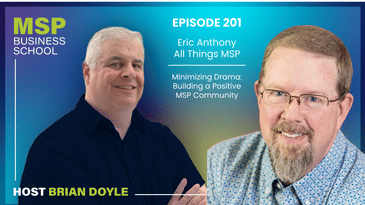

Show Website: https://mspbusinessschool.com/
Guest Name: Eric Anthony
LinkedIn page: https://www.linkedin.com/in/esanthony/
Company: All Things MSP
Episode Summary:
In this episode of MSP Business School, host Brian Doyle engages with Eric Anthony from All Things MSP to delve into purposeful discussions, offering valuable insights into the MSP (Managed Service Provider) landscape. Eric, a seasoned media professional, shares his extensive journey from starting as a teenage consultant to becoming the Director of Partner Engagement at Ignite.
The conversation captures critical themes, including industry evolution, community building, and providing a balanced professional and personal life. Eric emphasizes the significance of work-life balance, a common struggle in the MSP realm, and introduces effective strategies like time blocking and purposeful scheduling to mitigate daily chaos. Analysis of AI implementation in SMBs, particularly generative AI, forms another crucial segment, highlighting opportunities and challenges. Eric and Brian discuss the gap in perception about AI adoption and its practical, secure usage within businesses, offering listeners a valuable guide to navigating the future of technology.
Key Takeaways:
Work-Life Balance Strategies: Eric stresses the importance of time blocking and creating dedicated personal time within daily schedules to maintain a healthy work-life balance. AI
Adoption in SMBs: Despite MSPs underestimating it, 77% of SMBs are using generative AI, presenting new service opportunities for MSPs.
Addressing Security Concerns: The need for MSPs to develop AI policies and provide education on secure AI usage to mitigate risks.
Community Engagement: Learn about Eric's efforts with All Things MSP, fostering a supportive, non-technical space for MSP professionals.
Industry Evolution: The evolution of MSP roles extending into AI technology and the essential shift towards consulting in tech-driven business environments.
Resources:
- All Things MSP Facebook Group: facebook.com/groups/allthingsmsp
All Things MSP
YouTube Channel: YouTube Channel
Ignite: Ignite
Website Books Mentioned: The 12 Week Year by Brian P. Moran and Michael Lennington
Discover more by listening to the full episode, and stay tuned for further engaging content from MSP Business School as we delve into more industry insights and expert advice. Feel free to subscribe to our podcast on your favorite platforms, and join us in our next episode as we continue to bring you critical discussions and strategies from the world of MSPs.
Hosts Brian Doyle: https://www.linkedin.com/in/briandoylemetathinq/
Sponsors vCIOToolbox: https://vciotoolbox.com
Listen to MSP Business School on the Fox and Crow Group Your IT Podcasts Network!
[00:00:10] [SPEAKER_01]: Hey everyone and welcome to the latest installment of MSP Business School.
[00:00:15] [SPEAKER_01]: As always, I'm your host Brian Doyle and I am excited today.
[00:00:19] [SPEAKER_01]: I've got a fellow person in the media if you well.
[00:00:23] [SPEAKER_01]: I should not probably put myself into the media in the same class as him but we're out there trying to educate the world in and bring information forward.
[00:00:31] [SPEAKER_01]: So I'd like to welcome Eric Anthony from all things MSP to the show today.
[00:00:34] [SPEAKER_00]: Thank you Brian. I just love being here and by the way, we're all doing this. I don't think there's different levels right?
[00:00:42] [SPEAKER_00]: I think we're all just trying to contribute our own little piece to this community and doing the best we can.
[00:00:49] [SPEAKER_01]: Yeah, I think you know this industry is filled with servants, right?
[00:00:53] [SPEAKER_01]: You know that's what we do by nature and I think all of us are just looking for ways in our own lives to give back and bring people in that can help share
[00:01:01] [SPEAKER_01]: you know messages that may be many people don't get to here so I appreciate you coming on and sharing yours today.
[00:01:08] [SPEAKER_01]: Now, I'll hear our get the more I want to share so no doubt.
[00:01:12] [SPEAKER_01]: Eric, I mean you know there's a lot of people that know who you are but there's probably quite a few that are listening today
[00:01:17] [SPEAKER_01]: that might not have yet gotten to meet you so why don't you tell us a little bit about yourself and your backstory on how you got into the wild world of MSP?
[00:01:25] [SPEAKER_00]: So it really started I mean a long time ago because I'm not lying, you know I'm not a young chicken anymore.
[00:01:34] [SPEAKER_00]: I started doing consulting for friends, neighbors, friends of friends, small businesses when I was 15 years old
[00:01:43] [SPEAKER_00]: and my mom actually had to drive me to my first appointments right? So,
[00:01:53] [SPEAKER_00]: I really didn't know what I wanted to do with my life. I mean if it were left up to me I would have been working at a radio shack for the rest of my life
[00:02:01] [SPEAKER_00]: but I went to the University of Central Florida, got a degree in computer engineering that I never used
[00:02:07] [SPEAKER_00]: but I learned a lot about trouble shooting, you know solving problems I guess I would say with the engineering degree
[00:02:14] [SPEAKER_00]: and worked for a retail computer store in college started my own consulting business I guess we would call it back then
[00:02:22] [SPEAKER_00]: and you know did website design the whole nine yards.
[00:02:26] [SPEAKER_00]: And then kind of took a detour after 10 years of doing that and was the chief operating officer of a fashion jewelry company
[00:02:33] [SPEAKER_00]: and then the CIO of a furniture manufacturing company that included
[00:02:37] [SPEAKER_00]: a billion tables which was kind of a lot of fun. So the corporate track. Yes, yes. Although they were still small businesses as
[00:02:44] [SPEAKER_00]: the size that would typically still be served by an MSP I would probably say
[00:02:51] [SPEAKER_00]: but at the end of that I had an ex client from when I was a consultant before that said hey we're splitting off from this other company
[00:03:00] [SPEAKER_00]: we really want you to come back and do our IT. And by the way, we'll pay you a salary, we'll give you benefits
[00:03:06] [SPEAKER_00]: and an office next door that you can use to start another business if you want to. I said heck yeah
[00:03:14] [SPEAKER_00]: you know we learned that no doubt that's a great deal. And so I did that we did that for seven years
[00:03:21] [SPEAKER_00]: and ended up just got to the point where I was doing a lot of stuff kind of on the vendor side in terms of presentations and
[00:03:29] [SPEAKER_00]: going to shows on behalf of the vendor. And really liked that. And so the opportunity came up to sell the MSP
[00:03:37] [SPEAKER_00]: switch to the vendor side and that's where I've been for the past oh it'll be 11 years this year.
[00:03:43] [SPEAKER_01]: Let's talk a little bit about where you are today there. No, no harm in sharing a little bit about what you do there
[00:03:48] [SPEAKER_00]: and trying to drop up a little bit. Yeah sure. So I am the director of partner engagement at Ignite
[00:03:54] [SPEAKER_00]: that's my day job. And love it. If you haven't looked at Ignite, the perfect solution for replacing a file server
[00:04:02] [SPEAKER_00]: and going to the cloud with those file server type services. Lots of security and stuff you can build around it
[00:04:09] [SPEAKER_00]: can just also be a simple map driver letter to their files. The end users have no clue they're using something in the cloud
[00:04:17] [SPEAKER_00]: and not an on-premise file server. So great solution for that. Love talking about that all the time
[00:04:23] [SPEAKER_00]: but then of course I also do this all things MSP thing that I've been doing for I think it's I think it's about seven years now
[00:04:32] [SPEAKER_01]: and it started as a phase one right? It's amazing it's been that long. It's time flies. Well, it started out as something very simple
[00:04:41] [SPEAKER_00]: right? It was something where I was kind of I changed my role at SolarWinds a little bit
[00:04:47] [SPEAKER_00]: and I was looking for kind of another outlet to share my experiences the experiences that I was shared with others
[00:04:57] [SPEAKER_00]: because I just talking to a lot of people in the space back then. And so it gave me that outlet for sharing some of that information
[00:05:04] [SPEAKER_00]: to hopefully give back as much as this community has given me. And then it just kind of started growing and growing
[00:05:12] [SPEAKER_00]: and growing to the point where in the last two or three years we've started the YouTube channel and the podcast
[00:05:19] [SPEAKER_00]: and a lot of different things and it's been so much fun. And we've got you know a decent following at this point
[00:05:26] [SPEAKER_00]: there's I think 5,600 people in the Facebook group maybe a little bit more. Yeah, we're closing in on about 2000 subscribers on YouTube
[00:05:35] [SPEAKER_00]: so yeah I couldn't be more pleased with it and I just I have so much fun with it that's the major point. That's awesome
[00:05:42] [SPEAKER_01]: and the fun's got to be a big part of it right? You know, I think we're all doing this. I mean we're adding one more task to our days right
[00:05:48] [SPEAKER_01]: so in doing this you know there's got to be a passion behind it and certainly as somebody that's a member of all things MSP
[00:05:55] [SPEAKER_01]: you know you see the conversation that goes on in the community see how people are helping one another there
[00:05:59] [SPEAKER_01]: and it's great to have you know somebody at the helm of that type of forum kind of guiding the conversation
[00:06:04] [SPEAKER_01]: but more importantly getting a place for people to feel like they're included. Yeah because one of the things
[00:06:11] [SPEAKER_00]: it's a little bit different about all things MSP and it's kind of the way I started it so it's just kept that kind of culture
[00:06:18] [SPEAKER_00]: is that number one we are mostly about the non-technical side of things. We're in a technical business you'll never be able to separate it completely
[00:06:27] [SPEAKER_00]: but it's more about the business, the productivity, the HR type topics that might come up
[00:06:34] [SPEAKER_00]: and then for whatever reason we've been able to minimize the drama in the group which has been really great
[00:06:40] [SPEAKER_00]: and I'm so appreciative of the you know the members, the vendors, everybody in the group who just keeps it civil
[00:06:48] [SPEAKER_01]: Yeah and that's a big part of it right? You know we've seen in some of the Facebook groups out there
[00:06:52] [SPEAKER_01]: unfortunately things can turn a little dark at times and you know if you can live it out that drama
[00:06:58] [SPEAKER_01]: and really just be a helpful community it's huge. I think people know how to share their opinions in your group
[00:07:04] [SPEAKER_01]: and away that it's inclusionary as opposed to maybe trying to single out people in some ways right?
[00:07:13] [SPEAKER_01]: So good stuff and for those that are watching the video today we do have the link up here to all things MSP
[00:07:19] [SPEAKER_01]: It's ATMSP.Link forward slash Facebook for those listening on podcast
[00:07:24] [SPEAKER_01]: and as always we'll pop that into our show notes as well as Eric's Facebook link so you can get in touch with him as well that way
[00:07:32] [SPEAKER_01]: but you know at this point maybe let's segue a little bit into something you and I were talking about before the call
[00:07:39] [SPEAKER_01]: and something you're really passionate about and it's something a lot of our listeners struggle with
[00:07:44] [SPEAKER_01]: especially you know really the community a large struggles with
[00:07:48] [SPEAKER_01]: you know that work life balance piece how do we keep home life and work life separate but more importantly
[00:07:55] [SPEAKER_01]: be giving adequate space for both right? So I'd love to get your take on you know
[00:08:00] [SPEAKER_01]: attack to you take to keep that work life balance going. So there's so much to this right
[00:08:05] [SPEAKER_00]: and the first thing I will say is that thinking of it as a balance is probably not the best thing
[00:08:12] [SPEAKER_00]: because it's not a one for one right? It's appropriate amount of time and appropriate amount of time
[00:08:18] [SPEAKER_00]: work is going to probably take more time than your personal life but you need to make sure that when it's personal
[00:08:25] [SPEAKER_00]: it's personal and you don't let the work creep in but in terms of attack
[00:08:31] [SPEAKER_00]: I think that time blocking is the most important thing that you can do. I mean simply using a calendar
[00:08:38] [SPEAKER_00]: and it sounds stupid simple right? But actually making sure that you are calendaring everything
[00:08:46] [SPEAKER_00]: right? I'm running three different calendars. I have a personal calendar. I have my ignite calendar
[00:08:54] [SPEAKER_00]: and I have my all things MSP calendar. But I also bring them all into one calendar. I use fantastic
[00:09:02] [SPEAKER_00]: a Cal. I'm not promoting it but I do like it and it brings all of those Google calendars in
[00:09:09] [SPEAKER_00]: so that I can see everything on one calendar and in addition to just knowing that you have time
[00:09:15] [SPEAKER_00]: blocked out for these things. Doing it proactively allows you to make sure that you are also
[00:09:22] [SPEAKER_00]: from a work standpoint, putting in the strategic blocks of time to work on your business rather than just
[00:09:31] [SPEAKER_00]: in your business. Because if we all know that's a big problem with small businesses of any type,
[00:09:37] [SPEAKER_00]: MSP or regardless and one of the things that I read just recently in the 12th, I think it's called the 12 week
[00:09:46] [SPEAKER_00]: year. If you schedule that three hours at the beginning of your week to work on your business,
[00:09:54] [SPEAKER_00]: the amount of power that that has to improving your business is just huge.
[00:10:02] [SPEAKER_01]: When I can appreciate that as somebody that does struggle with the content of time blocking,
[00:10:08] [SPEAKER_01]: it's very easy to move things in your schedule. It's very easy to re-adapt the way the day comes and hits you.
[00:10:16] [SPEAKER_01]: I can understand that getting that strategic piece and always here owners talk about I got to be working on my business,
[00:10:24] [SPEAKER_01]: not in my business but we all struggle with actually making that happen. I'm familiar with time blocking.
[00:10:30] [SPEAKER_01]: I would love to say I do it well. I'm getting better at putting those strategic things and making sure there's time to plan both
[00:10:38] [SPEAKER_01]: and big picture, plan the marketing routine. The things that we need to do in order to continue to scale and grow.
[00:10:45] [SPEAKER_01]: But I'm bad at blocking outside my calendar for the personal things. That's where the things run together.
[00:10:52] [SPEAKER_01]: I'd love to hear a little bit more.
[00:10:54] [SPEAKER_00]: Yeah. So I literally schedule everything, including dinner. Because we sit down as a family still and have dinner,
[00:11:03] [SPEAKER_00]: I have adults children still at home and so we still schedule that time.
[00:11:09] [SPEAKER_00]: And even down to one of the things I wanted to mention by the way, in terms of the time blocking is there are three types.
[00:11:15] [SPEAKER_00]: And I mentioned one that are important. Everybody schedules, they're meeting sometimes they even schedule some focus work to get specific things done.
[00:11:23] [SPEAKER_00]: But the, the piece is that typically we miss her number one that strategy piece.
[00:11:32] [SPEAKER_00]: But second of all, it's buffer time and buffer time is the time that you set aside to deal with those things that come up every day.
[00:11:40] [SPEAKER_00]: And then you have breakout time, which are longer pieces of time that you use for personal stuff.
[00:11:46] [SPEAKER_00]: It's for the recharging stuff.
[00:11:48] [SPEAKER_00]: And that's where you really just need to intentionally schedule that time for those personal things to make sure that, oh, I'm supposed to just be doing personal stuff right now.
[00:12:02] [SPEAKER_01]: And, you know, one of the things that I think all of us, especially those that work remotely now is you can time shift things and bring some of that personal into our,
[00:12:11] [SPEAKER_01]: work calendar where we need to and where it's appropriate to get some things done. And I think, overall you're seeing more people doing that. But I think that structure I'm when the day should end.
[00:12:22] [SPEAKER_01]: When, you know, when work should be put away.
[00:12:25] [SPEAKER_01]: That's the things that I see people struggle with and hear oftentimes, you know, rule their lives and I'm chief of vendor.
[00:12:32] [SPEAKER_00]: So every day on my calendar has a 30 minute block called work day startup.
[00:12:38] [SPEAKER_00]: Well, except for Mondays, Mondays actually includes a one hour block called week startup. And then I have my weekday startup is a half an hour each day and then I have a work day shut down, which is a 30 minute block at the end of the day.
[00:12:53] [SPEAKER_01]: So maybe you expand a little bit more and talk a little bit about what those blocks do for you and what you're executing during those times.
[00:13:00] [SPEAKER_00]: So during those times, I have very specific, I should have lists on index cards of the things that I do during that time so that I don't forget.
[00:13:09] [SPEAKER_00]: And a lot of it is around just going through my to do list making sure that the to do list is prioritized for the day and that I have everything blocked out because one of the other things about time blocking is that it shows you whether or not you have the time resources in the day to actually accomplish the tasks that you want to get done.
[00:13:28] [SPEAKER_00]: And if you don't, you know that you need to push something off to the future.
[00:13:35] [SPEAKER_00]: And so doing that is calendar management is the time blocking it is the inbox to zero.
[00:13:43] [SPEAKER_00]: Okay, inbox to zero happens in the morning happens at night.
[00:13:46] [SPEAKER_00]: Sometimes if I can get away with it during the day, but it always happens at the beginning of the day and at the end of the day.
[00:13:52] [SPEAKER_00]: And one of the things that it's so important at the end of the day is to make sure I've captured all of the tasks that I'm trying to make sure that are captured and that they are put somewhere.
[00:14:05] [SPEAKER_00]: To wherever the next time I'm going to need them is.
[00:14:09] [SPEAKER_01]: So that's where you might be creating these tasks is coming right out of that that might have looking at those emails at the end of the day and.
[00:14:17] [SPEAKER_01]: Certainly, you know that's something I agree with too.
[00:14:20] [SPEAKER_01]: I try to do the two times a day email but I think again we're all guilty with all these devices that we have of seeing some of those things in the middle of the day and all of a sudden getting reactionary again right with the well that's something I need to take care of now.
[00:14:33] [SPEAKER_00]: And well and that and they happen right if that's what the buffer time in the middle of the day is for.
[00:14:38] [SPEAKER_01]: Perfect perfect.
[00:14:39] [SPEAKER_01]: So you've done time blocking you've got I mean it sounds like you've got a very rigid kind of approach to it probably something you can teach that's my two cents because everybody does struggle with this and.
[00:14:50] [SPEAKER_01]: And really give some some good insight what if some of the gains you've seen since you've started doing this.
[00:14:56] [SPEAKER_00]: Oh, just the productivity gains the ability to get through 90% of my tasks for the day versus just haphazardly going to the day and maybe getting half of them done.
[00:15:08] [SPEAKER_00]: It's a huge difference in terms of productivity and I just I noticed at the most really when I fall off the wagon because I would love to sit here and tell you that I do this religiously every day.
[00:15:23] [SPEAKER_00]: That's just not practical but there have been times when I fall on off the wagon for a week or more and it really has affected my productivity.
[00:15:32] [SPEAKER_01]: Yeah, and I don't think there's a listener out there that would think that you're doing it religiously every day because we just work in a world that unfortunately sometimes.
[00:15:38] [SPEAKER_01]: Forces for us to be reactionary right, right? You know especially on the MSP side of things where all it takes is one phone call to really change the complexion of the day.
[00:15:47] [SPEAKER_01]: We don't have that struttle as much on the vendor side but it's there you know there are still days like that they just tend to be a little less frequent right.
[00:15:55] [SPEAKER_01]: But kudos man, I mean, you know just trying to take control is definitely a big part of it and I'm sure the family is very happy on the other side of the equation.
[00:16:02] [SPEAKER_01]: You know I made some changes that have definitely you know pivoted that and my family tells me I'm a lot easier to deal with now.
[00:16:11] [SPEAKER_01]: So for sure it's a big part of it because it does reduce stress by a lot as well.
[00:16:16] [SPEAKER_01]: Yeah, and that stress is shared right? And any family you know we feel the stress of the others around us and they feel it right back from us as well.
[00:16:23] [SPEAKER_01]: So you know if you're not winding your day down and getting control of it, you can come out of the day at least I know I found for myself sometimes a little agitated and that agitation would be shared with others.
[00:16:37] [SPEAKER_01]: All right so you know we we've I think we've covered off unless you have anything else that you'd like to talk about work life balance and let's get into our next topic you and I were talking about because this is a fun one as well.
[00:16:49] [SPEAKER_00]: Okay, so AI I mean everybody's talking about it but I did a poll in my Facebook group recently where I asked them how much do you think your clients or how many of your clients do you think are using.
[00:17:06] [SPEAKER_00]: AI specifically generative AI in their business and it's very interesting because less than 10% of the MSPs in the group came back and said that.
[00:17:19] [SPEAKER_00]: Their clients were using it significantly in their business and so I went out and started looking for more data because you know I'm a data kind of guy.
[00:17:29] [SPEAKER_00]: And I found in article in Forbes that said that 77% of small medium sized businesses are already using generative AI in.
[00:17:38] [SPEAKER_00]: You know to do something in their business and that's a huge disparity right and it's a disparity that has implications because.
[00:17:48] [SPEAKER_00]: There are best practices and security issues that are present in the use of AI.
[00:17:56] [SPEAKER_00]: And so the opportunity that I see for MSPs in this space is the ability to go in at first to do project work to build an acceptable use policy and I actually posted an example of that so that people can download it for free as well as a checklist and kind of a little training.
[00:18:17] [SPEAKER_00]: And so not necessarily all the things that they need to train like specifically but just a outline of what a training program might look like in terms of best practices for AI.
[00:18:30] [SPEAKER_00]: And then of course there's the consistent monitoring and training of the best uses for AI as we kind of more some MSPs at least into more of this consulting role kind of this chief technology officer role where you're actually teaching them how to leverage new technologies to gain efficiencies to gain productivity to gain revenue and profit in their business.
[00:18:57] [SPEAKER_00]: So a lot of different opportunities here but it's a big one and one of the things that I think is kind of disturbing the picture a little bit is a lot of people are saying there's a lot of hype around AI and a lot of vendors adding AI to their products tax which I think is true by the way, I think Tom Lawrence had a great conversation on LinkedIn about this a couple weeks ago.
[00:19:19] [SPEAKER_00]: And while that hype is true it's hype and there's probably a bubble there as Tom put it in his article.
[00:19:29] [SPEAKER_00]: I also think that AI is not leaving like this is something that is going to be here to stay and it's something that MSPs need to address and I think it's an opportunity to add to the services.
[00:19:43] [SPEAKER_01]: And I agree with so much of that because you know let's start with the vendor piece of that conversation I think a lot of folks just started jamming AI into their applications because it was becoming one of those things if we don't have it we're going to fall behind.
[00:19:54] [SPEAKER_01]: But I think as it as that concept matures now these vendors are looking going really where we bring value through the AI and is their value being extracted from the customer and really trying to work on it.
[00:20:08] [SPEAKER_01]: So you know whether there's a bubble perceptionally or not I think it's going to just be a maturation process almost the same way cloud was right almost the same way other things that we've gone through.
[00:20:17] [SPEAKER_01]: Now what I what I'm diving into and what we're certainly seeing having a lot of conversations around is the security of using AI.
[00:20:26] [SPEAKER_01]: And I put it almost to the wild wild west of them and I just mentioned cloud of when SaaS applications really came back into focus.
[00:20:33] [SPEAKER_01]: And you had groups like your marketing teams testing all kinds of software is using it and putting personal data up into the web not even thinking about it with IT having no awareness of how it was being used where it really was and how many of those systems were being abandoned because they were really just test farms right.
[00:20:52] [SPEAKER_01]: And you know I'm picking on marketing but you know where you and I do marketing we have software loves right you know we love to try new things and experiment and.
[00:21:03] [SPEAKER_01]: You know that was an area that we were seeing a lot of potential data leakage now you look at AI and I think as the industry and the end users are learning how to use it where it's really valuable that's where some concerns come into play.
[00:21:15] [SPEAKER_01]: Yeah, you know I look at how AI is introduced to my life right if you're a Grammily user which got forbid I wasn't.
[00:21:22] [SPEAKER_01]: You know you've got AI sitting right in front of your face whether or not you're using it or not it's there and you know it it's ready for you and I think that's what's contributing to that true 77% number.
[00:21:32] [SPEAKER_01]: People are finding ways to use the gender of AI side or being directed to ways to use it.
[00:21:38] [SPEAKER_01]: And we're not accounting for it as an MSP community because we're not directly delivered.
[00:21:43] [SPEAKER_00]: I think you're right I'll even take your you know you're analogy a little bit farther and say that AI is a lot like rogue IT was in COVID right people.
[00:21:56] [SPEAKER_00]: So they started using it MSP's were not necessarily aware that they were using it and it had security implications right but then there's also this other element.
[00:22:08] [SPEAKER_00]: Where it is a lot like cloud because you know it's an adoptive technology that's evolving right.
[00:22:15] [SPEAKER_00]: But I think the difference is with cloud there was a lot of hesitation on the part of the end users to adopt it you know officially in the business.
[00:22:25] [SPEAKER_00]: Where is AI I think the adoption is much faster because people are just starting to use it because there's a lower barrier to entry number one plus it's it's cooler number two and it's free.
[00:22:39] [SPEAKER_01]: Yeah I think I saw an article in the Harvard business review that really spoke to that like there's been no technology that has come out that has been adopted at the pace of AI and you know that's inclusive of social media right.
[00:22:52] [SPEAKER_01]: You know that took while it became hot and new social media outlets might grab some quick traction the reality is when you think of when Facebook first came out people are skeptical for a while right it took some time for some some growth there but AI has definitely been adopted and adopted quickly by all of us in some fashion.
[00:23:09] [SPEAKER_00]: Yeah and I think as MSPs there's a responsibility to go to your clients and say.
[00:23:19] [SPEAKER_00]: AI it's great it's a great tool but here's how you need to leverage it and by the way we need to put some guardrails around your employees to make sure they're using it properly and securely.
[00:23:32] [SPEAKER_01]: And those AI policies are becoming real and you're even seeing the frameworks now starting to bring in from a governance and compliance standpoint.
[00:23:40] [SPEAKER_01]: AI benchmark CIS as I or no excuse me this has an AI benchmark right now we're starting to see some of the others starting to look at that as well.
[00:23:49] [SPEAKER_01]: And it's critical right I mean it's it's an education thing you need people to understand how to use it what's appropriate what's not especially in your delivery if you're incorporating it into your deliverables that you might be giving to your.
[00:24:01] [SPEAKER_01]: Meaning your customers and users are giving to their end users right so you know there's a lot to take in the consideration in this process.
[00:24:10] [SPEAKER_01]: But I think the other part is you're starting to see the mind shift at the ownership level.
[00:24:13] [SPEAKER_01]: Genetic AIs the big thing that everybody's talking about but now people are looking and saying yep but how can we train that and bring it into business process and what are the gains and efficiencies we can get there that are beyond.
[00:24:25] [SPEAKER_01]: You know I mean I think marketing is probably the biggest area where it's being utilized today right but you know get past that.
[00:24:31] [SPEAKER_01]: There's a really a lot of great stuff going on I mean we're seeing it in our own industry with guys like you know thread and MSP bots and other folks like that building it into their automation stack.
[00:24:42] [SPEAKER_00]: Absolutely and I just think it's going to grow more and more and it's going to be more and more part of our everyday world I mean it's.
[00:24:50] [SPEAKER_00]: Marketing because it's creative and it's you know there's a lot to be done there in terms of generating content but also we we had Adam angstrom tidbits on the podcast not that long ago.
[00:25:04] [SPEAKER_00]: And he said AI is a C plus student at best and so you you can't just rely on it you still have to have the expertise but there's so much more that it can do and you know I just look forward to.
[00:25:20] [SPEAKER_01]: What MSPs are going to be able to help their clients with in terms of AI and I mean I'm glad you said that too because that's a big the biggest thing in AI is you got to take it at face value if you're not going in there proofing it.
[00:25:32] [SPEAKER_01]: You know assuming you know kind of doing some of your R&D or I shouldn't say are but research behind it to really make sure that the facts are true.
[00:25:39] [SPEAKER_01]: It is a C plus student I think that's a great analogy that he had because you know there are things you got to tweak and in some people haven't really adopted that part of it yet like this is something you should just be turning around.
[00:25:52] [SPEAKER_00]: But you can take a C plus student and generate a lot of great stuff that then you can start building on right.
[00:25:57] [SPEAKER_00]: Yeah it's almost like because you're never going to have all A plus employees right you're going to have some C plus employees so it's just like having a C plus employee.
[00:26:08] [SPEAKER_00]: You just need to learn how to work within what they give you so that you can then take that and make it what it needs to be before you put it in front of clients or whatever it is.
[00:26:20] [SPEAKER_01]: Awesome well we're getting near the end of our time Eric you know I'd love to go into if you have any other closing thoughts around AI or anything else.
[00:26:27] [SPEAKER_01]: That you want to share with the community before we wrap up today.
[00:26:32] [SPEAKER_00]: Well, you know I just want to say thank you for you know having me on today I really do appreciate it.
[00:26:37] [SPEAKER_00]: I love what you guys do and just you know I'm here to help anybody you know I love just sharing with the community and if anybody wants to join the Facebook group again.
[00:26:49] [SPEAKER_00]: You know just head on over to at msp.link for slash Facebook or find us on YouTube where there as well and yeah just love yeah.
[00:26:59] [SPEAKER_01]: And I definitely encourage everybody if you're not part of the Facebook group jump in because as you know Eric indicated it's one of the more friendly or helpful groups sets out in the market place there's great information and great I guess coming in from Eric side.
[00:27:14] [SPEAKER_01]: And you know really appreciate folks like him that are trying to foster and build those communities as well because it's tough you know everybody's at a different part of their art right and that's what you see sometimes in these communities people kind of ridiculing those that might just be on the front end of their journey.
[00:27:32] [SPEAKER_01]: You know how do you not know that kind of thing I see often but the reality is where do you get this information?
[00:27:37] [SPEAKER_01]: How do you get better you need these communities like you've built here to be able to share freely where you're stuck and hopefully get responses back that help you grow.
[00:27:48] [SPEAKER_01]: You know we all had mentors when we were young we didn't all step into this like geniuses right so you know my two cents and hopefully I'm being an advocate for your group here in the sense of just be kind.
[00:27:58] [SPEAKER_01]: When you're in there understand everybody's on a different step in their path the two guys in front of you today have gray hair we've been around for a while.
[00:28:06] [SPEAKER_01]: But there's people that are just jumping it into it this morning and I will tell you it's much more complex when than when Eric and I jumped into it.
[00:28:14] [SPEAKER_01]: So you know there's a lot more to know my favorite line is every day I get stupid or because I learned something else I didn't know and it just continues to tell me how much you know there is out there in technology that's really.
[00:28:26] [SPEAKER_01]: You know we know one person can paint it all so you know.
[00:28:29] [SPEAKER_00]: That is really one of the ways that this industry has evolved is because back then it was easy right we were taken care computers we were designing websites that was about it and now you got all the security compliance governance AI there's so much more to deal with.
[00:28:47] [SPEAKER_01]: Yeah and and again everybody's more mature too right when you and I first started in the industry we were talking to people that had to understand what these systems can do.
[00:28:56] [SPEAKER_01]: But now those managers are digital natives people that have had these tools at their fingertip for the majority of not all of their lives so they're asking a different set of questions even then then you know the people that we dealt with before so you know.
[00:29:12] [SPEAKER_01]: I go back to be kind to all because we need to rise the tides you know raise the tides right and support those that are you know in their walking in their journey and I love what you guys do there because there is very little trauma in your group I do notice that.
[00:29:28] [SPEAKER_01]: Well, thanks.
[00:29:30] [SPEAKER_01]: Awesome well Eric you know again thank you so much for being a guest today listeners you know you can get this anywhere you can download your podcasts as well as our YouTube just go to at MSP business school and you'll be able to get those there.
[00:29:43] [SPEAKER_01]: In our show notes will be including the links to Eric's Facebook group his faith LinkedIn profile so get in touch with him.
[00:29:51] [SPEAKER_01]: And the other ways that people can get in touch with you Eric that you want to share or anything that's going on in the group that you want to highlight before we say goodbye.
[00:29:58] [SPEAKER_00]: Really, you know LinkedIn is probably the best way to find me and get a hold of me just message me there that's usually where I'm most responsive.
[00:30:05] [SPEAKER_00]: Join the Facebook group let me know that you know you heard from us here on the podcast so that we know where you're coming from and other than that if YouTube is more your thing.
[00:30:16] [SPEAKER_00]: Find us there and we do have a page we actually have a page on LinkedIn as well so if you're not that into Facebook most of what is in the Facebook group is also published to the LinkedIn page as well.
[00:30:29] [SPEAKER_01]: Awesome so let's just turn away as you can get in touch with Eric and go see his content I encourage you to do so.
[00:30:36] [SPEAKER_01]: Eric, thank you so much for joining me today and I look forward to seeing you out there on the show circuit.
[00:30:42] [SPEAKER_01]: Thank you. I'll see you in a couple weeks.
[00:30:44] [SPEAKER_01]: All right.