
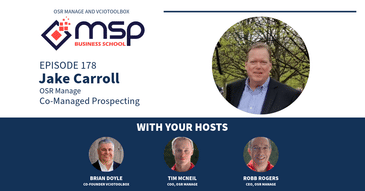

Show Website: https://mspbusinessschool.com/
Guest
Jake Carroll https://www.linkedin.com/in/jake-carroll-3855977/
OSR Manage https://osrmanage.com/
Hosts
Brian Doyle: https://www.linkedin.com/in/briandoylemetathinq/
Robb Rogers: https://www.linkedin.com/in/robb-rogers-07415251/
Tim McNeil: https://www.linkedin.com/in/timmcneil3/
Sponsors
vCIOToolbox: https://vciotoolbox.com
OSR Manage: https://osrmanage.com
00:30:00 Robb kicks off today's podcast with a warm introduction to our special guest, setting the stage for the insightful conversation ahead. As we dive into the world of co-management, Robb sheds light on the unique challenges that come with it.
00:03:49 Sharing his own experiences, Jake chimes in with valuable thoughts and practical insights on overcoming hurdles. Robb also shares his personal strategy for effective co-management with IT professionals.
00:07:10 Jake stresses the significance of understanding people's preferences, aspirations, and capabilities. Unpacking the crucial concepts of capacity and capability gaps, he highlights the need to identify these gaps, ensuring clarity about roles and responsibilities.
00:10:33 Jake emphasizes that 'story telling" is a key. He emphasizes that knowing the challenges your prospects face and demonstrating how you can bridge those gaps, coupled with compelling storytelling, is a recipe for success. Naturally, he goes on to share some tried-and-true tips.
00:14:08 Talking about business risks Jake enlightens us on potential pitfalls that could lead to failure. He places importance on discussing risk mitigation and high profitability with both IT professionals and business owners alike, advocating for a proactive approach to success.
Listen to MSP Business School on the Fox and Crow Group Your IT Podcasts Network!
[00:00:00] Welcome to MSP Business School led by our Deans of Business Development, Brian Doyle, Tim McNeil and Rob Rogers.
[00:00:11] Each week MSP Business School is committed to delivering you proven strategies, tips and tactics for MSPs to accelerate their business growth and revenue through better sales, better marketing and true account management.
[00:00:26] Class is starting now, so let's get started. Let's throw it to the Deans.
[00:00:36] Hey everybody, welcome back to another episode of MSP Business School dot com. Today you got your host Rob Rogers here but my two cohorts are missing today.
[00:00:45] We got Brian Doyle and Tim McNeil are both out doing bigger and better things I guess, but I have a special guest here today we have Jake Carroll. How you doing Jake?
[00:00:54] Rob I'm doing great. Thanks for having me again. Yeah, it's always great to have you here. We love hearing all your sales strategies Jake. You're always you're the best word smear th I know.
[00:01:04] That's nice to hear. I hope I can get into that for 20 minutes. Nothing like embarrassing you right off the rip. Yeah, it's alright. No pressure.
[00:01:14] Alright, well, everybody today we're going to be talking about something a little bit different. We're going to be talking about co managed IT and how you can implement this into your company or maybe we can give you some tips and tricks today on how to better implement this in your company as it relates to prospecting.
[00:01:31] We're going to be going over things like the challenges and the opportunities, natural friction that may arise. The messaging and the nuances that need to be addressed and credibility trust everything that has to do with trying to get your co managed opportunity into a prospects understanding and then have them eventually signed the deal.
[00:01:50] Is that about right Jake? Yeah, I think so it's it's different enough that your approach in terms of how they can handle from a sales and messaging perspective all the way up.
[00:02:00] How it services the service over time is different than the typical messaging that you know the msp can be like hey, leave the IT to us and you can go around your business. I mean obviously that that whole idea needs to be rethought when you're doing co manage IT.
[00:02:20] Yeah, I've always loved co manage IT. I've always thought it was something that can really separate you from the crowd and I think everybody's starting to move into this direction now.
[00:02:33] I would say Jake what 10 years ago 8 years ago the thought was maybe don't do co manage IT is too complicated and too much friction as you would say.
[00:02:43] Yeah, yeah I mean look I think if you think about all of the folks that we know that are in the managed service provider business they all.
[00:02:51] You know some of them may have started their early careers as you know as an employee of a managed service provider and moved up to you know own one or in many cases we see that you know a lot of folks are starting in this business coming from a corporate IT background right there.
[00:03:05] They either got to the point where they've exhausted what they could do with that company weren't great at following orders from others and decided to start their own company in many cases.
[00:03:15] And so there are certainly built in knowledge of the challenges and the things that happen inside of a corporate company that has an internal IT department.
[00:03:24] So in terms of being able to you know truly understand the challenges that are happening inside that company there's no lack of empathy in terms of most of the folks that we work with knowing exactly what happens inside those organizations where they can help and how they can you know how they can improve their life of their customer with their co manage IT offering but also how to message it like they know where all the bodies are buried right in terms of what internal IT can't do generally speaking.
[00:03:53] Yeah, I kind of wanted to jump into the challenges and the opportunities there's massive opportunity to move into a larger market when you're going into these code managed types of opportunities and with that you get better maturity in the business you get you know a lot more streamlined systems but one of the challenges that we always faced when we were doing these code managed opportunities is you know you go in there and the IT department that they're that's already there they feel like you're you know stepping on their toes.
[00:04:22] Yeah, and so you know the kind of address that on your side what have you seen work.
[00:04:28] Yeah, I think that's a real consideration right you know we've done a podcast recently when we talked about you know you have different talking points to different people inside the organization based on what their needs fears desires are right you can't speak the same way to a manager as you would to an owner or as an employee as you would to a manager right everybody's got different motivators and things that they're working towards in their role.
[00:04:51] And look if we if we went with you know the standard outsourced IT messaging into an internal IT department there's no way they're not going to feel threatened and that you're trying to disintermediate them and replace them in the company.
[00:05:04] So so that does require a nuanced approach to the account on how you get into the account first even start having a conversation and then what what that looks like at least in the sales process or the pre sales process.
[00:05:16] You know when you get in there so yeah there is some natural friction there and you need to look the sales is all about breaking down barriers you know and friction to begin with right if you're really good at what you do in sales it's all about making your prospect and customer feel really comfortable about telling you what it is they really want to achieve what are the challenges that they're facing and then determining whether or not you can solve those in a way that makes sense for them.
[00:05:40] So this is really no different than that it's just it's just nuance in terms of the way that the IT services are traditionally delivered versus you know what's going to happen in a in a co manage environment.
[00:05:50] Yeah well what are the ways that I used to do it was you know I would ask them what what did they enjoy about their job and what were the things that they wish they could give to somebody else and say that's what we want to help with so you know what are the things that IT people are really good at is like through the superhero of the industry of the organist.
[00:06:09] Of the organization they can fix and do things that everybody else can't do even the superheroes don't want to do some tasks like you'll have some people who just don't want to do the password resets again for the same person again we can take that off their plate and so we would tell people that look you fight you.
[00:06:29] You work with all the things that you like to do those high level big brain projects that give you fulfillment in your job and we'll take the menial tasks off your plate then there'd be other you know IT professionals that love doing the day to day they love going out and you know like doing password resets and talking to people as you're doing all those things but they really hate trying to figure out all those really big engineering level tasks that it just boredom death we would take that off their plate and so we once we carved out a niche.
[00:06:58] Of what they like to do versus what they didn't like to do then we could have a conversation about well let us take that part away and you're basically to be managing us while we're doing those tasks for them so it gave them that that heightened sense of ownership and you know where they were you know teaching people and you know having people work for them so that was how we did it how did how do you handle that kind of situation well in any situation where you're like we do outsource sales management as a service right.
[00:07:25] And you know we have to have a different conversation with the company that has an internal sales manager then we would it was a it was an owner started from scratch or sales organization right.
[00:07:34] Like we wouldn't want to a sales manager and say hey we're outsource sales management as a service isn't that great for you you probably know pay put your breaks on.
[00:07:41] I think that there are always learning what people like to do want to do are capable of doing and get it right I mean it goes back to that old thing with that old thing the entrepreneur playbook right.
[00:07:54] EOS it's like gets it wants it has capacity yeah and the I always think that in most cases where you're going to be able to penetrate is going to be where there is capacity in capability gaps right if someone was hired as a level three network engineer.
[00:08:14] To help a company that's expanding you know ensure that the network infrastructure and architecture support the company's growth but can't get to those big projects because there's too much of the day to day make sure the machines are patched make sure passwords are reset make sure the printers are printing make sure the Wi-Fi is working right those kinds of things are going to keep you from doing what you want to do.
[00:08:35] And I think as a whether it's your initial sales calls or as you're working you're going through your working relationship with your customer understanding what people want to do are capable of doing have the capacity to get done if there's gaps and coverage that align with what your best and best and breed practices are then there's there's room for working together for sure profitably.
[00:09:00] Yeah so I think it's always about identifying where there's where there's gaps where what you do aligns and there's synergy and making sure that if the company is going to stay with their internal IT department and work with an outsource resource that everybody knows exactly you know why they're in the room what they're there for.
[00:09:19] And the capabilities and the capacity of your going to provide sure it so you know another thing that you know as you're discussing that it like kind of brought to my attention and I remembered one of the things.
[00:09:29] That we always did when we had that conversation a co-managed conversation we always like opened up the hand grenade before the tech person could say I'm you know the number one concern that they have and we're coming in the door is you're going to take my job you're here to take my job.
[00:09:46] And so I would curious how you handled it but the way that we handled it was while we were in discovering while we were having the conversation we would let them know that you know hey we're here to be you know just like a feather in your cap and arrow in your quiver to help you be more successful.
[00:10:03] So we're not here to try and take over your job that that's not what we're here to do we're here just to be a co-managed and we would show them you know a lot of our documentation where we worked with a lot of other companies in a co-managed environment that had multi year you know engagements where the co-managed was working and working really well.
[00:10:23] Now how did you handle that number one concern of the influencer which is you know the tech department in that conversation.
[00:10:30] So I think you're your final bullet there really hit the nail on the head you as salespeople or business people we can always tell people what we do right.
[00:10:40] This is what we've done successfully for the last 20 years we do this that the other thing but you would mention referencing customers that you'd work with before seven eight years where you've had success I think I think the win here is in the storytelling right if what you what you do aligns and
[00:10:59] the person that you sign on previously is in the same roles the person that you're talking to now and you can very clearly articulate in a story in a kind of a you know you got to tell the story hey we work with and tell them we work with such and such leader I.T. leader at such and such company and where we've had success over the last seven or eight years is here here here here is that something you be looking forward to or is it something else.
[00:11:25] And then they have the agency to tell you whether or not they're comfortable with what you just told them right or whether that whether they're concentrating on something else.
[00:11:32] The answer doesn't really matter you just want to know what the challenges are of this person and if you can fill that gap right so I think the win is in the storytelling not in the telling of the benefit of it right I think bring a relevant story of how you've helped another company with you know and by the way bring names right
[00:11:52] we almost MSPs that we know so locally or regionally chances are if you're working with a well known company the person that you're talking to now is going to recognize that company as being in their marketplace and really well known bring it up.
[00:12:06] So I got a question for you so you said to discuss the company would you find an instance where you discussed a person and how they got they leveled up in both their knowledge their abilities and maybe their you know their job title.
[00:12:21] Would you bring that up when you're talking to an influencer or is do you keep it to the company level.
[00:12:28] No I think role is really important right I mean you know you don't want to talk to an like if I were talking to the owner of the business I wouldn't want to necessarily focus on 100% you know how we help the IT department any more than I'd want to tell them sure the IT guy runs the IT department how we help the company so I would bring the role and I would bring the role this relevant into the conversation maybe not my name but certainly if the director
[00:12:50] of IT at the other company that we're working with kind of same level skepticism that you have now here's what our relationship is looked like over the last seven or eight years he started as the manager of IT.
[00:13:01] He's now the you know the the CIO for the company and they're you know in addition to working with us you now has a bigger staff and more respond I mean you could share all these stories right.
[00:13:11] Yep so so I think you got to tell it and you got to tell truthfully right don't make them up.
[00:13:15] Well of course yeah yeah okay one last question here so you know we just had somebody ask us you know like features as it relates to like the features and the benefits of this you know this engagement are you big into discussing the features when you're having a discovery call of all the things that we can provide or are you more of a you know a global conversation when you're doing your storytelling.
[00:13:43] Do you care about 24 seven and no vacations and you know expertise do you care about those things in your conversation or are you bigger.
[00:13:50] Bigger picture I think eventually you got you're going to have to tell them what you do right and if that's 24 seven 365 we're going to add scale to their organization.
[00:13:59] People who haven't been able to go on vacation in a while can go and leave their you know leave their phone at home and enjoy their time with their family those kinds of things are sort of table stakes.
[00:14:09] I tend to lead with the things that motivate people to actually make a decision right which is paint and mostly what's the penalty of the status quo or the penalty of an action right POI rather than ROI right benefits tend to talk to ROI.
[00:14:27] And you know this is an ever changing landscape and if you're walking into a company that has you know a single IT person.
[00:14:36] That's a you know in our parlance that's always single point of failure you don't want it in the network you don't want it on a computer you don't want it in your financial statement you don't want it anywhere in your organization.
[00:14:45] And if it's a business that's relying on technology a single IT person is a single part of failure in the organization whether they're out sick whether they whether something they're too busy whether they're under capacity.
[00:14:56] Whether they don't have the skill to do a certain job it's risk in the business and no one wants to be you know in that position so.
[00:15:04] You know it makes more vulnerable for everything when you're a single point of you know contacting an organization as you said even if you are the hero sometimes there's crypto night out there and being a single single point is not is not great so no I tend to talk about you know the things that you know risk mitigation certainly to the business owner.
[00:15:24] And into the person that you're talking to and trying to make comfortable with a co managed situation I think you've got to relate the stories of the things that have happened in the concerns other companies have had about having that that one point in the company that was responsible for so much so I would concentrate on those things.
[00:15:46] Okay, so let me sum this up let's see if I got this so if you're speaking to the influencer or you know the IT professional or the IT team.
[00:15:55] You're you're mostly in that conversation you're mostly going to alleviating their concerns by showing your expertise and showing your abilities that you were able to do with other companies but if you are talking to a business owner you're more into describing the RY.
[00:16:15] The you know the efficiencies of the systems and the ability to mitigate risk on the corporate level.
[00:16:21] Yeah, I think I think companies are always about risk mitigation higher profitability making sure the balance sheet is right and de-risking the business.
[00:16:33] And I think from an IT person's perspective you know if you came from that environment or you've talked to enough customers that have the same kind of problems you can articulate to them the things that you know are their challenges every day.
[00:16:44] And I think that's the thing that gets folks emotionally involved.
[00:16:47] Okay, and I think that's as a business person or salesperson in order to get people to move now in particular there's got to be an emotional attachment to the fix or the change because everybody's going to burn
[00:17:02] burn either in real capital and money in terms of changing.
[00:17:07] But also the internal political capital that it takes to make any change along these lines right bringing in an IT service providers not small there's going to be new things that are happening in a company it's going to affect everybody in the business.
[00:17:18] And you know whether you're working with the owner and he's got to convince his staff to do it or whether you're working with an influencer and he's going to bring that story to the business owner.
[00:17:26] So when he's walking into somebody's office and convincing them to do something that they're not doing now.
[00:17:31] And as a salesperson, they need to know going in that meeting and this is worth it.
[00:17:36] Yeah, okay, all right well Jake I really appreciate your time here jumping on with me you are fantastic co host as always.
[00:17:44] And I wish you all the best you're going next week Thanksgiving right home here and people are coming to visit so looking forward to good.
[00:17:53] So Jake I really appreciate your time here today. I thank you everybody and we'll catch you next week. Thanks Rob. See you.
[00:17:58] All right bye.