
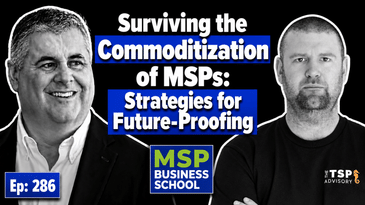

In this episode of MSP Business School, host Brian Doyle sits down with technology consultant and advisor James Davis to discuss the evolving landscape of the MSP industry. They dive deep into the transition from traditional break-fix models to the more integrated role of technology partners. Davis reflects on his own journey through various facets of the MSP world, offering rich insights into the shifts and transformations necessary for survival in the current digital age.
Throughout the conversation, Brian and James explore the changing expectations of the modern client, emphasizing the need for MSPs to move beyond just infrastructure management to a more consultative role in business growth. They navigate the complexities introduced by AI and cybersecurity, advising MSPs to not merely add these as cosmetic changes but to fundamentally reimagine their business models. Davis stresses the importance of understanding clients' business challenges and aligning with their strategic objectives, a notion he refers to as becoming a "Technology Solutions Partner" rather than remaining a traditional MSP.
Key Takeaways:
- Evolving Roles: MSPs need to transition from break-fix models to a comprehensive consultative role, focusing more on data, workflow, and clients' business needs.
- Vertical Specialization: Emphasizing the importance of specialization, MSPs should consider vertical or horizontal approaches to better align with client industries.
- Client-Centric Approach: Prioritizing client conversations and understanding their challenges is crucial for developing relevant technology solutions.
- Skepticism of Industry Hype: Davis encourages skepticism of industry trends without real insight, urging MSPs to focus on client-specific needs over generic industry advice.
- Transformative Opportunities: Viewing modern challenges as opportunities for transformational growth, with a focus on advisory services, strategic conversations, and rising above infrastructure management.
Guest Name: Brian Davis
LinkedIn page: https://www.linkedin.com/in/thejamesdavisaus/
Company: The TSP Adivsory
Company Website: https://thetspadvisory.com/
Show Website: https://mspbusinessschool.com/
Host Brian Doyle: https://www.linkedin.com/in/briandoylevciotoolbox/
Sponsor vCIOToolbox: https://vciotoolbox.com
Listen to MSP Business School on the Fox and Crow Group Your IT Podcasts Network!
[00:00:09] Hey everyone, welcome to the latest installment of MSP Business School. As always, I'm Brian Doyle here with you today. And I've got a guest joining us today. He's coming to us from the other side of the world. I get to speak to him periodically, but it's always bright and early in the morning for him and late at night for me. But I'm excited today and it looks like he's got a co-star with him too today, which is awesome. But I'd like to welcome to the show James Davis. James, how are you today?
[00:00:37] James Davis- Good thanks, mate. It's really a pleasure to be on the podcast and sharing my weird accent to the rest of the world. And I think this is going to be a fun conversation. James Davis- So James, you know, I love to always kick off with just a quick chat about who you are and how you ended up in the MSP industry for those that don't know you already today. James Davis- Keep it sort of short. I basically fell into the MSP industry in 2011 as a sales and account manager.
[00:01:06] James Davis- And I was the poor bugger that had to sell clients on the dream of managed services and do all of that fun conversion back in the day. James Davis- And I ended up leaving, coming back, being a general manager at that MSP. James Davis- And then did that for a while and started to get bored. James Davis- And I started doing consulting with other MSPs through HCG back in the day. James Davis- And I just kept doing that. James Davis- Ended up partnering with C-level operations and brought that down to APAC.
[00:01:34] James Davis- Got acquired by PAX 8, got sick of global corporate. James Davis- And now I'm back out advising and being a fractional leader in some of the leading partners that are transforming. James Davis- So, you know, quite the journey in the sense that, you know, a little time at an MSP, then out doing some consulting, working with one of the bigger peer groups globally, and then rolling into the biggest marketplace. James Davis- You've seen a lot of different changes throughout the years in those roles. James Davis- And of course, you know, those are the things that arm you with the expertise to do what you're doing today.
[00:02:02] James Davis- But I'd love to get your take on, you know, what that journey felt like and some of the interesting things you may have seen along the way. James Davis- It has been an interesting journey in reflecting back, like going from that T&M transformation to then Office 365 coming out. James Davis- I was actually the first salesperson in my region to sell it. James Davis- And just how long it took for the industry to adopt that and then seeing the changes of requirements as we needed to do cybersecurity.
[00:02:31] James Davis- And yeah, up to now, where actually the modern client needs are really dramatically changing. James Davis- I think there's been some logical iterations through that T&M to manage services space. James Davis- A lot of, I'd say, great majority of MSPs still operate like they break, fix, even though they've got recurring revenue.
[00:02:51] James Davis- The cybersecurity part, we've gotten that wrong, I think, because we dove straight into the technical controls rather than seeing as an opportunity to elevate to GRC first and then work backwards with our clients. James Davis- But that's because we stuck on the logical iteration rather than transforming. James Davis- And now where we are now, and I'll use the AI buzzword even though I hate it, that's getting so far away from most of our traditional business models. James Davis- It's a leap too far.
[00:03:19] James Davis- Unless we actually truly transform, we're not actually going to be able to keep up and meet our modern client's needs. James Davis- And you really hit upon two different things there. James Davis- There's still a lot of the MSP community that's acting like the traditional break, fix of the past. James Davis- Or even, dare I say, kind of that core MSP where we're just worried about monitoring and managing things and we're not really thinking about things bigger and strategically, right? James Davis- And obviously find ourselves walking into that commodity bucket sometimes when that happens.
[00:03:49] James Davis- But also there's a transformation coming with the next generation of MSPs where you've got to think a little bit differently about what you're doing too. James Davis- And not just move past break, fix, but really become almost more involved with customer data than it's ever been before. James Davis- And that's an interesting transition. James Davis- And one I'm finding a lot of MSPs that I've talked to struggling with. James Davis- I'd love to get your take. James Davis- Well, it's a different space. James Davis- I think to like, I have a little bit of a rant first.
[00:04:18] James Davis- There's a lot of people getting caught up in the AI hype and seeing this is all a brand new world where actually none of this is that new. James Davis- We're just consulting and advisory that people need. James Davis- There's the data space and information governance. James Davis- There's workflow and automation. James Davis- These are business models that have existed for quite a while.
[00:04:41] James Davis- It's just that we haven't had to think about this and do this in the SMB space as traditional MSPs. James Davis- And that mindset difference is going from end user support and infrastructure management to thinking about data workflow, business and how it operates with technology. James Davis- And ultimately, we're really talking about the application layer. James Davis- And most of us have always avoided that. James Davis- Like you just look at most of us from the traditional MSP space.
[00:05:09] James Davis- We never really did application support. James Davis- We just made sure the infrastructure and device worked. James Davis- And then we would do vendor management to escalate to the vendor and get something solved. James Davis- And so we deliberately have never understood our client space. James Davis- And they're needing us to actually understand their business, how they operate, then what technology fits into that business. James Davis- And that's a completely different approach, different mindset, different perspective.
[00:05:38] James Davis- And that's why a lot of partners are really struggling. James Davis- And especially when all the thought leadership is very much just like bolt this stuff on, bolt this stuff on. James Davis- It's not a bolt on. James Davis- It's very much a trend. James Davis- We need to transform our business models hugely. James Davis- You know, and the sad part is a lot of what you explained there is kind of what we did to ourselves as an industry as well. James Davis- I've obviously been around the industry for a while. James Davis- And I go back to some of the pre-MSP time when it was a lot more consultative.
[00:06:06] James Davis- We were trying to teach people why they needed this, you know, hardware, why they needed these systems to go in there. James Davis- We were definitely more involved with the application, maybe not from a support perspective, but having to understand how to integrate it and implement it into the hardware we were delivering. James Davis- So we worked very hand in hand. James Davis- And then when managed services really came on the scene, it became more of a race to operationalize, reduce cost, and kind of almost make everybody look the same. James Davis- Right?
[00:06:33] James Davis- And in doing that, we took away part of the special sauce that we brought to the table, which was really understanding the business side. James Davis- Now, fast forward to today, where a lot of digital natives are now in the seats of decision making. James Davis- And they're not, they don't want to hear how it's made because they understand that part, you know, that's done. James Davis- Now they want to understand how are you going to make my business better? James Davis- How are you going to make us more efficient? James Davis- How are you going to help us bring in more revenue? James Davis- And a lot of MSPs aren't ready to have that conversation.
[00:07:04] James Davis- No, and I don't think they want to. James Davis- To be fair, we've gone back on that journey and reflecting. James Davis- We needed to go in the direction that we did for the MSP space. James Davis- We needed to bring down the cost of service for our clients. James Davis- We needed to get them stable and maintained. James Davis- The problem for us is the world's changed. James Davis- Technology itself has gotten a lot simpler, a lot better.
[00:07:31] James Davis- So there's less stuff that we need to do, even though we've got more cybersecurity. James Davis- It's not actually that complicated at the baseline level. James Davis- Then, at the same time you mentioned that the client demographics are changing quite significantly. James Davis- Decision makers are seeing technology in a different way, but they've also got very different buying behaviors.
[00:07:54] James Davis- And how they see partnerships and relationships are very different to the original sort of client baby boomers that we used to work with. James Davis- And then the client environments, like the technology environments, have gotten more complicated than ever. James Davis- But it's not complicated because of the infrastructure.
[00:08:13] James Davis- It's complicated because of the data, the system integration, the GRC, and the identity management across all of these has created this huge amount of sprawl. James Davis- And because we're still thinking about it from an infrastructure mindset, we're like it's all handled. James Davis- But actually the client is sitting there completely lost. James Davis- They don't really know what they're spending on technology. James Davis- They don't know what they should be doing.
[00:08:40] James Davis- They don't know how they could consolidate that so they can grow, they can generate more profit, and they can actually mitigate their business risks. James Davis- And we keep coming at it from a low-level tactical technology perspective rather than a client-centric perspective in the first place. James Davis- And I think people are, you know, a lot of partners are struggling for a few reasons. James Davis- They don't, like they lack confidence of, they don't have the answers, so they're too afraid to ask.
[00:09:09] James Davis- They're too spread thin about the types of clients they've got, so they don't actually have a chance to understand their clients in depth. James Davis- And a lot of people just don't actually want to do that. James Davis- A lot of partners are burnt out. James Davis- They're very tired. James Davis- They've been doing this for 20 plus years. James Davis- They've done the long nights. James Davis- They've done the hard yards. James Davis- They're ready to print some money, get their exit right off into the sunset. James Davis- And so it's like this perfect storm happening at once with all these dynamics.
[00:09:38] James Davis- And it's a big challenge. James Davis- Yeah. James Davis- And, you know, I think there's some truth to that, right? James Davis- Because this industry is also mature, but it's also aged up a little bit. James Davis- And a lot of the original founders are at that stage of their career where it's, James Davis- You know, it's almost that, do I learn and grow one more phase or is it time James Davis- for me to exit, right? James Davis- And as a result, that's inhibiting too. James Davis- But some of those people have probably the best knowledge with the time that James Davis- they've been business owners to actually control that conversation in a much James Davis- different manner than before.
[00:10:08] James Davis- And the other piece you talked about is just that lack of confidence, right? James Davis- Of having those business discussions. James Davis- But one of the most powerful things you can do is say, hey, I don't know, but let James Davis- Let me work to get you that answer and come back. James Davis- And it almost builds better credibility than if you had the answer for everything. James Davis- So, you know, listener, just kind of take that to heed. James Davis- It's okay to say no, as long as you then go out and say, but let me find James Davis- That answer for you and execute. James Davis- 100%. James Davis- I think that as well, like I know a lot of partners hear from their clients
[00:10:38] all the time that, oh, you don't understand my business. James Davis- It's a very, very typical thing. James Davis- Many times they're right. James Davis- They are, but us as partners take that the wrong way because we think, oh, James Davis- It's our help desk, don't understand their technical environments. James Davis- It's probably true, but that's not actually what they're talking about. James Davis- And the challenge at the moment is the clients can't actually articulate what they want yet. James Davis- They don't know the art of the possible.
[00:11:04] James Davis- Ultimately, they just need technology partners that are going to sit down and understand them and then be able to show them the art of the possible and lead them in some directions and help them make some decisions. James Davis- So what you just said before around like being confident and going, I don't know, I'll find out. James Davis- Well, you can walk in and go, times are changing. James Davis- We're trying to adapt. James Davis- We want to know a lot more about you. James Davis- We're going to ask a whole bunch of questions so that we can actually help you. James Davis- It's as easy as that.
[00:11:32] James Davis- Yeah, and it's a great approach because a lot of times you're going to get welcomed by a customer who says, well, we were hoping you were going to get to that point or you're going to hear that we were looking for somebody else because we need somebody to be more strategic in our relationship. And that's really something we're seeing the buyer look at. But I want to key on something else you said there a little bit about that confidence in understanding the business. James Davis- And I think there's always been an argument in the MSP world about, you know, do I go vertical or do I stay general, right?
[00:12:02] And I think that this has really been a tougher transition for the generalists than those that have at least, you know, even if they're not fully verticalized, have settled on, you know, two primary verticals that, you know, 60% of their customers reside in. And, you know, I'd love to get your take on what you're seeing out there, you know, from that lens. It's very much you need to find a niche. And a lot of us as small business owners hear that and go, oh, I'm restricting way too down.
[00:12:32] That means I can't, I'm limiting the amount of opportunities I can have. I can't really grow. And when you bring the perspective of a traditional MSP, that's true because when we originally bit our business, it was all based on our local vicinity and how fast we could get in the car and get somewhere. And that made sense for those days. But these days, that's less important. It's more about that expertise.
[00:12:58] And when you think about a niche, it's not necessarily just like focusing on one vertical. It could be one vertical or it could be two or three that are sort of complementary. It could also be a niche in a speciality of technology or it could be a horizontal approach, but actually like attributed companies. So it could be as simple as going where we're focused on emerging growth companies that are
[00:13:25] 20 to 50 people that don't have internal IT that want to mature and then grow through that as a fast growing company. Like that's an example of it. It doesn't matter. And that makes sense because you can look at those groups too. And you can also see that a lot of times they have got a commonality of tools. They're not yet at the stage where they've got specialized ERPs. So they're using the off the shelf things like Dynamics or QuickBooks and they're using, you know, Salesforce or HubSpot.
[00:13:53] And these common tools allow you to get deeper into your knowledge around them while still opening the door for, you know, a wider array of clients. Correct. And you've just got to base that niche on your company identity. It's like who actually are you? And this is a really hard thing for a lot of partners because they try and copy and paste
[00:14:19] everyone else instead of being confident of this is what we are. And it's always revolving around who the owner is. Like there's no point pretending we're small businesses. So who is the owner? What does, what do you stand for? So how does that then get framed into the business? And then what's our ideal client profile? Who fits what we stand for? What are we best suited to actually serve? And then what do they need?
[00:14:47] And then we can think about that industry verticals, the segmentation of size, the demographics inside that of the decision maker and the champions, and then understand the actual business challenges, then create a solution where we do everything backwards. We don't think about those things first. We think about what's everyone else doing? I'll copy that and then try and sledgehammer that into my client base and wonder why it doesn't work.
[00:15:15] They're like, there is no one size fits all approach at the moment where that MSP reflecting on our MSP journey, that traditional MSP, that was a very specific business model. End user support and infrastructure management. There was only certain ways to actually do that right. So it was always going to be cookie cutter. It was always going to turn into commodity.
[00:15:37] But when we're looking at whatever you call yourself as a modern technology partner, that is different. And again, this is what's challenging a lot of partners because they're looking towards the industry for the answers. And to be brutally frank, hardly anyone in the industry knows what they're doing at this point. Everyone's looking at that. The vendors are driving agendas. A lot of partners are really performing poorly.
[00:16:04] The ones that do have the answers are too busy worrying about their clients and growing to share a lot of this information. So there's a lot of theory and rubbish going around where the ones that are being successful at the moment are doing what I said before. They have a clear strategy, identity, and they're focusing on their clients and their clients' industries. And, you know, you've said it numerous times now, but that whole conversation with the client that needs to be had.
[00:16:30] It's you're always been the best source of information to understand how you can scale and grow your relationship with a client. Comes simply from looking at the client and going, hey, what are the key initiatives you're going after for the next three years? You know, what is the plan for the organization? We may not fit into what some of those initiatives are, but certainly we want to have awareness of it because, you know, you'll be surprised how much technology does touch it.
[00:16:55] And definitely the MSPs are looking for that easy button to get that done. You know, everybody's looking at it. Well, how can AI do that for me? Well, it can't. You know, personal relationships are personal relationships for a reason. Very much so. And this is so much money to be made in not doing this. There's advisory services, there's consulting, there's new technology offerings that we can do, there's new projects, you name it.
[00:17:25] It's a blue, we're in blue ocean stuff, but we're defaulting to being a reseller. Let's just grab Copilot and how do we resell that into our clients? I don't know about you, but I don't know too many MSPs that's had conversations with clients to dictate what accounting software they should use. And so why are we doing that with AI? But we're stuck in that traditional mentality of managing IT.
[00:17:51] And, you know, on a total aside, I find it, you know, interesting and a little bit humorous as well because you go back to what you said about being one of the first people doing Microsoft 365. You know, I remember everybody being up in arms when that came out because we were like, how are we going to go from selling and managing exchange servers to all of a sudden making a buck a box a month? You know, on Microsoft 365, fast forward, we're almost taking the same approach of, you know, let's just get some copilot licenses out there to close the gap.
[00:18:19] And, you know, there's so much more that can be done. There's so much more training that can be done. And, you know, for building a relationship, I don't think there's ever been a better time than now because the blocker used to be your point of contact. But now to really start talking about how to better the business, you have to talk to line of business managers who are teams are the front line. You have to talk to, you know, the CFO and the COO that you might not have gotten to before because they understand how the business needs to operate.
[00:18:48] And they're going to have keen interest on whether or not they want to sponsor the projects that are found down below. So for the first time ever, I'm, you know, kind of almost envious of the MSPs that there's a natural course of conversation that should lead you to broadening the relationship and building more allies. Yeah, 100%. It is an exciting time. But the challenge goes back to, apart from the perspective and mindset we were talking about before, a lot of MSPs have spread themselves so thin.
[00:19:18] They don't have the room to go have these conversations. We're heading towards, well, we've hit the point of commoditization and there's going to be completely different competitors coming in from a platform approach. So they're going to rip the floor from under a lot of partners. But there's a window here of refreshing our engagements and our standing with the client. You know, we've, being the IT people, we've always just been sat at the operational layer.
[00:19:48] We're not going to have strategic conversations because we're just the people that fix the computer. Where if we're actually leading the conversation, asking more questions, we're talking to more people in the organization, all of a sudden we rise up to that advisor status that we've always talked about and wanted. But very few are actually taking that opportunity while it's there. And the thing is, if you're not having those conversations, someone else is going to come in and have those conversations.
[00:20:17] Because this level of staff, the clients care about their growth, their profitability, their business risk. And if the current partner isn't being proactive of having these conversations, they run into someone else that is talking at this level. They're going to go with that because that's what's actually going to help their business. And we're still stuck in that thought process of end user support and that infrastructure management. It's the be all and end all of the world. And we're the most important thing, keeping things going.
[00:20:47] But, well, let's be honest. A lot of the time, if we weren't there, most of the technology would still function now. It's not like the old days where a light breeze would knock it all over and we need to save the day. Like, people will function. The days of the 15-minute boot up and those kind of conversations, right? You know, they just don't happen that way anymore, thankfully. And you're spot on. People would be able to muddle through most days as opposed to being totally shut down from being able to be productive. Well, James, we're getting near the end of our time.
[00:21:16] But I want to make sure we cover off on anything we didn't talk about today that you may want to share and make sure you get into our conversation. I think the biggest takeaway I want everyone to have from this is stop focusing on the industry and start focusing on your clients. Now, there's no point going to these industry events and keep hearing the same things over and over again from a lot of people that don't actually know what they're talking about.
[00:21:42] And I wouldn't be copying from an industry that's only making 6% EBITDA as average. The successful people focus on their own identity, their own strategy, their own clients. And I would invest far more time going to speak to your clients rather than keep going to industry events. Go to your clients' industry events and hear what's actually going on in their world. And you will find way more opportunity to deliver technology solutions through that.
[00:22:12] And really stop thinking of all this new world as just a bolt-on to what we've always done. It's not. We're going through a curve jump. It's a completely different business model. And there's a reason why I call it technology solutions partner. It's just to break that thought process. If you want to be a tech partner in the future, you're not an MSP anymore. And MSP is end user support and infrastructure management.
[00:22:34] And while that's still a need in the scheme of IT, it's not going to be the core thing that clients care about and value. They'll only care about it when something breaks and they need help. But where they're going to spend more of their money is on how they're going to grow their business, how they're going to increase profitability and efficiency. That's where the money is. And if I recall, you have a giveaway for our audience as well. I do.
[00:23:02] So I'm part of an organization called Channel Guru. And I created a TCP operating maturity self-assessment last year for partners to go have a look at where they're sitting across a lot of different areas in the business. And they can identify where they're at and then where to work towards. So that's all free, no obligations, just trying to help the partners navigate the industry in an agnostic way.
[00:23:34] And listener, we did put that URL up for those of you that are watching video. So you could grab it here. Otherwise, we will put it in the show notes. So, of course, you can get that wherever you're getting your podcasts. The other thing we're going to share with you is how to reach out to James directly. So we've got his LinkedIn address here on the screen. But more importantly, again, we'll be in the show notes. I encourage you, connect, follow him. Just listen to some of the wisdom he's putting out into the world.
[00:23:59] And certainly if you have questions, I'm sure he'll be happy to do a quick DM with you and see what's going on. I always like hearing from people around the world and what's going on. And if you're not sick of hearing my voice already and my random ramblings, you'll get sick of me on LinkedIn. So, yeah, well, we're following for that. Well, James, really appreciate you joining me today. Always fun to have this conversation with you.
[00:24:25] And, you know, I look forward to future chats as time moves on. Thanks for having me, Brian. And everybody, just, you know, get your podcast where you normally do as well as YouTube. And we will see you all next week.