
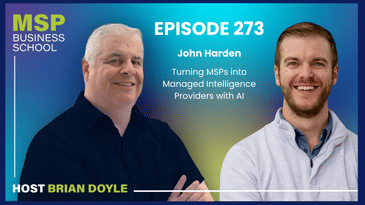

In this episode of MSP Business School, host Brian Doyle engages in a dynamic discussion with John Harden, a pioneer in the AI realm within the MSP industry. With an impressive 17-year tenure in the sector, John Harden brings an expert perspective on the rapid evolution of AI technology. As MSPs grapple with AI's practical applications and benefits, Harden provides insights into achieving scalability, responsibility, and repeatability with AI solutions. John also shares his experience of launching Lemhi, a new venture focused on guiding MSPs to effectively harness AI for service improvements and operational excellence.
John Harden and Brian Doyle highlight how AI is transforming the landscape for MSPs. Through engaging dialogue, they discuss tooling, responsible deployment, and strategic implementation of AI to boost client relations and service offerings. They emphasize the importance of establishing a repeatable sales motion and developing a robust, manageable AI framework. Harden's Lemhi is positioned to directly address this by providing the necessary resources and expertise to integrate AI into MSP operations effectively, focusing on incremental value creation across all levels of client relationships.
Key Takeaways:
- AI Strategy and Deployment: Successful AI integration requires repeatable, responsible, and scalable strategies, as articulated by John Harden based on his extensive research and experience.
- MSP Transformation: MSPs have an unprecedented opportunity to evolve into Managed Intelligence Providers, offering AI-driven solutions that enhance service offerings and deepen client engagement.
- Project vs. Ongoing Engagement: Rather than viewing AI implementations as one-off projects, MSPs can achieve greater value by adopting a continuous, relationship-focused approach that caters to individual job roles within client organizations.
- Lemhi's Offering: The launch of Lemhi aims to help MSPs initiate a repeatable sales motion around AI, supporting them with tools and frameworks for effective AI rollout and management.
- Open Engagement Opportunities: John emphasizes building in collaboration with design partners and actively encourages MSPs to engage with Lemhi for better alignment and co-development.
Guest Name: John Harden
LinkedIn page: https://www.linkedin.com/in/john-harden/
Company: Lemhi
Website: https://www.lemhi.com/
Show Website: https://mspbusinessschool.com/
Host Brian Doyle: https://www.linkedin.com/in/briandoylevciotoolbox/
Sponsor vCIOToolbox: https://vciotoolbox.com
Listen to MSP Business School on the Fox and Crow Group Your IT Podcasts Network!
[00:00:09] Hey everyone, welcome to the latest installment of MSP Business School. As always, I'm Brian Doyle here with you today. And I think we're going to have a fun, fun conversation today because it's about everybody's favorite topic, right? AI, right? But I think we're going to hear from somebody that really is living it much deeper than most of us who will be able to give us a little bit of insight. So with that, I want to welcome today's guest, John Harden, to our conversation. John, how are you?
[00:00:35] Doing well. It's a wonderful day. And every day I love talking about AI. So this is going to be fun. Yeah, you know, I mean, John, for those of you that don't know him, which has got to be maybe about five people at this point in our industry. But for those that don't know John, you know, not only is he living the world of startup, but he's got startup on two fronts right now. Just had another little one. This guy's running crazy right now. So, John, I hope we're getting a little bit of sleep.
[00:01:01] Yeah, we're getting a little bit of sleep. Blessed to have a great family, a supportive family, and one that allows me to continually do startups. But yeah, it's a wild time. I think Riverside's doing a really good job of filtering the bags for my eyes for me. Riverside does a lot of good things. You know, that's why I chose it. I need gels, filters, you know, all that stuff. It does his fault of fingers, doesn't it, Brian?
[00:01:28] Yeah, no, it's good stuff. But yeah, but you know, you're also like the energizer bunny. I don't think you're somebody that can sit still for too long a time. You know, in the short time I've gotten to know you, you're bouncing somewhere at all points. And, you know, that's, that's probably one of the great traits that makes you a good leader for a startup because chief cook and bottle washer, right? Yeah, absolutely. It is. It's not a bad trait for the startup. But you'll have to ask my co founders about that. You know, I don't think so. But they've all developed systems of working around my energy.
[00:01:57] Which I find is really funny. That's awesome. So, you know, maybe again, for the listeners that don't know you, though, talk a little bit about your background. You know, you've, you've had guided a few successful startups. And I think it'd be good for folks to know, you know, where'd you come from? So they know why they should listen to you going forward.
[00:02:16] Absolutely. Brian, you know, I used to say this story a lot. And I, I would say I'm almost halfway of my, you know, half of my life has been in the MSP industry. And, you know, that ticked over last year, when I now entered 17 years in the MSP industry. I know. Well, the face gives it away, but I started as a 16 year old. So now my age is given away. But I started as a tier one help desk. You know, my previous job was building websites for non for profit.
[00:02:44] I built a website for my MSP. And they're like, well, why don't you come on and work for us? I triaged the help desk for, you know, a couple of years before they realized, wait, this guy can write some good software. And I did. I built, you know, I look at the conference floor. I built a lot of tools that were out there. Now, not scalable SaaS versions of them, but I had built my own, you know, RMM Lite, where we were using reverse proxies to, you know, execute commands at scale.
[00:03:10] All sort of like hacky stuff internally until one of those turned into a real thing. It was a unified communication software back when there was money to be made in the contact center space. I spun that out of the MSP with my founders. The business name was Carano, and we launched that for about six, seven years. Took a nice series amount of capital. But unfortunately, COVID took us, you know, contact centers didn't really thrive well during COVID and nor did voice. Hence, we're always on Teams and Zoom and Riverside and StreamYard nowadays, not phone calls.
[00:03:42] And then that led me to the opportunity to start a business called SaaS Leo, which was all about shadow IT. That was a breakneck 28 month story. You know, shadow IT is so relevant right now, especially on shadow AI. And so, you know, we can talk about that today. That'll be fun. And spent a few years stint at Auvik. My last year at Auvik, I led AI strategy internally. So I ran the playbook at that time. You know, it's changed even in the last year, even the last month, it's changed.
[00:04:12] But I took our organization from, you know, about 10% of employees were using it daily. We ended at about 80% of our employees were using it daily. Auvik's an incredible organization. And the adoption, which we did with AI was impressive. You know, between the shadow AI company and the AI strategy, I kind of had this like problem in my mind. It was like, well, this isn't scalable. There's not a John Hart in every company running this thing. And so that synthesized for me to leave and begin a new journey, Brian.
[00:04:40] So a bit of a prolonged introduction there, but. But I think it's going to set the tone for the conversation we're going to have today. You know, as we're recording this, we're a little bit before, but as this goes live, you are now going to have taken Lemhi out to the world. So maybe talk a little bit about what Lemhi can bring to the party for the MSP. Yeah. So Lemhi, you know, my fun little hoodie here that we had to verify when we were going to publish it for.
[00:05:07] You know, Lemhi is a business of, quite frankly, passion. I've got the same executive team from my last few startups together. And we are very passionate about helping MSPs go from internal AI automation. That's already happening. That's not what we solve, but to external AI. How are you serving your clients and how are you scaling your managed service practice at scale with AI? And how do you do it?
[00:05:35] You know, for us, we choose three key words when we look at AI. It's how do you do it repeatedly? How do you do it responsibly? And how do you do it at scale? And those were the three words, you know, before we did anything else at Lemhi. We said, how do we help MSPs do that? And we're grounded around that. And, you know, we've come out of launch recently and we're very early, of course, but we've got a stellar team, stellar capital partners.
[00:06:02] And we believe that MSPs will make sure that their customers are part of this transformation. And Lemhi wants to be just a step in the journey to make that happen. And, you know, and the time is right for that, too, because I think, you know, as I talk to a lot of MSPs, especially in my day job over at VCIO Toolbox, everybody is still kind of at that trying to get the first project out the door stage. They know they need to do it. They're listening to the customers.
[00:06:27] But when we really sit down and talk to the people that have actually executed and brought something to market, it's still a relatively small share. And I think a lot of them are concerned about the gotchas in the process. You talked a little bit about responsibly. You talked about scale. And I think some of them haven't figured that out. You know, I'd love to hear your thoughts on, you know, where the state of the market is, because you're talking to a lot of those MSPs as well and how you feel you can help.
[00:06:53] Yeah, I came to those three words, Brian, after 100 MSP interviews in 120 days. That's what formed the thesis of the business. And, you know, of course, I'm using AI to analyze all that data. And it's super fun to get to the trends. But what I found was that, you know, word for word, what you said is happening. There's experimentation. There's ad hoc projects. There's one-off experiments. You know, the MSPs feel the pressure to monetize AI downstream.
[00:07:23] You can't go to a conference without talking about it. But they're struggling to find a, the way I look at it is like a steel thread, like the bare minimum they can do to be able to create value and maintain responsible AI rollout. And from our perspective, you know, responsible AI rollout, you know, is a lot of things. It's more than a tool deployment. It's proper, you know, deployment rings. It's proper executive champions. It's proper policy and guardrails.
[00:07:52] And it's proper security. You know, everybody's looking at all of the different AI tools in the ecosystem, whether it's Claw and ChatGPT or CoPilot. But they're still integrating into critical data sets and most often the Microsoft 365 ecosystem. And so how do you responsibly allow that to happen? Because MSPs are struggling right now where their customers are asking them for help, but they don't have an offering to bring to them. And they, you know, are going around them. That was my talk at IT Nation last year in November.
[00:08:22] I showed data when I was at Auvik around our shadow AI findings in the organization with our SaaS management tool. The average small business, they have it. This isn't like, this isn't a, I think we all know it, but like the numbers back that we have it, something around, you know, 60% of SMBs had more than three shadow AI tools internally. Dr. Satlow. I know. Oh, sorry. And that's for a segment of like, that's like a segment. That's a good call out, Brian. That's a segment of like 26 to 50 employees. Okay.
[00:08:51] When you get to like 250 plus employees, it's like 12 to 13 shadow AI tools. And so how do you take that fragmentation and bring it into something central? Well, you do a proper AI rollout. You come in and you bring a centralized tool or set of tools and you implement it correctly at scale. And you establish things like I think, Brian, you were talking about before, Shelley, acceptable use policy. You establish things like, you know, rollouts.
[00:09:21] You establish things like guardrails and security settings. And it's a big journey, but it's not all tech. And I think that's where the problem space is right now. It's a big journey, but I think it's good that, you know, the questions are being asked, right? Because I think the MSP community as a whole has matured enough over the last, you know, 15, 20 years that these things looking post project are actually considerations they're taking as opposed to do the project and we'll figure it out later.
[00:09:48] Right. So I've been having more and more discussions and granted a little of what I do is what drives that. But, you know, those discussions have been around how am I going to govern this afterward? Of course, that ties into how am I going to build a recurring revenue stream off of what we deliver? Because, you know, when you talk to most folks, AI is just a project. We deliver it. It's there. But now how do we continue to maintain it, monetize it and stay engaged with it? And I think that's where folks like you will probably help lead the way in answering those questions.
[00:10:15] Yeah. And, you know, from my perspective, you know, I want to build this for the community and with the community. And so, you know, we have free resources and happy to share them so you can distribute after this show, like free frameworks for MSPs to look at and like think about building a plan around. I think I think, you know, I'm never prescriptive because every customer's journey is different. You can't just come in with a hammer and say, this is it. That's a surefire way to get fired from your client.
[00:10:43] But, you know, my opinion really is one that you just expressed. It's a managed recurring revenue stream and it's not a one off project. And, you know, that means you've got to look at what you're packaging and pricing. I mean, there's a lot of ways that people are going about it, but we can make that as the next topic if you want. No doubt. And but, you know, I want to go back to even the first word you said, right, repeatable, because that's another area that I'm seeing the MSP struggle as they look at AI, because so many of them have taken the generalist approach to being an MSP.
[00:11:12] So there's not that consistent thread of a project that they can really take to, you know, a multitude of verticals. Right. You know, where if you are specializing in legal or you're specializing in finance, you can probably get to what that AI project should be. And once you successfully deploy the first one, it becomes really easy to go to others. Hey, would you like this, too? What are you seeing out there and how are you kind of seeing that being broached by maybe the generalists? Yeah, I think of it like this.
[00:11:40] We as MSPs in this industry for a decade and a half have been technology generalists. And that's who we are. And we shouldn't we shouldn't expect we being the industry leaders ship space shouldn't expect us to change that dramatically. Right. Like right now, the pressure to all of a sudden become a custom software development shop and build custom agents is being pushed upon MSPs. And I don't think that's a healthy strategy because it's not recurring. But what I do see is repeatable as something I can pull back from my Auvik journey.
[00:12:10] You know, when I worked at Auvik, I found myself often DMing my internal IT manager and asking for data and configuration and settings and understanding where we are and like setting me up to be able to do it right. And he would show up every call with insights on what's going on inside the business. And, you know, the adoption of our that time was the chat GPT rollout so that we can make business decisions. So, you know, that's repeatable because valuable observability is critical.
[00:12:41] Being able to be a subject matter expert also should not be underrated. We talked earlier on behind the show, like the hype factor is real. But if you cut through the noise, you realize there's some real practical use cases. But if you're a, you know, business owner, you know, small business owner that's just golfing with his buddies and hear AI is the panacea, all you want is AI. You don't know what you want. And so that's where the MSP could be the subject matter expert, that voice of reason cutting through the noise. And so.
[00:13:11] And I think that that is the biggest challenge. I'm glad you kind of highlighted that a bit because I think it's very confusing to the layman. You know, you hear all these broad things that AI can do and then you throw the acronyms around, you know, the agentic approach, the MCP server, you know, all these kind of different, you know, things that go in there. And you're like, where do I even start? And that's where I think the MSP has got the huge opportunity is you can come in and just go, hey, here's kind of the one on one of it all. Here's what you need to care about. Here's what you don't need to care about because we're going to care about that for you. Yeah.
[00:13:39] And I had this conversation with Alex Stanton, you know, it was last week when we recorded this about a month ago now, I think. And we talked about the barbell curve and revenue creation right now. And on one side, these deep agentic ROI projects, and there's a lot of money to be there, but they're kind of custom software development. And you really need to have a good DevOps SDLC set up for this. And then you have the words you use, the one on one.
[00:14:07] Like fundamentally, Brian, I argue that if I went to a business and I helped light up use cases across every employee in their organization, I'm going to create far more value than any like deep custom bespoke agent. And the one on one is really what it takes to get that started. Right now it's in those SMBs fairly isolated. It might be the leadership team trying or experimenting with it or a couple of the new Gen Z employees. But there's no cohesive strategy. And that's where I think there's a lot of repeatable.
[00:14:37] I think that's interesting on two fronts, right? You know, one, looking at the individual people and treating them almost individually because they do all have different job roles, right? And helping them build, you know, if you want to use a cloud vernacular, the skill, right? That can help them get something done. But it's also a way, and this is a big part of it, of deepening the relationship with the clients. So many people have such a tough time getting past that point of contact.
[00:14:59] But now if you can engage these people practically at their own, you know, at their individual roles, it's only going to curry you more favor when questions come up. Oh, it's a golden era for relationship building. I just like it. You should be able to strike so effectively internally with your base, with your account management or VCIO team because everybody wants to be asked. They're just not asking. And I think that's another thing I found in my 100 days and 120 days is, you know, silence is real.
[00:15:28] The clients don't look at the MSP. When they look at their Rolodex of people, they don't go, maybe I should call my MSP for animation. Because most of the times you're looked at as like an insurer or a, you know, keep the lights on kind of a relationship. This is the golden era of stickiness. If you really lean into it and you really build out a practice that helps those customers deliver outcomes and not MCPs, APIs, Claude skills and all the other stuff.
[00:15:56] All the big words really give them a practical model that they can lean on. And in that, you know, deepening the relationship across multiple tiers, you know, obviously in my role, that's what I'm always trying to teach. And it's one of the hardest parts, you know, for people to have an excuse to engage. So here's your excuse. Ready built for you. And they're ready. That's the thing is like, if I went to an organization, I said, hey, like, can I survey your leadership and understand what they want? They're ready. They want that.
[00:16:26] They're itching. They want to be able to bring that value. So if you're, you know, I said in 2025, I did my annual 2026 predictions. And one thing that I quote a lot still from that and is still accurate is customer silence is going to be the number one KPI to pay attention to. Yes. That's that's been very true across your business forever. I know. But it needs to be said. Yeah. I think we take for granted the check comes in every month and people are happy at the help desk.
[00:16:54] And if those things are going on, that's it. But I've always said the biggest curse to an MSP is oftentimes the strongest relationship is with the help desk for your customer. And those are the people that you're generally probably paying the least to. So do they care as much? You know, and I'm not saying they don't. But you get my point, you know, the early stage. Yeah. Yeah. And quite frankly, the value right now isn't can you fix my printer ranch jammed? It's can you transform my business? And so making sure you support that's a really critical part. I also like what you're talking about there.
[00:17:24] You know, the sum being worth more than the parts, so to speak. Right. You know, having this one big bang event, which a lot of MSPs are looking at AI going, what is that one big project that I can deliver to a customer? And really breaking it down to maybe a set of sub sub projects. You know, the value has always been in, you know, the sum of the parts is often more valuable than the whole. Right. And, you know, that's why guys sell scrap parts off beat up cars. Right. And I think that's a very cool approach, too.
[00:17:54] I think it makes it simpler and it makes it more valuable. John, you're off mic right now. Maybe we could edit it out. I don't care. Yeah. It doesn't matter. Yeah. My dog is going bonkers. You can keep it in. And I always like to make fun of myself. I look at it this way and I pull back to a conversation point you said, which is repeatable. And so one thing that is repeatable and one thing that's going to be reliable, because you talk about kind of like piecemealing a journey.
[00:18:20] One thing that I can guarantee in 27 and 28 and 29, like one thing I can guarantee about AI. It's going to change demonstrably. And the one thing that you need to be able to do as a VCIO or an account manager or, you know, whatever your role is. And just speaking to your audience here, like you need to be that subject matter expert. You need to be that noise cutter. Like there is just no excuse to not know the answer to those questions when they're the most valuable questions right now.
[00:18:50] And I think the acceleration is going to be the big one, right? You know, what we learned today isn't going to necessarily be how it's been tomorrow. Even the last six months of this has really shown us how things are going to move really fast. But yet the principles kind of stay the same. And, you know, find something that shouldn't be done by a human anymore. And let's figure out a way to make it automated. Right. And if we can do that enough times, people are going to be happy.
[00:19:14] And, you know, I'm assuming, you know, from Lemmy's point of view, how are you, you know, I'd love to hear a little bit how you're going to enable the MSP to do that. You know, because I think that's the big mystery. How do I engage with a company that is an AI company to then support me as the MSP? Yeah, I did not plant this word in your mind, Brian. Nope. This is a real question I have, man. I see a lot of you guys coming out there and it's like, okay, but now what do I got to do to engage appropriately? Yeah. Well, use the word again. Oh, my gosh.
[00:19:43] You didn't know you used it. So you use the word called engage. And that is the first product we're launching, right? It's about Lemhy. Oh, geez. I know. That's why I was impressed. It's about opening and brokering a repeatable sales motion. That's where Lemhy is coming out to market in day one. We've surveyed all the MSPs and the number one thing they're struggling with is a repeatable sales motion around AI so that we can have a repeatable problem that we've just spent the last five minutes talking about.
[00:20:13] Talking about it. Servicing AI. They're struggling to open the doors and have motions. It's the CEO at top who has to break those conversations because they may be the most informed. Or it's the really technical SME. We're building a really color by numbers sales approach to AI as an entry point for MSPs who are looking to broker the conversation. And it's data backed.
[00:20:36] It's a technical tool where you can dig in and actually look at the gaps in 365 and find what it's going to take to get it done. And what we're doing is helping MSPs engage. Perfect. Perfect. And, you know, things just take off from there, right? I mean, we know that that's it. You know, those that show up, good things happen. So we're getting near the end of our time, John.
[00:21:02] But I want to make sure that we cover off on other things that you might want to share about the Lemmy journey that people should know about, especially as you're now post-launch. And the word needs to get out to the public on how they can do more. Yeah, Brian, I appreciate the opportunity. You know, frankly, we're taking this as a slow measure. Everybody in this AI space, I think, is really rushing. Right now, we're just recruiting design partners.
[00:21:25] We are out there sharing our vision, sharing our framework, sharing our belief, and wanting to work with partners in an early stage to help launch our product as we get throughout the rest of the year. I think from our perspective, we don't want to build in a vacuum in some theoretical room in a corner. We want to work with partners like we always have, like the same executive team and I have always had.
[00:21:48] We're leaning in and we're listening and we're helping guide some of the narrative and helping guide thought leadership all just to make sure that the space is leveled up. So if you want to engage, pulling that word back out again, Brian, it's all about, you know, we have a waitlist that's public. And we'd love for you to sign up for the waitlist. We'll be dropping knowledge content. None of it's going to be anything that's going to cost you a dollar.
[00:22:10] And as you raise your hand on that waitlist, if you think, hey, my practice really, really is ready to lean in on this thing and wants to be a design partner, just raise your hand in the forum and we'll have a conversation with you. But it's early and we're building something that's going to change the space. I firmly believe it. I think we have a five year transformation happening in our space right now in the industry. And in five years, everybody will be a managed intelligence provider. And I want Lemhi to be the tool to make that happen for them.
[00:22:38] Well, you know, I think, you know, you've got a great team. I've gotten to meet a few of the folks out at some of the events. And I think it's going to be interesting to see where you guys go with this. Kudos to you again for, you know, having the foresight to get it launched. If you could maybe share the address where people can go to get on the waitlist, if you wouldn't mind. Yeah. Lemhi.com. L-E-M-H-I.com. Nice and simple. And listeners, as always, we'll have links to both, you know, the website to John's LinkedIn profile as well. So reach out. He's one of the go-givers in the industry.
[00:23:08] So, you know, don't be shy, although be mindful. He's a busy man. I'm always fine to talk to a managed service provider. Yeah. But, you know, really excited to see where this goes, John. I'm really excited, you know, for you personally to, you know, have yet another project to energize you and bring out some great things to the community. You know, and I thank you for taking some time with me today to talk about it. Well, thank you. Yeah, I look forward to it. And I think we're a couple weeks out to have you on my show on Coffee Chats. I'm excited.
[00:23:36] There's a little rumor about that as well, and I'm looking forward to that too. It's always different for me to be on the other side of the mind. I know it's fun. It's different. I almost started the show with that. It's fun being interviewed instead of being a viewer. Yeah, it's a different vibe when you're on that side. But I really enjoyed the conversation today. Thanks for sharing your insights on AI, and we'd certainly wish you the best with Lemhi and the launch. Thank you, Brian. Appreciate it, and I appreciate your support. You bet. We'll talk soon.