
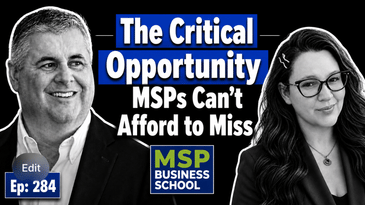

In this captivating episode of the MSP Business School podcast, host Brian Doyle converses with Megan Killion from Pisces Growth. This episode zeroes in on one of the most pressing challenges for Managed Service Providers (MSPs) - acquiring new customers. Megan Killion shares her story of accidental entry into the MSP domain and highlights her transformation from being an agency owner to a focused consultant. This episode is a must-listen for MSPs looking to enhance their go-to-market strategies, especially in a time dominated by digital transformations and AI.
Megan discusses the importance of a strong go-to-market strategy, emphasizing the need for well-aligned messaging and recognizing local market opportunities. She shares her experiences and stresses the significance of understanding customer needs and leveraging strategic insights to achieve business growth. Megan also touches upon the evolving role of AI in the industry, recommending MSPs to seize the opportunity and integrate AI into their service offerings to remain competitive. Her approach to business development is a blend of strategic insight, curiosity, and leveraging local reputations for building trustworthy relationships.
Key Takeaways:
- Local Focus: Emphasize strengthening local market reputation to gain competitive advantages rather than overextending reach to unfamiliar markets.
- Targeted Messaging: Craft concise, targeted messaging that aligns with how potential clients self-identify and solve specific pain points they experience.
- AI Integration: Encourage MSPs to adopt and integrate AI into their processes and service offerings to remain competitive and meet client expectations.
- Client-centric Approach: Build strong relationships by focusing on understanding and solving client problems comprehensively, thereby enhancing value.
- Continuous Learning: Keep evolving your product offerings by revamping strategies and adapting to new technologies, ensuring future-proof MSP operations.
Guest Name: Megan Killion
LinkedIn page: https://www.linkedin.com/in/megankillion/
Company: Pisces Growth Consulting
Company Website: https://mkcagency.com/pgi/
Show Website: https://mspbusinessschool.com/
Host Brian Doyle: https://www.linkedin.com/in/briandoylevciotoolbox/
Sponsor vCIOToolbox: https://vciotoolbox.com
Listen to MSP Business School on the Fox and Crow Group Your IT Podcasts Network!
[00:00:08] Hey everyone, welcome to the latest installment of MSP Business School. As always, I'm Brian Doyle here to help navigate this for you. But I've got a guest that's really going to help some of you MSPs with the biggest struggle we hear out there all the time, and that's how to find more customers. So I'd like to welcome to the show Megan Killion from Pisces Growth. Megan, how are you today? How are you, Brian?
[00:00:33] I'm doing wonderful. So Megan, one of the things that we really like to do is help people that might not be familiar with you, and I'm sure many are because you're very active out in the space and on LinkedIn. But for those that aren't familiar with you, why don't you tell a little bit about your background and how you ended up in the crazy world of MSP?
[00:00:52] Absolutely. So as you mentioned, I'm the founder and chief consultant at Pisces Growth. Before we were Pisces, we were MKC Agency for a couple years, so people may have heard that name thrown around. And before that, we were Megan Killion Consulting.
[00:01:06] I got into MSPs very much on accident, which I think is true of kind of all of us. I'd already been in B2B tech sales for a while. I'd gone from telecom into infrastructure, CDN and cybersecurity.
[00:01:24] And I had very, very rapidly in less than five years gone from BDR, business development manager, VP of sales and marketing, CRO. And kind of in the middle of that journey, I was working at a CDN called Highwinds that got rolled up and acquired into StockPath.
[00:01:44] They laid off the entire business development team. And that's awesome. Yeah, happens a lot. I did such a good job. They were acquired and I lost my job. And that was really the first time I'd gotten tremendous confidence around go to market, not just, hey, I know how to sell, but I know how to go out and manage client acquisition.
[00:02:08] And that's where I was promoted from business development to business development manager. I took the team from struggling to hit 10 meetings a month to I was doing 40 and everyone else on the team was doing 14 or above. And got laid off middle of the summer. We just bought a house. And so I'm scrambling. And I really, really temporarily took a job at Sprint's like business department.
[00:02:33] And then I got a job at I think a lot of people in the space have heard this name. Taylor Works. I worked for Tim Taylor locally here just outside Orlando. And that's kind of how I got my feet wet on managed services. And I worked for him for less than a year. I had been making very good money in infrastructure, took a pay cut to go to MSP and then got another infrastructure job, multi six figure immediately after.
[00:02:59] So I worked for him for under a year. And a couple of years later, when I had gone at that point, I'd already been a VP of sales and marketing and already been a CRO. I'd started my own consultancy because I had twins and I wanted to be able to spend more time at home with them, work a little bit less.
[00:03:19] And Tim reached out to me and was like, hey, in the time that we worked together, every deal I've closed in the last three or four years since you left has had your name attached to it as where it came from. How did you do that? And can we do more, right? How do we do that more? So I took them on as a client along with a couple of other MSPs.
[00:03:47] And since then, I've worked directly for two MSPs as a CRO. I've had tons of fractional clients. And then I did agency work for a couple of years. And while I was doing agency work, I got really frustrated and burnt out. Ultimately, I sold my agency because I got a cancer diagnosis and I was working 60 hours a week. I'm in remission now. But it was very much like a, hey, truly, this is going to... The wake-up call, as they say.
[00:04:16] Yes, it was a huge wake-up call. Like, you can't do this. And so I sold the agency. It was a fire sale. But I had already been discussing selling it because inherently, I either had to overcharge clients for the deliverables they were going to receive or underpay salespeople for what they could do, right?
[00:04:45] Or churn people really, really rapidly. And I think every MSP that has bought agency services, specifically lead gen, has experienced this, right? What happens six months into a campaign? Your BDR that was working for your account is suddenly gone because they've gone and taken a job that pays way more elsewhere. Or your agency wants more money because your person is performing. Or you get no results, right? So either...
[00:05:09] But, like, what you pay going in is never enough to cover someone who can actually perform. And because MSPs in particular, which are my niche, have a long sales cycle, six months to a year, from the time a lead comes in, you cannot really afford to be putting out $5,000, $10,000 a month and not recouping that faster than how that system works.
[00:05:37] So I was already sort of like, this isn't working. Yes, my clients are getting results, but I'm not making any margin. I'm working crazy hours. I loved what I did. I loved, in particular, my agency was very philanthropic. So our entire mission was about taking people who wouldn't get opportunities elsewhere and building them up. I'm so proud of that work and the people that I placed and that went on to have incredible careers.
[00:06:04] But at the same time, I was essentially running a 501c without running a 501c. And I think a lot of MSPs run your business that way. Like, I've seen your books. If you are under 18% margin, like, you're running a 501c, dude. Yeah, there's very little margin for error. And you're always chasing uphill. I mean, that's fact. And what happens when you have a bad month? Which we had a couple of those in our years, right?
[00:06:34] Where, like, I'd have a month where a client would churn and a resource would churn in the same month. And I had to, like, double pay salaries and I was losing income. And, like, it happens. And when you don't have enough margin, that's very difficult to cover. So anyways, then I got my cancer diagnosis. I knew this wasn't going to work. I cut back tremendously and very much focused around doing less better. So we are not going to be everything to everyone.
[00:07:02] We're not going to do websites and lead generation and inbound and outbound and solve every single one of your sales and marketing problems in one house. That used to be the gig, right? It was like, we are very similar to how MSPs market, right? Where you say, hey, we're your outsourced IT. Hey, we're your outsourced revenue team. Instead, I was like, well, what am I really, truly good at? Where do I thrive?
[00:07:26] And I did, for anybody who's, like, familiar with Strategic Coach, I did my little, like, framework of, I forget what that's called. It's like a quadrant. But it's like, hey, where are you drained by what you do? Where are you fulfilled by what you do? And it's kind of two separate levers around what are you the best at and what doesn't drain your car. And that's what I want to do all day. That's consulting work for me. It's strategy work, messaging work, targeting work.
[00:07:56] So that's what I do. I work three days a week, Tuesday, Wednesday, Thursday. I usually work, like, 10 to 4-ish. I make more money than I did when I was running an agency. I have so much more authority over my life. And I deliver better results to clients because I'm in my lane. And so when they say, hey, can you run our Google ads? I'm like, absolutely fucking not. I can't.
[00:08:17] What I can do is help you find someone who can deploy the strategy I put together on where ads sit in your revenue ecosystem. But no, I'm not going to go push the buttons because that's not my job. It's not what I'm good at. Also, I'm $500 an hour. That's you're overpaying for Google ad management. And starting from the top down, and I thought that that was a piece that is like there are a lot of coaches and strategists in this space.
[00:08:46] But I think there is a big gap. Not many people are bullish that you have to have the strategy first. I think a lot of the time, you know, MSPs don't have a ton of budget. And so we feel the need to like meet their needs and take the client and figure out something I can do for you in your budget.
[00:09:08] And it kills the whole industry because those of us that are consultants are not standing firm and saying, hey, no, you would be better off taking this worksheet I can give you. And doing the strategic work yourself and putting that budget into an intern, then giving like I'm not going to get you return at that price point. Yeah. And I mean, it's similar to the MSP, you know, proposition going out, too. Right. You know, when they try to be too much to everybody, they tend not to excel.
[00:09:38] The margins get watered down and they find themselves struggling in that process. And I think, you know, there's that old saying niches are in the rich, you know, the riches are in the niches. Right. And when you can look at yourself and kind of really get laser focused on what you do, then the good things come out. The messaging becomes much stronger by just, you know, by by nature of it. Right. So, you know, maybe let's shift gears a little bit from your background here into kind of go to market strategy.
[00:10:06] How, you know, especially in the world of AI, where everybody's looking to get that first AI project out the door. And, you know, what are some of the steps that somebody can do to kind of hone in on their messaging? And the other thing I want you to talk about was that piece about also the local. I think everybody starts thinking, especially since COVID, we're much more broad. People are used to these video calls. Let's expand our reach. And there's so much to be served in our backyard. And I think we step past it and it's usually easier to get.
[00:10:34] It is, especially when we look at historically where your revenues come from, like where have your clients always come from? And I think as we get larger, we think everything has to change. And there are absolutely things that have to change as you get bigger, but you do not have to abandon your roots. Like you signed your first deal at your kids baseball games. Right. Like that. You got your first client from your kids baseball game.
[00:11:00] Why now do we want to talk to someone in another state who's never met you, who doesn't know what you do for the community? The value is not there, especially if you're trying to be that local MSP. Right. So if part of your value proposition is we've got all local tents, we don't offshore. Like you're going to get someone, you know, a face you recognize is going to come into your office. Why would you then try to go talk to people who've never heard of you, never seen your faces before?
[00:11:28] I think doubling down on what works is probably going to serve you better than trying to reinvent the wheel, especially when you are starting at zero. So like if we think about reputation, right, we have local reputation, word of mouth reputation and digital reputation. Most MSPs have tremendous local reputation. If you didn't, you would not still be here 20 years later because when your MSP started, local was the only way you got your business.
[00:11:55] If you had a shitty local reputation as an MSP, you would not still be alive 20, 30 years later. Right. Why are we abandoning that to go hunt digitally where you have no reputation and there are way bigger fish trying to eat you alive? You do not have $50,000 a month to put into Google ads to go head to head with our Arctic wolf in your local. Geo, they will outbid you for every term that you go for unless you get super, super niche.
[00:12:25] And that kind of comes back to that messaging piece, right? Of if you are super niche, if you understand the intent funnel and the stages of research people go through before they buy a product, you can get ahead of the point at which they say, oh, I think I'd like an MSP. They put that into Google. You have 50 to 100 local competitors that want that business. They're going to go out and get three quotes.
[00:12:53] You may not even know how to do well in a multiple RFP scenario. So depending on... Or even be one of the ones selected because oftentimes the results come up in alphabetical order, right? And start with the first three. Yeah. I mean, it might be alphabetical or by the number of keywords you've monetized on your site. Or it could just be, you know, how many reviews you have. Depends on how they're filtering. But regardless, like, you're too late to the game.
[00:13:21] So if you want to get ahead of that crunch, which also, by the way, in that scenario where you're one of three to five MSPs that are bidding, they're probably going to pick the second cheapest one. Right. Go with the old lowest responsible bid proposition. Too cheap. Probably not good enough. Too much. Don't want to spend it. Yeah. There's a couple somewhere in the middle. And they're probably going to make the decision based on price. And you've already been commoditized.
[00:13:45] When someone already has figured out the problem that they have and how to solve it, you are late to the game. So how do you get ahead of that is more of a they ask you answer type of approach where you're trying to help them figure out that an MSP is what they need. Like, oh, phone systems keep going down. You help them troubleshoot the phone through digital content.
[00:14:09] You become that trusted resource in your community for the things that you do. Right. So that when people are like if you if you do a lot of finance, maybe you have a ton of pages on your website dedicated to troubleshooting QuickBooks. And so you become this resource and this expert. But that is not a overnight strategy.
[00:14:34] It doesn't go like you don't just wake up tomorrow and say, hey, I want to become the local expert for my city in these three subjects. And then boom, you're showing up in everybody's search results. It takes time. And typically money, if you don't know how to do it yourself, you're going to have to outsource it. You're going to pay a lot. But why wouldn't you just go to the local networking event?
[00:14:57] And shake some hands and rebuild relationships that you've probably had in your community since like forever. Build some referral or center of influence relationships inside those local networking groups. So I always say like sell to the same people who sell to your people, but that know them first. So like my when I was when I was selling managed services, my favorite referral partner was my local ADT girl. Why?
[00:15:23] Because she has a Salesforce integration that gives tells her every new business in the area. Someone opens a new business. ADT is there with a sticker on the door before they even like this lease. They the lease is signed. I want that girl to be like, oh, hey, they need they need all these things set up. Hey, did you know that there's a that this new accounting firm is coming in and they're there? They have two offices in town and they haven't figured out their Internet yet. I want to be there.
[00:15:53] And it's also helpful like that particular one's helpful because we are two different things, but we support one another because she can't get in until the Internet's in. And if they can't figure out how to install their Wi-Fi service, then she can't get the cameras up that she wants up. So, like, we need each other.
[00:16:13] That level of one to one, you know, growth was how most of the relationship started for those of us that were in the MSP world in the early 2000s and the 10s because there wasn't as much of the communications availability that we have today. And, you know, the other part I really wanted to hone in there, too, is that piece of, you know, that that relationship building part. I think part of the trouble today is everybody's looking for the easy button.
[00:16:38] You look anywhere online and you'll get you hear people going, oh, I built five agents that handled all my cold calling and appointments came in. And we all know that that's not the truth. There's still that middle piece that needs to be executed by humans and the effort that needs to be put in to build the relationship. It also very much depends on your maturity and capacity to approach a channel. So MSPs are small business to small business.
[00:17:07] And that strategy of, like, essentially spray and pray, it works great if you have a huge TAM, total addressable market. So if I say I truly could sell a product to every single business in America because I sell, like, a $15 a month software tool that most people need for their business, spray and pray is going to work great for me. I'm not reliant on the same things MSPs are.
[00:17:36] First of all, you are expensive to your buyer. It doesn't mean you're really expensive. Like, I've sold million-dollar-a-month CDN contracts. But that's to your buyer. The amount of money you are asking for feels big. They need to trust you. You are a business. You are an outsourced piece of their business that they rely on. They have to trust you. They have to believe you. You have to have a relationship.
[00:18:02] You do not build relationships with people by sending 10,000 emails a day. It's not going to work for you in that capacity. Does that mean that email is not an effective channel for MSPs? Hell no. I've closed tons of business off email for MSPs. But you have to come at it differently. And that is more about, again, building reputation and trust. And that requires paying more attention. So it's not just like, oh, hey, we email everyone.
[00:18:31] It's I look for specific triggers in my market that I know I can solve for and then email people how to solve their problems with talking to me as the secondary CTA. The CTA is not, the call to action is not buy something for me. The call to action is, hey, I saw that you set up, you have a new office building downtown. Usually when people start a new office, they run into these three problems.
[00:19:00] I've put together a guide on exactly everything you should be looking for and asking your current MSP to make sure that your setup looks right. If you have any problems, my number's right on the bottom. You can give us a call. The first hour's free. Now you have built reputation and relationship and you follow up and you say, hey, you know, I saw that you took a look at me. Things happening right at the onset, all of all the important things. So email can work. And agents, by the way, AI can help tremendously with this.
[00:19:29] I have three AIs working in the background right now. What are they doing? They're cleaning my CRM. They're putting in notes. They're doing research. They're finding digital triggers that give me intel on who I should be talking to and why I should be talking to them. They're not hammering my market. They're doing the research. They're putting in notes for me. It's human in the loop. AI and automation, right? It exists, but it's asking me before it does anything. That's what I really recommend if you're going to go with that type of strategy.
[00:19:59] Like people say cold calling doesn't work for MSPs. Cold calling works for MSPs. I cold called for MSP. I still sometimes cold call for MSPs just to make sure I can still do it. It works. You have to know how to do it well, not just calling up and being like, hey, do you need IT services? I get I like I probably get more solicitations for IT than anything else other than lead gen. Like those I get them constantly.
[00:20:24] Unfortunately, my business mailbox is full of MSPs trying to pitch me, which I consistently liked. Hilarious. It's good to see what's going on out there. And I'm sure that could become a lead source for you, too. But sometimes I email that like I have been known to like email their supervisor and be like, hey, just FYI, I think your scripts could use some work. You need better frameworks. And I'm going to do this that way.
[00:20:50] You know, to that end, though, I think, you know, again, that comes back to better messaging is always been the problem. Right. I believe cold calling can still work. You just got to go into it with a different mindset than we did 10 years ago. You know, it's going to take you 150 dials to get to 10, 12 people that are legitimate because nobody picks up their phones anymore. You know, without dating myself. Quality is a real issue. Yeah. I mean, you know. You can build a machine.
[00:21:16] I know people who build monster engines for this stuff and it works really, really well, but it's not instantaneous. Right. Like there's the messaging piece. A hundred percent. That's the biggest piece to me is like you need to know who you're talking to, what they care about and why they should spend more time with you. And you should never go into a conversation worried about selling the deal.
[00:21:43] You're trying to get to the next piece of time. Right. If you don't sell the appointment, that's all you're trying to do at this stage. Yeah. You just want to see. And honestly, coming at it, like for me, the biggest thing is I am not trying to sell you anything. I am trying to figure out if there's a problem I can solve. Be curious. Curiosity is like the number one sales skill. We don't talk about it enough. You just should be curious if they have a problem you can solve.
[00:22:09] And I think that's why MSP founders sometimes find themselves very innately good at sales. Not the motion, not the strategy, but that moment when they're in a call and the prospect is super frustrated because they've got this recurring issue that's been with them for years. And they come at it like an engineer and they're like, oh, yeah, I want to see that. Like, let me look. Let me get into your your cabinets and get under here. And like that.
[00:22:39] They're so good at that piece of it. But it's how do I get to that moment? Right. Like, how do I get there? How do I be curious before I'm sitting in front of the actual problem? And I think that takes more business level curiosity, which MSPs sometimes struggle with. The technical curiosity is there. In fact, I've sat in enough MSP sales calls that I think you guys are too technically curious too early. Yes. It's the physical curiosity. But again, you already hit upon the why on that. Technical founders.
[00:23:09] That's the language they know. And the business piece is catching up, right? As they develop their businesses, the longer they're in it, the more they hold those business conversations appropriately. But the people sitting across the table from you now are digital natives. You know, now they understand how tech works. They've had it in their hands since day one. And they are not looking for you to explain to them how the toaster operates. They just want to know, how do I get my toast better and make sure it doesn't burn me? They know how to look up.
[00:23:38] They're more fact finding than previously too. So they know how to look up if you're bullshitting and look for it. That's part of why I say like, hey, build the troubleshooting content because your millennials actually might read some documentation and try to do it themselves. And if they come to you for that and then they get stuck, yours is the number they're going to call as opposed to if they're doing it directly with Microsoft or wherever else.
[00:24:03] And I think that millennials are now our number one business owner decision maker. Right. So we used to sell the boomers primarily. Now we have to be ready to sell to millennials. And Gen Z is coming up behind extremely rapidly. And it's a very, very different decision maker. Messaging has to be stronger. And one of the things that I see constantly is most MSPs are terrified of because they because they're not getting a whole bunch of new revenue every year.
[00:24:32] They're terrified of slimming the pie. Right. They're like, well, I have to sell to everyone because otherwise I'm going to get less less business, which is fallacious and the opposite of what actually works. The more you try to sell to everyone, when you message to everyone, you message to no one. If your website just says like, we're your technology Tylenol and we help solve IT problems. We're great IT. Everybody loves our team.
[00:25:02] Outsource your IT to us. Best MSP in region. One, God, you talk about yourself a lot. Two, why should like you're like most small businesses don't actually identify as a small business. I know that because I sell to small businesses. They're called MSPs and they identify as MSPs. But y'all are small businesses. Like the number of enterprise businesses and MSPs like almost non-existent in terms of our market.
[00:25:29] So your average small business does not wake up every morning thinking, oh, I want IT for small businesses. They wake up thinking, I have these five headaches and these five headaches are, you know, probably four of them are technology related. They just don't know they're technology related. So if I'm an accountant, I consider myself to be in financial services. I consider myself an accountant.
[00:25:53] So when we talk about like messaging, one of the first pieces of messaging is how does my prospect self-identify? How do they see themselves? How do they see themselves? My targeting needs to be built around that. My messaging needs to be built around that. And then the second piece is like, well, what language do they use? We in the MSP space are super technical, which is great. But we tend to use a lot of technical explanations, technical jargon.
[00:26:21] That is probably not how they are thinking about the problem. Because if they were thinking about the problem like that, they'd probably be technical and they could probably solve it themselves. So I think everybody just needs to dumb down their language, like 20 to 30%. And especially technically, like if you want mature business owners, you should be using mature business language. Let's start talking about OML.
[00:26:44] Instead of talking about IT, let's say that we are the superpower behind the curtain of increasing your operational maturity. That's what I do. And I think, you know, those are the things, too, when you're talking to, you know, your customers, that unearthing the pain is where you can map back the opportunity.
[00:27:09] I always joke with, you know, our customers that the customer doesn't see the technology behind the scenes. So you have to work with them to identify key initiatives they're going after and those obstacles they're facing because oftentimes they don't see the technology relationship. And oftentimes that's where your quick wins live, too. Like, hey, you're already using Office 365. Let's extend out how you're using SharePoint. Costs you nothing except a little bit of time. And boom, you're going to be able to do X, Y, and Z with it, right?
[00:27:37] And those are the things that MSP understand. Hmm. That's actually a great piece of messaging I've seen work really well is, like, get more out of products you're already paying for. I will say I think Microsoft has become very diluted that everyone does Microsoft. You are not a special snowflake for knowing how to support the number one business tool out there. Like, we know that that's huge. The MSP ecosystem, great.
[00:28:06] Pick another tool. What else do you have in your stack that you know a lot about that you can help people be better at? And I think we talked about this before we started recording around, like, go look at your actual service desk and see what the trends are in your tickets. We're not going to turn the messaging into all the technical jargon that's in there, but we're going to say, like, find the problem, the pain that sits behind that and build messaging around it.
[00:28:33] Like, are there tools in the stack that are just hyper frustrating to all of your clients? What everybody knows, like, you could just ask any tech in your business and be like, hey, what's the number one tool our clients bitch about? Yep. And make it answer that question for you. And, like, why would you not have messaging around that? Well, it goes back to something that has been very common in the MSP space, and I think we're starting to see the shift. They used to ignore what the line of business does.
[00:28:59] They didn't want to look at the applications that the end users were using that belonged to the software vendor. But the truth is, there's so many points of integration. There's so much new AI capability that can be integrated into it that if you're not going out there and learning what your customer's doing at the end user level, you know, what their people are pumping into those machines every day, you're missing the opportunity to really grow your organization. And what value are you serving at this point? We're in the 21st century.
[00:29:29] So many businesses are remote. Like, I'm a remote business owner, and to try to sell me, like, IT support, but you won't touch my SaaS tools? Why do I need IT then? Like, because then I still have to sit on the phone with the vendor while you figure out my internet. That's just no, that's not fun for anybody.
[00:29:50] I think that's a big piece of where I see, there's, like, two sides of the MSP challenge, and one of those is very much, like, GTM from, like, a messaging. Perspective, a targeting perspective. But I do think we also have, we have some product challenges in that where a lot of us are very much clutching our pearls, sticking to the way the business was a decade ago, two decades ago. And, like, I get it.
[00:30:16] If I had a business that had been a cash cow for me for 20 years, and we just kind of plateaued, part of me would be like, can I just sit this out? Still retirement? Like, are we dwindling so fast that I can't just, like, retire on this? But the truth is, most MSPs want to sell their business and sell it well, walk away with a chunk of change they can retire on.
[00:30:39] I think if you want your M&A to go well for you, you have to be a little bit future-proof. And so to do that, I think you got to get with the times on AI and automation. And if not that, then you have to pick a different specialization path to be on.
[00:30:59] I think it's okay if your specialization is compliance or cybersecurity, but also know that almost everyone in this space wants to be the compliance specialist, wants to be the cybersecurity specialist. And in the time I've been doing this, I've probably only had three of the thousand or so MSPs that were actually capable of being, yeah, of actually being a specialist.
[00:31:26] And I think there's just, there's so many places that you could be investing in improving product. Just pick one that your clients care about, so long as you want more of the clients that you already have, right? So if you look at your client pool and you're like, eh, my clients, they call it the worst hours. I'm so stressed out. We don't want to go get you more of the kind of business you already have.
[00:31:51] But if you look at your clients like, I love them, they're great, make that the ICP. Like what are businesses that look like this? How do we go get more of them? And I think we really tend to undervalue. You already have clients. Go talk to them. How do they see technology evolving in the next five years? Where do they see that integrating in their businesses? What kinds of work do you do for them that they value the most?
[00:32:18] What are the things you don't do for them that they wish you did? What have they bought this year that you weren't involved in the conversation? Because really, as the MSP, I feel like you should know every vendor that they're buying from. Very quickly you do that, you'll find out whether or not you're looked at as a commodity. Whether they look at you as a true leadership partner. If they do look at you as a leadership partner, you're spot on.
[00:32:44] You should be involved in those decisions, not necessarily influencing go or no go necessarily, but giving them what the pitfalls might be if they go one way or another. And I think compatibility, integrations, like you don't have to be the expert on like every piece of the business, but you should be in that. If you're saying we're outsourced IT department and I'm your CTO, the CTO would know if we're buying a new tech tool and whether it was going to integrate with what we already have. No doubt about it.
[00:33:13] And, you know, and you also can help that CTO out by identifying where people might be going rogue, right? And that gets back into your natural, you know, MSP kind of work. Megan, we're getting near the end of our time, and I want to make sure that if you have any other message that you want to share today, that we're able to do so. So I don't know if you've got any closing thoughts before we get into where you're going to be in the next couple of weeks.
[00:33:36] The only thing we really didn't talk about was the AI piece, which is fine because I have literally two sessions up and coming about AI, and I just did AI in the channel. So that's evergreen content. You can go look it up. But the big thing with AI that I just kind of want to throw out there is it's now or never at this point. The boat is leaving the harbor. You're going to have to swim after it.
[00:34:03] And if you don't build the muscle to be able to do that, these opportunities are not going to be here because other people will be eating your customers. Like if you're not doing AI for your clients, someone else will be. And I think we learned this with VoIP, with Telco, right, where it was like, well, why aren't they buying it from me? Because they don't know you sell it and you don't have like a product.
[00:34:27] You need to build the like you need to build a real product and just maybe not being so afraid of it and knowing that sometimes the first run sucks. So just be honest about that. Like I think some of the best products I have personally come up with for my business started as me talking to a client and being like, hey, I think I can solve your problem. I've never done it this way before. Are we cool if it's a little messy? Yep.
[00:34:56] Can we go on the journey together and see where it lands? And, you know, the other thing that I think the MSPs need to consider, you know, in that same vein is there's a whole new breed of AI first consultants coming into the market space who are not even looking to pull your traditional MSP business. But they're going to be the people that come in, command the ear of the leadership because they're now solving business problems. It might even be the one telling you what to do when all said and done. Or deciding you're unnecessary.
[00:35:27] Do you want some upstart 21-year-old AI consultant automating you out of the business that you've been with for the last 15 years? If you don't want them having that control, then you need to take ownership of that piece of the business because they're going to use it. Even in a company that says they're not into AI. Well, do you use HubSpot? AI. QuickBooks? AI. Do you use Facebook? AI. AI.
[00:35:54] Like, that's not we're no longer at a place where like we can even argue, oh, well, I'm not going to be an AI business. You already are. Like, especially MSPs, you have Microsoft, you have Copilot, AI is happening to you, whether you're participating or not. Just figure it out a little bit. And honestly, just start with one problem you can solve. You don't have to come at it as like, well, I'm going to be your full AI consultant.
[00:36:19] And you can come at it and say, hey, pretty much all of our clients use Microsoft Xbox. Did you know you can integrate those and build these three automations with a little bit of AI on top that save on average 20 hours a week of work? Nope. That's good. That's your first, now you have a flagship AI product. Look at you. And that will turn into more business.
[00:36:44] Because as we've learned through the project-based side of MSP, right, if I solve one of your problems and I do a good job and I deliver you something final that helps you, next time you have a problem, what do you do? Who do you come to first? Me. So if I can solve one problem with AI and I bring that one to you as like, okay, I can do this one thing. The next time that you're having a challenge in your business and you're like, I wonder if this could be automated, then I become the person you talk to about that.
[00:37:13] And that's really who we want to be in our corner of the world, in our niche. So if I were to like say, hey, I want to be the MSP for lawyers in Orlando, then I would know everything there is to know about perfect law and all these like, and just yet and all these various things. And I would know how to build their automations and their AI searches. So you don't have to be the expert on the entire thing.
[00:37:41] You can just find one little thing and do that really well. All right. So Megan, I want to thank you for joining me today and certainly sharing a lot of great tips for MSPs that are always looking to acquire new customers and strategies to go out there and do it. I think you have given them a lot of food for thought today, which is great. I know that you're going to be at a couple shows upcoming in the near future. So if you want to share where you're going to be. Yeah, absolutely.
[00:38:07] I will be speaking at both MSP Summit and ScaleCon. They are both in September. One's here in Orlando. Other one is in San Diego. And so that's my next immediate events. And then I've got a couple more on the horizon that I'll share as they become more solid. So listen, if you're heading out to those events, definitely go check out Megan's Talks. And in the meantime, this podcast, as always, will be up on YouTube and anywhere that you get your podcast downloaded with our show notes.
[00:38:36] We'll have Megan's LinkedIn address. We'll have a link to her website. And we'll make sure that you have ways to get in touch with her, at least connect with her online. Megan, I want to thank you so much for joining me today. And I will see you again down the road. Thanks, Brian. It's been great.