

Listen to MSP Business School on the Fox and Crow Group Your IT Podcasts Network!
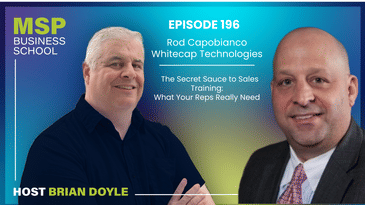
[00:00:01] Hey guys, it's Brian Doyle and this week on MSP Business School, we've got a sales clinic to bring to you. My old boss, actually my first boss, Rock Cap of Bianco is going to join me
[00:00:11] and we're going to really cover a bunch of topics around sales like effective hiring, essential training approaches, and how to keep your sales team on track. Can't wait for you to join us. Now let's get to this week's MSP Business School.
[00:00:27] Welcome to MSP Business School, led by our deans of business development, Brian Doyle, Tim McNeil, and Rob Rogers. Each week MSP Business School is committed to delivering you proven strategies, tips, and tactics for MSPs to accelerate their business growth and revenue through better sales,
[00:00:46] better marketing, and true account management. Classes start now, so let's get started. Let's throw it to the deans. Hey everyone, welcome to the latest installment of MSP Business School. As always, I'm your host Brian Doyle and I'm really excited today because I've got a fun guest coming on.
[00:01:09] Many of you may not know my friend here, Rod Cap of Bianco. He's one of the unsung heroes of the IT industry, but Rod, his biggest thing was he was my
[00:01:20] first boss. And as such, I've asked him to come on and really come in and talk about the sales and sales management. That's a topic that comes up often here in our conversations and definitely want to get Rob's idea of expert in area of expertise into this
[00:01:37] conversation today. So Rod, thanks for joining, man. Brian, glad to be on and you should know as part of me being your first boss, you were my first hire if you remember. I know and we'll share some more stories a little bit later,
[00:01:52] but the first one I'll have you guys with, listener, is I showed up for my first interview coming out of college and the guy I was meeting with was getting fired in the conference room as I was walking in the door.
[00:02:05] So I got to be Rod's first interview. He got to be my first boss and oh my god, maybe we're either both regretting or happy about that today. We don't know yet. Exactly. Great memory, Brian. You remember some of those details all too well.
[00:02:18] But you know, with that being said, Rod, I want you first to introduce yourself and share a little bit about what you're doing within the industry today. Sure, sure. Well, Brian, glad to be on the show. Thanks for having me.
[00:02:29] Really interested in chatting today. So I've been in the industry of telecom for pretty close to 30 something years now with YCAP Technologies now, 20 year old company coming upon 20 years and we're an agnostic telecom agent providing different technologies, different services to customers.
[00:02:53] The difference with YCAP is that we're sitting on the other side of the desk with customers versus where we might have been before. So we're really helping them understand technology, understanding their business initiatives, directives and so forth,
[00:03:06] and helping them find a platform of service that matches what they're trying to drive towards and what their objectives might be. Yeah, and that's music to my ears because these days you really got to get into the strategy of a customer as well.
[00:03:19] Understand what they're trying to accomplish as a business overall before you can really make those technology recommendations. You know, you say telecom agent, but really, you know, the overlap keeps getting narrower between the pure, you know, telecom agent world and the IT service provider sector.
[00:03:36] And I know you're providing a lot of those services as well. You know, talk a little bit maybe, you know, how the world of the agent gets involved with IT and how you approach some of those things.
[00:03:46] Sure. You know, telecom is a word that's kind of ingrained in my vocabulary. It's been there for so long that sometimes I just can't get away from it. But really, it's technology as a whole. It's that whole umbrella of the technology stack, the services that we provide.
[00:04:01] And so, you know, that ranges a whole number of things. And I won't belabor Internet voice so forth right up to cybersecurity services. But when we're an agent, we're able to engage, you know, different suppliers that satisfy different business requirements, different initiatives.
[00:04:23] And we're able to bring in subject matter experts to support us, whether it's MSPs that are local that have some of these services that we partner with or it's some of these global suppliers that really satisfy, you know, the bigger initiatives that businesses need.
[00:04:38] And we're bringing different ones to the talk track with the customer so that we're making sure that as an agent, I said telecom service provider before, but really a technology service provider,
[00:04:49] we're bringing things that are different, that are satisfying today as well as 18 months down the road as far as what their requirements might be. And it's changed, you know, the conversations are different. The decision making is different with these businesses.
[00:05:04] You have to be prepared. You have to have the firepower to help them find what it is they're totally looking for. And sometimes they don't even know what that is. Sometimes it's really unsure and having that discovery and asking some really challenging questions
[00:05:17] help them understand some of the things they should be looking at that they hadn't prior to that. And that's the truth, right? I mean, that's a big part of this world is understanding what the customer really needs because they don't and help guide them to that point.
[00:05:33] And, you know, the reason I asked you to kind of share a little bit about the technology piece, you know, and how the telecom agents have kind of embraced going outsource for technologies because we're seeing that movement happening,
[00:05:44] you know, within the MSP space as a whole as well. More and more customers are outsourcing level one help desk, outsourcing their SOC services, you know, for security. And it's because we generally don't have that expertise on staff, especially when we're a young MSP.
[00:06:00] So, you know, and I think that's very, you know, again, having come from the agent world before going into the MSP world, I'm seeing a lot of parallels now where groups like yours who have really kind of attacked the market from a sales first mentality,
[00:06:13] you know, you've never had that depth of bench that a lot of MSPs had. And as such, you had to go reach out for these experts.
[00:06:21] Now, you know, as you guys evolve, you start bringing in some of those key areas where you see repeatable services over and over again. Maybe you can speak to a little bit of what that outsourcing process has been like and why you're comfortable with it,
[00:06:33] because many MSPs are a little uncomfortable giving up control. Yeah, well, I can see it, you know, the whole. It kind of goes back a few years when when the shift started to happen with the old traditional telephony world where the PBXs were in the closet.
[00:06:53] A technician had to come out and make a repair. You know, everything was done locally. And we were part of the early stage of this transition where everything then went to the cloud.
[00:07:04] So all the components were in the cloud, all the feature set was in the cloud and all of the service, the remediation. Everything was now cloud centric, but but we were still able to bring phones to the desk where there was desktop phone, soft client on the laptop.
[00:07:19] So we were kind of involved in all of that getting it out of the facility kind of thing. So the next phase of that now is the whole IT world started to slowly transition to this whole cloud based effort as well.
[00:07:32] And I remember you and I had a conversation some years ago, maybe close to a decade ago, where you said, you know, at some point,
[00:07:39] really all a user is going to need is either a Chromebook and or an iPad or even their smartphone, because everything is going to be somewhere in the cloud.
[00:07:47] So when we talk about this whole outside the facility thing and offloading everything, it kind of came natural to us because it started with the phone thing. And listen, there was a learning curve. We had a we really had to wrap our heads around how this evolved.
[00:08:02] So so once we did that, some of the other services that go along with it now that are outside the facility, that to us is kind of like more natural than having it be inside.
[00:08:13] And I don't know if that answered your question, but that's kind of a lot. No, it definitely does. You know, I mean, the reality is gaining you guys started from an outside in perspective.
[00:08:21] So that trust was really born from some of the earlier technologies that you had supported. But then as you started moving to cloud based, it almost gave you guys the advantage of getting to the cloud a little bit faster than some of the pure play.
[00:08:32] I.T. service providers were, you know, obviously we all got that nice accelerant. Well, I guess we shouldn't call it nice because it was really because of covid.
[00:08:40] But we got that accelerant where things did get us back out to the VMS or to the cloud a little bit faster in the early twenty twenties.
[00:08:47] And now it's almost like a foregone conclusion that almost every app you have will be there still some traditionalist, though, that aren't prepared and don't agree with that concept
[00:08:56] and want everything in the closet in the back so they could see it, touch it, kiss a good night when they leave. So those those people still exist. And if it's right for them, that's fine. You know, we're not there to to forklift that.
[00:09:07] But if the conversation evolves to to next steps and futureizing what that might look like, well, you know, we're prepared to have a discussion on that. Cool. So, you know, let's transition a little bit maybe to the world of sales now.
[00:09:21] Right. You know, you've been in sales your entire career. You know, I've been in around and, you know, seems like never can get away from sales in my roles, even as the CEO over here. I do at VCO Toolbox.
[00:09:35] I'm still primary about building brand and getting out there and enclosing those larger deals as well. So, you know, as a sales guy, you know, what are you looking for in the salespeople you bring on?
[00:09:47] Because that is something that IT service providers struggle with because most of them are tech first owners. And they just don't know the characteristics of a good salesperson. Yeah, yeah. It's not easy and there's no magic pill.
[00:10:01] So certainly this discussion is going to reveal something that's the secret sauce that that no one knew beforehand. Everybody wants a salesperson that's like themselves if they're the owner of a company.
[00:10:14] They want their clone to go out and try to attempt to sell the way that they've sold that has helped them grow and evolve their company. That's just the way it is. Everybody wants that.
[00:10:27] But that's not out there, you know, otherwise they'd be running their own company as well. And so in the best attempt to try to emulate themselves, it's tough. You know, a lot of people follow those MBTI tests and the personality tests.
[00:10:41] And if it checks all the boxes, well, that's a good hire. You got to bring him or her on board. You know, for me, a lot of it is gut. Now, I know that sounds kind of cliche and very kind of loosey goosey.
[00:10:54] But there's a lot of things about people that that I look for that if they fall into that category, there's a high probability that we could help them develop into a good salesperson. And they don't need to have sales experience before.
[00:11:09] If they played sports, you know, we've talked about the athlete, you know, understanding the competitive nature and wins and losses.
[00:11:16] That plays a lot into what we do in sales and can that person endure a lot of the rejection and the downside that goes into making 500 calls a week and talk it to three people? That's always a challenge.
[00:11:30] Understanding their persona and their family background, what are things like outside of work and what do they do in their spare time? And can you get a sense of their conscientious in their discussion and what they bring to your conversation?
[00:11:44] Those are small things, but you add those all up. They turn into bigger things. And then again, are they engaging? You know, if they go straight to what the competition is like and how many weeks vacation they get, they're probably not a right fit.
[00:11:57] But if they're interested in what a day is like and what goes on and how they could play a role in what we do, certainly then, you know, they're kind of a key contributor.
[00:12:12] You know, we recently hired a young lady some months ago and in the conversation, we had five interviews and each one of the people in this interview process were all really pretty good, actually. So it wasn't an easy decision to narrow this down.
[00:12:26] And but one of the candidates had a lot of moxie, you know, a lot of like confidence to carry the conversation well, almost to the point as if, geez, you need me more than I really need you.
[00:12:39] Again, checked all the other boxes about the athlete and kind of the background and so forth. But but a lot of confidence that came out in the conversation that was, you know, that was helpful in determining whether or not they could play a role.
[00:12:53] We had an interview or candidate, he's been here 15 years now, but, you know, he came in and really wanted to learn. He didn't have experience or knowledge, but what you could tell him the questions he was asking about his his interest in wanting to evolve.
[00:13:07] And can he play a role in helping? It certainly has become a huge factor in that. So again, it's got and I know that it's you know, that's a hard thing to really understand.
[00:13:19] But a lot of times, you know, it, you know, I've had interviews where in the first two or three minutes, you could really tell like this is going sideways. I think this is probably going to end here now. And we've done that too a bunch of times.
[00:13:33] Yeah, but let's kind of stay on one thing I picked up on there. And I definitely agree with you, you know, through some of the hires I've made. Do they ask questions? Right.
[00:13:42] You know, half of the battle with a salesperson, a good salesperson is are they doing a good discovery? Are they bringing back enough information that the team can figure out what the solution is? You know, do they have the capacity to go dig in there a little bit?
[00:13:56] And I think when you're doing those interviews, if the you know, if that salesperson is asking you questions and you're right, not the PTO and the salary questions, right? Yeah. But if they're but if they're asking questions that are real, like, how do you guys acquire those customers?
[00:14:11] Have you tried these avenues? Can you you know, what support can I expect on this? How can I approach this? But if they're asking probing questions to you about the job, and those probing questions make sense, those are a good barometer for understanding
[00:14:24] can this person ask probing questions to a customer? Because, you know, when you're sitting across from somebody, especially when you're a young salesperson or a relatively green salesperson,
[00:14:35] it can be intimidating because those people across the table have those titles that you aspire to be someday but are still up the chart. And it can be a little intimidating sitting in front of a CEO when you're 23 years old.
[00:14:47] You're just getting to know your job a little bit. Right. Yeah. Yeah. You know, I don't know if you know what else you look for in that, but I definitely look for do they ask questions and definitely on board with you on the persona piece.
[00:14:58] You know, if you see a guy that's, you know, that is athletic, and these are not absolutes, but or R and two some sort of team approach sport, you know, or team or, you know, even, you know, in terms of some of the gamers,
[00:15:11] if you see somebody that has to work in a game, that's kind of a team based game with a goal at the end and they know how to approach that.
[00:15:18] Those are the skills that really get you to, you know, to your end game, which is I got to make a sale. Yeah, yeah, for sure. You know, Brian, maybe there's this connection in our kindred spirit because we're both CCSU grads.
[00:15:30] But one of the things that I've done for 25 years is try to give back to CCSU in any number of ways in their advanced education or career services department. And I'm a student of the co-op program there as well.
[00:15:43] So for years, we participated in their co-op program and try to hire students that come out of CCSU both as interns, co-ops and or graduates. And we used to do a lot of the mock interviews up there.
[00:15:55] So we would spend a couple of days kind of mentoring some of the students on on how to be prepared for what happens when you you you're in an interview and you're looking for your next step in your career.
[00:16:08] And I will say that CCSU has always done a pretty good job with their students, but there's always a few that approach you. And we do a lot of the career fairs there, too. So this is as recent as three months ago.
[00:16:19] We do a lot of the career fairs there and some of the students come up to you and and they freeze like they're not really. And it's not because they can't conduct themselves well, but the moment causes them to kind of like choke up.
[00:16:32] And so one of the things we have done when we do these things is try to open them up a little bit, try to get them to ask questions like tell if you're interviewing someone and and they're interviewing you, make sure you have questions prepared.
[00:16:46] Ask about the role. Ask about the expectation. Ask about what goes on into the average day. Ask what what kind of training is like to help you be prepared for what it is like day one in the real world.
[00:16:59] So, you know, those are some of the things we try to instill.
[00:17:03] And I do think questions are important because it gives you a cue into kind of what they're thinking and and what might come to them as an expectation when they if they are hired and what they might do and what their expectation is.
[00:17:18] So now, Rod, we've gotten through the interview process. We've made our selection. They're coming on board with us. What do we expect on day one? What should a manager be doing with the new sales rep on day one?
[00:17:33] You know, we've already gotten coffee and they've already gotten their tchotchkes and they saw where their desk is. But how do you get them really prepared for the job as they're getting started?
[00:17:41] That has been an evolution here at White Cap and been an evolution in my entire career. The first thing I want to make sure that they feel like they're part of the team. They don't have any knowledge or any experience of what we do.
[00:17:54] They don't know anybody in the organization. But but our goal is to make them feel like they've been here and celebrated their 12 month anniversary. Our goal is to have them become a lifer here.
[00:18:04] Certainly, we want people to come in our organization and adapt to the culture and put that customer first mentality, but also be a performer and help us grow and evolve so that we can continue to to expand our footprint, continue to grow our our revenue and customer base.
[00:18:20] So day one, I want them to feel like they're part of the family. And so part of what we've done over the years and Andrew has been a huge part of this in development with me is is building a curriculum.
[00:18:32] So when they come in day one, even though we're this small company, we're not huge, we're a huge training department and a training lab. Have them come in and feel as if they are part of something that's bigger than than what we are. So they have an agenda.
[00:18:46] They have a week one outline. They have a week two outline. They have a week four outline who they're meeting with, what vendors are going to come in and introduce their wares. What's the training going to be like for sales training?
[00:18:58] What's their curriculum going to be to learn their composition and practice when they get distractions from a customer? What those responses are going to be?
[00:19:06] We're going to practice that just like when you go to the drive in range and you whack your nine iron 50 times and then you go to your seven iron or your eight iron to your driver.
[00:19:14] Just like, you know, anything else that you're practicing, you're going to understand what your composition is going to be when you're reaching out to to communicate and have a conversation and then handle what those responses are.
[00:19:26] What people often call them as objections might be like we don't want them to go cold and we don't want them to feel like they're annihilating on their own and they're making. And those those are two big things that I see go wrong.
[00:19:37] A lot of times in IT service providers when they hire salespeople, I've gotten to work with quite a few of them.
[00:19:43] A lot of times these people are on their own island when they're coming into that environment, especially in the MSP world where they're really surrounded by a bunch of engineers and not often with any sales peers.
[00:19:53] Right. So, you know, we have to look at even the most successful salespeople just can't come in and be successful on day one. They need that training program like you were talking about. They need that outline of expectations. You know, they need the sales.
[00:20:08] You know, if it's owner led sales management, they need to have that weekly visit with you once a week, minimally or maybe once a day as you're getting started. In the beginning, it's got to be daily for sure. Yeah. So there you go.
[00:20:19] So to provide feedback and it can't get trumped by the technical issues that you might be experiencing in other areas of your business. If you want to have success with a sales rep.
[00:20:28] I love that concept of having weekly outlines for these people too, because just because they know how to sell doesn't mean they know how to be structured. Sometimes they need to be reined in a little bit.
[00:20:38] Salespeople tend to be a little fast moving and can overlook simple steps that will make them successful if we don't kind of put a fence around it. Yeah, you know, and to that point, it's not easy.
[00:20:51] Right. You know, you have a business owner that's trying to run his company, trying to take care of all of the minutiae that goes on every single day. Customer, customer sale, customer issue, customer order, customer deployment, maybe even equipment failure, personnel issue, who's out sick.
[00:21:07] All of those things play a huge role. And then so you're supposed to find time somewhere in that week to build a curriculum. It's not easy. It's time consuming. Certainly, if you don't have the experience in doing it, it makes it that much harder.
[00:21:23] But trying to build it before you have the hire so that when they come in, you're not reactive, you're proactive. That's what we did some months ago, years ago, is build the curriculum. We've modified it more recently.
[00:21:35] We're continuing to modify it so that we have when someone comes in, they get their their playbook day one. The only thing that changes is the agenda on the schedule as to who's doing what training for those first 60 days.
[00:21:48] And then, you know, after that, we cut them loose and let them kind of cut their teeth on their own and come back to us with their challenges. So, Rod, all of us have had good hires and bad hires, right?
[00:21:58] You know, that's part of the game, unfortunately, in doing that. But how do you know when to continue working with somebody and when to just cut B? You know, what are some of the indicators that you see there?
[00:22:10] Because another problem I see a lot in the MSP world is they don't give enough runway to their salespeople to get the job done. And I think most of us recognize most sales cycles and I'd love to hear how it is for you.
[00:22:22] But realistically, an MSP sales cycle could be three to six months. Yeah. So you got to give your guys some runway. What have you experienced? You know, what I've experienced or what I might share is not for everybody.
[00:22:35] And it certainly doesn't work for a lot of different companies. And it has a lot to do with your tolerance to lack of production as well as your tolerance to the financial implication of spending this money on said resource and not getting return on investment. Everybody's different.
[00:22:53] And so what I might say is a lot of it's gut. Again, it's gut. If someone's working really hard and grinding and they're not having the success that they should or, you know, that you're expecting them to have, but they're in the game.
[00:23:11] It's just not turning their way. You know, someone like that might get a little bit longer of a lease than someone who's not making the calls, who's not executing based on the training that you've provided has kind of thrown in the towel.
[00:23:25] That's a quick exit that you pull the rope cord really fast. But if there's some grit, if there's some some tenacity that you got to give a little credit to and you got to take that as the business owner on the chin a little bit. But you'll know.
[00:23:40] I mean, it starts to come to the point where you figure that out.
[00:23:46] Yeah. I mean, I think there's a lot of sales reps out there that put in the activity and show that they've got that kind of tenacity to continue doing it even when things aren't turning their way. Right. And you see that consistency on what's going on there.
[00:23:59] And to me, that's always been the people you got to invest into because the close can be hard sometimes. The close can also be out of their control from a timing and perspective kind of thing.
[00:24:07] They might, you know, they may have great sales calls with somebody, but they're starting the process five months before the actual due date. You know, the contract end date, they want to get in front of it. So they've initiated it earlier.
[00:24:19] And as a result, we have to wait for those natural, you know, cut overs. Also, some people have to be taught how to close. Right. You know, you can have a hundred guys that have those meetings that, you know, I've had my sixth meeting with the guy.
[00:24:31] OK. At what point did you say, hey, let's put the pen on the paper? You know, what do we got to do to end this today? Love coming out here. Love to come out here with you as a customer, not as a prospect.
[00:24:41] You know, that kind of thing. And if you see that time too. Sure. If you see that stick to it, it is that that, you know, some salespeople lack. But someone has and they're still not getting to that point.
[00:24:53] You know, you can forgive those sins a little bit. It becomes a financial issue down the line. But, you know, I've always said if someone's working hard and stuff hasn't turned their way.
[00:25:05] I tend to turn the eye a little bit more just in hopes that that luck starts to come their way. But everybody's different. But I found myself kind of like, I'll know when I know. Yeah. But but I will say, I will say over the years,
[00:25:22] I have taken a much stricter approach to fire slow, fire fast. Yeah. And you know, again, I think that approach comes out just an activity. I mean, if you've got something that can't show you activity inside of a month, you know, picking up the phone, making some contacts,
[00:25:39] having an understanding of what's happening in those contacts business. Yeah, you got to cut them. Right. Yes. That means foundationally, you've talked to them about it along the way. It's not like it's a shock.
[00:25:50] But, you know, there are those people that, you know, it's not that the ball is not bouncing. It's just the pipeline is full, but the timing is not right for some of those closes.
[00:25:58] And they may have lost a couple because they didn't have the full skills to close. But, you know, with a little bit more coaching, they can turn the corner. Yeah. And that's where you got to put an investment.
[00:26:06] You know, I go back to, you know, we'll go into a couple of the war stories here, but I go back to our old VP of sales when we were together, Jack Behar.
[00:26:14] One of the things that he brought up to me came up to me and for you listeners, my first job was selling, you know, really my first job was for the first month, selling nothing but 800 numbers.
[00:26:24] And I was given the phone book and was told, call everybody with an 800 number. Ask them if it's with at the time it was S&ET, now AT&T. If it is, do you want or if it is great, I hope the service is working well.
[00:26:36] If it isn't, do you want it to be? And that was basically the pitch. Right. But Jack, you know, Jack came up to me one day because I was struggling a little bit early on.
[00:26:44] And he said, well, how many calls do you need to make usually to get a lead? And how many leads do you need to make to make a sale? And, you know, listener take this as the spirit was met. You see, you know, Rod's head in my head.
[00:26:54] This goes back a little way. So the call numbers have definitely changed. But it used to be, well, you know, I got to make about 30 calls to get an appointment and I got to make about three appointments to get a sale.
[00:27:03] So he's like, so, you know, Jack went to me and said, so really, you're telling me it makes you 100 calls to make 300 dollars. I go, yeah. He goes, great. So every call you make that you don't you get a nose for three bucks. Yeah. That was me.
[00:27:15] I'd be on the phone trying to make 200 calls every day. You know, Jack Behar, he was he was big data, as we call it today, before big data was a thing. He was he was, you know, the analytical guy.
[00:27:30] How many calls did you make? How many nos did you get? What were your average time? Let the time on the phone. We had this wonky software we used to have to put in with the disk to get them our forecast.
[00:27:40] But, you know, much like you, we owe a lot to Jack in the way of what we learned to get us to this point and how to really grind. He was a tough guy from the Bronx. And he always talked stories about how world trade was his territory.
[00:27:54] And he had like, I don't know how many floors in there. And he was wearing shoes out every few weeks. That that's how we cut our teeth. And he was huge in us getting to understand what needed to happen.
[00:28:05] And he had a great way about fueling and motivating us and breaking us down, but bringing us back up to. He was great. And you know, you can tell that World Trade Center story there. And he was great at reminding us. He goes, You think it's tough?
[00:28:19] You got a bad territory? I had the first 20 floors of one tower. You guys got the whole state of Connecticut. Right. Right. You got no problem. Don't tell me you can't make quote. I've been quoted 10 times over with that. Yeah, for sure.
[00:28:31] You know, there's certainly some truth to you know, it is difficult when you figure out how to make it work with whatever your parameters are, whatever your quotas are, whatever your sales, whatever your sales to our territory is.
[00:28:45] If you believe in you and you can get out there and do it, you got to make it happen with what you got. Sure. And I, you know, if we're going back in time a little bit, Brian,
[00:28:53] I don't know if Tim Kennedy was there when when we were working together. But you had Jack Behar, who was hard knocks, and he had Timmy, who was the nurture and the supporter. Both of those two guys as mentors.
[00:29:04] And I guess I'll even put Tom Moise in there because he was huge and and just inspiring and driving towards sensible sales stuff. It was great. I mean, I wouldn't change any of that beginning for anything. Yeah. And listeners, because you'll get tired of our sales stories,
[00:29:21] but I'll close with a big one. We came from an environment where everybody was Friday's hero. Monday zero weekly weekly quotas. Now imagine that if you that lived in your world every Friday, if you hit quota, you were a hero Monday. You were back to zero. Yeah.
[00:29:37] Yeah. There was a lot of cool negotiations that went behind the scenes. If somebody was a little light on quota and somebody else had a little extra something in their bag that there was. I was always tracking the total. You guys did all the negotiating.
[00:29:52] Yeah. But there was a lot of good stuff going on there. Rod, any closing thoughts before we wrap up for today? You know, Brian, I'll say this. You know, sales has changed a lot over the years. And I would say that in the past 12, 18 months,
[00:30:07] it might have even changed a lot within that amount of time. And you just you got to grind, you know, you got to be making the calls. You got to be putting in the time. You've got to be driving for conversations
[00:30:21] to understand what these customers are looking for and what they need, because if you take that old that old school sales approach where it's about you and not about them, you're going to find yourself behind the eight ball. But if but if you kind of reposition that
[00:30:36] and it's about the customer and their business and their team and some of the challenges they're facing or are ways in which you might be able to help them get further along, you're going to find yourself having more healthier conversations that might lead
[00:30:48] to to more fruitful sales over time. And let's also say listener, my two cents on that, too. When we refer to calls, we're talking about all the touch points because a big part of being a salesperson today is being visible visible across many channels.
[00:31:01] Email, phone, you know, and phone is not that but the email phone, LinkedIn, you know, all that was where your customers hang out networking. You really got to spread your wings to get this done today. Yeah, we didn't touch base on that much,
[00:31:15] but it is multi-channel, multi-touch approach all the time. Six months from now, we can give the next master class. But with that being said, Rod, you know, why don't you tell people how they can get in touch with you?
[00:31:28] I'm going to put your website up on the on the page as well for those that are watching on YouTube. Yeah, for sure. Whitecaptech.com has everything about Whitecap, our services, our products, some of the suppliers that we represent. If anybody needs anything or wants to talk further,
[00:31:42] feel free to give us a call or drop us an email. We'd love to chat and certainly those of you in the MSP community that are not doing telecom, you know, this is Rod would be a great resource for you as well.
[00:31:53] They're not competitive when they're in arrangements with their clients. So, you know, if you're looking for somebody to work with on telecom opportunities, you know, certainly reach out to Whitecaptech. We'll also be good segue before you leave that.
[00:32:05] I thank you for mentioning that we do have a partner program that can be can be discussed with different MSPs that don't have access to these kinds of technologies or suppliers that we could talk about. Awesome. So we'll be putting Rod's LinkedIn profile in our show notes today.
[00:32:22] So, you know, as everybody knows that's listening, you can get this podcast anywhere that you can download your podcast or you can see it up on YouTube at at YouTube dot com at MSP Business School. But more importantly, you know, reach out to Rod
[00:32:37] if you want to further the discussion and we'll have his website up there. We'll have his LinkedIn address up there. Rod, I really enjoyed having you on today. I know we've been talking about this for a while. You did awesome. Thanks, Brian. Great to be on.
[00:32:50] You made it easy, man. And it's always great speaking with you. You know that. And we'll look to have you back on again in the future. Thanks, bud. I hope so. Look forward to it. Have a good day.