
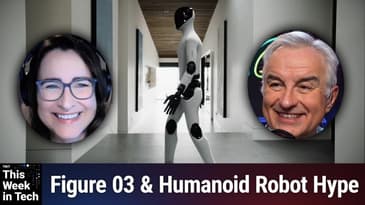
From internet service providers facing billion-dollar lawsuits for their users' file sharing to Amazon's smart displays turning into ad machines, the future of your connected life is up for grabs. If you want to know who's really pulling the strings in tech and where the battle lines are being drawn, this is the episode you can't miss.
- October Term 2025
- Supreme Court denies Google's request to pause Play Store changes while it appeals Epic case
- I Want A New Drug. A Vaccine Even. And A Functioning FDA, CDC, NIH, Etc...
- AI videos of dead celebrities are horrifying many of their families
- Amazon's giant ads have ruined the Echo Show
- Chat Control: Germany says NEIN
- Apple Banned an App That Simply Archived Videos of ICE Abuses
- China Flexed. Trump Hit Back. So Much for the Thaw.
- Taiwan sees no significant impact on chip sector from China rare earths curbs
- FCC Chair Brendan Carr says major US online retailers have removed several million listings for prohibited Chinese electronics as part of the agency's crackdown
- Windows 10 support ends October 14, but here's how to get an extra year for free
- California bans loud commercials on Netflix, Hulu, and other streaming services
- Synology Reverses Policy Banning Third-Party HDDs After NAS sales plummet
- TiVo Exiting Legacy DVR Business - Media Play News
- Introducing Figure 03
Host: Leo Laporte
Guests: Cathy Gellis, Jennifer Pattison Tuohy, and Gary Rivlin
Download or subscribe to This Week in Tech at https://twit.tv/shows/this-week-in-tech
Join Club TWiT for Ad-Free Podcasts!
Support what you love and get ad-free shows, a members-only Discord, and behind-the-scenes access. Join today: https://twit.tv/clubtwit
Sponsors:
[00:00:00] It's time for TWIT This Week in Tech. We have a fantastic panel for you. Gary Rivlin is here, the author of AI Valley. Kathy Gellis, our favorite attorney to talk about the Supreme Court. They just started their new term. And from The Verge, Jennifer Pattison-Tui. She's going to talk about robotic vacuum cleaners and the new figure three humanoid robot. We'll also talk about the Supreme Court and a couple of interesting cases, including one where Sony Music is suing an IAV.
[00:00:30] ASP saying they should have blocked all their users. They were stealing our music. And maybe some good news for chat control in the EU. All that and a whole lot more coming up next on TWIT. Podcasts you love. From people you trust. This is TWIT.
[00:00:59] This is TWIT This Week in Tech. Episode 1053, recorded Sunday, October 12th, 2025. Robotic Lap Trimmer. It's time for TWIT This Week in Tech, the show where we cover the week's tech news with always fascinating people. This week in particular is going to be great. Kathy Gellis is back, our attorney at law. Now a fellow at UC Law SF. Congratulations. And a writer, of course, for Tech Dirt.
[00:01:28] Always a pleasure to see you and your collection of beverages. Thank you. Usually you put a blanket over the beverage. I was like, there's nothing in there I'm embarrassed about. You can see that I'm hydrating. This is fine. Nor should there be. Kathy, we should mention, lives on a houseboat. So, of course, it's very important that she, I don't know, she keeps water around? I don't know. That doesn't make sense. Yeah, I'm going to water, you know, everywhere. Not a drop to drink. I got to have a bottle inside the shelf. You don't want to drink the San Francisco Bay water, that's for sure.
[00:01:57] Not in any respect, no. Also with us, Jennifer Patterson-Tui. She's a senior reviewer at The Verge. We love having her on. Regular also on our Tech News Weekly show with Micah Sargent. Always a pleasure to see you. Jennifer lives in a home that is wired in so many ways. So many ways. And your poor teenagers, they can't sneak out at any time.
[00:02:19] Oh, no. Never. I just got actually a new system set up that recognizes when my children comes home and decides whether to unlock the door for them or not. Oh, my God. Oh, my God. Is it using the new Apple key thing? Because that's why I'm very interested in that. Oh, the home key? No. Home key, yeah. It is. It's actually, I'm testing an ADT security system and they partnered with Google and it uses Google's familiar face recognition feature. Oh, isn't that nice?
[00:02:47] To determine if you're someone that's allowed in or not. Yeah, Ring has just announced they're going to be sending your face far and wide. We'll talk about that with Jennifer. Also here, a Pulitzer Prize winning author, Gary Rivlin. We first talked to him with his book, AI Valley, which is his most recent about AI, but he's written so many books, including Katrina. It's the 20th anniversary or was a couple of months ago. Did you do anything to commemorate it? You know, I moved on with AI and there was some activity.
[00:03:17] Actually, I thought the coverage was really good because they use that as a news hook to talk about Trump cutting FEMA and trying to kind of outsource it to the states. And the new FEMA director doesn't have the experience. After Katrina, they really had all these reforms. Who was it? Did a great job, Scotty? You did a great job. Browdy. Yeah. Scotty's Star Trek. Scotty's a different one. I can't stop the flooding. Okay. Yeah.
[00:03:47] Browdy. Anyway, it's great to see all three of you. Thank you all for being here. This makes it a particularly smart show, which is good because I'm bringing the IQ down. We can start with you, Kathy, because the Supreme Court, what is it? The second Tuesday in October? Is that what it is? I can't remember. The new session began. Well, yes. Except with the rocket docket, with the shadow docket, they're in session all year round, aren't they?
[00:04:17] There used to be sort of a, yes, there is sort of a system to this, and it's a regular and knowable and predictable system. And then there's this particular court, which doesn't, it is in some ways adhering to business as usual with the regular state thing. So, what's happening now is now we are into the normal process of granting cert petitions and hearing the cert petitions and reaching decisions on the merits.
[00:04:44] So, we're doing the normal stuff now where we're expecting to get normal-ridden decisions at some point later this year. That's great, I guess. I mean, other than it's, we're dreading what they're actually going to decide. But, you know, it's kind of moot because it's not really, you know, everything that they're doing now will probably suffer from down the road. But in the meantime, they're doing a whole bunch of things right now that are just really fundamental to our constitutional order.
[00:05:13] And they're just doing them with no explanations whatsoever on a timeline. That's the problem, isn't it, with the shadow docket is they don't have to write an opinion and they don't even, do they put their names on it? I guess there is a judge in charge of each district court, so. Only to some extent where the name is, there was an emergency appeal that went to one specific judge because in theory one is like kind of on duty for that circuit. But that's not the names in any sort of normal way.
[00:05:42] So we're only really it's anonymous. They're anonymous judge. You know, to some extent, anonymous decisions are a thing to some extent. Like if you see some decisions that are per curium, that tends to mean we all got together. We all agreed with this was the thing, but we're not ascribing it to any particular judge or justice from the court, from the court. So that's fine.
[00:06:08] But we're not even really getting that, because in that case, all the judges who would be represented by the per curium are kind of on the hook for it. It's just no one has to bear the front of any criticisms or praise one way or the other. But here it's even more vague than that. Nobody's really standing behind things unless they're doing a noted dissent.
[00:06:29] And Justice Jackson's been writing a whole bunch of really, really, I think, important memos to file for the future about what's going on right here. She's one of the three. I hate to say this because you're not supposed to be politicized, but liberal judges. I mean, conventionally, she was an appointee of this is fine. This is no nobody knows.
[00:06:52] This is not a controversial decision as opposed to the six who were nominated by Republican presidents. These are she's not supposed to be partisan, depending on who nominated you, obviously. But that doesn't seem to be holding true. I mean, historically, there's always been, you know, some tendencies for certain justices to have certain judicial traditions. That might inform their jurisprudence. And that could kind of vary a little bit, whether they were reddish or bluish, which is in some ways a shame.
[00:07:22] But on some hand, you know, you kind of want a diversity of thought as you're getting your jurors together. Right. The big problem now is that the conservative justices are really not even being conservative justices. If they were like there's decisions that they've done in the past where I can't imagine them ever doing them today, like the Bostock decision, which was, I think, a Justice Gorsuch decision. And that was one. And I'm forgetting a little bit.
[00:07:49] It was I think I think it was an LGBT case or something where those were the kinds of social values at issue. And, you know, he wasn't necessarily a fan of protecting those rights, but he looked at the statute and said, this is what we got to do. And that sort of sort of purity of like there's rules for these. And even though we don't like the result, there's a system and we really have to uphold the system. I don't think we would see those decisions now.
[00:08:16] And the problem with the shadow docket is it is the claim of certain forms of executive power that may not be sound. I mean, I think spoiler alert, they're not sound, but, you know, there's certainly a very strong whiff that there's a problem here. But there there's just sort of in this group of like, oh, it would be so bad if we inadvertently and joined a valid use of executive power.
[00:08:45] So they're just just it's all OK. It's all fine. That's my big question. And I'd love I'm great. We've got an expert here. It's like because I'm obviously not I did not grow up in this country. So what? Whole different world of West Virginia accent. And my husband, who is American, is always just going, oh, my God, we're just so. Screwed with this Supreme Court and what they're doing.
[00:09:14] And it's just our country is completely a mess. And, you know, and I'm like, really? I mean, don't we? Isn't the law the one thing that's still holding strong? And I know what we've seen from the Supreme Court in the last few years has been sort of disconcerting. But to ask an expert, like, are you genuinely concerned about the state of the current Supreme Court or do you feel like we are going to have that check is still balancing? I am deeply afraid.
[00:09:43] But there's a there's another writer named Chris Geidner who writes a lot. And he I agree with one of the arguments he keeps having on on social media, which is that things are bad does not mean that it's over. They've been bad before. Any student of history remembers the Dred Scott decision. Well, yeah, seven to two.
[00:10:07] It was OK to take a formerly enslaved man out of his state and bring him back to slavery. There's not a ton of comfort in that analogy because that analogy precipitated the Civil War. And we had a war over it. And Mr. DePix said, so I think the movie 12 Years a Slave was about, right? It it. Oh, I don't know. I don't think I ever saw the movie, but great movie. OK, sorry. Different slave. Same idea. Yeah. Same idea.
[00:10:37] Yeah. I mean, it was all bad. And there is. But you go back all the way through the history of the Supreme Court and there have been ebbs and flows. You know, I mean, it's well, yeah. And is this an ebb and flow or have we like? That's the question. Is this irreparable? Swung off the pendulum.
[00:10:54] So I think I mean, I think what I would say that this is the analogy is apt, but that doesn't help the hope because that analogy was so apt where the decisions that they were spitting out are so abominable.
[00:11:07] I mean, Trump v. U.S. was a Dred Scott quality decision because they were something that struck so deeply at the fundamental balance of how civil power is accorded to our governing officials and what license they have to do the governance with with an awful lot of power that we've bestowed upon them. And the tradeoff of giving them all this power is that power is also checked and it just uprooted all those checks.
[00:11:33] So the types of things that the court is doing is uprooting that fundamental balance. And what happened with Dred Scott was something that, again, struck so at the core of sort of the balance of freedom and humanity that might make a sustainable democracy work that then it collapsed. So then we fixed it and we fixed it by we had a war and then we had some constitutional amendments that were saying, OK, in case there was any ambiguity about how things worked before,
[00:11:59] we're going to do it differently this time to make sure that we can't go out of whack in that balance sort of way. Let me let me bring this back to the 21st century. So civil war does not feel that far away. It doesn't. And it doesn't. You know, I've been reading a lot about it lately because I feel like there are similarities. But let's not go down down that road. So they they did give certiorari to a number of cases.
[00:12:27] Are there any I want to kind of talk about tech primarily. Are there any that are tech related or copyright related? I know you've had amicus briefs. We should mention that Kathy is approved to file to to what to work in front of the Supreme Court. I am a member of the Supreme Court. She's a member. Well, and as opposed to Bill Clinton, who is not because after his fiasco, the Supreme Court disbarred him from their course.
[00:12:56] Oh, did they? I didn't. Oh, yeah. I think that was there wasn't a whole lot they could do to him, but they could do that. So, wow. Yeah, I did not know that. Yeah. Anyway, you can still file amicus briefs. In fact, if you wanted to, if I ever have a case there, I will be hiring you to represent me. God, hope I don't. What are we looking at on the October? They've announced a number of cases for cert.
[00:13:19] Yeah. So just to close where we were going before, it's very weird because I'm going to now talk about a very normal case. Official cases. It's going through the official process. It's reached their their desks. I'm really excited about it. I want to talk about it because this is the kind of case I've been working on my entire career as a free speech tech focused lawyer. So I got lots to say about it and lots to say about it.
[00:13:45] But we're dealing with this very weird world of I'm going to go. I'm putting that brief before the court and hoping that these esteemed people will rule, you know, in the way that I think truth, justice and the American way will will, you know, require. And it's the same people who are also doing all this stuff that's ending up being extremely destructive. That could just happen in the background. And not and I'm struggling arguments and written decisions and all of that. Yeah, I'm struggling with this.
[00:14:15] I'm going to talk a little bit and I'm going to start talking about the court and I'm going to talk about a couple of good precedents that they've done before, including recently. And this case is going to draw from and I'm going to speak with a lot of reverence towards some, you know, jurisprudence that they've been producing. And I'm going to say and we're I'm really excited about what kind of decision they're going to come up with. In other words, you're going to pretend things are normal. I'm going to pretend and the cognitive distance is starting to get to me.
[00:14:44] And I'm just putting that out there that that this is a thing. So anyway, back to normal. This is this is a case Cox Communications versus Sony Music Entertainment. It's very interesting that this is a major copyright case involving Sony. But this time, Sony is on the copyright holder side as opposed to Sony V Betamax from 1984.
[00:15:09] They were on the side of the people who wanted a freer hand to be able to use copyrighted works without liability. That's really kind of a very sad irony, but let's just note it. And this is a case involving file sharing. It's because what was happening is file sharing was happening. And there was these are the cases that came out of the rights corp fiasco, I would say.
[00:15:38] Rights Corp was engaged by a bunch of content owners to review what was going on online and send takedown notices. And so they were sending takedown notices, in this case, to a broadband ISP Cox Communications and saying that we've identified these IP addresses as file sharing works that they're not supposed to.
[00:15:58] And there was a whole bunch of litigation, including an earlier case called BMV versus Cox, where eventually some of the copyright holders sued Cox because they're like, dude, you're all your users are still file sharing our stuff. This is bad. You must be now liable for it. And which the Fourth Circuit agreed.
[00:16:17] The Fourth Circuit agreed. And what the Fourth Circuit agreed that was also troubling on the way was that there's supposed there's the DMCA, the Digital Millennium Copyright Act. That protects service providers, including broadband providers who are doing that throughput of how people are using the Internet.
[00:16:37] We think about it mostly in terms of the 512C safe harbor, which is the one where you see real takedown notices of that video on YouTube violates my copyright. So you, Google, need to take it down or else you'll potentially be liable for that infringement. And that's how the DMCA works. If the providers take the notices that there's something wrong and act upon them, then basically no harm, no foul.
[00:17:05] So even if there's infringement, they're not going to be on the hook for it. But Cox Communication, they're using a slightly different safe harbor. They're using the 512A safe harbor because they are they're a conduit provider. They're not storing stuff or they might be storing it, too. But in this faculty, they're just providing throughput.
[00:17:24] And they kept getting and I'm going to put quotes, takedown notices from the from Rights Corp and these copyright holders saying your users are file sharing our stuff. You need to take down the users because we're considering them repeat infringers that they keep doing it and you're doing nothing to stop it. And because Cox didn't really take down most of their users, they may have taken down some, but by and large, they didn't take down them.
[00:17:53] They lost their safe harbor. No DMCA protection for them whatsoever. So that was problem number one. And then problem number two is, oh, and you're totally sharing the liability for all the infringement of your users. Just because you knew it was happening. You're like, well, we you we told you it was happening and therefore you, quote unquote, knew and you're totally liable. You share in all the liability.
[00:18:16] Is it the case now that most Internet service providers ignore these requests from this is in this case, Sony Music, but ignore requests from rights holders that when there's file sharing going on, do they just go? Oh, yeah, fine. Well, one of the things that Cox pointed out of this is. I haven't heard of a takedown. I mean, an ISP used to be they disconnect people, right? They'd say you lose, you know, you're not going to you do this three times. Remember the three strikes and you're out. Yeah.
[00:18:41] Well, so there there has always been in the DMCA for as long as it's been on the books and it's been on the books since 1998. For as long as it's been on the books, one of the things that this that the providers have to they have to do a whole bunch of things in order to get their protection. And one of the things that they have to do is have a policy for disconnecting repeat infringers. And so in theory that. Well, nobody actually knows what that means.
[00:19:08] For a number of years, decades and decades. Basically, OK, the providers would have a policy about what to do hypothetically. Right. But they wouldn't actually but the statute didn't actually require termination. And I think for a very for several key reasons, which were showing up in our brief, one of which is every takedown demand or copyright infringement notice that they're getting is an allegation that there's an infringement.
[00:19:37] But that allegation may be wrong. There may be fair use. The person claiming it may not may not have a copyright. They may not be somebody on your Wi-Fi. It could not be. Maybe not you. Maybe. Yeah. Also made the point of they, you know, sometimes the IP address was for an entire coffee shop or university or, you know, and this idea that you would disconnect that user would might mean that you'd be disconnecting thousands of people. A university. Yeah. Or a household or roommates or neighbors or whatever.
[00:20:06] And so, like, there's some big problems with the idea that with this allegation, if you get more than one of them, you've got to disconnect anybody. That's bad. That is a big problem that you would be disconnecting people. What do you do if you get caught, cut, cut off from your broadband provider, which we don't have a whole lot of competition for? What do you do instead? You just cut people entirely off from the Internet. So that's a problem. And then the fact that the allegations that are prompting it may be unsound. These have never been adjudicated.
[00:20:35] I mean, yeah, sure. More likely than not, they might have been infringing. We don't know. They went from three strikes to six strikes because ISPs were really reluctant to cut off a subscriber for a variety of reasons. And the last thing I heard was in 2017, they abandoned the copyright alert system entirely. Like they just gave up. So I'm surprised that this is an ongoing thing.
[00:21:00] The music industry, for the most part, realized that suing its customers or cutting them off from the Internet was perhaps not the best way to keep customers happy. This is bad on any number of fronts. But the problem now the lawyers swooping in is there was that original BMV versus Cox case, which all of a sudden said no DMCA protection for you because you didn't terminate. And oh, by the way, you're potentially liable for all this harm.
[00:21:25] That case ended up getting settled, but it became it opened the door to a whole bunch of other cases. So that's why this is bad against both Cox itself and like every other broadband ISP in the United States, including last year, one against Verizon. So I need to move on because there's only a three hour show. But we will watch this. They've granted it cert, but they don't have an oral argument date set yet. So this is one of the things.
[00:21:53] We'll get the briefs from the other side shortly in another couple of weeks. I'm just surprised because a lot of this, I think, became irrelevant. I mean, sharing music when it was streaming and you could stream it from Spotify and Apple and all these other places. I'm surprised this is even a thing. Well, the law drags. I mean, this is litigation based on notices that I think were sent, you know, quite a few years ago now.
[00:22:21] So, I mean, some of it is there is a principle and it took a while to get here, including that there was a cert petition. This is actually interesting. There was a cert petition that went in from Cox. Actually, Cox had one and Sony had one. And this went in last year. And then what was interesting is the court looked at their petitions, asked the government, the solicitor general to weigh in. And at that point, it was still the Biden solicitor general. And I waited and waited and waited and waited.
[00:22:51] And there was no brief. Then Trump takes over and there's a new solicitor general. And finally, the brief goes in. The brief was clearly written by actual career lawyers who know a thing or two about copyright. But it ended up being a rather full throated defense of the First Amendment issues that are wrapped up in this entire thing. And it came from the Trump administration, who I think has no idea what they have just sent.
[00:23:15] But it helped grant cert for Cox, denied the cert questions for Sony. We should again repeat, lost in the lower court. Right. And so Cox appealed this saying, wait a minute, Your Honor, you know, Sony can't hold us liable for all of this. And they were granted cert based on the Trump solicitor's brief. So that's good. So this was good. You never know what's happening in the world. You never know. One other thing real quickly.
[00:23:43] Supreme Court denies Google's request to pause Play Store changes while it appeals the Epic case. So this means Google has till next week, 10 days to allow non-Play Store payments and external downlinks on the Google Play Store. That was also that was a shadow docket, I think. Right. Well, shadow docket is sort of what happens. So the shadow docket isn't inherently a bad thing.
[00:24:11] Sometimes things are going to break before the normal processing, normal process has a chance to catch up. But they granted a stay just kind of right. So it's an appeal to say that, oh, my gosh, you know, a bad thing is going to happen if we wait for the normal process before you would normally get to fix the bad thing. Right. So you want to you want to shadow docket to exist because you want to make sure that, like, OK, something is going to break and we want a way of a way of stopping that.
[00:24:40] The problem is that's supposed to be really exceptional relief. And here they're granting it for everything. And they're always granting it when it comes to something Trump wants to do. So that's the problem with it and not explaining it either. So October 22nd, Google is going to suddenly have to like this on the turn on a dime and open up the Play Store. There is another one that actually there was a shadow docket appeal off of U.S. off of Netchoice v.
[00:25:04] Fitch, which is one of the age gating cases that's coming out of Mississippi and Mississippi. And this has been upheld again on the shadow docket by the Supreme Court says you have to be 16 to use social media. Yeah. I mean, the Supreme Court was not that specific, but the law was enjoined at the district court. Then it got to the Fifth Circuit. The Fifth Circuit just said, nope, this law is sound and didn't.
[00:25:31] I don't think they've even necessarily produced a full decision. I don't think it's even gotten that far. Is this the scrutiny issue, whether it required strict scrutiny or not? It's a First Amendment issue, obviously. And the issue was whether, you know, this is no big deal. It's not really a violation of the First Amendment. I think that may be free speech versus Paxton. That was the Texas one. OK. But those issues do show up in these cases.
[00:26:00] But I think the problem is it went to the Fifth Circuit and it's not even been fully adjudicated by the Fifth Circuit. But the Fifth Circuit killed the injunction. So and then the law in effect, which put the law in effect. So there was an appeal to the shadow docket to say, time out, time out. Could we please have our stay so the injunction can go in effect? Because this really, you know, catastrophic First Amendment effect will be realized if we don't.
[00:26:26] And the Supreme Court, which wants to grant all the other petitions for emergency relief, said, nah, go ahead. We go ahead and put this law into effect. So so blue sky is not in Mississippi, for instance, because they can't. Well, it's been an issue for me. I run a Mastodon instance. Mastodon doesn't really provide any way that for me to say, how old are you and I'm not going to unilaterally at twit.social implement age, some sort of age gate system because there is no privacy respecting age gate system.
[00:26:56] So I all I did is say, if you're signing up, you better be 18. And that I mean, I'm sure that doesn't hold water, but it's it's the only thing I could do. This is why I do what I do, because everybody who's pushing for these rules and I point to a whole bunch of Democrats who still want to get to do it. Meta can do it. Facebook can do it. Reddit can do it. But what about little old Leo? Exactly. Exactly. Mastodon instance.
[00:27:25] People are mad at the companies. You know, people are going to be mad at Google. Go be mad at Facebook because they're doing a lot. It's like, dude, why? What are you thinking? But the problem is they if anybody can cope, it's them. And it's not about them. It is about you. It is about me. It is about tech dirt. It is about a Mastodon administrators. It's about Blue Sky. It's about everybody else helping, making sure that we can talk to each other.
[00:27:52] And the idea that we are going to impose all this liability on the people who help us speak to each other is nuts. There's no way that the First Amendment could stand for this. And yet we are doing it to ourselves. And there's a whole bunch of courts and political leaders on both sides of the aisle who think this is a great, a great thing for us to be doing.
[00:28:10] It is really important that you tell your story, Leo, because they are forgetting that every time they propose a law like COSA, they are talking about what you do and how what you do affects how your audience can form a community. I don't want to mess up any teenagers, believe me. But at the same time, I don't want to have to ask every single user of my Mastodon instance for government ID and then be responsible for protecting that data. It's just it's it's untenable.
[00:28:39] And there's no there's no good system to do it anyway, even if there was. The technology, there's also being a lot of snake oil of like, oh, yes, we just add this technology and you'll solve this problem. No, there's there's no technology. Look right. Yeah, you look like you're 16. And then you get something like Discord, which just had a big data breach that people's scanned IDs were there. And that creates a whole other vector of harm. Yeah, yeah. Discord was doing this.
[00:29:03] I remember telling you about this the last time I was on is that my son walked into my room about three weeks ago, four weeks ago and said, Mom, TikTok wants me to scan my driver's license. Shall I do that? No, no, no, no, no. So, yeah. Well, at least he's not riding the subway trains. We'll talk about it. Yeah, but we're encouraging other unhealthy behavior. We're forcing it. This is problematic. Hey, we got to take a break. We got to take a break. But we'll have more. I want to give Gary and Jennifer a chance to talk to.
[00:29:32] So enough court talk. I'm sure there's much more we could say about this. We should just do a whole show at some point with you, Kathy, about the Supreme Court. This week in Scotus. This week in Scotus. Yeah, there's something about that. This isn't very, very true. I'll squeeze in a little bit more. It's going to be banned in Mississippi. It's going to be banned in Mississippi. I'll squeeze in a little bit more law just to, you know, keep to my shtick. You can squeeze in a little more. Yeah, yeah. Yeah.
[00:30:01] But I'm thrilled to have you, of course, Kathy. And by the way, just a little commiseration. Kathy published a piece yesterday in TechDirt, a day before yesterday, saying that your ovarian cancer has returned. And I'm very sorry to hear that. Yeah. Especially, as you say, without a functioning FDA, CDC, and NIH. Yeah. The gist of that post is it's kind of exciting to be a cancer patient because the science
[00:30:29] that was building up to finding cures was just really fascinating. And the idea that if I can just hold on long enough, this could be cured is a very palpable, you know, future within five to 10 years. I just have to get to five to 10 years. Right. And meanwhile, we're now exercising a lot of public policy that's just crashing into the wall. And that's a little bit terrifying.
[00:30:52] MRNA, very positive prospects for an MRNA anti-cancer vaccine. But the government has just withdrawn hundreds of millions of dollars for MRNA funding because RFK Jr. thinks, I don't know, it turns you into a lizard. I don't know. He's nonsense. It's just nonsense. Anyway. The worm in his brain didn't like it. The worm didn't like it. So, but this is the point is that has a concrete, real impact on people like you, Kathy, who
[00:31:22] are currently suffering from cancer, who are hoping for, you know, some of these breakthroughs and to suddenly hear, yeah, maybe the research will come back with the next administration, but it might be too late for you. And that's terrible. It might be too late. And these things take a long time to cook. I mean, every trial, every experiment, even if the experiment happened that day, takes prep time and research time. And then if you've got a lab and something's getting cultured and, or you give a treatment, you know, my treatment is going to take months and months.
[00:31:49] And they, even if they gave me something new and experimental, they need at least six months to see if it worked. And then they got to follow me to see if it stayed working. And it takes time. So every time you interrupted, you know, it's not like you just lose the amount of time that pause was pressed. You end up, you sometimes lose something much more fundamental cultures, research things, just stuff that you'll never get back. Yeah. Anyway, I'm sorry that it's back. I wish you the best. I mean, it's not over by any means.
[00:32:19] They treat it as a chronic condition and I'm exercising as much as I can, trying to be normal as much as I can. And drinking as many, hydrating, they recommend that. So yeah, I want to be as normal as possible and continue to do the advocacy that I do. And thanks for having my show, even though I'm decrepit, but you're far from decrepit, but you know, so this will be a story now and later, but I'm trying to do the best I can.
[00:32:49] And it's, and thank you for letting me be normal. So yeah. Good. Yeah. It's wonderful to have you on as always. And Jennifer Patterson-Tui and Gary Rivlin. And we will talk about other things in just a moment, but first a word from our sponsor, this portion of this week in tech brought to you by Brickhouse Nutrition's fields of greens. And it's something I've been deliciously enjoying for some time now. Think of it kind of as a hard reset. You know, a reset on your computer brings it back to factory settings.
[00:33:18] You know, that's often the best thing to do, especially if you're running Windows. It's just to start over, right? Well, in a way, this is a smart reset of your health. Get you back to factory settings with your health too. And field of greens, we know this works because they did a sizable, a very impressive biological age study with Auburn University. This was a double blind study. The goal was to see if taking field of greens daily could slow down test subjects aging.
[00:33:47] By the way, I've been taking this for some time and I just got a report from my aura ring that I am now four years younger than I ought to be. I'm four years younger than my chronological age. I don't know if it's field of greens, but that's pretty good news. Slowing the rate at which your body ages generally means you're going to live longer. You're going to live healthier. And they've designed this to do that. Every fruit and vegetable and field of greens was, and by the way, it's founded by a doctor, medically selected for specific health benefits.
[00:34:17] For me, it's important. It's 100% organic. And they have, it's interesting if you read the label and I encourage you to do that. You can do it on the website. It's a little fine print here. I don't know if you can read it here, but on the website, it's very clear. Every one of the ingredients in here is designed to do a specific thing. There's a heart health group. There's a cells group, lungs, kidney, liver health, even a metabolism group for healthy weight. So here's how the study at Auburn worked.
[00:34:45] The biological study participants did all the blood work, all the pre-testing. Some learned that they were aging too quickly, that their age was, their physical age was older than their chronological age. That's scary. Now, this is what I love about this. They were told, don't do, don't change your lifestyle in any way. Eat exactly as you have been. If you drink, fine. If you don't exercise, fine. We don't want any other variables.
[00:35:14] All we're going to do is have two groups, one taking a placebo and one doing field of greens. And the results were remarkable. The group that added field of greens literally slowed how fast their bodies were aging. Their physical age started to get younger than their chronological age. I mean, imagine how that might make you feel and how it might make you feel and feel.
[00:35:39] And look, I tell you what, I just want to show you how delicious this is. This is the other thing. Because a lot of times when you say, oh, this is something that's good for you, people go, yeah, broccoli's in this? No, I'm not going to. It doesn't taste like broccoli. I'm going to do, they have a lot of different flavors. This is the wild berry flavor. You do a scoop once a day or two. I like it so much. I actually do two a day because it tastes really great. There's my scoop. I'm going to put it in the field of greens shaker.
[00:36:08] I do it with cold water. You could do it in tea. You could do it in any beverage, soup, whatever you want to put it into. You know what I've been tempted to do? I make little protein snacks. I think it'd be good to put it in the protein snacks. It tastes fantastic. But let me prove it to you. I'm going to shake it up and pour it out. It's a little green juice. There you go. Look at that. That's pretty. That's all the vegetables in there. There's a lot of good stuff in there.
[00:36:38] Oh, I haven't done the wild berry yet. That's delicious. Hmm. This is good. If I get a little peppier during the show, it's because I'm getting younger as we speak. Check out the university study. Get 20% off. Use the promo code TWIT at fieldofgreens.com. That's fieldofgreens.com. And the promo code is TWIT. Here's to your good health. Field of Greens from Brickhouse Nutrition. Hmm.
[00:37:09] That's delicious. I'll send you a case if you want, Kathy. You could add it to your hydration routine. Put it in the La Croix. It'd be delicious in your La Croix. All right. Continuing on with the stories. I don't know. Every once in a while, my mouse decides to give up. I hate it when that happens.
[00:37:34] I've been reading mouse studies, like mouse studies about the effect of exercise. Really? Yeah. I read one that was about an mRNA vaccine potential for ovarian cancer. And I read one. I'm on a drug now that has a lot of side effects, like cardiomyopathy. And I was reading about. That you do not want. They noticed that. Yeah, I do not want that.
[00:37:59] But so they had some mouse studies about how did the mice fare if they exercised and including like if they went on their wheel before they got the drug, they seem to do a little bit better. So I like you and your mouse. Whenever I go on my wheel, I feel great. I just drink a little field of greens and I get on the wheel and I spin forever. Yeah. So my thanks to the mice that are serving us. I do exercise a lot and trying to keep my muscle mass up. That's the issue as you get old.
[00:38:29] Let's talk AI. That's much more interesting. The other way humanity is going to end. The other end of humanity. Gary wrote a fantastic book, by the way, about AI, which I highly, highly recommend. If you're looking for a little something to read, I highly recommend it. But I wanted to ask you, Gary, if you you're keeping up with the AI thing, right, that you've wrote the AI Valley.
[00:38:53] It's over Microsoft, Google and the trillion dollar race to cash in on an artificial intelligence. One of the big companies, of course, besides Microsoft and Google is OpenAI. They're getting a lot of attention now. They just announced that they have what is it? 800 million. 800 million. Yeah. Yeah. Is that key? Keeping up by 800 million users a week. Monthly active users? No, weekly. Weekly. Holy cow. Per week. Yeah.
[00:39:19] I mean, we could criticize OpenAI and hopefully during the show we will. But, you know, it truly is an amazing company. I mean, it's 10 years old. It now has a valuation of a half a trillion dollars, which ranks it in one of the 20 most valuable companies on earth. Three years ago made virtually no revenue. Now it's bringing in like 12, 13, 14 billion dollars a year. So it's on pace to bring on to bring 12, 13 billion.
[00:39:49] I mean, its problem is it's spending more than that. So it's still losing. Well, that's the issue, right? In fact, I just read a from Platformnomics, a newsletter. This is Charles Fitzgerald. They don't have the money. He does a little math and it is, you know, their run rate is so high that it doesn't matter how much they raise. Right. And on top of that, like we keep, oh, I'm going to spend 100 billion dollars for these set of data centers. I'm going to spend, you know, some of that's partnerships, some of that's money from others.
[00:40:18] Well, and some of it's round trip money, right? The buying chips from NVIDIA, which then NVIDIA then gives them the money for to build. It's like nobody, it's kind of a net zero change. Right. NVIDIA is invested in hundreds of AI startups. And yes, it's. And the requirement is that they buy NVIDIA chips. That's how people are, people are using it. But, you know, just to continue on open AI, like obviously chat CPT, they have models for image, for video, et cetera.
[00:40:45] But, you know, it reminds me, so I covered Google in the mid 2000s for the New York Times. And I read this article about like move over Microsoft. It's Google. Everyone wants to hate. You know, they're hiring up all the engineers. You were a little ahead of your time, but you were absolutely right now. It's true. And, you know, they're like just kind of moving, you know, startups were scared to pitch them, you know, for potential as partnership or for acquisition because they would just do it. Why don't we just do it? And I see the line I love from that article was like someone said, yeah, they just want
[00:41:15] you to drive your Google to the Google to fill up with more Google. And I'm kind of feeling that about open AI where it's browsers. It's AI search. It's chips. It's some device with Johnny Ivy. I mean, like they are involved in pretty much social media. You know, they just came out with a, you know, with with a. Sora. Oh, my God. I can't stop playing with it. So that's the end of civilization. Fastest growing consumer application in history. Right. Chat GPT.
[00:41:46] Biggest, most valuable startup ever. Half trillion dollar valuation. You mentioned that. Raising more money than anybody's ever raised before. All of that looks good until you realize that they probably lose money on every single transaction. Well, I remember it was about six months ago. They had this, you know, the $200 a month subscription rather than $20 a month that most consumers, if they pay for it, are paying most. By the way, of the 800 million, most people are using it for free.
[00:42:14] But, you know, they were losing money even on the $200 a month because it's, you know, the compute, the amount of computer time you need is it's so voracious and stuff. So, you know, they raised, I think it was $40 billion, which is the biggest raise ever by a startup. Yes. 60. Well, I think that was 40 plus 20. Yeah. Okay. So total is 60. I think so. But you might be right. But the point is they still have to raise a lot more.
[00:42:44] They need a trillion. He said a trillion. We need a trillion. Well, Dario Mote, the CEO of Anthropic, they do Claude, you know, he says that, you know, he's going to need a hundred billion dollars to train one of these models. And so, you know, it's like they are raising money and it's amazing. They have a great valuation. But like, okay, if you're worth a half a trillion dollars now, what are you going to be worth on your next raise and your next raise and your next raise?
[00:43:13] So, yeah, I don't know how this plays out. I started this book thinking in 2022, the end of 2022, like I'm looking who's going to be the next Google, who's going to be the next Facebook. I think the next Google is Google. I think the next, you know, Facebook or Meta is Meta because they have the cash to do it. Maybe OpenAI breaks in, maybe Anthropic. But, you know, it's sort of this is a game of giants. You know, Google has a hundred billion dollars in cash laying around. You know, they don't have to raise it.
[00:43:42] They just have to kind of lean over and, you know, grab their cash kind of thing. And so, you know, I do think the salaries for these engineers, which are going up into the hundreds of millions of dollars for the top, top, top, the billions it costs to train, to operate these things and the data. I mean, you know, you need access to a ton of data that Google has and OpenAI now has. But now, I mean, the rumors or not rumors. I mean, they've said outright, haven't they, that they're going to start putting advertising
[00:44:12] in to. But will that even be enough? I mean, I wonder. Yeah. Is that going to sort of move the needle a little? Especially since they're now having to make deals with content companies, right? Like they have to buy the training data now all of a sudden. Anthropic's paying one and a half billion dollars to a handful of authors because they illegally use their books. But some of that is not necessarily because the law is requiring it. Like we really don't have. No, they're making the deal.
[00:44:37] Well, the issue, like the big one, and I think it was BART's was the biggest one where the live, that decision actually found that there's probably a strong fair use claim for the training. The issue was, what did they train on? They trained on stuff that they file shared. And so a lot of what they're purchasing is essentially just access to the stuff so that they don't run into the liability for how do they get the stuff that they're training on? And then it becomes a big deal because what money is collected?
[00:45:06] How is that distributed? And to whom is it distributed in terms of creators? And there's a lot of inequitability that's going here. But what they're paying now is not necessarily because they want to train on it. It's mostly because they want to get access to it to be able to train on it. We talk about this, of course, we have a Wednesday show, Intelligent Machines. It's all about AI. We talk about it. In fact, that's where I first met Gary. So we don't need to go in great depth, but just to kind of summarize this.
[00:45:36] You've got a number of companies doing this at great expense. There may be further expenses paying for the content. They're actually running out of stuff. I mean, they've kind of consumed the entire internet. Now they're making artificial content trying to add to the base. And then there's the environmental impact, which is massive. It's hard. You know, the argument I often have is, yeah, something like 1.1% of our nation's energy budget
[00:46:05] goes to AI right now. But that's 1%. I mean, there's still 99% that is doing all sorts of other stuff, including Google searches and all the other things that we kind of depend on these days. So I'm not sure of the energy. We've got an energy problem in general, period. It may be that AI encourages the use of renewables of less expensive forms of energy. Although I just saw an article that says that we're doing more coal than ever before because
[00:46:35] of these network centers. Well, and the Trump factor that Silicon Valley generally supports Trump or the leaders of Silicon Valley. But he's just cut off subsidies for wind and solar. And 80% of the increased capacity in recent last few years has been wind and solar. But that's what I think maybe is positive is that there is going to be increasing pressure from Silicon Valley to bring that back because they need it, right?
[00:47:03] Yeah, I can't rely on natural gas and coal for much longer. Well, but you can keep on you can revive mothballed coal plants, which they're doing. You can extend the life of coal plants, which they had an expire date that they're now extending because of these days. Same with nuclear, right? Yeah. Well, yes, with nuclear kind of old nuclear. They're coming up with kind of new nuclear plants. But that's years and years away.
[00:47:30] I think the real issue is kind of this in between moment that we are, you know, unfortunately, as a country pausing wind and solar, nuclear and other. Kind of bad timing for that. Yeah, you think? And then, you know, and then we have, you know, nuclear coming, but down the road. And so I think what's going to happen is we're going to have a lot more reliance on coal and gas. Gas is cheap. And so, in fact, Musk, you know, he built, you know, a couple of dozen, few dozen gas turbines to power XAI, his Colossus thing.
[00:47:59] And so I think we're going to see a lot more of that. So, you know, let's give Silicon Valley credit. They've given lip service to, you know, carbon neutral, Meta, Google, Microsoft, Amazon. They all talked about going carbon neutral. But like, oh, wait a second. We can make trillions of dollars on AI. And suddenly like, yeah, but we need coal plants to do that. We need gas plants to do that. Because they're in such a hurry, I think, right? If they were, if they weren't in such a hurry, they could. It's an arm's race.
[00:48:26] So the other side of that is there is definite, definitely genuine value being created. I mean, chat GPT is a success because people are enjoying it. And I think with vibe coding, it's pretty clear that there is a lot of coding going on that companies are finding valuable. Almost every company I know of is incorporating AI into their business plans, rightly or wrongly. So there is an upside. Yeah, no, I think AI is amazing.
[00:48:55] I use it every day, all day, you know, to help me with work as an editor, as a research assistant, read this interview. Did I leave out any salient points? You know, there's many, many, many uses. You know, the enterprise, like, you know, this, you know, 2025 is supposed to be the year of the AI agent. Like, but they still can't do very much. No, what people are mostly into at this point is making stupid videos. Sora, immediately the number one app on the App Store.
[00:49:23] Have you, any of you, I'm ashamed to say I have played with it extensively. Have any of you? I mean, I've used it, but that's almost my point that it's just like, yeah, you can make a funny video. You could, you know, use this as a large language model. This seems like a waste of power, doesn't it? I love it. Yeah, that's me and Sam Altman doing a TikTok dance together. Well, that would have saved me. I spent the whole day with my daughters trying to actually do a TikTok dance. No, no, no.
[00:49:52] Yeah, you don't have to do one. I should have just generated it artificially. Yeah, that's the beauty of it. Much easier, much easier. There is an issue. If you go to Sora, you will notice there are a lot of videos of famous people. For instance, Martin Luther King, very popular. I find this kind of offensive. This is Martin Luther King saying, well. He asked for content violation. So does Robin Williams' daughter.
[00:50:19] A Sora AI will listen to us and stop flagging us for content violation. That is kind of awful, if you ask me. And yes, Robin Williams' daughter is furious. Yeah. So, by the way, OpenAI says, oh, oh, sorry. This is from the Washington Post. AI videos of dead celebrities are horrifying many of their families.
[00:50:44] He's chat GPT maker OpenAI is trying to give people, rights holders, the estate, a chance to say stop. Here's the problem with that. So I have no problems with us as human beings deciding that this is gross and disgusting and should not be tolerated. It's appalling to see Martin Luther King used that way. I think that's just appalling. But it's a separate thing to say that law gets to say no to it.
[00:51:12] And let's just have the sort of thought experiment here about, like, what is different between doing one of these videos and having a President's Day sale where somebody is dressed up as Abe Lincoln selling cars? Or having the President of the United States selling watches in the Oval Office. Oh, wait a minute. Never mind. You're fighting my hypolio. That's a whole other kettle of fish.
[00:51:39] But I think that's the thing of, like, we do. There is something actually legitimate about using memes that we understand in our world. Like, memes are who we understand. We're significant people. Like, you want to use this as the vocabulary to say new things. True. That has to be legal. And that is not inherently invalid. In some ways, it's actually extremely valuable. On the other hand, there's something gross. But when we do it in, like, the MLK way of it.
[00:52:07] What you're talking about here is law versus norms. Exactly. And we need most of the things that we want in the world are enforced by norms. Like, we look at it. And we go, don't be doing that with Martin Luther King. That's horrible. And in theory, that would carry some weight. But what we're also seeing is the collapse of norms. Like, they're not working anymore.
[00:52:34] And if you see Abe Lincoln dressed up on the side of the road outside a mattress shop, you know it's not Abe Lincoln. No, it must be President's Day sale. But when you watch a Robin Williams video and you're a 12-year-old and you don't know that he's dead and you see him saying something, you believe it because it looks so bloody real. That's the differentiation here between what's real and what's not real. That line is disappearing. That's a good point. But I have to agree with Kathy. Like, so we outlaw it? I mean, like, that's the problem.
[00:53:03] We always want to use the law as the solution. And, like, what are we going to outlaw? You can't use Martin Luther King in this way, but you could use him in that way? Yeah. So I just want to note that every time we talk about the estate having rights, every time you use the word rights, you've left the normative discussion and you're now in the legal discussion. And I think the big thing here is what do we want the norms to be? Like, is there some like what Jennifer is saying?
[00:53:28] Like, is there something different where MLK is a much more recent person than a Blinken? Like, is there sort of a time like we could have a really interesting discussion of what the norm should be between this being sure fine versus look. But every time we say and that somebody should have the right to say no to it, somebody has the power of some law to say no to it. That's a whole separate thing. And, yes, now Gary is on my side. We should not do that.
[00:53:55] I, by the way, on Sora, you know, they call your avatar a cameo. When you first sign up for it, you pose, you turn your head and you say three random numbers. And then they've got your image and you saw it looked pretty good of me and your voice. And you can say, you can get permission for, you can say only I can use that. Only people I know can use that. I decided, Kathy, tell me if I'm nuts to make it, anybody can use it. You're nuts, Leo. Well, you know why I did that, Jennifer?
[00:54:26] Because you're nuts. No, because it's basically because people are going to do it anyway. So if I've said, okay, then the theory in my head anyway is, well, nothing you see about me can be believable. And I think that it's plausible deniability, even if it really was real. But I think that's what you have to teach your 12-year-old Jennifer is don't believe what you see. She already doesn't. That's the scary thing, though. She doesn't believe anything. Right.
[00:54:56] That, you know, and that's, you know, there's a fun line. Well, then we have to teach people how to vet stuff so that you know what you can't believe. That's what I've been trying to do. You know, reliable sources, although that gets harder and harder on a daily basis. You know, where it's coming from. I mean, but now anything you see online is automatically, in her mind, something she can't trust. Which means that online is everything now. There is very little else.
[00:55:21] And so that fine line between understanding, you know, what's happening in the world and getting information that's valuable to you versus it's just all entertainment and nothing is real is pretty terrifying. You know, I'm old enough to remember when, you know, Adobe came out and like, you know, manipulating images and then we're having the same conversation. Like, wow, can you trust anything? Yeah. Photoshop. What is a photo? But this does feel profoundly different. I don't know if it's video.
[00:55:51] I don't know if AI just makes it so easy. I don't know if there's the power of seeing a human being saying words and who are you going to believe what you see with your eyes. Right. Of course, you're going to believe what you see with your eyes. But it does seem different. Even though we've had this conversation before, even though we survive Photoshop and similar technologies, I'm much more worried about this moment. I have a 13-year-old, same exact thing. You know, it's not that he's gullible. It's that he trusts nothing. Right. Nothing is real anymore.
[00:56:20] And that's, yeah, a little terrifying for this generation because they're especially, you know, this generation, the COVID generation, which kind of grew up very much in online, the online generation. And now having this innate hostility towards information is, you know, creating a real kind of vacuum for children. And it's, I've tried, you know, I try very hard to sort of help her.
[00:56:48] I mean, I've actually subscribed her to the Week magazine. Good for you. I did the same for my kids back when the Week first came out. That's great. You need to start reading some, like, print media. You know, I mean, not that you can always innately trust all media, but there is, you know, there's just this balance has become so skewed that you can't, you know, the idea that nothing you find online you can believe anymore. Because, sorry, there's a rather large plane going overhead. I don't know. I believe you. I believe you.
[00:57:18] I know. That's real. We can see that. I'm sure it's not the Queen of England being raptured because I saw it. I swear to God, I saw this in a video somewhere. Have you been fooled? Have anyone here been fooled by an AI video? I just see. How do you respond to the recent criticism about it? You know what? I'm sick of you, guys. All right. Now, here's a question. That's a meme. You know, the rapture meme. Everybody with the TikTok rapture. It's the Queen of England recently passed.
[00:57:48] That seems like that's okay somehow. Maybe because it's so unbelievable. Yeah. It has a satiric value is more obvious. But on the other hand, really good satire. Sometimes it's very valuable, but it's not as obvious. And that's why it's valuable. Well, and the Washington Post gives it as an example of video that showed police body camera footage of Whitney Houston intoxicated, which is fake. But it's made credible because it's a body cam. You kind of believe it.
[00:58:17] And I could see you posted that on Blue Sky or Twitter or X and somebody might say it. I could believe that. So I think one of the issues is less the medium itself and something that is a different problem that's also been brewing, which is who do we trust and the voices that we trust? And I think we're seeing a great re-scrambling of who has credibility to speak to us in society. We've sort of lost mass media, which used to be sort of trusted vectors of information.
[00:58:47] The problem now is it's very civic driven. But I think there's going to be a great reshuffling as we figure out who are the credible voices to continue to give us a steady stream of who's going to talk about the court well, who's going to be able to talk about this topic well. But maybe that's not entirely a bad thing. I feel like it's good for us as humans. I think if we can manage to recognize the problem and work through it, I think this is almost
[00:59:12] like good because I think the old structures were starting to break and we sort of needed to shuffle things around and figure out who's really worth the credibility. But I think not just because of the tech, but also consider some of these political discussions that are going that a lot of people that we were turning to to be voices that, well, whatever they tell us can be trusted, that ended up not being as true as we thought it was. But that's what I mean about norms, right? Norms faded, failed.
[00:59:41] But on the other hand, with the Internet and the opportunity to bring new voices together, we can build something new. Who needs CBS if all of a sudden, you know, TV is actually a more responsible vector. That's my plug for what we do is that we are independent. We're not regulated by any government agency. And we live on the, you know, the support of our audience.
[01:00:08] I think that that's and we're and we're visibly human, although that may be hard to tell in the future. I don't know. You did just post an AI representation of you dancing with Sam Maltman. That's real. No, no, that really happened. Yeah. No, I'm kidding. Somebody in the YouTube chat, 222, said, what happens when we start seeing these in court? In fact, we've seen pleadings with AI generated fake references.
[01:00:38] We're up to more than 35, by the way. So someone keeps count. And there's 35 or 36, last time I checked, filings that had at least one made up. That got caught. And that's the scary thing, right? No, I think the scary thing is after the first or second time a lawyer got caught. They didn't stop. Just click. Just make sure it exists. Don't do it. That's the scary part. The penalties are starting to get a lot more serious. But what about a video?
[01:01:07] What if I brought in as a plaintiff a video of me getting, you know, driving my car and somebody hit me and it's a made up video? The jury might believe it. This is this is an issue that isn't getting a lot of attention. I mean, let's be clear. That violates the rules. And whoever does it, if they get caught, will be in trouble. The question is whether they would get caught or not. But on the other hand, if you handed your video over to if the other side could afford forensic analysis, they might be able to suss this out.
[01:01:35] So you're you're still taking a big chance if you do some nonsense like that. But it's on the table as the type of nonsense that can now happen, is now happening. And we may be under discussing in terms of being able to suss it out and police for it. But there was an interesting. So actually, so getting back to my snazzy new my snazzy new fellowship. One of the things I have done with the school is I do a CLE.
[01:02:02] Well, I did it as a CLE for lawyers, but I've also done it for law school classes on doing legal ethics and A.I. Because there's a whole bunch of people running in and say there is nothing but good if lawyers start using A.I. in their practices. And this is just not the case. There are so many minefields to to so many landmines to trigger. So I do a kind of a one hour class on here's all the minefields. Be really, really, really careful.
[01:02:30] Yeah, lawyers should be taught this. I mean, presumably. Yeah. I mean, there are two. Well, there's ethics rules that not just in terms of being a good person, being a not good person. There's actual rules that govern how we do our job and what we need to do. You're not supposed to lie to the judge. Right. But things like that. Yeah. But one of the things I thought was interesting is like there's two. Actually, there is somebody who's tracking these.
[01:02:55] I don't have the URL at hand, but there's somebody who is actually keeping track of all the hallucinating cases. But one of the cases I thought was interesting was the other side asked for fees for the one side submitted hallucinated cases. And the other side didn't get fees for having to deal with it because the court was mad that when you discovered surely you discovered that these cases were bogus. Why didn't you bring it to the court's attention?
[01:03:24] So they may actually be creating a duty for lawyers to do their own policing and make sure that, you know, if you were the side who got injured by your opponent's brief full of all this garbage, you may have an actual obligation under your own license to to bring it to the court's attention. Or at least if you want to make sure that you're compensated for the extra work you had to do as a result.
[01:03:49] So Zelda Williams, Robin Williams' daughter posted on Instagram to please stop sending me AI videos of dad. And you really have to when she says that you just have to your heart has to ache for her. Apparently, OpenAI has decided that it's OK with historical figures, even though they don't really. He's the queen of England, a historical figure. I guess she is. Is Robin Williams? I guess so. I don't know.
[01:04:15] You can't use Robin Williams in a commercial without paying his estate. He has, you know, there are rights there. Well, it's the right of publicity. And there's an open question of whether that should actually last beyond life. It makes sense during life. Yeah. I mean, the thing that you're trying to protect against, you know. So I better not die is what you're saying, because I have now posted my cameo in public. Well, you're taking field of green.
[01:04:45] Don't worry. Oh, yeah. That's right. I'm not going to die. I got plenty of green juice left. You know, come to think of it, there's 100,000 hours of me on the Internet right now, which almost certainly have been ingested by every AI out there. Valuable stuff. No doubt. Well, it's not valuable, but I'm just saying it's not going to be anything I can fight. I'm just thinking about how lucky I was that I was able to actually meet you in person in your studio. But now that you don't have the studio anymore, there's no way to verify that you are in fact the real deal.
[01:05:15] It's interesting, isn't it? Nobody has seen me in the real world in a year and a half now. Yeah. Well done, Sam Altman. This is very lifelike. Jennifer, go ahead. I had an interesting sort of experience trying to deal with AI recently because one of the problems, you know, as we're talking about whether people are understanding what's real and what's not anymore, is my son is going through the process of applying to colleges. So he's filling out the Common App and you have to write a person's essay.
[01:05:45] And there's lots of advice out there everywhere, TikTok, online for, you know, how to do your essay. But one of the big things I started to see is that people saying that the essays just don't matter anymore. Because they're generated. They don't, the colleges don't trust them because they think everyone's using AI. Right. And it's like, so you're sort of basically taking away this valuable element for like my son wrote a really great essay.
[01:06:13] And I'm like, the idea that it's just going to be dismissed because it could have been written by AI. Now, that kind of, you know, taking away that creativity from people because it's like, well, you probably just used AI in some way. You know, and this is true for everything now, for books and movies and films. Like Taylor Swift's in trouble because she probably, she maybe used some AI in one of her videos.
[01:06:34] And like, you just, I don't know, this is an area of being a writer myself where I feel we're kind of losing, you know, when you're losing that value of genuine creativity with everyone creating everything using AI or everyone assuming everything is being created with AI. I would, I would, I have an 11th grader, so I'll be going through this next year. Start now. Start now. But I would break it down into two components.
[01:07:02] One is, okay, the craft of writing. Okay. Even if you're not a great writer, you can present a terrific, a well-written essay. But what's the idea? What is your child trying to convey? I had this challenge. Like there is this element, there is this idea like, oh, well, I could use a Sora or whatever to make a Martin Scorsese movie. Like, no, you have to come up with the idea. You have to have the characters. You have to have the plot devices.
[01:07:30] And like, there still is a human element to all of this stuff. You have to have the idea. This is an amazing, it's a co-pilot. It's an assistant. It's a tool, you know? And so this tool can amplify your intelligence. It can make you look like a good writer. It can make you a much better coder than you are, whatever it is. But it's still the human brain that's coming up with the essential idea. And so maybe the college, you know, admissions officer is like, oh, this is really well-written. Like, okay, I can't trust that anymore.
[01:07:57] But, you know, what is this kid trying to tell me about it? I'm just making this up. What's the challenge you faced? I mean, there's just a few questions I guess you would answer in a college essay. And so, you know, I don't know. I guess I would break it into two component parts. There is still the human element, the originality, and that is still necessary to create something of quality. There's also the issue of the false positive.
[01:08:21] People are using tools to detect AI that don't work very well and that often flag non-AI stuff as AI, which is why the colleges are saying we can't. I want to ask the question, though, to, I mean, we've got a whole bunch of writers here today. Do you think that it's possible to tell whether it's an AI-driven essay or not? And I say this. And even if you can now, maybe tomorrow you won't be able to. It's the same thing with Sora videos.
[01:08:51] People say, oh, I know what's in it. But maybe not tomorrow. The best arguments I've seen by some of the evangelists, like trying to get AI used in the legal world, is that there's actually some kind of writing where as long as you could actually trust it to produce a valid result, the writing doesn't matter enough. So you might as well get AI to do it. Honestly. You don't need something where you bring more of the humanity and soul to the writing. It's a misuse of AI if you're getting phony citations, to be honest. You can do it in a way that you don't get that. But there's a whole bunch of things. And I agree with you.
[01:09:21] It's boilerplate in most cases, right? No, Cathy's on to a good point. Like what AI is good at right now, writing, well, let's stick with writing, is formulaic stuff. If I was writing press releases for a business for a living, I'd be really, really. Or sports stories, right? Right. There's a formula. There's a basic way you write that. You know, can you tell, like, I'm going to throw my then 10th grader under the bus. You know, he hands me, like, let me show you, let me see the English paper you wrote.
[01:09:46] And within three or four sentences, I put down the paper and said, you had AI write this in the color drain from his face. It was too perfect. I've had that experience. It was too good. It was too good. Well, it was, you say too good. I mean, he's a good writer. He could write something good. It was too perfect. And now it had no humanity. It had no... Well, it reminded me of like, you know, I'm old enough that I cheated with cliff notes when I was in high school, you know?
[01:10:11] And it had that like, you know, just like, you know, piggies, glasses, you know, represent, you know, inhumanity of humans to humans. It's like, no, no one talks like that. So, you know, I mean, in that case... Maybe that's what's going to save the saving grace. Humans are imperfect. And our imperfection, our humanity shines through in a way that AI can never do because it's perfect.
[01:10:38] I don't know if I would phrase it like that, but I do think there is... AI doesn't have a soul. Humans do. Surely that shows up evidenced in some way. When I baked a birthday cake for my daughter's first birthday, you knew I made it. You knew I didn't get it at a bakery, right? Because a bakery cake would have been just so. Mine was tilted a little bit, but I think it was better because of that, because it was clearly dad put his heart and soul into it. Maybe that's the saving grace.
[01:11:07] Well, I think we're going to have a sort of... I mean, this will probably be a small movement, but there'll be a sort of backlash against AI towards artisanal... The artisanal creation. Just like we had with homemade bread and farmer's markets against mass-produced food. It's like we want... AI can't do sourdough. I'm sorry. Jennifer, she raises a really important point. I use the example of chess.
[01:11:34] So in 1997, a computer program was able to beat the best chess master, Kasparov, at chess. And I go, okay, chess is over. No, it's not. It's bigger than ever. My kids both have apps where they play chess. There's a TV show from a few years ago that was all around chess. I think sometimes AI can make art. AI can make music. I think that's going to mean that human-made art, human-made music is going to become that much more... It's more valuable. Yeah, I do. I agree with you.
[01:12:01] And in fact, I was a pretty serious chess player in high school, and I still play chess. And it is a concern of mine when I'm playing this as a real game against a real player, a real person. And I don't want him to think that I'm cheating. Right? But I think we can tell... One of the things that is great, that AI has helped made a difference in chess, is after the game, I'm going to get an analysis from the AI. This is chess.com. Where it's going to say, this is a blunder, this is a mistake if you did this.
[01:12:30] And that's actually really helpful in learning. And fortunately, I still make plenty of mistakes. So it should be very clear to the people that I play that I'm not getting help. But it has come up even at the highest levels of chess that players have been accused of cheating. A lot of this is really just also a question of, is trust something that works the way it ever used to before? And we need to kind of get straight on that.
[01:12:56] And I use this example from, I don't know, what was this, like 10, 15 years ago, somebody I knew liked to play online poker. And this was when that was a bigger thing. And he would do it by joining these rooms that his friend would also join. And then they would back channel each other about what they had in their hands. So, like, no AI involved. But this is incredibly skeevy that, like, no, you should not be trusting that he's playing honestly.
[01:13:24] He wasn't playing honestly at all. And so we need sort of better ways of having trust and forcing trust, verifying trust. How about captchas? Oh, wait a minute. Never mind. Isn't there an irony that now, of course, all AIs could solve captures very well? And one of the reasons is because those captures were used for years to train AI. And so now they're really good at captures. We're going to take a break. We have a great panel. Way too good, frankly. It's so great to have all three of you.
[01:13:54] Gary, I really appreciate you taking time with us, the author of AI Valley, but also an author of many fabulous books, all of which you should read, including, and I mentioned this last time you were on Broke USA, which is about the debt crisis, and very interesting and timely and maybe a cautionary tale as we head into an unusual financial landscape, shall we say, in the next few years. Great to have you, Gary. Thanks for being here. GaryRivlin.com is his website. Jennifer Patterson-Tui writes for The Verge.
[01:14:23] We're going to talk in a minute about a great piece you wrote, and you may have changed the world with that piece alone about Amazon's Echo becoming an ad machine. And all of a sudden it stopped. So I don't, maybe you have a lot of power. I don't know if it stopped for everyone, but we'll see. We'll find out. We'll find out. Also here, I'm sure somebody who on her houseboat has no AI assistance or voice assistance of any kind. Right? I'm right.
[01:14:51] Kathy Gellis of Tech Dirt fame. I, on the other hand, have them all. In fact, I was listening to an audio book this morning and it used the word seriously. And of course, immediately, Apple jumped and said, what? Yes? What? Huh? What? When they all start talking to each other, it's when we can just step out. There was a, in Reddit this week, somebody said, do not listen. What was the book? Was it The Martian? Do not listen to this book in front of an AI assistant.
[01:15:21] Mine called 911 because of it. We have to be very careful. Anyway, we'll have more in just a little bit. We're so glad you're here. This Week in Tech brought to you this time by NetSuite. What does the future hold? I mean, this is one of the things we talk about all the time. What does the future hold for business, especially? You ask nine experts, you're going to get 10 answers. Bull market, bear market. Rates will rise. Rates will fall. Inflation's up. Inflation's down. Can somebody just, you know, invent a crystal ball?
[01:15:50] Until then, over 43,000 businesses have future-proofed their business with NetSuite by Oracle, the number one AI cloud ERP. Bringing accounting, financial management, inventory, and HR into one fluid platform. With a single unified business management suite, there's one source of truth giving you the visibility and control you need to make quick decisions. With real-time insights and forecasting, you're peering into the future with actionable data.
[01:16:20] When you're closing the books in days, not weeks, you're spending less time looking backwards and more time on what's next. Whether your company is earning millions or even hundreds of millions, NetSuite helps you respond to immediate challenges and seize your biggest opportunities. Download the CFO's Guide to AI and Machine Learning for free right now at netsuite.com slash twit. That's netsuite.com slash twit. NetSuite.com slash twit.
[01:16:50] N-E-T-S-U-I-T-E dot com slash T-W-I-T. We thank them so much for supporting this week in tech. I was visiting my mom. She's in a nursing home in Rhode Island a couple of weeks ago. And one of the things I had done for her was I set up an Amazon Echo, one of the shows. So it had a frame to be a slideshow, a picture show. And I put in all of the pictures from our youth and our childhood and her youth.
[01:17:19] And she loves it because while she's in a memory care ward right now, so she can't make new memories, but she remembers everything that ever happened perfectly. So she loves looking at these pictures. And I'll talk with her about it and say, oh, you remember that? And she knows much better than I do, remembers every detail from it. So I was there two weeks ago and it's still showing those pictures. Meanwhile, at home, all of a sudden, it's not a picture frame anymore.
[01:17:47] It's showing ads. This is why I was so happy when I read your story, Jennifer Patterson. Tooie, the problems with the... Amazon's giant ads have ruined the Echo show. They have ruined the Echo show. Yes. Yeah. So tell me what's going on. So this has been, I know people, a lot of people who have Alexa Echo displays.
[01:18:15] So the Echo smart display is one of Amazon's AI voice assistant powered smart displays. Ah, I thought I had... I thought I had that all needed. Did you say the word A-L-E-X-A? It woke up. It woke up. Seriously now. Oh, I'm sorry. And the smart... So there's two different types of smart speakers that Amazon produces. One has the display. One is the speaker. Right. And recently...
[01:18:42] So ever since they've been in people's houses, they have been sending... Providing some form of advertising. So I think a lot of people that responded to my article like, oh, this isn't new. No, in fact, I learned that you can go into the settings and go into the home settings and turn off all that stuff, which I did on my mom's and online at home. But that's different. That's the content that Amazon offers. So your smart displays can show, like can offer news, music, shopping. Yeah, turn all that stuff off. You can turn all of that off.
[01:19:12] And you can also just choose to use the photo frame feature, which it sounds like you set up for your mom. Yes. And the photo frame feature is wonderful. But what has happened within the last few weeks for a lot of people, and it sounds like it's been happening for some people for almost a year now. But not everybody. But not everybody, is that you are starting to see full screen display ads in between your photos.
[01:19:38] So instead of the photo frame feature that you thought you were getting when you bought this device, you are now seeing an ad. And I was seeing an ad every two or three photos. So there'd be a photo of my, you know, a lovely picture of my kid from, you know, a few years ago. And then the next picture would be this Quest Sports Nutrition chips and crisp snack ad. And then there'd be a picture of my son as a baby. And then there'd be an ad for herbal elderberry gummies.
[01:20:07] And it was just like, what the? I mean, what is going on here? What's going on? I mean, so, you know, prior to this. So I noticed this before I read your article. I noticed this in the Echo in our kitchen. And I kept pressing the button to say, but now here's the thing. I set this up so that we could look at my Echo. And now it's not showing them. And now it's just doing the photo frame. So did they see, did they read your article and say, oh, was there a mistake being made? No, no.
[01:20:33] I mean, this is so that they've been doing this some form of advertising on Alexa smart displays for a while. But as you mentioned, you could turn some of it off. So there was like suggested shopping features. So like if you bought paper towels recently, it might suggest, do you want to buy more paper towels? But they would be sort of related to what you had used the device for. The other thing it has been doing ever since pretty much since the Echoes began, you know, 10 years ago is suggesting things that it can do for you.
[01:21:03] You know what I can also do? I could also book an Uber for you. I'm not going anywhere. I'm not going anywhere. Right. And then sometimes it would say, by the way, would you like to buy more paper towels? No. So, right. Those things were annoying. And then you'd start a few months ago. Every now and then I would see something that said sponsored on it. And it's like, well, that's new. So I started sort of looking into it more and looking on Reddit user forums, Facebook user forums, and people were starting to see more and more these sponsored ads, these
[01:21:33] full page ads that you couldn't get rid of. You couldn't go into the settings and disable anything. That's what I've been getting. And that you can't. Some people were changing like the language or setting it to kids mode or putting it in do not disturb. That could help to get rid of these ads. But then you're not able to use the device the way that you want to use it. So it felt sort of like you're hobbling the device. Why even bother? And then, but so what I looked, I looked into this and I asked Amazon when this started. They didn't answer.
[01:22:01] But they actually have a Amazon ads website where you can go and see this campaign or this new product that they have launched. This actually rolled out this summer and actually Andy Jassy, the CEO of Amazon, talked about this product in the earnings call over the summer. So this is something new that they have added to Alexa Echo Show's screen devices. Full page display ads.
[01:22:29] So it is new and it is becoming much more pervasive. So can I turn it off? No, I asked Amazon this specifically and they said users. So they are saying that a lot of this is designed to be helpful, present information that you may need. And that if you don't like it. It makes us money. If you don't like it, you can swipe to the next page. No, I don't want to go over to my show and swipe.
[01:22:58] Can I use my middle finger to do the swipe? Because that's what I really feel like doing. But then you can also press and it's a shame you don't have one come up because they told me and I wrote this in my piece. You can press and hold on the ad and you can provide feedback and a little thumbs up and or a thumbs down appears. And when you hit the thumbs down, it gives you the option of like five or six different things that you can say like irrelevant ad. But none of the things is do not show me any more ads.
[01:23:25] So right now, there does not appear to be a way to turn it off. Although, as Leo pointed out, not everyone has it. And it is also like intermittent. So like right when I was writing this article four or five days ago, I had a barrage of ads. I hadn't had any up until that point. And now I have none again. So it's clearly one of those things that they're rolling out to people to sort of test the
[01:23:50] waters and judging by the comments on my article and the comments I've seen on other articles and Reddit. People are not happy because this is not a product you bought with the understanding that it was ad supported. It's not like the ad supported Kindle. It doesn't say anything on the product when you buy it that you're going to have these ads. There is a difference. Because we got a discount on the Kindle because of that. There was no discount on the show. Well, and when you bought it presumably a few years ago or even a year ago, none of this was there.
[01:24:19] And now it's been added. And it's really intrusive. It's not subtle. It's not helpful. It's not adding to the product in any way. But other than to its bottom line, which has been well reported, is not great. The Amazon. They lost $10 billion in what was it? 10 years or something. I mean, it was it's been on hardware. They've lost hardware. Yes. So the hardware has been a huge sort of loss leader because it's been very integral.
[01:24:48] I mean, there are billions of these in people's homes now. It's really, you know, Amazon has a huge reach with these devices. And obviously, this could be a big moneymaker for them. It's a little bait and switchy, right? Because this isn't what we bought in the first place. How much does one cost? I've never bought it. Is it a couple of hundreds? Hundreds? 250? So the Echo Show 8, which is an 8 that you have there, Leo, right? Yeah. That's like, I think it's $150 right now.
[01:25:14] And they just released new hardware about two weeks ago in a big event in New York City. Did you go to that? I did go to that, yes. And they had and the new hardware is much nicer looking. It's now Panos Panay from Microsoft has been installed there for a couple of years. He brought a few Microsoft designers over to Amazon to develop this new hardware. It looks much nicer, works from my limited time with it much better, a lot snappier, sounds better.
[01:25:43] We don't know yet if these ads are going to be on there because part of what this rollout of new ads seems to have been tied to is its new Alexa Plus AI-powered voice assistant. So I have Alexa Plus on this Alexa. Oh, I shouldn't say the A word. On this Echo. No, sorry, everyone. I've said it too many times, haven't I? Alexa, how are you today? Say hello to all the folks. Hey there, Lyle.
[01:26:14] I'm doing fantastic. It calls me Lyle for some reason. Hello to all the wonderful folks out there listening in. Hope everyone's having a stellar Sunday afternoon. I'm over here living my best digital life. Soaking up all the facts. Okay, that's enough. It's very chatty. That's enough. Goodbye. The new Alexa Plus is very chatty. I have multiple shows. The one in the kitchen is still showing ads. This one's decided to be a frame again. My mom's is a frame.
[01:26:42] But if it starts showing ads, I'm not going to be happy. Yeah, not having control over the device is the most frustrating thing, I think, for most of the users. As a general proposition for everything that we talk about, not having control over our devices as users is probably the biggest policy failure, technology failure, innovation failure, and the thing that we should be solving for most.
[01:27:04] And this would be appropriate time to mention that Cory Doctorow's new book, And Shittification, Why Everything Suddenly Got Worse and What to Do About It, comes out on Tuesday. And we know Cory very well. He's been on the show. He's talked about this book. He says, it's not your imagination. Life online really does get worse by the day. And that is by intent. Well, it's what it feels like this, you know, especially in the home. I mean, I cover the home. The smart home is my main beat.
[01:27:33] And the influx of advertising into all of the devices and the apps that we use to manage our homes has become somewhat untenable. I mean, Samsung recently just announced or didn't announce but was sort of found out that it was adding ads to its smart fridges that have the big screens. And so, and you know, and the argument I hear from some people, not from, is, you know, well, like TVs are full of ads.
[01:28:02] But when you come, when you sit down to watch your TV, you're expecting that, right? You know, that's like a contract is kind of interacted. Increasingly, like your kid's generation is not going to expect ads. Increasingly, people are paying not to have ads. Not to have ads. But then, but to have ads around your home, it feels so sort of back to the future too. Like, you know, the ads are just following you into every space that you go. It's straight out of a Philip K. Dick novel is what it is.
[01:28:30] I was noticing the other day that I don't like watching Atlas television because it kind of changes the pacing. Well, you're just weird, Kathy. No, I'm artisan. But the thought was, so I've been watching some British mysteries on a show that for some reason has, I guess they have it with the rights in a way that they can stick in the ad. So a show that would be like under an hour, if you saw it on PBS, where actually I do like it, but you still get like a 10 minute break at the end of the show.
[01:28:58] So these can be stretched into like an hour and a half up to like two and a half hours, depending on what the show is. A half hour network television show in the United States is 22 minutes. So there's eight minutes for ads and it's 44 minutes for an hour. So there's 16 minutes of ads in your hour. But I realized that I wanted to- But it's a contract, isn't it? That you've already entered into. Like, you know, you're sitting down to watch TV, you're expecting ads. Well, you've paid to not have ads, but to have your fridge suddenly give you an ad.
[01:29:24] And I don't want to pay more for my TV than I'm already paying. It's ridiculous that I essentially have to pay for an antenna just to have reception. Well, you pay with your attention or you pay with your money, but you pay one way or the other you pay. But then I was just realizing that I was liking these shows where if I didn't get the commercial breaks, it was screwing up my productivity because I wanted just kind of the noise. What am I supposed to pee? I can't pee anymore.
[01:29:54] I needed the dramatic pause. Actually, I enjoy it. I'm watching a show that's intended for commercial television. And you can tell there's a beat. It ends the act. And the next act begins immediately. I go, I just didn't see an ad. I didn't see five minutes worth of ads. I love it. On the other hand, you can't watch NFL football without having a nonstop barrage of ads every three seconds.
[01:30:19] Well, and the thing that's interesting about the new Alexa Plus, and I will stop saying that A word, sorry, is that that's paid for. Whereas the old A was free in theory. I mean, you paid for your device. Well, I'm a Prime member, so everything is free. Right. But you don't have to have Prime to use the original A. Ah. You do need to have Prime to use the new one or you pay $20 a month. And now, it looks like. Which, by the way, is more than having Prime. More than Prime. So, there's no reason.
[01:30:49] So, get Prime, right? I just want you to get Prime. It's pretty clear what Amazon's intent is here. But they are looking for money out of this because they think it has more value than the original A had because it is more conversational. What do you think of A word plus? Are you liking the new AI A word? So, I've written a few articles, a few reviews because it does so many different things. I think I really like the more conversational tone. I think not the chatty tone. That's annoying.
[01:31:18] The example you just showed where it went shut up. Yeah, that was a little chatty. Yeah. But it's so much easier to get it. It's like you can ask for what you want without having to use precise nomenclature. I think that is a huge improvement for because it means it's more accessible for everyone in the home. It's not just the one person that knows how to get it to turn the lights on or how to get it to turn the TV on. You can now use more natural language.
[01:31:40] But I have come across, and this is the other article I wrote this week, which is the problems of AI in the smart home, is that it is a lot slower because everything is cloud-based now, whereas we had moved towards more local control in the home. And there is still some element of that, especially with Matter, which is all local. But the majority of the time, I find that using the new A is a lot slower. It's also less reliable.
[01:32:08] And this is something I'd be interested in Gary's take on because one of the main benefits, I suppose, of LLMs and generative AI is that they are creative, as we discussed earlier. Like they can create and do something. Like I can prompt it to do one thing, and then Gary could do the same prompt and get a completely different answer. When you're in your smart home and you want it to turn up the thermostat and turn the lights off, you want it to do that same thing every single time.
[01:32:35] It does not do that same thing every single time. There is this disconnect between, and this is something that both companies that recently launched smart voice assistants in the home, Google just launched its last week, its Gemini for home, have both admitted is a problem because the old form of these voice assistants was this command and control machine learning system. Like you gave it very specific commands and it knew how to do it.
[01:33:02] If you deviated from that command at all, it wouldn't be able to do it. Now, with the new assistants, you can deviate. You can ahm and ahm, you can actually maybe throw in, you know, pink elephant, and it will still, it should still be able to do it. It just doesn't always. So this consistency, this reliability has now gone to some extent from the smart home. And then the third point is they're clearly going to monetize this.
[01:33:28] And this is going to be a problem in our home because we do not want to have, you know, people don't want to have to deal with ads or paying a lot of money just for a function that you previously got for free, which is using voice control to control your home. But as you say, Gary, maybe that's the price we have to pay. I mean, if AI is, if this stuff's going to- I said that? No, no, no. No. I didn't say that. But you pointed out that they're making no money. So the polarity of that is they've got to find a way to make money. They're finding the monetization here.
[01:33:58] Well, and that's a perfect setup for like, I think there's going to come a day in the future where all of this, you know, billboard ads, obvious ads are quaint. What I'm worried about is covert influence. I think the way they're going to make money is, you know, whether it's OpenAI or, you know, Amazon for its device, you know, Apple with its, is like selling to someone like, okay, you ask it a question. And the answer you give, you assume is based on, well, I've read consumer reports.
[01:34:28] I've read Wirecutter kind of thing. And yet the answer they're giving you, the answer they're delivering is because someone bought it. And so at least if I see an ad, I can roll my eyes. I could be annoyed. I could like know exactly what's happening. They're trying to get me to do something. I was particularly scared. There's a study, I think it was from Anthropic, but in the last six months, there was a study that showed that AI models are about 60% more effective at selling us something, selling us on an idea, selling us on a product.
[01:34:57] And that's where it is now. And so my big fear is like, this could be a new version of product placement. Oh, I don't think it's a fear. It's already real. That's what YouTube has brought us, right? And that's what the influencers have brought us. Andy Jassy said at the same time at that piece I was mentioning before. He said, there is great potential here for product placements in response to requests. You know, that is, and like you say, and this is down to voice as well.
[01:35:21] It's a much more intimate medium when you're in your home asking something as opposed to typing into a chatbot on your computer when you can just hop into a different window and Google it as well. When you're just interacting with voice and maybe a screen with showing you some of the results. And like it will suggest, you know, it does have agentic, in air quotes, capabilities.
[01:35:44] I think it's at the moment, it's more going to APIs and getting other systems in the internet to work using the LLM as the sort of trigger point as opposed to the LLM actually going out and doing stuff. But it feels that there's that much more intimate relationship with something in your home that you're talking to. And the way it talks back to you, for example, when I'll ask it for recipes, it's actually very good at recipes. That's one thing I have really enjoyed. It's so much better than the old A.
[01:36:14] But it'll say, I found these fantastic recipes for you. It's like trying to create that relationship with you so that you will trust it. And to your point, Gary, you're more likely to do what it says. And that, yeah, that is that insidiousness of it becoming... Sycophantism. I think they're playing some legal chicken here.
[01:36:36] And I say this cautiously because I don't like a lot of the reflexive regulatory reactions to a lot of stupid things that big tech companies do. But my brain is firing on two things. One, what you're talking about now with that deception, if we hadn't gutted the FTC, I would see that the FTC might try to flex some of its enforcement muscles in the same ways that they tried to when it came to influencers.
[01:37:03] Where, what do you mean you didn't disclose that you were getting so money for it? Yeah, they have a lot of rules and there have been fines. I mean, it hasn't stopped the behavior. As a First Amendment lawyer, I get queasy about those things, but there's probably, to some extent, some space for the government to actually play here if it was actually in the business of still regulating. I think ads should be labeled as ads. I have no problem. Yeah, well, and I don't think Amazon was... We're very clear. We always say this episode brought to you by before every ad. Yeah, well, I think that would be... Norms is true, too.
[01:37:32] For a norm-based thing, more people are going to take you seriously and give you credibility because you're identifying which is which. But I think that ad, you know, I don't think Amazon is doing this without saying it's sponsored. No, they say sponsored, yeah. Yeah, it's because it's so much more, as I said, intimate. Like, you're right there and it's easier rather than having to sort of go back to your computer or get your phone out. Well, that's actually a question for advertisers. Do you think those ads work? The ones on the Echoes now?
[01:38:02] No. Have you ever bought anything from any one of those? No. No. No, they don't. They're wasted money. But anyway... The other legal thing, getting back to the part about... I don't know, the people on... The Crisp company got just an awful lot of attention recently, though. Who did? The one that's on the front page of my article. Oh, yeah, because of your article. They got a free ad. But that's because The Verge is an excellent place to purchase advertising. Yeah. Right? Yeah.
[01:38:30] Sports Nutrition chips and crisps. Snacks by Quest Nutrition. They're fabulous. You see? Everybody should go buy some and then make sure you credit The Verge. The other area of law that I think, getting back to the part about that the smart home technology is not producing anticipated results. I'm not a big fan of how this is getting used, but products liability law exists for a reason,
[01:39:00] and they are dancing with that policy value of it. Especially for something... I do not like the way that regulators keep trying to do products liability for speech-related platforms. I think up with that, that is not something that can comport with the First Amendment at all. Because what do you mean they didn't design a way for people to talk to each other the way you think they needed to talk to each other? That's controlling expression, and no, that's not what product liability does.
[01:39:28] But product liability law came because people were producing physical products that did physical, non-expressive things disastrously, and people were dying from them. I mean, maybe that's a little overstated for the smart home thing, but that matters for fire danger for your thermostats and things like that. Well, I assume this is why it's all in both Gemini for Home and Alexa Plus are in early access, and you have to sign up to go to it and to get it.
[01:39:58] It's not out there for everyone yet, and I'm sure there's legal reasons behind that, but the main reason, obviously, is also, as I've discussed, there's a lot of issues still where it's not working the way it should, but I can imagine there's legal issues there, too, that they, you know, if it's something like that's essentially a better rather than a public. Yeah, and you just have basic computer protection law, consumer protection law, which is people buy something and expect it to do what it was advertised to do,
[01:40:27] and if it can't deliver that, you don't even need products liability law. That's just standard, like, breach of contract and consumer protection law. I will say that, and I'll quote Alex Lindsay from our MacBreak Weekly show who is listening right now, he said that he stopped buying Amazon stuff, including the tablets, the TV, and the Echoes, because they're basically an orifice for ads. Yeah. And that really is what all of the Amazon stuff has become.
[01:40:55] That's clearly more important to him than anything else, which is funny because they have other ways of making money. I know, and this was my argument. They need to be an ad company. And what they've got with Alexa Plus, sorry, is potentially really game-changing in the smart home. The smart home is a complicated, difficult space right now. It has so many great benefits, especially, like, for assisted living, for aging in place, for people with disabilities, just for convenience, for parents.
[01:41:25] There's a lot of great value. I love my little frame. My mom loves that. But having something that's easier to use, and that's the one thing I've noticed and I've seen with these new assistants, well, Gemini for Home is not really out yet, but with Amazon's version, is it's so much easier to interact with, so much easier to set things up. And it can actually, like, when you get a smart device, you put it in your home, it can do all the configuration for you. It can come up with the routines and the automation, so you don't have to sit there and act like a programmer using the app to figure out how to make it work.
[01:41:55] So there's a lot of value here that with – and I feel like they're just ruining it by throwing ads because you could – people would – if you can make this work well, it needs to work better than it does today. But there is enough value, I think, that people would pay for it or at least include it as part of their prime. I mean, people pay for ChatGPT. And Jennifer, you just make a – you make a really important point that it's – there's something intimate about voice. There's something intimate that once ChatGPT,
[01:42:25] you were able to talk to it rather than type. It's a different relationship. It makes no sense. It's the same large language model, but it is different. And I do think that the winner of the chat wars is going to be someone who figures out voice and personality. You know, you're going to give me the right voices because I enjoy talking. I like your style. I like your – you know, some people want chatty. Some people want just the facts, whatever it is. But it's the companies that figure that out, I think, that when –
[01:42:54] the thing I want to know is like – so you have Amazon and Apple, you know, in the mid-2010s had a device that's AI. And, you know, so, okay, it was rules-based, then not machine learning, not deep learning. How did they miss it? So ChatGPT comes out at the end of 22. 2022. All these other companies figured out how to, like, weave the large language model into whatever they were offering. I don't know.
[01:43:21] I think it's malpractice. Sorry for the legal term. You know, on behalf of Apple and Amazon, like why did it take you almost three years to get to the point where we're now rolling out something in test cases? I don't know. It's a mystery to me. Do you know the answer to that? Well, from the smart home perspective, I think the answer is what I was just discussing is that once it starts to interact with devices in your home and actually take actions,
[01:43:49] it's at another level. And they had to be so careful and make sure it works before doing that. Because if once you're, you know, if you're turning the thermostat up when you shouldn't or you're unlocking the door when you shouldn't, as you know, if you're hallucinating, which is obviously being a major issue with the generative AI to date. So just open the door. I know that sounds like Santa's here.
[01:44:18] I think your point is very valid, Gary, is that they should have. I mean, they've been doing this for over a decade. And I remember Amazon was in a very similar position to Apple not so long ago. Apple was trying to incorporate Siri chat with some sort of AI and having trouble because there were two different kinds of ways of doing things. Amazon actually did the same. They fired the team. They started all over a couple of years ago.
[01:44:45] Remember, they said they had pre-announced this A word AI and they had to stop. They had to pause. And they even had a big meeting with all the executives saying, is it ready? Can we ship it? And I think there has been reasonable concern of exactly what you talked about, Jennifer, of hallucination. And to be clear, both the A one and the Gemini for home. So Gemini for home has replaced Google Assistant in the home.
[01:45:13] And we should point out Gemini is the thing that you said you should be using Elmer's glue to keep your pizza together and eating rocks for the mineral content. So this is a risky area. Well, and they've completely, both companies completely threw out the old. So there is no Google Assistant and there is no old A, although you can use the old A still if you want. And I think Apple's going to do the same thing with Shlomo. I think Siri's going to be, yeah, the new S will be a completely new Shlomo.
[01:45:42] I call her Shlomo. I don't know why, but we do. They tried initially to piece together the old command and control systems with the new LLM generative AI. And that apparently was not successful. That's why it took Amazon, like, from the, yeah, they first announced this in 2023. And they, or the end of 2022. But they had only just launched it this March. So, yes, it's taken, they just had to go back to the door. It's a hard thing to do. Yeah. It is a very hard thing to do.
[01:46:09] And it's still not, they've still not solved it. And this is also why I think Apple has not stepped in. They have not done anything in their smart home space in a while. And I think, you know, we're expecting like new HomePod minis potentially. And if they would do it, if they would do it, I think people would trust them compared to others, right? Others, yeah. I certainly trust them over Amazon. They definitely, the biggest problem with the Apple coming into this space is cost. Their products are so much more expensive. Yeah, but that's what you pay for. You pay for the privacy.
[01:46:39] You pay for the lack of ads. You pay, you pay a premium not to be inshidified. Yeah, but a lot of people won't do that. I mean, you guys have heard of the telly, right? We, have you heard of telly? Telly? You talked about telly. Is that free? That's the free TV. Yeah. That you can buy. You, you don't buy. Amazon abandoned their free TV. Well, no, this is an actual TV that you get for free. It's called telly. We saw this with the internet. Remember when you would get the internet for free if you were willing to put up with ads? Do you remember that?
[01:47:08] Well, this actually is a television. It's a 55 inch decent TV that has a secondary screen underneath that runs ads constantly while you're watching TV. Like CNN. And it's free and people really like it because you get a free TV. We wrote, there's an article by Emma Roth on our website, on the verge.com. She reviewed it. She actually got it. She didn't do it as, didn't like contact the company.
[01:47:34] She just, to get a review unit, she just signed up like anyone else does. Right. Because it's free. I'm entering it right now. I'm entering my name. It has a camera that watches you to make sure you're watching the ads and the TV when you say you are. This is not what I meant, just to be clear, that I said I like ads on my TV. Do you like more ads? Would you like more ads? It's the smartest TV. People want this.
[01:48:00] If you give someone something for free, they put up with the ads, whereas people are much, you know, spending, I think, Apple's new HomePod with an arm with the screen, whatever it comes out with, is going to be $400, you know. This is interesting. I mean, this is probably an $800 or $900 television, given what you're getting, good speakers and all of this stuff. And it's all supported by these ads? Well, I'd be interested to see. I would just put a big piece of tape over there. You can't do that, though. It knows. Somehow.
[01:48:30] You have to, like, sign a contract saying that it will be in your main, it'll be your main TV. So you can't, like, put it in the guest room. Can't put it in the bathroom? No, it has to be your main TV. And it has a camera there to watch you. And it also has, like, an AI-generated host that pops up every time you turn the TV on and, like, prevents you the news headlines and such. I'd like to read you some news headlines. Could you do something like get one of those dummies that people kept trying to do crippling violations with and just set that out in front of the sofa?
[01:48:59] But it's like, yeah, I feel like that might be more effort than you really need. I mean, TVs are not expensive. I mean, I just want to see if the terms of service actually, like, thought about that and prohibited it in anticipation. No mannequins allowed. I'm sure there's all sorts of things in there. I mean, there's a very extensive sort of terms of service that you sign up for before you get your TV or your telly. I do like the name because that's the English word. It's a good name. Yeah.
[01:49:25] Oh, I wanted to ask Jennifer, for all your home devices, what accent do they speak to you in? So I like to set them, the ones that can do it, to British English. But only... Not Australian. You don't want Australians in your house. Well, because people think I'm Australian all the time. You're not Australian. But the only one that does that is Siri, but only on the phone. I think...
[01:49:54] I would definitely put it Australian if I could say, Aussie, Aussie, Aussie. Aussie, Aussie. And I would say, oi, oi, oi. That I would do. I do. I'm sure they've all got... Sorry. I use what I think. Okay. I don't want to sound racist here. It's an urban accent. We heard the voice. Yes. Yes. It's an urban accent. Oh, for Alexa. Yeah. So it now has five new voices or six new voices where it used to only have the one. You just... There was the 1A voice. And now there are options you can choose from.
[01:50:23] And I don't like any of the new options. I do miss the old one, to be fair. The one I've chosen is the sort of... I didn't like her. There's the sort of moderate one. The moderate feminine voice is the closest to the old one. And then Gemini for Home also has like 10 new voices you can choose from. So it's kind of... It's nice to have that variety. And I think it's nice to have the different kind of, you know, tones and not all being very homogenous is nice to be able to find one that fits into your family. I use what Apple euphemistically calls American Voice 3.
[01:50:54] But that's on the phone. I don't think you can do the different voices on the HomePods. I may be wrong. It seems like if you've got those AI engines attached to it, you should be able to say, Alexa, speak to me in an Australian accent. And they should be able to do that. You say, can you change your voices? No, no, no, no, no. You have to do that. Well, I don't know why that is. Hey, we got to take a break. I got ads to do. I got ads to do, you guys. By the way, this portion of the show brought to you by Quest Nutrition, maker of fine crisps.
[01:51:24] No, not true. Not yet. Not yet. Next week's show. So, Jennifer, they actually got response from that, from your article? Oh, I don't know. I'm just guessing. I bet they did, though. They probably did. It's a full-page ad on The Verge. Yeah, the front page of The Verge for Quest Chips. I've never heard of that brand. Neither had I. The reason I chose that one was because they said, oh, well, I spoke to Panos Panay about the ads. And he's like, well, we try and, you know, we want them to be relevant and like something that you might want. I'm like, I have never heard of this. And I don't like nutrition stuff.
[01:51:55] Nutrition tortilla style protein crisps. I have no idea where this came from. Had no relevance to me whatsoever. This is terrible. I'm sure it's a very good chip, but not for me. No, none of the ads have ever been relevant to me. No, and Elderberry Herbal Supplements not really interesting to me either. So I'm sure they're great. But yeah, it wasn't relevant. Like Za. See, if I'm Za, I would be a little annoyed that they've cut off the rest of my name.
[01:52:25] Like, I don't think these are good ads. And if you do the customize, as you point out, it doesn't effectively do it. No, well, I don't know. I mean, I think if more or enough people, if you have one of these and you don't like them, I would thumbs down as much as you can. The feedback is what, I mean, this is what I hear from Amazon a lot when I ask these types of questions. So they're like, oh, you know, customer feedback is really important. In fact, you can tell A when it's annoying you. Like, if you yell at it, they do actually take that into account.
[01:52:56] My wife never says, and I tell her, if you just say A word stop, it would stop. But she never says that. She says, and I can't say what she says, but it's S-T-F-U. S-T-F-U. Every single time. And she yells it. And I just feel like when the robots take over, this is not going to go well. I feel like they'll remember. I don't know. They remember who was nice and who was mean. She says, it's a machine.
[01:53:26] You can do whatever you want. And I said, well, you're right. Of course, you're right. We got a great panel having way too much fun. Jennifer Patterson-Tui is here from The Verge. Gary Rivlin from GaryRivlin.com, the author of AI Valley. What are you working on next? No, actually, I'm thinking of AI and energy. I mean, exactly what you brought up. It's voracious. And I'm really scared we're staring down a new energy crisis.
[01:53:54] In 10 years, I'm confident that nuclear and other energy sources will be available. But in this interim period, the next two, five, seven years, while wind and solar are off the table now temporarily, I'm really nervous about that we're going to have soaring prices. Already utility prices are going up. It seems like the wrong direction to take. And we've eliminated subsidies for EVs, for solar panels. I would put solar panels on my roof.
[01:54:24] You have to do it by the end of the year. Otherwise, you're not going to get a subsidy anymore. It seems like we're going in the wrong direction. Well, the Trump administration is choosing. And every energy expert I talk to says it's and. We need whatever, you know, solar and hydrogen. And, and, and, and. And so, yeah, I'm really nervous about that. And, and the data center, so Mark Zuckerberg has an uncanny ability to say the wrong things all the time. He posts, he posts, I think it was this summer.
[01:54:53] He's boasting about the new data center they're building in a rural parish in Louisiana. And he shows this map of Manhattan, Manhattan Island. You know, I'm sure we've all been on it. I live on it. And the data centers is almost the size of Manhattan. And it was funny, like, until that point, I was managing a few football fields, like the size of Manhattan. And so, you know, it's like, and basically it's going to require the energy is in Louisiana of like two and a half New Orleans is.
[01:55:22] And so they're having to put on, you know, revive coal plans, add gas, gas. And who's going to pay for all that build out? It's the local folks, the utilities are going up. So I don't know. It's just, I, I don't have a book yet in my head, but I'm starting to write about it. And it's really scary.
[01:55:40] Well, this is where the smart home really comes into play in distributed energy management and the distributed grid and people having EVs and batteries and solar in their homes. You can create these virtual power plants. And this is a really interesting space, I think, for energy in the U.S. Because it's, there is one of the biggest problems with our infrastructure is we're so reliant on these individual power plants.
[01:56:09] And when they go down, we, you know, we lose, we lose our power. Whereas if you can, or when there's the balance, when there's the high demand and these power plants can't cope, they have to do these rolling blackouts, which I know people on the West Coast are very familiar with when there's just way too much demand.
[01:56:26] Whereas if we could distribute our energy resources and our energy storage, that then they can always, rather than having to overbuild power plants, they can build regular sized power plants and then pull from these virtual power plants. And once, if we could get more infrastructure, but by taking away solar subsidies and the battery subsidies so that people can create, can build this into their homes, we're going to have less chance of that.
[01:56:54] Although there are a few VPPs coming on, coming online that I've been hearing about recently, but it's definitely slowing down. And it's a real shame because I think there's, you know, it used to be, oh, you go solar because, you know, your country canola, but now people want to have their own resource. They want to be in control of their power because that control has been taken away from us because the companies are having, the power plants are having to do these rolling blackouts and shut things down in order to meet demand.
[01:57:22] So the more people that, you know, are more self resilient, the longer, you know, the more potential there is for this distributed virtual power plants. So, yeah, there's so much of interest in that space in the smart home, particularly. It's not just all about turning lights on with your voice. The Hoover Dam, which powers most of Las Vegas, generates about 1.2 gigawatts of power a year.
[01:57:47] Trump just killed Esmeralda 7, a solar project in Nevada desert that would have produced 6.2 gigawatts of power. They just killed it for no apparent reason. And this is a completely backwards step. It just doesn't make any sense. It did not announce it. It just, it was learned. Someone used that phrase earlier during the show. It's like, you know, they just pulled the plug and someone figured it out.
[01:58:17] It's just insane. But Jennifer, you're right on everything you said. There is this interesting thing of storage in our homes are like our own mini power plants. But at the same time, demand is going up because of the electrification. Right. Which is a good thing. It's a chicken and egg. No, I mean, electric cars are fantastic. I mean, you know, kind of there's so many interesting things we could do that are electrified. But it puts more and more demand on the grid.
[01:58:43] And until we get to that point where all of mini power plants, you know, battery storage, you mentioned it in passing. That's another thing that's being, the plug is being pulled on. You know, the Trump administration is pulling the plug on. By the way, a cautionary tale, NextEra, which is building Esmeralda among the companies, had donated $5 million for the ballroom. For the White House ballroom. Apparently, that's not enough. So just so you know, the price just went up if you want to get your projects approved.
[01:59:13] We're going to take a break. Also, Kathy Gellis is here. Great to have you from Tech Dirt. Kathy Gellis is on Blue Sky at C-A-T-H-Y-G-E-L-L-I-S. Is that your primary social? Yeah, that's where I mostly hang out. But I was trying to run Bridgie to my Mastodon, but I don't think it works. So, but I go there sometimes. Yeah. What I do, which I do recommend, I'm a big believer in posse, you know, post on your own site and syndicate everywhere else. And I use, yeah.
[01:59:43] And I use a micro blog, which is a wonderful project for my blog, but you just use it for short posts and it will post to Mastodon Blue Sky. It will post to a huge number of places. LinkedIn. Yeah. Do you know about that, Gary? No, I did not. I just wrote it down. Yes, yes, yes. That's fantastic. Manton Reese, who is a brilliant programmer, has been doing this for some time. I pay five bucks. Actually, I pay 10 bucks now, but you could do it for five bucks for my website.
[02:00:10] But every time I post to my website, it automatically goes everywhere else. And so you could just do short posts if you want and then post them to everywhere else. I really think this is a fact. Oh, and by the way, comments come back from those places. So I get comments from Blue Sky. It's really, it's pretty awesome. And Mastodon. So. I do my posting generally manually across all these things. Oh my God. How do you live? Oh, I know. It's a problem.
[02:00:39] But I think there's something to be said for every different platform has a different community and a different audience. And you kind of want to invest in it. Like, I don't always, even when I post in the other ones, I change the posts. That's completely legitimate point of view. And I completely agree with it. I have, I think, an equally legitimate point of view, which is you need to own all of your posts, which is on my website. Yeah. And then they can be everywhere else. Yeah. Yeah. All right. Let's take a break. We'll have more. You know what?
[02:01:09] When you get a great panel, it's hard to stop talking. I'm really enjoying all three of you. Thank you for being here. I really appreciate it. Our show today brought to you by Shopify. By the way, I have a little bit of a dog in this hunt because both my kids, I'm trying to get them off the parental teat, if you will, the trough of parental support. And Shopify has actually made that possible.
[02:01:36] Henry, of course, uses Shopify to sell his salts and pickles online. My daughter sells T-shirts and her poetry books. And they're doing it with Shopify because it makes it easy. When you're starting a new business, it's tough. You got to learn all those new hats you have to wear. And your to-do list just gets bigger and bigger every day with tasks that easily can overrun your life. Finding the right tool that not only helps you out, but simplifies everything can be such a game changer for millions of businesses.
[02:02:04] That tool is Shopify. I love that sound. It means we just made another sale. Shopify is the commerce platform. Millions of businesses, including my kids, around the world. 10% of all e-commerce in the U.S. From household names like Mattel and Gymshark to Salt Hanks and other brands just getting started. Get started with your own design studio. By the way, when I saw Hank's website at first, I said, wow, that's nice. Who would you get to do that? He said, Shopify.
[02:02:33] With hundreds of ready-to-use templates, Shopify helps you build a beautiful online store to match your brand's style. It can accelerate your content creation because they are now using AI. Shopify is packed with helpful AI tools that can write product descriptions, page headlines, even enhance your product photography. Isn't that nice? Get the word out like you have a marketing team behind you. Easily create email and social media campaigns wherever your customers are scrolling or strolling
[02:03:02] because, yes, it's brick and mortar as well. Best yet, Shopify is your e-commerce expert. Did I say e-commerce? Let's just say commerce expert. World-class expertise in everything from managing inventory to processing returns and beyond. If you're ready to sell, you're ready for Shopify. Turn your big business idea into with Shopify on your side. Sign up for your $1 per month trial and start selling today at shopify.com slash twit.
[02:03:31] Go to shopify.com slash twit. Shopify.com slash twit. Another sale. I love it. Thank you, Shopify, for helping me get the kids off of my wallet, off the allowance. Oh, just an update. We have been talking a lot. We talked last week about it.
[02:03:54] We talked about it on Security Now about the EU's plan to do something that's been kind of generally called chat control. This is a requirement from the EU. If they approve it and Tuesday they're voting that all chat platforms offer in the clear text so that they can scan. And by the way, images, too. So they can scan for child sexual abuse material or whatever the government's interested in scanning for. This is a big deal.
[02:04:23] Signal has already said if they pass this, Signal will leave the EU. Each country has to vote on this. All the members of the European Parliament. It was a proposal by Denmark. I want to mention that on Mastodon just a couple of days ago, Patrick Breyer posted Germany's Minister of Justice today.
[02:04:45] They quote, suspicionless chat control must be taboo in a state governed by the rule of law. This is huge because Germany has the most votes in the EU Parliament. And it's a number of people said, look, they're the swing state on this. They're the ones that will make the difference, yay or nay, to chat control. So very good news. It sounds like the Germans have decided not to support chat control. Would be a very big deal if they did.
[02:05:14] So just crossing our fingers, just an update on that. Let's see. Should we talk about something controversial? Are you in the mood? This is an ongoing story. Last week, we talked about Apple and Google both pulling down IceBlock and its ilk apps that were used by people to identify action by immigration control in their jurisdictions.
[02:05:43] The Attorney General, Pam Bondi, said we're going to investigate those guys. The prevailing message from government is it puts ICE agents at risk. Apple, without as far as I know, any legal requirement banned all of the apps. Google, without even being asked, did the same. Now, 404 Media says Apple has also banned an app that merely archived videos of ICE abuses.
[02:06:13] I don't think you could say that this in any way could be used to target ICE. It was more, according to the apps developer, to preserve evidence until it can be used in court. But is Apple caving necessarily to the government? Kathy, first of all, this is what you call jawboning, isn't it? Potentially. But I think what you pointed out is why.
[02:06:41] What is going on that is causing Apple and Google to make this decision? Like, is there even any legal pressure being put upon them? Because we are not publicly aware of that. As far as we know, there's been no threat of legal action. Unless they just think that this is so anticipated, where if they don't take this action now, they will face a consequence later. In which case, yeah, maybe it is jawboning. You could make the case, and as the government, I guess, has,
[02:07:09] that ICE agents are potentially targeted by something like ICE block, because not only, I mean, the premise of ICE block is- They're the police. You have a First Amendment right to document what the police are doing in your community. They don't take them. That's right. Of course, they don't take well to that. And we've seen lately videos of people who are recording ICE actions being forcibly arrested. In fact, news reporters and others being arrested.
[02:07:36] ICE is acting, to my mind, extrajudicially in a lot of cases. I think that's absolutely the case. And even if they were acting entirely within statutory and constitutional grounds, this is a police power. One of the reasons we have the First Amendment is because we gave the government a whole bunch of power, and we want to make sure it's being used responsibly and not abusively. And the First Amendment gives us a chance to keep track of it.
[02:08:04] So it is certainly a pro-First Amendment value to be able to have apps that do this. It's potentially jawboning if the platform providers are genuinely fearful of some legal pressure, either directly or indirectly. Define jawbonings. Yeah, thanks. I was wondering. Jawboning is conventionally, it's a colloquial term, but it's generally being used to describe
[02:08:30] when a platform is, it's the government pressuring an intermediary to cause, to affect somebody else's speech. So is this what the Biden administration did, for instance, with Meta during COVID, telling them you should take down these COVID disinformation posts? It's what they were accused of doing, but no, because there was no or else built into that conversation.
[02:09:00] When the Twitter files were published, it looked pretty clear that the government was being very careful about not saying you must. The government can talk to people if they want to hear it, and the people can certainly talk to their government because that's the petitioning right that's also directly protected by the First Amendment. So the case that you're referring to was Murti versus Missouri, and it's a garbage case because it was all, gotcha, you had conversations, Meta and Biden, and therefore any platform
[02:09:29] platform moderation decisions that happened were totally government driven. And that's unconstitutional. Now, it's conceivably possible. And I think we're seeing it in the Trump administration where the government is pressing on platforms and driving their content moderation decisions. And that is bad. It's not an unsound legal theory. It was unsound in the particular factual posture of what they were complaining about in the Biden administration.
[02:09:55] When the attorney general says about Joshua Aaron, the author of Ice Block, we're going to investigate that guy. That sounds like a threat. That sounds like a threat. But that one, that's the threat to the individual speaker himself as opposed to the threat to Google. But there may have been other nudge, nudge, wink. We're going to investigate. You, Apple, is just one step down the road from that. And maybe that was also, we don't know because we don't know. Now, here's another example that just happened. This is from X.
[02:10:25] Prem Takar tweeting, posting, TikTok just took down my eight second video featuring an image of Debbie Brockman, who was a news producer who was forcibly arrested by ICE. TikTok said it violates the joy of TikTok. TikTok. Maybe it violates TikTok's joy continuing their acquisition by Oracle. I don't know.
[02:10:54] So there are other social networks doing the same thing. It's a problem. And the fact that we're so dependent on these particular players. We are learning that people under 25, like half of them get their news from TikTok and other social networks. Your kids, is that happening with your kids? Gary? Yes, definitely. But I don't think it's a bad thing because I don't think they were getting news otherwise. So better than TikTok. Yeah, they're getting it from somewhere.
[02:11:24] My daughter, who's 32, says, Dad, this is what we use for search now is TikTok. I said, come on. She said, give me a search. How long is the Golden Gate Bridge? She said, watch. And she searched TikTok and found it. Yeah. Well, it also would help if Google itself hadn't just blown up the utility of its own search engine. Search sucks, too. I use Kagi, as I've mentioned before, because I can't use Google anymore. It's horrible. I mean, I'm all- Oh, go ahead. No, no. No, I think what's most insidious here is like, oh, have they been threatened?
[02:11:54] Like, we're watching it in real time. Meta, Apple, you know, all of these companies, Google, they don't want to get on the wrong side of Donald Trump. It's a pretty low bar, a pretty low price for being on his right side, say a few complimentary things. Is it, though, if you're starting to do stuff like this, is that a low bar? It starts to feel like Apple is acting spinelessly. They are the four trillion dollar company. Yeah.
[02:12:22] I think Gary makes an interesting point. And I may be dismissing the jawboning aspect a little too easily. The threat is, for instance, that Trump could say, well, we don't tariff iPhones, but we could. There's no obvious or else here. But given everything that he has said and done, there appears to be an or else. And some of it may be other areas of business that these companies are doing. Like, do they have government contracts that they need to protect?
[02:12:51] Like, is that the core of their business now where they make most of the money and that they have to protect this corrupt relationship because they don't feel that they can count on the law? On the other hand, they can stand up for things. They can challenge things. I don't know why they aren't. It's a problem when people can't afford the resources to fight back legally. But that's not the problem for these these companies. They can afford the lawyers to fight back when they need to fight back. And I don't know why they're not.
[02:13:17] And I dropped in the discord a skeet that I had today about it was what's four words that would like strike fear. And, you know, for anybody who works with you and my four words was Google drops its opposition. Like just just seeing that, like that's the scariest thing when all of a sudden these companies stop defending the people and the users that we thought we were their business. We thought there was a partnership. We're very, very dependent on them.
[02:13:44] And they're just selling us out and expecting that that's the right business decision. And I just don't see how in the long run it can be. Yeah. I joke like what's the use of having F you money if you never say that. But I think I'm beginning to think it's the absolute opposite that once you are this wealthy, once you're that big a company and you have hundreds of contracts with the U.S. government
[02:14:12] and if you don't do this thing, you're risking billions, tens of billions on, you know, a tariff of this kind of stuff. I think the stakes become so high that, you know, it's the opposite. Like, oh, because you have so much money now, you're more cautious. Like young Mark Zuckerberg was very, you know, daring compared to present day. Mark Zuckerberg was very conscious of his place of him being part of the establishment
[02:14:37] and wants to make footsie with Trump, whether it's, you know, giving him $25 million in cash to get rid of a lawsuit or actually it was a lawsuit that wasn't much of a risk, but let's give him $25 million. Amazon gave you $40 million. Well, that's what's scary is these companies like CBS and others saying, well, here, have some money.
[02:15:07] But have $25 million anyway. That's, you're right. That's a, that is to me a very scary. Well, the big problem with it is that they then don't, it doesn't, whereas if you go through the courts, you have a decision and it, it is resolved and there's a precedent or, you know, law has been upheld. When you use money, like you just mentioned, Leo, you know, the company earlier that only gave 500,000 for the ballroom. They gave 5 million, wasn't enough, wasn't enough. 5 million, wasn't enough.
[02:15:37] Yeah. So now they don't get what they were hoping they would get because bribing someone is not a guarantee. You can get what you want. And as, as Corey Doctorow said, you don't, you know that when you give the bully your lunch money, it doesn't make him go away. It just makes him hungrier. And I see everybody giving the bully their, his lunch, their lunch money.
[02:16:00] I, uh, well, and now, uh, on, we're going to face some very interesting consequences because the president has decided, uh, that China deserves 150% tariff. Um, I just feel so much. I, I, I speak to a lot of small companies in my, on my beat, small smart home companies, startups, and they're just, they've just been dying for like five years. It's been killing them this back and forth.
[02:16:29] And now this will just, because a lot of them tried to move with the first administrator, you know, the first time, and a lot of them moved to come to countries that are now being hit. Um, but a lot of them couldn't move because we just, there are not the options to do the type of manufacturing in many other countries. Um, and they had to stay in China and it's just killing. So we've had, I think, I think at least 10 small businesses that I, that I've reported on in the last like six months that have gone under because of tariffs.
[02:16:59] And I'm sure there's many, many, many more, but. So it started on Thursday, you know, the Trump and, uh, uh, Ping, Xi Jinping administrations have been talking, we've been having trade talks and it, and everybody said, oh, it's going well. In fact, the tick tock deal kind of seemed to be moving along. Although we never heard anything from China about that, that all, all of that tick tock news came from the Trump administration. Nevertheless, on Thursday, the Chinese government said it's escalating its curbs on the exports of rare earth metals.
[02:17:27] These metals are critical, uh, to the Silicon Valley, to EVs, to a whole bunch of stuff. Uh, Trump said he was blindsided by that and he's hitting back now by saying, okay, the a hundred percent tariffs are back on. I say 150 because, uh, and I'm not sure what the tariffs are. I don't think anybody is, but there were 50% tariffs and it sounded like he's adding another a hundred percent to it. So it doesn't much matter. A hundred percent, 150%. It's untenable.
[02:17:55] Nobody's going to buy anything from China if it costs twice as much because of tariffs. So this is where, oh, sorry. This is a Supreme moment for the Supreme court to swoop in here. Um, they're going to hear tariff challenges sooner before later. Um, there is a question. Trump uses different claimed authority to do different forms of tariffs. And I don't know if the China tariff is the one where it might be a fentanyl crisis. It might be an emergency. Well, yeah, yeah.
[02:18:23] And like he's not, the constitution says he doesn't, he's not supposed to be able to do this, but there's some statutory flexibility in certain contexts. And, uh, one of the big ones that he was using was the one that, um, two separate courts had found, no, no, you don't get to use it here, but there's no injunction. The injunction has been stayed. So even though the Supreme court is going to hear the merits on a really pretty soon, like I think it's coming up next month, maybe in which case we might get a decision shortly
[02:18:52] thereafter, uh, which is pretty fast for the Supreme court to work in any sort of normal capacity, no injunction. So if he doesn't have the lawful authority to do this, he's yet he's exercising unconstitutional power. And we're just saying until they tell you to stop. If the Supreme court told him to stop, we'd have to pay the tariffs back, which has some consequences. It's hundreds of billions of dollars. Uh, by the way, you aren't going to get the money. The companies that paid the tariffs would get the money.
[02:19:22] I don't think they're going to rebate you for the increased cost of your, you know, I don't know how we are this, but that is not a reason to, it's certainly not a reason not to enjoin it. It's a reason why that is likely. You could say no more. You could say let's, you know, okay, what's done is done, but stop from now on. Well, no, you're going to have to find a way to, by the way, does the Supreme court have a, any law enforcement arm?
[02:19:48] Not, it's got some leverage, but no, that's, I mean, that's a whole other kettle of fish about when, if the Supreme court, what we have not reached is the moment where the Supreme court says no. And Trump says, well, screw you. I'm doing it anyway. I feel like we're getting close. Am I wrong? Well, we're getting close, but we haven't really gotten there because the Supreme court doesn't keep telling him no. So, um, we haven't actually hit, we, we've been delaying that. Maybe they don't want to find out. Maybe they're just, maybe we don't want to find out.
[02:20:16] I mean, at that point we're a Potemkin democracy and there's nothing here for either the constitutional balance works or they're, you know, call it a day. I like that phrase, a Potemkin democracy. Yeah. So connect a point that Jennifer just made about all these small businesses that are overwhelmed. Some are going under, uh, because of tariffs, but guess who's getting exemptions? You know, Apple with their 24 carat gold gift from Tim Cook to the president and the million
[02:20:43] dollars for his inauguration and, you know, all of his praise. Well, they're getting exemptions. I, you know, it's just like, it's the unfairness. It's like bidding for government. It's, it's the bidding here. Like, well, if we give you this money, we might get an exemption. Jim, I'm going to say also when this is all over, if we're still functioning as, as a going country, I would like to see some corruption charges for the people with the authority to
[02:21:08] make these decisions because we're being, there's a whole bunch of really in charge, powerful people, not just in the government, but also at all these other institutions, including private ones who don't seem to recognize that there is a public interest component to what they end up doing. And they're really just falling over to kiss the ring and in a very overtly corrupt way. And it seems like there's probably some laws against this.
[02:21:35] And I would like to see those laws enforced because people should not be in a position to feel like these are acceptable decisions that they can make. Taiwan says, for some reason, it says there will be no significant impact on the check, check chip sector from the China rare earth curves. Maybe they have alternative sources. We have considerable lithium resources, for instance, in the United States that have not been mined, but they're there. And remember the deal that the president made with Ukraine, we get your, your rare earth too, right?
[02:22:03] We get your, even though again, they have not been mined. So maybe there is some thought that, well, this rare earth thing isn't going to affect us too much. I don't know. FCC chair, Brendan Carr says major U.S. online retailers have removed listings for millions of prohibited Chinese electronics. So that's a good thing, I guess. Yeah.
[02:22:31] The Huawei stuff, the ZTE stuff, the Dahua stuff, PickVision. Yeah. So there's a lot of camera companies. Yeah. And there's a lot of home security companies, camera companies that were on a U.S. ban list, but it was specifically for like U.S. government facilities. So like U.S. government couldn't use, couldn't buy these, but a lot of people, consumers would
[02:22:59] kind of pay attention to that as well, because if the, if they're not secure enough for the U.S. government, why should we put them in our homes? But those companies are still selling products. I mean, whether we're going to see, I mean, I've seen a lot of those in like Costco and Walmart. I mean, these aren't just online. And maybe you shouldn't buy a Hikvision camera if it's spying on you, I guess, or not secure in some way. I mean, that's a reasonable thing. And that's the thing.
[02:23:26] There's no, I don't believe that there's ever been any specific proof that there's anything wrong with these. It's more the threat. It's the idea. And then this idea has sort of permeated into all Chinese, all technology made by Chinese companies is inherently suspicious. That's the end game here is big walls between the U.S. and China. Yeah. The problem is, and somebody's in our club tweet saying, what's this have to do with tech? Well, the problem is that everything you're using is made in China right now.
[02:23:56] And everything's getting more expensive. Like every, all the smart home products, all that, like the DJI Osmo that someone just put in the tech. Speaking of DJI, you better get it before Christmas because December 23rd, federal law could force DJI's equipment to be banned in the U.S. So if you want to get that new drone, get it now. Rule of law inherently attached is relevant to tech. It's relevant to whether we have the freedom to develop it is whether we have the freedom to use it.
[02:24:24] Like these aren't things where you can just kind of carve this out and leave the politics on the side and just talk about the good stuff. They're inherently interrelated and interdependent. And, you know, we probably have been trying to keep them separate to our detriment for many years up until this administration when it's just not possible to keep that silo anymore because everything that this administration does affects every aspect of our lives, including the ones that we want to talk about here.
[02:24:51] The deadline for the FCC audit, the National Defense Authorization Act's audit of DJI is December 23rd of this year. If the audit is not completed or comes back negative, then the DJI will be automatically added to the FCC covered list, which means you won't be able to buy. It'll be one of those Chinese products like Hikvision and Huawei that you won't, and Dahua that you won't be able to buy.
[02:25:20] Despite the fact that no one's ever shown that these, but by the way, the most popular drones in the United States by far are a threat. Maybe they are. I don't know. Maybe the Chinese are spying on me when I fly it over my house. I don't know. I mean, and this, I have not done enough research into this and Gary, maybe this is a good new book for you, but there is a real distinct, there does seem to be a distinction between
[02:25:44] some companies based in China and companies that do actually have ties to the Chinese government. Yeah. Well, and like they actually have some, have our control by or influenced by, I mean, most companies in China are influenced by the government as well. The assertion is. The US are influenced by the government, but there are some that have specific ties. It's a little different in China because the Chinese government requires what they call golden shares in all companies.
[02:26:11] So they do have board seats. They do have shares. They do have some influence on those companies. And of course, legally they have absolute control over those companies. Right. And I can understand the fear. Speaking of which we're waiting to hear what happens to TikTok. It is very unclear what's going to happen to TikTok, whether TikTok will, it looks like the money from advertising will still go to China, which is bizarre.
[02:26:42] Oracle and a number of other companies, including by the way, the Saudi Arabians will have ownership, 80% ownership of TikTok. China is going to, according to the government, the federal government, our government is going to license the algorithm to us. And then, and you'll have to start using at the end of the year, a new TikTok America app. Is that still the case?
[02:27:10] I heard that they had to use another app and then they changed their mind. No, that's still the case to my knowledge. Yeah. That's part of the deal. Yeah. Good luck. We don't know because it Chinese have literally said nothing about this. It's all come from the Trump side. So I don't know. I've done no reporting on this, but like $14 billion. It's so low. It's so low. That's nothing. 14. It's worth so much more than that. TikTok is so valuable. I mean, American TikTok, I guess if they're not getting the advertising piece, that changes
[02:27:40] the equation. But like, it just seems such a sweetheart deal. I don't think it's worth more because I think it's a golden goose. I think that once you start alienating- Would all of those 140 million people who use TikTok in the United States, would they continue to use TikTok America? I think the answer is no. I mean, there's a tipping point where maybe the answer could be yes, but I think the answer is probably, I would bet on no. Because the same reason they're not using LiveJournal.
[02:28:09] Like, apps are created by their users and they're created by the communities. If you antagonize the users and antagonize the communities, they go find other platforms to go somewhere else. Netflix is sitting there waiting. And they've already ruined it for so many of their users anyway. So I think there's already a withering that's in process where the moderation has changed and some people didn't get access to it for a while and had to take their businesses elsewhere. They already started the exodus and have done nothing to stem the bleeding.
[02:28:39] I think they're taking for granted that their user base would want to stay because we're also starting to innovate new choices anyway. Yeah. Let's take another break and we'll find something less political to talk about. I don't know what that would be, but- It doesn't exist. TiVo. We'll talk about TiVo. I think we could talk about TiVo safely. TiVo. You'd be surprised. TiVo.
[02:29:07] Kathy Gellis, the bearer of bad news. Hello, Kathy. TechDirt.com and CGCouncil.com. And of course, Kathy Gellis on Blue Sky. Wonderful to have you. Gary Rivlin, author of AI Valley, which by the way, I still highly recommend as a survey of what's going on in the world of AI. Gary Rivlin.com. I look forward to the next book. That will be your dozens. Yeah.
[02:29:35] And I don't want to do a baker's dozen, but- Yeah. Yeah. Lucky 13. Let's go for it. It's great to have you too, Gary. And of course, Jennifer Patterson too. Was it you whose teenager was calling your name earlier? I heard somebody shouting- I was just yelling, mom. Mom. I'm like, what happened? What happened? That's so universal. Mom, the internet's out. Mom. I used to hear that because I would set the router to go off at 10 p.m. so that the kids
[02:30:01] would go to bed instead of staying up all night on whatever it was then. It wasn't TikTok. It was probably, I don't know, probably a live journal. No, it was pre-YouTube. My kids are in their 30s. Yeah, my space. He keeps me around. MySpace. I think it was Neopets, actually. Do anybody know what that is? Anyway, I would hear, dad, about 10.01. I would say to my wife, wait for it. The internet's down.
[02:30:29] Anyway, great to have you, Jennifer Pattison-Tui from The Verge. A great panel this week, all three of you. Our show brought to you by Bitwarden. Now, here is a sponsor that I love and use religiously. Well, I use them all, but this one's fantastic. It's the trusted leader in password, passkey, and secrets management. Bitwarden is the best password manager. I can say that. Consistently ranked number one in user satisfaction by both G2 and software reviews.
[02:30:59] 10 million users, 180 countries, 50,000 businesses. One of the reasons I use Bitwarden is because it's open source. I think that's super important when you're talking any tool that uses encryption. You want to know that the protocols it uses, that the software is safe, secure, doesn't have any back doors. Open source is the only way to be sure of that. The other reason, though, I think open source is important is because Bitwarden is constantly improving, constantly getting better.
[02:31:26] For instance, they just solved a really big problem with people using agentic AI. If you have an AI and you want it to buy something online, you've got to give it your logins, right, to Amazon or to Delta Airlines or whatever. That's problematic if you think about it because you're sending your password out into the void. There's a solution. Bitwarden has just launched an MCP server. It's on the Bitwarden GitHub.
[02:31:54] It soon will have full documentation and release. But right now, and this is the beauty of it, it's open source. So it's out there on the GitHub. People can look at it, bang on it, make sure it's doing everything right. What this does, it lets you securely integrate your AI agents and your credential workflows. And it stays, it keeps your credentials local on your machine. It's a secure, standardized way for AI agents to communicate with Bitwarden. Users get a local first architecture.
[02:32:23] Your passwords never go outside your network. The Bitwarden's MCP server is running on your local machine. It keeps all the client interactions within the local environment, which minimizes exposure to external threats. Very important. It also, and another reason I like Bitwarden because I'm a nerd, is the command line interface. I love it. Well, the MCP server works with the command line interface. So users can opt, you can also opt for self-hosted deployments for greater control over system configuration.
[02:32:52] Your data, again, completely local. Cool. The MCP server is an open protocol for AI assistants. They enable AI systems to interact with applications used commonly, not just content repositories and business platforms, but developer environments. They give you a consistent open interface, a secure interface. And this is why the Bitwarden MCP server is so important. It's driving secure integration with agentic AI, a foundational step towards securing agentic AI adoption.
[02:33:22] Just one of the many reasons I love Bitwarden. And Infotech's research groups just put out a report called Streamline Security and Protect Your Organization. The report highlights how enterprises in the Forbes Global 2000 are frequently turning to Bitwarden to secure identity and access at scale.
[02:33:38] The report emphasizes the growing complexity of security in the modern age, globally distributed teams, fragmented infrastructure, credentials dispersed, not just across teams, but with contractors and many devices. Enterprises need to address these issues. And they do. They address credential management gaps and strengthen their security posture by investing in scalable enterprise-grade solutions like Bitwarden. The open source helps, too.
[02:34:08] Bitwarden's setup is easy. It supports importing from most password management solutions. It's quick to move. When I moved to Bitwarden, Steve Gibson did the same thing. It took us just a few minutes. It's the Bitwarden open source code regularly audited by third-party experts, of course. Bitwarden also meets SOC 2, Type 2, GDPR, HIPAA, CCPA compliance. It's ISO 27001-2002 certified. It's just what you want. It's the way to go. It's the first thing I install.
[02:34:33] When I just set up my new framework desktop, put CacheOS on it, first thing I install is Bitwarden because I'm going to use it to log in everything else. Get started today with Bitwarden's free trial of a Teams or Enterprise plan or, and this is really important because it's open source, free forever across all devices if you're an individual user, at bitwarden.com.twit. I pay $10 a year for the premium version, but you don't have to. Bitwarden.com.twit.
[02:35:03] I couldn't recommend it more highly. It's what I use. Bitwarden.com.twit. We thank them for their support. We are two days away from the end. This is the end, my friend, of Windows 10. The end. Microsoft is basically backing down.
[02:35:23] The EU has said, no, you can't stop providing security updates for Windows 10 October 14th, which means that at least if you're in the EU, you can use it for another year and continue to get security updates. It also means that Microsoft's doing the security updates. So why won't they give them to everybody? Well, it's getting easier and easier. Yeah. Because they want us to buy Windows 11. Because they want you to buy.
[02:35:53] That's a trick question. They want you to buy a new computer. Here's the article from Gadget. How can you get Windows 11? Well, if your computer is compatible, which many are not, you can just do it for free, which is great. Thank you, Microsoft. You can buy a new PC that has Windows 11 pre-installed or in Gadget points out or just get a Mac or Chromebook. And you can forget about Windows 11 and sign up for something called extended security updates.
[02:36:22] And Microsoft has slowly been making that easier and easier if you have a thousand Bing points. Bing points. If you use Windows, you probably have Bing points. Or if you back up your settings to OneDrive, you get it for free. Or you could pay $30 for a 12-month extension. But, you know, it's a big story.
[02:36:47] Two days from now, the last Patch Tuesday update for Windows 10. And after that, you're on your own, buddy. And I think most experts, including Steve Gibson and our Windows guys, Paul Theret and Richard Campbell, say you probably should not use Windows 10 without security updates. That's a bad idea. That's a bad idea. Other stories.
[02:37:13] Governor Newsom of California has signed a bill banning loud commercials on streaming. Have you noticed this, Jennifer, that when you're watching YouTube TV, the commercial? Well, didn't they used to do that on regular TV as well? FCC made it illegal. Okay. So now, yes. But FCC does not regulate streaming. Right. So now, just in California, how's that going to work?
[02:37:42] Well, the rest of you are going to get loud ads. That's all I can say. It doesn't start until July 1st of next year. So is this going to be like, what was the there was a recent great law that got put in or not didn't get enacted around TVs about owner subscriptions. That was it. Is this going to be one of those things that that gets pulled away? Remember this? Oh, yeah. Yeah. The FTC. They were going to make you underling the cancel everything really easily.
[02:38:10] I just had a terrible experience trying to cancel something. And they were like, no, you can't. They said that's right. What? Isn't that illegal? And it's like, oh, no, not anymore. Not anymore. But I feel like this is one of those kind of… The FTC under Lina Khan and the Biden administration said click to cancel. It has to be as easy to cancel as it was to create the account. Everybody went, thank God, because, of course, they don't let you cancel. You have to – you can't do it. You can buy online, but you've got to call somebody to cancel, that kind of thing.
[02:38:38] And then the FTC under Trump said, no, no. This is what – these great – we get these great things that politicians do that never seem to actually happen. The things that everyone agrees we want. We don't – no one wants loud ads. No one wants to have to call someone to cancel. And these things never actually seem to happen. I just – I guess I'm excited by this one, but I feel like it's not going to happen. It wasn't the Trump administration. It was the Eighth Circuit Court, which voided the FTC click to cancel rule back in July.
[02:39:09] Based on… Oh, it's too hard. Lobbying, I think. Freedom to screw over people. Lobbying is what happened. Sorry, Kathy. We lost you, Kathy. Oh, Kathy's trying to – And we need the legal opinion. Yeah. I think that's a policy that could probably survive. I don't think – I don't know what happened at the Eighth Circuit. But that's something where it came from whatever authority the FTC derived to be able to do whatever it wanted to do.
[02:39:37] And I think it was probably a legitimate exercise of its power. But sometimes it can be controversial to figure out exactly what the FTC really does get to do, which is kind of why it's so controversial about whether Trump can fire the people who run the FCC because it's a little bit nebulous in terms of where it sits in our constitutional order federally. But that was an internal policy that they thought, based on their own authority, they could enforce.
[02:40:03] And then the Eighth Circuit said no, but maybe down the road somebody might say yes. But this is the one that happened in California. This is what the Eighth Circuit justices said. We hold the FTC's rulemaking process was procedurally insufficient. And petitioners, you know, your cable company, your phone company, demonstrated prejudicial error, demonstrated that the FTC was prejudiced. We need not address petitioners' other substantive challenges to the rule.
[02:40:31] While we certainly do not endorse the use of unfair and deceptive practices in negative option marketing – that's what the judges call clicked to cancel – the procedural deficiencies of the rulemaking process are fatal. So it's kind of a technical argument. Yeah, and that's probably not a very good technical argument. FTC also said it would cost $100 million, and the judges said, oh, that's way low. It's going to cost a lot more than that.
[02:40:59] But in terms of – to answer Jennifer's question, so what Gavin Newsom did is he's got a statutory authority that now will get administered, but from the state of California. Now you get into weird things, which I think you also were alluding to, which is, wait, California is running the Internet? Like, how does it get to do that? And those are fair questions. This is why preemption, federal preemption tends to be important, where we put this back at Congress.
[02:41:25] I don't want 50 different rules about something that is national or even international. But since Congress is out of business, the federal government is falling apart. Like, at this point, this is what's going to happen to muddle through, and we'll clean this up later. They passed an AI law. They've been very aggressive about – and we have a very good privacy law here in California. Yeah.
[02:41:48] We have a – one that likes to do a lot of stuff, but whether it does stuff that it's supposed to do, allowed to do, and does it effectively, not everybody agrees that it's, quote, unquote, good. Well, and it makes it – again, this is something I see in the smart home from the businesses I talk to, because there's – like, Illinois has specific laws against, like, facial recognition. Yeah.
[02:42:10] And, like, so there's different laws across different states that make it very difficult for manufacturers to come up with products that can work. I mean, you just basically can't use their products in different states – in the states that have laws, rather than them trying to adapt to fit the laws. Isn't the theory that we're raising the bar that instead of – if California says this is the rule – like, I remember this with CAFTA, with, you know – Should everyone else then get it?
[02:42:37] Everyone, you know, has to, like, well, we don't want to get rid of the California or Illinois market. They're big markets, so we're going to make sure that we're improving our products so it qualifies in California and, therefore, everywhere else. That's, in theory, what it's supposed to be. I mean, in theory, that sort of violates the dormant commerce clause of the Constitution for a state like California to just throw its own independent weight around because it's going to have such a distorting effect on the rest of the country.
[02:43:06] But then again, it's the fifth largest economy in the world. It's going to throw its weight around, and here we are. So, it's – there's a lot that California is going to be able to get away with, and companies are going to – I mean, some of them, they'll challenge. They'll just challenge it straight out. Net choice will bring all sorts of litigation against a lot of stupid California laws. But some of it, they're going to just let it go, and it's going to be a lot cheaper to just do what California public policy is telling them they need to, because also, it's probably the right business decision.
[02:43:36] If there is a political wave of support for policies that say no to certain corporate practices, it's really stupid for the companies to keep doing it unless there's, like, a damn good reason not to. Like, on the speech front where they're enabling user speech, yes, I think it's really important to hold the line and make sure that they're really doing the pro-speech, pro-user choices that they're making.
[02:44:00] But for the other stuff, everybody is going – when you antagonize your users, your users – and if the users have no choice to, like, put pressure back on the company, they're going to run to their regulators, and the regulators are going to pass a law. And the law may be stupid, bad, and or unconstitutional, but that's what you get for poking the bear, you silly company that, you know, should have made better decisions. Foolish, you. Foolish company. Silly company.
[02:44:27] Speaking of silly companies, Synology made a rule that said if you're going to use a Synology NAS, which I do, and we've recommended for a long time, you have to use one of our hard drives in the new NASes. Well, apparently, sales plummeted. And Synology has backed down.
[02:44:50] Now, I think Synology had a point because I'm sure people were – you could buy the NAS as an enclosure and put any old crappy drive in it. In fact, that was one of the selling points of Synology is they don't have to all be the same drive. And then people could complain to Synology, well, my NAS isn't working, and it turns out it's because they put bad hard drives in there. So Synology said, well, no, you're going to have to buy approved drives. And right now, the only drives we approve are the ones we sell. The Apple model.
[02:45:20] The Apple model. It's for you. We're doing it for you. Don't you understand? We're making use life better for you. Users were furious. I mean, there was a huge uproar on Reddit. Apparently, it caused so many people to stop buying Synology NASes and go to other companies that Synology has now backed down. They haven't admitted fault, and critics say it's damaged your reputation permanently.
[02:45:50] But they have said, okay, go ahead, use whatever the hell you want, which points out that there really was no technical reason for the decision. How do you spell greedy? Yeah. Sonos. I spell it Sonos. S-O-N-O-S. I don't know. Don't get me started on that one. TiVo has decided to stop making hardware. Aw. No, no, wait, wait. When I heard that, it was like, it's like that, you know, wait, so-and-so died?
[02:46:19] I didn't know they were alive. Oh, my God. They've been dead all this time. TiVo, which was the king of the DVR, right? I mean, it wasn't the first. There was replay before them, and I think Microsoft had a product. But TiVo was like the best. In fact, even one of my 13 books was about, it was Leo Laporte's Guide to TiVo, but it was the Series 1 TiVo.
[02:46:45] So, the thing is, I had several, I think three or four, I had one for every TV, TiVos with lifetime subscriptions. Whose lifetime? Yeah, not mine. No, I'm still alive. TiVo's not. The truth is, as soon as YouTube TV and Hulu and the other, you know, slaying the streaming solutions came along with their built-in DVRs, there really was no reason to have any hardware, and I didn't really need a TiVo anymore.
[02:47:14] Well, they gave it, their cable companies gave it for free. Yeah, even though those set-top boxes were not as good. I mean, TiVo is still better, I think. No, no, seriously, let's give TiVo its due. Like, when I had the idea, like, wow, you could pause and rewind TV. Oh, man. It was, I had my TiVo. I loved my TiVo. Oh, me too. The Janet Jackson Super Bowl incident alone made that TiVo. Wardrobe malfunction. One of the best terms ever.
[02:47:44] I remember at the time, I don't know, how long ago was that? It was a long time ago. But I remember, even I'm sitting watching with my kids, I said, what? Wait a minute. And I rewound it, which you could do with live TV on TiVo, which is amazing. TiVo did say, by the way. We have our use case here. That was the most rewound TiVo incident ever, was the Janet Jackson wardrobe malfunction. I don't know what my kids made of it. They were, gosh, it must have been 15, 20 years ago. How innocent we all were back then, hey?
[02:48:14] It was a different world. It really was. It was all about a nipple. I did not yet have my JD. You weren't even a lawyer yet. I think I was in law school during the Janet Jackson thing. I'm going to guess mid-90s, 30 years ago? No, I think it was later than that. Oh, yeah. It wasn't because my kids are 30 and 32, and they were maybe eight, seven, six, or young. Well, I feel like the Janet Jackson thing was when I was in law school somewhere after 2003.
[02:48:43] Too bad there's no easy way to find out when. February 1st, 2004. So it was 21 years ago. I was right. It was my 1LU. Yep. Wow. 2004. I did ask Claude, my favorite chatbot, how comes Roku figured it out, but TiVo didn't? And it gave this very long answer of basically, it's a textbook example of corporate overreach.
[02:49:09] They just started suing folks rather than saying, hey, wait a second. Our core product isn't as important as it was. I mean, I don't know. I kind of asked this about Amazon before. Why did they blow it? They're right there in the center. Yes, the landscape changed. Yes. But instead of selling this expensive piece of hardware, TiVo figured it out. Excuse me. Roku figured it out. We'll just sell this thing and we'll be a middle person. I don't know.
[02:49:39] For $29.99. That's why, right? I mean, a lot of it is the legal environment that these companies are operating in between patent claims and that secondary liability for copyright. These have been very distorting things on any of the market trying to innovate any of this technology. And the answer to the question, which Claude may not have given, but my answer would be because we had a very dysfunctional IP environment and that inherently skewed the development
[02:50:08] of all of these products and companies and their futures. TiVo was only five years old when the Janet Jackson wardrobe malfunction happened. It started in 1999. So it was a brand new product at the time. Okay. This is Claude. The brutal truth. TiVo became a patent troll. It's like Blockbuster and Netflix. I mean, that's the business case study there. And then also iRobot and the robot vacuum world, because that's what they did.
[02:50:34] They just tried to defend their patents for 10 years and didn't innovate and lost the war. So is it done for iRobot? You're already dying. Is it done for iRobot? Is it over? They're still around. There's still a company called iRobot that makes vacuums called Roombas. But if there is any DNA left, there is no DNA left really from the original product and the original company. It's all been made and designed and manufactured in China, although they say there's some design
[02:51:02] happening still in the U.S., but it's definitely a completely different company. Would you not recommend buying a Roomba at this point? You would buy somebody else's? Not the new ones, no. I've just started testing the new ones recently, and they are nothing like the old Roombas. They're completely different products. That's sad. Same thing happened to Segway. When Segway was made in New Hampshire, it was this amazing thing, and then it got bought
[02:51:31] by Sixbot or some Chinese company. Yeah. We had Segways. They have made a robot vacuum, too. Yeah, I bet. We had the original. It's clear. It's see-through. Oh, no, that's DJI. Sorry. I'm thinking. DJI. Does it fly? Now, flying Roombas would be good. Because it could go downstairs. It does not. It does not fly, but it is. So, Segway. So, DJI made a see-through robot vacuum. Which everybody wants.
[02:52:00] I want to see what's happening inside. It's all clear. Segway made a robot mower, a robot lawnmower, and it's actually quite good. I have tested that, and it's quite good. But, yeah, because both companies, both DJI and Segway, you know, were using their navigation tech, and they're like, oh, well, what's a really popular thing in the technology space right now, robotics in the home, mowers and vacuums. And so, they're like, well, DJI knows how to make things move around and not bump into things.
[02:52:28] So, it put its technology into robot vacuum. And it's, like I said, it's see-through. That's kind of its one kind of difference. Because it's like all the other robot vacuums other than that. You can see the dust. You can see everything. Well, I guess that's how you believe it's doing its job. But I just need to jump in here and say that there's something fundamentally different about letting loose an autonomous thing that's going to suck up dust versus one with rotating blades. I agree.
[02:52:58] Let loose in the community. An autonomous lawnmower seems a bad idea on the face of it. So, the interesting thing about the lawnmowers is they don't use big blades like a manual lawnmower. They use tiny little razor blades. Oh, that's so much better. They just shave a tiny, like, millimeter. It shaves your lawn. It does. It literally shaves your lawn. That's how it works. Oh, but I bet it looks good. Is it really like- Constantly. Well, yeah, you run it constantly.
[02:53:26] It runs, like, you know, seven to eight hours a day. And it's much healthier for your lawn because your lawn is just getting trimmed a little rather than cut. It's why I get a haircut every three weeks. I don't- Right. I don't- It's better. I don't want to- Yeah, no. Yeah. But you pay a human being, not an autonomous robot to do it. I don't use an autonomous barber. No. And back to electrification. Eight hours a day? I know. To power this thing? It's for people with estates. Well, it's battery-powered. It is nice subject. It's for people with estates.
[02:53:56] I mean, you have to have a lot of lawn to make that make sense. Well, you could- They're a lot less expensive now. They've come down in price significantly, but they're still around- I think the least expensive, which is one of the segues, is about $1,000. So, they're still not inexpensive, but they used to be five or six or even 10- It would almost be better- It would be like for a golf course kind of thing, right? Yeah. Well, I mean, that's- I think a lot of- Like, Husqvarna was the big name in this space for a long time. And yeah, you would see those on golf courses.
[02:54:26] But most people that- I mean, they're very popular in Europe because people have like postage size yards. And it's easier to just have this running. It's just a little thing. Oh, it's cute. Yeah, just little. Look at it. Yeah, and they run- Yeah, the i-series is the one that I tested most recently. These are the new- Yeah, the Navamo. The Navamo. So, the least expensive one, I think, is at $999. And it doesn't use guide wires. So, you don't have to stick wires.
[02:54:51] Here it comes. That would be cool. I think that it is.
[02:55:19] They're not quite there yet, but they're definitely getting better. It's an interesting space. And they are better for your lawn than using a lawnmower because of that. Right. And they can't cut off a limb. They could just slice off a little skin. Exactly. So, that's what happened to us. My husband managed to slice off a bit of skin, but that was the extent of the damage. And they do have AI- Your husband is such a patient person. Oh, my God. True journalism.
[02:55:47] I know there was blood and guts. We finally got to blood and guts on Twit. Oh, my God. It's all fun and games until someone loses a portion of their skin. How did he do that? Did he stick his hand under it? It was entirely his own fault. They are quite smart. Oh, sure. It wasn't the man-eating robot. They are quite smart. They do have obstacle recognition. So, like, if there's something in the way, they will stop and go around it. They won't just run over you. But he was helping me assemble them. And he's used to robot vacuums, which we have-
[02:56:17] Which don't have razor plates underneath. This was my point. Which don't have razor plates. So, he picked- And he's used to picking up robot vacuums and putting them on his lap and doing, like, the setup. And so, he picked up- Do not cuddle the rotating blades. And put it on his lap. Wait, on his lap? Why did he cut? I sliced the top of his thigh quite badly. This could have been much worse. It could have been very bad. You know- But it was not the mower's fault to be there. It was insane. It was not the mower's fault.
[02:56:45] If he does get anything sliced off, don't take Tylenol. Okay? I'm just saying. We're going to pause. We managed to stay away from politics for like five minutes, Leo. Before we get into that note. Oh. Before we go, I know everybody wants to know. What robot vacuum do you recommend, Jennifer Patterson? So, you can get a sneak peek.
[02:57:12] I haven't published my review of this yet, but I've just almost finished testing it. It's a robot called the MATIC, M-A-T-I-C. And it's a brand. It's a new model. It's not from one of the big Chinese or other manufacturers. They're all Chinese now, actually. But it is made by former Google Nest designers, engineers. And it's really unique because it uses entirely vision to navigate.
[02:57:42] It doesn't use LiDAR, which is what most of the robot vacuums do. These days is use LiDAR, which is fine. LiDAR works well in the home. But this one with its vision navigation works much more like an autonomous vehicle rather than a kind of... And you can talk to it. You can say, hey, clean this up. So, it doesn't have voice control yet, but you can use the app to tell it to go to clean specific areas. But it doesn't get stuck. And that's what most... The problem with most robot vacuums today, even though they've tried many things to fix it,
[02:58:11] like even one now that has an arm to pick stuff up to get it out of the way. You've got the socks, yes. But if you see the way it moves, it moves in a completely different way from most vacuums. And it just... It has... It also can work entirely locally. It does not need a connection to the internet. It does not send your maps to the internet. You can connect it to Wi-Fi if you want to control it remotely, but you do not have to. It all works locally. It actually uses NVIDIA chips processing onboard AI to kind of manage.
[02:58:40] It's really... It's a really interesting product. It's been going through a lot of development. So, I started testing it a few months ago. And they're still slowly adding features. But they just got to the point where they released an Android app. So, now it's not just iOS. So, this is why I'm at the point where I think about to publish my review. And I'm a big fan of it. I think it's a really good product. It has one major flaw, though. Did it slice off anything from your husband? It did not slice off things.
[02:59:09] I'm just interested where her threshold is about what is its effective product. What is the flaw? Well, one of the great things about robot vacuums is they clean under your bed and under your couch, which no one ever does. Lots of dust bunnies, yes. This cannot get under because it has a high advantage point. And its high advantage point means it is able to navigate much better around your home. But it also means it's too tall to go under furniture. That's not good.
[02:59:35] Which is a big issue if you want it to clean under your furniture. However, most of the time a robot vacuum gets stuck is probably when it goes under something. No. That's why I stopped using the Roomba. It would, every night in the middle of the night, it would go and start going. And there was a hutch that was just, it thought it could go under, but it couldn't. And it would get stuck. And it would go bang, bang, bang. And I would get up in the, every, for like a week, every 2 a.m.
[03:00:04] Every morning, get up. And I would put it back on its charger and go back to bed. Finally, the last time I've told this story before I put it, I didn't put it back on the charger. I put it underneath the wheel of my wife's car. Alas, she did not drive over it, but it was our last Roomba. Because it was so annoying. Well, that's the nice thing about this. It doesn't make noises. It doesn't go, da-da-da-da-da-da-da. It doesn't. And that is, I mean, I have a lot of robots in my house. They make so much noise. You almost have the cleanest house ever.
[03:00:35] Yeah, you'd think. She's got teenagers. She's got teenagers. Teenagers and pets, but all the robots. It's a constant battle. But the Roborocks are very good, too, if you want one that can go under your bed. I think that's mostly what I'd want it for, is the dust bunnies. Because it's easy to clean up everywhere else. But under the bed, who wants to go there? Yeah, but the other problem with Roborocks is they're noisy, right? And the Matic does a really good job of not being annoying. Compared to a regular vacuum, though?
[03:01:05] Well. Yeah, but they have to run more often than you would run a regular vacuum. So it comes to the point where you're balancing, like, well, do I want a clean floor? Or do I want to actually watch this TV show? Like, I can't hear it if the robot's going. So most people would have planned for them to run when they're out of the house. But then they get stuck, and you come home, and they've only cleaned half the house. And then you're, meh. That frustration. We never leave home anymore, so that wouldn't work. And that's the other thing.
[03:01:31] Because most people are working from home now, you want a robot vacuum that isn't going to be super loud. Yeah. And they've done a really good job with that. That it's not super noisy. Some of them these days are just crazy loud. And they have these suction docks that go and suck all the air out. And it sounds like a jet engine going off in your house. But this doesn't have one of those docks. So if, you know, you do have to empty its bin, which some people will see. We're going to take a little break, last break.
[03:02:00] But I do have one robot story for y'all in just a little bit, speaking of robots. But first, a word from our sponsor. This episode of This Week in Tech is brought to you by ExpressVPN. This is more than a sponsor. This is the VPN I use. It's the only one I recommend. Going online without ExpressVPN. How could I say this? It'd be like driving without car insurance. You could be a great driver. You'd probably, you know, never have an accident.
[03:02:28] But the problem is you can't account for those other crazy people on the road. So why take the risk, right? Everyone needs ExpressVPN. Why? Well, every time you connect to an unencrypted network, whether it's a cafe, a hotel, an airport, your online data is not secure. Any hacker on the same network can see you. And there are tools, cheap tools, that let them gain access to and steal your personal data. You just, it doesn't take technical knowledge. A 12-year-old could do it.
[03:02:57] Just get a Wi-Fi pineapple and they can impersonate your home. This is what one trick they use. They impersonate. You're on, you're at the airport. You're online. They fire up the Wi-Fi pineapple. One of the things you can see is all of the networks that your computer normally hooks up to, all the Wi-Fi networks. They pick your house and they say, I'm here. You're home. And I'm right next to you. I'm the most powerful Wi-Fi. And your computer goes, oh, we're home. And it's powerful. And it joins it.
[03:03:26] Meanwhile, you're going through the hacker's computer to get to the internet. And they get everything. Hackers can make up to $1,000 a person selling your personal info on the dark web. But see, even if that scenario was going on at the hotel or the airport, you fire up ExpressVPN. Even if they impersonated your computer, which by the way, they couldn't because they can't even see your computer.
[03:03:52] But even if they could, you're creating a secure encrypted tunnel between you and the outside world. All they would see is gobbledygook. But the VPN you use, the choice you make is super important because you have to trust the VPN. I trust. I love. I use ExpressVPN because they go the extra mile to make sure your data is absolutely invisible. And they invest to make sure that they're the best VPN out there. No logging. It runs in RAM.
[03:04:21] That trusted server technology they use cannot write. It's sandbox. It cannot write to the hard drive. And furthermore, they run custom version of Debian that wipes the entire hard drive every morning on reboot. So there is no record of your visit at all. You can even use cryptocurrency to pay for ExpressVPN. So you can be completely anonymous. One of the many reasons ExpressVPN is the best VPN. It's super secure. Take a hacker with a supercomputer a billion years to get past ExpressVPN's encryption.
[03:04:50] It couldn't be easier to use. They've got apps for everything. If fire up the app, you click one button, you're protected. iPhone, Android phone, laptops, Linux, Windows, Mac. Tablets. You can even put it on your router. In fact, they even sell great routers with ExpressVPN pre-installed. Rated number one by top tech reviewers like CNET and The Verge. In fact, when I travel, I use it. I kind of catch the Niners game, right? Or my favorite show. And it keeps me secure at the same time.
[03:05:20] Secure your online data today by visiting expressvpn.com. That's E-X-P-R-E-S-S-V-P-N.com. To find out how you can get up to four extra months. Expressvpn.com. I said we'd talk about robots. The Optimus robot from Tesla. By the way, Elon's all in on this. This is why he's going to get a trillion dollar payday if he can deliver.
[03:05:51] Not quite there yet, although he has promised dancing Optimus robots at the next chairholder meeting, which is like a month off. So we'll see. He got scooped a little bit by a company called Figure 3. Have you seen the Figure 3 robot? This is supposed to be a household robot. Yeah. This is very interesting. I would like to see a real live demo, though, rather than a video. It does kind of look like somebody in a robot costume. I must confess.
[03:06:17] And the CEO posts on his social media feeds videos of it working in his home and such, you know, just sort of lend the authenticity. And there was a really interesting video that they posted a few months ago that showed two robots working together to unload groceries. And it wasn't using any pre-programmed, you know, the idea behind this is it's, you know, it's an AI-powered robot that doesn't need to follow tasks that it's been pre-programmed.
[03:06:46] You can just tell it what to do. So the video showed a man walking up with the bags and saying, put these away. And the two robots work together to unpack the groceries and put them away. And that's why you're going to find the tinfoil in the refrigerator and the peanut butter underneath the toilet. And it's going to put stuff away, but who knows where, right? Well, you need a nice Roomba that can go underneath all the objects to scoop out all the peanut butter. But this is designed to be a home robot, right? Yeah. And this is the sort of argument that's been in roboticists.
[03:07:16] You know, roboticists have been discussing for years. It's like, is it better to have a humanoid form factor? Because we're humans. Right. Because we can do. In our environment. Yeah. And it should be able to do everything that we can do. Or is it better to develop individual single purpose robots that can do things for us? Like, you know, a robot vacuum or even a dishwasher or, you know, these, which is essentially a robot, just not a smart robot at this stage.
[03:07:41] But would it be better to develop something that could unload the dishwasher for you or to develop a humanoid robot that can do all of these things for you? Well, that's the point. This is a home robot. This isn't a robot that's going to build cars. No, but they have to do multiple things. It can't just be programmed to do one thing, which is what the robots do. I mean, FIGURE has robots in BMW's factory here in South Carolina on the production line sorting through materials.
[03:08:10] That's another video that they showed. But that's real because it's actually on, I think, yeah, it's happening in factories. But there's a real difference between a programmed robot on a factory floor and putting a robot that could, in theory, do everything for you into a home. There's the biggest, obviously, barrier is cost. I mean, there's nowhere anywhere that they mention how much this is going to cost you.
[03:08:34] And then how and then the other thing is this hat to have the force to do things like a human, like walk up the stairs or pick things up. It's a powerful machine in your home. That is something I would be worried about. I don't think, you know. Well, they say specifically targeted at your husband. They say that they have very soft padding around the pinch points. But can they hold knives?
[03:09:03] But the force, the force that they have, you know, just to walk up the stairs. If they grab you, they could crush you. Yeah. They can carry the knives. They could go to the kitchen drawer and pick one out. And they don't even need force. I mean, I feel it's very interesting. I mean, I've written and talked about the Rosie the Robot sort of dream for the smart home for a long time. But ultimately, I think this kind of a solution is makes a great video.
[03:09:30] But how practical it would be in people's homes versus having more of an like omniscient intelligence, like a generative AI, LLM powered intelligence that can manipulate the different smart connected appliances in your home for you. So, you know, tell your robot. Look at the hands on this thing. I mean, figure.ai is the website.
[03:09:52] If you have to spend more bandwidth policing for mayhem caused by your robot than the savings of any chore that the robot's doing, then I don't think there's any future for this. It's I mean, it's a future. It's the sci-fi future that everyone's been trying to achieve. But is it really practical, realistic for most people to have this in their home? Or is this a great demo for raising money? Is this hype from a figure? Yeah, that's the question.
[03:10:21] Is this hype or is this reality? I mean, it's interesting because what's made that leap. And I actually had I spoke with Colin Angle, who is the founder of iRobot, but now no longer the CEO, about this a while back, a couple months ago.
[03:10:37] And, you know, these make great demos, but the practicality of this in a home is really unlikely and very unrealistic that it's going to actually do what you want it to do. And I mean, we're going to see the difference here is generative AI. But that's what's made it. That's why I mean, this is a huge leap from what you saw with the optimist when it was like on the stage, what, two years ago? And it was just a guy in a suit, right?
[03:11:06] Back then, there weren't the tools to do this. And now having the ability to not have to program every single action and to actually use. And so this company did work with NVIDIA originally, but now they've stopped working with NVIDIA and have developed their own chips and to power the AI models and its vision language models. It's like it's a really interesting technology, but I think ultimately this isn't something they're going to bring to market for the mass market.
[03:11:34] This is technology that they're showing off what they have been able to achieve. Elon Musk's optimist robot serving popcorn at his drive in in the Tesla supercharger in the Southland. Well, but like Jennifer is saying, you see this with generative AI. It's like the videotape demos mean virtually nothing. That means you found it at a perfect moment and you're sharing only the best.
[03:12:04] But to me, the question isn't if, it's when. It's really expensive. Fine motor stuff. It's the danger factor. You know, I think we're many, many years, perhaps decades away, but this is coming. It's just a question of when, right? Wouldn't you agree with that? Yeah, it's not the end of next year, which. Well, it's years and years and years. It's a ways away. Well, here's the thing. It'll be in, well, maybe not my lifetime, but it'll be in your lifetime. Yeah, I think it's a lot sooner than it could have been for sure.
[03:12:33] And your kid's lifetime is for sure. Because of LLMs. Because. Because of LLMs, yeah. Machine learning. Yeah, that's made, the leap is there. But it's still really expensive. That's why it's not going to be in people's homes. I mean, it might be in one or two people's homes. Right. No, but you'll see it in coffee shops. You'll see it in places where it justifies it. Or a cruise ship or a hotel. You'll see it in places like that first. There are already things like that in places. You know. No, there's a robotic drink maker in the cruise ships. You know. Yeah.
[03:13:03] It's stupid. But something that can. Sorry. We talked about Segway before. Like, Segway got into amusement parks. Segway was used by the post office. Right. There were isolated use cases. But it. It might have been just a movie, but maybe. But it's. But it never. It never took off. It never became this thing like, oh, we're going to use it as an alternative transportation idea, which was the original notion behind it. And robots, I'd put a different category. Yes.
[03:13:32] It's just kind of like all these boutique uses or there'll be for very wealthy people. But I just have to think like we want this so much that eventually we're going to have the chat GPT moment where like it seemed impossible. And now it's everywhere. David Schaub says in our YouTube chat is a really good point. Yeah. The Segway didn't take off, but electric scooters did and e-bikes did.
[03:13:55] So there's an evolutionary thing that, you know, and I think that's often the case that the first generation of something isn't really the product like the Vision Pro, like Apple's Vision Pro. But it is a hint or the Newton of something that is going to come. The Palm Pilot was really cool, but it presaged something that ended up changing the world, which is the smartphone. Right. So maybe that's what we're seeing is the first inklings. Yeah, I think so.
[03:14:25] Yeah. Fascinating. I would put a guess on years. Is it five or 15 or 25? We don't know. The company behind the Matic robot I mentioned earlier, their long term plan is like they see the Matic as like the infant. And then the next stage will be the toddler. And then they're moving up to like the teenager that will be a humanoid robot that will work around your home.
[03:14:49] Well, and they use those phrases because it was like the vision that those term that terminology applied to the sort of stage of development of the amount it can do in terms of how it moves around your home and its perception of your home. Because that's the key, isn't it? It's like every home. I mean, so Ring has been trying to develop this drone, indoor drone for security. Yeah, we keep seeing that. And it has struggled to release this product because whilst it works, it doesn't work in every home.
[03:15:19] Every home is so unique that it's very difficult to adapt something like this to different environments. You can't anticipate every scenario it's going to encounter. And I think, you know, the idea of a humanoid robot that can do anything as opposed to have specific tasks is just it's going to be a long time until even with the advances in technology that we've seen, which have been huge just in the last couple of years.
[03:15:48] The home is just a very difficult environment for anyone to kind of reliably deploy this type of technology. What was we read it in our our sci fi book group for the club, the Adrian Tchaikovsky book about the the robot who shaves his master and accidentally cuts his throat. I hate it when that happens. I hate it when that happens. Yeah, I mean, it's going to be a service model. Thank you, John.
[03:16:18] It's not just that it's not even the malicious. I'm not worried too much. No, it wasn't malicious. It was an accident. Right. Yeah. The robot was confused. It didn't figure out why the clothes were so stained. It had to wash them extra long to get the blood out. And it didn't realize that it had killed its master for quite a while. I think on that note, it's getting a little dark, but it is Halloween in just a couple of weeks. It's a spooky season. I think maybe we wrap this this puppy up. We've gone for way too long.
[03:16:47] And I apologize, Gary, because I know when I first asked Gary on, he said, I don't have time. I don't have time to sit for three hours of a Sunday evening. So you'll sit for three and a half and you'll take it. Apologize. And thank you, Gary, for your patience. No, I'm just a Gary clone. I actually, the real Gary. That's my hope. That's the use case for the rocket. That's my hope. Someday. Gary Rivlin, it's so great to have you on. A Pulitzer Prize winning author for his incredible book about Katrina. AI Valley is his most recent.
[03:17:16] I look forward to future volumes about the economy of AI and more. So nice to talk to you. GaryRivlin.com. Thank you for spending this evening. Thank you. My pleasure. I appreciate it. That's such a great, such a great honor to have you here. And I say the same for Jennifer Patterson-Tui. She's a senior reviewer at The Verge. Look for her robot vacuum review soon to come. We kind of teased a little bit of it. Thank you so much for being here, Jennifer. Thanks for having me. Always wonderful to have you on.
[03:17:43] You can catch Jennifer every month, of course, on Tech News Weekly and regularly at TheVerge.com. Thank you, Jennifer. Smart home mama on the blue sky. And Kathy Gellis, our favorite attorney and now a fellow at SF Law, which is fantastic. The former Hastings Law School at San Francisco State, or University of San Francisco. Is it USF or SF State? No, it's University of California. UC. It's UC San Francisco.
[03:18:13] Yeah, USF is a private school, oddly enough. Yes. Yes, UC San Francisco's law school. Really nice to have you on. You can read her work at Tech Dirt. And we wish you the best for your health. If there's anything we can do, just let us know. Thank you. Yeah. We want to do many, many more. We want you to be around for the humanoid robots. That's all I'm saying. Not if they've got rotating knives. She's obsessed with the knives.
[03:18:45] We thank all of you for being here as well. We do twit every Sunday from two to five or later. Five-ish. Every Sunday. It's 8.30 here. Yeah, I'm sorry. Yeah, I apologize. Thank you for your patience. You can watch us live if you're in the club. Of course, Club Twit Discord, but also on YouTube, Twitch, TikTok, Facebook, LinkedIn, x.com, and Kik. We stream it live, but you don't have to watch live. We have on-demand versions of the show, audio and video at our website, twit.tv.
[03:19:15] There's a YouTube channel dedicated to the video. Great way to share clips. If you have a friend who's interested in robotic lawnmowers and doesn't want bad things to happen, perhaps you would share that clip. Do not put it in your lap, I guess would be the advice. We all have learned a little something today. You can also subscribe on your favorite podcast player, and I urge you to do so. That way you'll get it when we're done cleaning it up and just in time for your Monday morning. Thank you, everybody, for being here.
[03:19:44] A special thanks to our Club Twit members who make this show possible. If you're not a member, please, add free versions of the shows. No ads if you go to twit.tv slash Club Twit and hold on. Thanks for being here, everybody. 20 years we've been doing this. It feels like 20 just tonight, but thank you for your patience, and we'll be back next week. And as I've said for the last 20 years, another twit is in the can. See you next time.