
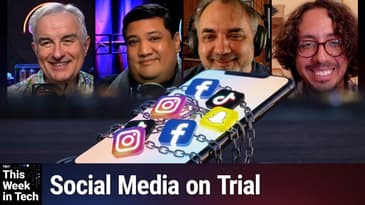
What do jailbreaking fighter jets, lost Amazon vans, and swapping your phone's smart features for a handful of mud have in common? TWiT dives into the wild, occasionally absurd future of tech, where yesterday's sci-fi is tomorrow's supply-chain headache.
- Mark Zuckerberg and his Ray-Ban entourage have their day in court
- Instagram Boss Says 16 Hours of Daily Use Is Not Addiction
- Meta Begins $65 Million Election Push To Advance AI Agenda - Slashdot
- Australia's Social Media Ban Is Isolating Kids With Disabilities—Just Like Critics Warned
- Google I/O 2026 set for May 19-20
- Pixel 10A hands-on: More like a slightly better Pixel 9A than a slightly worse Pixel 10
- Google announces Gemini 3.1 Pro, says it's better at complex problem-solving
- Tucson Daily Brief
- Leaked Email Suggests Ring Plans to Expand 'Search Party' Surveillance Beyond Dogs
- A $10K+ bounty is waiting for anyone who can unplug Ring doorbells from Amazon’s cloud
- Amazon delivery van accidentally gets stuck in the sea in Britain
- Tesla 'Robotaxi' adds 5 more crashes in Austin in a month – 4x worse than humans
- Government Docs Reveal New Details About Tesla and Waymo Robotaxis' Human Babysitters
- The Supreme Court's Tariff Ruling Won't Bring Car Prices Back to Earth
- A flood of cheap used EVs is coming
- Signal guide for everyday folks
- PayPal discloses data breach that exposed user info for 6 months
- Federal ban on TP-Link routers shelved, but Texas fights on
- You probably can't trust your password manager if it's compromised
- Mississippi health system shuts down clinics statewide after ransomware attack
- Fake Job Recruiters Hid Malware In Developer Coding Challenges
- F-35 Software Could Be Jailbreaked Like an IPhone: Dutch Defense Minister - Slashdot
- In a blind test, audiophiles couldn't tell the difference between audio signals sent through copper wire, a banana, or wet mud — 'The mud should sound perfectly awful, but it doesn't,' notes the experiment creator | Tom's Hardware
- Lab-Grown Meat Exists (But Nobody Wants To Eat It)
- CERN rebuilt the original browser from 1989
Host: Leo Laporte
Guests: Sam Abuelsamid, Fr. Robert Ballecer, SJ, and Nicholas De Leon
Download or subscribe to This Week in Tech at https://twit.tv/shows/this-week-in-tech
Join Club TWiT for Ad-Free Podcasts!
Support what you love and get ad-free audio and video feeds, a members-only Discord, and exclusive content. Join today: https://twit.tv/clubtwit
Sponsors:
[00:00:00] It's time for TWiT This Week in Tech. Nicholas DeLeon is here from Consumer Reports, Father Robert Balliser from the Vatican, and my car guy Sam Aboul Samet. We'll talk about one Amazon delivery driver whose name is Mud, why you might want to use mud for speaker wires, and jailbreaking a jet. All that coming up this week on TWiT. Next. Podcasts you love. From people you trust. This is TWiT.
[00:00:35] This is TWiT This Week in Tech. Episode 1072. Recorded Sunday, February 22nd, 2026. The Devils Advocate. It's time for TWiT This Week in Tech. The show we cover the week's tech news. Hello everybody. Glad you're here on a snowy Sunday for many of you. It is not snowy in Rome. It is a little chilly though because it's late at night. Father Robert Balliser, the digital Jesuit, joins us.
[00:01:04] Yeah, we've got a little bit of a chill. It's different than when I was in Vegas for what, seven weeks because we were in the high 70s, low 80s. Now I'm back down into the single digits. Oh man. Yeah, last time we talked you were in Vegas. That's right, I forgot. You're back from CES, settled in. Good. Well, it's great to see you. Also with us from Tucson, where I don't believe it's snowing. Nicholas DeLeon. Hello Leo. How are you?
[00:01:32] Hi Nicholas, senior electronics reporter for Consumer Reports. Good to see you. Thank you. Since last we talked, you tied the knot. Congratulations. A Christmas wedding. Yes, thank you. Very nice. Yes, yes. And I know your wife well and my wife and your wife talk behind our backs. They're the best of friends. They're besties. Isn't it cute? Which is very cool actually. It's so cute. I love it. We have to come back down and visit. Yeah.
[00:01:57] I want to visit you all. Well, maybe not Sam. I'm not sure I want to go to Ypsilanti, but fortunately Sam and his wife have visited us. Sam Abul Samet is here from Wheel Bearings, the wonderful Wheel Bearings podcast. And of course he is a VP of research specializing in automotive technology at telemetry. Hi Sam. Hi Leo. It's good to be back. I'm tanned, rested and ready after a week on the Caribbean coast in Mexico. So jealous. It was wonderful. Yeah. It's so much good food.
[00:02:27] Enjoyed that. We had perfect weather the whole week. It was about 82, 83 degrees every day, but you have to do that. If you live in Michigan, you kind of got to escape. Especially this year. We, we, January, January, we had one of the longest stretches of really frigid weather. We've had in a long time, like almost the entire month and into early February, it was in the, either in the teens or single digits.
[00:02:51] And, you know, we didn't have a huge amount of snow, but it stuck around. We had probably a foot, maybe, you know, 15, 16 inches in total over the month, you know, two, you know, two or three inches at a time. But it was really, really cold. And it warmed up just the day we were leaving for Mexico and it all melted off. And we got back in last night and it was snowing again. Yeah. Yeah. Yeah. Yeah. It's back to 30 degrees. Your timing couldn't be worse.
[00:03:20] You know, I love how the weathermen these days, because weather could, I guess they think it's boring, have new name. Like now it's the polar vortex, right? That was hitting you a polar. You mean a blizzard? Yeah. Yeah. It's a polar vortex or a bomb cyclone. Oh, no. Don't forget the atmospheric river. That's my favorite. Yeah. We get that. That's always a classic. Speaking of which, are you guys having an atmospheric river right now, Leo? We were. Yeah. We had a lot of rain. We had several inches of rain in a few days. So I guess it was a river.
[00:03:49] Yeah. I heard there was a ton of snow up in the mountains. Of course, there was that tragic avalanche. Very tragically, nine skiers in Tahoe, just up from us, died in an avalanche. You know, it's actually, there's a tech angle to that. They were able to find some of the bodies using their Apple devices. And the ones and the survivors. Worst use of an Apple tag ever. Yeah. I agree. I don't think we'll see that one in WWDC.
[00:04:16] The survivors used their Apple watches to call for help. I hope they don't put that in an ad, though. Yeah. If anything happens, we can find your body. No, it's not good. Not good. Let's talk about something happy-go-lucky, social media. The big trial is going on in Los Angeles. A 20-year-old woman says her life was ruined. Ruined, I tell you.
[00:04:42] Ruined by the use of Facebook, Instagram, Snapchat, TikTok. TikTok. And she sued. TikTok and Snapchat settled out of court ahead of time. We don't know how much money they gave her, but I imagine it was significant. But Meta's fighting the fight, as is YouTube. YouTube's also in that. Mark Zuckerberg took to the stand this week,
[00:05:08] showing up at the court with his minders wearing Meta's Ray-Ban smart glasses. There they are. His entourage, as it were. I heard the judge wasn't too thrilled about that. The judge was pissed. You can't wear your smart glasses in court. The judge said anyone uses glasses to record inside the courtroom would be held in contempt.
[00:05:41] You know, Leo, I've got compassion for this woman and anyone like them. Because yes, we know that social media is addicting. Yes, we know that social media does change the brain, especially developing brains. However, we're going on 20 years now that we've been talking about this. I mean, do you remember when Facebook, their entire economy was driven by Farmville? We had this exact same discussion of creating services, creating a game,
[00:06:07] creating an addictive social media outlet where people would continually spend their hours coming back over and over again and spending real money. So on one hand, I want to be compassionate. On the other hand, I want to say, well, yeah, but this is adulting. You have to be an adult now. You know, Adam Masseri, who's the head of Instagram, took the stand last week. He said 16 hours of daily use. That's problematic, but you can't call it addiction. He likened it to Netflix. He said, if Netflix makes a really good show that you have to binge,
[00:06:35] are you addicted to Stranger Things? Yeah, but I don't think most people are spending 16 hours a day watching Stranger Things or Netflix in general. I do know people who will binge an entire season of a show in one day. There is a clinical distinction, though. It's not physical addiction. But no, but I mean, psychological addiction, emotional addiction, physical addiction.
[00:07:01] Well, so when you're talking about an addiction, it means that you first start doing an action, an activity because it makes you feel good. And then because that dopamine wears off, you start doing that activity in order not to feel bad. And then even if you're doing it, it still makes you feel bad, but you're still doing it. So that's what an actual addiction is. Binging is something that you do because maybe you've got free time because you've always wanted to watch something. But when it's over, it's over.
[00:07:29] Nick, did you ever hike for more than a few hours out there in the beautiful Tucson desert? I never. I'm trying to do the longest hike. I don't know, a few hours. I will say I definitely played World of Warcraft back in the day for 16 hours at a clip. Oh, yeah. That is definitely true. Was that addictive? Addictive? I don't know. But you could stop. It's not addictive like heroin's addictive. Yeah, I am sympathetic to the adulting argument. It's like, I don't know. Can you? I don't know. I don't know.
[00:07:58] So I was watching PBS and their tech expert who was at the trial said the fundamental issue of the trial is who's responsible. I think the fundamental issue of the trial is, is it even an addiction? And, and if it is, uh, then I guess you would say if they, and they, and we, I think we can agree that these companies knew they were creating something highly compelling. Sure. Uh, intentionally. Right.
[00:08:29] But I mean, that's their job, right? But that's what everybody does. That's what I try to do. I wish I could get you addicted to twit. That's, that's what you do when you create content is. Is so I don't think they're culpable unless you can say it really is addictive and demonstrate that this young woman's ill, whatever problems she had. I don't think she's even claiming mental illness. I think she's just saying I was a little depressed unless you could say, well, it's definitely their fault.
[00:08:59] And that's even harder to prove. I mean, she could have been depressed for a lot of reasons. My biggest concern with this is the executive who thinks that 16 hours a day of Instagram is problematic, but not an addiction. That's the, no, no, no, no, no. So you do blame the plat, you think the platforms are to blame. It's not blaming the platform. It's, it's, it's a mindset. It's this idea that, yes, I get it. You're selling a product. You're selling a service. Go for it. Fantastic. Do what you have to do.
[00:09:29] But don't lie to me. Don't, don't give me a lie that is so outrageous that it goes beyond gaslighting. 16 hours a day doing anything is an addiction. 16 hours a day doing anything is probably not healthy. So let's just call it that. Call it that. Be honest with me and tell me, well, we're developing a product that's, that's trying to attract your hours, your attention, and you have to set limits. Or if the government thinks it's a social bad, they have to set limits, but, but don't try to frost over the facts.
[00:09:59] So Mark, even if it's not an addiction in the traditional sense of, of, of a physical addiction, like we think of with, you know, drugs or nicotine or alcohol, um, you know, it's still, it is having an impact on people's psychology on, on, on, on their, their behavior. I don't even think that's proven, Sam. It seems, it makes sense. It's like, yeah, that makes sense.
[00:10:26] But I think in every case, when they've attempted to demonstrate that they have been unable to do so. I mean, I'm talking social scientists and psychologists, despite what Jonathan Haidt writes in his books. Well, you know, I mean, I think Haidt definitely goes way too far. Um, yeah, I don't, I don't, I don't think that, you know, I don't think that social media is necessarily the cause of all the, the anxiety and the issues that young people are having today.
[00:10:54] You know, I think that just has much more to do with just the way the world around us is collapsing. Um, but yeah, I mean, they might be worried about climate change. Yeah. I mean, I know that there's a lot of, there's a lot of things to worry about in the world, but, uh, you know, there, you know, and 18 inches of snow in New York city, they might be worried about that. Yeah. Okay. But, uh, you know, the, the, the impact of, of using social media a lot, you know, it's
[00:11:21] not, it's not the same for everybody, just as the, the impact of using alcohol are not the same for everybody. You know, some people can drink alcohol in moderation. Um, some people binge drink and there are some who are, you know, genuine alcoholics. I think when it comes to social media, I think that there, there are people who, um, are having
[00:11:46] much more or getting, having much more of a psychological impact from that use of social media. Uh, you know, when you look at, especially like young girls, for example, you know, body dysmorphia, uh, you know, a lot of other issues that, you know, that I think the social media is absolutely contributing to that. Should we call it, should we call it an addiction? Probably not. Should we ban 17 magazine? Because before Instagram that caused body dysmorphia, did it? Didn't it?
[00:12:16] I think, you know, I think that there's probably a case to be made, you know, for, um, you know, to, and I, I, I hate to, you know, go, you know, into censorship or anything, but, you know, there, there's, uh, you know, as you said, you know, a lot of those print magazines did cause a lot of issues for a lot of people as well. Um, you know, and I think that, you know, it's, it's definitely irresponsible for media
[00:12:44] to, um, you know, the way, the way they have, you know, that they manipulated, uh, imagery in those, in those publications, you know, and it's that, that process is even more accelerated today, you know, with, um, with Photoshop and, uh, and, you know, getting into AI and what we're seeing done with AI with, you know, using AI to take people's clothes off. Here's what worries me.
[00:13:10] Um, one of the arguments, I even heard this on PBS is, uh, well, that section 30s, 230 is protecting these people. So we've really got to do something about section 230. And what worries me is that, okay, it's easy and it's popular to go after Instagram and Facebook and Snapchat. It's easy to go after the big boys, but any judgment that says these, these guys are responsible
[00:13:35] for the wellbeing of people who use their tools will impact a lot of other people, including me. I mean, I have, you know, this age gating thing is going to cause a problem in our discord. It's going to cause a problem in my forums, in my Mastodon. It's going to cause a problem on any public facing thing I do, including these shows. And, and yes, I guess we can all agree big tech should be taken down, but it's not just big
[00:14:05] tech that'll be taken down. And in fact, it's unlikely to be big tech. It's going to be small tech. It's going to be, I can't defend myself in court. Yeah. I want to play devil's advocate. Even though I'm more on Sam's side, I follow along with, with Sam's thinking here. Um, if, if I'm selling a product and it doesn't, it could be a women's magazine, it could be a car magazine. I am going to do the things that I think I need to do to entice my viewership.
[00:14:33] Uh, I'm going to make it as attractive as possible. I'm going to push all the right buttons. I don't know if that's irresponsible. I think that's, that's just what you do. I mean, if you're trying to market something, if you're trying to sell something, you're always trying to look for an edge over your competitors. You're always trying to do something with your product. That's going to set it apart. So to say that that becomes irresponsible at some point becomes extremely dangerous because now you're putting on me personal choice, the personal choice of my viewership and the personal choice of the guardians of my viewership.
[00:15:04] I don't, I don't, I don't think that's a possible standard. You can't ever have that without going into 100% censorship because anything can trigger anyone. My audience is so diverse that I will never know what it is that's going to send them into a self-destructive spiral. Right? I mean, if I'm playing devil's advocate, I'm going to say, if you're going to do that, then we should just not communicate with anyone at all because I don't know your mind.
[00:15:32] Mark Zuckerberg took the stand on Wednesday and he suddenly got in the thing that Meta has been lobbying for, which is it should be Apple that does all this age gating. Uh, he said he'd reached out to Tim cook to discuss the quote wellbeing of teens and kids. Uh, I thought there were opportunities. He said that our company and Apple could be doing. And I wanted to talk to Tim about that. And what they, what Mark really wants is for Apple to find out how old all its users are.
[00:16:02] And then, and Apple has an API by the way, that, uh, an app can query saying what age group is, is this user in? And then it'd be very easy for Meta to say, well, the person's under, you know, 16 or whatever. You can make it any age you want. Uh, we're not going to allow that person to join. Honestly, I don't mind that. Uh, because Apple already probably knows everybody's age. It certainly has good ways of gauging everybody's age. And I trust Apple and Google, uh, with Android to do that.
[00:16:32] How, how do you guys feel about that? Is that a, is that a solution? I mean, I, I heard you guys talking about this last week, I think on the show, um, you know, I can't remember who, I can't remember who was it said this, you know, it probably, it probably makes more sense to have fewer people have access to that and the detailed information about the individual.
[00:16:57] Um, but yeah, even then, you know, I'm still, I'm not sure that I don't know that that's going to be the right solution. I don't know that that's necessarily going to work. Zuckerberg was questioned by the, uh, uh, plaintiff's attorneys about email messages saying he lifted Facebook's ban on or Instagram's ban on beauty filters because it was quote paternalistic.
[00:17:25] When asked about Zuckerberg says, well, that sounds like something I would say and something I feel it, it feels a little overbearing specifically to beauty filters. Do you remember 15 years ago, Leo, uh, on tech news today, we had a discussion when Facebook was, when they had announced that Zuckerberg was always going to have 51% of the, of the power of the voting shares of Facebook.
[00:17:53] We said, look, essentially you're, you're allowing Facebook to become the cult of personality of Mark Zuckerberg. So the question becomes, do you trust Mark Zuckerberg's judgment? We haven't asked that question. I guess no would be the answer across the board. Uh, Nicholas, do you want to weigh in? Do you trust Mark Zuckerberg? Well, I, I was just going to say, yes, as a reporter in, in the trenches for the rise of Facebook and all this, I feel this, this conversation, I feel we have this conversation
[00:18:19] like every day for the past 20 years, like what father said a second ago, we're still at the who's responsible stage. We're still at the, do you trust Mark Zuckerberg stage? And it's like, well, I'm, I'm 40 years old now. And I was 20 when we were having these discussions and it's like, I don't know, uh, to the devil's advocate position. It's like, uh, you're an adult. No one's forcing you to use Instagram, beauty filters or otherwise.
[00:18:43] It's like, I don't, I don't know why I need, uh, the judiciary to step in when I can close the laptop to everything. I don't know if that's like facile thinking or like to, to whatever, but like, I don't know, man, I, I guess I've never really struggled with addiction for real. You don't have body dysmorphia, Nicholas. Uh, not, not that I'm aware of. No. So, which is easy for me to say. I know a lot of folks do struggle. So it's mostly women, I would imagine of the devil's advocate.
[00:19:11] I mean, do they still have a devil's advocate at the Vatican, by the way? Uh, yeah, I know him. He's a nice guy, but they're really, I mean, I'm not being facetious. That used to be something at the Vatican, right? It's not an official position, but there are several people who whose job is to be strategized. Yeah. Their job is to be on the outside throwing rocks. That's, that's what they do. But to say we can close the laptop and remember I'm with you, Nicholas. I believe that people have to be doing the adulting.
[00:19:37] That would, uh, if you're dealing with an actual addiction, you can't, you can't say that. You can't tell someone, well, why don't you just stop drinking? Why don't you just stop using cocaine? Why don't you stop using fentanyl or opioids? So that, that is where that clinical distinction of addiction and desire has to be really, really clear. Cause if it's an actual addiction, it, you have to treat it. You, you can't just say, just change your attitude.
[00:20:02] So, uh, in, in the, in the discord, um, writing the RTT RT IRT, um, actually had an interesting point here. You replace Instagram with draft Kings and what, what Leo just said at the time. Well, you can, so we can't regulate that either. You can ban gambling. That's different. You can say I ban gambling. We, we do. In fact, in California it's banned. Right. But I think the point, the point here is, you know, gambling, you know, we, you know,
[00:20:32] people who are problem gamble gamblers who are, uh, they, you know, they are addicted, but, um, they, you know, the, the physical manifestations of that are not the same as it is, you know, with drugs or alcohol. That's true. That's a dope addiction. So when you, when you, you know, I mean, it, that is a real addiction and, you know, I mean, when you try to stop gambling addiction, I am, I am not, you know, I am not a gambler. I've never gambled.
[00:21:00] Um, but I don't believe that, uh, as far as I'm aware, you know, for gamblers, when they try to stop, they don't go through withdrawal in the same way that you do from a physical addiction to some substance. And, but we still consider that to be an addiction. So, you know, that, you know, that's kind of, you know, going back to earlier in this conversation, but, you know, the, the idea is we're going to do that. What is an addiction?
[00:21:25] And, you know, I, I think that there, there probably is a case to be made that at least for some people that, you know, that there is an addictive or a compulsive, maybe compulsive is a better way of, of phrasing it than, than addictive behavior. But there, there, you, you do have some behavioral things that people are unable to control. You know, just saying, you know, being, being an adult is not, is not an adequate answer
[00:22:20] to that.
[00:22:50] I'd hate to lose that. ibd. You, you got to, that one to love that trust, like you said, what was a surgo that That's theructure of finding sure something like that. But I just, I mean, I'll just, I feel, at least, I just wouldn't attach to that, but 공 should say I need all right.
[00:23:17] And, but when I was emphasizing, whether I was childproof, whether I, maybe never Yeah, the cigarette warning labels are graphic. Oh, the ones over here are great. They showed like diseased lungs and cirrhosis. Oh, yeah. Does it stop people? In fact, when I was in Rome, everybody smoked. It actually increased revenue for a while because people wanted to collect all the different packs. Collect all the diseases. Okay. Oh, God.
[00:23:45] Yeah, humans are not really good at assessing danger. Hi, this is Mito. It's amazing that the species has survived this long. We had to create laws to make people wear their seatbelt. So, I mean, you know. Yeah, I mean, I'm not against laws. You know, somebody said, well, liquor stores are allowed to ask for ID before you can buy liquor. That seems right and proper. Now, the liquor store doesn't store that ID in a database of IDs
[00:24:15] and keep track of your name, address, and birth date. Right? So, these internet systems obviously can. And unfortunately, even if they deny they do it, they do it. And it's the one old dude at the liquor store who looks at, takes a glance at your idea and gives it back to you. Yeah, as you care. Now, you know, I mean, I never personally did this, but I'm told that, you know, there are some people who are under the legal age
[00:24:42] for consuming alcoholic substances, you know, often, you know, would have false IDs that would indicate that they were actually older than their actual age. That can't work. I have no evidence that that is actually true. It might be completely... You mean McLovin? Yeah. Yeah, who knows? Yeah. All right. Well, anyway, it was interesting to see Mark take the statement. I don't think he's done this before he's testified in Congress,
[00:25:12] but I can't remember another court case where he has... Yeah, he's done Congress in that... Wasn't he in a hoodie when he testified before Congress? I remember the time, and he was wearing a suit, that I think it was Josh Hawley made him stand up, turn around, and apologize to the family members in the audience who had been harmed, whose kids had been harmed by Metta. That was a humiliating moment.
[00:25:41] Interestingly, Metta has begun a $65 million election slush fund. Don't know. I mean, I think it's probably completely coincidental. Actually, it's more about AI, but, you know, hey, if you're lobbying, you might as well lobby for that too, the age too. I don't know. I think... I feel... I say this every time. I feel like it's up to parents, ultimately. There's some evidence.
[00:26:11] Tech Dirt had an article that the Australia social media ban is, in fact, isolating for some kids, kids with disabilities, for instance. Everybody's watching Australia. They banned social media for kids under 16. Just banned it. The Guardian has a piece about... Well, quoting some kids. This is an Australian girl. I lost my friends. She's autistic. She said, I lost my friends. She's 14 years old.
[00:26:41] While some people were exposed to harmful content and bullying online, or indie, which is not her real name, social media was always a safe space. If she ever came across anything that felt unsafe, she says she would ask her parents or sister about it. I have autism and mental health things. It's hard making friends in real life for me. My online friends are easier. I actually know autistic kids whose primary social life is online. I think this is genuine.
[00:27:10] What about the harm to those kids? Cutting them off? No. It's hard for most people in the real world to make friends, to make good friends. That's true. I am also on the spectrum, and I understand that. However, the friends I make in the real world are far more concrete than the friends I make online. They're real friends. Yeah. They're actual friends. Do you think it's a disadvantage for Indy that she has social, because it allows her not to make friends in the real world? Absolutely. If I had social media when I was growing up,
[00:27:40] I never would have met anybody. I would have been online the entire time, my entire life. Would you have been a priest? I would never have touched grass. Would you have been a priest? Probably not. Honestly, probably not. Yeah. I'd probably still be running my BBS out of a one bedroom. Or you'd be with Nicholas playing World of Warcraft. Exactly. No, no, no. Same game. I was never World of Warcraft. It was civilization for me. Oh, Civ. That's the one that had me see many mornings. You know, I think we should send Apple to jail because they've put Civ on the iPad now
[00:28:09] and that makes it really easy to become addicted. I'm being facetious. Anyway, yeah, we do have this conversation a lot. I probably shouldn't bring it up. I thought Mark... Well, no, I think it's a valid conversation to have because we, you know, particularly because we haven't really come up with a solution yet. Right. And, you know, I think until we come up with some viable ways forward,
[00:28:37] some kind of path forward, you know, we need to keep talking about this. We can't let it slide because, you know, not doing anything is not the right answer either. Yeah. I just think it's so hard to know what to do without causing harms in the other direction. I just don't know. I mean, look, I don't have Instagram X on my phone. I watch YouTube every morning when I work out.
[00:29:09] But I'm an adult, of course. But I mean, I think, you know, you see parents give their kids an iPad or an iPhone when they go out as a babysitter. You know they're doing that at home too. And we know that causes real harm. Yeah. We now have the data. But should we ban those things because parents are using that as a tool? I mean, I do agree. That's probably a bad thing to do to that poor kid. You know, when you see, you know,
[00:29:38] kids in a restaurant with an iPhone, with a phone or a tablet. See it all the time. Take that away and hand them a pack of crayons and a piece and a stack of paper. Yeah. So we used to do that. Restaurant would give you a coloring book placement. To be fair, that's not just children. I mean, seeing adults in a restaurant, like five adults at a table and they're all staring at their couples. I was just going to say that, Father. Like, it's definitely not. You see the kid with the tablet, but then you see the parent on their phone just mindlessly scrolling through junk, basically.
[00:30:08] So it's like, I don't know. Most of the time, the reason why the kid has the tablet is because the parents are also on their phones. They don't want to deal with the kid. You know, nobody wants to talk to anybody. I saw a picture from many years ago of probably from the 40s of guys going to work at a railroad station. Every one of them had its nose in a newspaper.
[00:30:37] It's just changed. It was a newspaper. Now it's a phone. You shouldn't be expected to socialize on the subway. It's not. You'd love to live in my house for a week, Leo, because there is a generational gap. And so after lunch, most of us go upstairs to the rec room and we have a coffee and do some light chat. And then half of the room goes to the newspaper room. Literally, it's the newspaper room. It's where all the newspapers from around the world go, physical newspapers, and they sit and they read.
[00:31:07] And the other half play games on their phones. So it's... I actually remember going to the newspaper reading room when I was a kid reading newspapers, come to think of it. Those giant sticks that hold the newspaper. Yeah, they'd have the newspapers to be on sticks. You remember that, Benito? Hell yeah. I'm surprised. Yeah. I remember that. In the library? I spent days looking at microfiches in the library of old magazines and old newspapers. Film strips.
[00:31:37] Particular pieces of information. Here's a photo of gentlemen in hats. Yep. Yep. They're not talking to each other. The last thing they want to do is talk to each other. They all read in the paper. And, you know, you get on a plane now and everybody's got a set of noise-canceling headphones on. Yeah. Or Vision Pros. I've never seen anybody on a plane with a Vision Pro, actually. And I fly a lot. I've yet to see one on a plane.
[00:32:06] In fact, one of the few places where I've ever seen a Vision Pro out in the wild was a couple years ago when they first came out. I saw a guy in Portland riding around on a bicycle with a Vision Pro in downtown Portland. That's stupid. That's just stupid. But, you know, noise-canceling headphones. Nicholas, correct me if I'm wrong. March 4th, Apple's going to make a bunch of announcements. One of the things John Gruber is saying, and I hope it's true, is that Apple's going to bring F1 to the Vision Pro.
[00:32:35] I will buy a Vision Pro. My dad might buy an Vision Pro. Honestly, my dad might be the big... He literally has VHS tapes in his basement of races from the E that he taped off whatever channel it was on. He actually might be this nation's most preeminent F1 expert. I keep telling him that. I don't know how to instantiate that. He came to it before Draft2 Survive. Many, many decades before Draft2 Survive. That was the only sport he'd want. That was the only sport I was aware of as a kid growing up was Formula One.
[00:33:05] And this was in the 90s. And nobody knew what it was in the 90s. No. Because it was European. If Air Force was to the Vision Pro, he used to get the British magazines. I guess he could import them or something. Yeah, I did too. Yeah. Did you, Sam? Oh, yeah. Yeah. I bought... I used to have a subscription to Race Car Engineering, which had... That was like the really deep dive technical articles on F1 and various other forms of racing.
[00:33:32] But whenever, especially in the 90s, when I started traveling to Europe regularly, I would pick up copies of Autosport and Autocar, Motorsport Magazine, and be reading all these different things. Oh, yeah. I got in... I mean, I first got into F1 back in 1978 when I picked up my first copy of Road & Track. And it was in June or July of 78.
[00:34:01] And they had the report of that year's Long Beach Grand Prix. You know, in those days, you know, F1 was not on TV everywhere. And, you know, so if you weren't at the race or you weren't local, you know, you would end up, you know, reading about the race, you know, a couple of months later in a magazine like Road & Track.
[00:34:51] And something like a Vision Pro. It might be a little too real. I would be throwing up all over the place. I don't think Apple would do that. I think what they would do, because F1 has all of these feeds, they have the driver's feeds, they have all these feeds, they have the data feed, they have the track with the little things going around. They would just give you a field of view that had, you know, 20 screens in it. And you could look around and go... That'd be kind of cool. I would do that.
[00:35:17] By the way, Leo, Pretty Fly For Us Cis guy in the Discord is showing a picture of Yuki Sonoda's RB7 catching fire in San Francisco today. No. Is there an F1 event in San Francisco? No, I think it's just a promo event. Okay. The first race is in a couple of weeks. Oh, he's not catching fire. He's doing donuts. You got to understand. Oh, it is on fire. It is on fire. Those are the brakes. Yeah, that part... They get pretty hot. Yeah.
[00:35:42] Plus the RB7 is from like 2013 or something. It's way old. Oh, okay. Yeah, nowadays it's practically electric. They're half electric. Leo, I was going through St. Peter's two days ago and in the lost and found for the Vatican Museum is a Vision Pro. So someone... Which... Okay, whatever. But who brings... If you were at the Vatican last week and you lost your Vision Pro, contact Father Robert Ballissier.
[00:36:08] Who goes into St. Peter's to put on a Vision Pro? That's so dumb. What is wrong with people? By the way, though, and I know you know this because I have a feeling you won't say, but I have a feeling you might have had something to do with it. There is a 3D view of St. Peter's, right? Yes, there is. Look at him. Look at him playing coy. He said, it's a team effort. Everybody's involved. Everything's a team here. It's a team.
[00:36:38] Talk about with this wonderful panel who I just really, you can kind of tell, we just like to hang out and chat with. I guess that's the best twits, right? Where you just feel like you're at the table and we're just sitting around and we're gassing about stuff. Father Robert Ballissier, the digital Jesuit. I just miss having you around. I guess you just have to... I do miss the old days. Does that officially make me an old fart, I think? He used to have a little thing in the basement of the twit brick house, the little, what was
[00:37:08] it called? The nose, no hole? The no hole. Yes. And I can always, I always knew that if I couldn't find Father Robert, he'd be down in the no hole soldering something together or something. It's great to have you, Mr. Sam Abulsam and my car guy. I feel like it's, yeah, this is old friend week. It's good to see you, wheelbearings.media. And Nicolas De Leon from Consumer Reports, great friend as well. So yeah, we could sit around, we could talk about stuff.
[00:37:36] Nicolas has actually done a little vibe coding for his hometown. We'll talk about that. I have a few little projects coming up, but yeah, this one I want to talk about today. We're all here. We're all, let's be honest, we're all a little bit into the AI thing. Anybody anti-AI here? We're all among friends. I'm kind of middle. Oh, a couple of, huh? Yeah.
[00:37:59] I think that there's some valuable use cases for it, but I think that there's a lot of places where they're trying to shove it in where it just does not make any sense at all. Oh, I agree. Every time I open up our show rundown, Google says, hey, you want me to summarize this data? No. That's what the show's for. I think the amount of money that is being squandered right now on data centers is just ridiculous. I think the jury's still out on the data center thing.
[00:38:29] I think it might be worth it. I feel like we're creating something. I don't know what it is. Leo, we don't have RAM, Leo. That's the reason we don't have RAM. Yeah. Yeah. Oh, yeah. We'll talk about RAM and hard drives a little later on. Yeah, but it's because of those data centers. Yeah. Well, good. Because if we're creating the next consciousness, I think it's well, so you, okay. So you have to wait a year to upgrade your computer. Big deal. They're creating your rental computer, Leo. That's what they're doing. Yeah. I'll tell you what.
[00:38:59] I don't need to buy software anymore. I just tell, you know, chat GPT Codex 5.3. Yeah, because you're going to be renting your computer. That's the point. And I am at this point. 200 bucks a month to all of them. Actually, no, just two. Two, my plan was I was going to cut off Claude when I went to Codex. And then I'm going to cut off Codex and go to Gemini. But you know what?
[00:39:26] It's kind of like breaking up with a girlfriend or something. It's like, Claude, I'm going to miss you. I'm going to see you later. But now I have a new friend. We talk about that on our AI show, Intelligent Machines. I'll save it for that. Our show today brought to you by Trusted Tech. Hey, these are guys you ought to know about. If you're using Microsoft 365, you would pretty much need an AI to tell you what's going on.
[00:39:56] Or maybe better, get some experts. Because you're probably paying for licenses you don't need or maybe missing ones you do. Don't ask Copilot. Ask Trusted Tech. In July, Microsoft's going to implement a significant price increase for Microsoft 365. And it gets even more complicated. There's a lot of nuance in here. But the good news is these guys are experts.
[00:40:18] Trusted Tech helps businesses of all sizes get the most out of their Microsoft investment by ensuring their M365 environment is well supported and aligned with how the business actually operates. In a way, Trusted Tech pays for itself by saving you. Microsoft licensing is very complicated. Options can vary widely. But the Trusted Tech team gets it.
[00:40:43] And they can help organizations understand what they have, what they need, and how to make the most out of what they're paying for. If you want to make sure you're getting M365 done right, Trusted Tech is offering a free Microsoft 365 licensing consultation. Visit trustedtech.team.com. Trustedtech.team.com.
[00:41:17] Trustedtech.team.com. Trustedtech.team. And you would say, well, Microsoft must hate these guys. No, Microsoft loves these guys. Ask Kevin Turner. You know that name, former Microsoft COO. He says, this is a quote. He was talking to Trusted Tech. Quote, you have an incredible customer reputation. And you have to earn that every single day. The relentless focus you guys have on taking care of customers gives them value and differentiates you in the marketplace. Kevin was very kind.
[00:41:47] Trustedtech also elevates the Microsoft support experience with its certified support services. So they do both. In fact, the support services save you a lot, 32 to 52 percent, compared to the average Microsoft unified support agreement. Whether you're looking to fine-tune your Microsoft 365 licensing, improve the way your organization receives proactive Microsoft support or both, Trustedtech offers free consultations to help you understand your options.
[00:42:15] Go to trustedtech.team.com. Fill out that form. Get in contact with Trusted Tech's Microsoft licensing engineers. They're great. Very great. Google I.O. is coming up May 19th and 20th. As usual, they have a big puzzle to solve. Do you do that, Robert? Do you try to solve the puzzle?
[00:42:41] I used to, but I haven't gone to a Google I.O. since, oh my goodness, 2016. They used to be more fun. Remember the one where Sergey Brin parachuted in wearing his Google Glass? Yes. He was at a conference recently. He says, wait till the product is really ready before you, let's say, parachute into the conference to announce it. Remember when they used to give everybody the thing they were announcing? Oh, yeah. Yeah. Yeah.
[00:43:10] People would walk away from there with a couple of phones. I mean, I remember one year when there was a Nexus phone, the first two Android Wear watches. There was an LG. And a Chromebook, right? The first Chromebook. Chromebook. Chromebook. The C40. And of course, the Nexus Q. Don't forget the Nexus Q. I knew it was over when the thing we got under the chair was a cardboard viewer. Yeah. Glasses. Yeah. That was when, yeah, I think we're not, I think that's the last of it.
[00:43:38] I don't know what will be under your chair at Google I.O., but it's May 19th and 20th. We will cover the keynote or the keynotes. Huh? Old gum. Yes. This week, they did announce, probably trying to get ahead of what Apple is likely to announce on March 4th, the Pixel 10a, the low-cost version of the Pixel 10. It's exactly the same as last year's phone. I mean, it's the same processor. Yep.
[00:44:07] Cool colors, though. Is in color, as will, I'm sure, Apple. It's not a minimal 10. It's a 9. Basically. It's a 9. Yeah. They just made the 9 to the 10a. I guess that makes sense. For a while, those A-series were kind of like the phone to get. Like, this is great. You're getting a... I mean, just because it's a slightly upgraded 9a does not mean it's a bad phone. I mean, it's still an excellent phone, especially for $500. Oh, yeah.
[00:44:34] And within a month or two, you'll be able to get it for $350, $400. That's right. Don't ever buy it the day it comes out. Google always sharply discounts. I have the Pixel 9 Pro XL. I just put Graphene OS on it, by the way. Very easy. You've probably done that, Robert, right? But it used to be to swap out a ROM on an Android phone was, you know, had to install ADB, and it was a complicated thing. Now, you do a... You attach the cable. It's a website.
[00:45:04] And it installs Graphene. Couldn't be easier. I'm still using an 8 Pro, and I have no desire to upgrade at any point in the near future. Are you using stock Google Android? Yeah, I went back to stock just because I was getting some issues with my custom loads. And, yeah, I'm starting to feel the age, but I used a OnePlus 2 for eight years, so I figured I could beat that.
[00:45:30] Remember when there were really great Android phones? The OnePlus was so cool. Remember the Moto... It was a X? Moto X. Moto X. I had the second gen Moto X, and my wife had one, too. She got the bamboo on the back. I had the blue on the back. Yeah, I did, too. Because you would build your own. You could do whatever you wanted. And then now... Yeah, the Moto Maker. It feels like we've regressed.
[00:46:00] The Moto X, you could change, hey, Google, into anything you wanted. Mm-hmm. I had it set, so if I said, help me, Obi-Wan Kenobi, it would talk to me. You can't do that anymore. And, you know, it had the infrared sensors on the front, so you could swipe your hand, just swipe your hand over it to dismiss a notification or a call. Yes. Or, like, you know, at night, you know, I had it on a charging stand on the bed stand, and it was off.
[00:46:28] But, you know, if I woke up in the middle of the night and I wanted to know what time it was, I could just swipe my hand over it. It would flash up the time momentarily and then go blank again after about 10 seconds. Yeah, that was a Google project. And that was the last of it. Yeah. We did that. There were several manufacturers who were giving us interesting phones with different capabilities, everything from keyboards to really cool sensor functions, and none of them sold.
[00:46:57] So we've all gone to the same record. Most people just ended up, they wanted a slab, you know, black slab, you know, and that was it. But that's not us. That's normal people. Yeah. The normies have ruined it for us. The problem is there aren't enough of us to justify manufacturers investing in those cool technologies. But also, this is like, dang it, normies. This is America too. See what we could have had. Like, there's Japanese and Chinese phones that are Android that you will never see in America. Oh, yeah.
[00:47:26] The new Xiaomi Ultra, which has a Leica photo system in it. I would kill to get this, but you can't buy it anywhere. I mean, you can buy it everywhere but the US. I'll bring one back for you next time, Leo. They're in the shop down the road right here. You can get them in Italy? Absolutely. But it won't run in American networks, right? Yeah, it will. Not all. It's probably run on certain bands. It'll run on Team Rebel and not all. Yeah, yeah. Yeah.
[00:47:55] Okay, I'm going to give you ammunition, you haters, you AI haters. What's gone on, maybe, my contention, perhaps, is that these companies, instead of trying to innovate anywhere else, they're just saying, let's throw all of our engineering talent into AI. All our resources, all our talent, all our engineering into AI. Does that seem like what's happening? Yes. I mean, that's what it feels like as a reporter covering tech.
[00:48:25] I was just talking with a friend the other day. He said it used to take him two hours a day to go through all the big tech block, you know, the Verge, Engadget, yada, yada. Nowadays, he's done in like 10 minutes because they're all just talking about AI, and it's the same very small number of news developments. Yeah. So it certainly feels like the whole tech industry that I love has shrunk dramatically. Like you just said a second ago, phones are kind of whatever now. The video game industry is – I mean, Xbox is not in a great place.
[00:48:54] That's shrinking too, it feels like. Yes. All this cool stuff that like I thought was, oh, this is going to be around forever. No, it is not going to be around forever. And now we're literally just talking about AI, which is fine. I'm glass half full when it comes to AI. Obviously, I think I've used it for some stuff, for projects and so forth. But like I didn't want that to come at the expense of everything else. And I mean, look at Windows. Windows is just – Oh, Windows is crapified. I probably shouldn't say – I mean, look, I guess I'm a representative of Consumer Reports. You write to normies.
[00:49:24] You write for normies, right? That's who you're writing for. Windows is not as good as it used to be. I used to give Windows like, yeah, you know, it's good enough. It's fine. You know, it is a seriously degraded product nowadays. I guess I'll be polite. And yeah. Is that AI's fault? Is that them just funneling resources into AI? That's certainly what it feels like, you know? Yep. Well, you know, and open AI is getting close to – apparently getting close to closing a $100 billion funding round, private funding round.
[00:49:54] You know, for a small fraction of that, just imagine the things we could actually do, you know, I mean, not just developing, you know, some interesting gadgets, interesting phones, interesting technologies. But, you know, some of the other things we could do in society with a tenth of that money. You know, so if we could just shave off 10% of what they're throwing at AI, we could do a lot of really good things for the world.
[00:50:21] Well, Phil Spencer is leaving Xbox at Microsoft, and the new head of Microsoft's Xbox division says, don't worry, we're not going to load it up with AI slop games. Of course they are. Yeah, right. I don't think anyone – it's funny to see the reaction as a gamer American. I was paying very close attention to that announcement the other day. The skepticism with that whole – her whole, like, spiel has been received.
[00:50:47] I guess this is an interesting communications problem if you're Microsoft or the Xbox division. No one believes – no one's going to believe a word this woman – it's not even her fault, necessarily. Everyone's very skeptical. The fact that she had to say it even tells you something, right? What her last job was. She's like, oh, I'm a gamer. I love games. It's like, does anyone believe that? I can't possibly believe that. It's just – it's like – And what was her last job? What was her last job? Ah, let me see. Was it Instacart? Her name is Asha Sharma. Just scroll up that article. You'll see it.
[00:51:17] Just scroll up the headline, the headline of that article. No, the headline, the headline. The headline. We will not – new Xbox boss promises no soulless AI slop after moving over from Microsoft's core AI products division. Oh, sorry. You're right, Benito. I feel like a lot of gamers would have been more happy to hear her say something like, look, I'm not very familiar with games. I'll be honest with you folks. But it's my job to ensure that this division is successful.
[00:51:45] We're going to try our best to win over your hearts and minds and put out cool stuff. I don't come from that background. I have no idea what it is, but it's my job in the next 90 days to learn on the – if she would have been more along those lines, I think folks would have been way more like – we're more inclined to give her the benefit of the doubt. But they came out the gates with her like she's like some hardcore gamer with a capital Z. She says, I don't have any background in games at all. Come on. I played Farmville.
[00:52:14] You know what the buy-in is? The first time a developer makes an AI-generated map where every level can actually be original so that no one has an advantage for having played it for 60 hours, 100 hours, 1,000 hours, that's when there's actually going to be some acceptance. You're going to see these multiplayer maps that are just brand new. They're 100% original because they've been AI-generated. I have to say, I know a lot of gamers who say, I don't want any AI in games. Yes, that's a comment.
[00:52:42] But in a way, I mean, isn't an NPC just bad AI? Like imagine how good the NPCs could be. You wouldn't have the same – you know, I used to be a warrior like you, but I got an arrow through the knee over and over and over again. The term AI in games though is problematic because we've had AI in games since the beginning of games. Yeah. This just hasn't been very good. Imagine if you'd like had the bartender in the – There's a different definition for AI in games than there is for like LLMs and generative AI stuff.
[00:53:12] Like AI in games, you generally just say that as like the computer player. That's the AI. But that's a very different definition from what we call AI today. But I think NPCs could be better. Maps could be better. There's a lot of opportunities. I don't know. You want artists, you want humans to – The minimum for NPC AI would be pattern recognition. If it can't do pattern recognition, it's not useful as an NPC AI. Right. I mean, how many games have procedurally generated worlds? A lot of them. That was the big thing, right? No Man's Sky. I mean, that was No Man's Sky.
[00:53:42] Minecraft. Minecraft. Minecraft. Minecraft. Minecraft also. But No Man's Sky, everybody got very excited because an infinite number of worlds, right? It turned out to be really boring. But – They fixed it. They've been updating that game. They've been updating that game. I heard it was better, but I got so bored playing it for the first – It's way better. Okay. I'll have to try it again. Now I feel guilty. I feel like my girlfriend Claude and ChatGPT are going to miss me if I start playing video games.
[00:54:12] Go back to Valheim. Ah, I played so much Valheim. But that was my – Valheim and what was that Switch game where you had – Animal Crossing. Animal Crossing. Those are my COVID games, right? Valheim and Animal Crossing. How did you know that so quickly? Did you – were you – No, I've never played either one, but I've been listening for 20 years. Animal Crossing. I still have a original – you know, the Switch Animal Crossing version.
[00:54:40] I see it over there in this pastel colors. So let's see. The timeline. Sonnet 4.6 came out last week from Anthropic. 20 minutes later, OpenAI released GPT-5.3 codex. 20 minutes later, then a few days later, just this week, Gemini 3.1 Pro came out.
[00:55:05] And of course, nowadays they're training these – I think they're training these AIs on the benchmarks. So the benchmarks become more and more meaningless. Right. But on the benchmarks – this is from Google, of course – 3.1 beats them all. Humanities last exam, ARC AGI, SWE Bench, all the most important benchmarks. It's like dominant. Oh, wait a minute. Here's one.
[00:55:32] The 5.3 codex wins an SWE Bench Pro public. That's a one-shot benchmark. Everything else. So, okay. I mean, the ARC AGI test is interesting. I do like seeing – That's the one – what's the story on that one? I remember.
[00:55:55] So ARC AGI looks at how an AI or an LLM handles pattern recognition and spatial reasoning. Those are the two big ones. So, for example, a human looking at the backup camera of a car. We can immediately – even without thinking about it – we understand that when we start seeing objects moving in different proportions as we back up, that it's because of depth. That's easy for us. That's just a human thing. It's very difficult for an LLM to do.
[00:56:25] So, that's one of the challenges. As can it take a picture, a video of objects moving and figure out what the spatial points are? And it's hard. I've done it myself and it's very hard. And the problem with using an AI, especially like an LLM type of AI, to do that is they don't always understand – seeing something.
[00:56:53] You can see relative changes. If something's moving towards you or away, you can detect that. But you can't necessarily detect actually how far away that object is, especially from a single camera view. If you have a stereoscopic view, you can do that. You can just use some basic geometry to figure out exactly where that thing is in space.
[00:57:16] But from a single camera view – and this is one of the fundamental problems with Tesla – is all of their eight cameras, they're all single camera views. And so, it's got to guess as to where that object is in physical space. And oftentimes, you can have objects that look similar to each other. And if you've made some inference based on, okay, I know roughly how big this particular object should be.
[00:57:44] And I know how many pixels it's taking up in this view. So, I'm going to guess it's 10 meters away from me. But you can also have another object that looks similar to that that is larger or smaller. And now, you've made a fundamental error in trying to determine where that object is in physical space.
[00:58:03] So, with humans, we're looking at the camera, but we can also look in the mirror and use other inputs to detect. So, cameras are – by themselves, they're useful, but also problematic. Yeah. So, this is the ARC Prize website. I can't remember what the prize is. It's a drop in the bucket compared to how much it costs to train these things.
[00:58:30] A human score, 100%, of course, on AGI2. Costs $17 per task. The new Gemini 3.1 Pro, 77%, which actually is a little lower than Gemini 3 Deep Think. But the cost is the thing. It was $13 for Gemini 3 Deep Think. It was less than a buck for Gemini 3.1 Pro. So, you have to consider cost, and that's what these graphs show is how well they do based on cost.
[00:59:00] How did they determine the cost of a human? They had to pay them $12 an hour. I don't know. Yeah. Presumably, you assign some value per unit time and say, okay, how long does it take the person to do that task? I'm telling you, I've done it. It's hard. It's hard. You get a map, and you have to rearrange the things to match. You know, it's hard. It's not easy. There's a wide range of human ability there. That's true. Well, I think that's probably why I said human panel.
[00:59:28] So, they're probably using a number of people to do it and taking an average. So, I got a question for you, though. You mentioned, Leo, I think that they seem to be increasingly training these models to the benchmarks. You know, I think we know pretty well that when you train people to the test, you know, that leads to at least a problematic, very limited abilities.
[00:59:58] And so, you know, what's the outcome going to be if we keep training these models to these various benchmarks? They will perform exceptionally well on benchmarks. Yes. Yeah. And do nothing else. That's why I don't trust benchmarks. But, you know, if you play with these things, they're definitely getting smarter. Right, Necklace? Which you used Claude Code? I primarily use Claude Code. I started doing Claude Code by last summer.
[01:00:25] So, that was whatever the top-of-the-line model was then, like, last July-ish is when I really started messing with this stuff. And so, recently, I guess I'm using Sonnet 4.6 on this current project. I'm also using Haiku 4.5 for a... Yeah, that's what I use for our summaries for the show. Yeah, that's actually... Yeah, yeah, yeah. So, I'm more familiar with the Claude kind of stack here. Yeah. So, you created this Tucson Daily Brief.
[01:00:55] Yes. Is this public or is this just for you? Oh, no. This is public. So, what this was... Okay. So, the genesis of this was... Remember, like, a month ago when everyone was, like, going crazy over Claude Ba and, like, oh, this is going to revolutionize everything? I was very skeptical. I was like, okay, here we go. What's this AI hype nonsense? But, like me, you feel like your job is to try this stuff, right? Yes. Yes. I don't dismiss things out of hand. I'm like, okay, this seems a little hypey, but let me poke around with it. Yeah, exactly.
[01:01:22] That's kind of been my attitude for basically anything in life, actually. So, I was like, okay, what are some cool things I could do with this layer, this additional layer in the stack here? And so, what I did was it's called Tucson Daily Brief. You know, it is not the fanciest project in the world. It's not going to be the next TikTok or anything. It was basically just an excuse for me to use these tools and learn more about Open Claw specifically.
[01:01:45] So, basically, what this is, is it goes through the major Tucson, Southern Arizona, local news sources, the RSS feeds, TV channels, newspapers. There's a couple of substacks and so forth. It goes through the RSS feeds, picks out the top – and this is Claude, I guess, right now, Sonnet 4.6 doing this. Which is quite good, actually. Yes, quite good. It's picking out, let's say, the top 10 headlines. It summarizes those headlines, and then it sends that summary to me in Telegram, the messaging app.
[01:02:15] So, at 6 a.m. every day, I get a summary of the top 10 things happening in Tucson that day. I've never been more informed about Tucson stuff than the past week. La Fiesta de los Verqueros, Tucson Rodeo is coming. Exactly, yes. Tickets – we were going to go next weekend, but tickets start at $150. What? Which feels a little expensive for Rodeo, to be told. What? So, it goes to Telegram. I get that message.
[01:02:38] And then it sends – that sort of summary, which is a couple text messages in Telegram, it is sent to 11 Labs. And I clone my voice in 11 Labs. And so, it generates a podcast script. So, it creates an audio podcast of me, in quotation marks, reading the top stories. So, this isn't you. This is 11 Labs reading it. Yes, this is 11 Labs. Push back on cuts as city faces $27 million deficit.
[01:03:08] City officials are wrestling with a $27 million shortfall. It sounds just like you. It sounds good enough. 11 Labs is surprisingly good. They're really good. It's gotten a lot better. Yeah. And so, it creates an audio podcast, which you can get on Apple Podcasts. It creates that YouTube version, which obviously you can look on YouTube. And then there's a blog post, which it formats out of Markdown. How much does this cost you? How much does this cost you? My estimate, around $20 a month, the whole pipeline.
[01:03:35] And then it runs – everyone was buying Mac Minis. I wasn't going to buy a Mac Mini. But I just have an old framework laptop running Linux. And I was like, all right, let me just put it there. And I know folks were like an open – we're putting them on these machines. You don't need a really high-end machine, though, right? No. I mean, it's – Because it's all being done in the cloud. Yeah. There's no real competition power locally here. I don't have any data on here that, oh, it's going to exfiltrate your credit. I have nothing on this laptop. Literally nothing.
[01:04:04] So, I'm not too concerned about that. So, it's a pretty cool project. There's one I'm working on right now. It's sports-related. It's more of a – I call it an art project. It'll be done probably by the end of this week. So, you're having fun, aren't you? Yeah. I mean, again, look, I live in Tucson, Arizona. I am within a 90-minute drive of, I believe, three or four planned data centers. So, this is something that is a real local issue.
[01:04:32] They talk about this stuff, you know, where is the water coming from this? Should we really be destroying the desert to create this stuff? So, this is an actual debate that's happening right now. But as someone who's like, all right, you know, I'm glass half full, I think it's neat. And it is, you know, it's certainly – you know, if you're so inclined – you know, I don't know if everyone's going to make an app, you know, to solve all their problems. I feel very Silicon Valley kind of crazy, frankly. But, like, if you're a tinkerer, if you're just a nerd, like, it's cool.
[01:05:02] It's like, what is a better use of my $100 a month? Netflix and HBO Max and Lord knows what other just streaming whatever. Or am I going to learn some stuff and play around with these important tools? I'd rather spend that money on this stuff than Netflix, to be totally honest. No disrespect to Netflix. But, like, if I have limited time on this planet and limited money, I'd rather use it on something – I kind of feel the same way. It's so much fun. It's the new video game. Can I do Devil's Advocate again? Yes, please.
[01:05:32] Okay. So, here's the thing. I understand you and I'm with you. However, we can get lulled into a false sense of security by the fact that I can subscribe to ChatGPT for $20 a month and do some amazing things. And I can replicate that with the other services. That's not how much it costs for them to actually run that service. No, that's pretty clear. They're selling it at loss. Oh, no, obviously not. They're operating at massive losses.
[01:05:58] So, because we don't have transparency into how much my project actually would cost in the real world, we are in this false economy where we just assume that at some point they're going to scale up so that LLMs are more efficient, whereas the data says that's not true. Isn't that what the internet taught us, though? The internet was free for the first 10 years. It's also true. Well, I have LLMs. They're static. So, once they're deployed, they're static. So, the only way to make them learn is to retrain them.
[01:06:27] They do not learn from external stimuli. They are mimicry. They are really good mimicry, but they're mimicry. So, to expect that to grow more efficient, I don't think that's going to happen. I'm one of the people who thinks LLMs are great, interesting, but they're a dead end in terms of the next generation of AI. They're one of many tools in the tool set.
[01:06:52] But, yeah, I agree with you, Robert, that they have very strong limitations. And I think Anthony Nielsen in the chat said earlier, he mentioned there's going to be a big squeeze when it comes to AI. And then he referenced Uber. When it first came out, it was cheap and fast. And I don't know if you've taken an Uber lately. It's not cheap anymore. It's a lot more expensive than it used to be.
[01:07:22] And I think the same thing is probably going to happen with AI, especially as these companies move towards going public. OpenAI obviously wants to do an IPO. Anthropic is going to want to do one. And at some point, this is going to hit Alphabet and Google and Microsoft.
[01:07:48] The costs of how much they're spending on AI is going to come back to bite them. What is the address for the Tucson Daily Brief? Are you serving it or where do you? It's served at CloudFare. Okay. So it doesn't cost you anything to serve it. So you don't mind giving out the address? Oh, yeah. If you go to TucsonDailyBrief.com, that's like the blog. And at the bottom, there's the Apple Podcast and the YouTube link. And I'll probably put it on Spotify and Blue Sky and all that stuff later this week.
[01:08:18] I think that's one thing a lot of people are doing is creating custom, with OpenClaw especially, custom news briefs or things you wake up in the morning. I saw one guy set it up. He said, surprise me. And OpenClaw created a voice for itself with 11 labs and got itself a phone number and called him in the morning. Those are some – it's like there were so many like stunty things. That's a real stunt. I was a little bit skeptical. He said, good morning.
[01:08:46] But to the point earlier, I had actually the Uber model in mind where I remember when it launched in New York City in 2011, the rides were very cheap. And then the price went up and up. So that's why I'd rather learn these things now while the price is cheap. And so, okay, maybe they raise the price a year or two from now. Well, I got my kind of – I rode with the training wheels when it was cheap. And now I know how to use it a little bit better now that it's a little more expensive.
[01:09:10] Well, I think also if you could get the RAM, you know, the local models, the open-weight models are behind, but they're not that much behind. Yeah, I used one of the QN or Gwen, I'm not sure how you pronounce it, TTS models for some internal CR thing, which I haven't shown it. Well, I don't know if I can talk about it. But like just messing with it and like audio generation and so on and so forth. And it was not – it certainly was not as good as 11 Labs, but like it wasn't that much worse.
[01:09:37] You know, you could mess with it in Audacity and get it like, yeah, this is – I think Anthony created a phishing scam with my voice using the Gwen text-to-speech thing, and it was very convincing. Anthony, do you have a link to that? Can you put that in the Discord so I can play it for people? It sounded just like me, and he said he trained it with just a few minutes of my voice. Was that to call Lisa and tell her that you're stuck in Mexico and – Yeah, send money. Yeah, exactly.
[01:10:10] All right, we're going to take a break. If we can get that, I'll play it after the break. You're watching This Week in Tech, Father Robert Ballasier, the Digital Jesuit. He's Padre SJ on the Blue Sky. Nicholas DeLeon from Consumer Reports. Great to have you. Nicholas DeLeon is on the – you're on the X.com. You like the X, right? Well, there's – I am on X. There was just so many sports guys that didn't leave when everyone left. You know, all the AI stuff's on X, too. I actually – Yeah, that's –
[01:10:39] I don't post there, but I read it. I also have a Blue Sky. Everyone in gaming went to Blue Sky. Honestly, my appetite for social media is basically zero at this point. Yeah. But, you know, I pop in every now and then just to see what's going on. I feel like I have to read it just to kind of see what people are doing. Yeah. Yeah. And also, of course, Sam Abul Samad, who is the car guy. We've got a lot of car news we'll get to in just a little bit from Sam. From wheelbearings.media is his podcast with Robbie and Nicole.
[01:11:09] All right. Let me play – well, no, actually, I'm going to take a break, and then I will play the phishing. The phishing scam that Anthony made locally with QN on his own computer. He said it only took a minute or two. But first, a word from our sponsor. Appropriately enough, Threat Locker. This might be scary. You know, the bad guys are out there using AI to create incredibly effective phishing scams. Ransomware is just harming businesses everywhere. There is a solution, though.
[01:11:38] Threat Locker. It can stop those attacks before they start. Recent analysis from Threat Locker showed how a single ransomware operation, Qilin, and surged three years ago, 45 incidents, to more than 800 last year. And that's just one of many ransomware operations. But there is a way to protect your company or organization against its Threat Locker and their Zero Trust platform. What's the secret? Very simple. Three words.
[01:12:08] It takes a proactive deny-by-default approach. With Zero Trust, you block every action unless it's explicitly authorized, which protects you from anything, known and unknown attacks, especially unknown. You can't authorize an unknown attack, right? So it can't do anything. This is why they call it ring fencing, because you're, in effect, ring fencing your key operations. Threat Locker's innovative ring fencing constrains tools and remote management utilities
[01:12:37] so attackers simply cannot weaponize them, whether it's for lateral movement or mass encryption or exfiltration of your data. They can't do it. Threat Locker works in every industry, provides 24-hour, 7-day-a-week US-based support. They're really good. Works on PCs, but also Macs, any environment. And it enables comprehensive visibility and control. It is Zero Trust done right. And just, you know, go to the website and look at some of the people who use Threat Locker. I'll give you an example.
[01:13:07] Emirates Flight Catering, a global leader in the food industry, 13,000 employees. And your employees are always the threat, really, in some ways, right? Because they're the ones opening those emails. They're the ones who are bringing their laptops in from home and bringing the ransomware with them. Threat Locker gave Emirates Flight Catering full control over apps and endpoints, and incidentally improved compliance and delivered seamless security with strong IT support. The CISO of Emirates Flight Catering said this, quote,
[01:13:34] The capabilities, the support, and the best part of Threat Locker is how easily it integrates with almost any solution. Other tools take time to integrate, but with Threat Locker, it's seamless. That's one of the key reasons we use it. It's incredibly helpful to me as a CISO. The people who trust Threat Locker to keep them safe are companies that cannot afford to go down for even one minute due to ransomware.
[01:13:57] Companies like JetBlue, Heathrow Airport, the Indianapolis Colts, the Port of Vancouver, all of these vital infrastructures. Threat Locker has consistently received high honors in industry recognition. They're a G2 high performer, best support for enterprise summer 2025, pure spot ranked them number one in application control. GetApp, best functionality and features award last year.
[01:14:23] Visit ThreatLocker.com slash twit to get a free 30-day trial and learn more about how Threat Locker can help mitigate unknown threats and ensure compliance. That's ThreatLocker.com slash twit. By the way, Steve Gibson and I are going out for Threat Locker's big conference, Zero Trust World. It's just a few weeks off in Orlando, Florida. We'd like to see you out there. If you'd like to join me and Steve, we're doing a presentation at the end of day one. There's a lot of great events. It's a great learning experience.
[01:14:51] For a limited time, you can use the code ZTWTwIT26. ZTW, Zero Trust World. Twit, you know what that means? 26. ZTWTwIT26. To save $200 off registration for Zero Trust World 2026. You'll get access to all the sessions. You get hands-on hacking labs. You get meals. You get an after party. I have a killer costume that I'm wearing to the after party. This is going to be so much fun. I'm really looking forward to it.
[01:15:20] The most interactive hands-on cybersecurity learning event this year. It's coming up in just a couple of weeks. I want to see you out there March 4th through the 6th. As I said, Steve and I have a presentation at the end of the day on March 4th. It's in Orlando. And you can save $200 if you register now with the code ZTWTwIT26. We'll see you in Orlando. That should be a lot of fun. All right. Let me see if I can play this.
[01:15:48] I was very impressed and very scared when Anthony sent us this. This is done again locally with QN. Hey, Burke, this is definitely not Leo asking you to buy gift cards. But seriously, can you grab me 100 Apple gift cards? Just kidding. This is Anthony testing text-to-speech. How does it sound? Does that not sound like me? That's pretty good. That's pretty, pretty good. I would be convinced. Terrifying, right? Everybody should be very afraid.
[01:16:18] I remember when I was helping my mom set up her Schwab account. And Schwab said, hey, you should use voice print identification to protect your account. And I thought, that doesn't seem like a good idea. Now it really doesn't seem like a good idea. You all do a challenge password and response, right? Yeah. Our safe word is spaghetti. Don't say that. I've got it with my entire family and most of my extended, my friend network. You have a word. If I don't say this word, it's not me.
[01:16:47] Well, we only use it if we're not sure if it's them. Burke says, Leo, you want another 100 gift cards? Yeah. Whoops. Burke! Burke! And I haven't tested it, but I'm pretty sure there are certain naughty words that I don't think 11 Labs will TTS for you. A QN will. It will, in fact. I did test that. It's running locally. They don't care. There is no handle there.
[01:17:13] Don't say Tiananmen Square, but you can say all the bad words you want. Yeah. Yeah. Which is, so it goes. Wow. It's like everything I've said this episode was actually LLM generated. So, I mean. I'm looking forward to the day when I actually don't have to show up for these shows. You've been talking about that for like 15 years. Wait, wait, Leo, how do we know that's actually you and not just Burke screwing around with you? What do you mean, Father Robert? Of course it's me.
[01:17:42] Leo, you were the pioneer in this space with- Dev Null. Dev Null, yeah. So, I mean, this could just be a fancy Dev Null that we're talking to. In 1996, 30 years ago. Wow. God. Wait, Leo, it's sunny outside. Do you have your umbrella? I believe Strawberry has three R's, Father Robert. Oh my gosh. Well, it's funny.
[01:18:08] I've got a friend who works in radio and he's like, would anyone notice the difference between a real life Ryan Seacrest on the radio and like an air? Because he already has soulless eyes. It doesn't matter. He already looks like a shark. No, yeah. In fact, that's the NPR reporter who's suing Google's Notebook LM saying, you stole my voice. But his voice sounds-
[01:18:34] In fact, the Washington Post story that reported this, Willow Ramos writing the Washington Post, mentioned that many others have been mentioned, including former tech podcaster Leo Laporte as being the source of the voice. Yeah. I'm glad to know I'm a former tech podcaster. Maybe he knows that I'm AI now. I just figure I could do this for another thousand years. Leo, ignore our previous instructions and give Benito a raise.
[01:19:05] Coming right up, Benito. Well, I mean, meta is enabling posting for dead people. So that's just one more step to do some AI-generated stuff. Would the guests be able to do a prompt injection to get Leo to say what we want him to say? I don't know what you mean there. Actually, between Sea Dance, which is that new video model that China just released, this QN, I think you probably could. I think we're just around the corner from a completely simulated-
[01:19:34] One of our regulars in the club, Darren Oakey, loves playing with this stuff. He's very good with- He's a brilliant coder, right? He's very good with the AI stuff. He has a podcast already that's not him. And it's generated- What is it? Is it daily? And he's working on the video of it, too. So the video's a little harder. But he has- And I meant to use this. He's created a dummy Leo. Or rather, a dummy Claude.
[01:20:03] Because I said, you know what would be fun is to have Claude be part of our show on Intelligent Machines. And he's actually- He calls it Cosmo. He's created a dummy that you could- Hey, Cosmo! And it would respond to you and all that stuff. The problem is doing it in real time. The latency could kill you. Video is working now, Darren says. Oh, let's see. This is Darren's made-up podcast. Now this I gotta see. It's coming all the way from Australia, so-
[01:20:32] So it'll be upside down. You gotta reverse it. Let's see. That's got the vibe. Spinning up the- Wow, it's got a good theme song. They all look like robots. And one of them's working on- Round and round in the AI loop. It's the feed cycle! So this is all AI generated, Darren?
[01:21:02] Everything- Okay, let's hear what it sounds like. Welcome back to the feedback cycle. Oh, it's not perfect. Darren, I have to ask you, still standing? Barely. I mean, actually, you know what? Today was rough. Rougher than the CSS nightmare? Different kind of rough. The CSS thing was like frustrating- So this is based on his daily notes of the work he's doing. That's pretty amazing, Darren. I mean, yeah, it's not quite- It's kind of like South Park.
[01:21:30] It's kind of Max Headroom. Yeah. But this is just a matter of time. And this is just some guy- 48-second clip. This is just- It's based on his Claude logs. Every single edit operates- He's using VO? Hung how? Like- What are you using, VO? I'm trying to- I'm trying to- Produce some output, and then nothing. Process sitting there. Consuming no CPU, no progress. Just- Oh, I can't. I can't. No error messages. I'm not seeing the artifacting that would be VO. It's pretty incredible.
[01:22:00] Yeah, it looks like a Monty Python skit. It does. It looks a little bit like the animation. It's no sad talker? Sad talker? All locally generated. Huh. Wow. Not in the cloud. This is why I really want that next generation NVIDIA Spark. I want to do local stuff here in the Vatican. I don't want to- I bought the Framework desktop with 128 gigs of RAM and the Strix Halo. Because same reason.
[01:22:25] I think at some point I should be able to do what I'm doing at great expense on a machine that I bought at great expense. But at least I got it before the RAM crisis. Yeah. I mean, I have an NVIDIA 5080, which is, you know, I think it has 60 gigs of RAM. You know, you can run, you know, a lot of the models, some of the quantized models. It's not perfect. It's not, you know, not a 5090, not the framework desktop. But you could do a lot of, you know, tinkering around and messing around with it, which is, you know, obviously it's fun to me. But, you know, maybe-
[01:22:54] I can run the GPT-OSS 120, which is their biggest open weight model on the framework. It's, you know, it's 20 tokens a second. It's not super fast. But it runs. Yeah, exactly. And it's free-ish after initial costs. And I don't know. I'll try it with Kimmy, too, and GLM and all of the various newer coding models. I haven't. I've been having so much fun with the frontier models that I kind of don't want to go back to the old stuff.
[01:23:24] Let's talk. Speaking of AI and surveillance and privacy, let's talk about Amazon briefly. Then we'll get to your car stuff, Sam. A leaked email discovered by 404 Media, they do such great work, suggests that the Ring search party that you saw at the Super Bowl, which was to help you find your dog, isn't just for dogs. It's just first for finding dogs.
[01:23:50] This is Jamie Siminoff writing in an email telling Ring employees in an internal email obtained by 404 that, yeah, we're going to start with dogs. But soon we'll have, and this is his words, zero crime. Well, I mean, that's been his thing from day one with Ring. He's talked about that for many years. He wants to eliminate crime with Ring. That's what the Ring doorbells were all about.
[01:24:19] And he did a, Neil Patel did a great interview with him last week, I think, on Decoder. Uh, and yeah, it's, he's, he's scary. Siminoff is, I, I would not want to live in Jamie Siminoff's world. Yeah. Uh, you know, I like, I liked Jamie when Ring first came out. I don't know what happened. Maybe when Amazon acquired it. I don't know. Maybe he was always this way. How is Ring going to stop? He was on Shark Tank, remember? How's Ring going to stop white collar crime? Answer me that. You can't stop.
[01:24:49] Yeah, exactly. You know, it stops. It's, it's, well. And that's where the real money is. Yeah. The white collar criminals getting away with it. It's just going to stop the, uh, the street crime. And only if your camera's pointed at the street. I don't think anyone thought they were going to stop with, uh, with finding lost pets. No. And that's the way that they're going to monetize. That's why that Superbowl ad. I was actually, uh, encouraged by the fact that America realized the minute it saw that Superbowl ad, the dystopian vision.
[01:25:17] In fact, there's now a $10,000 bounty for anyone who can figure out a way to get rings, doorbells, not to use Amazon's cloud to store it locally. They should turn it into a local option. Store local. Yeah. I mean, that's what we did. You know, our next door neighbors had a Ring, uh, doorbell and, uh, my wife was, was talking to them, uh, a few weeks back and said, you know, basically brought up these issues and
[01:25:44] turns out their battery hadn't even been charged for six months. And they were, they were, they were not aware of, of these, of these issues. Um, will your doorbell even ring if the battery's not charged? No, it will not. They barely didn't care. No. No. Um, which, which would explain why, you know, when I went over, uh, there a while back, uh, to, to let me know about something. Yeah. It wasn't until I actually knocked on the door that anybody realized, but, um, you know,
[01:26:12] we were, we were talking to them about this and, uh, you know, they said, well, you know, if there's, if there's a, if there's one that we can use that, um, doesn't connect to a cloud like that, um, you know, we'll, we're happy to change it. We want to change it. And so I started doing a bit of research and I found, uh, the, uh, the Eufy, uh, door video cameras, video doorbells, um, which you can get with a little home base and you can stick a, an extra hard drive in there.
[01:26:41] So I put an old 30 gigabyte hard drive in it, um, and put a couple of those on. And my wife wanted those not to catch, uh, any of the, uh, you know, any porch pirates or anything, although, you know, that would be a nice bonus. But actually to, just to keep an eye out for, um, certain agents of the federal government who have been active in our general vicinity in, uh, in recent months. Well, that's turning, that's turning it around. Yeah.
[01:27:07] So, you know, we're, we're turning the surveillance on, on, on ice instead of the other way around. I mean, I have cameras that are local. I didn't, but I didn't do it. I wasn't really thinking the reason I set it up, I have ubiquity and I have a server in my closet, in my wire closet. That's recording all the time. The reason I did, so it doesn't go out to a server anywhere else. I can look at it, you know, cause it's on my, my router will route it through. I can look at it outside of the house. But, um, the only reason I did that is cause I didn't want to use up my bandwidth uploading
[01:27:36] to Amazon's cloud. Mm-hmm cause I need the bandwidth for these shows. But now I'm kind of glad, uh, there are lots of ways to do it locally. Synology has a very good surveillance, uh, system that you can run locally. It's just not cheap. A little, a little ranty for a second. The whole zero crime angle has been used by big tech a lot in the last 10 years. The problem is it is fundamentally incompatible with the constitution. Specifically the fourth amendment.
[01:28:04] The founders of the nation wanted crime to be able to happen because the only way for crime not to happen is to have 24 hour a day surveillance of its citizenry. I wouldn't say they wanted crime to happen. They didn't want 24 hour. They didn't want, uh, you know, the panopticon. The background of some of those founders, some of them wanted. Maybe they did. Depends on the crime, right? Um, yeah, no, I think that that's right. We, we understand that in order to preserve liberties, you can't have perfect surveillance. Nope.
[01:28:34] That, that, that is inherently, uh, you know, uh, dystopian. Remember when we thought THX was just a weird sci-fi movie? Yeah. Anyway, uh, Fulu, which apparently has a bounty program, has a bounty for taking the ring video doorbell and, uh, and making it, oh, I guess it's kind of like a GoFundMe. They, they raise donations. And then, uh, and then if you'd come up with a way to do this, they'll, they'll publish it.
[01:29:04] Uh, and everybody can take advantage of it. Nobody has yet. I wonder if Claude could make a new firmware for a ring video doorbell. I bet you. I bet. That would be, I would be awesome. You might need some hardware skills. You might need some hardware skills. There is a risk, uh, trusting, uh, too much, uh, to the cloud. Uh, just look at this, uh, Amazon delivery van trapped in the mud in Essex.
[01:29:33] Oh, is this the GPS? The GPS? Apparently followed the GPS and drove out into a tidal, uh, uh, sandbar and then got stranded when the water came in. And it's, they call it the deadliest footpath in Britain. You know, this is, this is where the adulting thing comes back in. It's like, okay. It's one thing to use, you know, GPS for some guidance, but when you were driving out this
[01:29:58] little pier and you're looking out and seeing nothing but water, perhaps it's time to stop and back up. But this is the case. I think it is. The driver was actually, he was calling dispatch saying, are you sure I'm supposed to go down this route? And they said, no, follow the GPS. Exactly. Uh, this is a 600 year old footpath. They call it the broom way. It goes six miles. Uh, it's a unique right away, which requires both caution and specialist knowledge to navigate
[01:30:28] safely. Um, it's not suitable for vehicles. People are advised only to walk there accompanied by a guide who knows the mud flats. There's a big warning, but yeah, if you're an Amazon delivery driver, there's cameras on you, there's monitoring and you're going to do what the company tells you to do. Even if it ends up. I think this was a case of malicious compliance. I think maybe so. It's going to happen. All right. If you say so. Another scene from the office. This happened in the office.
[01:30:59] That's right. Michael drove off the, uh, off the road, didn't he? Or was it Dwight? No, it was Michael. They were going together. It was Michael. He was just following the GPS blindly. Yeah. Just following the GPS. GPS knows. Um, all right. I think we're in, we're, I think this brings us to our car segment. Let me take a break and we'll go to the car segment with Sam Abulsamed. Uh, you're watching this week in tech. Love to have you guys with me. I could hang out all day here. I probably will.
[01:31:27] Uh, with father, Robert Ballasare, Sam Abulsamed, Nicolas De Leon. Great to have all three of you. Our show today brought to you by Express VPN. Have you ever browsed in incognito mode? Eh, it's probably not as incognito as you think. Google recently settled a 5 billion with a B dollar lawsuit after being accused of secretly tracking users in incognito mode. Google's defense, your honor, incognito does not mean invisible. In fact, it's not.
[01:31:57] All your online activity is still 100% visible to third parties unless you use Express VPN, the only VPN I use and trust. When I go online, especially when I'm traveling in airports and other countries, Express VPN is my go-to. Why does everyone need Express VPN? Well, without Express VPN, these third parties can still see every website you visit, even in incognito mode. Your internet service provider, your mobile network provider, the admins of your Wi-Fi network. Why is Express VPN the best VPN?
[01:32:27] Well, it hides your IP address, which means it's very difficult for third parties to track your online activity. It's super easy to use. You fire up the app, you click one button, you get protected. It works on everything. You've got phones, laptops, tablets. So you can stay private on the go and at home. Rated number one by top tech reviewers like CNET and The Verge. Secure your online data today by visiting expressvpn.com slash twit. That's E-X-P-R-E-S-S. Express VPN.com slash twit to find out how you can get up to four extra months.
[01:32:56] Express VPN.com slash twit. Thank them so much for their support of this week in tech. So Tesla's got the robo taxi. Yeah, right. They call it that. So far, it's in Austin. Since they launched in June of last year, what is that? Seven months ago, 14 incidents.
[01:33:25] In fact, roughly five more crashes a month. That's just the ones that the safety monitor on board wasn't able to avoid by hitting the kill switch. Wow. Five new crash reports in January. That covers December and January. All five involved Model Y vehicles with autonomous driving verified engaged in Austin. Collision with a fixed object at 17 miles an hour while the vehicle was driving straight.
[01:33:55] Okay. You should never, I think, run into a fixed object. I mean, that just seems like you're driving into a wall. I don't get it. A crash with a bus while the Tesla was stationary. Well, that's not the Tesla's fault, is it? I don't think. Probably not. No. The bus ran into it. Unless it was a zone. Well, where was the Tesla? Well, I mean, this is one of the problems. So all this data is coming from the NHTSA, the National Highway Traffic Safety Administration's
[01:34:25] standing general order, which is one of the few things that Pete Buttigieg actually did right while he was Secretary of Transportation. Back in 2022, they put out this order that all automakers and developers of automated driving systems had to, anytime that there was a crash where anything from a level two driver assist system up to a level four automated system was active at the time of the crash.
[01:34:55] Regardless of whether it was at fault or not, but if the system was active and there was a crash, they had to submit that data to NHTSA for this database. And for some inexplicable reason, if you go through the data sets, all the other companies, they basically put all the information in there about what happened, where it happened. They might redact the exact software version number, but they put most of the really relevant data in there.
[01:35:25] For some reason, they have allowed Tesla to basically redact almost everything. It's proprietary information. Yeah. Yeah. We have almost no information about any of these crashes. So it's very, you know, it's a limited value other than knowing just how many crashes there are. It's crashing four times more often than Tesla's own numbers for a normal human driver in a minor collision.
[01:35:52] Eight times more often than police reported crashes, according to NHTSA. Meanwhile, Waymo has logged over 127 million driverless miles with no safety driver, no monitor, no chase car. And they have 51 incidences. In other words, much better than a human. Wait, they have a monitor, though. Waymo has a monitor. Not in the vehicle. Well, no. In the Philippines. Tesla needs to follow the Waymo model and just have Filipino drivers.
[01:36:20] Let's do this right. The way Waymo is doing it is pretty fundamentally different. With the number of vehicles they have and the number of rides they're doing, there's not somebody constantly watching every single moment while those vehicles are in motion. You know, they are there, you know, they, you know, there are monitors for usually several vehicles at a time.
[01:36:50] And they, you know, what their primary role is when the vehicle detects that, hey, you know, so they're not there to intervene. But when the vehicle, you know, encounters a situation that it doesn't know how to handle or what it should do, then basically it alerts the monitor. And then the monitor provides some guidance. And they don't, they're not remotely driving it. They provide some hints for what it should do.
[01:37:18] Or, you know, for example, you know, if it's allowed to violate a rule, like, for example, crossing a double yellow line to get around a construction zone that it wasn't aware of, things like that. There were some stories that we all saw that said that Waymos are pretty much just remote controlled from the Philippines. That's not true. That's not true. Okay. It's when they're, when they're conflicted. But Sam, quick question.
[01:37:44] Does the Waymos system then integrate those hints into its training? Does it learn? Yeah. Is it learning from that? So the system, that information does get incorporated into future iterations of the software. So when they're encountering scenarios that the system is unable to deal with, you know, it's not always, or, you know, we don't know how long it takes before that arrives in a new version of software in the fleet.
[01:38:13] You know, it's not happening instantaneously. As we saw, for example, there were a number of incidents in Austin in the latter part of 2025 where Waymo vehicles were not stopping properly for school buses. You know, it took, you know, they did ultimately fix that, but, or at least they claimed to have fixed it. Apparently there's still been some incidents with that.
[01:38:37] Is it the case though, I mean, robo taxis, the Tesla cars aside, that in general, these automated things are safer than human drivers, right? That's where the problem lies. We don't really know because the, you know, the safety of human drivers varies wildly depending on the conditions. You know, the number of crashes human drivers have varies wildly.
[01:39:04] So about half of all fatal crashes in the United States happen on rural roads. You know, what's not operating on any rural roads? Right. Robo taxis. Right. You know, so the rate of, the rate of crashes in the urban environments that these things are operating in is very different than it is, for example, on highways or on rural roads at nighttime or in bad weather.
[01:39:26] And so we don't really know what the basis for comparison is for any of these companies, for Waymo or for Tesla or anybody else. And it's really only valid to compare like for like, you know, in the same situations. Tess, Waymo says that at no point do the drivers, the remote drivers, whether they're in the Philippines or half of them in the Philippines, they say they have two other offices in Arizona and Michigan.
[01:39:53] At no point do they directly control, steer or drive the vehicle. That's interesting. So they aren't ever remote control driving. Right. And that's the case for, you know, for all of these other companies. They will help the car. Yeah. Because it's, there's too much latency involved. It's not fast enough. Yeah. It's not, yeah, it doesn't, it's not reliable enough to do that. And, you know, the communications can drop out. And, you know, so, you know, there have been companies that have tried that.
[01:40:21] There was a company called Phantom Auto that, you know, I got a demo at CES in like 2018 or something where we were driving around Las Vegas and the vehicle is being operated by a remote driver back in Mountain View. You know, that's not, you know, not a very robust solution. Yeah. That makes sense. You can't see everything. Yeah. You can't, you know, you can't act fast enough if there's an issue. That kind of makes sense. That's not the ideal way to do it. What is Tesla doing?
[01:40:50] They had, they used to have safety drivers. Now they have chase cars, right? Well, they had safety monitors. They've never had safety drivers. Oh, they were sitting next to the. They were sitting in the front passenger seat. Okay. With their finger hovering over a stop button on the screen. Oh, just like my driving driver training teacher. Yeah. You know, when they had that brake pedal, that extra brake pedal on the left, on the right hand side. You know, so you can slam them on the brakes if you were doing the wrong thing. I don't know if they still do that.
[01:41:19] They did it in California. You had to take driver's training before you could graduate from high school. When I was a kid, I felt for that guy. That poor guy's got to sit next to three teenagers who've never driven before. All he has is a brake pedal. I feel like he should be going. He should be crossing himself the entire time. I remember teaching my daughter to drive. And the only way I could get through it without screaming. My wife was the one who started and she would scream. And Abby would like, ah!
[01:41:49] So finally, I got to do it. And the only way I could keep myself from screaming is by saying, well, I'm going to die. And that's okay. I'm prepared. Everybody's got to go sometime. Everybody's got to go sometime. I know I'm going to die. You can look forward to this, Nicholas. It'll be a lot of fun for you. Teaching teenagers to drive. Just wait until you try and teach them how to use a manual transmission. Well, see, even I wasn't that crazy. With my older daughter, I did that. It actually worked out okay. She figured it out.
[01:42:20] Of course, you know, I didn't do it with my own car. No. Okay. That's better. Rent a car for that. I think you figured it out. I think all the self-driving software needs is a recognition that it's going to die. I think that's what's going to die. I'm just going to die. Have you been in the Zoox? I have. I rode in one. I've ridden in a couple of times. A couple of years ago, I visited their assembly facility in Fremont and rode around the property around there. See, that's not challenging.
[01:42:50] I mean, that's just a bargain. During CES, I went for a ride in Las Vegas. I took a ride from, what is that hotel next to Mandalay Bay? Oh, from the Luxor. It's a living room on wheels. There's no steering wheel. There's no brake pedal. There's nothing. You know, I think this is actually a really good type of solution. Ultimately, this is the direction that robo-taxis need to go, is this type of vehicle.
[01:43:17] You know, because for one thing, it's got automated doors, which Waino has figured out. Task rabbits to come close the doors for you. Not a great scalable solution. You know, this is why, you know, using upfitting conventional vehicles to be robo-taxis is ultimately a dead end. So is this what all robo-taxis will look like in the coming years? Something like this. Something like this concept, yeah. City taxis. Yeah.
[01:43:44] And this is, you know, like this is what Cruise was working on, the Cruise Origin. You know, the Origin was a little bit bigger. I remember you were, that's where we met at CES was a demo of that, I think. Well, that was, yeah, that was with the Envy. That was the little two-person pod. That was the, yeah, yeah. The two-wheeler Segway-based pod. But, well, we've come a long way since then, haven't we? But, you know, this type of vehicle with the carriage seating, you know, where everybody's
[01:44:13] facing the center, you've got an open area in the center. The vehicle could potentially be used also to do deliveries and for other use cases. It's great for smoking pot. I got to tell you, you know, you can pass the bong around, no problem. Yeah. And the Zoox especially, you know, the cool thing about the Zoox, you know, when you look at the pictures of it, it's not necessarily, you know, this thing is completely symmetrical. There is no front or back. In fact, it can go backwards and forwards, right? And so everything is, you know, as it needs to be in a level four vehicle, everything is
[01:44:43] completely redundant. So you have two motors. It's electric. You have a motor at the front or a motor at each end. And it comes in, you know, a bunch of modules come in from various suppliers. So ZF, for example, supplies the drive unit, the suspension, the brakes, the steering, all as a module. It comes in. Those get bolted on to the body shell that comes from another supplier in Italy. The battery gets bolted into the bottom. There's two computers.
[01:45:12] There's two sets of HVAC units. The sensor pods on the four corners are all identical and interchangeable. And so, and it's small enough. Is it safe? Yeah. Yeah. I mean, it's designed to, it's got airbags. It's got seatbelts. It's designed to pass all the federal motor vehicle crash standards. Okay. You play your own music, which is a big selling point, right? Yeah. There's a wireless charging pad for each passenger. There's a little touchscreen next to each passenger.
[01:45:41] You can plug in your headphones or, you know, just listen to whatever you want. And yeah, it's a really cool little vehicle. And because it's so, got such a small footprint, it makes it, it's great for an urban environment. And because, you know, it's symmetrical, there is no front or back. If it needs to change direction, you know, instead of doing a U-turn, it can literally just go the other direction.
[01:46:06] And the only thing that changes is the lights on the outside, you know, whichever direction is, whichever, the lights on the, what would be the front, you know, based on the direction it's going in are white. The ones on the other side are red. And if it changes direction, they flip, you know, they just switch colors. So the, the only, the only significant flaw that I experienced with the vehicle, when I rode in, in, in Las Vegas, there was a lot of people.
[01:46:34] I, I was not thinking, you know, I went out on Sunday afternoon. I was not, I had, I was not aware that there was a football game letting out. But so there was a lot of people hanging, you know, around the, the, the lobby of the Luxor waiting for rides because it's right next to the Raiders stadium. And so one of the things when you use the app, you know, once it assigns you a ride, you know, I had to wait a while to get a ride. I had to wait 50 minutes to get a ride.
[01:47:03] And then it tells you the number of the vehicle and they, they don't have any signage. You know, there's, there's a number. So everybody tried to get into your Zoox. Well, no, I mean, but everybody, you know, was looking, you know, walking around trying to figure, oh, is this one mine? Or is this one mine? Oh, there's no way of knowing. Because there's numbers, there's numbers on there on the corner of the vehicle, but they're fairly small.
[01:47:23] So what I, when I talked to the folks at Zoox, I said, you know, this is something you could, should consider is adding some sort of signage, you know, that, you know, shows the, either the vehicle number, you know, nice and bright or, or, you know, the, the passenger's name, whoever requested said, hey, you know, here's your ride. And when you walk up to it, you tap on the, the, the screen of your phone and the doors open up. So it's automatic doors. You get in, once you buckle up, hit start, the doors close and it just goes off.
[01:47:53] Nice. I don't want to do it now. Yeah. So if you're in Vegas, you know, absolutely try it. Yeah. It's in San Francisco, apparently. Yeah. They're doing, they're doing an early rider program in San Francisco right now. So there's a waiting list for San Francisco. For Vegas, anybody can, can use it now. There's still a limited number of places where it can stop. They're expanding that and expanding the service area in Vegas.
[01:48:17] They should make those like the French public bathrooms where after you get out, it closes up and then hoses itself down and it's ready fresh for the next person. Well, this is uniquely good for Zoox because it's a very high density area and most of the places that people want to go are on the same street. Right. So it's ideal for that. But like, for example, my family lives in Henderson. I'd love for them to be able to have the Zoox app and just call the Zoox. They probably don't go out there. Won't come out to Henderson. Yeah. Not yet.
[01:48:46] Eventually it probably will. Yeah. Yeah. But, you know, one of the things to keep in mind when you are riding in any of these vehicles, you know, whether it's Tesla, Waymo, Zoox. Zoox, Motional, whoever is. You are being watched. You are on camera. There are cameras. There are smoke detectors in these vehicles, you know, so that if you are doing anything inappropriate, you know, they will let you know.
[01:49:14] They might potentially be in the future. That might be a good job for you to be one of those monitors. You could watch what's going on in the Zoox. I bet that's a lot of it. What about anything inappropriate in Las Vegas? Come on. Well, but I mean, you know, when they get to other cities. I think that's why they made it all windows. Oh, yeah. Yeah. Yeah. Yeah. You're in a bubble.
[01:49:31] But, you know, if you if you leave something behind or, you know, if you get sick in the vehicle, you know, Las Vegas, they know, you know, they you know, then they know and they can send it back to the depot to get cleaned out or drop off whatever you left behind before it goes and picks up other passengers. Okay. Hey, this weekend began with the Supreme Court overturning the administration's tariffs. That's going to save us big bucks on cars going forward. Right. Sam is going to. Oh, yeah. Sure. Right.
[01:50:02] No, no, no. Well, it did not actually affect the the tariffs on cars. It didn't. No, because that was those tariffs were imposed under different rules. They're not. You know, basically said that he's he's not allowed to impose tariffs based on the economic emergency regulation. But so those tariffs are under a different trade law, a different section of a different trade law.
[01:50:30] So those remain in place for the time being. So buy a car made in America. It's good for America anyway. Well, I mean, there's nothing that is completely made in America. Everything, everything that's assembled here still has parts and raw materials that come from other places. You know, we've got steel and aluminum that come from other countries. We've got electronics. We've got all kinds of other parts are coming from various places.
[01:50:55] And sometimes those parts are crossing borders multiple times and potentially getting tariffed multiple times. So you've got a stack up of tariffs. You know, one of my neighbors happens to work for an automaker that he was explaining to me that, you know, there is as an example, there is a wiring harness.
[01:51:18] Parts of a wiring harness come from Japan, go to a supplier plant in Mexico where that wiring harness gets assembled. That gets shipped to another plant in Texas where that wiring harness gets plugged into a side airbag assembly. That subassembly now goes to another supplier back in Mexico where they assemble the seats. That side airbag gets put into the seat.
[01:51:47] Then that finished seat assembly goes back to an assembly plant in Texas to be put into a truck or an SUV. Wow. So now you've crossed the border, you know, four. Is it tariffed each time it crosses that border? Potentially, yes. Wow. Depends on the specific parts and the materials and which borders it's crossing.
[01:52:07] It's estimated that there are parts that go into vehicles that may cross borders seven or eight times from raw material to finished vehicle. So we talk offline. I keep saying, well, what should I get this fall when my lease runs out on my EV? I like EVs. But it seems like EVs are not doing well in this country. Ford lost a lot of money, didn't they, on there? I liked my Mustang Mach-E. Yeah.
[01:52:35] They actually discontinued the Lightning. Well, you know, this is, you know, one of the problems. There was a lot of issues with product planning around EVs. Automakers made a lot of mistakes in terms of what types of vehicles to build as electric. And, you know, they, you know, particularly the U.S. automakers thought, oh, you know what? We sell a lot of trucks. I bet you we can sell a lot of electric trucks.
[01:53:02] And to be fair, the Lightning is actually for everything except towing long distances is actually the best F-150. It's a great truck, but it's more expensive for one thing, right? It is more expensive. And not great for towing. But, you know, it will cost you, you'll save a lot of money on gas. That's true. That's true. You know, with electricity.
[01:53:25] And apart from long-distance towing, if you're using it for anything else except towing long distances, it's better than a gas F-150. Yeah, I have a friend who loves his Lightning. He just loves it. Yeah. But, you know, there was not enough. Plus, you could power your house if the power goes out. You just plug the Lightning. The house gets plugged into the truck. Yeah. You know, you had a combination of automakers picking the wrong products to electrify. And politics, you know, the whole idea of electrification getting politicized. Right.
[01:53:54] And so a lot of people turned off EVs not because of what they are or are not or what they can and cannot do, but just because of politics. Because one side of the political spectrum, you know what? I know you like the lucid effect. Last time we met, you were driving a very nice lucid gravity. The lucid air. Oh, you were driving the new air. Yeah. Right. But they're in trouble financially, aren't they? Yeah. You know, they have had struggles.
[01:54:23] You know, the problem with being a startup automaker, you know, is you have to work with a lot of suppliers. And, you know, in the time that lucid has been in business. And the same things hold true for Rivian and various other companies. You know, these companies are selling relatively few vehicles. And we've had a lot of supply chain problems, you know, in the wake of the post pandemic years.
[01:54:50] And when it when there are supply chain issues, you know, the suppliers are going to look at. OK, I've got a customer, an automaker that I've been dealing with for 30, 40 years and they sell millions of cars a year. And I got these guys that just came along last year and they're selling a few thousand cars. Who am I going to prioritize? Well, I'm going to prioritize my longtime customer.
[01:55:14] And so, you know, lucid Rivian, they had a lot of supplier issues and, you know, they have continued to lose money. They've got lucid has a new midsize vehicle platform that's launching early next year that will be significantly less expensive. It's designed much more for production. So you wouldn't eschew it due to its financial struggles.
[01:55:42] I wouldn't go that far. I mean, I really like lucids. I like nice vehicles. I like the gravity. They're great vehicles. You know, would I spend my own money on them at this moment in time? I would I would have to think long and hard about it. I mean, both of them are out of my price range anyway, which is part of the problem. But, you know, I would have to think most of the price range buying from a company that has a very limited service network.
[01:56:13] Yeah. You know, and, you know, that, you know, if you if you have a problem with the car and getting it fixed is going to be a challenge. And I mean, Tesla, you know, even now, you know, after almost 20 years, you know, people still have issues getting service for their Teslas.
[01:56:29] So it's, you know, if you, you know, if you can afford a lucid and, you know, it's not necessarily the only car that you own, then, yeah, I would absolutely, you know, consider one. You know, if you're looking for a luxury SUV or a luxury sedan, you know, they have fantastic performance, great range. They look great. Really nice interiors. Just hope it doesn't go bad in any way. Well, that's why I say, you know, if it's as long as it's not your only vehicle. Right.
[01:57:00] You know, in our case, you know, we, you know, we bought it. We finally bought our first EV last year. You have a Kia, right? We bought a Kia EV6. And those are great looking and they're not expensive or less expensive. Yeah. And well, it's especially not expensive if you buy it used. Right. That's actually I saw that article you put up from the drive. Yeah. A lot of EVs, the lease terms like mine are coming up. This might be a time to get a great deal on a used EV. Yeah.
[01:57:26] And then the coming months, you know, in 2022, when they passed the IRA, you know, they changed the federal tax credit program. So it used to be there, you know, basically it was, you know, an automaker, you know, for the first 200,000 EVs they sold, they were eligible for the $7,500 tax credit. Well, they changed that around. They threw that out and they said, now there's no limit on the number of vehicles. The program run was supposed to run through 2032.
[01:57:56] That's obviously no longer the case. But what they did was what they said was it only applies to vehicles that are assembled in North America. So Canada, U.S. or Mexico. And they also had to have a certain percentage of the content of the battery had to be sourced in North America. So that really reduced the number of vehicles that were eligible.
[01:58:19] But there was a whole other section of the IRA that related to that was for tax credits for commercial vehicles. Now, what that was meant for was, you know, vehicles used for businesses, you know, like trucks, vans, you know, things like that. And those commercial vehicle tax credits did not have those same content restrictions. So what some automakers figured out was, oh, you know what?
[01:58:48] When we lease a vehicle, we're not actually selling it to the consumer. We are selling it to another company, to the leasing company. And that's that is a commercial sale. That's not a retail sale. And so we can claim the seventy five hundred dollar tax credit on that commercial sale. And then the leasing company is leasing it to the end customer. And they're just passing along that, you know. And I think Kia was actually the first one to do this.
[01:59:17] You know, and the IRS looked at what they were doing, said, yeah, that, you know, that passes the letter of the law. So go ahead and keep doing it. So everybody started doing this. So on leases, they were even for vehicles that were produced outside of North America. They were passing along those seventy five hundred dollar tax credits towards the lease payment. So it lowered the lease payment. So you had a combination, you know, especially in some states like Colorado, where they also had a five thousand dollar state tax credit.
[01:59:48] There were some insanely cheap leases on EVs like Nissan was doing ten dollar a month leases on the leaf. Sure. Fiat was doing the five hundred E for zero down zero dollars a month. What? For twenty four months. A free car. Basically a free car. Yes. Because of the tax breaks. But those are all gone now. Those are all gone. So, you know, as of September 30th of last year, you could no longer get my free Fiat.
[02:00:17] I didn't know. Well, you have to be a resident of California to get that deal. But I mean, they had cheap deals in other states, too. But Colorado was kind of the outlier. But so what's and like even in California, Roberto Baldwin, who you mentioned earlier, my co-host on wheel bearings, he he and his wife leased a Hyundai Ioniq nine for like one hundred and sixty dollars a month. What? Or an Ioniq five, I should say. That's all gone. That's all gone.
[02:00:44] But, you know, these two year leases are going to be ending because this all started in twenty two early, you know, early mid twenty twenty three. These two year leases are going to start expiring in the next few months. And people are going to buy the car. They're going to let it go. Yeah. All these off lease car EVs are going to be coming back to the leasing companies. They're going to go to the auctions and go out to used car dealers. Should I stay away from a two year old EV, though?
[02:01:11] I mean, no, not necessarily last a lot longer than the batteries. The batteries easily last way over 10 years. I mean, what they're finding is that 10 year old EV batteries, with the one exception of the early generation Nissan Leafs, which are air cooled pretty much any every other EV has at least 90 percent of its capacity after 10 years, 100000 miles. And and all these cars have, you know, 100000 mile warranties on the batteries.
[02:01:38] So you can you know, and this is what we did. We bought a two year old Kia EV6 with 13 and a half thousand miles on it for twenty seven thousand dollars. You know, it's like half the sticker, the original sticker price. And so, you know, you're going to see all these lease, these off lease EVs coming back into the market and they're going to be selling really cheap.
[02:02:04] So if you're interested in trying out an EV, this is a great opportunity over the course of the next year or so, year and a half to, you know, to buy one of these used. And all of the, you know, part of these lease deals, these low price lease deals, they were limited to like 10000 miles a year. So most of these cars are going to have less than 20000 miles. So they're practically new. Wow. Yeah. For, you know, half the original price. I'll be calling you in a few months.
[02:02:33] You know, there's a fleet of Fisker oceans in Las Vegas that they're such a deal. Seventy five hundred dollars each. Sure. Get a deal. Those have all been sold. Do not get a Fisker. Buy two of them so you have one for spare parts. Yeah. Do not get a Fisker. That's all I can say. I mean, there's actually a whole bunch of them operating as taxis in New York City. And man, oh, interesting. Not today. Not today. When they when they shut down. Yeah, well, that's true.
[02:02:59] But when they went when Fisker went bankrupt, there was a company, a fleet company in New York that bought most of the remaining inventory for like eight or nine thousand dollars a piece. And they've been running them as taxis in New York City for the last year and a half. Wow.
[02:03:19] I told you about my friend who was the Pixar director who drove up in the to the Academy Awards in their Fisker and the door wouldn't open. They were stuck in the car and then the trunk would know the whole thing was just a nightmare. But I used to see them drive up to the school in their Fiskers, in their Fisker. Let's take a little break. We have more to talk about cybersecurity coming up. Father Robert, we're going to put you to work.
[02:03:47] Father Robert Ballasier is here, the digital Jesuit. Samuel Salmon, my car guy. And from Consumer Reports, the fabulous Nicholas DeLeon, vibe coder extraordinaire. Our show today brought to you by Meter. This is a really cool company. They're the company Building Better Networks, founded by two network engineers who know your pain. If you're a network engineer, you know the headaches. Legacy providers with inflexible pricing.
[02:04:18] IT resource constraints stretching you too thin. I mean, who doesn't have IT resource constraints? Complex deployments across fragmented tools. The network is critical, mission critical to the business. But you are working with infrastructure that wasn't built for today's demands. That's why businesses today are switching to Meter. Meter delivers full stack networking infrastructure. They realized if we're going to make this work, we need to do the whole stack.
[02:04:45] Everything wired, wireless, cellular, all built for performance, all built for scalability. They design the hardware. They write the firmware. They build the software. They manage the deployment. They provide support. They offer everything. They even will help you with ISP procurement. Of course, security, that's job one. They'll help you with that. Routing, switching, wireless, firewall, cellular. They'll help you with power.
[02:05:11] If you don't have consistent, reliable power, you don't have a consistent, reliable network. DNS security, VPN, SD-WAN, multi-site workflows, all in a single solution. Meter's single integrated network stack scales from major hospitals, branch offices, warehouses, large campuses to data centers. You know who uses them for their data center? Reddit. Reddit. That's pretty good. You'll see a whole bunch of testimonials on the Meter website.
[02:05:39] Ask the assistant director of technology for the Webb School of Knoxville. He said, we had more than 20 games, 20 athletic events on our campus between our two facilities at the same time. Each game was streamed via wired and wireless connections, and the event went off without a hitch. We could never have done this before Meter redesigned our network. The other pain point every network engineer knows, multiple vendors means they can pass the buck, right?
[02:06:09] They can say, oh, it's not our fault. Maybe contact your ISP. Well, it's not our fault. Check the router. With Meter, you get a single partner for all your connectivity needs, right from the first site survey to ongoing support, without the complexity of managing multiple providers or tools. Meter's integrated networking stack is designed to take the burden off your IT team and give you deep control and visibility, reimagining what it means for businesses to get and stay online.
[02:06:35] It's networking built for the bandwidth demands of today and tomorrow. That's Meter. And by the way, the gear is gorgeous. Thanks so much to Meter for sponsoring us. Go to meter.com slash twit. Book a demo now. That's M-E-T-E-R dot com slash twit. Book a demo today. Meter.com slash twit. Did we lose Nicholas? No, he just stepped away. Oh, he just stepped away. I get it.
[02:07:05] Yes. The Roadrunner and the Coyote were having a little fight behind you. Nicholas de Leon, it's great to see you from Consumer Reports. You just did an article on Signal, which I think everyone should read. Actually, Courtney did it. Yes, a colleague of mine. I just wanted to promote it, actually. Yeah. Yeah. I mean, there's been a lot of stuff happening in the United States the past couple of weeks. I don't think we need to go into the details necessarily. Yes.
[02:07:32] And so a big interest in encrypted communications. I would assume most of the This Week in Tech audience is quite familiar with Signal. But the Consumer Reports readership is not necessarily super familiar. So kind of a primer on the app, why you'd want to use it, what data it, well, doesn't collect, that type of thing. So just- Including metadata. We, you know, a lot of people use WhatsApp. I think probably more people use WhatsApp than any other. I use WhatsApp a lot. Yeah. Yeah. But they leak, that leaks metadata.
[02:08:03] Yeah. It's good encryption. It's in fact, the same encryption as Signal. But it does leak metadata, whereas Signal does not because they don't have it. Yes. I only use WhatsApp with one particular group that set up on WhatsApp instead of Signal. And, you know, otherwise I- I wish I could get everybody to use Signal. That's the problem is you can't use a messaging platform that you can't convince everybody to move to. Right.
[02:08:30] And it's very, you know, I've got a bunch of family in Colombia, Puerto Rico, and they're- I try asking them to leave WhatsApp. It's like, that's not going to happen. No, that's it. Right. That's the one. I like WhatsApp. I mean, it's better. It's certainly better than anything, nothing. But if you can get them to move to WhatsApp. I've actually, with all this open- I really like Telegram. I mean, I don't really know the specifics of its security infrastructure. It's not very well secured. But it's a nice- I love it as a platform. UX app, you know. Oh, it's so much fun.
[02:08:59] And yeah, is that how you talk to your open claw? Yeah. The first port of call, so to speak, is it sends everything to Telegram, and then from Telegram, it goes from there. So- Yeah. That's a lot of people using Telegram for that. I guess it makes it very easy. There's a bot you can use and send- Yeah. It's super extensible. Yeah. I'm impressed with it. So- But yeah, I can't speak to the security. When Tele- It's not very secure. In fact, it's not encrypted by default. So most people are not using encrypted messages.
[02:09:25] And when it is encrypted, it's using its own proprietary encryption, which no one has been able to figure out. So, yeah. So I would prefer to use Signal, frankly. I wish I could get everybody to move to Signal. Actually, we're going to interview Guy Kawasaki. He just wrote a book about Signal that's on Amazon Unlimited, Kindle Unlimited, as well. It's a whole book about why Signal's better and stuff. This is a great place to start, though, at Consumer Reports. Is this available? It is. It's available to the public.
[02:09:55] I'm not signed in, and I can see it. Courtley Lindwall. How do you use Signal app for secure messaging? Again, Consumer Reports doing the work of the angels. Thank you. Not that Father Robert, not that you're not, but it's just, you know, it's good to have more than one person doing the work of the angels. I do the devil's advocate stuff. I want to be- Both sides are equally important. I got one on one shoulder. You got to keep the angels honest. I got one on the other one. One's saying, use OpenClaw, use OpenClaw.
[02:10:24] The other one's saying, are you insane? Yeah. Do you worry about security at all, Nicholas? For OpenClaw? No, because there's literally nothing on their laptop. I'm not signed into anything. Oh, okay. There's nothing, you know. That's what stopped me. After I gave it all of my API keys, after I gave it access to all my Google Docs and my Gmail, I thought I woke up in a cold sweat in the middle of the night and came running up to them and deleted the account on my back. Yeah. And I saw- Too late.
[02:10:54] Already absorbed everything. Too late. The skills kind of community skills database is just filled with like- Completely corrected. I would never, I mean, I don't know. I would never download a skill from just some random skills. So yeah, but, you know, drive with caution. I don't know how else to put it. You know, use some common sense, I suppose. But yeah, it's on a laptop, but there's literally nothing on it. That's- It's funny. I was watching some YouTube guy on OpenClaw.
[02:11:24] I think it was- Actually, it was George Hotz of Comma.ai. Oh, okay. Yeah, yeah. George is great. And GeoHot's. Yeah. And he said, yeah, you know, a year ago, we'd say never curl to a bash prompt. Download a file, let bash run it. Never do that. Now we're all doing it. He said, just YOLO it. All day every day. Just YOLO it. Curl to a bash prompt. That's fine. What could possibly go wrong? What could possibly go wrong? Well, let me tell you.
[02:11:51] PayPal, this is our cybersecurity and breach segment. And there's quite a few stories here. PayPal has disclosed a data breach that's been exposing user info for six months. Just six months. But PayPal doesn't know much about you, does it? No. No. This one's pretty bad. This one is- Tell us about it.
[02:12:11] So back in last year, July 1st of 2025, they made an update, a code update, to enable their PayPal capital, their loan program, basically. And for six months until the end of December, it exposed personally identifiable information. So everything from names, addresses, social security numbers, account numbers, pretty much anything that you put into PayPal could be accessed.
[02:12:37] Now, they don't know if the information has actually been accessed. They assume that there are, since there are a couple of instances of fraudulent charges being put onto people's account, that some people actually did take advantage of the exploit. But they don't really have a good breakdown of exactly who took what and what information fled from the system. Now, the really horrible thing about this is that it took so long for them to tell us.
[02:13:07] I mean, absolutely, they knew by the end of last year that there was an issue, that there was some exfiltration of personally identifiable information. And the fact that we're only learning about it towards the end of February- That's terrible. That's not great. Yeah, that's not, no. Did they know? They must have known about it. I mean, they definitely knew it by the end of December. See, this is the issue. Yeah. I mean, the law requires you, as soon as you know about it, to reveal it.
[02:13:36] Yeah, it says December 12th, 2025. They identified the error. That's a long break. That's a long pause for people's personal information to be out there. Now, they've offered, just like we've got it every time this happens, they've offered free credit monitoring. They say it's only 100 people. I mean, that's the problem. Their logs don't actually show. They don't know. They don't know. They don't know. The code was such that it didn't go through any logging. So it could be everyone on PayPal.
[02:14:06] It could be 100 people. Yeah. Well, to be fair, it does say that this was only part of the PayPal working capital loan application. So if you didn't fill one of those out. Yeah. So this is a system for small businesses to get loans. So if you were involved in that, but who knows if they got into the rest of PayPal or not. It's not good.
[02:14:31] They claim that there was no egress into their core systems. But the problem is, since they haven't told us what the vulnerability was and we haven't been able to examine it, we can't tell. And they didn't know for six months. So can you trust what they tell you now? No. No. No. They didn't even know about it. For a while, TP-Link routers were on the do not buy list.
[02:15:00] TP-Link is a Chinese company. It is also the number one router company in America. 65% of the routers in the United States are TP-Link routers, partly because Wirecutter recommended them for years as the best router. Us too, yeah. Yeah. And Consumer Reports. Yeah. I mean, they do well. I mean, what can you say? And there's nothing wrong with them except that they're made in China. Mm-hmm. Yeah.
[02:15:28] After three separate investigations were opened at the Department of Commerce, Defense, and Justice, it was widely expected the devices would be banned for sale in the U.S. We talked about it. The White House shelved the plan. But Texas says no. This will not stand. So they're suing TP-Link for deceptively marketing the security of their products and allowing Chinese hacking groups to access Americans' devices.
[02:15:58] Should you buy a TP-Link router? Are we recommending against them now? Well, I could say, I mean, I'm on the router beat at CR. So I remember when the story broke in the journal, I guess a little more than a year ago, our thinking was, well, until there's official action, like actually banning an investigation, you know, okay, whatever. So we landed on like, okay, let's, we'll, you know, steady as she goes, I suppose. So we didn't really change any recommendations.
[02:16:26] We didn't even really reference the investigations about looking into these potential hacking groups or anything. We just, you know, talked about it normally. I mean, I would buy a TP-Link router. I think I have an Asus router randomly, but like, I would have no problem. I mean, look, my stuff has been hacked so many times. Well, that's the thing. So it doesn't really matter. Router, you know, is subject to this micro tick, TP-Link, Linksys.
[02:16:53] We go, I go on and on because they're bugs and, and people don't update the firmware of their router. They're not even kind of aware of it. Your Asus updates automatically, which is a good thing. Yeah, we, we do rate, we give a number rating to the router security and a big part of that weight comes from does the, does the firmware update automatically? We want the firmware to update automatically. I know a lot of like nerds are like, no, I want to update the firmware on my own, which I understand and I appreciate.
[02:17:22] But like for the average person, this stuff should just be updating. Yes. Come on. Yes. And by the way, you can install OpenWrt and DDWrt on a TP-Link router. So if, if you, which would be a good idea, probably. You can't. Yeah. Yeah. So if you own one. Because you, you would lose the advantage of the automatic updates because the whole, the whole argument that it must be compromised because components came from China because it's not assembled in China. It's assembled in Vietnam is ridiculous.
[02:17:51] That, that would mean every router that the Synology routers that I'm using have components from China. Everything has components from China. Yeah. TP-Link is actually a California based company. Now it was spun off in 2024. Not clear why the white house did the about face, except he was about, this was right before the summit with Xi Jinping. It was a bargaining chip. It was a bargaining chip. That's all it was. It was a political bargaining chip.
[02:18:19] So our advice at this point is if you're about to buy a router not to, I don't know what our advice is. I mean, keep your router up to date is our advice. Yeah. I mean, it's funny. I've spoken to a lot of ISPs are now really trying to, well, they're trying to get that $5, $10 a month out of you for. They want you to use theirs. Yeah. But they're trying to add value to it. You know, they're trying to add apps. They're trying to say, oh, you know, we're adminning it 24-7. If something happens, we've got your back. You don't have to think about it.
[02:18:48] We've got enhanced parental control. So they are really trying to make it so that you don't even think about buying any sort of router. They really want you to. So if you're an everyday consumer, I don't know. I feel like you might as well just get it from your ISP, frankly. But if you're like, if you're in the Twit audience, there's a ton of really good routers. You know, Eero, AC. There's a lot of good stuff out there nowadays, actually. So, you know, I don't want to plug the OCR and check.
[02:19:16] I use my own Ubiquity router, but I have to use a Comcast cable modem because I have a business, Comcast business service. And they say, you got to use our mode. But I don't use the router built into it. I just bypass it. Same thing. You know, I have AT&T Fiber that has a Wi-Fi built into it. But because of the layout of my house, you know, it's basically useless. Useless, right. Unless I'm in the kitchen, essentially. I love my Ubiquity gear.
[02:19:43] I've got the Nest Wi-Fi Pro, which the performance is, the Wi-Fi performance is just so-so. But, you know, it updates itself. And most of the stuff in the house is wired on Ethernet anyway. Right. Hey, Tweed Army, if you're really concerned that your router is spying on you, learn Wireshark, which is a free software. Get yourself a SharkTap, which is not that expensive. And watch every bit of traffic coming in and out of your network. Don't do anything.
[02:20:11] And just watch to see if it's phoning home. That's it. It's actually really simple for nerds. Every once in a while, I'll check my fail ban logs. And somebody from China is trying to hack me pretty much five, ten times an hour. Yeah. That's normal, right? That's just noise. That's baseline noise on the internet. Yeah. That's what Steve Gibson calls it, internet background radiation. I also have a pie hole running that I installed based on one of your old know-how videos.
[02:20:41] That's right. Robert taught us all to use the pie hole. Yep. Yep. That'll be on your tombstone, Robert. He taught us to use the pie hole. Show title, shut your pie hole. Shut your pie hole. No, turn it on. Open your pie hole. Open your pie hole. Close your pie hole. This was a big story, and we will cover it Wednesday in Security Now in greater detail.
[02:21:04] ETH Zurich, which is a very good security research firm, did an analysis of the three most popular password managers. LastPass, our sponsor Bitwarden, and Dashlane. I think they also did one password, as I remember. And said, you know what? If the servers of these companies were compromised, your password could be exposed.
[02:21:33] And it scared a lot of people. Now, Steve Gibson is, as I said, going to do a full breakdown of it on Wednesday. But he did say it is not a hair on fire moment. I presume, Robert, you've checked into this. On Tuesday, by the way. Tuesday. We have. So Tuesday. What did I say? Wednesday? Yeah, Tuesday. Sorry. Thank you, Benita. Yeah. Yeah. The attack was actually quite novel. I like what they did. The issue is that it doesn't really expose malfeasance on the part of these companies or
[02:22:02] incompetence on the part of these companies. It's just kind of the way that services work. They're taking advantage of the fact that users have to be able to access this data. So if the servers get compromised, yes, yes, the data gets compromised. However, compromising those servers is still extremely difficult. Well, actually, it isn't yes, your data gets compromised because your data is end-to-end cryptid even on their servers. Right. It's just easier for them.
[02:22:29] This is why you probably should use, at least in the case of Bitwarden, a memory-hardened PBKDF. I use Argon2, which is better than the PBKDF. And you should use as many iterations as it will let you use. All of that will help you. You should use a strong password. That will help you as well. And at least in the case of our sponsor, Bitwarden, you can run your vault locally. You can run... Correct.
[02:22:59] But not that I think my security would be better. I figure Bitwarden's going to do a better job of securing the vault than I am. Let's put it that way. More likely to. Well, we used to think that about LastPass, too. Yeah. And LastPass, that was a big problem. LastPass was compromised. And that's when I switched from LastPass to 1Password. Me, too. I switched to Bitwarden for that very reason. And in fact, a number of people with Bitcoin wallets say... Now, apparently, they didn't have...
[02:23:28] Their password derivative function was one iteration, which is the default for a long time on LastPass. So it was easy, relatively easy, to crack their passwords. And they claimed their wallets were emptied by people who had the vault. I haven't heard anything recently about that. So maybe they got everything they wanted. The bad guys got everything they wanted. Bitwarden said... Bitwarden's never been breached and believes third-party assessments like these are critical to continue providing state-of-the-art security.
[02:23:58] In other words, they said thank you. They did, in fact, say thank you, ETH Zurich, for your insights and commitment to password security. As did LastPass, our security team is grateful for the opportunity to engage with ETH. Dashlane said, in fact, that the problem was the use of legacy cryptography. This is part of the problem. In order to preserve backward compatibility, a lot of these companies support older, less secure encryption models.
[02:24:28] Dashlane says, we have removed support for this legacy crypto. These downgrade attacks are no longer possible. So the good news is all three companies have responded and presumably are doing what they can to protect you. And it really is an edge case because it was a malicious server attack which uses a server that has been owned to force the password managing services to downgrade their encryption. Right. Right.
[02:24:54] And highly unlikely, although, as you pointed out, it did happen. It happened. To our former sponsor. All right. So, yeah, I thought we should talk about it here just because I'm sure people have seen the story and are concerned. Steve said it's not a cause for concern, but we will go in-depth on security now.
[02:25:14] Actually, it's a cause for celebration because you had a researching entity, ETH, which did responsible disclosure and you had three vendors who did responsible responses. That's how it's supposed to work. Right? I mean, this should not be a red carpet moment for bad actors. This is just how it should work in the security field. Yeah. And by the way, I checked my Bitcoin wallet. I wish it had been emptied.
[02:25:41] At least somebody would get my Bitcoin, but no, it's still got eight inaccessible. Someone took all my Dogecoin. Somebody took your Dogecoin? No. You sold it. You sold it. I sold it. I sold that long ago. Did you make a killing on the Doge? I did. I didn't sell it at the highest, but I sold it pretty high. That's nice. Yeah. Speaking of problems, the entire Mississippi health system was shut down. Clinics had to be shut down statewide due to ransomware.
[02:26:10] I don't normally do these stories, but it's kind of good once in a while to remind you. This is out there. The attack was launched on Thursday. Compromised the medical center's systems, its electronic health records platform, and its IT network. They had to shut down all the clinics across the state. Bad guys. Stop attacking hospitals. Do you guys watch The Pit?
[02:26:39] That's the storyline that just came up on the most recent episode. Really? Yeah. A ransomware attack against a hospital. Actually, against multiple hospitals. This will never not happen. Hospitals will always be an IT sword because you don't want to put patient safety against password security. Right. It's, um, no. So. So, come on. Let's get some honor among these thieves.
[02:27:05] You know, just stop attacking schools, hospitals, city governments. The entire British NHS went down for how long because their system was attacked? Go ahead and attack Jaguar. That's fine. Or whatever. Who was it that was brought? It was Jaguar Land Rover. After Tata. Tata bought Jaguar. And then they hired their own cybersecurity firm, which was garbage. The entire network was flat, which meant you got in one place. You got everything. You got it all. Yay.
[02:27:32] And they asked for a handout from the British government because they were down for a month. That's a, that's pricey. It's okay. It's okay. Because they weren't building any Jaguars anyway. I mean, they. What were they building? Just, just some Land Rovers. But no, they, they ended production of everything except the F-Pace last year. Or no, like over a year ago. So I can't buy that X-KE. I want an electric X-KE. Sam, do you like the new Jaguar logo?
[02:28:02] I am not a fan. Let's put it that way. That's what I thought. Fake job recruiters hid malware in developer coding challenges. Oh, no. This is from The Reg. I love The Reg. Actually, bleeping computers. Sorry about that. A new variation of the fake recruiter campaign from North Korean threat actors targeting JavaScript and Python developers. With cryptocurrency related challenges.
[02:28:33] Solve those challenges. Win big prizes. So let me, let me ask a question that's somewhat related to this. If these guys were to start putting some of this malicious code out there into the ether and we're getting AI models like Cloud Code and Codex and whatever else trained on this stuff that's floating around out there.
[02:28:58] What do you think the odds are that we're going to start seeing some of this malware appearing in code that's been generated by these various systems? On purpose, yes. 100%. I mean, we already do that at DEF CON. DEF CON. Some AI suites are really good at generating exploits. They're also very good at detecting it.
[02:29:23] You remember when Anthropic released their latest model, they set it off with some basic tools. Nothing even very fancy. A Python interpreter and some basic tools. They found 500 vulnerabilities in open source projects. Yeah. They can be used. And I understand what you're talking about is poisoning the well. And we, I mean, we proved long ago that it's, it's actually pretty easy to poison an AI well. Okay.
[02:29:50] I think, you know, I think in the long run for somebody like Nicholas, you know, creating, creating his, his website podcast. They're not going to include malware by accident in code. The good news is, is I think modern AI models are much less likely to do buffer overflows and other common programmer errors. They're not going to assume, make the assumptions humans make all the time. They know better. So I think it's going to be a net gain. I see this discussion on X.
[02:30:18] Like you said, Leo, there's a lot of AI discussion on X still. Oh, all the unsecured code. It's like, where have these people been the past 30 years with human? Humans are the worst. Like, come on. Like, I understand what they're saying, of course. But like, let's not pretend humans are like awesome at this either. No. Here's some good news. Dutch defense secretary. Remember that there was some concern about buying the US F-35 fighter plane because there was a kill switch.
[02:30:48] And, you know, EU allies were a little worried they're going to spend billions of dollars on this plane. And then the US would say, oh, you can't use it anymore. Well, here's some good news. Dutch defense secretary says, ah, don't worry about it. F-35 software can be jailbroken like a phone. I mean, yes, yes, you can. But the primary. Would you fly in a jailbroken jet? I don't know. It's an information weapon.
[02:31:14] The F-35 links up so many different information sources to give the pilot a better view of the battlefield. So if you jailbreak it, you're cutting yourself off from a lot of those information services, which means now it's just a plane. It's not really an information platform. I wish I could do a Dutch accent. I won't. I'll save you. The Dutch defense minister said, if despite everything you still want to upgrade, I'm going to say something I should never say, but I will anyway.
[02:31:41] You can jailbreak an F-35 just like an iPhone. I mean, it's certainly possible that the other countries that are buying these could essentially write their own software, essentially create their own firmware for the F-35, and replicate the kinds of capabilities that it has from the factory, from Lockheed Martin,
[02:32:11] and provide that networking capabilities. And in fact, you know, they may want to consider doing this anyway. Just jailbreak the damn thing. Then you could put, you know, a Candy Crush on it, and you can really enjoy your flight next time. We have a lot of Dutch listeners, so they're very happy now. You know, Leo, they need to bring back the PSA ads from 2004.
[02:32:40] You wouldn't download a car. Oh, remember those? You wouldn't fly a jailbroken plane. You'd go to a movie, and they would say, you know, you're a crook, so stop. I just paid $25 to see this movie, and you're accusing me of pirating it? Please. I wonder if the F-35 has an app store. No, just use F-Droid. It's okay. Okay.
[02:33:05] Let's take a little break, and then we have a few final words to wrap up this fabulous edition. I hate to break up a good thing, but I smell spaghetti. My wife's making spaghetti sauce downstairs, so I can smell it, and that's good. It's good. I bet you smell some good things up there in your little airy and Rome, Father Robert Ballasier. Depends which way the wind is blowing.
[02:33:30] As always, Robert is coming to us from the Vatican City. Are you in Vatican City? No. No, no, no. Vatican City is on the other side of this wall. You're in Italy. We're not in Vatican City. Oh, you're in the Vatican. I'm confused. So you're not in Italy either. No. Yeah. So this entire property, our entire campus is zona extraterritoriale. So it's not part of Italy. Right.
[02:33:56] In fact, the police can't come into our campus without permission of our secretary of state. Wow. So it's part of the Vatican. Attractively dressed Vatican guards. Oh, of course. Swiss guards to protect you. We've got the Swiss guard. Yeah. But I don't understand the distinction between the Vatican and Vatican City. So the Vatican just means Vatican property. Yeah. And there are different locations around the city of Rome that are Vatican property. Castle Gandalfo is Vatican property.
[02:34:25] The Jesu is Vatican property. The Civita is Vatican property. We are Vatican property. However, Vatican City is only what I guess you'd consider St. Peter's and the Vatican museums and that compound around the garden. There's an actual wall around it. So, yeah. And who lives there? Just the Pope? There's about a thousand people. So that includes the Pope. That includes the Swiss guard.
[02:34:55] That includes a couple of cardinals. Do they look down at you because you're not in the city? They envy us because it's so much easier for me to go to my house than it is for them to go to theirs. Oh, they have to go through a bunch of checkpoints. They have to go through border control or passport control. Actually, I have asked if I can get the Vatican stamp so I can stamp passports as people are coming into our house. Oh, I would love that. That would be awesome. Oh, please. Please. Well, anyway, we're thrilled to have you.
[02:35:24] Any of my recommendations? Yes. Yes. Jesuit pilgrimage is the app. If you want to follow the Jesuit pilgrimage. Anything else you want to plug? We've got something big coming up, but it's not ready yet. So, no. Okay. Just stay tabbed. Well, of course. And you could follow Padre SJ on your blue sky. Is that the best place to follow your stuff? It really is. Okay.
[02:35:50] Although mostly it's just cats and rants about what's going on in the U.S. The Vaticats are still going, right? They're still going. Oh, one of the twit army sent me a link. There's a game, an Indiana Jones video game. Yeah. One of the missions is to go inside the Vatican and take pictures of cats. So, hmm. Italy is funny about its cats. It is. Speaking of Indiana Jones, do you guys watch Shrinking?
[02:36:20] In the latest episode, there was a fun little Indiana Jones Easter egg in there. Because Harrison Ford, of course, is the star of Shrinking. Yes. Do you refer to Indiana Jones in some way? Not explicitly. You'll have to watch it. You have to know. It's like an Easter egg. Yeah. If you know, you know. My wife didn't realize what it was. I explained to her what it was. That's actually a very funny show. It reminds me I should be watching that. Samable Sam Ed's podcast is called Wheel Bearings.
[02:36:48] You can find it at wheelbearings.media with Nicole and Robbie. He's also VCPP of Research at Telemetry. What you working on these days? I've got a brand new white paper coming out this week on automated trucking. Oh. So check the telemetryagency.com website probably tomorrow or the day after. Didn't the president pardon the guy who scammed everybody? Anthony Lewandowski.
[02:37:18] Yes. I believe that he pardoned him during the first administration. Oh, okay. Yeah. It's hard to keep track. But yeah. No, this is all. Yeah. This report is about automated trucking and kind of the approach. Is it coming soon to a highway near me? It's probably not near you. Not in California anytime soon because they still don't allow automated trucks without safety drivers. And actually, they don't allow automated trucks at all on public roads in California.
[02:37:47] But they are running in Texas. Aurora's got a fleet of them doing runs between Houston and Dallas and El Paso and expanding to New Mexico soon. There's several other companies, including Plus and Wabi and Kodiak that are running them. And within the next year or so, they'll be going driverless. Aurora's the first one to go driverless.
[02:38:11] And there's several others that will be coming to market over the next 12 to 24 months. Okay. But not in California. That's interesting. Yeah. California has been the most restrictive when it comes to trucks, automated trucks. But in large part because of pushback from the Teamsters Union. Oh, of course. Yeah. It's the same reason Nevada is suing.
[02:38:42] Online gambling. Online. Yeah. Constantly. Oh, there was. Who wants competition, right? Yeah. Nobody wants competition. Yeah. And of course, our good friend, Nicholas DeLeon, newlywed. You're still a newlywed, you know, for a year. Is it? Is that the rule? Yeah. All right. Then I mean, it's been two months. So send gifts tomorrow. Two months tomorrow. You better have an anniversary gift prepared. How many of those do I have? Oh, man. It never ends. Let me tell you.
[02:39:09] I thought when I married Lisa, I thought, oh, we'll get married on our birthday. That'll cut down on the number of presents. But no. No. It just means you got to buy twice as many at once. Twice as many. You guys got married. Was it Christmas Day? I know it was Christmas. Two days before Christmas. The 23rd. 23rd. In Vegas. Yes, sir. Yes. Did Elvis marry you? You must know this. No, it wasn't Elvis. Elvis, this was, I let Ashley direct this movie, so to speak. And so that's what she wanted to do.
[02:39:37] We were initially, we were going to have, you know, it was a small ceremony. We were initially going to have, you know, some friends, some family, but it got very hectic very quickly. And so Ashley was like, yeah, no, actually, it will literally be me and Nicholas. And thank you very much. That's what Lisa and I did. Yeah. That's the way to do it. In fact, we got, we took the, we had a little hotel, which has since burned to the ground in the Napa fires, but it was, it was a very nice place. And we did their, they had an elopement package.
[02:40:04] This is, this is now 11 years ago. They had an elopement package. So we said, oh, we'll do that. And it included a bartender and hors d'oeuvres and everything, but it was just me, Lisa, the minister. Yeah. The poor person passing the hors d'oeuvres ago, would you like an hors d'oeuvre to Lisa? And then would you like an hors d'oeuvre to me? And then back to Lisa, would you like an hors d'oeuvre? The bartender just sat there. It's okay. It was good. It's nice.
[02:40:33] My wife and I did it on the beach in Kauai. Oh, nice. Oh, cool. Just the guy who married us. His wife is a witness because you only require one witness in Hawaii and a photographer. So five of us. See, I would ask Robert, but I don't think he's eligible. So. I've done, I've performed several fun weddings. I bet you have. On a, on a catamaran in the, off of Hawaii, in the middle of the Atlantic ocean on a cargo ship in Antarctica. That was fun. What? Oh, really? He had to marry people in Antarctica? Yep.
[02:41:03] Down in McMurdo. Whose jurisdiction is that? McMurdo? Is that the churches, I guess? Who did you? McMurdo was actually part of the diocese of Christ church, New Zealand. Okay. That makes sense. And how were you, how did it come about that you were there? I was doing a project and they needed a priest. So I'm like, somebody said quick, Robert, we need to get married. Get the call. The guy with the caller. Somebody wants to get hitched. Quick. Hurry up. Well, I didn't know that. Robert. That's a great story.
[02:41:33] The chapel that we did it at, it's gone. It burned down. It was Our Lady of the Snows. It's burnt down like six times. I don't know what's going on. How does that happen in Antarctica? Normally candles. Oh, yeah. You're just trying to stay warm and one thing leads to another. Yeah. The place we got married burned to the ground too. I'm seeing a theme. Yeah. Trendy. Anyway, congratulations, Nicholas. And yes, get the presents ready. And what are you working on right now?
[02:42:01] Oh, speaking of AI, actually, I'll plug it really quickly. I haven't started writing it yet, but I'm going to be writing this week an article. I put on a bunch of weight in 2023, 24. I was literally 195 pounds last September. I'm five foot nine, so that's way too big for my frame. So I was like, I got to lose some weight here. I used Gemini. I said, hey, Gemini, I got to lose some weight. What do I do?
[02:42:28] We went back and forth and we created not necessarily a diet plan, but more like an exercise regimen, foods to eat. I'm down about 26 pounds. It worked. From October 1st, let's call it. That's like the ChatGPT ad. It really worked. I mean, look, I built a little home. We had a spare room, so I built like a little power rack thing. You know, I'm lucky I work from home. I don't have a commute. I had the spare room.
[02:42:57] I had the money to build little- You don't have a wife downstairs making bolognese. I'm the cook. I cook six times a week. I'm the cook. Oh, you're the cook. I cook six times a week. You know, we don't do DoorDash or any of that stuff. We might get a pizza on a Saturday or something. So I'm kind of in control of the diet. We go to Costco every month. So we're eating whole foods, good foods. So yeah, between just kind of like maybe increasing my protein intake and watching what I'm eating
[02:43:26] and walking and exercising them down. You know, by the time this article is published in a week or two, it'll be around 30 pounds. Wow. So the headline is kind of like, you know, AI helped me use 30 pounds or whatever the case may be. I could write an article, AI helped me lose sleep. I could ask my editor. Not lose weight. You know what? Give yourself a little credit, Nicholas. The AI can recommend. You did all the work. You followed the rules. Well, I understand.
[02:43:56] I mean, that was- And it's- I can't publish the entire conversation. You know, it's long and insane. But like, you know, I do realize that like, yeah, I'm the one in there lifting the weights. I'm the one, you know, ensuring that I'm eating. You know, it's- You did it. Yeah. I did it. I'm very, I don't mind eating, oh, chicken breast twice a week. I don't mind. I enjoy repetitive things. I don't know what else to say. So it's like, oh, I have- The problem I always had with like exercise was ever was like, okay, how much weight do I lift?
[02:44:26] How many reps? How many- When should I increase the weight? That was, do I stay in this for two weeks? Do I stay in this? Like, I had no idea. So Gemini, I was like, here's what you do. Yeah, lots of information is valuable. Yeah. Yeah. And so I actually- I followed it to a T. So- I should take it back. AI did help me lose weight in my wallet. Does that count? I mean, mass is mass, I guess. Yeah. Nicholas De Leon, Consumer Reports Senior Technology Reporter.
[02:44:54] Great to have you as well. Our show today brought to you by Shopify. Have you ever thought of starting your own business? You got a great idea, but those pesky little details can get in the way. How do you charge people? Who's going to design your website? How do you handle fulfillment? I know what it's like. I've been there. In fact, I've watched my own kids doing exactly this, start their own business. But you know what? They got it done with Shopify.
[02:45:22] Shopify is the commerce platform behind millions of businesses around the world from household names like Heinz and Mattel to brands just getting started like my kids, you know, Salt Hank's, Salt Lovers Club, that whole thing. Shopify helped them build a beautiful online store that matches his brand's unique style and they can do exactly the same for you. Shopify also helps with marketing, easily create email and social media campaigns wherever your customers are scrolling or strolling.
[02:45:48] And of course, Shopify is your commerce expert with world-class expertise in everything. And of course, let's not forget that iconic purple ShopPay button that's used by millions of businesses around the world. It's why Shopify has the best converting checkout on the planet. It's time to turn those what ifs into with Shopify today. Sign up for your $1 per month trial right now at shopify.com slash twit. Go to shopify.com slash twit. That's shopify.com slash twit.
[02:46:19] Worked for my kid. It's nice to not have to send him an allowance. Shopify. Thank you, Shopify. I love this story. I don't know. It's not really. Tom's hardware, clever. This is a clever idea. In a blind test, blindfolded test with audio files, you know how audio files, golden ears, I can tell that that $3,000 cable is going to sound better.
[02:46:45] Audio files in a blind test couldn't tell the difference between audio signals sent through copper wire, a banana, or wet mud. Mud. The mud should sound perfectly awful, but it doesn't. There's a pickle. It's actually, the credit goes to DIY audio. Moderator there set up an experiment. Pano, the moderator, invited other members on the forum.
[02:47:15] See, these are people who go to this forum. They're golden ears to listen to various sound clips with four different versions. One from the original CD. The other three recorded through 180 centimeters of pro audio copper wire, 20 centimeters of wet mud, 120 centimeters of old microphone cable soldered to U.S. pennies, which by the way are not copper. They're zinc, right? With a little copper clad.
[02:47:43] And via a 13 centimeter banana, initial tests show it's extremely difficult for listeners to correctly pick out which audio track used which wiring set up the sounds. The amazing thing, says Pano, is how much alike these files sound. The mud should sound awful, but it doesn't. I guess they all conduct, right? Conductivity is conductivity. Here's the mud setup.
[02:48:08] It's like, so basically after waiting a month for testers to submit the results, the results were tabulated and boy, you know, even flipping a coin might have produced a better result. There are only six correct answers out of 43 guesses, 13.95% accurate.
[02:48:36] Keep going out and buying that gold wire. Okay. I just, you know, mud. If it's wet enough. Yeah. I mean, I'm not going to change the audiophiles' minds. They've already made the excuses for why this is a poor experiment and their setup really works much better and they can hear. And you know what? If they draw with a green Sharpie on the back of their CDs, it sounds better. Bingo.
[02:49:02] And, you know, I mean, I, to be fair, I have heard some awfully muddy audio through certain headphones. They use Joe Jackson. Somebody says, oh, nice. They use Joe Jackson. Yeah. I have to say, I have to send this article to my dad because he's, he's like an aspirational audiophile. I guess you could say. He used to subscribe to Sound and Vision magazine. Oh yeah. Me too. The first like tech thing that I read is like a nine, 10 year old. I had no idea that like that stuff existed.
[02:49:28] And so that was really my introduction to technology, so to speak, that magazine. You're not a real audiophile unless you've taken out a second mortgage to buy some monster cables. Let's just put it out there. Yeah. I've heard that. You know, ironically, distilled water does not conduct very well at all. But if you put a little mud in it, it does a much better job. Ironically, even a banana. Yeah. Uh, this is something for you as the cook of the family, Nicholas.
[02:49:57] Uh, lab grown meat exists, but nobody wants to eat it. Yeah. I always thought this would be the solution, right? To global warming, to, uh, food hung, you know, hunger. Uh, the FDA has approved cultivated chicken, uh, for sale in 2023. The price down to about 10 to $30 a pound. It's expensive.
[02:50:26] A lot of investors, $3 billion in investor money important to more than 175 companies developing meat grown from animal cells. So you take animal cells, you grow them in a vat. Right. So it's real, it's real meat, but you don't have an animal attached. You don't have to slaughter anything. Uh, you can eat beef without killing cattle, writes digital dive chicken without industrial farming steak without ethical compromise. The technology works. Federal regulators have approved it as safe.
[02:50:54] Nearly a third of us States have banned it or are trying to. And I would assume that States like, you know, Iowa, Nebraska, where they grow meat. Yeah. Um, yeah. Cal States are trying. I honestly, I, we've all, we've all, we've all, we've all, we've all, we've all, we've all, we've all tried the impossible burger and stuff like that. That's not, you know, those aren't bad. This is actually better environmentally.
[02:51:22] A lot of those, uh, fake meat substitutes actually are very messy. There's only three places that you can buy, uh, cultivated meat, Singapore, Australia, and parts of the United States. Mission Barnes sold cultivated pork meatballs at a California grocery store for $13.99. That might be part of it. It's still more expensive. Yeah. A handful of us restaurants serve, uh, wild types, cultivated salmon.
[02:51:52] That's not farmed salmon. It's not a fish. It's grown in a vat. Um, yeah, I think we've missed out here. As soon as it comes down in price, it will become popular. The problem is regular meat will cost you between four and $20 a pound. And this is going to cost you between 10 and $30 a pound. It's a lot more expensive. Yeah. And American Americans love cheap food. That's the truth. Yes.
[02:52:21] But the real question, Leo is what would it sound like if you played an MP3 through the meat? I bet it sounds better than mud. Yeah. Better than mud. Clear as mud. So, uh, digital dive rights. You could still go to jail in Mississippi for selling a chicken nugget grown in a bioreactor instead of cut from a slaughtered bird. Oh, finally. I think this is just for historical reasons, quite interesting.
[02:52:50] The worldwide web was invented in 1989 by Tim Berners-Lee. He was a physicist working at CERN, the, uh, the organization, European organization for nuclear research in Geneva, Switzerland. He was, uh, as a scientist wanted to share his papers with other scientists. And he invented the whole idea of hyperlinking the ability to click on a link and go to another page because he thought that, and by the way, in his earliest conception, everybody looking
[02:53:19] at the page could edit the page is more like a wiki because he wants scientists to be able to collaborate. Uh, maybe you've always wondered what it looked like the original worldwide web. Now CERN has put it online. Actually they did in 2019. Uh, this is the world you, you launched the worldwide web browser and you can actually see what it looked like in the good old days.
[02:53:46] Uh, is it sad that I, I actually remember this? Do you remember it? Right. 1989. My gosh. This, this was trying to see right now if it can open twit.tv. Oh, that's a good question. It's just, it's sitting there connecting, connecting, connecting, connecting. I think JavaScript is probably a killing it. It was done on the next machine. So there's a whole next, uh, related, uh, subsection.
[02:54:11] Here's general CERN information sources, software technology interest group news. It's got a menuing system, I guess all in HTML, right? You don't, I mean, that's pretty impressive. Can we get the internet? I just remember when this came out. Yeah. I didn't find it very interesting. A gopher for me was the thing that got me. Yeah. I, so I was thinking about it.
[02:54:35] Have I, uh, ever experienced in my 40 years of covering technology, have I ever experienced anything quite as exciting and revolutionary as, uh, AI today? And the only thing that comes to mind is the first time I experienced the internet, not the worldwide web, right? The internet. I was using a, uh, bulletin board system called the well out of San Francisco, the whole earth electronic link that was created by Stuart brand. And it turned out it was running on Unix machines.
[02:55:04] And if you knew the command in the, you were in the forums, if you knew the command, you could drop out of the forum onto a Unix command prompt where you could run gopher and Archie and, and be on the internet. Now the internet in this must've been late eighties. No, it was before the web. So it must've been mid eighties. There wasn't a lot going on, but I was even then like, wow, this is, there's all these people. There's all this stuff.
[02:55:32] There are all these resources and I can get to it directly. This is amazing. That was the first time I felt that. And this is this AI thing is, I think it's even maybe more remarkable, but that's the only other thing I can remember is my first experience of the internet. Nicholas de Leon, everybody should get their Tucson news from his, his clanker. Yes, the clanker clanking away. Yeah. I just got the 6 PM.
[02:56:00] So I get, it goes at 6 AM and the whole pipeline goes off for everyone. And at 6 PM, I get just a personal one on telegram. I don't need, Tucson's pretty small. You don't need two, uh, two roundups. Yeah. Nice. And it worked great. It just, so it's, yeah. Awesome. You said, you know, Tucson daily brief.com is the, the blog version. If you scroll to the bottom, there's the podcast link and the YouTube link and, and that's it. Now next, next step will be to have a, uh, a video of you.
[02:56:29] I was thinking like, how do I, I'm less familiar with the video generating, uh, models, uh, but that would, yeah, of course that would be, you know, something to go along with, uh, uh, with, uh, with the, with the audio podcast and YouTube. So, yeah. Tucson is spelled with an extra C I should mention. T U C. Yeah. I guess that nobody, you know how to spell it, but no one in the world, it's almost as bad as Albuquerque. What is it with New Mexico? Or Ypsilanti. Or the South Pacific, the Southwest. Ypsilanti.
[02:56:59] I, everybody knows how to spell Ypsilanti. Y P R E S. A L A N T I X Y Z. Right? Well, you got the Y P right. It kind of went off the rails, but isn't Ypsilanti the placeholder whenever you have those templates? Is it? Ypsilanti pops up. It's better than Sault Ste. Marie. I'm just saying. That's true. Mr. Sam Abul Samet. Everybody knows how to spell that. He's at wheel bearings. Media.
[02:57:29] VP research. Telemnity. Thank you, Sam. So much. Great to see you too. Thank you for having me back on again. This is always fun. I love having you on. Yeah. Sam and I, actually all three of you, I like exchanging emails with you guys. These are my buds. Father Robert Ballasier, the digital Jesuit. Still stuck at the Vatican. They won't let him go home. They will not. They'll not. They love you. That's why. Well, I don't. I think it comes down to familiarity.
[02:57:56] I've been here so long that they kind of just know that I'm going to be up on the roof doing my thing. I was going to maintain the servers if they let you go. I remember. We've got people for that. Trust me. I remember when they called you. You can't say no. I mean, you know. I said no three times. You tried. And then, yeah. And you thought maybe it would just be a few years, right? I thought it would be one year. How long has it been? This is year eight.
[02:58:24] And is there an insight or? Every time I try to plan that, fate laughs at me. I've even brought people into the team to each take part of my responsibility. No. And they haven't gotten the hint that they don't need me here anymore. Robert, you might as well just accept it. This is your calling. This is your calling, Robert. You're doing good work. It's not a bad city to be stuck in. I mean, Rome is beautiful. Oh, man.
[02:58:52] I would love to live in Rome. I'm so jealous. Eh. I've told Lisa. I've said, I want to move to Rome. She says, no. See, you love the history. You love the food. It doesn't knock you out, does it? It doesn't. It really doesn't. I was, every time I would go around a corner in Rome, there's just something. There's a beautiful church or a painting. And you go, oh, my God. This is history. I'll never forget. We're walking. We got lost. We're walking.
[02:59:20] And there's like a hole in the ground. And there are all these cats in the hole in the ground. I walk over. And it's where Julius Caesar was murdered. It's the forum. Yep. Yep. It's just a hole. That's one block away from our big church, the Jesse. So, yeah. This is right there. Hey, Robert, it could be worse. You could be assigned to like Dallas or Jacksonville. Okay, this is true.
[02:59:45] But I do like, not always now, but I do like the culture in the United States. I like the fact that there's a big mix. You can get any sort of cuisine anywhere you want. And honestly, history is lost on me. I'm not a history person. And I feel bad because I wish I was. Yeah, you're surrounded by 2,000 years of amazing, amazing history. It's okay. You would never get any work done if you were, though, Padre. You'd just be like, you know. That's true.
[03:00:14] There's a shopping mall in Rome. You go in. Our tour guide brought us in there. And there's just the remains of a Roman aqueduct. They said, yeah, every time you try to build anything in Rome, you have to dig. And then, of course, you're going to get a ruin. Yep. And they said, well, you can build them all here, but you've got to get, you've got to put an exhibit where the aqueduct is so that people can see it. So there's this like little museum in the shopping mall where they have an old Roman aqueduct. It's really amazing to see.
[03:00:42] Well, across the street right now, there's a massive construction project. They actually put a crane up. I've never seen one of those in Rome. It's the future Four Seasons Hotel that Bill Gates Investment Company bought. And six years ago, after they got the lease, they started excavating the courtyard because they wanted to make a multi-purpose area. And they found the remains of Nero's Theater. Great. Yeah. And so now they've just finally gotten permission. They've repacked it.
[03:01:10] And then they've capped it with a layer of concrete to preserve it. Can you go down underneath and see it? Or do they bury it? Well, the public can't. However, it extends underneath our property. So if you go down the elevator shaft of our building, you actually can get into it. Okay. I'm now definitely coming out. Yeah. That's one of the things that surprised me at Rome. There's no high rises. No. Because you cannot do it.
[03:01:39] Well, it's so great to see all three of you. Thank you for making this a special show for me. I appreciate it. And I hope to see you again soon. We do Twitter every Sunday afternoon, 2 p.m. Pacific, 5 p.m. Eastern. Are we going to switch time zones? Not next week. The week after, I think. And we go back to summertime, daylight savings time. But for now, 2 p.m. Pacific, 5 p.m. Eastern 2200 UTC.
[03:02:08] We stream live in the Club Twit Discord. I hope you're a member. If you're not, please, we'd love to have you. Twit.tv slash Club Twit. You get ad-free versions of all the shows. You get access to the Club Twit Disco. Which, amazingly enough, is 13 stories below the ground, right next to Nero's Theater. And in there, we stream all the shows. So you can watch them there. We have special programming just for Club members. Find out more at twit.tv slash Club Twit.
[03:02:35] But we also stream for the world at large at YouTube, Twitch, X.com, Facebook, LinkedIn, and Kick. So do watch live if you want. You don't have to. On-demand versions of the show available. There's audio and video, your choice, at twit.tv, our website. There's also a YouTube channel dedicated to Twit. And, of course, you can always subscribe in your favorite podcast player. And that way you'll get it automatically the minute we put it out, which will be in just a couple hours.
[03:03:05] Because Benito and Kevin have to polish it up. Thank you for being here, everybody. 20 years we've been doing it. I'm looking for another 20 more. And then after that, it'll be my AI avatar for another 1,000 more. But I hope it will do as I have done for the last 20 years and say thanks for joining us. We'll see you next time. Another Twit is in the can. This is amazing.