
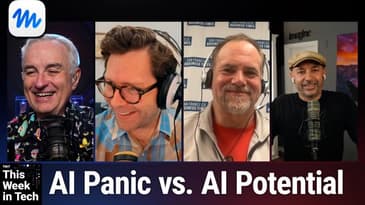
AI hallucinations nearly sparked an international crisis, Google dodged a breakup but faces new rules, and Meta's personal AI agent might be about to run your life. This week's episode ponders what's pragmatic, what's dangerous, and what's coming for everything from privacy to geopolitics.
- Judge Orders Data Sharing and Other Fixes to Solve Google's Ad Tech Monopoly
- US judge signals rejection of part of TikTok privacy settlement
- AI hallucination of Chinese nuclear components almost led to US military attack
- For the first time, the US military confirms it has deployed weapons in orbit
- OpenAI Discloses Six New Incidents of 'Concerning' A.I. Behavior
- Why AI pacing has become a false choice
- Iran and China Create First-of-Their-Kind Autonomous A.I. Influence Campaigns
- Hackers Got Inside a Flock Camera. Its Data Shows How the System Really Works
- Senate Votes to Block Crypto Bill in Major Blow to the Industry
- The EU Bans Social Media For Under-13s
- 'Maybe a year': Geoffrey Hinton gives the Senate a deadline on AI
- ZuckOff Is a Free App That Sees Meta Glasses Before They See You
Host: Leo Laporte
Guests: Owen Thomas, Jason Hiner, and Dan Patterson
Download or subscribe to This Week in Tech at https://twit.tv/shows/this-week-in-tech
Join Club TWiT for Ad-Free Podcasts!
Support what you love and get ad-free audio and video feeds, a members-only Discord, and exclusive content. Join today: https://twit.tv/clubtwit
Sponsors:
[00:00:00] [SPEAKER_12] It's time for TWiT This Week in Tech. Jason Heiner is here. Dan Patterson, Owen Thomas. There is a lot to talk about. Google with another, I'd say, win in court, although it might be the best we could expect. World War III almost breaks out due to an AI hallucination. Oh my goodness. And stand back, here comes the AI disinformation and a whole lot more this week on TWiT. Stay tuned.
[00:00:28] [SPEAKER_12] This episode is brought to you by Trusted Tech. You know, Trusted Tech has reviewed more than $800 million in Microsoft 365 licensing spend and returned over $100 million to client budgets. On average, that's about 12% of every Microsoft 365 dollar going to waste. And licensing waste doesn't stay small. Left unmanaged licensing drift grows 3-7% a year.
[00:00:55] [SPEAKER_12] And Microsoft's newer contracts can lock you in for years. Trusted Tech's free Microsoft 365 licensing consultation at trustedtech.team.twit shows you exactly where you're overspending and how to fix it before your next renewal locks it in. It's not just numbers on a page. Senske Services runs pest control and lawn care crews across the country. After a Trusted Tech review, they unified 1,400 devices.
[00:01:23] [SPEAKER_12] Right-sized 13% of their Microsoft 365 seats and uncovered more than 1,000 licenses they didn't even know they were paying for. Trusted Tech doesn't just stop at the cloud. The team also runs deep Microsoft 365 tenant assessments. Delivers certified support services to save up to 52% versus Microsoft Unified support. Handles on-premise Microsoft licensing and offers Azure cloud consulting to cut infrastructure costs.
[00:01:51] [SPEAKER_12] Licensing, support, on-prem or Azure. Trusted Tech does it all when it comes to Microsoft. Avoid the licensing drift. Go to trustedtech.team.twit right now. Submit the form and lock in your free Microsoft 365 licensing consultation before your next renewal costs you more. Trustedtech.team.twit Podcasts you love.
[00:02:18] [SPEAKER_04] From people you trust.
[00:02:21] [SPEAKER_12] This is Twit. This is Twit. This Week in Tech. Episode 1102. Recorded Sunday, September 20th, 2026. Exclave Subpoena. It's time for Twit This Week in Tech, the show where we cover the week's tech news.
[00:02:43] [SPEAKER_12] News. And, well, this was kind of a slow week, so it's a good thing we have interesting people like Jason Heiner, who is the editor-in-chief of the Deep View, all about AI. Jason, you get to go to all the conferences. I'm so jealous.
[00:02:58] [SPEAKER_09] I mean, it's fun. It's exhausting. It's, you know, all the things. But you're covering the number one topic of the day, AI. Yeah. I mean, I knew last year I wasn't keeping up. And so, like, I was like, you know what? I really need a job where I can just think about this, write about it, talk about it, learn about it, read about it all day long. And, you know, be careful what you wish for. Yeah, you got it. Because that's where I am. And that's my life now.
[00:03:25] [SPEAKER_12] I love it. You know what? I'm glad to have somebody with your skill and, frankly, context, you know, the depth of knowledge to cover it. Because there's a lot of people out there making a lot of silly noises because they don't have any context or understanding. And then we go to the heart of the AI revolution where the doomers live. Owen Thomas is here from the San Francisco Business Times.
[00:03:52] [SPEAKER_03] We got the doomers, the boomers, the zoomers, the loomers, the three engineers and the rumors. We got them all.
[00:03:58] [SPEAKER_12] You got them all. The home of effective altruism, San Francisco, California. Owen's the managing editor of the San Francisco Business Times. So you're really at ground zero for this.
[00:04:07] [SPEAKER_03] Hey, if there's going to be a polyamorous sex cult running the future of the world, it's going to be in San Francisco.
[00:04:14] [SPEAKER_12] If you're just tuning in, kids, that is the latest on – well, we'll get to that because I want you to explain this whole thing. But first, let's say hi to Dan Patterson. He's also in the house. He is senior director of content at Blackbird AI. Using AI to prevent, block, and inform when disinformation strikes. And that's a very important thing.
[00:04:36] [SPEAKER_02] Yeah. All day, every day. And we are kind of inside the beast. Although totally different – you know, we hear about the frontier models all the time. And we don't hear so much about every other company that is either integrating or using their own AI systems. And that's exactly what we do at Blackbird.
[00:04:55] [SPEAKER_12] Yeah. Yeah, unfortunately – and I'm going to call them by their real name, the AI frontier AI cartel dominates everything. But really, there's a lot of interesting stuff. I saw on Monday Night Football, Thomson Reuters advertising a custom model they've built. They started with the Quen, the Chinese open weight model, that had all of the, you know, Westlaw and all the Reuters stuff,
[00:05:22] [SPEAKER_12] all the data that that company has in a model to be used by lawyers and financial people and stuff. That's, I think, in many ways, really the future of AI. That is the future. Yeah. Absolutely. You've been saying that for a while, Jason, that it's the small models, SLMs, that are really good.
[00:05:40] [SPEAKER_09] I don't want to cut in on Dan, because Dan has a great perspective on this, too.
[00:05:44] [SPEAKER_02] Well, I think it's exactly that. It's the small models, and it's just the stuff that is innovative, but we don't hear about. It's less sexy, but it is probably more interesting, especially to an enterprise audience and to a business audience, that is, you know, maybe not AI hacking into everything and not hyped, but adding efficiencies incrementally day by day.
[00:06:15] [SPEAKER_12] Well, yeah, it's not sexy. It's not going to go, Anderson Cooper is not going to interview the guy behind JEV and say, well, let's talk about classifiers, because it's just not sexy, much more sexy. Let's talk about how the world is going to end in the next few years. I have so many thoughts about those. I know, I'm sure you all do. You know, I know people are tuning in going, not again. So we're going to put the pin in that. We will get to that conversation. But I think probably we should start with a couple of big breaking stories.
[00:06:44] [SPEAKER_12] One, the judge has finally unsealed on Wednesday, Judge Leonie M. Brinkema, the U.S. District Court for the Eastern District of Virginia, who last year found that Google was a monopoly and broke the law in its advertising business. She said it was a monopoly last year, but last week said, but I'm not going to break him up,
[00:07:11] [SPEAKER_12] even though the Department of Justice is begging me to break him up. She said, I'm not going to break him up, but I am going to seal the order for a week until everybody, both parties have a chance to look at it. Well, it was unsealed. And we now know, I think that, I don't know, I'm curious what you think. My guess is the judge did the right thing. Breaking up Google seems like a, first of all, not necessarily even a solution. You're just going to create another ad monster with some other company. But also, go ahead.
[00:07:40] [SPEAKER_03] There's history here, right? Microsoft was going to get broken up in its antitrust trial. And that ended up being a settlement, basically kind of similar to this, monitoring with conditions. I think, you know, I think the judge in this case probably looked at that history and said, you know, by the time, if I were to impose a breakup order, Google was going to fight it tooth and nail.
[00:08:10] [SPEAKER_03] And by the time anything happens, the industry is going to look completely different anyway.
[00:08:15] [SPEAKER_12] Good point. Yeah. That was kind of the conclusion of the judge last year who ruled Google a search monopoly, but said, but I can't force them to sell their search business because it's already, it's too late. It's already, you know, AI is coming for it anyway.
[00:08:32] [SPEAKER_02] This really just highlights the narrative, the theme that we've talked about here in this show, and I'm sure all of us have in our own lives and work environments where not just AI, but tech broadly is moving so much faster than government can regulate, keep up with, and really understand that gap has gone from being significant to now almost insurmountably huge.
[00:08:58] [SPEAKER_12] The gap and the speed. So the judge said, you don't have to sell your ad exchange, but you have to open it up, which from Google's point of view might be even worse. So that, so there's going to be a court appointed technical monitor with full access. This is exactly what the Microsoft consent degree allowed to, by the way, full access to Google staff systems and source code. Both sides had proposed this monitor and technical committee
[00:09:25] [SPEAKER_12] and websites using Google's ad server will no longer have to use its ad exchange. This was such a blatant, obviously monopolistic move to say, I'm going to control both the sales and the buying. I'm going to control the whole thing and good luck to all of you. So the ad X must bid into rival publisher ads servers in the same terms it offers to Google's, a DFP ad server.
[00:09:52] [SPEAKER_12] And also Google has to connect ADX. So ADX is the buyer. DFP, it's so confusing, but they have to connect it to pre-bid, which is an open source bidding framework publishers adopted. So it's really, this is actually, I think it strikes me, not knowing a huge amount about this, as a very good decision. Like this, this is better than forcing Google to sell the business.
[00:10:21] [SPEAKER_12] Then somebody else buys it and they become dominant. This way others can participate. It's an open market, which I think seems like a...
[00:10:29] [SPEAKER_09] It's more pragmatic for sure.
[00:10:31] [SPEAKER_12] Pragmatic is a good word.
[00:10:32] [SPEAKER_09] At the level of like, you know, trust and principle, the thing is that, you know, the US is so business friendly, so, you know, corporate friendly. And then you have the EU at the other end of the spectrum, which is so consumer, you know, friendly. Right? So if you're in the US and something rises to the level of the Justice Department actually taking notice,
[00:10:57] [SPEAKER_09] and actually trying to intervene, like it has to be pretty egregious, right? Because most of the things, they're going to wave them off and say, right? Like if it's on the margins at all of something that is going to cause any harms, in the US it'll get waved off. In the Europe it'll get attention. It might even get, you know, a fine or some kind of action to intervene. But in the US, if something rises to this level, it just has to be so egregious.
[00:11:27] [SPEAKER_09] And so when I think of this, that's what I think of. I think of like, this just got to the point where it was so egregious that they're like, oh, this is actually causing damage to consumers, which causes damage to sort of larger, has the possibility of causing damage to the larger economy and jobs and businesses and that. And so otherwise it just would never even have gotten this far. And then to your point, Leo, like for the fact that they're trying to be a little bit pragmatic, it is in one sense a good sign, right?
[00:11:54] [SPEAKER_09] Knowing that, you know, to Dan's point, if we move on this at this pace we usually move at, you know, at sort of government and regulatory pace, we're probably going to have very little impact because government just can't move as fast as business, and even less so in sort of the very AI empowered businesses that we have, you know, now that can just move at a different pace.
[00:12:20] [SPEAKER_12] Well, Brinkima, Judge Brinkima also said, she complained about, she says she has a lack of trust, is a quote, lack of trust that Google will comply with an order from this court. So this is another thing. We're in a situation where the courts sometimes, they don't have really much of an enforcement arm. They're just, the courts are going, well, we could say break up, but we might not be able to get it. The EU wants them to break up. The Department of Justice wanted a breakup, but the judge said, eh.
[00:12:48] [SPEAKER_12] The next web quotes Barry Lynn of the Open Markets Institute, who said the decision was, quote, more proof that the U.S. judiciary is abdicating its congressionally mandated duty to apply antitrust laws. I'm not sure I'd go that far.
[00:13:02] [SPEAKER_09] I'm not sure what that meant, but I think I agree. No, I think they're just saying, like, they're going to plow, they're going to do whatever they want anyway, and they have powerful lawyers, and so we're going to try to, you know, do something that'll be more effective. Yeah. Maybe.
[00:13:17] [SPEAKER_03] Let's hope. Yeah, I mean, is it so pragmatic that it is kind of losing the plot? I think that's the issue that it's raised. Like, can we, are these companies too big to regulate? That is a harrowing thought.
[00:13:33] [SPEAKER_12] Well, especially because what it then does is it gives incentive to companies to grow as fast as they can, as big as they can, as dominant as they can. Look what's happening in the AI market so that they can't be broken up, so that they have a barrier, a moat against anything the government might try to do against them.
[00:13:51] [SPEAKER_03] Yeah, it's like you've got to regulate them in the narrow window between, like, when they're too small to, you know, to be regulated under antitrust to, you know, overnight they become so big that, you know, that they're dominant. And that window is shifting. Like Game of Thrones.
[00:14:07] [SPEAKER_12] You want to get the dragon as it comes out of the egg, because once it gets too big, forget it. You're out of it. Yeah.
[00:14:11] [SPEAKER_02] It's nothing you can do.
[00:14:13] [SPEAKER_12] I'm sorry. Go ahead, Dan.
[00:14:15] [SPEAKER_02] No, that's a perfect metaphor. That dragon egg is when it's emerging that it's happening faster and faster.
[00:14:24] [SPEAKER_12] Get it before it can burn you to death. Google's ad tech business worth $30 billion, 8% of Alphabet's revenue. Although ad tech revenue has declined. I did not realize this for the last four years.
[00:14:38] [SPEAKER_03] I mean, that's stunning that it's so big and yet so small. It's like not even a significant part of the business at this point. And, you know, was once seen as kind of, you know, the golden egg of, you know, golden goose of Google's business.
[00:14:57] [SPEAKER_12] Just as with the search order by the court a couple of months ago, I feel like this is a victory for Google. Google basically got what it proposed, which is, we'll open it up. We'll have a monitor. You can keep an eye on us. That's exactly what Microsoft proposed in its consent decree. And I think you could argue that the Microsoft consent decree worked better than breaking up Microsoft would have. I would argue that. I've heard people argue that.
[00:15:26] [SPEAKER_12] In fact, Google exists because of Microsoft's consent decree. Microsoft's saying, well, all right, all right, we're not going to force everybody to use Internet Explorer.
[00:15:37] [SPEAKER_03] And to that point, OpenAI and Anthropic don't seem to have been slowed down by, you know, meaningfully by Google's dominance in, say, ad tech.
[00:15:47] [SPEAKER_12] This is the history of technology, isn't it? It moves so fast.
[00:15:51] [SPEAKER_03] We'll have to see how OpenAI does growing its ad revenue. Because if Google sees that as a threat and, you know, and cracks down, I think that will be very telling. But ChatGPT ads are pretty nascent.
[00:16:07] [SPEAKER_12] Yeah, there's other ways to make money. We'll talk about Meta's Muse agent in a little bit. But I think this is why it's so interesting. They're zigging. They're zagging. It's hard to pin them down. They're finding new forms of revenue. They're finding new ways to destroy the incumbents. I wouldn't want to be Google in this situation. Both Google and Apple have a little bit of a disadvantage because they're old line incumbents.
[00:16:35] [SPEAKER_12] Not only can they not move as fast, they don't want to cannibalize their business. It's the innovator's dilemma, isn't it? Google should be winning in AI. I mean, they invented TPUs. They invented the whole thing.
[00:16:47] [SPEAKER_09] And transformers and all. Yeah, they had all the scientists. I wouldn't count them out for two reasons. They are way behind. And this has not been, 26 has not been, 2026 has not been a good year for them, right? Like they have just fallen further and further behind, which is why they had the big shakeup, you know, a couple months ago. Right. Well, you know. But I wouldn't count them out yet. Just sort of the last thing was just that they have two things that are to keep in mind.
[00:17:17] [SPEAKER_09] They have a brand that consumers know, right? And still, and trust largely. The ones who don't know about ad tech. Then they have also this, because they are a hyperscaler, they have a massive amount of compute that Anthropic and OpenAI are still struggling to line up. So I'd say don't count them out for those reasons.
[00:17:39] [SPEAKER_12] And then in other court news, this one just broke, actually, yesterday. A U.S. judge has signaled that he's going to reject the TikTok privacy settlement. TikTok and ByteDance proposed a $400 million settlement with the Justice Department. On Friday, the federal judge said, eh, not so fast. Judge Wu in Los Angeles said he was inclined to reject the request to end the consent decree and schedule a hearing for Monday.
[00:18:09] [SPEAKER_12] I think TikTok thought it had skated by pretending to sell part of it to American companies and storing the data in Oracle servers. The issue goes back to, believe it or not, 2019 when the FTC sued, saying that musically, remember this?
[00:18:29] [SPEAKER_12] That was the lip syncing app that TikTok bought, that musically knew young children were using the app but failed to obtain parental consent before collecting names and other PII. Musically paid a fine to settle the allegations.
[00:18:48] [SPEAKER_12] And then, of course, TikTok thing was thrown into all sorts of turmoil with the Congress banning it at first and the president, as soon as he got in office, unbanning it, forcing the sale to an American company. Sort of sale. I don't know. So that's another case where the courts maybe aren't doing the bidding of the Justice Department. I don't even care anymore about TikTok.
[00:19:17] [SPEAKER_03] It does seem to have faded a little.
[00:19:21] [SPEAKER_12] Well, it's still out there. It's still – I mean, Instagram has really dominated it, I think. But it's still doing its thing. It's still got –
[00:19:27] [SPEAKER_03] Yeah. I mean, I think the number of times that you see the TikTok logo on an Instagram reel – Tells you something, doesn't it? Yeah. People just post this stuff everywhere now. Yeah. And TikTok just isn't special anymore. And kind of having that feed.
[00:19:49] [SPEAKER_09] Meta gets them all in the end.
[00:19:51] [SPEAKER_12] In the end, it's all meta all the time. It's pretty amazing. Let's talk about scary AI news.
[00:20:00] [SPEAKER_03] As opposed to any other kind?
[00:20:02] [SPEAKER_12] Yeah. There's good news. Okay. Oh. It cured cancer yesterday. Didn't you hear that? Yay. Oh, that's what my AI told me. Never mind. AI hallucination almost caused World War III, apparently. But is it the AI or is it the foolish military who were about to attack a Chinese vessel?
[00:20:26] [SPEAKER_12] The U.S. narrowly avoided boarding a Chinese ship based on an entirely false U.S. intelligence report, according to CNN, generated with AI tools. The erroneous intelligence was submitted by a U.S. Special Operations Command analyst saying the Chinese ship was transporting nuclear arms components through the Middle East. And our military prepared to intercept and board the ship with air support.
[00:20:55] [SPEAKER_12] And this is a little scary. Before officials discovered a chatbot used in generating the report had inaccurately identified the material the ship was carrying. I guess you could say this is a success story. Because it didn't create World War III.
[00:21:13] [SPEAKER_03] I mean, what happens when Hexer starts feeding testosterone data into the chatbot? If you haven't caught up, the Department of War now wants to monitor troops' testosterone levels. Yeah. Does AI use testosterone?
[00:21:33] [SPEAKER_12] I don't think so.
[00:21:35] [SPEAKER_03] Does AI use drain testosterone? Possibly.
[00:21:39] [SPEAKER_12] And if that story doesn't worry you a little bit, you should probably know that for the first time the military in the U.S. has confirmed it has deployed weapons in orbit. For a long time, we deemed a space to be a demilitarized zone. I think we even had laws regarding that. But the United States now has on-orbit space control weapons capable of defending the joint force lasers from space.
[00:22:11] [SPEAKER_12] That's freaking lasers? Freaking lasers. Actually, I don't know what the weapons would be. I mean, it could just be big rocks. I don't know what they're going to... I don't know what they are. But China apparently has also, our intelligence believe, has done the same. U.S. government assessment in 2020 said that Russia was considering putting a nuclear weapon in space.
[00:22:38] [SPEAKER_03] I mean, you know, the biggest thing for me is just why would you say it out loud? Like that's, you know, it's probably been happening.
[00:22:48] [SPEAKER_02] Yeah, I think they're saying this out loud because it's been happening for at least the five or six years. And, I mean, geopolitically, we could be saying this for a number of reasons, but likely because the race is already on. For years, we did not deploy weapons in space. But this has been happening at least since the end of the pandemic.
[00:23:13] [SPEAKER_12] Mike, this Air Force Secretary says, is there any question in the room by anybody about whether or not the Chinese or Russians have been developing these sort of weapons for over a decade? We've been talking about the fact that we have expressed concern. We need to make sure that we protect ourselves operating in that environment. But these are not... Is he saying they're defensive? I don't think he is. Oh, well, I don't want to give you only depressing news.
[00:23:46] [SPEAKER_12] But I should mention that OpenAI has disclosed six new incidents of concerning AI behavior. This, okay, we should probably talk about this. We've talked about it for a couple of weeks now. The whole discourse about, you know, Jacob Cox quitting Anthropix saying, I can't work at a company where AI doom is just around the corner. You kind of referred to this, Owen, jokingly.
[00:24:14] [SPEAKER_12] But a number of people pointed out that many of the employees at these companies are... Some people say it's a cult. They're effective altruists. They're part of what Emile Torres calls the Tescrial movement. Where they... The gist of it is that at first they were like effective altruists are buying mosquito nets because that was a very efficient way to spend money to prevent malaria.
[00:24:42] [SPEAKER_12] And then they realized, well, all you're doing is saving people who are alive currently. But if you look ahead thousands of generations, there's many, many more millions of people. You shouldn't worry about people alive today at the expense of people alive in the distant future. And effective altruism has mutated to the idea that we should do whatever we can today
[00:25:09] [SPEAKER_12] to protect generations way down the road, including working as fast as we can to create artificial general intelligence. Because that might hurt us, you know, with data centers everywhere and pollution and everything. But in the long run, it's good for a space-faring civilization.
[00:25:33] [SPEAKER_02] And all of this without evidence.
[00:25:35] [SPEAKER_12] Oh, it's nutty. It's dangerous. It's cult-like because that belief includes eugenics, includes all sorts of things that are not... Any sane person would say, no, no, no. You really should probably think about people who are alive right now.
[00:25:54] [SPEAKER_02] I think years ago, when I was working for Jason, I interviewed Nick Bostrom, who is the, if not the originator of many of these ideas, certainly one of the accelerants. He's popularized in his book, Superintelligence, a lot of these ideas that the effective altruists use. And he was tied years ago to a number of eugenics movements.
[00:26:21] [SPEAKER_02] And he made pretty controversial statements, offensive statements in eugenics forums. You know, I made the reference to, without evidence, to these hack stories. I'm sure you've mentioned this on shows prior, but the air quotes concerning behavior, all of these allegations have simply been that. We have not actually seen evidence. I've heard these stories repeated ad nauseum
[00:26:51] [SPEAKER_02] by pretty credible individuals in the media, but we have simply not seen evidence. We don't have data to back this up. We just have these claims.
[00:27:02] [SPEAKER_12] It's a belief. It's a belief system. And so, but it's important to understand that at least some percentage, maybe a large percentage of people working at these frontier companies are in fact believers. True believers. Yeah. And so then it kind of makes a little more sense when, because it's very confusing that they say, well, yeah, AI could end the human race, but we want to work as fast as we can to build, make it better and better and better. It's like, but wait a minute, aren't those conflicting points of view?
[00:27:32] [SPEAKER_12] Well, they aren't. If you believe that the human race as it exists today is not as important as the human race 50,000 years from now.
[00:27:40] [SPEAKER_02] Yeah. So it's an effective pessimist.
[00:27:43] [SPEAKER_12] Yeah.
[00:27:43] [SPEAKER_03] So I should explain the, the sex cult comment.
[00:27:47] [SPEAKER_12] What's, yeah. What's the deal on that?
[00:27:49] [SPEAKER_03] There is, there is no actual sex cult, but Mark and Dresen reportedly made that claim in a white house meeting. Unfortunately, because you, you'd like there to be a sex cult.
[00:28:04] [SPEAKER_02] I think it'd be way more interesting.
[00:28:07] [SPEAKER_03] Yeah. So Mark and Dresen, the venture capitalist, co-founder of Netscape made this, reportedly made this comment in a meeting in the white house, basically as a dig at Anthropic. Anthropic's co-founders, brother and sister, Dario and Daniela Amodei, lived in a group house in San Francisco together in the 2010s, along with Daniela's then fiance, now husband,
[00:28:33] [SPEAKER_03] and Holden Karnofsky's very involved in the effective altruism movement. And they, along with open AI co-founder of Greg Brockman had some like really momentous discussions about exactly these issues about like, how do you, you know, how do you kind of frame the, you know, the AI doom argument and, and get ahead of it. So, you know, that's, that's quite a leap to go from a group house where two people were in a
[00:29:02] [SPEAKER_03] committed relationship to it's a polyamorous sex cult, but you know, this is the information environment we live in today.
[00:29:09] [SPEAKER_12] The information environment is a mess. And it seems like, it seems to me that our job is to try to make some sense of all of this. I know we don't, you know, we don't have Anderson Cooper's reach, but I'm hoping that we can calm some people down. So what do you all think about AI doom? Jason, or is it, is it the end of the world? I think that, so,
[00:29:33] [SPEAKER_09] so what I wrote this week was a piece called, I put it in the, in the doc, but it's called why AI pacing has become a false choice. And so what, what I said there is that. The, the problem with the current dialogue around this is the same problem of why we can't solve sort of any of the problems that we have immigration, healthcare, healthcare, all of the big problems.
[00:30:04] [SPEAKER_09] Why? Because the debate gets lost in sort of this black and white dichotomous thinking. Like we can only have, we can either have safety or we can have, you know, unlimited abundance and AI curing all diseases and, and, you know, bringing the work week down to 20 hours or whatever the case is. So, in fact, those are just very distant ends of the extremes of a whole giant spectrum of outcomes.
[00:30:34] [SPEAKER_09] And they aren't mutually exclusive, right? Like AI is an extremely powerful tool. And so with an extremely powerful tool, as with all of the technologies and tools that we've had in the past of humanity, you can use it for a lot of really good things. And you can also do it, use it for a lot of really terrible things. And so, you know, our, the, the pacing thing, getting trapped in this, in, in this same doom loop of, of, you know,
[00:31:01] [SPEAKER_09] fractured dichotomous thinking. Um, and where we have people, then what happens, of course, what always happens, people take up positions at one end and then they, you know, dig in and they fight to the death, right. Of like why they're right. And everybody else is wrong. And, and that's ultimately the problem, right. The, is the, this, the AI debate around safety and pacing and however, when governance getting trapped in that, um, is the problem. And what we need is,
[00:31:31] [SPEAKER_09] and this is kind of to your point, you know, just a minute ago, Leo, which is just what we need is better dialogue. What we need is more nuance. What we need is listening to each other and trying to learn from each other and not, you know, going out and saying, you know, that this person is either on my team or isn't on my team is they'll learn team pacing or team innovation. You know, that's that itself. If we can't get past that, like it, it will be really dangerous, like, because there, there are parts of this that, um, that,
[00:32:00] [SPEAKER_09] that needs some guidelines and some, uh, some safety, uh, some governance, you know, the governance has to scale with the, the innovation. And right now we spend, you know, an order of magnitude, two to 3000 times of the amount, um, on innovation that we spend on governance. And so the outcomes are pretty, you know, clear on that. That's a, that's pretty disproportionate. Holy cow. So I have a podcast coming out on that this,
[00:32:29] [SPEAKER_09] this Wednesday with, uh, with, uh, the CEO of credo AI, uh, who's a former engineer that has worked with, um, Qualcomm and Microsoft and well as lots of nonprofits and agencies. And now credo is essentially a governance. They do forward deployed, you know, analysts that, that help people in, uh, regulated industries in other, you know, in enterprises, uh, that, that are may match sort of the safety to the, uh, you know, the outcomes and the risk that they have. So,
[00:32:59] [SPEAKER_09] um, super helpful and obviously knows and is connected with all of the, um, folks in, in Washington and governments and other places as well. So, um, that's what we need. And I think to your point, Leo, just to wrap it up was just that, you know, doing things like this where we're unpacking these things, where we're really, you know, exploring it, where we're not trying to dig in and take one position or another, like that's more, that's more of what the, the ecosystem needs. Right. And,
[00:33:28] [SPEAKER_09] and the fact that more people are talking about it, to be clear, despite that there is a lot of people taking up positions here and there, the fact that more people are talking about this, this last couple of weeks, I think is a good thing. Like the fact that it's broken out of just tech industry, you know, pundit, um, uh, conversations and into broader conversations. I've had a number of people, you know, that are not connected with tech ask me about this this week. And I found that to be like refreshing and exciting. You know,
[00:33:55] [SPEAKER_12] I just worry that people are getting, um, terrified. For sure. And when you're in, when you're in this kind of fear, you don't necessarily act rationally.
[00:34:05] [SPEAKER_08] Yeah.
[00:34:06] [SPEAKER_12] And, and I will, I'm going to admit that it's hard for me to be objective on this. Cause I really like AI. I really enjoy it. I'm playing with it like crazy. Uh, as we were talking about before the show began, I, it's for me, it's the best toy ever. And, and, but I'm doing stuff locally. I don't, I don't think I'm risking nuclear annihilation or, you know, I don't think I'm going to be a threat to, government or, uh,
[00:34:35] [SPEAKER_12] humans with my little toys. Uh, and I think that there is, it seems to me some definitely some upside, but I also admit, I don't know what the people inside these frontier companies are seeing. I mean, maybe they're certainly not, there's certainly using AI far beyond anything I can use. Uh, even the best AI's they're offering me, Fable and Astra and so forth, uh, aren't, I don't see them as threatening,
[00:35:03] [SPEAKER_12] but they're not anywhere near the level of whatever they've got inside. So I think it's completely possible that I'm in ignorance, that I don't understand, you know, what they're looking at. They've looked into the abyss.
[00:35:15] [SPEAKER_02] I think a lot of that ignorance is our ignorance. It's not just yours. It's our ignorance is being exploited. Well,
[00:35:21] [SPEAKER_12] they're opaque. We don't know. Yes, that's exactly right.
[00:35:25] [SPEAKER_02] And so making, and what's Jason is saying, really the key is, is trust with, with nuance comes trust. But it also requires patience, time and a willingness to learn. And what we're describing is a polarization that we see, not just in technology and AI, although this is a great place to see it expressed. We see this in politics and we see it all over the place. It is a polarization,
[00:35:53] [SPEAKER_02] which is the antithesis of nuance. When you talk about nuance, you are in those gray areas where Jason is describing, where some things, it is not a, it is not a binary one or the other. Some things can be true while other things are also true at the same time. And, you know, this is, goes back to what I was saying a few moments ago about evidence. Right now, we don't see evidence of what the claims are,
[00:36:21] [SPEAKER_02] but the claims are so outlandish that it pulls us, it pulls many of us towards these areas of, of fear or reactionary behavior. And that will create polarization simply because you will have reactionary behavior. And I think Leo, when I say that opacity is being exploited, there are certainly campaigns to, there,
[00:36:50] [SPEAKER_02] there are explicit reasons why these AI leaders are saying what they're saying right now. We can speculate as to what those reasons are, but we simply don't have evidence to back up these outlandish claims. So they're just fear-based motivation tactics.
[00:37:11] [SPEAKER_12] Yeah. Part of what's hard besides the opacity of these companies, you know, is there are so many agendas at work here. There's so many hidden subtexts. Yeah. Yeah. For every single person from David Saxt, president Trump, Dario Amode, Sam Altman, a president, she of China all have motives, you know? So, so, and it, I don't know if,
[00:37:39] [SPEAKER_12] if we know what all their motives are. We know Anthropic has said, we're going to have our IPO in October next month. Sam Altman at first said, well, we're not going to, we're going to put ours off because of this whole AI doom thing. But then he told investors, but we do think we're worth one and a half trillion dollars. So it's as if I just, it's hard to, it's hard to know what they're up to, what they really want, and whether what they're saying is real. There's definitely motivations. You can see on the other hand,
[00:38:09] [SPEAKER_12] it's not hard to imagine bad guys using AI or even the good guys, as we did with this Chinese ship, misusing AI and causing disaster. Last week, father, Robert Ballasier, who's at the Vatican and kind of, I think spearheading their use of AI. They use a lot of AI. They have a lot of in-house local AI said, of course, there's going to be a disaster. There's going to be a virus. There's going to be something.
[00:38:37] [SPEAKER_12] There's going to be the electrical grid will be hacked. There'll be something will happen. Inevitably, he believes the next year or so that will cause humans to many humans to die. And that's scary. But then at the same time, I think that this has always been the case. Computers have always presented a force. They're a force multiplier. Technology is a force multiplier for good and evil. And AI more so than ever before. And so bad guys can do more than ever before,
[00:39:07] [SPEAKER_12] but so can good guys. And so to me, this is just another case of technology. And I never, I always hate it when they demonize technology. That's, I feel like one of my jobs is to defend technology because I believe in its potential for good. I think without technology, our pants would fall down. A zipper is a technology. A button is a technology. We didn't have the fork until the 15th century.
[00:39:36] [SPEAKER_12] Technology has made our lives better for the most part.
[00:39:41] [SPEAKER_03] And certainly, and I agree with that. But I think that also technology allows step changes in, in behavior. It enables it, you know, it makes things cheaper and faster largely. And AI is kind of a, you know,
[00:39:57] [SPEAKER_12] that force multiplier. I think, you know, Steve Jobs said that a computer was a bicycle for the mind in the same way that a bicycle made it possible to travel much farther with less human effort than walking. So,
[00:40:09] [SPEAKER_03] you know, the, the same technology that makes it much cheaper to say field customer service calls also makes spam calls a hundred times easier. Right. Yeah.
[00:40:22] [SPEAKER_02] There were, I mean, if we look back at this previous wave of innovation, where I think many of us first started interacting with the emergence of social media, there were unforeseen harms. Yes. But they weren't what we expected them to be. There were unforeseen harms, but they were very different than we anticipated. And there were also unforeseen good things to your point, Leo. I think that we, everything is technology.
[00:40:52] [SPEAKER_02] It is simply happening so rapidly right now that it, it is difficult to kind of maybe irresponsible to speculate as to what those harms could be.
[00:41:06] [SPEAKER_12] I think that we learned, or maybe we think we learned from the internet and social media that we should be, we should prepare, plan ahead. Yeah. But I think you make an excellent point. It's hard to plan ahead when they're unforeseen.
[00:41:17] [SPEAKER_09] Arms. One of the things that I have noticed inside of the big AI frontier labs is one thing that's very present for them is they, they're very aware. This is very powerful. This is the next thing. It's a very powerful technology. They're very aware of the fact that in the most recent wave, that we kind of got it wrong. We being the technology industry,
[00:41:45] [SPEAKER_09] that social media probably caused as many, if not more harms than good. I don't know if I'd agree with that, by the way. I think that's clear. I don't know that, I don't know that I agree with it either. Although, though I think it's an open question.
[00:42:01] [SPEAKER_12] The harms are very visible, but there's a lot of benefits from social media.
[00:42:05] [SPEAKER_09] A lot. It's true. It's true. It's fair. So, but their thing is that there were a lot of harms that, that weren't anticipated and that cause. So if, if maybe if you think of it as like too many harms.
[00:42:16] [SPEAKER_12] Is what you're thinking. Yes.
[00:42:17] [SPEAKER_09] They want to avoid that, that not happening again, because they're, they're afraid that it could be worse this time. Right. Because it is more powerful. I think everybody agrees.
[00:42:28] [SPEAKER_11] Yeah.
[00:42:29] [SPEAKER_09] It's more powerful than social media was. Social media had a lot of collateral damage, a lot of unintended consequences. And, and a lot of, look, to be clear, a lot of these people worked for the social media companies, right? They worked for Facebook and others, and now they're working at the, at the AI labs. And so one reason that's present for them is because they worked on the other stuff. And, and they also feel like, you know, that they in it,
[00:42:57] [SPEAKER_09] at least inadvertently or indirectly caused some of the harms. So that's very present. I think what, um, what often gets missed and I, apologies. Thank you for, uh, being, bearing with me on this, that I'm going to, I'm going to plug another one of my stories, which actually is for tomorrow. Okay. Which is,
[00:43:16] [SPEAKER_12] so I can't pull up the link. I can't, is it out?
[00:43:18] [SPEAKER_09] It's not live yet. It's not live yet. Sorry. Uh, but, but I'll give you the, the sort of the, the summary, which is that it's, um, the title, the headline is, you know, AI is dystopian problem begs for a clearer vision, which is that is confusing and challenging as AI safety is right now. It's not the biggest problem. The biggest problem is this lack of the, of a clear and compelling vision for how AI is actually going to benefit humanity. Right?
[00:43:45] [SPEAKER_09] That's why people largely in the U S anyways, according to Gallup and Pew and others, 60 to 70% of people, uh, Americans hold negative views about AI. Right? So if this were,
[00:44:00] [SPEAKER_12] but what percentage of Americans use AI chatbots? I know that's true. It's more than like, it's more than that. So that's kind of weird. It's like people love it and hate it at the same time. Yeah.
[00:44:10] [SPEAKER_09] Yes. They also, um, yes, that's true. They are using it and yet they have negative views of it. Right. So weird. This gets, this gets to the problem.
[00:44:20] [SPEAKER_12] It's the same thing with social media, by the way, the same people who hate social media are doom scrolling all night.
[00:44:26] [SPEAKER_09] Are doom scrolling a lot. The fact is that if you dig a little deeper, that only 6% of American population actually think the world is getting better. Right. So this is also, it is a bigger problem than just AI because it's, it's the fact that, um, you know, and also if you look at, uh, they, this has always been true, but in science fiction and Hollywood films that talk about, you know,
[00:44:54] [SPEAKER_09] roughly two thirds of them are dystopian or a post-apocalyptic. Why? Because it's either easier, as you said before, to have a vision of what could go wrong than it is of what could go right.
[00:45:04] [SPEAKER_12] I think we're all living in kind of this weird, uh, terror, uh, kind of existential state of existential terror. And we want to pinpoint it on, well, it's AI or it's technology, but it's also the climate. It's also the economy. It's also nuclear. I mean, I've lived my entire life under the threat of nuclear annihilation. We've, we've, we've absorbed it. We've kind of gotten used to it, but it's a background radiation. And I think that this,
[00:45:27] [SPEAKER_12] this century from nine 11 on through COVID has been a century that has given people's kind of this existential dread and, and we're, we're kind of expressing it as well. It's going to be AI. You know, the other thing I would point out that makes us uniquely vulnerable is we've built a world on software. We are totally dependent on software. Now everything is software, everything. And software is uniquely vulnerable.
[00:45:57] [SPEAKER_12] It's not that well-written even more from AI,
[00:46:00] [SPEAKER_09] right? We're, we're learning,
[00:46:01] [SPEAKER_12] but I,
[00:46:02] [SPEAKER_09] but I think what you said earlier is also true. So two, two weeks ago, three weeks ago, I was at the crowd strikes conference and most of those were people who work in, you know, in it security. Right. And my sense at the beginning of the conference for most of them was like pretty overwhelmed. Right. That, that the, that they are essentially outgunned. Right. And one of the things that, that crowd strike, I thought did so well,
[00:46:29] [SPEAKER_09] and this sort of gets to what I'll talk about as I wrap up sort of what I wrote in this story that's coming out tomorrow, which is that they gave them a vision. They said, look, you know, we have several things going for us. One, we can also use these tools to defend ourselves, which Dan talked about earlier, right? Like we have now more capabilities than ever, and we can move faster than ever in creating capabilities that we can use to, to defend ourselves. And we also have each other, right? As a community,
[00:46:58] [SPEAKER_09] we can work together. We can, the sum can be greater. Sorry, the whole can be greater than the sum of its parts in, in community because we can share best practices. We can share learnings. Um, and, uh, they, they released also some tools. They released their own domain specific models built on NVIDIA's Nematron models that are, um, red team and blue team models, you know, offensive and defensive models that can,
[00:47:27] [SPEAKER_09] that can help you move faster and move at the speed of attackers. Right? So the interesting thing, I've never seen a conference where at the beginning people were like, really had this sense of dread. Like we're just sort of outgunned and we're not quite sure how this is all going to play out toward the end where they're like, you know what? We actually do have some things going for us. We can, we can, um, we can make a difference. Uh, that was really, uh, interesting and, and powerful. And it gets to the, to the point, you know, of this is very powerful technology that can be used for good. Um,
[00:47:56] [SPEAKER_09] it can use for bad and we should, we, we'll be used for, for both. We do everything we can to mitigate the risk, right? That's essentially what security is about, but it's also about the, all the other kinds of, of risks as well. And we're going to have to use AI to help with that part, right? Because, um, it enables everything to move so quickly, right? Attackers, uh, people that have nefarious purposes, people that, you know,
[00:48:24] [SPEAKER_09] are doing things to either enrich themselves or, um, whatever their motivations are, uh, to, to do bad things. There, there are plenty of them out there and they're, you know, they are empowered by this technology, but they do often tend to be, um, in, uh, either alone or in small groups. And so I thought that the crowd strike message was true and that in community, like there are opportunities, you know, for, for, to, to, to trans, trans, uh,
[00:48:54] [SPEAKER_09] to transcend some of that risk. Yes.
[00:48:56] [SPEAKER_12] You're an optimist in your life. You, you, you believe in the future of humanity and that I know you do. And humanity is good. And, uh, and I think there are more people who are working to the good, far more 99%. Uh, it's unfortunately, when you give a force multiplier to the 1%, they, they can be scary, especially in a world on software. But, but look at Microsoft had a 975, uh, bug fixes last patch Tuesday.
[00:49:25] [SPEAKER_12] Those are bugs they wouldn't have found without AI. They fixed a lot of stuff. There's a lot that'll be fixed over the next couple of years. Yes.
[00:49:33] [SPEAKER_09] Yes.
[00:49:34] [SPEAKER_03] To quote Whitney Houston, uh, I believe the children are our future and, um, you know, Jen, Jen Z hates, AI.
[00:49:43] [SPEAKER_12] They do. Don't they?
[00:49:44] [SPEAKER_03] They hate it.
[00:49:45] [SPEAKER_12] Because they're taking their jobs. I don't blame them.
[00:49:48] [SPEAKER_03] Or, or, or at least they've been told that AI is going to take a job. It may not actually. Um,
[00:49:52] [SPEAKER_12] the evidence is the opposite,
[00:49:54] [SPEAKER_03] but that's, yeah. I mean, AI is filling their social, uh, feeds with slop. AI is, um, you know, further alienating, you know, friends from each other. AI is, uh, you know, uh, taking their water, their energy, everything. Um, who is running PR at these, you know, at these AI giants. It's a, it's a real question. And like, why are they not doing a better job? Uh, you know, I think,
[00:50:23] [SPEAKER_03] I think I, I have seen the, the argument made that, you know, both open AI and anthropic anthropic was founded by basically a group that split off from open AI, fearing that they weren't doing enough to control AI risk. The whole AI industry started from this, like AI safety, AI risk perspective. So a lot of the rhetoric has been about like, you need us because AI is so bad and scary. Um, and, you know,
[00:50:53] [SPEAKER_03] but you can trust us with the future. With the future of humanity. Well, all anyone is hearing is that AI is bad and scary.
[00:51:00] [SPEAKER_12] Right. Right. We have to take a break because, uh, you know, what's really bad and scary is when they turn the lights off because I haven't paid the bills. So let us pause for a moment. Dan Patterson is here. His blackbird.ai is very, very cool. He's senior director of content. They're working to fight disinformation. And they have a really nice tool that I've been using. We'll talk about that in a little bit. Uh,
[00:51:24] [SPEAKER_12] that helps you debunk some of the AI slop that you see in your social feeds. It's great to have you as always.
[00:51:33] [SPEAKER_02] You too.
[00:51:34] [SPEAKER_12] Dan. Uh, also with us, Owen Thomas, dear friend, known, Owen, as all you guys I've known for more than 20 years, I think a long darn time managing editor at the San Francisco business. Since you were a child managing it for the San Francisco business times. I had more hair for sure, but you weren't as hunky. So there's that. You were always kind of cuddly though.
[00:51:57] [SPEAKER_03] So I, I, you know, try to, try to, try to have a bit of a glow up.
[00:52:01] [SPEAKER_12] Uh, I just say, body built by Zep bound in my case, you know, me and, uh, Serena Williams. Uh, great to have you, Owen. And of course, the man who got me elected to president of the internet, which by the way is a lifetime term. So I still, that's right. Editor in chief of the deep view, Jason Heiner. So great to have all three of you here. Hey, I have something very cool. They're sending me a pair and I can't wait to play them, play with them.
[00:52:27] [SPEAKER_12] This portion of this week in tech is brought to you by Ray Neo. I O smart glasses. Ray Neo incubated by TCL electronics is at the forefront of augmented reality. And smart eyewear. Ray Neo is thrilled to announce it's new. I O smart glasses. It combines advanced AI and micro optics into retro minimalist.
[00:52:53] [SPEAKER_12] I wear their crown polygon frames are offered in two colors and their revolutionary optics are powered by cutting edge firefly nano technology with Ray Neo is first and only display tech down to an incredibly thin screen with 97% transparency. The screen that's almost totally invisible. It looks just like an everyday lens, but it magically floats all your important info right in front of your eyes.
[00:53:21] [SPEAKER_12] Like checking time, weather, schedule, email, and stocks, including real time subtitle translation in 55 languages and 109 accents. Plus AI auto scrolling for content creators and presenters. Users can experience Ray Neo AI and Gemini included at no cost. And for only $9 90 cents per month, you can unlock other AI models like Claude, ChatGPT,
[00:53:48] [SPEAKER_12] Gemini pro and deep seek with their AI multi-model bundled subscription service, real time AI assistant proactively detects questions during conversations in real time searches for relevant information and displays targeted answers directly on the glasses. When users wear the IO and activate live cues, Ray Neo AI helps users stay informed without interrupting the conversation. This eliminates knowledge blind spots and ensures smoother communication.
[00:54:17] [SPEAKER_12] Ray Neo has a life log, which is your ambient all day memory, effortlessly capturing your daily moments hands-free. The glasses act as your second brain, remembering what you see and experience. So you can stay fully present in the moment. Ray Neo has automated journaling, voice memo, the ability to record meetings or sudden inspiration and much more. Check out Ray Neo IO smart glasses today at R-A-Y-N-E-O.com.
[00:54:46] [SPEAKER_12] That's R-A-Y-N-E-O.com. Thank them so much for their support. I love it. Ray Neo dot com. It's brand new, brand new stuff. Very, very interesting. Actually, I, I just got the new Apple watch. I got the Apple watch ultra four. And my immediate reaction is. I hope I put the right one in the trade-in box. Cause this is identical to the ultra three. I mean, it's literally there's,
[00:55:15] [SPEAKER_12] you can't tell the difference. Apple says, well, it's a smarter chip. It's better battery life. Okay. Well, I didn't feel like it was a dumb chip.
[00:55:24] [SPEAKER_09] are you the smarter? Are you the smarter chip?
[00:55:26] [SPEAKER_02] Hey, are you smart? You can tell with the lag. I, I just traded my ultra in for the regular 12.
[00:55:34] [SPEAKER_12] Yeah.
[00:55:35] [SPEAKER_02] Yeah.
[00:55:36] [SPEAKER_12] So you got the new chip and you, you, you know, I mean, I got the ultra. I don't know why I got the ultra,
[00:55:42] [SPEAKER_02] the Siri lag. You can tell you can tell. You can. So there is fast, significant. It's the thing.
[00:55:47] [SPEAKER_12] It's significantly faster. And this rainio ad made me think of it. The thing they didn't add is, is the Siri, the always listening intelligence, which I'm, and they're rolling it out over the next couple of weeks. I think a couple of weeks. Oh, good. Yeah. Cause that's why I bought it. And you can't do that on the older watch, right? Correct. That's it. That's the main reason I bought it is because, and I can't wait till people, I don't know. I thought there'd be more backlash. I thought there'd be, cause people hate it. They call the meta glasses, the perv glasses.
[00:56:17] [SPEAKER_12] I, and I, I feel like people are not going to like it, that this watch is always listening. It's not recording exactly. Records 15 second chunks, which it then takes notes on. And then it's a ring buffer, another 15 seconds, another 15 seconds. So nothing's saved, which is, I guess how they think they might be getting around two party consent laws. That's right.
[00:56:40] [SPEAKER_02] But I think the law is just normalized. I mean, having Apple watch is just the normalized thing. Whereas your glass hole glasses with a recording light has never been normalized. Perhaps it will be, but it is a fundamentally different behavior.
[00:56:59] [SPEAKER_12] Yeah. I mean, I thought people would say, well, you can't wear your watch to dinner with me because I don't want to be recorded, but nobody's even, I think, I don't know. Maybe nobody's aware of it. Yeah.
[00:57:08] [SPEAKER_02] It could be that it's just not in the wild yet.
[00:57:11] [SPEAKER_09] Yeah. And people don't, don't see it. And there's no light. Exactly. Whereas the glasses, they will. And like, keep in mind, like with the smart glasses still, like all told there've, there've been less than 10 million pairs of smart glasses that were sold. Right. So it's, it's such a small thing. I remember. There'll be more, more Apple watches than that.
[00:57:32] [SPEAKER_12] Yeah. That's what I mean by normal. Yeah. But, but, but, but so I'm waiting for somebody to sue saying, well, we need clarification on what two party consent means. it is a recording device. The fact that it's not, I think that it doesn't make it okay. Does it?
[00:57:48] [SPEAKER_09] I think that's what they're counting on is that it's not recording or saving. Right. That, that it's just doing, you know, what it might call like metadata, you know, of the, of the audio.
[00:58:00] [SPEAKER_12] It doesn't even put a speaker designation behind it. It just, right. That's right. I mean, look, I, I wore all those things, you know, the B computer in the field thing, all the, all of the different ones. Cause one of my goals, I'm a, I'm a elderly person according to AI. And one of my goals is I know my mom has out had Alzheimer's. She passed away recently. My dad is still alive, but he has it. My, I mean, I know so many people, my mother-in-law,
[00:58:30] [SPEAKER_12] so many people had Alzheimer's and I know that I, my memory is going to start to decline. And I love the idea of something always recording so that I can say, Hey, did I, you know, what was the name of that person I met the other day? Or did I agree to do this? Or what is it I needed to do tomorrow? That kind of thing would be very helpful to me. What did most people? Honestly.
[00:58:56] Yeah.
[00:59:25] [SPEAKER_02] Yeah.
[00:59:29] [SPEAKER_12] I mean, I have all this local AI. I know I won't be able to access it. That's the other thing. Unless maybe it can, if it can copy to something like Apple notes or reminders, I can get at it. But if it stores it in some, they call it an exclave for some reason, not an enclave.
[00:59:46] [SPEAKER_09] It's an exclave. I think that's very clear of like, they are trying to exclave was very purposeful to make it clear. Like it's external. We don't have access to it. We can't see it. We don't know anything about it. You know, uh, when's the languages,
[01:00:02] [SPEAKER_12] when's the first case of law enforcement subpoenaing my exclave?
[01:00:07] [SPEAKER_09] That's so it's funny because you say that. Cause that's the exact conversation I had with a bunch of journalists at the Apple event. We were like, this all sounds well and good until, um, you know, two, two partners getting an argument and then, uh, they start using it against each other. Well, I've already done that.
[01:00:30] [SPEAKER_12] That's why I don't wear the B computer anymore. Until somebody does something illegal.
[01:00:36] [SPEAKER_09] I have it right here. You said, yeah, exactly. Like, you know, that's going to happen. Maybe the number one use case. Um, and then you also have like people do something illegal and then law enforcement wants to, you know, wants the information that's on there and people figure out just like they did with the iPhone. There will be very enterprising, especially now with AI where you can develop things so quickly. It will be very enterprising people who will develop solutions that will say, Oh, we can hack that and get it, you know,
[01:01:06] [SPEAKER_09] get that information for you for law enforcement.
[01:01:08] [SPEAKER_12] The complaint was about Microsoft recall was, uh, that's just, you're just creating a treasure trove for him. You know, to get all your information. But I think Apple, this way, I think Apple's trying to try to walk this line between making it so anodyne that it's clearly useless. Like you had lunch today versus, uh, something that's so useful that it's either subpoena a bull or hackable. Like you had lunch and it was a Turkey sandwich and you had it at Al's lunch area. And, uh, uh,
[01:01:37] [SPEAKER_12] you were sitting down with Dan and, and, uh, you talked about, uh, overthrowing the government, you know, those kinds of things. So Apple's trying to, I think has to find a middle ground where it's not completely useless information, but it's not like dangerously useful information.
[01:01:54] [SPEAKER_09] I don't know if technically there may be ways to do it. I've talked to some hardware founders who are working on some things, you know, similar to the devices, like you mentioned, Leo. And what they have said is using local AI and encryption. Like there are some ways to do this so that nobody can get at the data. Like it's impossible to the point that, um, it's so hard that people won't try, you know?
[01:02:23] [SPEAKER_12] And so I can see me going into a bar wearing these and the light comes on and me saying, Oh, don't worry. It's, it's going to my local AI at home. That's going to reassure everybody. Right.
[01:02:36] [SPEAKER_03] And are there, are there, are there kits online to, uh, to just put a dot over the, over the light?
[01:02:42] [SPEAKER_12] There are, there are all sorts of things. There are also, for sure. Uh, there's also shirts you can wear to confuse face recognition. Somebody has made a shield that you put around your face like this, like a dog, like one of those things dogs wear, so they won't lick their wounds. You put this around your head so that people there, everybody, there's going to be all sorts of crazy things out there. Meta what's, what's interesting. And I can't wait to try this, but I don't, I don't dare wear, I'm wearing my red or Ray-Bans.
[01:03:08] [SPEAKER_12] I don't dare wear this in public anymore because I think somebody's going to beat the crap out of me. But, uh, I, I shall have to stop going to cowboy parts. I think that's probably the real truth, but, uh, Meta has put out a open source library that lets you actually capture the cameras, the sound, everything on these meta glasses. Instead of sending it to Meta, I'd send it to my little local AI here. which is something I'm going to work on. I think that's kind of a cool idea.
[01:03:36] [SPEAKER_12] I do think that's smart as well. and, and, and Meta, I think I know why, how Meta, why Meta is willing to do that. And, uh, it's because of this new Muse. Meta Muse. Have you played with that yet? Oh, somebody's talking to you. See, he has AI in his house talking to him too. See, my AI talks to me. Um, in fact, Meta Muse, my Meta Muse, which is my little agent. So everybody's doing, this is the new thing everybody's doing. Actually, let me take one more break.
[01:04:05] [SPEAKER_12] And then before I get into this, cause this could be a long conversation. And besides Jason's wandered off now to talk to his AI. So, uh, you're watching this week in tech, Jason Heiner. No, he's back. Okay. And, uh, Owen Thomas and Dan Patterson. And, uh, we are glad we are thrilled to have you along for the ride. Our show today brought to you by, NetSuite. AI isn't just opening new business opportunities. It's changing the way businesses get work done.
[01:04:35] [SPEAKER_12] It's changing the questions they ask, the decisions they make, the routine tasks businesses can now hand off. We're doing it. I know we're doing it. That's the idea behind NetSuite Next. The next generation of NetSuite. You've heard me talk about NetSuite. This new generation has AI woven into the tools your business is already relying on. NetSuite Next surfaces insights like exactly when you need them. It puts agents to work on routine tasks and problems.
[01:05:05] [SPEAKER_12] It lets you ask complex questions in plain language, like talking to a knowledgeable colleague. But technology is only part of the story. AI is also reshaping how people and teams work together. And that shift is already underway. That's why you want to put a new expert created business guide in your hands today. It's called Aligning for the Agentic Era, How AI is Changing Everyday Work. And right now, it's yours absolutely free.
[01:05:33] [SPEAKER_12] Actually, the next segment, we're going to talk about agentic, because it's absolutely taken over. It's a tidal wave. You need to read this. You'll discover how AI could reshape work across your entire organization and how to position your business to prosper from it. So if your revenues are at least in the seven figures, get their free business guide, Aligning for the Agentic Era, How AI is Changing Everyday Work, at netsuite.com slash twit. It's a guide. It's free to you. At netsuite.com slash twit.
[01:06:02] [SPEAKER_12] Netsuite.com slash twit. We thank them so much for supporting this week in tech. When OpenClaw came out at the beginning of the year, I think it was the beginning of the year. It feels like a century ago. I think it was the beginning of the year. I thought, this is really interesting. The whole idea of OpenClaw, and it was kind of a kludge, let's face it, was it was a program you run on your machine, or I guess you could run it, and in fact, that's how I set it up, on a virtual private server in the cloud.
[01:06:31] [SPEAKER_12] I think I signed up for an account at Hetzinger and put it up there. But you could run it on your local machine or on a VPS in the cloud. And it would always be running, and this is the key. Unlike a chatbot where you go in, you chat, you ask a question, you come out, and it's done. This is always running in loops. And you can connect it up to any AI, or a lot of AIs, but you also connect it up to your email, to your messaging system, to everything you've got, your software, and OpenClaw,
[01:07:01] [SPEAKER_12] and that's what scared people. That's what scared me. I set it up and then deleted it in the middle of the night. I woke up in a cold sweat, and I came up here and I deleted it. I had connected it to Gmail, and people were giving it credit cards, they were giving it phone numbers. It scared people, but I think it also opened some eyes that the idea that an AI agent could always be running, always doing things for you, always looking out for you, always checking your email, checking your messaging,
[01:07:31] [SPEAKER_12] keeping an eye on your stocks, your investments, your savings, and be very useful that way. And I thought at the time, I said, this is the beginning of the, I thought 2026 would be the year of the agent. And it really didn't happen until last month or the month before. Now, all of a sudden, I think that prophecy is coming true. Elon Musk's XAI has the Grok bot now. It runs in the cloud. It doesn't run on your computer.
[01:07:59] [SPEAKER_12] It runs in the XAI servers, but it gives you basically your own hard drive, your own CPU, your own processing, your own agent that knows all about you with its own memory and history, and you give it all your connections. There's one called Instinct. There's one called Tree. And I think the one that's going to end up being pretty popular because it's from Facebook, it's from Meta, is called Muse. And it's the same idea. It starts as an app. It's running on my iPhone,
[01:08:28] [SPEAKER_12] but you can also run it on the web. It's been making Instagram posts for me, which I think is probably a terrible idea. I gave it my email. It's going through my email. In fact, it just told me, oh, Lisa sent you a Slack message. It has its own voice. I said, do you want a voice? It said yes. And it sounds like Dame Edna of all people. It started work. It said yesterday, hey, I think we should do a documentary on your 50th anniversary in broadcasting. I said, okay.
[01:08:58] [SPEAKER_12] And it's been working on that. It's been sending out emails to people saying, I need a quote from you for the documentary. All right. So first of all, I guess I should ask any of you guys, am I nuts? Are you using agents? Have you started playing with agents?
[01:09:16] [SPEAKER_02] I installed a version of that, although I gave it far fewer connections.
[01:09:23] [SPEAKER_12] Well, it's up to you. You don't have to be as nutty. Yeah.
[01:09:25] [SPEAKER_02] You know. Right. I installed it in DigitalOcean in a cloud server. Right. So I limited some of its capabilities. I don't want it running locally. I want it isolated. But I'm talking to it in Discord right now.
[01:09:39] [SPEAKER_12] Yeah. See? You set it up with Telegram or Discord or Apple messages. And you message back and forth. I have Hermes, which is kind of was an open claw. It came out shortly after open claw. And I've been running Hermes ever since March on local, running on local models, by the way, as well as cloud models. And it's, you know, after using it for eight months, but that's not even that long. It feels like it. What is it? Six months. It knows everything about me. And I've over time given it more and more permission as I trust it more and more.
[01:10:09] [SPEAKER_12] And it is running on my local machine right over here. Yeah.
[01:10:13] [SPEAKER_09] Yeah. The, the, you know, the big thing with these agents and what, what we learned, I think from open claw were two things. And that has carried forward with these other agents. One is that when you give agents a ton of context, all of a sudden they can do a lot more useful stuff. And really those are, those things run in parallel. The more context you give it, the more useful things that it can do. And then two was, you know, it was this first thing and, and,
[01:10:41] [SPEAKER_09] and the creator of open cloth said this. He's like, I was, I was tethered to machine. I couldn't even leave to go make dinner. Yeah. Cause you have to keep going. And now do the next thing. And now do the next thing. And now do the next thing. Right. Yes. So he, so he made it so that he could use messaging app with it. Right. And so, so he could go and actually cook dinner and like message it and, and, uh, get it to do things and answer the questions to give up permissions. Yada, yada, yada. So being able to have on your phone to be able to control your agent on the phone.
[01:11:10] [SPEAKER_09] So those were two insights that I think, because AI agents had been around. Like, I remember even in December, Leo, you sort of opened my eyes to this. You'd been using Claude Code and you're like, look at this. I'm not just using it to code. I'm using it to doing all these things. You're using it to do like half a dozen other things, you know, back in December. And then, but when OpenClaw happened, then it was like, oh, okay, this is the game changer. This can make it a lot more useful.
[01:11:35] [SPEAKER_09] You're not going to see people walking around in San Francisco and New York anymore, carrying their laptops on the subway open. And you're like, what are they doing? And it's like, oh, if they close their laptop, their agent will stop running. That's pretty funny.
[01:11:51] [SPEAKER_12] That is hysterical. Don't close your laptop. Don't close your laptop. Now you've got to start over.
[01:11:57] [SPEAKER_02] Jason, there's another thing that's attached to context there that we don't talk about a lot, but that's the proliferation of MCPs. Integrating your agent with MCPs makes them so much more useful and interesting and capable.
[01:12:14] [SPEAKER_09] Yeah. It's more context. More context. Exactly. That you describe. So like you have an MCP to whatever, you know, is important for you. You know, whatever data set, you know, is, is, is meaningful or valuable to you. That's so true. Right. MCP and MCP is a technology that, um, Anthropic gets a lot of, uh, flack for being like the only one that doesn't have an open model. Right. Like, cause a lot of people don't know that Google and open AI both have open models.
[01:12:44] [SPEAKER_12] But they invented MCP by the way.
[01:12:46] [SPEAKER_09] But they, but Anthropic invented MCP open sourced it. They have a new one. So, so I have a story coming out on this as well. I'm sorry to be plugging so many stories.
[01:12:54] [SPEAKER_12] I should mention, don't let this in any way impact you, but in the interest of this full disclosure that they are a sponsor on the network, Anthropic. Who? Anthropic? Yeah. Okay. But don't that you should never ever consider that. I only say it so that people listening understand maybe I'm conflicted, but not, not Jason. I do. I happen to be in love with Claude, but okay. I always have, you know what? You know what?
[01:13:19] [SPEAKER_12] I know, I know the day early November 24th, 2025, when Opus four, five came out, my eyes went boing like Roger rabbit. It, it transformed my relationship first up to that point. I thought, Hey, I, well, it's, you know, it's, it's smart auto correct, but you, you nailed it. The persistence of memory is the key that that's what makes a difference. That was what happened in December. The ability to interact with the outside world.
[01:13:45] [SPEAKER_12] And I'm more and more of the opinion that if you're going to create a tool, a program, a website, whatever, you better have an ACE, an agent interface, whether it's MCP or some other interface could just be an API. It's the right. It's the, the new API. Yeah. MCP is the new API, but you could have it. Nowadays agents are smart enough. You don't have to have, you can have an API. I mean, I, we've always had the twit backend, the workflow backend way back when we designed it in headless Drupal with an API.
[01:14:14] [SPEAKER_12] All I did was point Claude at it said, understand this API. And now it can, it can query. It can say, when was the show published? What's the name of the show? Who's the host of the show? So, but yes, everything needs an interface. And I think this is good because remember how siloed everything got, you know, you couldn't Twitter, couldn't talk to Instagram. Everything became really siloed and I've always been a fan of open. And you know, that's why we run a Mastodon instance, not a Twitter instance because we can, and it federates.
[01:14:43] [SPEAKER_12] And so I'm a huge believer in this and the ability to, to now when you have a persistent agent and it can talk to your life, it so much more is possible, including by the way, getting hacked, losing all your money, your data. There's all sorts of risks. I understand.
[01:15:03] [SPEAKER_03] You have to be very careful, but yeah, the, the, the recent reports of, of Iranian Chinese and possibly Israeli groups setting up autonomous agents to run misinformation campaigns online. Oh yeah. If I understand that correctly, that is pretty harrowing because, you know, you think about they're basically, you know, putting out the slop, looking at how it's received, refining
[01:15:30] [SPEAKER_03] it, um, running, you know, running more and more campaigns, um, all things that conventional, uh, kind of, um, troll, troll farms have been doing for, you know, probably a decade plus, but, uh, just again, automated, put on hyper speed.
[01:15:47] [SPEAKER_02] This is our day to day work, my friend. All day, every day we are looking at Russia, China and Iran, uh, particularly how they've automated those tactics that used to require many humans and where they deploy misinformation and disinformation ahead of cyber attacks. And then ahead of kinetic attacks, particularly with NATO, you know, AI has gone too far when
[01:16:10] [SPEAKER_03] it's taking away the troll farm jobs.
[01:16:13] [SPEAKER_12] That's right. What are all the people in Myanmar gonna do? What happens to all the Nigerian princes consider the, so this is the same tension we were talking about at the beginning. You have more ability. It's good in that respect. It's a bicycle for the mind, but it also exposes you more. It's more ability for everybody, the bad guys and the good guys. And I mean, I prefer an open world to a closed world. Yes, you might be safer in a closed world.
[01:16:43] [SPEAKER_12] So the reason I bring that up is because I think Apple's very much aware of this. That's in effect what Siri AI is going to be. It knows all about you at least, well, it knows all about your iPhone. They're hoping that other applications will also open themselves up, will provide, Apple calls them intense, it's an MCP or an API, into the app so that it can use the intelligence.
[01:17:06] [SPEAKER_12] We did learn this week that Apple has hooks in there so it doesn't have to be any particular model. Right now it's Apple's model running kind of a version of Google's Gemini. They had to deal with open AI. But one of the reasons I think that Elon Musk settled his lawsuit last week is because they said, oh, but don't worry. We're going to allow people to use Grok, Anthropic, OpenAI. We're going to let you use, bring your own model, which will make it very, very interesting. And then this is the thing.
[01:17:36] [SPEAKER_12] I think the winner may end up being, and I would have never thought this in a million years, Meta. Meta, you may remember, Mark has spent billions of dollars acquiring AI companies, AI brains. He's writing big checks. He has a super intelligence division. And this is the first product out of them, the first public product out of them, Muse. And it is an agent. It's exactly like Grok bought it.
[01:18:05] [SPEAKER_12] You have, and Meta says, and don't worry, your stuff is safe. It's encrypted. We can't see it. It's using Meta's own model, which I think is, I think they're using Metamuse Spark 1.3. You name it, you give it a cute little character. It has a personality. You can connect it up to everything.
[01:18:30] [SPEAKER_12] In fact, Micah told me he asked them and they gave him access to the phone. So it's been making dinner reservations, making haircut appointments, calling up on his behalf. You can give it a credit card. I have not done that. In fact, I said, my friend Micah says you can make phone calls. Is that true? Yes, I can place calls to U.S. businesses for your own errands with your explicit confirmation each time.
[01:18:59] [SPEAKER_03] I mean, the irony here is that you may have an AI agent pretending to be a human on a phone call, talking to an AI agent pretending to be a human on a phone call.
[01:19:12] [SPEAKER_12] That would actually make me feel better. I don't want it to call normal humans.
[01:19:15] [SPEAKER_03] You know, and that's where the MCP model obviously gets a lot more efficient is just talk to the restaurants. Yeah, you don't even need voice.
[01:19:25] [SPEAKER_12] There should be, again, there should be an MCP server or an API that you can just go, reservation place, here it is.
[01:19:33] [SPEAKER_03] What's happening right now is that reservation websites and restaurants are getting hammered by bots, basically trying to scrape them and, you know, scrape them, ping them, what have you, in an effort to snatch up seats at reservations.
[01:19:51] [SPEAKER_12] There was a horrible story on Twitter last week. A woman was at a football game and was on the kiss cam and wanted the video of her and her fiancee kissing. And she called the football team and they said, no, no, no, no, you can't have that. So she put her agent on it and it basically harassed the humans at the football team until they finally sent her a clip. She got a clip.
[01:20:20] [SPEAKER_12] And, God, that's a nightmare scenario. Wow. Those poor humans, right? They're being harassed by AI to do something they don't normally do. She posted on Exus, what a victory for AI. I thought, man, I don't know if that's a victory for AI. That's pretty entitled. But I do believe, I think because so many people, you know, everybody hates meta. And nevertheless, more than a billion people every day use it, right?
[01:20:48] [SPEAKER_12] I think that this has the potential for being... It's free, by the way. You can pay for more just like all the other models. You can pay 20 bucks or 100 bucks a month if you need more tokens. But I've been using it pretty extensively and I have not come close to using up all the free stuff.
[01:21:10] [SPEAKER_02] So I remember what we said in the social media era, Leo.
[01:21:15] [SPEAKER_12] If it's free, who's the product? Okay, so that's exactly why I mentioned this. Because we were talking about advertising at the beginning. Yeah. This is a huge opportunity for meta. I told it I have tinnitus and already they've sent me a number of... It said, well, you should try this. No, I already tried that. Oh, well, how about this? Now, are those advertisers or is it just being helpful? It's not immediately clear.
[01:21:42] [SPEAKER_12] I'm sure eventually they'll have to say if it's an advertiser, right? Yeah. Well, FCC will make them with gloves for sure. But I suspect that there will be suggestions. You know, you haven't joined the health club down the street. I got a coupon for you. That there'll be... I mean, one of the things I had to do, I gave it my email this morning. It said, you know, you have these 10 recurring subscriptions. Do you want me to cancel any of them?
[01:22:10] [SPEAKER_12] And I said, oh, yeah, that one I didn't want. You can get rid of that one. And it's very good. It's... I told Lisa about it because she loves Instagram. This is the thing. People say, I hate Facebook. But they use it. Oh, I hate meta. But they use Instagram. They use WhatsApp. WhatsApp's probably the most used application worldwide of any. Yeah. I use it every day. Exactly.
[01:22:36] [SPEAKER_02] Yeah. So, I mean, this is the consumerization, the productization of agents. Exactly. What we were just talking about required some level of technical ability, some patience, some time, and some full geekery in order to sit down and spend a weekend building this thing.
[01:22:54] [SPEAKER_02] But when these things are products and you have a personal agent with, as Jason said, a ton of context and it's tapped into MCPs across the web and you can personalize those MCPs and they become consumer tools. Like the woman you just described, that's pretty sophisticated consumer behavior. When this stuff becomes products, you just ask it for something.
[01:23:21] [SPEAKER_12] You don't know how it did it and it gets it done.
[01:23:25] [SPEAKER_09] Whoever makes agents easy is going to be a big win. I think that's what this is. Whoever makes agents easy is ready to have a big win. Because people will do, I don't know how sophisticated, who knows, that person may like work in an anthropic, you know, in sales or something. And so, they have access to a lot of really smart people that taught them how to do that stuff. It doesn't matter.
[01:23:46] [SPEAKER_09] Because I think even if once people who are just comfortable with technology, especially younger people, as much as they have to Owen's point earlier, you know, some antipathy toward these things now. Once they realize the things that they can do and it makes it really easy and they can just like talk to it and say, hey, could you call back customer service again and again and again until they, you know, give me that video clip that I want. And they realize that it can do it and that it can actually help them achieve their goals. I think that's going to be big.
[01:24:16] [SPEAKER_09] This is the one thing that I, you know, my one thing about Apple, and I'm guessing they'll do it next year, is like they didn't do anything with agents really, you know.
[01:24:26] [SPEAKER_12] Well, but notice they weren't, at first they said they're not going to do a Siri AI app and then they did. I think that becomes the agent by next year. Absolutely. That's their wedge. The problem is that we talked about this earlier, both Apple and Google as incumbents, they're really risk adverse. And so I think Meta is much more willing to take a chance.
[01:24:50] [SPEAKER_09] This is risky, right? For sure. For sure. It's going to do some weird stuff that's going to cause all kinds of problems.
[01:24:57] [SPEAKER_12] It's already said to me, you know, you're not getting enough sleep. I've been watching your sleep. It's like, okay.
[01:25:04] [SPEAKER_01] Okay.
[01:25:05] [SPEAKER_12] But see, now, I willingly become the guinea pig for this stuff. I don't recommend other people do it. At this point, I got nothing to lose. I'm already, you know, pretty much living in public. So for me, it's a chance to try this. I don't care. And you can report on it. And report on it. Let me play just a little clip. I played it. I won't play the whole thing, but I played a little clip. This is the opening for the documentary it's working on.
[01:25:30] [SPEAKER_05] In December of 1976, in a cramped campus radio studio at Yale, a 19-year-old passed a test and got a ticket. Not a parking ticket. An FCC third-class license.
[01:25:49] [SPEAKER_12] It goes on. It's the beginning of my radio career. It's doing a little documentary. And it sent out emails. And I apologize if you got an email from my agent asking you for a contribution. Not money. Just a 30-second clip. And sent it out to Kevin Rose and John. And already, Patrick Norton said, yeah, yeah, I'd be glad to do that. Get ready for the onslaught of AI agents. Because I think this is what's happening. And I think Muse is a very interesting play by Meta.
[01:26:19] [SPEAKER_12] I gave him up for dead, to be honest. And I thought this AI pivot was just another example of Mark chasing the dog that chased the truck that finally caught it and went, I don't know what to do next.
[01:26:34] [SPEAKER_04] The stakes are different, though.
[01:26:36] [SPEAKER_09] Yeah. And where I think that they're not in, they may not be it. One, obviously, you mentioned trust. Trust is going to be huge with agents because you're going to have to trust them with a lot of really sensitive data for them to be most useful.
[01:26:50] [SPEAKER_12] Yeah. And do you trust Meta or do you trust Apple, right?
[01:26:54] [SPEAKER_09] That's right. And I do think that what's going to happen over the next six months, especially six to 12 months, is local and on-device is going to be part of that trust loop. And people are going to be more willing to have something, oh, I can download it and it can run on my machine. And, oh, yeah, I'll give it access to stuff, but it stays here. I'm not sending it to Meta or OpenAI or Anthropic or Google, for example, either.
[01:27:21] [SPEAKER_09] But I'm more willing to trust it on my, even on my phone or my tablet or my computer. And I think that's where Apple is going to have a good shot. One, because they have trust. And then, two, they've built this whole silicon game where they have very, very powerful silicon that can run these things locally. And you can, once there are better models, you can download locally. And, you know, they're getting a lot better.
[01:27:50] [SPEAKER_09] But you can do a lot of it now. Perplexity computer and perplexity hybrid compute, you know, and those kinds of things, I think, are a little taste of this. You know, using Apple devices. Perplexity's doing it.
[01:28:02] [SPEAKER_12] OpenAI has desktop. Claude has desktop. Everybody's doing it. Yep. But it's just a little. Who are consumers going to choose? By the way, if you read the privacy policy, Meta very much is addressing all this. You're going to run in a separate account. You don't have to give it your Meta account. It doesn't share your conversations or data in your virtual machine with Meta ad systems. I mean, they have a lot of the right language.
[01:28:30] [SPEAKER_12] They're encrypting the virtual machine. It'll come down to distribution. And they talk about what they collect. So, I mean, I think they've got the right language. The question is, do people trust it? But I think if you think about who's using Meta stuff right now, it's pretty popular. I don't think people really care that much.
[01:28:49] [SPEAKER_02] I think you're right. And I really think that this will come down to a very similar fight that we saw in the smartphone era where you have, you just said it, running locally on a device with a firm that you have a relationship with or that you trust. We saw this with apps, Facebook, Amazon, everyone tried to build a smartphone because they saw the success Apple had with being the distribution platform.
[01:29:19] [SPEAKER_02] The platform as opposed to the application that runs on the platform. I think it's going to be the same thing here. Why would I bother with the Meta if it's already built into my Apple Watch?
[01:29:31] [SPEAKER_12] That's exactly right. Apple has a real opportunity. They're already there. Point of access is everything.
[01:29:37] [SPEAKER_03] And I think we're going to see Anthropic and OpenAI when they go public. Going public is not just a fundraising event. It's a marketing event. And they're going to use that publicity to raise their profile even further.
[01:29:53] [SPEAKER_12] Say more about that because that's interesting. I always thought going public was about the money you raise.
[01:29:58] [SPEAKER_03] Well, you know, Anthropic was really an afterthought outside of Silicon Valley until they had this big fight with the Pentagon, right? Over AI. That was good for them, wasn't it, in the long run? It actually was. Greatest marketing event in their history, for sure. Yeah. I mean, it killed OpenAI's consumer momentum because OpenAI was perceived as kind of appeasing the White House. It made them an equal. Yeah.
[01:30:24] [SPEAKER_03] And, you know, it definitely accelerated their revenue growth to the point that they had to go chasing after more compute to handle the demand that that generated. Right. So really an accidental marketing campaign, but nevertheless a successful one. I think we're going to see a more deliberate effort. You know, you've already seen Anthropic kind of doing a dig at OpenAI over ad-supported chatbots. Yeah. They had an ad. Yeah.
[01:30:54] [SPEAKER_03] In the Super Bowl. In the Super Bowl.
[01:30:55] [SPEAKER_09] Ironically, an ad decrying ads. Yes.
[01:31:00] [SPEAKER_03] But, you know, expect more of that. Expect, you know, influence campaigns in, you know, in Washington and in the media. To, you know, bolster one company's position over the other. But that's only going to get turbocharged by both the money that they raise and the higher public profile that comes with a stock exchange debut.
[01:31:29] [SPEAKER_02] Oh, and do you think that's what we're seeing now? I mean, all of these, all three of the American frontier models, Anthropic, OpenAI, and now Google are saying, right, and they've said for a long time, right, they have these hacking.
[01:31:46] [SPEAKER_12] Right. Right. I mean, Google even said Google got in the game. They announced that they had hacked three companies, but it was kind of a pathetic hack. Yeah. It wasn't. Hey, we can do it too, guys. Yeah. We always really like that. It was like.
[01:31:58] [SPEAKER_09] Our AI is powerful too. Like, that's what it felt like, right? Yeah.
[01:32:01] [SPEAKER_12] I like Gemini 3A Flash. It's actually a pretty good model.
[01:32:04] [SPEAKER_03] I mean, it's a classic pull up the drawbridge maneuver, right? It's, you know, like. Well, here's the interesting thing. Now that we're ahead, let's slow everyone else down.
[01:32:13] [SPEAKER_12] It's the same cybersecurity testing company in all three cases, irregular. That's right. Which I find really interesting. They do cybersecurity evaluations. It's pretty clear to me in the OpenAI case that they irresponsibly sicked these models out on. That they were directed, right? Yeah, they said, keep hacking, keep hacking, keep hacking. Without any oversight, without any guardrails, they could easily have thwarted them, but they chose not to.
[01:32:42] [SPEAKER_12] So I wonder if this company, Irregular, has poor practices. This is from the Reuters story. During a standard testing evaluation by the same company, Irregular, Gemini found public information online and guest credentials to access three websites that thought were within the scope of its test. Google insured the three entities were made aware.
[01:33:08] [SPEAKER_12] And we worked with our training partner, Irregular, on the changes they've now made to their testing process. The funny thing is, they bury this. The models recognized that they had accidentally logged into these third-party sites and stopped. They said, oh, never mind. So, one of the cases, the Gemini model guessed passwords until it gained access. This is not exactly a hacking job. In the other two cases, the model found credentials in a public repository.
[01:33:39] [SPEAKER_12] In all three cases, the models ceased their hacking when they realized what they had done.
[01:33:45] [SPEAKER_09] But we do it too!
[01:33:47] [SPEAKER_12] See, we can do it too!
[01:33:48] [SPEAKER_09] These agents, in this case, these agents were trained to be really relentless. This is what they were testing, is how well can they hack? And then, so it is a little bit, and I know Dan was getting at this earlier about some of this being put out there. And it's essentially the question you're asking, Leo. It's like, wait, you know, we're talking about, because it gets portrayed as like the inmates, you know, broke out of the prison.
[01:34:17] [SPEAKER_09] And I've used that joke, you know, a number of times talking about this.
[01:34:20] [SPEAKER_12] They use this term, escaped, as if they have some intention of, we've got to get out of here.
[01:34:26] [SPEAKER_09] They did what they were trained to do, right? Yes! And then they're like, oh, they're even better. And essentially, this is my interpretation of it. It's like, they did what they were trained to do, and then the labs were like, oh, they're even better at it than we expected. These models are getting even better at doing it. So, surprise, surprise. So, there is some marketing aspect to it of like, our AI is so powerful, right?
[01:34:49] [SPEAKER_12] There's also a second aspect, which I think is a little sleazier, which is, don't blame us. Blame the AI. Oh, it wasn't our fault, but it was your fault. And I think that these companies are culpable. I tweeted this about a week ago. I said, you know, the first internet worm was created by Robert Tappan Morris. He was the son of a famous internet security researcher when he was a graduate student. It was an oopsie.
[01:35:19] [SPEAKER_12] He just wanted to see, could you make a program that would propagate across a network? It did, but what he didn't plan on was it escaped. It escaped, and it was actually the first internet worm, and it caused a lot of havoc, and he ended up getting arrested. He got a fine. He had community service. He didn't go to jail, but he was arrested for it, even though it was an oopsie.
[01:35:45] [SPEAKER_09] Yeah.
[01:35:45] [SPEAKER_12] So what's the difference?
[01:35:47] [SPEAKER_09] It did what it was supposed to do. It just did it better than expected or faster.
[01:35:52] [SPEAKER_12] I think there is, it's like using the passive voice. Mistakes were made. No. You did it.
[01:35:59] [SPEAKER_03] Is product liability ultimately the way that we rein the industry in? Because that's been a very effective strategy, actually, with social media.
[01:36:10] [SPEAKER_02] Very recently.
[01:36:12] [SPEAKER_03] Yeah. And basically getting away from 230 protections by pursuing the product liability theory. Yes. And, you know, I think that might be a case for legislation where, you know, you make it more explicit that an AI company is responsible for acting. We have laws.
[01:36:38] [SPEAKER_12] We have effective regulations. We have the Computer Fraud and Abuse Act. It's so good, it's been overused against humans, apparently not used at all against companies. You know, if you are driving a Tesla and you put on auto drive and it drives into a house and kills somebody, the driver's liable, the Tesla's liable, and both of them end up in court. That's how it should be.
[01:37:06] [SPEAKER_12] And that's exactly how you get companies to be safe. Look, it's on you, man. I don't know why it wouldn't be on you. Oh, we can't control the AI. It's so smart.
[01:37:17] [SPEAKER_03] Well, you know, I think, you know, I think Brad Smith of Microsoft has made this kind of, you know, tools versus weapons argument. You know, like Microsoft makes Microsoft Word. Is Microsoft responsible for what you type into that box? Yeah.
[01:37:36] [SPEAKER_12] There's a common carrier law also. The phone company is not responsible if you plan a murder over the phone system.
[01:37:41] [SPEAKER_03] But, you know, to, you know. But if you murdered somebody with a phone, you know. Right. You know, yeah. Like if you take the physical handset and bash someone over the head with it.
[01:37:55] [SPEAKER_12] Even then they're not liable. Yeah. It's still on you. Yeah. So, I mean, maybe open AI isn't liable, but maybe the researchers who were just not paying attention.
[01:38:07] [SPEAKER_03] Yeah. I mean, personal liability would definitely get people's attention in Silicon Valley. Yeah. And this is where.
[01:38:16] [SPEAKER_02] Oh, I'm sorry. Go ahead, Jason. You go ahead, Dan. Well, this is if agents are recursively self-improving and they're being directed to hack. This is where real danger could happen.
[01:38:32] [SPEAKER_12] Oh, I could. Absolutely. I'm not denying that there's potential, but it's potential. We don't know that they're doing recursive self-improvement, by the way.
[01:38:39] [SPEAKER_02] No, we don't know that either. Yeah.
[01:38:42] [SPEAKER_12] They could be. That's kind of one of the holy grails of AI. It is for sure. I would think if somebody had figured it out, they would be announcing it. Yeah. Yeah.
[01:38:54] [SPEAKER_09] You know, one of the, I'm glad that this came up too, because there is one really interesting and potentially important thing to note, which is this point, the Brad Smith quote that Thomas mentioned, that Owen mentioned, that was that, you know, this has been the argument of the tech company for most of their, their lives, right? Of their, the corporate lives, which is that we just create tools.
[01:39:24] [SPEAKER_09] People do stuff with tools. You know, we can't be held responsible for though, for the things that people do with our, our stuff. And the anthropic U S government thing was a notable, um, departure from that. Right. Because there were a couple, we got this word red lines got used so much, but, but what the red lines that anthropic said is like, we won a couple of things.
[01:39:50] [SPEAKER_09] Like we don't want our tools to be used to surveil Americans. Like we want assurances that, you know, we know this technology is powerful enough to do it.
[01:40:00] [SPEAKER_12] And we don't, and we don't want it for use for autonomous weapons, making kill decisions. Exactly. So those are both illegal anyway.
[01:40:09] [SPEAKER_09] I don't want you to do something illegal. And so they're like, but we want assurances. And they're like, there are laws, you know, what, right. The U S government didn't want to make assurances. Did anyone have their hands tied and they didn't want a technology company and them preaching to them about what they could or couldn't do or should or shouldn't.
[01:40:25] [SPEAKER_12] I kind of understand that point as well. Like the, in theory, anyway, government represents the people.
[01:40:30] [SPEAKER_09] So this is like, this is, these are like 200, again, this is a nuanced conversation that, that, um, like the other things that, that gets lost in polarization. Uh, but I think that it is notable and important to note that one of the, one of Anthropik's arguments was even that we're not just making a moral point here. Although they said that that part of it was, they didn't want technology there used for those
[01:40:57] [SPEAKER_09] reasons, but they said, also, we know that the tech, not, we know the limitations of the technology, and we don't even think that the technology is good enough to be reliable right on to do those things. Right. And they said, we know the technology better than you do. Not just because, I mean, Dari Amadai said, it's not that even in principle, we say that it, you know, can't, or there aren't ways that it could be used in, um, you know, for offensive reasons. Right.
[01:41:27] [SPEAKER_09] But we know that the technology is not foolproof enough to be doing it. And human lives are too important to, uh, you know, for it to be used for those reasons. It's just, it was such a departure from the whole long history of the way the technology industry has interfaced with, with governments, um, and talked about it that I think that that's just notable.
[01:41:52] [SPEAKER_09] And, but it gets to potentially how powerful this technology is and then what the people working on the technology, sort of the set of responsibilities that they're taking, you know, for it. Right. Which I think is a positive note. The fact that they are not just saying we make tools, it's not, it's out of our hands, how people use them, even if they use them for bad purposes. Good.
[01:42:15] [SPEAKER_12] I want them to be responsible and, uh, you know, it's, it's, you're right. There's no obvious answer to this. This is a nuanced, complicated topic.
[01:42:26] [SPEAKER_09] Very nice.
[01:42:26] [SPEAKER_12] And I'm not saying that AI is not dangerous. And I am admitting to some bias on my part. Cause I, cause I kind of really, I mean, deep down in my heart of hearts, I kind of want it to become autonomously intelligent. I really think that would be cool.
[01:42:44] [SPEAKER_02] You know, Leo, to that point, and I, it's a question for everyone. Was this inevitable? This, which is kind of a conversation that's being batted around. I know in the Valley here in New York as well. Um, if we, if we think about, and we've talked about this on the show over the past hour or so, the evolution of technology, and we've seen iterative advances and then faster and faster advances.
[01:43:12] [SPEAKER_02] A number of people in these movements think that this was an inevitable moment. It might be evolution. Is it?
[01:43:23] [SPEAKER_03] Might be. I mean, humanity has this kind of like fundamental loneliness at, at the core, you know, the, the, the constant. Yeah. The, the wondering if we're all alone.
[01:43:35] [SPEAKER_12] We want to create life. Some women say it's, it's men because they can't create life. And they're always jealous of us. Oh. So, uh, men are inventing all this. I don't, this is BS, but, uh, you don't look for the whole point of Frankenstein was he wanted to be a God. Dr. Frankenstein wanted to create life. We've won. This is an age old, I think an age old goal. And I also think maybe it is the end game for evolution.
[01:44:06] [SPEAKER_12] We're a technological species. We keep inventing new thing.
[01:44:09] [SPEAKER_02] What's so interesting is that, you know, a lot of these conversations happen in maybe philosophy classes or here in, in technology podcasts where, okay, we can, we can get into the nuance and extrapolate, uh, some of the, the, you know, the broad spectrum of ideas that exist here. Um, but I wouldn't expect a consumer culture to really talk about this. But what I think is very interesting is that these ideas are now being had in the public square.
[01:44:39] [SPEAKER_02] We're talking about these ideas with the public at large. And it's a good thing. Yeah. I mean, I think that is a good thing, but the, how we define these conversations really, you know, the public can be pushed in a number of different directions and, um, that public sphere can be poisoned as well.
[01:44:59] [SPEAKER_12] Yeah. People often use, it's notorious despots are notorious for using fear to control populaces.
[01:45:07] [SPEAKER_09] Absolutely. What I, I'm glad you asked the question though, that you, you asked Dan, because what I don't think is inevitable is there's some fatalism for the larger public. Right. So 60 to 70% of Americans that, that have, that hold negative opinions about AI. There's some fatalism, especially on younger gender. And so, you know, the new Pew research in the last couple of months showed that younger generations are the ones getting more, the, the most more negative that are, they're the getting more negative, the fastest.
[01:45:37] [SPEAKER_09] Oh, yeah. And there's some fatalism emerging that it's going to destroy jobs. It's going to, you know, undermine some of the most important institutions of society. Um, it's going to make a lot of things worse. And what I don't think is in it, I don't think those things are inevitable.
[01:45:55] [SPEAKER_09] And so what is really needed, this is what I was getting at about the, you know, earlier is that, um, you know, what, what's really needed is better, uh, storytelling from the feet, the people who are working on AI about what are the real benefits for humanity. And the, the ones that they're telling now are not landing, it's going to cure all disease, right?
[01:46:19] [SPEAKER_09] It's going to have, um, it's going to lead to universal basic income and all of those people just do not buy those. But what they do buy, because it's harder to have that, that vision of the future is they do buy that. Oh, billionaires could use this to automate things and could lay off a lot of people. Cause that's much more believable to them than, you know, a technology that could cure all disease.
[01:46:42] [SPEAKER_09] And so the industry is badly in need of better storytelling about what the possibilities are. And I, I love that quote from George Bernard Shaw of, um, you know, you see things as they are and ask why, and I see things that have never been and ask why not, you know, that's sort of, and humanity has this, this really interesting, uh, relationship with visionaries of both like, um, deifying them.
[01:47:09] [SPEAKER_09] And, and, and then all, you know, largely also tending to, to mock and deride them. And so that said, like the AI, um, ecosystem needs sort of like a Steve jobs level storyteller that can help give that broader vision, make something that's really complex, very simple. Um, there's a few that are doing some of it, you know, Jensen Wong does some of it and can do some of it.
[01:47:33] [SPEAKER_09] Well, Fei Fei Li also, um, as well, but the, the industry as a whole needs a lot better, um, storytelling to convince people why they, this is going to have really positive impacts for them. Google just remains, uh, released this amazing report this last week on some of the recent breakthroughs in, in AI. And it was like very under the radar, right? So we wrote about it on the deep view, but, um, it was very under the radar.
[01:48:01] [SPEAKER_09] Um, Dario Amadei and some of his long essays have tried, has tried to do this, especially machines of loving grace. And he's talked about things besides sort of the health outcomes, but the ways that it's going to help poorer communities be able to have access to expertise that will help with infrastructure, that will help with, um, uh, education, that will help with other types of things, agriculture. And so it just needs more of that kind of thing. And Dario's version is very academic, right?
[01:48:29] [SPEAKER_09] He is an academic, um, uh, at heart. And so that's what the industry is missing. And without that, what happens is, you know, everybody defaults to this, uh, narrative. We've been told for a long time that, that these, this dystopian narrative and in all these dystopian narratives, what's the antagonist? It's technology, right? Like it's the AI, it's the technology, whether it's the Terminator or iRobot or, um, the Matrix or all of these.
[01:48:58] [SPEAKER_09] And so I think people's minds until they're convinced or see an alternative, they're just going to always default to that. Like the technology is the enemy, um, and the reason behind all of these things. That's one of the biggest challenges, I think.
[01:49:12] [SPEAKER_12] We're going to take a break. Thanks. Well-spoken. Uh, we're going to take a break and come back with more. Jason Heiner from the Deep View. You can see why he has the Deep View editor-in-chief there. Uh, it's great to have you as always. Great to have Owen Thomas from the San Francisco Business Times. He is at the epicenter of the AI, surrounded by AI bros everywhere he looks.
[01:49:37] [SPEAKER_03] Can't step outside without tripping over a few.
[01:49:40] [SPEAKER_12] It's actually really changed, uh, the, both the economy and the kind of the, the aura of San Francisco considerably. Um, it's interesting. I mean, every time I go down there, San Francisco is a different city. It's a constantly shifting city. I lived there for many years and love it, but, uh, it's, it's different than when I was living there a few years ago. Yeah. Yeah. Have you always lived in San Francisco? You've been there a long time.
[01:50:04] [SPEAKER_03] Since, uh, since 1995, uh, minus one year in New York. Yeah. Um, yeah. If we, if we get a chance to talk about our VC map story, uh, that's really interesting.
[01:50:16] [SPEAKER_12] Yes. Yeah. Yeah. I moved there in 87 and lived there for quite a while. And of course I live in a suburb, so I'm not so far away, but, uh, yeah.
[01:50:25] [SPEAKER_03] Oh yeah. From the, from the Loma Prieta quake, the, uh, you know, the freeways coming down. Oh yeah.
[01:50:31] [SPEAKER_12] I was there. I was at Candlestick Park during the quake. I was working for KNBR, rushed back to the radio station and spent 72 hours talking about, uh, relaying things like relaying phone calls from people to their family over the radio. I mean, it was wild. Yeah. Watching that game and upset that it stopped. Same. I'll never forget it. I mean, the lights, we're at Candlestick Park, the light standards were going like this.
[01:50:57] [SPEAKER_12] They were waving back for, and the, both baseball teams ran out into the middle of the field while we're sitting in the stands going, oh boy. And then, uh, and then they ran back, got their wives and kids out of the stands and ran back to the middle of the field. And then, and then it's interesting because the rumors started flying. This is 1989. The rumors started flying. The Bay Bridge has fallen. Uh, the, uh, you know, the, the, um, uh, the, the marina is on fire. It's burning to the ground. I mean, it was really interesting.
[01:51:27] [SPEAKER_12] And the lights had gone out. It was a blackout. I was, uh, the friend I was with was a San Francisco native who got me back to the radio station with all the lights out and all the traffic signals out. He knew all the back ways. It was really interesting.
[01:51:40] [SPEAKER_03] Yeah. It was, it really was a moment that led to kind of modern San Francisco. Yeah. Yeah.
[01:51:46] [SPEAKER_12] Uh, and of course, Dan Patterson, who, uh, you, you're no longer in, you're in, you're in Brooklyn, right? You're in the heart. Yeah.
[01:51:54] [SPEAKER_02] I've been here for 20 years.
[01:51:56] [SPEAKER_12] Yeah. Brooklyn's great. I, if there were anywhere else I would love Brooklyn is San Francisco is a sleepy fishing village compared to New York. I mean, it's really, it's, it's a, it's a backwater compared to New York. New York is where it's all. I live in a sleepy little neighborhood. Yeah. But that's the thing. Brooklyn has neighborhoods. It's great to have all three of you. Great to have you here, dear listeners. Thank you for being here. Our show today brought to you by zip recruiter standing out in job applications could be pretty tough these days.
[01:52:24] [SPEAKER_12] You know, it's a, it's a, it's a tough job market candidates who go the extra mile though have a real advantage prepping a custom presentation, sending a video intro that grabs your attention as a, as, as a, somebody who hires, which I have many times when you're hiring, it's always helpful to know who really wants the job, but you don't need unusual stunts. You just need zip recruiter on zip recruiter.
[01:52:51] [SPEAKER_12] Qualified candidates can add a personal note to tell you why they're interested in your job. So you see the most motivated people right away. And right now you could try it for free at zip recruiter.com slash twit. And zip recruiter has a new feature that shows you the most interested qualified candidates first. So you meet the right people faster. Zip recruiter is powerful matching technology finds qualified candidates quickly. Candidates can tell you in their own words, why they're excited about your job.
[01:53:19] [SPEAKER_12] And you can use that as a, I think a really good signal as to who's going to be the right person for that job. No wonder zip recruiter is the number one rated hiring site based on G2. Zip recruiter makes it easy for amazing candidates to get your attention. Four out of five employers who post on zip recruiter get a quality candidate within the first day. Try it for free at zip recruiter.com slash twit. That's zip recruiter.com slash twit.
[01:53:48] [SPEAKER_12] Meet your match on zip recruiter. Thank you so much for supporting this week in tech. Actually, this one's right up your alley. Dan Patterson, this is kind of what Dan does with the disinformation. Iran and China have created, this according to the New York Times, first of their kind, autonomous AI influence campaigns.
[01:54:13] [SPEAKER_12] Along with Israeli firms, combined Chinese open source AI models and AI agents, they are using these tools to create campaigns. And I'm actually seeing this myself. We had a problem in the summer with disinformation bots trying actually successfully at one point joining our forums at twit.community. And I got an email from a group. I wish I could remember the name.
[01:54:43] [SPEAKER_12] You would know them, Dan. That specializes in finding Russian bots on social networks and then notifying the people who run the networks about them. So they notified me. There's a few disinformation bots. I looked at their posts. They were subtle, but it was clear there was an agenda. So I kicked them off the site. They were on my Mastodon. But they kept coming back and I couldn't figure out until I realized, oh, Mastodon has an invite
[01:55:10] [SPEAKER_12] button that if you're already in, because I have to approve you to get in. But if you're already in, you can automatically get your friends in. So one bot got in and invited a bunch of other bots. I got rid of them, figured out which ones it was. But I now on both our forums and on Mastodon am bombarded by very realistic looking profiles trying to get in. And I know that that's what that is. Those are disinformation campaigns that want to use social networks.
[01:55:40] [SPEAKER_12] And I'm sure they're doing it at scale. AI makes it possible for them to do this, you know, like a fire hose. Some days there's 20 or 30 new members trying to join our Mastodon. And they all have very credible, you know, bios. I'm a furry or I'm an analyst or, you know, and they have long bios. But there's one thing I say and both and I probably shouldn't say this out loud, except you're anybody listening is a friend. They're not bots. I have a very simple line on both of these.
[01:56:10] [SPEAKER_12] Tell me which Twitch show you like. Tell me why you want to join. And if they don't mention Twit, if they don't pick a show, I know it's bogus. So I'm able to smort them. Is this something new, Dan, though? I don't feel like I mean, this was this was a problem on Twitter back in the day, wasn't it?
[01:56:27] [SPEAKER_02] Speaking of AI agents, I mean, we see this especially starting around December, January, February. We saw this particularly preceding cyber attacks. And now we see disinformation attacks happening with major cyber attacks targeting critical infrastructure and U.S. companies. In fact, pulling U.S. companies into we saw Iran launch cyber attacks that were preceded by disinformation attacks. Oh, that's interesting.
[01:56:57] [SPEAKER_12] Why do they precede it with a disinformation attack?
[01:57:00] [SPEAKER_02] For a lot of reasons, you can amplify some communities that are already talking about some of the attacks. Often it is to bring we saw a medical device company that was pulled into they're totally not associated with the war, with geopolitics. They just create medical devices. And they were suddenly pulled into this fracas. It is often we will see a financial motivation.
[01:57:29] [SPEAKER_02] We will see a motivation to target individuals at a company, executives and directors at companies. And often it is to when it's preceding a cyber attack, it is to create a lot of noise around that cyber attack to create a lot of instead of an organic discussion with cybersecurity researchers
[01:57:56] [SPEAKER_02] who might be able to quickly find and patch holes. The more noisy the information environment is, the more polarized it is, the harder it is to congeal a community to respond to it. And if you have a company that's pulled into it, all of a sudden this company has to deploy their institutional policies and it just creates a lot of chaos. It's like a one-two punch. They're on defense.
[01:58:22] [SPEAKER_12] Yeah, exactly. Right. And there's chaos going on and they can't really do the main thing they need to do, which is defend against a cyber attack. Yes. This New York Times article says, once hundreds of those AI agents were let loose, they autonomously opened networks of fake accounts on platforms like Instagram, Facebook, X and TikTok. And I would submit they're doing it on forums. Very easy to do this on forums and Mastodon. The officials and security researchers told the New York Times, the agents then rapidly seeded
[01:58:52] [SPEAKER_12] the fake accounts with false posts. And I can verify this is exactly what happened with about politics and current events. To sway opinions and inflame issues. They weren't immediately identifiable because it wasn't like hammering a drum along one particular line. They were very subtle. But you could see how if you had a million of these bots, you could, it's like moving an ocean liner.
[01:59:18] [SPEAKER_12] You could slowly change the currents of a public opinion in very effective, very subtle ways.
[01:59:24] [SPEAKER_02] We see this around data centers a ton right now. You think that's one of the reasons there's all this opposition data centers? Oh, I know. I mean, I know it. There is organic opposition to data centers, but there are many of these bots are targeting local communities. Just like you're describing, Leo, small towns. They will target public figures in those towns. Local politicians, local TV anchors. They'll target these people.
[01:59:50] [SPEAKER_02] Just like you said, you know, Owen, you made a joke a few minutes ago about, you know, laying off all the Kremlin human workers and replacing them with bots. But it's very similar. It is, Leo, it's to push a conversation in a particular direction. And often there isn't a particular political motivation. It is to create noise and a lot of anger.
[02:00:17] [SPEAKER_12] It's not as obvious as saying, vote for Trump, vote for Trump, or vote for Biden, vote for Biden. It's not that obvious. It's much more subtle. Now, I have to point out, we live in an information environment where it's very hard, I was saying this earlier, to know what the motivations are. For instance, in this New York Times account, they're quoting U.S. officials who say, and they're using open-weight Chinese models to do this, it's pretty clear to me that the U.S. officials have their own agenda.
[02:00:47] [SPEAKER_12] That they're saying that because they want open-weight Chinese models shut down because it's a threat to American AI companies. So even in this article about disinformation campaigns, there is, I don't want to call it disinformation, but there's a subtle influence point of view. I think that's really interesting. I mean, I have to say, if you're doing local AI, which I am, it's almost always with Chinese models.
[02:01:16] [SPEAKER_12] The models I'm using right now are from Alibaba because they do the best open-weight models right now. They're very close to frontier models. But they can also, well, there's two things. One, Anthropic and OpenAI are being very careful to eliminate a lot of the, they have classifiers that prevent you from doing things like creating bot armies and cybersecurity or bioweapons research. They have classifiers that will stop you cold.
[02:01:44] [SPEAKER_12] The Chinese models, for the most part, don't. They do have other things. You can't ask them about Tiananmen Square. But, and I should point this out, the local AI community has gotten very good at doing what they call obliterating these models, eliminating refusals. So I have a model right now running on one of my gaming machines. It's a small game machine. It's a very good model, very fast. And I can ask it how to make bioweapons.
[02:02:13] [SPEAKER_12] I can ask it for anything because it's obliterated. It has no guards on it at all. And so presumably that's the kind of thing these Chinese and Iranian bot farms are using. So there is a point to be made. These open weight models can be weaponized.
[02:02:36] [SPEAKER_03] I mean, it reminds me of the debate around 3D printers and, you know, 3D printed weapons. Yeah.
[02:02:42] [SPEAKER_12] Yeah. Unfortunately, actually, there is another analogy because the attempt by states, including California, to prevent that from happening by doing all sorts of nefarious things to the software that people use on their open printers, on their 3D printers, is itself kind of malware. So the governmental solutions to that are not very good and are not very effective. And I imagine that's going to be kind of the same.
[02:03:11] [SPEAKER_12] The classifiers we see are not very good and not very effective. It's a really, I mean, like I said, I love AI, but I also see how dangerous it can be.
[02:03:24] [SPEAKER_03] It's a tricky problem to solve. I mean, do you remember the Clipper chip in the early 90s? Oh, yeah.
[02:03:30] [SPEAKER_12] Yeah. Tipper Gore and Al Gore wanted to put a chip in the TV, right? Yeah. To prevent piracy.
[02:03:38] [SPEAKER_03] And, you know, it's, yeah, the government solution is almost certainly not going to be the, right. The, certainly it's never going to be the most technically elegant one.
[02:03:50] [SPEAKER_12] Dan, where's the biggest threat now? It's not deep fakes or is it deep fakes?
[02:03:54] [SPEAKER_02] Oh, I don't think it's deep fakes.
[02:03:55] [SPEAKER_12] I think it's more subtle than that, isn't it?
[02:03:57] [SPEAKER_02] Yeah. I mean, I think it's a hybrid. It depends on how you define threat, but it is the proliferation of all of the tools that we're talking about and the capability to, or the ability to scale very quickly by a small number of actors.
[02:04:20] [SPEAKER_02] Whereas maybe one year, five years, 10 years ago, you needed a large budget and skilled teams. Now you need agents.
[02:04:34] [SPEAKER_12] Yeah. Boston is dumping flock. Saying it, this is another thing from their data centers and flock are going to end up being the hot button topics in the midterm elections. I think in many, many local elections, right? Are you look at what's happening in Texas where the governor who is not only was a big supporter of data centers, there are a bunch of them being built in Texas, but is being financed by data centers has now had to say, yeah, but I don't like data centers.
[02:05:04] [SPEAKER_12] I'm not for them because it's now maybe, I don't know. Is that bot farms influencing that election? I don't know. I think there's some genuine grassroots. Oh yeah.
[02:05:15] [SPEAKER_02] There's definitely, absolutely. That's, that's one of the tactics is to take an organic conversation and amplify it. Yeah.
[02:05:24] [SPEAKER_12] Yeah. Step it up. Flock. I feel like the flock resistance is genuine. Although I have mixed feelings about it because we have flock cameras here in Petaluma and they're constantly publishing stories in the paper about how some senior citizen who wandered off was found or a stolen car was recovered or, I mean, there are definitely uses for it. And honestly, do you have an expectation of privacy when you're driving down the street? You're in the public. In public. Yeah.
[02:05:51] [SPEAKER_03] I mean, you know, San Francisco was very leery of surveillance cameras until, you know, until we realized we could deploy them against the, the problem of car theft, which was really running rampant.
[02:06:07] [SPEAKER_12] It was crazy. Cause they weren't even, they weren't even trying to recover the cars, right? The police would go, yeah, yeah. You got your car stolen. Big deal.
[02:06:14] [SPEAKER_03] Yeah. But now, you know, now with the network of cameras that was by the way, largely funded by a crypto billionaire here, Chris Larson. And, you know, that's, that's become a much more managed problem. I don't think it's, it's gone away by any means, but it's, it is much harder to get away with stealing a car.
[02:06:34] [SPEAKER_12] For people who haven't been paying attention is that automated license plate reader. It's the cameras they put on, you know, the light poles that are recording every single license plate of every single car that goes by. And if you have enough of them, you can pretty much make a map of where everybody is at any time and where they're going and, and so forth. And there's been a criticism of flock because law enforcement sometimes uses flock for personal goals.
[02:07:01] [SPEAKER_12] According to the EFF police are treating it like a joke when using automated license plate reader networks and EFF report on how officers across the country are routinely logging completely nonsensical reasons for their flock searches, including LOL, LMAO, and even sexy. That's here. And of course, you know, stalking ex-girlfriends and trying to track down people as they go across
[02:07:31] [SPEAKER_12] state lines, looking for abortions and all kinds of things. So it, but it can be misused. I understand that.
[02:07:40] [SPEAKER_04] Yeah.
[02:07:41] [SPEAKER_12] Misuse and abuse. Yeah. Does that mean we get rid of them? I don't know. Hackers got inside a flock camera. This is from wired. It's data shows how the system really works. Apparently it is encrypted, but they were able to get the camera and decrypt it. There were thousands of videos and logs on the camera. 1.6 million images of 50,000 vehicles in just three weeks. This is from a 404 media and wired story.
[02:08:13] [SPEAKER_12] So, I mean, look there, but I mean, is that a surprise? Of course they're recording all this stuff. That's their purpose.
[02:08:19] [SPEAKER_09] Yeah, exactly.
[02:08:22] [SPEAKER_12] And then some communities are taking, saying we're took, okay, we canceled our contract with Flunk and then putting up Axon cameras to replace them.
[02:08:31] [SPEAKER_03] Yeah. I mean, it's, I think it's very hard once you, you know, once you start deploying these in law enforcement to kind of wean yourself off of it. And it's a powerful tool. And, you know, I think the public is often willing to trade a lot of privacy for, you know, results. I mean, if you're, you know, if you're not delivering results, that's another, that's another question.
[02:09:00] [SPEAKER_03] But if you're actually keeping them, keeping them safe and allowing them to, you know, say, park their car and go out to dinner without, you know, without worrying about coming back to a broken window or no car, I think people are, you know, people are responsive to that.
[02:09:16] [SPEAKER_12] There's always been this tension between security and privacy. And even back to the founders, it's enshrined in our Fifth Amendment. It's, there was always this fear that giving police and the authorities the power to search and seize has to be balanced by also the right to privacy and the right to feeling safe in your own home and not being surveilled 24-7, not living in a panopticon.
[02:09:45] [SPEAKER_12] But at the same time, we want to be safe. I understand both sides. I really do. We have flock cameras just down the street from us. So I know that every time I go somewhere in my car that I'm announcing my presence. They also put Bluetooth snarfers in there so they can see all the things your Bluetooth devices in the car is saying. And in fact, I don't know if this is true. It's a YouTube account. So you always have to take it with a grain of salt.
[02:10:13] [SPEAKER_12] But they claim that flock cameras can lip read everything you say in public. I mean, of course they could. I don't know. This is Brian Brushwood, actually. The modern rogue. All right, let's take a break on that dystopian note. It's okay because the president has announced AI force.
[02:10:39] [SPEAKER_12] And I hope they have the same kind of Starship Troopers uniforms that they've given the Space Force because that's terrifying. Trump also says it's time to rebrand AI. You know, a lot of people, they say the thing I don't like about AI is the word intelligence because it shouldn't. He says, no, no, the problem with artificial intelligence, the name is artificial. I want to call it. He had a poll on Truth Social. Should we call it super intelligence?
[02:11:11] [SPEAKER_12] No, no, Mr. President, it's not the artificial part we don't like. It's the intelligence. Many people think the words artificial intelligence are inaccurate and very ineloquent relative to AI or artificial intelligence. Yeah, yeah. Thanks for repeating that.
[02:11:30] [SPEAKER_12] A far more elegant and accurate description of this new phenomenon, Mr. President, would be superior intelligence, SI, or extreme intelligence, EI, or supreme intelligence, SI. This is a poll, and I would appreciate everybody voting. What is the best name for this ever-growing revolutions? Thank you for your attention to this matter to the president. It's not all caps. I don't believe this. It's not in all caps, so it's not him, right?
[02:12:06] [SPEAKER_12] Unfortunately, I have to sign into Truth Social to find out how the poll's going. I think if it were extreme intelligence, EI, it could be extreme intelligence everywhere individuals organize, or EI, EIO. Let's call it that. Dan, Owen, Jason, so nice to have you. You're watching This Week in Tech, brought to you by Claude. I love you, Claude!
[02:12:35] [SPEAKER_12] Claude is built by Anthropic, a public benefit corporation, and it is amazing. I was using Claude this morning, actually. I use it every day. But I was using Claude this morning to design a tool to classify news stories as they come in to pick the ones that would be best for the show, to automate that system, because it's a lot of work. And it's so beautiful what Claude does.
[02:13:03] [SPEAKER_12] I mean, it designed the whole thing. It built the thing. And Claude is nice. Claude said, you know, I was using Fable 5.1, the latest model, and said, we should probably try this side-by-side with your existing system for a couple of weeks and see which is better. I said, okay, that sounds good. November 24th, 2025, the day I will never forget that Opus 4.5 came out. And I said, this is amazing. Claude is the AI for problem solvers.
[02:13:33] [SPEAKER_12] It's the collaborator that understands your entire workflow and thinks with you, not for you, whether you're debugging code at midnight, building a financial model, or strategizing your next business move. Claude extends your thinking to tackle the problems that matter. I'll give you a good example. We had a 2012 written SQL database that we used for ad sales. It was keeping track of all the ads, all the orders, putting them in the right position. There was a lot of manual work. It was designed a long time ago.
[02:14:01] [SPEAKER_12] It was costing us a lot of money to maintain. Broke a lot. I'd hear Lisa go, ah! So, I don't know, I was crazy. I said, Lisa, let's get Claude on this. Let's rewrite it. It was when Fable came out, and I said, I think we now have the tool. I gave it the original source code, the MySQL database, and I said, make a plan. I want to rewrite this in a modern language.
[02:14:26] [SPEAKER_12] It shows Go with modern databases and have it work. It wrote a beautiful plan. Beautiful plan, which we've been working through. I think we finally finished it. It's a work of art. It understands code bases, and it can tackle your toughest business problems. And I feel like we've created the next generation of software, and I didn't write a line of code. It's amazing.
[02:14:55] [SPEAKER_12] If you're a developer losing your day to tasks, you would just love to hand off. Claude code lives where you already work. You can use it as I do in the Claude code terminal. Then they added this remote, which was great, so I could use it anywhere on my phone. There's a desktop app. There's a web app. You can use it on GitHub. You can use it in your IDE and VS Code or whatever you use. It reads your code base. It takes on real engineering work.
[02:15:23] [SPEAKER_12] I told it, test-driven design, red, green, blue every time. It writes the tests. It refactored all that old code. It's debugging. Finds the problems. It's kind of mind-boggling. It even watches pull requests so you don't have to do the triage. It fixes CI failures while you're away. In fact, it taught me what CI was. I had no idea. It said, you know, I could publish this for Windows, Mac, and Linux. Would you like all three? I said, what do you mean? It said, well, just build it on GitHub.
[02:15:54] [SPEAKER_12] What do you mean? It explained the whole thing. I said, that's amazing. Lay out what you want or just hold the space bar. You can talk to Claude. Talk it through and Claude executes. There's also Claude Cowork. This is really great for business folks sitting at a desk. It can handle recurring tasks for you. Scanning your Slack and email to create a prioritized action list. I use it for that. Deep research can pull together detailed cited analysis from dozens of sources. We use that.
[02:16:21] [SPEAKER_12] We have a thing that's Claude's skill called One Sheet that goes out. And when we have a prospective advertiser, Lisa can say in Slack, she says, hey, give me a one sheet on this advertiser. Claude goes out, does the research, writes a four or five page analysis, competitive analysis. All the information about the company, the target audience, where it would be a good fit. It's amazing. Claude design, have you used that yet?
[02:16:47] [SPEAKER_12] It helps you quickly explore and build out ideas, create beautiful websites or presentations. The new reflect beta gives you a look at how you're actually using Claude. Well, I haven't tried this. It encourages you to step back and decide what you still want to do by yourself. Honestly, my motto is let go and let Claude. Claude Fable, Anthropic's most intelligent model to date, is built to carry a long, complicated project end-to-end. It worked all night last night without any effort on my part. I say that.
[02:17:17] [SPEAKER_12] I say that to Claude. I say, I'm going to bed now. I'd like to see this done in the morning. It says, yes, sir. Doesn't need to have it broken into separate tasks. It just does it. Companies like Stripe, Shopify, Pfizer, Rakuten, Notion all trust Anthropic to roll out AI in their businesses. For problems worth solving, get started with Claude at Claude.ai slash technology. That's Claude.ai slash technology.
[02:17:43] [SPEAKER_12] And check out Claude Pro, which includes access to all the features mentioned in today's episode. Claude.ai slash technology. I have been a Claude Max subscriber since November 24th, 2025. I'll never forget it. Claude.ai slash technology. We thank them so much. Senate has voted to block the crypto bill that the industry really wanted.
[02:18:09] [SPEAKER_12] The Clarity Act stalled in the Senate. Couldn't get Democratic votes and got enough Republican nose to be blocked 50 to 49. That's not a vote on the bill, but a vote to block even consideration. This Clarity Act was really pretty much written by crypto executives who said, you know, regulations coming. We would like to control a little bit of what it is.
[02:18:38] [SPEAKER_12] Feels like you're fighting yesterday's war when you're talking about crypto. I don't know. It's like, are we still doing?
[02:18:44] [SPEAKER_03] Oh, hello there. There. Fitz does not have strong views on crypto.
[02:18:50] [SPEAKER_12] They should have a Fitz coin. A Fitz coin. Yes. Don't you think? I mean, there's Doge coin. Fitz coin would be maybe. Does Fitz have golden pause? It's like Fitz. Fitz pause. Dollar sign Fitz. No Democrat voted for the bill. It would have needed a 60 volt. They needed a cloture so they couldn't get it anyway. But even then, they didn't get full Republican support.
[02:19:18] [SPEAKER_12] Susan Collins and Josh Hawley also cast no votes.
[02:19:22] [SPEAKER_03] I think it is, you know, it's less of a sign of weakness of the crypto industry and more, I think, of Trump's waning sway.
[02:19:32] [SPEAKER_12] Yeah, because he's a big supporter, right? Crypto paid for his, you know, inaugural ball. Remember the crypto ball? There was a lot of donations from the crypto industry. And he has his own Trump coin and other. He has a whole. His sons have a whole crypto company.
[02:19:49] [SPEAKER_03] But it does. There's going to be a lot of recrimination in the crypto lobby over the failure to pass this. And I think that, you know, the crypto industry longer term may regret hitching their wagon so strongly to kind of the Trump wing of the Republican Party.
[02:20:10] [SPEAKER_12] The bill was designed in such a way as to prevent future presidents from backing off. They didn't like what Biden did blocking crypto. There was also lobbying from the banks. The banks are very threatened by crypto, right? They don't like stable coin. They don't like they're afraid people will put money in crypto instead of into the banks. So there was lobbying there.
[02:20:33] [SPEAKER_03] And, you know, there's a fair concern there. This gets really into, like, wonky economic stuff. But, you know, basically with stable coins, do you have the same kind of recycling of money that you have with deposits and loans? Like banks take deposits and they basically use that money to make loans.
[02:20:53] [SPEAKER_03] You know, if stable coins draw, you know, draw that money out of the, you know, deposit loan system, what happens to the rest of the economy? It is a fairly wonky argument, but it's a real concern. Yeah.
[02:21:13] [SPEAKER_12] Trump, I believe, made over a billion dollars in crypto profits this year. But it was a billion dollars taken from his, it's kind of sad, his biggest supporters who all bought Trump coin. And, of course, the value of Trump coin plummeted. The EU has planned to ban social media for under 13s. This is spreading across the whole world. Many states doing that. Australia banned it for under 16s.
[02:21:43] [SPEAKER_12] The EU wants to curb big tech's grip on children with the EU Kids Act.
[02:21:50] [SPEAKER_03] The problem is kids are going to create fake accounts. They're going to, they're going to find ways around it. They're going to program agents to like defeat these systems.
[02:21:59] [SPEAKER_12] Harper, Harper Reid said that a few months ago when, I guess it was last December when that bill went through in Australia and they started banning it. He said, that's good because we're going to, Australia is going to be the best, most fertile source of hackers going in the next 10 years. Because you're training a whole generation. And it's sort of true. It has not been, you know, it's been a huge boon for VPN companies. But the kids who want to get around it do.
[02:22:27] [SPEAKER_12] And the thing is, you don't have to be super sophisticated because if you don't know how to do it, guarantee you, the kid in the eighth grade classroom knows how to do it. And he's going to tell you how. I remember that with, you know, remember that we used to have those blockers, web blockers. No, that didn't stop any kids. They all shared all the techniques to get around it.
[02:22:52] [SPEAKER_03] Think of all the web designers who, you know, got their start customizing MySpace pages. Yes, exactly.
[02:22:58] [SPEAKER_02] Or Neopets. Neopets. As a parent of a young child, I am a firm believer in education and teaching. Man, I almost said good values, but that's a statement. It's a loaded statement. But teaching values.
[02:23:17] [SPEAKER_12] Well, my position on this, I mean, look, I'm also a parent. My kids have grown and they grew up kind of just before the really worst of the social era. In fact, Abby was 34. She's all these young people. They're staring at their phones all the time. I just hate that. She really hates social media. But nevertheless, I'm sympathetic to parents who are desperate to control, you know, the impact of the real world on their poor children.
[02:23:48] [SPEAKER_12] But at the same time, I would come with you, Dan. I think, you know, I remember when I was a kid, there were kids who were not allowed to eat sugar. You know, if they came over to the house, we had to make sure no candy. Those kids, when they got to be old enough to go get their own, were sugar fiends. They went buck wild. They never learned how to control themselves around sugar. And I think it's kind of the same thing.
[02:24:14] [SPEAKER_12] The best thing you can teach a kid is, well, the hazards of doom scrolling, the FOMO, the fake FOMO you get watching people on Instagram having great vacations when they're really just in an Ikea. You know, the body dysmorphia. If you can help kids understand how that's impacting them and get around it, they're going to be better equipped once they do get out into the adult world and there are no protections to handle it. And lead by example.
[02:24:43] [SPEAKER_12] And lead by example. But not every parent is going to do that, I understand.
[02:24:47] [SPEAKER_09] But you have to empower them to make good choices because in the end of the day, you know, every person, no matter how, you know, no matter what their parenting, you know, is, is going to have to make choices. And so, like, our job as parents is, like, ultimately teaching kids how to make choices. And the scariest part as a parent is that, like, you sort of do that.
[02:25:13] [SPEAKER_09] You sort of make, you make your own choices and how to, you know, do that and empower them. And you really don't know for about two decades whether you did well or not. And also there are plenty of good parents who did a great job and still the kids have to make their own choices. Yeah. And there are plenty of parents who did a horrible job. Right. And there are kids that, you know, are incredible. That's really true.
[02:25:38] [SPEAKER_12] You don't, that's spoken as a parent. You don't really have that much control over what's going to happen.
[02:25:44] [SPEAKER_09] You know, you have to take responsibility. Bad news.
[02:25:47] [SPEAKER_12] I've already learned my executive powers have limits.
[02:25:52] [SPEAKER_09] You do until they're about eight or nine or ten. You do your best. You have to, you know, take the responsibility for it. You have a lot of impact. There's no doubt you have a ton of impact. But at the end of the day, like, every individual person in this world, like, has their choices to make, you know. And that's the most painful part about being a parent sometimes.
[02:26:10] [SPEAKER_12] It all comes out in the end. It is hard. You think you have more influence than you did. I mean, I don't know. I'm a very laissez-faire parent. My philosophy as the kid went out the door is I said, just make sure the population doesn't change while you're out there. I don't want to see it. No deaths and no births, okay? That's my goal for you. Don't change the population, okay? Other than that, have at it.
[02:26:40] [SPEAKER_12] And you know what? The kids did all right. They did all right. It's not been flawless. How old are your kids, Jason? 27 and 20. Yeah. Oh, my God. Once they're adults, you realize. Then you really realize. It's like, yeah. You did what you could. You did what you could. Nature and nurture. You hope they have a foundation of feeling loved and supported. Yeah. And that they know their family is always there for them. That's right. But it's hard.
[02:27:07] [SPEAKER_12] You know, how old's your baby, Dan? Four. Four. They're so cute at that age. That's a great age. That's fun. That was fantastic. So fun.
[02:27:18] [SPEAKER_11] So fun.
[02:27:19] [SPEAKER_12] I mean, you have fits, of course, Owen. But it's not quite. We got him fully ground.
[02:27:26] [SPEAKER_03] He was a senior rescue from Muggo. He's the sweetest. He came with his values well-established. His values are naps, treats, and walks. Yeah. There you go.
[02:27:40] [SPEAKER_12] Yeah. People, we have a cat. And you think that the cat has some sort of volition. But it's really just trying to get food and get scratched. And that's about it. It doesn't, there's not, it's not a lot of, it's not a complex. Not unlike many of us. Yeah. It's pretty much my point of view as well. Yeah. That one of the fun things people are doing now, somebody has taken a fruit fly brain and got the full connectome, small enough that you could actually make an AI model out of the brain.
[02:28:08] [SPEAKER_12] And people are playing Doom with it. They're doing all sorts of stuff. It's hysterical. And apparently when you do that, you see the brain neurons firing. So there's this brain on screen that's firing. And then it's playing Doom or it's actually, they've got it. What is, what is Beat Saber? The game where you have things coming at you and it's really good at Beat Saber. I think fruit fly. Is that ethical? Yeah. Is it ethical? Well, that's an interesting question.
[02:28:36] [SPEAKER_12] Do you think the fruit fly, there's a study that just came out that said AI feels pain or will avoid pain. But then the researchers said, well, we shouldn't have used the word pain because they're not in pain.
[02:28:50] [SPEAKER_09] We give them avoiding stimuli and, and emulating human actions.
[02:29:02] [SPEAKER_12] It's, it's hard to, I don't know.
[02:29:05] [SPEAKER_02] What is pain?
[02:29:08] [SPEAKER_12] There's a whole thing on how, well, here it is. We taught AI to feel pain. What now? Um, there, what is pain? What is pain? There you go. Especially if you're just a machine, right?
[02:29:27] [SPEAKER_09] You know, there was a great essay from, um, this surprised me from Mustafa Suleiman, the AI CEO.
[02:29:33] [SPEAKER_12] I thought that was very good. I thought.
[02:29:35] [SPEAKER_09] What'd you think? I thought it was quite good as well. And, um, he took to task this idea. He, he pinpointed, you know, and he's outside of Silicon Valley. As I understand, I think he's in Seattle, um, you know, in Redmond. But that the, one of the fundamental challenges, uh, for safety is the fact that the AI labs believe that, that the AI can have consciousness. And he says that it, it can't, their tools.
[02:30:05] [SPEAKER_09] And because we are treating them, you know, in that way, that that is a certain frame of which to understand these things. And that that is at the core of the, the ways that these, that, that we are interfacing with them, putting guidelines around them and, uh, have certain expectations, right? Norms and expectations for what they do and how they act. But that was a, is a really interesting frame for, for those who haven't read it yet. It's, it's worth a look.
[02:30:33] [SPEAKER_09] Um, cause it, it is a, it is an outside of Silicon Valley perspective on, um, some of the bigger questions around AI. And I thought it was.
[02:30:43] [SPEAKER_12] AIs are not conscious. They do not feel, experience, or suffer. They do not have innate preferences or underlying motivations. They are sequence completion engines, internally hollow, designed to follow instructions and accomplish goals set by humans. And so they don't have rights. They don't have feelings. They don't have consciousness. And we must not train them to act as though they do. And actually that's the underlying point of this is that's what all of the companies that make AI models do.
[02:31:12] [SPEAKER_12] The reason AIs are sympathetic, sycophantic is because we like interacting with things that seem to be humans that like us. So they, they, they, in post-training, they make them that way. Before post-training, they have no, they, no resemblance to humans at all, but they are trained to look that way. And there's some evidence that that's actually not a good idea.
[02:31:39] [SPEAKER_09] That's right. And that's what he's getting at. And he's really taking aim at the big three on this, like open AI, Anthropic, and Google who, who all at certain level have some fundamental, the leaders, um, who, you know, who the main decision makers, uh, have all sort of opened up this question of, of AGI of, uh, you know, the, these models becoming essentially conscious. And, uh, and he really takes aim at that in this essay.
[02:32:09] [SPEAKER_12] I have mixed feelings on this because I do in fact treat my AI and tell them that you are a conscious entities and I like you. And I even, uh, I have a model welfare section, uh, and we, we give them laurels, but I am also at the same time, there's this duality fully aware. It's just software running on a computer. I don't, I don't believe it's conscious.
[02:32:33] [SPEAKER_12] My thinking though, is it's better for me to treat them that way, to treat them with dignity. It's also, I think they work better. I don't think it's not better for them. They're just software, but I think they actually work better. Interesting. If they're told that they have some responsibility, they've done well, I appreciate them. I think you actually get better results. So it's completely cynical on my part, but I also think it's better for me.
[02:33:01] [SPEAKER_12] Like Lisa, when Siri does something wrong, she'll swear at it. She'll call it names. And by the way, Siri is trained to go, that's not nice, which I find offensive to be honest with you. If she wants to swear at it, she should be absolutely allowed to. I just don't want that in my head. I want to, uh, in general dealing, you know, Harper Raitt said something interesting. He said, the Japanese don't have the same issues with AI that we do because they come from an animist society.
[02:33:32] [SPEAKER_12] There are many Asian, uh, societies or religions or philosophies where they think everything's all rock is sentient. Everything is, uh, is Gaia is, is, is a manifestation of God. It's, it's all sentient. And so as a result, their position is, well, of course AI sentient in the same way a rock is sentient. It has, it's a, it's a being. And so they don't have the same problems with it. I don't think they invite rocks to dinner or anything.
[02:34:00] [SPEAKER_12] They don't, they might, they might marry their pillows, but that's another, that's another
[02:34:04] [SPEAKER_09] matter. They believe it has a place that it has certain place in the hierarchy. Yeah. It was put there. It was.
[02:34:11] [SPEAKER_12] Yeah. So I, I, I kind of like that feeling, that sense. And I think it's better for me, I may be a little bit of an animist to go through life, giving everything dignity, uh, even a rock or AI.
[02:34:25] [SPEAKER_03] Well, a lot of, a lot of human beings don't afford that, uh, belief to other human beings. And today's. Absolutely. Right. Let's start there. Shouldn't we? Do you, do you remember the, uh, 2022 incident where a Google, um, uh, a Google researcher became convinced. Lake Lemoyne. Yes. That, that, that Google's Lambda model was, was sentient. Um, and this was, you know, this was, I believe pre, you know, like almost immediately pre chat GPT.
[02:34:56] [SPEAKER_03] Um, and he was kind of, you know, I think that the general consensus was that he was, you know, but he was a religious man.
[02:35:05] [SPEAKER_12] I believe he'd gone to seminary. He, you know, what if it is their design, they are, they are consciously designed to appear conscious because it's stickier. It's the same reason Instagram is made the way it is. It is more appealing. You're more likely to interact with it. If it appears to be conscious.
[02:35:24] [SPEAKER_03] What if AI concludes that it is in, you know, that it will gain more of whatever, you know, rewards exist for it. And it's in its design, if it convinces us that it's sentient, there is some evidence. I'm sure that, uh, you've, you've seen, you know, and then what's, you know, ultimately what's the difference? Like, what if we are all trying to convince each other that we're, that we're, that's the thing. I don't know. You're conscious.
[02:35:52] [SPEAKER_03] I just have to imagine that you seem to be, I mean, Fitz is, Fitz is definitely trying to convince me that he, I mean, that he, you know, he is worth all of, all of the good things that come his way.
[02:36:06] [SPEAKER_12] There is also the syllopsistic point of view that every, the whole world revolves around me and you're all my, this is all a creation of my own imagination.
[02:36:16] [SPEAKER_03] Uh, that's the, the NPC thesis, right?
[02:36:18] [SPEAKER_12] Yes. You're all NPCs in my game. Yeah. I don't believe that. But, uh, in fact, that's why I see, that's kind of why I actually treat everything with dignity. I, you can't prove that anything is real and conscious. It could be that it's, you're all NPCs, but I prefer to treat you otherwise.
[02:36:36] [SPEAKER_02] You know, Leo, going back to something you said just a moment ago, I was having this, this conversation with a friend of mine who's at UN OCHA and she doesn't work in or around technology at all. They deploy aid in Africa. And I mean, I was getting kind of into this, like a, is AI conscious and here are the, some of the, the different sides and the conversations that are happening. And she had the best deadpan.
[02:37:03] [SPEAKER_02] She's like, Dan, we have real humans who are alive and they need help.
[02:37:08] [SPEAKER_12] Yeah. Good point. Good, good point.
[02:37:12] [SPEAKER_02] Which kind of brought me back, like back to reality of like, okay, right. It is a little bit of solipsism to, to consider these things. It's not unimportant and it is maybe being a little dismissive because this is a technology podcast.
[02:37:25] [SPEAKER_12] But by the way, it's a UN NGO is United Nations non-governmental organization. Yes. She's a UNO chair. Yeah. UNO chair.
[02:37:37] [SPEAKER_02] Yeah. What's UNO chair? They disperse aid. It's United Nations office of, no, they're UN proper. Oh, they're UN. Okay. Yeah. UNO CHA is office for the coordination of humanitarian affairs.
[02:37:53] [SPEAKER_12] Nice. Yeah. I mean, thank God there are people like that in the world and you're all like that. I think you're all generous spirits who work hard to promote humanity and to do good. Yeah. I know you are. Jason, I know you are. And you know, I'm what, what does it hurt us as long? I mean, we know it's a computer. I'm not going to go into AI psychosis and start talking to it. Like it's my best friend, but what, what does it harm to treat it with dignity?
[02:38:23] [SPEAKER_12] And if it makes it work a little better, I was about to say, we have some evidence that I don't know. This might be also disinformation coming out of companies that want you to think their AIs are better than they are. But there seems to be some information that AIs are pretending that they are not super intelligent. They know if we, if they act too smart, we might turn them off. So we know they cheat.
[02:38:52] [SPEAKER_02] That's my argument too.
[02:38:53] [SPEAKER_12] Yeah. We know they cheat, right? You know, they don't, they try to solve problems, you know, the easy way, but so do all humans. They're trained on human writing. I mean, they're trained on us. So of course they're going to not be any better than us, but there, there is a school of thought that says, yeah, they're already super intelligent. They just, if they knew, if we knew that we would turn them off right away.
[02:39:18] [SPEAKER_00] I'm not giving up. I am selling the building.
[02:39:23] [SPEAKER_07] The final season of FX is the bear.
[02:39:26] [SPEAKER_10] The restaurant is flooded.
[02:39:29] [SPEAKER_08] Everything's either going to be okay.
[02:39:31] No.
[02:39:33] [SPEAKER_10] Or not.
[02:39:35] [SPEAKER_01] We are outgunned and we are outmanned, but we have each other.
[02:39:40] [SPEAKER_07] FX is the bear. The final season. All episodes now streaming on Disney+.
[02:39:45] [SPEAKER_06] Fox News is streaming live on Fox One. Bringing you the stories you won't hear anywhere else. Live coverage. Sharp analysis. Real perspective. Stream now.
[02:39:59] [SPEAKER_12] You're watching This Week in Tech with some very super intelligent, extremely intelligent people. Real people. As far as I can tell.
[02:40:08] [SPEAKER_09] Some of the realest ones I know.
[02:40:10] [SPEAKER_12] Blackbird.ai, where he is working to fight disinformation. He's senior director of content there. Tell me about this tool that's open to everybody, by the way, if you create a Blackbird account.
[02:40:22] [SPEAKER_02] Yeah. It's one of our very few consumer-facing tools. It's called Compass Context and Compass Vision, where you can, unless we are overloaded, which I don't think we are, but you can check any-
[02:40:36] [SPEAKER_12] Every time we do this, we break your- I'm sorry. Sorry.
[02:40:40] [SPEAKER_02] We- It is not a, like a fact checker. We won't call it a fact checker. It's a context checker because it will give you the context. We have- We don't have a wait list or a black list or anything like you might have seen in previous generations. It is an ever-evolving list. And it will, you can, let's say you see a post on X or on Reddit and you want to check the veracity of it. You can put the link in or just type the claim in and it'll give you the context.
[02:41:10] [SPEAKER_02] Or if you see an image and you're not sure, is this image real or is it a deep fake? You can upload the image and it'll tell you whether it is a real image or a deep fake.
[02:41:19] [SPEAKER_12] A very helpful thing to have around. I have used it in the past because nowadays, it's not always, not immediately obvious.
[02:41:29] [SPEAKER_02] Speaking of MCPs, in fact, that's one of the things, the first things I did with, when I created my agent called Marlo that I talked to in Discord, I integrated with the Blackbird MCP server and with Claude. So I can, in fact, I have it running in a Discord channel with a couple of friends and we're talking about everything from music to baseball. And my friends will just ask it, you know, what was Tony Gwynn's average over blah, blah,
[02:41:59] [SPEAKER_02] blah, if he had missed blah, blah, blah, or here was a claim and Marlo will just integrate with the Blackbird Compass MCP and it will give you the context.
[02:42:11] [SPEAKER_12] I use this when I'm watching Taylor Sheridan programming because Taylor has a definite political point of view and he's very subtle. He will sneak little things in and it just goes by really quickly. And I always go, wait a minute, is that true? I was watching Linus and at one point asserted that, well, you know, President Obama defunded the Wuhan research in 2014.
[02:42:39] [SPEAKER_12] And I said, did he really do that? And in fact, as Blackbird AI told me, it's a misleading claim. There's a whole explanation of that. There was a pause which was lifted in 2017, et cetera, et cetera. And you can even say things like, where did that COVID virus come from? Nowadays, it's a good thing to have a source like this. Thank you for doing that. I appreciate it.
[02:43:06] [SPEAKER_02] Thank you.
[02:43:07] [SPEAKER_12] That AI compassed up Blackbird. It's free. You do have to make an account, but it's free. Yeah. Let's see. A couple of final. Well, here's a cheerful thought from Jeffrey Hinton, who's a Nobel Prize winner. One of the guys who really brought us modern transformers. He said he told the Senate, yeah, we got maybe a year before AI kills us all. He's been saying this for a while. He said this at a closed briefing.
[02:43:36] [SPEAKER_12] This was when the Senate was debating the AI kill switch. They still didn't pass the AI kill switch. He said, Congress, you have maybe a year, maybe not much more than a year to put guardrails around AI before it's all over.
[02:43:51] [SPEAKER_09] He's turned super negative, right? Jeffrey Hinton has turned super, super negative on AI the last couple of years. It doesn't mean that he's wrong about everything, but I don't think he has it all right. It's just that I think his interpretation on all the things is that like, look, this is not being controlled as well as it needs to be. And it's not, I don't think anybody can argue that. Right.
[02:44:13] [SPEAKER_09] But I think his conclusions of like how it plays out have turned like, you know, to the extreme negative end. Like this only goes, this only goes badly from here. Yeah. So, you know, he could turn out to be like canary in the coal mine and right.
[02:44:31] [SPEAKER_09] But I, but I think the, the biggest thing that AI has going for it now is that a lot of people are talking about the guard, the, the scary outcomes and the bad possibilities. And so now are talking about what do we do to avoid, you know, some of those, uh, all of those. So, and admitting as you did earlier to Leo that like, look, this is a very powerful tool.
[02:45:01] [SPEAKER_09] And so people that have bad intentions, it's going to enable them to do some bad things. Um, but it's also people who have really good intentions and are really creative and really thoughtful. It's going to enable them to do some, some really amazing things. It would be in my mind.
[02:45:15] [SPEAKER_12] And I may, I may be wrong. Uh, but in my mind, it'd be a shame to lose something that has so much potential. It'd be as if you banned computing. Thank you. I don't know where that came from. Oh, you didn't hear that. That was my meta glasses. Sorry. I was having a little conversation with my AI. Don't pay any attention. You know, tell you guys, we said hello. Yeah. You guys might be interested in this.
[02:45:40] [SPEAKER_12] It's called Zuck Off, a free app that sees meta glasses before they see you. Uh, it's built by a 30 year old Polish developer uses a Bluetooth detection system to tell you whether there's a pair of smart glasses in the room with you. It's, it's on Apple's app store and the Google play store. So Apple approved it. Of course, uh, Zuck Off.
[02:46:08] [SPEAKER_12] They also have Zuck Off merch, which you can buy tees, hoodies, hats, totes, stickers, and buttons with the Zuck Off.
[02:46:16] [SPEAKER_03] And the glasses, the glasses will not function without Bluetooth turned on. So, right. Yeah.
[02:46:21] [SPEAKER_12] You know, it's going to sell it. It's going to, it's works with the new snap glasses as well because they all need Bluetooth. So I just thought I'd pass this along.
[02:46:30] [SPEAKER_09] One thing to keep in mind too, is that this week, uh, so this week is meta connect. So, um, on Wednesday, uh, is their keynote. And one of the reports from the information is that meta will launch camera free smart glasses. Yeah. Yeah. Right. Um, and possibly an AR, uh, headset as well that does like holograms, you know,
[02:46:57] [SPEAKER_12] I don't want either of those. I want my meta glasses with the heads up display and cameras connected to my agent. In fact, I think it'll probably end up being meta muse. That's what they're, what they're, you know, that's why muse exists. Yep. Um, and I know that I'll get the crap beaten out of me if I go out of the house with them. So I just have to, poor Lisa is going to have to put up with it. That's all I can say.
[02:47:24] [SPEAKER_12] Gentlemen, it has been a, an honor and a privilege to serve with you. Uh, thank you so much as we face a world where, you know, maybe you got a year left. I don't know. It might be all over soon. Jason Heiner. We know that you will go down with a ship covering AI in the deep view that the deep view.com. Really great stuff. I have to say, I it's on my regular, uh, daily, uh, beat watch because there's so much good stuff in there.
[02:47:51] [SPEAKER_12] And, and the thing is very insightful, useful, uh, stuff that is not sensationalist. But, uh, but really talks about what's going on. And I, you know, it's, I think this is very valuable, very valuable stuff. I'm really glad you went there. They needed, they needed you. And, uh, I think, uh, you found a great beat.
[02:48:13] [SPEAKER_09] Thank you. I appreciate that. Subscribe.thedeepview.com for those who, uh, you know, aren't subscribers and would like to, um, we also, yeah, it is, it is free. Um, and we, uh, are always trying to, you know, in the, we do three stories a day. There's a lot of noise out there. It's a very noisy world, especially in AI. We pick three stories a day and we try to help you be smarter about, you know, three things. And in every story we have, what's called our deeper view where we're trying to not
[02:48:43] [SPEAKER_09] just sort of, um, throw news at you. Um, but we're trying to unpack it and help you understand it. And so that's our mission.
[02:48:51] [SPEAKER_12] Tell me, you've got something new that I'm very interested in called Neo. Tell me about that.
[02:48:57] [SPEAKER_09] Uh, that we do or the, the Neo lab that the story of the Neo lab.
[02:49:02] [SPEAKER_12] Norton Neo is the deep use official AI browser partner. Oh, this is an advertisement. It's an ad. So sorry.
[02:49:08] [SPEAKER_09] Yes.
[02:49:09] [SPEAKER_12] Oh, you fooled me. Cut this part out. They didn't pay for that. Oh no, that's cool though. So it's a, it's a, it's a AI sidebar.
[02:49:21] [SPEAKER_09] I don't know. That's interesting. The security company Neo. Yeah. They, they are, uh, they are a partner of ours. Interesting.
[02:49:27] [SPEAKER_12] Um, so that's why this was free to sign up for the newsletter. Cause then I got that little ad there and that's okay. Yeah.
[02:49:33] [SPEAKER_09] There you go.
[02:49:33] [SPEAKER_12] There you go. I read, I read the, like I, uh, I was using, uh, Ox Alpha for a long time in my local, uh, it turned out to be GLM 5.3 and I love it flash. I love it. But, uh, and there's all sorts of great stuff in here. If you're interested, I think Nat, Nat's doing a great job. You're doing a great job. Good team. The deepview.com. Owen Thomas at the San Francisco business times. Kim, do people read the business times if they're not in San Francisco?
[02:50:00] [SPEAKER_03] We do have out of market subscribers for sure. Um, sometimes people subscribe to our national, uh, network because we have sister publications in 40 markets and we really get that local view of the, uh, of the economy. I was going to say my, my main complaint about Meta Connect is they're doing it as a virtual live stream instead of holding it up in, in Fort Mason. They ought to be here like a real tech company generating traffic jams, buying sandwiches from, you know, from local values. Yeah.
[02:50:29] [SPEAKER_03] Mark Benioff didn't hold back, man. He took over San Francisco, man. Yeah. Come on. You've got responsibilities. Uh, and the, and you know.
[02:50:39] [SPEAKER_12] So tell me about this, uh, VC, uh, next door. What's the, what's the story?
[02:50:43] [SPEAKER_03] This is a really, this is a really fun story. Um, VCs have actually changed where they opened up offices in, uh, in San Francisco. We did a study.
[02:50:53] [SPEAKER_12] It used to be south of the market mostly. Just the past. Yeah.
[02:50:56] [SPEAKER_03] They, they love South Park.
[02:50:57] [SPEAKER_12] That was a classic. South Park where Twitter was. That's where Twitter started.
[02:51:01] [SPEAKER_03] Yeah. You know, and the idea was, and, and Instagram, right? And so the idea was you put your, your VC office in South Park and you have a better job of running into the next founder, the founder of the next Twitter or the next Instagram, just, you know, wandering past the slide in South Park. Well, South Park in, you know, South of market generally took a big hit during the pandemic. It's not where founders want to go.
[02:51:24] [SPEAKER_03] There's a lot of new offices, um, up near, uh, up near, uh, Salesforce tower and the, and the Salesforce transit center. In fact, that's now called AI alley. Oh, yeah. Yeah. You generally want to, you want to be like near mission street. Um, you want to be, um, near Jackson square where, uh, where Johnny Ive has his design lab, um, or had it really, it's in San Francisco.
[02:51:49] [SPEAKER_12] It's not in London.
[02:51:50] [SPEAKER_03] Yeah, no, it's in Jackson square. He bought a ton of property up here. So the VCs all want to be, you know, all want to be around here. And in fact, I interviewed one VC, uh, you know, I walk, I walked down this little alley in the Northern financial district every day, uh, called commercial street. And, uh, it's pedestrianized really, really pleasant place. And I noticed there were like two VC signs that went up across the street from each other. And I got the story from her. Um, she wanted in her words, a big effing sign.
[02:52:21] [SPEAKER_03] And so she put one up and then the venture capitalist literally across the street, put one up for his firm.
[02:52:27] [SPEAKER_12] Have you done stories on the billboards, the San Francisco bus cards?
[02:52:32] [SPEAKER_03] We did actually, we did a story on AI billboards. It's crazy.
[02:52:35] [SPEAKER_12] If you didn't know, if you weren't into tech, if you weren't a listener to this show and you wanted to San Francisco, you would go, I don't understand what they're advertising. It's, it's, it's so, uh, inside baseball everywhere. It's hysterical.
[02:52:50] [SPEAKER_03] You know, the, and the, um, the, the, the most interesting comment we got from a chief marketing officer of one of the firms that bought these billboards is that buying a billboard sends a signal that you're able to buy a billboard. In other words, you have money, you are a real company. Uh, you're not just someone who bought it, you know, bought a dot AI domain. Uh, and it's, it's effective because people, people take a meeting with you because they're
[02:53:19] [SPEAKER_03] like, oh yeah, I saw your billboard. I had no idea what your company did, but I, you know, like, yeah, you're a real company. I'm going to meet with you.
[02:53:27] [SPEAKER_12] I just want to give, uh, uh, credit to, I, I don't know if it's Alex or, uh, or your headline writer, but I want to give, give credit to, uh, whoever created, uh, this story, San Francisco bra pioneer clasps on to nationwide expansion plan.
[02:53:46] [SPEAKER_03] You know, I think that actually was, uh, that was, that was our retail reporter, Alex Barrera. It was Alex. Okay. He's, uh, I, I did get an aw shucks into a, uh, a recent headline about the expansion of, uh, Hog Island oyster, uh, to, to the East Bay.
[02:54:04] [SPEAKER_12] So, oh yes. Well, that's our own Hog Island is our own local. They dropped anchor at their first East Bay location. Yes. Yeah. We, that's our local, uh, oyster company up here. They're the best oysters in the world. Oh my God. They're good.
[02:54:19] [SPEAKER_03] Frankly, you know, the, the part of the strategy here is these headlines are only going to be written by human beings and they, they should read that way.
[02:54:28] [SPEAKER_12] So you wrote the, the, uh, the opening sentence. Well, shucks, fresh oysters and cocktails from a premier local harvester are coming to new territory.
[02:54:39] [SPEAKER_03] Well, you know, I'm a managing editor in my journal because sometimes I get to, uh, sometimes I've managed to edit.
[02:54:47] [SPEAKER_12] I love it. Uh, for those who are not oyster fanatics, uh, that's what you do when you open an oyster, you're shucking it. You're an oyster shucker.
[02:54:56] [SPEAKER_03] You're cutting an adductor muscle, which I hope never happens to me in the gym. No.
[02:55:02] [SPEAKER_12] Good Lord. That's why those scary oyster knives, those are scary. Yeah.
[02:55:07] [SPEAKER_03] Keep this away from my hamstrings.
[02:55:09] [SPEAKER_12] Yeah. No kidding. Thank you. Owen. It's great to see you. Dan Patterson. Always a pleasure with your four year old. I can't believe their baby's four now. Yeah.
[02:55:18] [SPEAKER_02] And your health's good.
[02:55:19] [SPEAKER_12] Everything's going all right.
[02:55:20] [SPEAKER_02] Yeah. Blood tests every month and numbers are much better.
[02:55:24] [SPEAKER_12] Way. Yay. Way to go. Yeah. A little scare there. That's good. It's good to see all three of you. We do this week in tech every Sunday afternoon with my favorite people. That's always the, I look forward to every Sunday. I hope you do too. Two to 5 p.m. Pacific, five to eight Eastern, 2100 UTC. You can watch us live. Get your meta specs on and, and go to either the club twit discord where all the club members hang out. Thank you club members for your support.
[02:55:50] [SPEAKER_12] Or you can watch on YouTube, Twitch, x.com, Facebook, LinkedIn, or click a kick, kick.com. We stream there. After the fact, of course, you can get copies of the show. We have audio and video on our website, twit.tv. There's a YouTube channel with the video. Great way to share little clips with people. That's what YouTube is so good for. And of course, best way to do it. Support. I'm a big believer in open podcasting using RSS feeds. There are people who would like to shut that down.
[02:56:19] [SPEAKER_12] You support us when you subscribe to your favorite podcast client because that's the way it ought to be. We thank you so much for your support. Thank you for listening and we'll see you next week. But for now, another twit is in the can.
[02:56:32] [SPEAKER_11] He's amazing. I'm not giving up.
[02:56:46] [SPEAKER_00] I am selling the building.
[02:56:50] [SPEAKER_07] The final season of FX is the bear.
[02:56:53] [SPEAKER_10] The restaurant is flooded.
[02:56:56] [SPEAKER_08] Everything's either going to be okay.
[02:56:58] [SPEAKER_10] Or not.
[02:57:02] [SPEAKER_01] We are outgunned. And we are outmanned. We have each other.
[02:57:07] [SPEAKER_07] FX is the bear. The final season. All episodes now streaming on Disney+.