


Listen to "All Things MSP" on Your IT Podcasts!
[00:00:00] If you're struggling with the complexity of Microsoft 365 deployment, management and automation, it's time to check out CoreView. Created by MSPs for MSPs like you, they help you with the end-to-end Microsoft 365 administration from the moment you set up a new tenant.
[00:00:25] Work with things like unified visibility and control of all your tenants from a single UI to powerful no-code automation engine, baseline tenant configurations, drift remediation and much more. You can supercharge your productivity and do even the most time consuming tasks with just one click.
[00:00:44] Work effortlessly and deliver best practices to your customers today with CoreView. To learn more visit atmsp.link forward slash coreview. Here's a bit on how not to do marketing by the way. You know, there's somebody, I'm not going to say who but he's in our industry who loves
[00:01:03] to do LinkedIn marketing and he thinks that's the way to get new clients and stuff like that and you pay him a lot of money and nothing pans out just putting it out there.
[00:01:09] Anyway, I don't think this is from him but I do get solicited on LinkedIn a lot especially from people who want to help promote the podcast and I put that in quotes if you're not watching on YouTube.
[00:01:23] You know, I help you get podcast to one million view like it's not even England. Like it's not like you read it. Yeah. Anyway, so I got this one message the other day and it says, Hey Justin just wanted to see if you're up to partnering on something.
[00:01:39] I can bring you 10 qualified companies that need your business consulting services this month if you're interested. We're looking to partner on a long term win-win revenue share basis. You open to chat. Sounds great. Here's the kick.
[00:01:59] The subject comes in as partner up bracket first name bracket first name. Like, yeah, like thanks bot. That's the thing right? Like if you're going to do LinkedIn messaging, which is a legit tactic. Yep. Don't screw it up. Well, and there's even more to it than that, right?
[00:02:27] So I am listening to Gary Vaynerchuk's new book. Yeah, how that. Day trading attention. And of course, I mean, Gary always interesting always, you know, some really good insights. And you know, he talks about it and so many marketers and you know, I've used it to use
[00:02:48] the automation tools to just blast the same post across different things. And the different platforms behave differently. The algorithms are different. The people are different. The audiences react different. They react different on the platform that they're reacting on because people, they're
[00:03:11] doing one thing while they're on Facebook, they're doing another while they're on TikTok and they're doing another while they're on LinkedIn. So it really I mean, it clicked with me and makes sense. But that is a lot of work.
[00:03:25] The funny thing is he's been he's been toting that same thing since his first book crush it. And even with that, I still invented an app called home base where you can put like a tweet in a box and you can blast it to all your services.
[00:03:39] I built like a social media blessing service back in the day for the iPhone, even though I knew that it was like a bad idea. But yeah, you're right. Like the reaction and how you do things because a lot of people use Facebook for more personal
[00:03:51] things compared to LinkedIn which is supposed to be for more business things, which you know, it's a little blurry. And then people use TikTok for all the weird kinky sex things or dad jokes, whatever TikTok you're on. The most things go together. Yeah.
[00:04:07] Last week we talked about how I was on Costco food talk. So this week I'm on don't judge me. I'm on Power Ranger TikTok. I found a live feed of like the Japanese show on on YouTube and now I'm going down that a wrap up, but whatever.
[00:04:23] The point being that yes, they react differently. And so if you're going to be in a professional setting like LinkedIn, you need to not have common misplaced mistakes like bracket first name and try to use these automated platforms.
[00:04:37] So there is stuff that can be done there, but like I said, just don't screw it up. Yeah. Well, you know, people are going to continue to try and cheat the system. So I'm wondering like how long is it going to be before somebody creates one of these
[00:04:51] tools that takes your post and then adopts it for the different platforms to make it more searchable? It's not available. We did this for podcasts ago, but all things AI. Ben and Aaron and Aaron. Level up your domain security and email deliverability.
[00:05:18] Achieve peace of mind, reduce ransomware, reduce business email compromise, reduce email phishing and other attacks. Make DMARC a new revenue stream for your MSP becoming a managed service provider partner with easy DMARC is an excellent opportunity for your business to boost sales and increase revenue.
[00:05:38] Your customers need DMARC, although they might not realize it yet. Your job is to let them know that their email infrastructure might be at risk of email spoofing and phishing attacks and that you can offer them a simple solution. Email authentication.
[00:05:53] Become the DMARC expert your clients need with easy DMARC. Find out more today at atmsp.link forward slash easy DMARC. What's up everybody? Welcome to the All Things MSP Podcast. I'm your host, Justin Askar with me always my good friend podcast producer extraordinaire
[00:06:09] man in the blue and the green shirt. Mr. Eric Anthony. What's up buddy? Feeling blue today. You're all going to get that if you're watching the video by the way, which if you would if you're not subscribed to the YouTube channel, we are like 31 subscribers or away from 2000.
[00:06:28] And so it would really make my day if people could go and subscribe. If you if you go subscribe because it tells you which subscriber number you are, there's a way to tell. If you are the 2000 subscriber, grab a video screenshot of you subscribing becoming number
[00:06:45] 2000 send it to Eric and I and I'll send you a little something. Yeah, join us YouTube.com slash at all things MSP for that want to jump right into things today. It's been a hell of a week.
[00:06:57] Last time we you and I spoke the crowd strike thing was going on and then the memes started the the weekend of fun, the weekend of poking the bear. Crowd strike obviously bounced back, but so many companies did not.
[00:07:14] And I think the winner of the entire crowd strike thing as much as it pains me to say it is Southwest Airlines. Right? Yeah, you know one of my favorites actually were in fact we're flying Southwest on Monday to go to Channel Con.
[00:07:32] And yeah, kind of glad at this point that they're still using Windows 3.1. They did. However, as of today, they got rid of their like open seat policy. So now there was an article in the New Yorker this morning. All airlines are the same because they're like losing it.
[00:07:47] But I was like, this is clickbait. But yeah, the fact that they're still using Windows 3.1 and they were able to this goes back to what I was talking about the the. Self checkout machines at supermarkets and such, right? Some version of Windows XP.
[00:08:09] I don't understand like I think it's hilarious that Southwest was not affected by the crowd strike thing because they used old technology. But it also scares the absolute living ever living shit out of me that they're still using this and they haven't been hacked.
[00:08:23] And also, let's just take to account that they've now told the world that they use Windows 3.1. There's definitely someone who's like, I'm going to go after them. Yeah. And you know, somebody was kind of classic in the group. They did post, you know, the article about how Windows 3.1
[00:08:43] was saving Southwest's butt during this thing. And I loved their comment. They said, I kind of assumed they were on AS 400, which, you know, kind of not wrong, right? I know as a Mac person, I know nothing about these machines.
[00:09:00] I do know that I went to a Taurus event like two years ago and they were and one of the big things they were pitching was cloud infrastructure. And they were like, if any of your clients ever see the words
[00:09:08] AS 400, just tell them you have something for them. Put them on the phone with us. We'll take it from there. Oh, so otherwise I'm going to call Southwest. I'm going to take care of it. Get to Laura's and take care of Southwest. No, they're on Windows 3.1.
[00:09:19] I remember Windows 3. It was like an ugly green background and like it was the invention of Solitaire with these square boxes. Is it is it really that the old technology because they didn't implement the new stuff to protect them?
[00:09:35] Right. So that makes sense there, but they're not immune to problems. So who's supporting this? It's not an obviously they have internal IT. I know it's not an MSP, but like we put in our contracts
[00:09:48] that like we don't support operating systems are two years older than what's current. Windows 3.1 was what, like 84, 85? I'm going to look this up while you my guess would be that Microsoft gave them a number and they wrote a check. Windows 3.1 came out in 1992.
[00:10:07] I'm just putting that out there. So it's 32 years old because Microsoft doesn't make all their money on your office 365 subscription. Yeah. No, they do it on on Azure, Entra or or login ID or whatever they're calling it. All of those other things. All of those names.
[00:10:29] It's how the it's how the marketing department keeps themselves employed. Just coming we need to change the name of Azure. We need to we need to come over the new name. The the the argument of security through obscurity, I think is what wins here, right? Because possibly.
[00:10:47] Let's be honest, if it's an airline, their stuff must be. Gatewayed and firewalled to all living hell. So it really doesn't matter what's on the inside, as long as they're fully controlling like what's in the bubble, I would assume. And I'm making gross assumptions here, right?
[00:11:03] Like if you have it, you know what I'm thinking? Like this is coming to my mind top head. And this is why I am horrible at this show is that thinking about a Windows 3.1 machine from Southwest or the entire office in this bubble.
[00:11:17] The first thing that came to my mind, true story, is the mosquito that's been cooked in amber for Jurassic Park. Like it's preserved. It's preserved, right? So I don't know how this works. But you know, I want to go back to your your statement, though,
[00:11:36] because I really do think that what's inside really does matter. And the other thing, the other thing, the other statement you made was, you know, about gross assumptions. And you know what? We have a guest today. I see what you did there. So we have a guest.
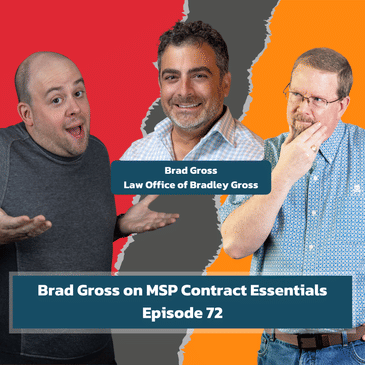
[00:11:57] I love it when we have a guest. I always say that. Yes, I do always say that. Bring them up. Mr. Brad grows from the law office is a Brad gross, very famous. How are you guys doing well today? Doing well. Thanks for having me on.
[00:12:11] Thanks for being here, man. I know you a long time. Eric knows you a long time. But for those who are listening and don't know you, give everybody like a quick two minute spiel who you are. And what's with that old timing computer back there, Boomer?
[00:12:24] If you're going to insult my computer, I'm hanging up. I'm getting out of here. OK, that's what I'm going to say. Yeah, let's set some ground rules. So who am I? I'm an attorney that has been representing service providers for 23 years.
[00:12:38] We've counseled more service providers than all law firms combined, thousands and thousands of them. And it's sort of this is what we do, right? The the topics that you're talking about, CrowdStrike and all that stuff, this is where we get involved. So I'm happy to be on today.
[00:12:54] We're going to talk about anything and everything MSP. Let's do it. I have my own podcast, by the way, that I know you're familiar with at technology Brad cast dot com. So you're going to make fun of my computer. I'm going to have you on my podcast.
[00:13:08] I'm going to make fun of your little Apple thing that's in the back down there. That's a pillow over there. Oh, I feel full. Well, I have my glasses. Oh, you're right. It's a pillow. Never mind. All right. So full transparency for everyone in the group.
[00:13:23] Brad does represent virtual computers. I do like to get that out there because I don't want anyone to think that like there's some secrets here or anything like that. So that's being said. Let's get into it. There's a lot of talk about contracts all over the place.
[00:13:37] Apple, PC, MSP does not matter. Should I have a contract? Should it be a year? Should it be a month? What? Let's start from the beginning. Most people probably have contracts. Yes. Well, most I would say that it's it's better than it used to be.
[00:13:55] A couple of years ago, I would say that most MSPs did not have contracts or they didn't use adequate contracts. Right. They were using purchase orders or invoices and thinking, oh, I'm protected. But that's how I put my kids through college.
[00:14:08] So that's not how it is any longer. So MSPs are now starting to use contracts. Now we're starting to question the the value of those contracts and how it's written so well. But they do, you know, they do try to move the ball down the field.
[00:14:26] Right. And now we have we have a trying to write contracts, and that's probably adding another layer of mess to this whole thing. Yeah, it's funny because in AI writing contracts, right? So I I wrote a book, right?
[00:14:41] And in that book, I actually have a chapter in which it is called. It is entitled I hope or I want you. I think it says I want you to use chat GBT to write your next contract because I have kids in college and I need the money.
[00:14:56] That's actually the name of the chapter. So, you know, AI look, AI is an interesting technology that gives you good ideas, right? It gives you a great place to start. But it's not ready to start writing out full length contracts
[00:15:10] and addressing the realities of the MSP industry, not even close. And if you go back to an episode where we had Adam M. Son, Adam very definitively puts it out there as chat GBT is a C plus student,
[00:15:21] which for me, which sucks for me because I was a D student, so chat GBT with. But Brad, is it? Brad, you're an official. You went to law school. You have the Esquire, the end of your name.
[00:15:33] You don't just fake it like some people in the was Bill and Ted's excellent adventure. And so it's a good thing. All right, so let's talk about the contracts themselves, right? So what obviously people understand I need to have a contract. I need to protect myself. But why?
[00:15:48] What is what's happening there? What's inside this contract that MSPs really should be thinking about to forward their business? Because from my perspective, the contract just isn't only about protecting, but it's also about value of your business. Right.
[00:16:04] So and that's actually where a lot of MSPs go off the rails from a contract perspective. A contract historically has always been thought of as a document that protects you from the legal things, right? The so-called legal legal.
[00:16:20] That's a fancy way of saying if we screw up, are we protected? That's legal. That's what we have a contract for. But in this industry, as in many, but this specific industry, the MSP industry, legal is not as relevant on a day-to-day basis.
[00:16:39] And what do I mean by that? I mean, you don't live in a world of legal. You don't live in a world where you're constantly writing checks and constantly being sued. And then you say, well, how much is my liability here?
[00:16:49] It's important to have it, but that's not where you live. Where you live or MSPs live is in a world of reality, right? Reality-based contracting as well. How I want people to start thinking about their contracts. Yes, it's important to talk about legal.
[00:17:05] But how about the realities that pop up on a day-to-day basis? OK, day-to-day basis. You're not in court. You're not being sued. You're not writing a check. But you have an issue, right? An issue. Your client doesn't listen to you.
[00:17:23] And then the thing that you said was going to happen happens. And they blame you. We're not in court, right? We're not being sued. But now we're going to spend money on attorneys to figure out who's right.
[00:17:34] The MSP that didn't do something because they recommended it and they were rejected. Or the customer who says, well, I didn't know what the heck I was rejecting. Right, I didn't know what. You're asking me, the customer, if I want this solution?
[00:17:51] Does a surgeon ask the patient, could I cut in over here or over here? Right, the surgeon does it. Now what? Now we're talking, right? This is reality. And this is the type of reality that contracts have to talk about. And there are dozens of these realities.
[00:18:06] And it is sort of my mantra to tell everybody that, yeah, legal is important and limitation liability. I get it. I get it. But where you really want to think about what you really want to focus in on is the reality that you face.
[00:18:21] And that's what keeps you up at night. And that's what you need to address. All right, so no one on that though. The reality of the world we live in from a technology standpoint nowadays is there's so much stuff in the cloud.
[00:18:31] So yeah, the post that we're talking about here, Mike Murphy posts on the All Things MSP Facebook group, which if you're not in facebook.com, all things MSP. The crowd strike issue, right? And it was how do you talk to your clients?
[00:18:44] Now the crowd strike thing, luckily for us as Apple consultants did not affect many of our clients. I had one client who was being affected by it because a bank was affected by it. It was scratching their Mac. Crowd strike is not owned by an MSP.
[00:18:58] It is not owned by us. It is not owned by the MSPs. And yet there's problems with it. Clients can't access Microsoft. So that is an upstream provider problem with everything being in the cloud. Going back to what we're talking about reality. Where is my reality?
[00:19:12] If everything's in the cloud, the client's still going to come after me. So how am I using a contract and using yourself to protect me from crowd strikes inadequacies for quality assurance? Sure. Well, in your example, your customer is going to come after you
[00:19:28] because you didn't address the reality that most things that you provide that you offer, I should say as an MSP, you don't actually provide. You facilitate them. You resell them. You monitor them, but you don't actually provide them. And that distinction is what separates the MSP that says,
[00:19:50] well, my customer is going to blame me and now what am I going to do from the MSP that says, I already explained that these are upstream third party providers and that while we will try to facilitate a workaround
[00:20:01] if one's available, we are not going to take liability or responsibility for things that happen upstream, that we don't govern, that we don't manage, that we don't control. But MSPs don't do that. Not often enough. They don't explain the relationship that they have with upstream vendors.
[00:20:18] And so as a result, what you now have is crowd strike saying, oh, well, listen, this is what we're going to do in the future. Oh, we're going to do a staggered deployment. We're going to do updates gradually and put them in, I think
[00:20:31] they said a canary environment. Well, that's all well and good. But as an MSP, now you, the MSP, you have to explain all this to your customer. That is not the time. That is not the time to first tell your customer, I think I should
[00:20:47] explain exactly what it is that we do and that we facilitate things. That's not the time. And that's the issue that MSPs face. So that's the reality. I just kind of had a revelation here where, you know, the legal side of it is the worst case scenario. Right.
[00:21:06] But when you're talking about reality base, depends on your perspective. But I don't know. It's a worst case. It's a tough situation. Let's say that situation where we're in a situation where relationship fails to solve the problem. But in creating a good contract, you're actually reducing the friction
[00:21:28] in the relationship. That's the point that I really wanted to make is that it does more on the day to day than it really does in that. OK, I'm not I don't have another word for worst case scenario for the end of the road. Right. No, you're right.
[00:21:49] Reducing the friction and you reduce the friction and you lower the tension by managing customer expectation and you manage expectation by explaining realities to them at the outset because and I tell this to MSPs all the time. MSP customers don't exactly understand what MSPs do.
[00:22:07] Right, right. They they say, oh, we have a guy, right? I got a guy. They mean an MSP, right? I have a guy who does my backup. I have a guy who does my security. But if you said, well, that backup that they're doing,
[00:22:20] if you needed to get your stuff back, how long would it take? I don't know. Let me ask you that backup that they're doing for you. Is the data encrypted at rest while it's on your computer and in transit? You know, oh, I don't know.
[00:22:36] Right. You can ask all kinds of questions. You know, that data is it also co-located somewhere else? So should one source fail, another will kick in? I don't know. All they know is I got a guy who does backup.
[00:22:52] So it's important for MSPs to explain the reality of the service. Right. It's important for them to explain the value and the scope of the service so that should something go wrong in the future, it's understood
[00:23:07] how it's going to be handled, who's going to take responsibility for it and how things will progress from there. So how do you propose that MSPs do this? Because like I'm sure a lot of MSPs don't want to they don't want to show what's
[00:23:20] behind the curtain, right? As an Apple provider, there's four major MZM providers that are out there. You got Jamf, Adagy, Conjim, Mozilla, right? If we're an Adagy shop and Adagy has problems, I can't go to my clients and go, well, Adagy has problems.
[00:23:33] They're not going to understand who Adagy is. And I don't want to go behind the curtain because I don't want them getting their own Adagy licenses and cutting me out or doing something or whatever. I'm making up a scenario. Yeah. So where's that balance between,
[00:23:45] let's say, truth telling what's behind the curtain and marketing rhetoric? Well, I think that, you know, you could explain any of your services in a vendor agnostic way. You don't have to mention Adagy. You don't have to mention any vendor.
[00:24:01] Nonetheless, you could explain what a service does, what it doesn't do, what its limitations are, should certain things happen, how those things will be remediated and never mention a vendor, right? Like the example I like to give is let's take awareness training.
[00:24:19] OK, pick any awareness training program you want, any solution you want. Doesn't matter. We're not endorsing the mirror by mentioning them, but just pick one. And if I said to you, starting next week, you can't use it anymore. Can't use it. You have to switch.
[00:24:34] So what are you going to do? So you're going to go online. You're going to look for a similar, similarly situated company that offers a similar service and you're going to go for it, right? You're going to find a service that
[00:24:46] offers 24 seven online on demand videos in multiple languages that teach employees latest malware, so on and so forth through fishing campaigns, blah, blah, blah. OK, so that is no before. That's breach secure now. That's bullfish. That's infamah. That's proof point, right? Cyber guard 360, they all do that.
[00:25:08] But by explaining it in a vendor agnostic way, because when I explained it, I didn't mention the vendor. I just said this is what it does. This is how we're going to, you know, how it will be delivered. You could even explain the
[00:25:22] the the limitations of it, right? Just because you have a security awareness solution does not make you invulnerable to malware. It is not a solution in and of itself. It must be combined with other security related solutions to provide a true safety net for you.
[00:25:42] You could explain all that and which vendor we using. I don't know. It doesn't really matter, does it? But this is how you manage expectations. You tell it because they might say, how did I get fished? I have security awareness training. We went through the training.
[00:25:57] We got fished anyway. It's your fault, Eric. Well, unless you explain that awareness training, what it does. But what it doesn't do, what its limitations are, unless you explain that. Yeah, you're going to have a phone call from a customer saying, how come I got fished?
[00:26:12] This is why you gave me a solution. It's your fault. I do like that. I do like that it was Eric's fault, not my fault. That makes me feel better about myself knowing that my security awareness training is always Eric's. We're going to screw you later.
[00:26:23] Don't worry, soon it's coming. So you make this service guide for clients. This when we interact with you, we have our service agreement and you created a service guide for us. And in that service guide was the list of all these things very agnostic
[00:26:42] to all of these particular items. How does then I now have a contract that you've written that's online because it's immutable, which we can get into later. And the service guide, how do I then get a client to sign off on these things?
[00:26:56] Am I giving them a quote and it says of our service guide, which may have 150 items, you're only getting four of them. You're getting all 150. How do I change my thinking as the MSP from a written contract where they
[00:27:12] would sign something off to this new modality with a service guide in an online contract? Sure. So a service guide like you're talking about is a document, a guide that explains everything that you do, every service that you provide.
[00:27:27] But the actual services that are being purchased, that's what they get. And that has to be explained to them the same way that if we were to go to Amazon.com to buy a pair of glasses, OK, we go to Amazon. What's the homepage show me?
[00:27:41] It shows me everything from markers to staplers, right? To everything, to kitchen knives. It shows me everything they sell. But I'm only there for glasses. And when I make a purchase of a glass of glasses, I get an invoice, right?
[00:27:57] Click here to click now to buy or whatever it is. Same thing that MSP should be doing. You can have a service guide explain everything that you're doing, all your services and so forth. But it's the quote that's going to tell them what they're going to get.
[00:28:11] And it is the quote that is going to direct them to look in the service guide to see what it is that they're buying. Now, the advantage of having a guide is that if you're listing everything that you provide, all the services that you provide or facilitate,
[00:28:28] your customer might actually read it. And while they're reading it, they might realize, oh, hey, they actually they offer a whole bunch of things. Same analogy to Amazon, right? You got Amazon by Glass, like, oh,
[00:28:41] I think I do need a battery backup for my, you know, whatever it is. Oh, gee, I think I do need a car reflector windshield thing. It's an upsell. It can act as an upsell, right? Because you're telling them not only are they getting this,
[00:28:58] but if they want it, they could get a whole bunch of other things. So it serves two purposes. One, it manages expectations by explaining what the thing does and what it doesn't do. And it also provides a marketing opportunity to show customers
[00:29:12] that you are actually far more varied, far more diversified than just a backup solution or an awareness training program. Right. You put together this whole service guide. That's online. All right. So I'm going to jump back to contracts because now I think we figured out
[00:29:29] how to show behind the curtain, but not really for the clients. Right? That's a good thing. So let's get to the contract now. Client MSPs want contracts, need contracts. We've already discussed that. Yeah. What's the number one mistake MSPs are doing with their contracts right now
[00:29:48] that are not with you? Besides not, I was going to say besides not having me right. Exactly. Other than that, yeah. Other than that obvious flaw in their strategy. I would say that I mean, look, content wise. MSPs are not addressing realities.
[00:30:07] OK, but we talked about that, how they have to address realities. Otherwise, all you have is an agreement that says if we screw up and we're sued, this is how much we're writing a check for. That's all your agreement says unless you put reality in it.
[00:30:19] Put that aside for a moment. The next biggest screw up is MSPs not using their agreements. Really? They have agreements and then they don't use them. It's shocking to me how many times I'll talk to an MSP
[00:30:34] and I'll say, do you send out a quote for everything you do? No. Why not? Well, it was just a printer install or we're just doing a diagnostic audit. So we didn't do it as if bad things can't happen in a printer install or diagnostic audit.
[00:30:56] You know, so that's the problem. Problems sometimes, I'll say bad things happen to good contracts because they're not used. If I ask you to come into my office to run a diagnostic audit and I don't know,
[00:31:11] you'll load up whatever you load up just to run the audit and it triggers a cryptovirus. Who am I blaming? Blaming you. Now, you could say, Brad, we didn't do anything wrong. All we did was load this up and it would have been triggered eventually.
[00:31:25] And you might be right. But from my perspective, things were working before you got here. They're not working now. Fix it or you're responsible. Now what? Now, lawyers will argue at an hourly rate very slowly, so slowly, about who's right and whose responsibility it is.
[00:31:48] If you had an MSA in place, it's a different story. So I would say that the number one mistake after the content of the MSA itself is just the idea of an MSA not using the contract it has for everything it does.
[00:32:03] Right. And one of the things you taught me when we did ours was every quote, every invoice that goes out has a little paragraph at the bottom of it that says like this quote or invoices governed by our MSA and with a link to it on our
[00:32:16] website, which is hidden from crawlers and follows the service guide with a link to the service guide. I forget our exact language, but it says something to that effect where it says like this this transaction that happens between you, customer and me,
[00:32:34] the MSP is covered under this contract and under this. And if you have a problem with it, tough noogies. Well, I don't know about tough noogies, but the idea is that if you're going to start doing the paradigm that I always encourage, which is posting things
[00:32:51] and referencing them, it has to be done in a clear, unambiguous manner with the obvious intent of the parties to be bound in that way. Fancy way of saying, if you're going to have an agreement that they're agreeing
[00:33:04] to and that agreement isn't in front of them, but it's in a different location, you need to make sure that your customers know clearly, unambiguously, before they accept that quote, that statement of work, right? That there's another document that governs and here it is.
[00:33:21] It's over here. And by accepting this, right? By accepting the quote, you accept that document. And that can be done, you know, depending on aesthetics of your quote, it could be done right up front. It could be done right above the signature block.
[00:33:36] But I always suggest putting that type of, I guess, warning for lack of a better way of putting those sentences. I always suggest putting them in a place where a reasonable person will always see them. So it might be at the very beginning because,
[00:33:53] I don't know, when you start reading a quote, you don't start from the middle and read down. You start from the top, right? So if it's there, a reasonable person would see it. If it's immediately above the signature block and clear
[00:34:04] an unambiguous font and typeface, they had to sign it, right? How do you sign? What are you looking here but not here? That doesn't make sense. So that's the way you do it. So it be like I'm thinking about how our PSA tool writes these quotes.
[00:34:21] And now you got me thinking because we just moved stuff into a new tool. I'm pretty sure that our terms of service fall on a second page, but the quote is on page one. Now granted, it is all digital and there's a digital signature of it.
[00:34:34] But according to your example, that would not be a good place to have it because it's technically on page two. And God forbid someone ever turns a page. Well, you know, look, ideally you don't want it in that format.
[00:34:47] But let's say your PSA sort of requires it or it's too difficult to change it in any other way than what you're going to do. OK, is again before the signature block or right on top of it,
[00:35:00] you make it very clear there are additional terms there on the next page. Right? They're on page two. They're binding their here and so forth by signing below. You accept this and that. It's all about clarity. So, you know, while I and I understand
[00:35:16] different PSAs do things differently, as long as you can sit back. And if we talked about it, I said, you know, pick someone who's not in the industry, pick your friend who's, I don't know, a waiter, right? OK. He reads this contract.
[00:35:32] Would he know that the terms were on the second page? Right. Would he know or might he be fooled into signing without? If the answer is yeah, he would know. Then you probably did it right. You know, the whole the whole historical process by which we've drafted contracts
[00:35:49] where you have the contract in a signature block below and so on. That's because back when this stuff started, all they had was a papyrus paper, right? And a little quill pen. And this is the way it was done. But, you know, with technology,
[00:36:06] contracts don't have to be on the same page as the acceptance. Right? They don't. They could be referenced. They could be online. They could be everywhere as long as the parties understand what they're getting into clearly before they accept you have an enforceable agreement.
[00:36:18] I'm thinking about as my friend, the waiter, because at my age, if my friend is a waiter, they're definitely not looking at page two because there's still a waiter. If he's a waiter, he's probably not signing too many contracts either because he's just living life, you know?
[00:36:32] So collecting tips and probably smoking weed. I don't know. I don't know. Waiters. By the way, we have a podcast on how we can all get that job. I don't know what waiters do anymore. Well, Brad, this has been so helpful. Thank you so much for being here.
[00:36:48] Where can people find you online? Because you're going to get bombarded with phone calls from ATMsP members who are looking to work on their contracts. Sure. So if they want to email me, Brad at BradleyGroce.com, hit me up on LinkedIn, BradleyGroce.
[00:37:06] You know, message me and connect with me. That's fine. Go to the podcast technology, Bradcast.com. But get in touch. Love to hear from you. Yeah, awesome. Yes. MSPs, you do need contracts. You should have them done. You should have them done by Brad.
[00:37:20] They are very well done. And also Brad's team is very thoughtful and methodical. And they really do get stuff. Actually, real quick anecdote. You know, don't don't say that too loud because then they're going to ask for more money. So just stop. Just stop. Quick anecdote. Quick anecdote.
[00:37:36] I was on vacation in the Bahamas and Shana from your team called me because I had called her like a couple of days earlier and I didn't have cell service. I don't know how my phone rang, which the only phone call I got my entire
[00:37:48] vacation and it was Shana calling me back and my wife made the connection to if you remember from Tropic Thunder where the agent brings the Tivo to bend in the forest and he's like, I got the Tivo in the jungle.
[00:38:03] That's my wife thinks that Sean is finding a way to get in touch with me no matter where I am to make sure that I can track you down. Track you down. Well, do you check out Brad stuff? Thank you. Yeah, thanks, man. Check out Brad stuff.
[00:38:18] Get a contract done. Eric, any final words before we say goodbye to the good folks at home? I think my favorite comment from today was bad things can can happen to good contracts and I think that's absolutely true.
[00:38:32] And I think that's going to go on a social media post accompanying the link to this podcast. I love it. And I will say that we've had Brad on the call now for about 36 minutes, so he's charged us six times because you do every six minutes with lawyers.
[00:38:46] Oh, you have no idea the bill you're going to get. So we're going to hang up now. Ladies and gentlemen, check us out at facebook.com. Sesh all things MSP follow us on YouTube, youtube.com. Sash at all things MSP.
[00:38:57] Follow us on your favorite podcasting tools, leave a review for us, leave a little room for Brad, whatever works. We're fine with that. That's Eric. I'm Justin. Bye. Take care. Thanks for listening and don't forget to subscribe to us on your favorite podcast
[00:39:12] platform. You can also follow us on Facebook, but better yet, go ahead and join the Facebook group. You can also follow us on Instagram if that's your thing and make sure you subscribe to our YouTube channel at all things MSP
[00:39:27] to catch us in all of our video glory. And last but certainly not least, if LinkedIn is your thing, you can follow us there as well. And a special thank you to our premiere sponsors, Super Ops, MoveBot, Gozinta, EasyDMark and Comtech.
[00:39:45] And we also want to thank our vendor sponsors. The All Things MSP podcast is a BizPow LLC production.