


Listen to "All Things MSP" on Your IT Podcasts!
Justin Esgar (00:07):
I think they should rename it. Microsoft 360 2.
Eric Anthony (00:14):
That joke is a little old. I realize it has new meaning today on the heels of CrowdStrike, but
Justin Esgar (00:21):
Yeah, this CrowdStrike thing is funny because a lot of people who are reading the news, they don't realize there's something like CrowdStrike or tools of that nature, and so you read an article and everyone just thinks Microsoft is down.
Eric Anthony (00:42):
Well, and I'll take a page out of a lot of people's books who are posting on this right now about this could happen to any EDR AV vendor that operates at the kernel level of an operating system. Now it just so happens that this one is Windows, and the Windows server operating system is still probably one of the most prolific, but just the mere fact that this is affecting airlines and banks and all of these different industries in mass is something that hasn't really happened recently.
Justin Esgar (01:28):
It also CrowdStrike when selling it, they're like, we take care of all the airlines, and it's like, well, should we put all our eggs in one basket?
Eric Anthony (01:37):
Well, yeah. I mean that's the danger, right? Yeah.
Justin Esgar (01:40):
If everyone's using the product and the product goes south, but the alternative is what? Open source everything. I'm a big proponent, I had an argument with somebody last week was Mac admin's, PSU and a couple of friends were there and a friend, my friend Rob Calvert was there and we were having a fundamental argument about using open source within my business versus using all the cloud providers, and I was like, I would never use open source products in my business because God forbid something happens to the person who wrote the code, I'm fd, but now here's his argument with, well, you're screwed anyway. Right?
Eric Anthony (02:20):
Well, it just goes to show there is no 100% right answer.
Justin Esgar (02:26):
That is a 100% right answer right there. I have a couple of jokes about today if you want them, Microsoft out Microsoft Outage, but Teams and Outlook are both fine is the adult version of Snow that doesn't settle enough for a school closure. I thought that was a good one.
Eric Anthony (02:47):
I like that one.
Justin Esgar (02:48):
Somebody sent me most of the legal industry was unharmed largely, but due to Windows 98 and Word perfect. There's also a post, and I'll send you the graphic of it. Obviously it's fake, but it's somebody who posted first day at CrowdStrike, push a little update and taking the afternoon off and he is piecing out in front of the CrowdStrike logo. That's a good one. There's nothing you can do but left. Actually, I got on a call with a new vendor today, which I do want to talk a little bit about it, and they started off with, how was your morning? They knew I was an MSP and I was like, fine. I had a bagel just like they were very confused by my response and I was like, oh, you mean because of the CrowdStrike thing? And she's like, yeah. And I was like, no effect auto because we have Max and we don't have clients who have these things. So we got into, it was just a really funny, and it's not like Apple people are not prone to this. There's plenty of my colleagues who take care of some Windows things that are being affected by this, but I've never been happier to be an Apple person slash Google user as I am today.
Eric Anthony (04:05):
Yeah, that's true. And Google has been unaffected. I haven't had any issues. One of the interesting things to me is how a lot of MSPs have reacted to this, both good and bad, and I'm not going to point any out individually on the bad side at least.
Justin Esgar (04:25):
Why not all the time? That's the show.
Eric Anthony (04:29):
No, but on the good side, there are companies, I'll point out one threat locker who is offering help, offering licenses, offering ways around it remotely, which one of the biggest problems with this, right, is the issue of a lot of people are having to go on site because this is causing the blue screen of death and causing reboots and a lot of times you can't get in remotely and there was a comment on a post, I forget which group it was in about this and having to go deal with it and I'm like, dude, this is why you use real server hardware because if you had vPro or some other type of out-of-band access to that server, you'd still be able to solve this remotely.
Justin Esgar (05:28):
Where did I see this? I'm going to find this comment because I want to get this right, but I believe it was the CEO somebody from CrowdStrike and I'm looking into one of my, oh, here it is. Brody Nesbitt, director of Overwatch at CrowdStrike posted on Twix this morning. I won't call it X. There is a fix of sorts for some devices between blue screens of death to pick up the new channel file and it remains stable. However, the faulty channel file is so not quite an update. The workaround that the director of Overwatch at CrowdStrike posted is boot windows into safe mode, go to this particular directory, locate and delete some file and reboot, which means millions of computers need to be physically touched. We have worked so hard to not have to go on site and not have to touch a computer directly, and here we are, millions of computers have to be touched in order to get this fixed faster than any other in-between blue screen of death download that can be happening. Someone else also posted the Las Vegas sphere, the big thing that's there. Somebody posted a picture of that with a big blue screen of death across it.
(07:03):
It's so bad that it's funny. Now, I do feel bad for the people who are in the thick of it, CrowdStrike, I was just looking at their stock and this technically started last night, right, because it started in the middle of the night, sometime in middle of the night for us because it followed the sun. So the update got pushed out in Australia and then backtracked all the way through yesterday at 8:00 PM the stock was at 3 45 and by nine 30 this morning, so 30 minutes after the opening bell, 2 94. So it dropped a solid 50 points in the overnight, which to be honest, that's not that bad. I expected it to be way worse. When I saw the news, I was expecting like a 200 point drop, but on the other side of that coin, half of the markets can't open because CrowdStrike has broken all their computers.
Eric Anthony (08:05):
Fair, fair. I mean that is mean. What is that? A 17, 18% drop. So it is significant still.
Justin Esgar (08:14):
Hundred percent. Yeah. It's definitely significant. I'm just saying they're, the other thing is they'll be fine at the end of the day, and this is my problem, this is now we're going to get political. My problem with big companies like this is they'll be fine, they'll get through this, they'll fix the problem. Everybody will be like, yes, there might be. I think the airlines are probably going to be the worst to play catch up for all those canceled flights and such, but CrowdStrike will be fine and by this time next week, I would suspect the stock to be back where it's at and they probably for public view, only fire, the CEO, I'm going to call it now that they're going to fire the CEO O or the COO for no other reason than they have to hang someone. Companies do that all the time. That's what companies do when there's a big F up like this, and this isn't even let, let's call a spade a spade here. This is even really a big F up. It's one small thing that got loose, didn't go through qa. The recourse of it is huge, but the actual problem itself, tiny.
Eric Anthony (09:24):
Well, and that's what I'm interested in seeing, right? Because they had to have tested it. There's no way that CrowdStrike let this out without testing it.
Justin Esgar (09:33):
Sure.
Eric Anthony (09:34):
So what is the magical combination of OS version and CrowdStrike version that caused this to happen? I almost guarantee that it's something like that where it is just the right combination of a certain version of the OS or a certain version of another kernel level application on the device that is causing a conflict. And therefore blue
Justin Esgar (10:04):
Screening, what mix of vinegar and baking soda caused the homemade volcano. That is the issue with Microsoft 365 this morning. For the record, I also want to look up what those two chemicals were while you were talking. I was quickly googling homemade volcano ingredients because I forget.
Eric Anthony (10:19):
Well, I think the big loser here is really going to probably be CrowdStrike's insurance carrier
Justin Esgar (10:28):
Sucks for that then an ear and ear and an ear.
Eric Anthony (10:37):
Elevate your IT managed service provider business with Super Ops, the all-in-one platform that integrates RMM and PSA powered by AI driven insights and automation. Super Ops helps you stay ahead, streamline operations, and boost efficiency. Are you ready for operational excellence? Find out more at atsp link slash Super Ops.
Justin Esgar (11:01):
What's up everybody? Welcome to all things MSP podcast. I'm your host Justin Asar with me always my good friend, podcast producer extraordinaire and man in the blue light. Mr. Eric Anthony. We were just discussing CrowdStrike as part of the cold opening only because damn. Yeah,
Eric Anthony (11:22):
I mean businesses were closed today because they couldn't take payments.
Justin Esgar (11:27):
I saw a picture. This is the best one and I'll share with you to put in the show notes. It's a store that says it issues closed temporarily. We'll open as soon as possible and it's handwritten on because obviously they can't print it. It's handwritten on a piece of paper, it's taped to the window. The store is Liquor Land in Australia, it's a liquor store. And I just thought the dichotomy of putting those two things together just because this was in us, was scrolling Apple News, whichever article Apple News was showing me about the crash wreck thing. And there's a picture of the CEO look at all stern and a picture of an airplane stock, image of an airplane, and then this picture of this handwritten note taped to a door for Liquorland. I thought it was. No, it's Apple News, 10 out of 10.
Eric Anthony (12:23):
This would be a classic time for somebody to, who has one of those old fashioned imprint machines for the credit cards to pull that out and go survive the day with this.
Justin Esgar (12:38):
There's an 80-year-old Glenn Gary Glen Ross salesperson right now being like, you need 15 card imprint machines to you immediately right away, sir. Just able to just do that on the fly
Eric Anthony (12:51):
If you're young enough to not know what I'm just referring to.
Justin Esgar (13:00):
That's it. Thanks for listening folks. If you don't know what Glenn Glenn Ross is and you're on, we should do an entire episode about movies every entrepreneur should watch.
Eric Anthony (13:13):
Oh, that's a great idea.
Justin Esgar (13:14):
That would be a good idea. Send us what movie use on your list, facebook.com/group/all things msp. If you're driving, pull over and do it. We don't want anyone to get into with an accident. We were talking about this in the cold, but it is just amazing how much damage I was just looking at. I don't know who sent it to me. I'll find it. Someone had made a, I guess it's an info gif of all the planes in the air over the United States from let's say 6:00 AM from yesterday until the issue started. And just first off, it's amazing when you really think about how many airplanes there are overhead at any given time right now, I don't hear a single plane, but there's tens of thousands of airplanes over the United States and the image of these planes and the amount that just it dwindles down to because there were airlines, I think you just said it, but there were planes that didn't want to land because they weren't sure the tower could see them.
(14:23):
So there were planes stuck in the air. There were news. I was just watching, if you do watch TikTok and you have TikTok on your phone under the desk news, this person v, she's amazing. She is very left, but she was covering the CrowdStrike thing and broadcasters couldn't get on the air. They just couldn't get the air. So she was saying that one of the shows that she watched, like the morning broadcast news in Rochester where she's located couldn't leave the air because they were afraid they wouldn't be able to get back on the air. So the broadcasters had just been broadcasting all this time, no commercial breaks, no anything. And I'm like, why wouldn't they just bring in other talent? Humans are capable of walking still, right? Just bring someone else in and put a micro just swap mic packs. But she made it sound like this person is being like, they're just like, we can't leave a studio. We're stuck in the box forever. But it's amazing just how bad one thing is affecting everyone. We could probably equate this to what it would be like as a small MSP, but I feel like so many of us are being affected by this right now that we don't need to make that analogy. But you should a hundred percent make this analogy.
Eric Anthony (15:41):
It's interesting though is I just thought of this. There's been hype about things before Y 2K, Y 2K just kind of came and went with no implications really at all.
Justin Esgar (15:56):
The Best Buy stickers for Y 2K, do you remember that the big yellow Y 2K is your computer ready stickers? My best buy was in its prime. That image has burned into my memory.
Eric Anthony (16:09):
Dude, I did so well that quarter. I created my own little stickers that said Y 2K ready. And I literally marketed the fact that we would come out and we would mark your computer, we would test your computers. You had that little thing where you could reboot the computer and it would test the bios and make sure it was Y 2K compatible. And then we would literally put a sticker on your computer that said, Y 2K. Ready.
Justin Esgar (16:37):
See, well, okay, fine. That's how we're going to upgrade this back. There are definitely, she, my mom even sent me a text message this morning going, are you taking advantage of what's happening? Yes, mom, I'm taking advantage of what's happening. There's opportunity here. This is something that people need to understand. Every time there is a problem, there is an opportunity. The question is, can you as the MS owner capitalize on that opportunity? And the problem is it doesn't have to be a massive outage issue like CrowdStrike. It could be as simple as their internet went out, did you sell them backup internet, this computer went missing, did you sell them some sort of tool to find it? Did those things. So you always have to be looking and it's almost perverse at how you have to look at every mistake and turn it into a sales opportunity.
Eric Anthony (17:32):
Well, but you can also turn that around and yes, it's an opportunity, yes, it's a sales opportunity, but let's take the example of using real server hardware so that you have that option to reboot and bypass the operating system and do things like a remote safe mode reboot and still have network connectivity. That is an opportunity for you to go to a client and say, Hey, things aren't perfect. Things will never be perfect. And there are some things we will never be able to avoid, but this is something we can avoid by using different server hardware so that if this happens with any other application that might be capable of doing this, we can do the same thing.
Justin Esgar (18:19):
That's why you shouldn't be using Windows servers for file share. You should move everybody to synology. That's true. But you're right. The fact is though, you can do that, there's only so much preparation, right? You said this, nothing's ever going to be perfect. Alright, we're going to get you some. We will break up the server with the virtualized servers into three actual servers. We'll spend a couple thousand bucks, buy some computers, whatever. But the second, because I was thinking while you were saying that, my joke of like, oh, switch everyone to synology, the first thing that came to my mind was what if Synology pushes out a bad update and all this syn analog go offline, right? It could happen. This is true, this situation, because we said in the cold open, they must have gone through QA and CrowdStrike's not the kind of company to be like, oops, they went through this. Keep in mind, there have been times where Apple has done this. Apple pushed out a software update even though, and it went through QA and it crashed a couple hundred computers. They pulled the update immediately so no one else got it. And Rereleased a new version of the update later that day or the next day or something like that. And there was a couple of years ago that they haven't done it since. So even these big companies are capable of being at fault for something.
Eric Anthony (19:41):
So no matter what, to your point on the sonology, Sonology have third party software that is capable of running on them and therefore this could have just as easily happened on a sonology could have just as easily happened on a Linux box.
Justin Esgar (20:00):
It wouldn't happen to a file share provider that keeps the file shares in the cloud. They'll remain nameless while we're on this show. But it could. It could. It could,
Eric Anthony (20:10):
But the chances are less.
Justin Esgar (20:14):
Yeah. The other thing is, well, so then is the answer. Everybody should use a cloud-based solution for everything because you could use Google Cloud platform or AWS, but those go down all the time where I'm confused as to where MSPs should weigh their risk options.
Eric Anthony (20:49):
Well, lemme ask you this.
Justin Esgar (20:50):
This is terrible. This CrowdStrike thing is terrible,
Eric Anthony (20:53):
Right? But let me ask you this because the obvious choices are cloud hosted or locally hosted, right? So what is going to be more reliable AWS Azure, Google Cloud or their office with maybe only one internet connection at best to a mobile one if you're lucky. And all of the things that have to go into getting the same type of uptime on a one physical server installation versus having geographic redundancy and connectivity redundancy and all of that just
Justin Esgar (21:39):
It comes down to one thing. It comes down to one simple thing, how much money you want to put into it,
Eric Anthony (21:45):
Correct? But at that point, you're building your own data center.
Justin Esgar (21:48):
So here's a great example. My wife used to work for a company years ago and we took care of their it. That's actually how we met. The company ran on FileMaker and the owner wanted no downtime and I said, that's impossible. You're running it locally on a Mac mini, which was fine to do it with. And he's like, I want no downtime. I go, then you need to give me unlimited budget. And he says, okay, tell me what you want to do. And so this is a completely true story and it's completely the way I built what I'm about to explain. I recognize just how ridiculous this sounds. This is also 2008 and it's still ridiculous.
(22:28):
MAC Minis only have one hard drive, potentially two in them. They had at the time fire wires. This is pre Thunderbolt, so you could do 800 megabits per second over fire wire. What I did was I took four Mac Minis, I took two of the Mac minis and I did a raid one mirror between the two Mac minis. So Mac Mini one, Mac mini two two was in target disc mode. So the hard drive would show up on one that was in raid one. I did the same with three and four. And then I had this raid one, two rated as a mirror, 2, 3, 4. So I basically had it on four individual drives. So if any of the computers died, you could just reboot any single one of them at any given time and FileMaker would work. It worked. This system worked. We had to actually implement recovery ones.
(23:23):
The problem that we ran into was because three of the Mac minis were in target disc mode, they couldn't control their fans. So the closet that he put it in, you would open the door and you're like, ah, it's the pits of hell. It was that bad. But yeah, it came down to money and he paid me a lot of money to build out this system. That's what it comes down to. You can put this stuff in the cloud, you can put it in AWS. We have a client who runs a surveying software in AWS. It's got load balancing, it's got redundancy, it's got all these things. Jeff Bezos Fells didn't wake up one day AWS is down. There's nothing we can do. Period. End of story.
Eric Anthony (23:59):
Have you ever wondered how much time your team spends in meetings and what the real impact was? Well wonder no more. With produce eight's latest release, you are getting insights into meeting effectiveness and productivity metrics that will improve the way you do business. Some of the benefits are seamless integrations with leading platforms such as Google Calendar Outlook, Microsoft Teams Zoom and Slack to help you streamline meetings, especially for your MSP teams. Executive dashboards help gain insights into meeting investments, including salary breakdowns and resource allocation that gives you enhanced views into profitability teams. Sentiment analysis provides understanding of employee morale through user sentiment analysis, leveraging feedback to improve productivity and workplace wellbeing. Team empowerment gives access to personalized reports, real-time metrics and goal setting features for better work-life balance and productivity control. Explore how Produce eight is revolutionizing the MSP landscape at ATP link slash produce. Eight, improve your productivity and propel your MSP business to new heights with Produce eight.
Justin Esgar (25:13):
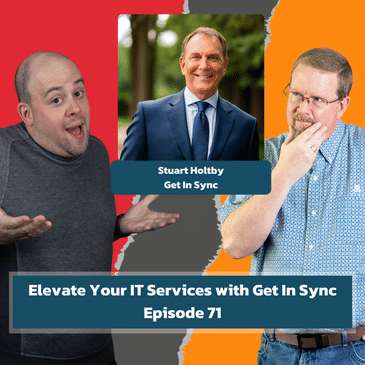
Hey Justin, guess what? We have a guest today. I love it when we have a guest. Yes, we have another guest today. I do always say that and I do always say that, which is weird. Now it's getting very meta, but enough about me. Let's bring on our guest, Mr. Stewart Holtby, founder of Get In Sync. Not the band, not the boy band though. If you could get in sync, probably making a lot more money, but no, but we have Stuart founder of Get Insync. Stuart, welcome. Thanks so much for being here on the All Things MSP podcast. Give everybody a two minute who you are, what is Get in sync and I know you're traveling Good breakfast at the hotel.
Stuart Holtby (25:52):
Yeah, it was an awesome breakfast. Had this morning. Yeah, I'm traveling in Nashville today at the Robin Robbins TMT Producers Club thing. And so yeah, it was pretty awesome here. And yeah, a little bit about me. Of course, I started an MSP way back in the day and I'm talking way back in the day before they called it MSP, so that was 1989. And yeah, I grew the MSP. And so that's where Get Insync was inspired out of Get insync is a SaaS product purpose built for advanced managed service providers who want to boost their margins by solving two interrelated problems for their clients. And that's indecision and the fear of change, that's where all good ideas go to die is the of indecision. So we try to help MSPs tackle that problem with a SaaS product. And we can get more into that in the details if you like.
Justin Esgar (26:55):
Yeah, I do want to dive in this. So indecision land, which I think I'm the mayor of that I think is a big thing, right? Because as any MSP wants to sell products or sell ideas, the clients always have a hard time especially, and it's funny that you bring, we were talking today, I was just discussing with a friend of mine, Alec will at a bit work where the client that he's talking to already had an MSP, so they're okay. But the idea of going from no MSP to full MSP is very fearful for clients.
Stuart Holtby (27:35):
Exactly.
Justin Esgar (27:36):
And so helping clients get over that fear of change, I'm really interested to hear how your product can help that.
Stuart Holtby (27:44):
So I mean, we have a structured approach that will allow people have, okay, let's just go back. So you mentioned trying to sell somebody on a full managed, so we all know selling's hard, but buying's even harder. April Dunford in her book, she talks about pitching and in her book she talks about she went to buy a toilet and she was doing some renovations and the contractors said, I absolutely need a toilet by noon tomorrow, go get one. She thought that would be pretty easy. Well, there's 700 models of toilets and they extra flush, blah, blah, blah. Anyway, so read the book, it's a great book. But what happens is that we get paralyzed the paradox of choice, and this creates indecision and particularly if it's a toilet doesn't sound all that significant, but if you're putting in something that could affect my job or maybe my client or perhaps even the company, there's a lot at stake.
(28:54):
So buying is really hard. And so what happens is that we often default to the status quo. We often do nothing. So good ideas die the death of a thousand doubts. And so what Get in Sync tries to help with is put all the cards on the table and narrow down that toilet decision, the buying decision to what it is you really need. And this is also sometimes MSPs are held victim because they come in very late in the sales process because customers always have done a whole bunch of research online and they've got an idea and now they just want you to go and get me one of them things. Even if they do make a decision, usually we get them what they ask for, but it's not what they need. And then if we do that, then we wear it because then it's like, well, you got me that and I didn't really need it and I didn't really use it. So it's that tension that we create in that indecision and fear that get in sync is that's what we do. We help work through the complex decision and the complex trade-offs to really make those informed decisions.
Justin Esgar (30:12):
I have so much to talk about here. Okay, number one, toto toilet with a bidet. If you get anything else you don't get, if you have anything other than that kicks ass literally
Stuart Holtby (30:21):
Kicks ass.
Justin Esgar (30:22):
Yeah. If you get anything else other than that, you're doing it wrong. So let's start there totally with, okay, so now that we've got that, the idea that a client comes with something and then lays it on you and you have to wear it. It's funny because in my side of things, as an Apple consultant, apple will typically sell something to a customer or push something on the customer that's from the Apple market and then ask me to clean it up. And I'm like, that's the wrong product for this customer. Exactly. But it's too late now because late especially because Apple being Apple and virtual is a little nothing comparatively, who's the client going to believe the client's going to be? Well, if Apple said, I need this, and it's like, yes, but Apple, the employee who sold it to you worked there for four days and read it in a book, and I've been doing this for 16 years, who do you trust
Stuart Holtby (31:12):
And their business? So you know that particular product won't fit in that particular business. And so yeah,
Justin Esgar (31:21):
A hundred percent. Because the number one thing that Apple pushes for mobile device management is Apple Business Essentials. And you can't push Zoom with Apple Business Essentials because it's not an app in the app store. And I don't know if Apple realizes this, but we live in a post pandemic world where everything's on Zoom.
Stuart Holtby (31:36):
Exactly, exactly. You would think they do.
Justin Esgar (31:39):
No, no, because they use WebEx. They're not allowed to use Zoom internally. So I don't think they noticed. But that's not all here nor there.
Eric Anthony (31:47):
That's the difference between being a virtual CIO and just being an outsourced IT services provider.
Stuart Holtby (31:54):
Correct. And Justin, you pick up on a good point. So in the world of trying to help your client, how do you help them get through decisions? But how do you know their ideas? And what, I mean, I'm not talking about technology ideas, business ideas. So okay, we want to land that big client. So if I'm in the construction business, maybe I want to land that school division that's planning to do two new schools. So how can we help our client land the client with innovative technology? So what's the idea that we don't see that we could help that client with? And then think if you did come up with something, maybe there's a K to 12 software package that you could put on some website somewhere to help the teachers whatnot in that construction questions and Q and a, whatever the product would be, some innovative idea. So that's where I think the value gets added. And so it's being able to have that line of sight to that strategy so then we can back it up. So if we're invited way too late in the game, we don't get to have that discussion. We don't know the ideas that are rolling around the organization.
Justin Esgar (33:21):
I want to make sure I'm understanding this right, because the number one thing is everybody always wants a seat at the table and none of us ever get it to know what our clients are working on. This is what get Insync will help with. It's allowing us to have that seat of the table to whatever the mechanic is used here, to have the client talk to us to be like, these are the projects we're working on. How can you help us? Right,
Stuart Holtby (33:45):
Exactly. Not even projects, even as say the seed. Seed of the idea. So it traps ideas. Like I often ask, well MSPs and MSPs clients, how do your clients innovate? We need to be more innovative. Okay, well great to say it, but how do you do that? Well, the way to be more innovative is to trap every idea there is, particularly from the front lines. Is there a mechanism to put the ideas into a funnel? Well, let's get in sync. And again, where we differ from other VCIO software or whatnot is we're more looking through the windshield. QBR are going the way from my perspective, the going away the fax machine, you might need one somewhere and pull it out every once in a while and plug it in, but it's like a rear view mirror. So if you're looking always in the rear view mirror with A QBR, so we're talking about leading indicators, what are those ideas?
(34:53):
And I'll just give you a quick story in my own MSP, I'll never forget folks running around trying to help our client and I'm stopped one of our techs and said, what are you doing? Oh, we're moving them, moving them. They're moving. Yeah, they bought another company. What? So I'm the last to know the techs at the front line know what's going on with the client. So that was a lost opportunity. I would've rather have seen that understood that the client is buying or acquiring another company. We could have had that discussion and as it turned out, we lost that client because the company that they bought had another MSP. And you get the story so you can connect the dots. I could have been more proactive and if I had seen that coming. So that's
Justin Esgar (35:42):
The move story is always a big one because the amount of clients who come to us after they've already picked out a place and after they've already had three rounds of architectural drawings before they come to us and go, by the way we're moving, my first always is I need to see drawings because if you don't put ethernet down, I can't help you. And they go, oh, we never thought about ethernet.
Stuart Holtby (36:03):
They move into, you
Justin Esgar (36:03):
Call me three months, months into this thing, why did you come to me and say we're thinking about moving?
Stuart Holtby (36:09):
Exactly.
Justin Esgar (36:10):
It's hard, I think for a lot of Ms. Small MSPs to get that language out to their clients of we are here to help proactively come to us. Whenever I talk to our clients, I always say, listen, if you're not sure we can help, call us anyway. I don't care if you're calling us because the toaster doesn't work. I'd rather tell you, we can't help you with this than you not tell us at all.
Stuart Holtby (36:38):
Exactly. So that's the idea is everything. The idea is the way it should work. It doesn't exist unless it's in Gety. And so the actual customer actually starts appreciating that because as MSPs, we have a lot of tools, but they're facing us. I mean, sure there's the odd dashboard, cloud radio does a good job of that and those kinds of things. But what I'm saying is that there isn't anything that the client can engage in or very few tools to put their ideas in so that they can share it with you strategically. And again, back to what you said, a seat at the table.
Justin Esgar (37:15):
I'm afraid though, and tell me if I'm wrong about this, I'd be afraid to do that because I don't want my client coming in being like, you guys are screwing up now. Yes. At the same time, I do want my clients to come in to tell me that we're screwing up. I want to make sure that we're not, but I'd be afraid of opening that gate and letting them come in and say, these are all the things we think is wrong, even though they might not be. Right.
Stuart Holtby (37:39):
Well, I hear that a lot, but see, then you're kind of taking co-ownership of, because particularly nowadays as the market matures more and more, gen Zs, whatnot, they're wanting to sort of self-provision. So it does give them that capability. It helps them be a part of it. And then again, back to wearing the solution, we all wear it together. You know what I mean? It's kind of like running a three legged race. We're tied together in one leg. If we're not running that race, we're going to fall on our face. And
Justin Esgar (38:26):
Where do you see trends coming within IT management?
Stuart Holtby (38:32):
Well, there's a big trend afoot right now with, I don't know if you guys have heard this, but compliance as a service. And we're seeing that come forward particularly with, I think it's the fccs new policies and a number of things. And of course, I think you guys were talking earlier a little bit about the CrowdStrike issue today and so forth. So that's certainly a big piece of it is try and help the small businesses be compliant. Just buying insurance nowadays is a difficult exercise for a lot of smaller businesses. So that's another component that is careful. You get dangerously close to becoming a lawyer. So one has
Justin Esgar (39:28):
To, which is okay, my mom still wants me to become one, so I'm okay with
Stuart Holtby (39:32):
Exactly.
Justin Esgar (39:33):
Yeah, the compliance thing is funny because for us, and I've said this on the show a lot, the clients that Virtua has, a lot of 'em are graphic design, design adjacent, things like that. And anytime we pick up any client, I immediately go like, are you beheld to any sort of compliance? And they immediately go, no. And I'm like, are you sure? Because they don't know. And with everything that's coming down the pipe, we thought that this was going to be the year where the government made a holistic privacy, privacy laws instead of CCPA or New York Shield or all these other ones, state have a government one, so maybe that'll get 2025. I think even just having that as your level of compliance would be massively important and people need to start protecting it. Still, people are just emailing all Willy-nilly whenever they want. And that's definitely a problem, which would be a great idea to put into get in sync as the MSP to the client saying, Hey, I've gotten four tickets from so-and-so about just them email blasting, why is this happening? And we should put this in the kibosh, get that on the agenda for that table seat.
Stuart Holtby (40:46):
Right, exactly. Yeah. Have the agenda. Yeah. So yeah, all of the compliance regarding hipaa, all of the PI can't think of all the alphabet soup. And just, again, helping MSPs can do go a long way by also helping them get compliant, not necessarily as a service, but also really help them lower the cost of insurance. So if the MSP has the right stack, just like you put an alarm system in your house, you get a discount on your insurance sort of thing with a lot of the brokers out there, if you have a certain stack, you'll get a discount and she can help the client save money. So that's a good thing.
Justin Esgar (41:35):
Really. My house insurance didn't give me a discount. They mandated I have a burglar alarm on the
Stuart Holtby (41:41):
Barrier and
Justin Esgar (41:42):
A central fire. Now it's a barrier. It used to be a discount, but now it's a barrier, which doesn't make any sense. I live in a pretty nice neighborhood where crime rate is pretty low here, and they were like, no, you have to have it or we won't renew you. And I was like, all right, well ouch. I'm going to spend money to keep my insurance. Seems awfully weird.
Stuart Holtby (42:00):
Yeah, like I say, insurance is getting harder and harder. Yes, it's a difficult thing.
Justin Esgar (42:07):
Does getting Inc help with the cyber insurance requirements? Because a lot of companies I find they just go get cyber insurance and then they don't do the things that the cyber insurance require them to do, and therefore when something happens, they're no longer covered. And the cyber insurance company is the ones who pocket all the money.
Stuart Holtby (42:25):
No, however, I mean, our answer is that we do partner with a number of providers that do that. So one of the things that I think a V ccio is intended to do key count management is you don't have to sell 'em everything. You know what I mean? You can be that general contractor, you know, need a plumber, you know, need electrician, you need a guy that do drywall, that kind of stuff. Maybe you do some of it, you won't do all of it. And so then you can help facilitate that and organize that stick, handle it, whatever you want to call it. So those are the kind of things that could go in and get in sync as an initiative and ideas turn into initiatives that should turn into a projects which then have an umbrella of programs. So you might have four or five if you're moving, you might have four or five discrete projects that roll up into move.
(43:23):
So that's what get Insync tracks. It also tracks all your business applications and whatnot and gives you that overall health of your organization. So back in the day when I was asked, I was called into a client, they wanted to talk about costs and I sat down and I walked through, I was fairly prepared, and they looked at me and they said, okay, so that's what you're charging us. Where's the other half a million dollars we're spending? Because they don't view technology, just what the MSP's billing, they view it as their accounting software. They're CRM software, the hosting, all even their cell phones. Anything that's technology rolls up and get Insync actually manages that as well in the sense of the overarching budget. There's only so much pie. So if you can help sha some costs off of those other services, more could be funneled towards your MSP sort of thing. So I know we're running low on time, so
Justin Esgar (44:29):
Real quick, Stuart, thanks so much for being here. Where can people find out more about you and get insync?
Stuart Holtby (44:34):
Well, it's get insync.ca, just like it's spelled our sounds. It's spelled the same way.ca though that we're a Canadian company always on LinkedIn. So it's just Stewart with a u, so S-T-U-A-R-T holtby on LinkedIn. And yeah, reach out to me and we can continue the conversation. I really appreciate being on guys.
Justin Esgar (44:55):
No, and we appreciate you being here. Eric, you're on mute, but any last words before we part ways today?
Eric Anthony (45:03):
Well, I just want to say that Stuart, thank you very much for being here and Get in Sync is a pitch at contestant for 2024. So we're looking forward to all the great things that happened through that. And if you haven't seen it yet, we did a little episode of a series that we like to call The Pitch is Right and Stewart and Get, Insync was on that for episode six, I believe it was. And I'll go ahead and link that down in the post, the comments, the whatever, wherever you see this coming out so that you can check that out. It was a lot of fun. And Stuart, thanks for participating in that as well. Yeah,
Stuart Holtby (45:41):
It was a lot of fun. It was good format. So yeah, I can't say enough about the Pitch It program. It's intense. So shout out to the guys at ConnectWise for that. Yep.
Justin Esgar (45:53):
Awesome. Well, Stuart, thanks so much, Eric. This has been another great episode. I hope everyone survives the week with everything that's going on. Yeah,
Stuart Holtby (46:02):
Get home safe. That's
Justin Esgar (46:02):
Eric. That's Eric. I'm Justin. That's it. Bye.
Eric Anthony (46:07):
Thanks for listening and don't forget to subscribe to us on your favorite podcast platform. You can also follow us on Facebook, but better yet, go ahead and join the Facebook group. You can also follow us on Instagram if that's your thing. And make sure you subscribe to our YouTube channel at All Things MSP to catch us in all of our video glory. And last but certainly not least, if LinkedIn is your thing, you can follow us there as well. And a special thank you to our premier sponsors Super Ops Move Bot goes into Easy MAC and comtech. And we also want to thank our vendor sponsors. The All Things MSP podcast is a biz POW LLC production.