
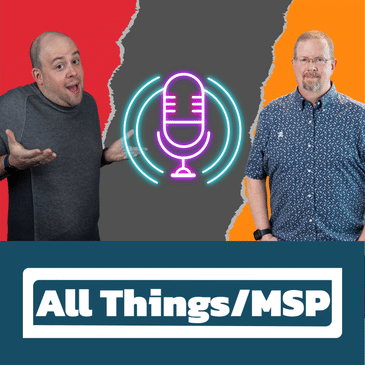


Justin and Eric emphasize that MSPs should familiarize themselves with the tools and solutions they offer to clients. Justin points out that this practice is crucial for offering effective support, as being well-versed in the software and services allows MSPs to troubleshoot issues more effectively and understand clients' needs better.
They also touch upon standardization in an MSP's toolset, advocating for consistent use of products across the board. Standardization not only makes management easier but also bolsters security since administrators can efficiently deploy updates and maintain configurations.
The hosts address the dilemma of using Microsoft and Google products within the MSP industry, with the conversation highlighting the challenges and advantages of managing and using both ecosystems. They explore the need for MSPs to adapt and be proficient in both Google Workspace and Microsoft 365.
The episode wraps up with the origins of the phrase "eating your own dog food," tracing it back to a Microsoft email from 1988. Justin finds this connection amusing, given the Microsoft-themed discussion.
Listen to "All Things MSP" on Your IT Podcasts!
Justin Esgar:
See, this is the dumbest thing. Mac, I ripped into someone on Apple yesterday. I was like, you guys want to tell me you're all for business and you have lasers? If this does make the cut and you're only listening to this on audio, do double bowl fingers into any Mac running MacOS Sonoma or Sonoma Sonoma or any iOS 17 device.
Eric Anthony:
That's the southern way of saying Sonoma.
Justin Esgar:
Sonoma. What's up everybody? Welcome to the All Things/MSP podcast. I'm your host, Justin Esgar. With me always is my good friend, podcast producer extraordinaire, and man with the plan, Mr. Eric Anthony. Eric,
Eric Anthony:
How are you today? Well, I don't know if I've earned that producer extraordinaire this week after you had to text me about the title, and actually what you didn't see was that the description wasn't right for the YouTube version of last week's podcast either. I know that it was in there. So the only thing I can think of is that I didn't save it before I changed screens
Justin Esgar:
Because
Eric Anthony:
It did something weird to me last week and I just didn't go back and check it. But anyway, that is now fixed.
Justin Esgar:
I'll give you a pass on that one. Listen, it's hard to do the stuff that you're doing. Also, if you're listening to this and you didn't realize that we have a YouTube youtube.com/at all things MSP doing this stuff is hard, man. Being a podcast producer is hard. And the funny thing is that you're producing this show, and I know you produce a couple of other shows for the All Things MSP channel. We have the live show, which is every Wednesday you do office hours, which I'm going to jump in on a couple. But the thing is, is that you're not a video person by trade, and therefore you are not in and out of this all day every day, and you're not using these and you're using these tools for your own good as opposed to using it. You know what I mean? There's a level of not eating your own dog food here, which is oddly enough, the topic of today. I was really trying to make it work. I really try on this one.
Eric Anthony:
Hey, I think it was a good segue. I got that. I will say that thank you for your forgiveness on the title and the description for last week. However, the SS e o gods not as forgiving. Hopefully we'll see an uptick in last week's podcast. Now that I've updated the keywords,
Justin Esgar:
The only God I believe in is the God of murdering your thirst Liquid death. Still not a sponsor. We're working on it though. I really am. Yeah, I wanted to talk today about eating our own dog food. This is something that's come up a lot, which is so many of us in the industry pitch products talk about products all the time, but how many of us are actually using those same products? So we are a Google shop and we have a couple of different spam protection tools that we sell, and like lo and behold, we don't use any of them right on the other side of the coin, on the other side of the coin, up until recently when we switched from Zendesk to Halo, we needed a way to get our information to record time from Zendesk to put it into FreshBooks, which is our billing software. And so we built an app called FreshBooks Time Tracker, and we sold it. It's available on the Zendesk marketplace, but we used it every day. So we were definitely eating our own dog food there because we needed to ensure that we knew what was going on because we were selling it as well as we were just using it because we needed to bill out. So it's funny how we run the whole dichotomy across the board, but I'm a big believer in eating your own dog food within the company.
What's your favorite networking brand? We're not sponsored, so who caress? What's your favorite networking brand
Eric Anthony:
At this point? I don't know, because things have changed so much. I used to use a lot of Juniper
Justin Esgar:
And I mean, I don't know if, are they still in business? Is Juniper still in business?
Eric Anthony:
I think so.
Justin Esgar:
I think so, right? We're a big Meraki and ubiquity shop, and for the longest time I had Meraki equipment in my old house, and now in the new house I have this full stack ubiquity set up, right? And the other reason is in New York City, prior to the acquisitions, we only did Meraki and now we do a lot more ubiquity stuff with the acquisitions of Des Moines and Columbia. And so the reason we only do those two brands and the reasons why my network is one of those two is that everyone in my team understands every detail of it. It makes it a lot easier to figure stuff out. And so in order for me to learn it, I was like, well, lemme just go set it up.
A Dream Machine Pro is 350 bucks a piss in the pot. And I'm not going to say I'm an expert in every last thing Today I had to set up a vlan because what you don't see behind the camera on the floor over there is a full network setup for a client. We're installing next week with a firewall and two professional switches and a redundant power supply and A P D U and the door access and the key cards and the whole nine. And I just went and plugged it into my network today and it shut my entire network down. And I was like, oh, learning experience. Let me figure out how to undo this. And so I zoomed with Kyle on my team to be like, what did I do wrong? And so he walked me through setting up a vlan, which I had never done before in
Eric Anthony:
Very helpful.
Justin Esgar:
It is very helpful, but the idea is that you need to be able to do this. Actually, this is a true story is a segue. I just want to tell this story. Yesterday I did a Mera install for a client and all of a sudden their server went offline and I was getting real frustrated. I thought it was something wrong with this. And I was like, I don't understand what could be going on. And there were a lot of layers here I was trying to unpack. The guy told me he had one switch, turned out he had four. They were all smart switches, they were all doing different things, whatever.
Eric Anthony:
Nice. It
Justin Esgar:
Turns out somewhere along the line, I fat fingered something and I blocked all local land traffic from the wifi.
Eric Anthony:
Sweet.
Justin Esgar:
But knowing Meraki well enough, I was able to figure it out. It took me a little bit of time because it's been a while. But that's the thing. You need to be in it. You need to be using it day to day. If you're selling Microsoft, be and Microsoft, you're selling Google, be and Google.
Eric Anthony:
And that's the point behind standardization too, right? Standardization of your shop, standardization of your clients. There's an efficiency gain and there's also, I believe a, there's a component to security that if you have everything the same, it is going to be much more secure because it's much easier and faster for you to deploy updates, to check configurations, all of those different things if things are standardized across your clients as well as in your own office.
Justin Esgar:
I wholly agree and I think that's one of the things I've been totting for a long time and it's funny how many of my friends, colleagues and competitors tell me otherwise. They're like, no, no, you got to do what's good for the customer. Customer doesn't know what they want. I'm going to give 'em a rocky or I'm going to give them ubiquity. And everyone on my team knows how to handle all of those. So yeah, you got to eat your own dog food. You should be living and breathing in your ticketing system, obviously, right? But do you know every inner workings of it? Are you using all of the tools that they provide because your clients could be using that stuff Also, you don't know. We had a client a long time ago, they're long out of business, but they were an internet reseller selling tchotchke BS on the you can buy. This is all before Ali and Wish they were pretty popular and their own support team used Zendesk. And I was like, oh, we can help you and your support team because we also do Zendesk.
Eric Anthony:
But
Justin Esgar:
If you weren't using Zendesk in your own company, there's no way you can offer that level of support to that client because you wouldn't understand it. And I understand everything is Googleable. You could easily look up the solutions and try to figure things out, but when you're in it day to day, and those are the things you're selling, having a problem with a client with Microsoft 365, and I don't know where this button is, I don't know where this thing is, and I had to escalate it all the way up and I went to Microsoft Support and
Eric Anthony:
I was like, I don't
Justin Esgar:
Know where any of this stuff, why is this not working? And they looked at it and they were like, oh, the button's over to the left. It was because it moved or changes Dan, but I don't live in the Microsoft interface. I kind of felt like a dummy a little bit and it wasn't really my fault, it was just that that's not the world. I live in Google. I'm a Google boy. So I've heard that a lot today. I dunno why.
Eric Anthony:
But I mean, that's a good point though because I mean, I agree with you. Standardization and eating your own dog food, all of that stuff is a good idea because of the efficiency gains. But you also have to be able to handle the situation because I don't think that any one M S P can either be a Google shop or a Microsoft shop.
Justin Esgar:
They try to be,
Eric Anthony:
They can try, they can try, but I don't know how practical it actually is. And to be fair, I've never had to administer both. I've worked in both. I work in both constantly, but having to administer both, I guess when you get to the size where you'd have a significant number of each, then you just have dedicated people that have knowledge of each,
Justin Esgar:
But you need 10 to 15 people on your team to do that. And the majority, as we know, the majority of MSPs are one to three people. And the way around this, excuse me, the way around this is you should have both, right? We have, we're Google Shop. We're Google Workspace, you can look up our email, it's a Google workspace, but we have an on Microsoft account with Microsoft. And the funny thing is I keep getting called out by my director of technology because in order to do the work with the Microsoft guy, I send them a Zoom link. They're like, we can't do Zoom. Can you send us a teams invite? And I was like, we're a Google shop, why don't you send me the teams invite? And I was like, because I don't have a full fledged version of teams, and my director of it was like, you do have a full fledged version of teams. You just don't have it with an actual email address tied to it to send out to receive the invites back. And I was like, see, this is where the problem is. I don't eat my own dog food well enough within the Microsoft industry to understand this because I know that tomorrow teams is going to be called groups and then it's going to go back to teams and it's going to be called couches because Microsoft marketing needs to keep
Eric Anthony:
Well, and that's an interesting question because of the way you position yourself, you are more Apple oriented, right?
Justin Esgar:
Yeah.
Eric Anthony:
So the question that I would have is in the Apple kind of ecosystem, is it more likely that a client is going to be on Google Workspace or Microsoft?
Justin Esgar:
That's a really good question. And to be honest, it's 50 50. I had a call with an A C N up in Canada yesterday and he sent me a teams link and the first thing I said to him was like, you use Teams. I got mad for a second. There are no, it's 50 50 for the MSPs themselves, for the ACSS themselves. I think I'm starting to see maybe 55, 45 Microsoft side. To be honest, a lot of ACN came in and was like, Google's the answer because bleep Microsoft, but it's slowly changing. My thing is, and I know we're off topic from the dog food thing, but this is where Microsoft should eat the run dog food, is that Microsoft has all but admitted that the Microsoft office suite for Mac is a bastardization of the Microsoft office suite. Outlook for Mac is garbage teams from Mac is garbage. Excel is missing half of its functions. And so when people question like, oh, you just do Max, and I'm like, we do PCs because we always have that one bookkeeper who needs to use Excel. That's our argument. But the truth of the matter is that Microsoft needs to eat their own dog food and play better in the sandbox, which it's really annoying.
Eric Anthony:
Yeah, I mean from what I see on the PC side, or let's call it the generic M S P side, it's actually closer to 80 20 or maybe even 90 10 in some cases. You don't see a lot of Google in the traditional small business. It's interesting to me because I tend to actually like the Google Workspace products themselves. In fact, when I spun up a work environment for All Things/MSP, I spun up Google Workspace just because it works well across all my devices and I can work on whatever I need to wherever I am.
Justin Esgar:
I mean, you can do that with Google, you can do that, you can do with both. I mean, the thing is true. It's what you feel comfortable with. I think the break point really comes down to how many Microsoft Teams meetings you're going to have because the whole, where is your MX live? Where does your domain actually live?
I think if we can get to the point where we could split an MX record and it doesn't have to be one or the other, we would be in such a different world like quantum computing, but for email, we would be in such a different world because then you could check your email with Google or with Office and you get the same email in both. I understand. Don't come at me haters. I understand that this is not possible, and I understand Google Drive and OneDrive, and I'm just using it as an example here, but it would make life so much easier for the user. It would be so much more complicated for IT people, but for the user, it would be amazing because then you can use teams, you can use Google
Eric Anthony:
Meet
Justin Esgar:
For people who stop using Google meets people.
Eric Anthony:
You also know though, you're going to get all of the comments from all of the people who say, oh, but you can do that just by connecting the accounts or forwarding emails or Yeah, we know. We know, but it's not
Justin Esgar:
What I'm saying.
Eric Anthony:
Yeah,
Justin Esgar:
But eat your own dog food is what I'm saying. Use the tools that you're selling use. We were rolling out an email security service, and I was like, we should roll this out internally. And we did internally and it ate our systems and we immediately pulled back on it so we didn't roll it out to anyone else. You need to do that. It's not just try it out and see if it works or what works best for the client. Eat your own dog food. It's tasty. That's all I got.
Eric Anthony:
That's all you got. And so yeah, thanks, because I'm trying to look up where that phrase comes from, like
Justin Esgar:
Live time searching on the web is great podcast material.
Eric Anthony:
I know, but I can edit this out if it's just not that funny.
Justin Esgar:
In 1988, Microsoft manager Paul Maritz at Brian Valentine, test manager, Microsoft Land Manager, an email titled Eating Our Dog Food and Challenge 'em to increase the internal usage of the company's product, therefore, the usage of the term spread through the company. So each and dog food is a Microsoft thing. I know
Eric Anthony:
How funny is that, right? How funny is the fact that we're talking about Microsoft and this phrase at the same time and it originated in 1988 from, that's
Justin Esgar:
Ridiculous. That's utterly ridiculous. I don't think we can beat that as a way to end this episode
Eric Anthony:
Probably.
Justin Esgar:
I promise you everyone will try to do better next time. Check us out on facebook.com/group/all things msp youtube.com/at all things MSP like subscribe, ring the bell, leave us a note, subscribe to our podcast, leave us a comment. I love reading all the stuff we're getting and some of the nasty dms. No, I'm just kidding. Nobody dms me. Dmm me. If you want, I'm around. But that's it for us. We will catch you next time. Bye.
Eric Anthony:
From your host, Justin Esgar and myself, thank you for listening to the All Things/MSP podcast. Join the All Things/MSP Facebook group or follow us on LinkedIn, Instagram, and YouTube. The All Things M SS P podcast is a biz POW L L C production and even though we drink a lot of it, this podcast is still not sponsored by liquid debt.