
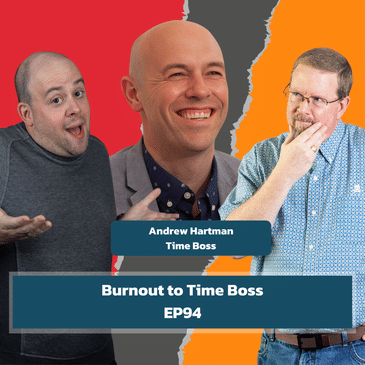


Discover why time blocking isn’t enough, the science behind our relationship with time, and the actionable steps you can take today to balance strategic goals with daily chaos. Whether you’re an MSP owner, a team leader, or an overwhelmed technician, this episode offers a roadmap to reclaim your time and your sanity.
Plus, Justin reflects on his own work habits, Eric shares his favorite productivity tools, and Andrew delivers a masterclass in aligning personal values with professional responsibilities.
If you’re ready to stop reacting and start thriving, don’t miss this insightful and practical conversation.
Listen to "All Things MSP" on Your IT Podcasts!
[00:00:07] Welcome to the All Things MSP Podcast. On this week's episode, Justin and I rant just a little bit more about the AI hype cycle and then we have Andrew Hartman from Time Boss to talk about time management and overwhelm for MSPs. It's an exciting episode without the singing this time. And if you don't know what I'm talking about, check out the Christmas Eve and New Year's Eve episodes so that you're in the know. And now, a word from our sponsors.
[00:00:35] Are you struggling with standardizing Microsoft 365 tenant configurations and keeping them the way you configured them? With Simeon Cloud, you can template your ideal tenant configurations and deploy them with just a click. Auto-deploy configurations for new clients, receive alerts on tenant drifts, and save your team endless hours of manual configurations. So why work for your tenant when it can work for you? Check out Simeon Cloud at atmsp.link forward slash core.
[00:01:35] Expert your client's expert your client's expert your client's expert your client's need with EZDMark. Find out more at atmsp.link forward slash EZDMark.
[00:01:43] What's up, everybody? Welcome to All Things MSP Podcast. I am your host, Justin Esgar. With me always is my good friend, podcast producer extraordinaire, man with a plan, pirate, Mr. Eric Anthony. Happy holidays, buddy.
[00:01:55] How are you, sir?
[00:02:24] Spending a whole lot of time with her. So we have endeavored to make a better effort at that.
[00:02:31] That's where you and I differ. I would never endeavor.
[00:02:38] So I wanted to talk a little bit today, beginning of the episode. I had a client who came to me, finally. I've had, in the last month or so, I've only had maybe two clients, one before and this other one, come to me and ask me about AI using ChatGPT in their business.
[00:02:55] And I thought this is a really interesting thing because you and I have been talking about this for months with us talking about, like, if you're not talking to your clients about it, you're losing out.
[00:03:03] None of my clients need it. And that is just the case of my particular type of clients.
[00:03:07] And I've now had two clients in the last month or so come to me and say, hey, what can we do with it?
[00:03:13] So interestingly enough, today's client came to me and was asking me about not just ChatGPT, but just AI in general.
[00:03:20] They do data analytics. They want AI to do the analytics for them and stuff like that.
[00:03:24] And they were trying to figure out, like, which ones are the best ones to use?
[00:03:27] And I was like, listen, and like I've said on this show, everybody, you know, my bagel store now comes with AI.
[00:03:33] Like, everyone's sticking it anywhere they can, right?
[00:03:37] And so I pulled up ChatGPT and I pulled up Perplexity and I pulled up the one that they had mentioned to me, which is something with a C, not Chandler, something, I forget what it's called, whatever.
[00:03:51] And I was like, let's see which one does the best.
[00:03:56] And the person was like, how are we going to do that?
[00:03:57] I'm going to go, I'm going to ask it to write about you.
[00:04:01] And I live, we were on Zoom, so I shared my screen.
[00:04:05] And I went to ChatGPT and Perplexity, whatever the other one was.
[00:04:08] And I wrote, like, write me a bio on this person.
[00:04:12] And the one that they picked out couldn't do it because it doesn't have internet access.
[00:04:18] Perplexity wrote a pretty significantly good one, but Perplexity actually just aggregates web searches.
[00:04:25] And then ChatGPT aggregated the web searches and then outputted its own solution, its own bio.
[00:04:33] And I was like, here's your answer.
[00:04:34] I was like, ChatGPT is by far, you know, way better.
[00:04:39] But I still wouldn't upload proprietary confidential data that, like, my company holds and no other company holds into ChatGPT.
[00:04:49] Because even if you buy premium or business or whatever they're calling it, you know, it does say, like, it even says at the bottom, because I'm in my personal one, it says,
[00:05:00] Virtual Consulting Group workspace chats aren't used to train our models.
[00:05:04] Sure.
[00:05:05] But that doesn't mean that the data I'm uploading isn't going to be held somewhere.
[00:05:08] And also, someone's going to buy this and sell your data or sell your information.
[00:05:15] So, like, I'm very weary.
[00:05:16] And I said to them, I said, listen, if you want to white out, you know, what do they call that when you have, like, a document from the government that has all those black lines on it?
[00:05:27] Redacted.
[00:05:28] Yeah, if you want to redact your data and then upload it and let it come up with models.
[00:05:34] And then I asked the best question, which was like, what data modeling have you been doing now?
[00:05:39] And they were like, we just sit around the table and talk about it.
[00:05:43] I was like, you don't need ChatGPT then.
[00:05:47] Yeah, you know what?
[00:05:48] But it was interesting you brought this up because Tom Lawrence actually had a post on LinkedIn today, the day that we're recording this.
[00:05:55] And it was a very, it was a great picture because we've talked about the hype around AI, right?
[00:06:00] Yeah.
[00:06:01] And it says data plus machine learning equals poop emoji.
[00:06:08] Data plus AI equals, and I don't know what exactly this emoji was, but it basically, I'm going to call it polished poop emoji.
[00:06:18] Okay, because that stars around it.
[00:06:19] Yeah, yeah, yeah.
[00:06:20] And then the third one was data plus generative AI equals a rainbow unicorn poop emoji.
[00:06:31] Poop emoji.
[00:06:33] And then the last one is agentic AI, which is just basically all the little different poop emojis that they could find.
[00:06:41] Well, so, okay.
[00:06:43] There's two ways to interpret this because in all of the poop emojis, data plus AI equals poop tells me that the data, like if I work for an AI company, my answer to that would be like, your data was garbage to begin with.
[00:06:57] Garbage in, garbage out.
[00:06:58] Right?
[00:06:59] And there were actually poop emojis on the data icon.
[00:07:02] Right.
[00:07:03] Right.
[00:07:03] So, like, I don't know what the angle here is.
[00:07:07] Is Tom saying that, like, AI is not doing anything?
[00:07:11] AI is polishing the garbage?
[00:07:13] Like, where?
[00:07:14] That it's really just hype.
[00:07:16] Yeah.
[00:07:16] Oh, that it's just hype.
[00:07:17] Okay, fine.
[00:07:18] That's fine.
[00:07:18] Yeah, yeah, yeah.
[00:07:18] He's saying the same thing we are.
[00:07:20] Right.
[00:07:20] I got you.
[00:07:21] I got you.
[00:07:21] I got you.
[00:07:21] I will say, like, there is definitely use for it.
[00:07:26] I feel bad that we talk about it so much on this show because, you know, listeners know, I like it, but I don't like it.
[00:07:34] Right?
[00:07:35] But there are definitely use cases.
[00:07:36] Like, here's a great example.
[00:07:39] We have a Google sheet with how much our clients are paying broken down into services.
[00:07:47] I keep a manual client list.
[00:07:48] We do have it in our PSA and whatever.
[00:07:50] But I do keep a manual list just because it's easier for me to read than having to pull reports out of the room.
[00:07:55] And I took this list and I redacted all the customer names and I uploaded it into ChatGBT and I said, which customer, ABCDE, whatever, like, who's making me the most money by percentage?
[00:08:11] And I let it figure that out.
[00:08:13] Like, I could have sat there and done in a Google sheet 100 equals da-da-da-da-da-da divided by whatever.
[00:08:19] I let it figure it out.
[00:08:20] I didn't want to do that math.
[00:08:21] Like, that was awesome because it gave me a CSV that I could export, I can look at, I can manipulate.
[00:08:29] And it told me exactly, you know, which client row.
[00:08:33] I'll just keep saying the word client even though we wouldn't know them.
[00:08:35] Which client was, you know, what percentage?
[00:08:39] And it was good because it was, number one, from a business perspective, it was good to know that you never want to have a client that weighs too much in your business.
[00:08:45] I think the most we have is one client who's about 12%, which is not great, but gives me a target for 2025 to lower that percentage.
[00:08:56] But, like, I had no idea that that one client was 12% and that that was our highest cut of the monthly recurring revenue.
[00:09:04] Right.
[00:09:05] So using it for that is great, I think.
[00:09:08] So I have a theory here.
[00:09:10] And my theory is that the reason why we have the hype cycle around AI that we do is that adoption has outpaced innovation.
[00:09:21] So what I mean by that is AI has actual uses that are productive.
[00:09:27] Okay.
[00:09:28] But because the adoption has outpaced that innovation, now we're in a situation where because adoption has gone through the roof, vendors are kind of just attaching to that and building anything they can to slap an AI label on their product to take advantage of the dollars behind the adoption.
[00:09:51] 100%.
[00:09:52] 100%.
[00:09:52] Your theory is 100%.
[00:09:54] We've proven that 100 times over on this show and talked about this.
[00:09:57] I know, but I never said it well.
[00:09:59] Well, that's fine.
[00:10:01] I'll refrain from making any jokes about that.
[00:10:05] Thank you.
[00:10:06] You're welcome.
[00:10:06] Is that my holiday present?
[00:10:09] Of course.
[00:10:10] That's the thing.
[00:10:11] Like, there's just – I think the thing with AI, especially generative, chat, unless specifically chat, you would be doing, right?
[00:10:20] It's like it's really good for somebody like me where I know what I want but I can't phrase it the right way so I can kind of just like stumble through it with chat, JBT, to get the answer I'm looking for.
[00:10:33] Otherwise, I'd be sitting there Googling like how do I divide these numbers in an Excel sheet, in Google Sheets because you got to convert with this thing to get a percentage.
[00:10:42] Whereas I could just go, here's some numbers, you do it.
[00:10:47] You know what I mean?
[00:10:49] Like, it makes it a lot easier.
[00:10:50] Yeah, yeah.
[00:10:51] And to your point, and we'll wrap on AI after this, is there was a white paper done by Apple that basically – and I'm paraphrasing.
[00:11:03] I'm a little bit – I know I'll be a little bit off.
[00:11:04] But basically, we've reached that threshold of AI learning to where it will just give answers no matter what just to keep the person happy.
[00:11:17] So like Apple did this test where like they gave it a bunch of information, they asked what was wrong, the thing came back and said what was wrong.
[00:11:23] Cool.
[00:11:23] They gave it a bunch of information, they said what was wrong, the thing came back and said what was wrong.
[00:11:27] They gave it a bunch of information knowing that they're changing like one or two things in their data they're going in.
[00:11:34] And the system still said this thing is what's wrong and Apple was like, that's – you're wrong, right?
[00:11:41] Like, it just wanted to appease the user basically.
[00:11:45] Right.
[00:11:46] And so much like Adam Engs talked about in episode, it's a C plus student.
[00:11:54] It's doing just enough to get by, to get right, and there's going to be plenty of things that are wrong, which is why that's a big fat label in the front of every thing.
[00:12:02] It's like we could – it even says it here.
[00:12:04] ChatGBT can make mistakes.
[00:12:05] It says it right here on my screen.
[00:12:07] Robots are supposed to be infallible.
[00:12:09] They're not because we make them.
[00:12:12] Well, yeah.
[00:12:20] You know, it's the holidays and I have a present for you, Eric.
[00:12:25] Is it a guest?
[00:12:27] It is a guest.
[00:12:27] I love it when we have a guest.
[00:12:29] Let's bring him up.
[00:12:30] Mr. Andrew Hartman, founder and CEO of Time Boss.
[00:12:34] I love the name of that company.
[00:12:35] Andrew, how are you, man?
[00:12:36] Doing well.
[00:12:37] Hey, Justin here.
[00:12:38] Thanks so much for having me.
[00:12:39] Yeah, thanks for being here.
[00:12:40] All right, Andrew, tell everybody real quick, two-minute spiel, who are you, what's Time Boss?
[00:12:43] And since you're a Time Boss, what watch are you wearing?
[00:12:47] We'll start with the watch, wearing an Apple watch.
[00:12:49] But I also have a timepiece right here next to me, which is very applicable.
[00:12:53] But yeah, my background, I've been a fractional and a full-time COO for early-stage software companies and MSPs for the last 10 years.
[00:13:01] During that time, I was overwhelmed in my relationship with Time, led to many burnouts.
[00:13:08] And when I hit rock bottom, I said, I have to figure out a way to get results without overwhelm.
[00:13:13] There's got to be a way for us to deliver results without constantly being overwhelmed.
[00:13:17] And in that process, built out a framework that has worked for my teams and then has now worked for hundreds of leaders that I've trained over the last couple of years.
[00:13:25] So we'd love to chat more about that.
[00:13:27] No, that's awesome.
[00:13:28] All right, I'm going to ask you because we talked about this in the pre-show and you already said overwhelmed three times.
[00:13:32] You can be overwhelmed, you can be underwhelmed, but can you ever just be whelmed?
[00:13:37] I think you can.
[00:13:38] I think you can.
[00:13:39] We should look it up.
[00:13:40] Maybe ask ChatGPT.
[00:13:40] Let's see.
[00:13:42] No, no, we don't talk about AI in the show.
[00:13:43] We'll talk about that.
[00:13:45] See, that's what happens when people sit in the waiting room with the green room.
[00:13:51] Okay, so this sounds really interesting to me because, you know, as an MSP owner, I'm constantly fearful that my team is overwhelmed.
[00:13:59] And we have taken whatever steps I believe are the right ones to move stuff.
[00:14:03] But inevitably, we always end up back into that state of everybody that we all think we're overwhelmed.
[00:14:09] It's a mix of like a lack of time management.
[00:14:12] Obviously, there are days where, you know, everything is on fire and then there are days that are not.
[00:14:17] How do we, you know, I know we're getting, we're going to do like a 30,000 foot overview here, right?
[00:14:23] But like, how do we stop that?
[00:14:27] How do we not feel overwhelmed?
[00:14:28] What are some of the systems that you've developed to like help companies like mine?
[00:14:32] Because I'm sure every other MSP is in the same boat.
[00:14:35] Like, how can you stop that from happening?
[00:14:39] Yeah, absolutely.
[00:14:40] So there's a couple things to keep in mind.
[00:14:42] One is you just think about the origin of an MSP.
[00:14:44] Typically, an MSP starts with one principal or multiple principals who are doing everything, right?
[00:14:49] They're wearing every single hat.
[00:14:51] And the primary hat of an MSP is the phone rang and I responded.
[00:14:55] So I am the nature of the role is putting out fires.
[00:14:58] Now, as the organization scales, the challenging thing that happens is we build up these habits around.
[00:15:03] I'm always going to put out the hottest fire because the hottest fire is the greatest risk to me.
[00:15:08] So those become our habits.
[00:15:10] Those literally become the rules of engagement that run an MSP.
[00:15:13] Now, certainly in the early stage, that's just how it is.
[00:15:16] You know, if you only have so many employees, you're going to have to operate that way.
[00:15:19] Someone's going to have to be putting out fires all the time.
[00:15:21] But as you scale, often what happens is you are promoting early employees who are operating that way.
[00:15:27] But now they're in roles where they need to think differently.
[00:15:30] They actually need to totally switch gears where they must think more strategically.
[00:15:33] They must think more about problem solving.
[00:15:36] Certainly there's going to be fires, but they must have habits that help them prioritize the most important things.
[00:15:43] Now, what you shared, Justin, I appreciate the question.
[00:15:45] When it comes to our relationship with time, it tends to be death by a thousand cuts.
[00:15:49] And it's for two reasons.
[00:15:50] One, because every time we say yes to a thing that comes to our plate, we feel the weight of either the result it's going to drive or we feel the weight of the relationship it's attached to.
[00:15:59] And that relationship might be a client that we care about.
[00:16:01] It might be you both as the principal.
[00:16:02] Someone that works for you is like, well, Justin asked me to do it.
[00:16:05] I feel like I need to do it.
[00:16:06] And so we end up overwhelmed again because we never are actually really clear about our capacity.
[00:16:12] So we keep adding things back into the system, again, for the results that we think we need to drive or relationships that we're trying to appease.
[00:16:19] Not in a bad way.
[00:16:20] Like people might respect you or they really care about their clients.
[00:16:23] They want to say yes.
[00:16:24] They don't want to say no.
[00:16:26] But again, if we don't contend with what our actual capacity is, by definition, even if we cut a bunch of stuff, if we don't have habits that protect us from going over capacity again, we're just going to go over capacity again.
[00:16:38] Right.
[00:16:38] Because if we – I kind of want to fall into that adage where it's like if you have two weeks to do a project, it'll take you two weeks.
[00:16:45] But if you have a month to do a project, it's going to take you a month, right?
[00:16:47] Yes.
[00:16:48] We tend to fill our time slot with work.
[00:16:53] Like does this fall into the category of people – like I'm a person who says I love to work.
[00:16:58] I don't know if you were listening during – probably during our cold open.
[00:17:01] My excuse for not hanging out with my kids during the Christmas break is that I have to work, right?
[00:17:05] I do love to work.
[00:17:07] But like is me saying I love to work like a psychological component of being overwhelmed?
[00:17:15] Like are those two things correlated or am I just a psychopath?
[00:17:20] I mean I don't want to – we just met, Justin.
[00:17:22] I don't want to go psycho.
[00:17:24] No.
[00:17:24] Well, so this is the thing.
[00:17:26] So there was this fascinating study in the 1900s called the Yerkes-Dodson study.
[00:17:30] And it compared the relationship between performance and stress.
[00:17:34] And this will make sense to you.
[00:17:36] As stress increases, performance increases, right?
[00:17:38] Because we care.
[00:17:39] Think of – you could trade out the word stress with active caring.
[00:17:42] Like we all showed up on time to this podcast because we care.
[00:17:45] And a little bit of stress might have drove it.
[00:17:47] We didn't want to miss.
[00:17:48] Now, at some point you go over the hump and you experience too much stress.
[00:17:53] And your performance actually declines as a function of the stress and overwhelm your feeling.
[00:17:57] But the thing I would say to you, Justin, so to your question, that study was fully detached from hours.
[00:18:03] So total hours worked had nothing to do with someone's experience of time.
[00:18:08] It comes down.
[00:18:09] So it's not just how you work or what you're actually doing.
[00:18:12] It's the story that you tell yourself about that work.
[00:18:14] So for you, if you love to work – I mean, again, you've got to make it work with the stakeholders in your life.
[00:18:20] Your spouse or significant other may have thoughts about how much time you're spending with your kids.
[00:18:23] I don't know.
[00:18:24] I'm not going to pass judgment.
[00:18:25] But if it works in your world, you're not going to experience overwhelm.
[00:18:28] If you feel like you are living consistent with your values and with your goals, you're not going to experience overwhelm.
[00:18:33] In fact, you're going to feel like a hero.
[00:18:35] You're going to feel like you're crushing it.
[00:18:36] But it comes down.
[00:18:37] It's got to make sense in your world.
[00:18:40] And again, it's not correlated to hours.
[00:18:41] We have people that go through Time Boss that work 80 hours a week whose hearts are on fire and they're doing the best work of their life.
[00:18:47] And we have people that work part-time roles that are fully flaming out because it does not work.
[00:18:52] The story that they tell themselves does not work with who they actually want to be.
[00:18:56] That's really interesting and kind of eye-opening.
[00:18:59] I mean, just this way everyone has clear the ears.
[00:19:03] My wife works just as hard as I do.
[00:19:06] We both ignore our kids.
[00:19:08] It's –
[00:19:09] No, they don't.
[00:19:11] They really don't.
[00:19:13] Eric's my voice of reason for it.
[00:19:17] It's interesting to hear that because the difference in the hours because I know that it's always –
[00:19:25] Again, going back to like everybody always wants to fill their bucket.
[00:19:27] Everybody wants to work.
[00:19:28] Right.
[00:19:28] And then we still have that dichotomy of like it's a 9 to 5 and like I'm going to start at 9 and I'm going to end at 5 and I'm going to fill all my hours with doing stuff.
[00:19:36] And I have a lunch break and a smoke break or whatever.
[00:19:39] Like is that – like should we break of that modality anymore to just be able to like feel better and work better?
[00:19:50] Right.
[00:19:51] So a couple big thoughts there.
[00:19:53] One, you're never going to finish your to-do list.
[00:19:55] Right.
[00:19:55] The average person has 121 items on their to-do list always because every time we check things off or we send an email, they spawn like rabbits and more come back.
[00:20:03] Right.
[00:20:04] That's never going to end.
[00:20:06] So if we're driving towards my to-do list is done in its entirety, that's never going to happen.
[00:20:12] So in ways – to your point, Justin, we have to manufacture ways of thinking about our time.
[00:20:18] We essentially have to define done for ourselves on a daily and weekly basis so that we feel accomplished.
[00:20:24] Otherwise, we're going to feel like I'm never done.
[00:20:26] I'm a failure.
[00:20:27] There's not enough time.
[00:20:28] We live in this horrible narrative that just leads us feeling overwhelmed.
[00:20:32] So to your point, the eight to five may need to break, but it can break with anything.
[00:20:36] It could really become anything we want as long as it makes sense with the stakeholders in our life.
[00:20:41] If you and your employees at your MSP agree like, hey, you can work whenever you want.
[00:20:46] We simply need to get six billable hours in a day or eight billable hours in a day, and we need to respond to clients within four business hours.
[00:20:54] Whatever it is.
[00:20:55] You could totally break it apart.
[00:20:57] But again, what you're providing for your team is a clear finish line that's not get everything off your to-do list that ever exists on it.
[00:21:03] You're giving them a different way to think about success on a daily and weekly basis.
[00:21:07] That's the key.
[00:21:08] They just have to have a framework that says, this is how I'm successful in this environment.
[00:21:13] No, that's awesome.
[00:21:15] Where though would be from a time perspective, the difference between getting things off your to-do list and like, let's say goal setting?
[00:21:23] Yeah.
[00:21:23] So a good way to think about it is we ultimately have outcomes that we're trying to drive and there's a million things we could do, right?
[00:21:30] Especially, so we work in what I call knowledge work, right?
[00:21:33] There's no factory floor where we're banging out widgets and the Fred Flintstone whistle blows and we're done for the day.
[00:21:38] We can just chill all night with our family.
[00:21:41] That world does not exist, right?
[00:21:43] We have 24, especially MSPs, 24-7 emergency lines.
[00:21:48] We've got Teams, Slack, whatever tools you're on that can ping you all hours of the day.
[00:21:52] So I think the way to think about it is this.
[00:21:57] Within the scope of that time, all of that time competes.
[00:22:01] And so anything I could possibly do, whether it's tickets or if you run EOS working on rocks or if you have a strategic plan where you're working on big things, everything competes.
[00:22:10] Every hour of the day at 8 a.m. when I show up on Monday, everything competes for that time.
[00:22:14] So you've got to create rituals and habits.
[00:22:17] Sober moments is what I call them, where you evaluate all the things I could possibly work on and you manufacture down.
[00:22:23] This is what I should actually be working on.
[00:22:26] This is the most important thing.
[00:22:27] And it's aligned with all the stakeholders in my life, my boss, my direct reports, my clients, whatever.
[00:22:33] And then you're doing the work to simply map those items to your calendar, saying no to everything else, which is often the hardest part.
[00:22:40] But what we do instead is we show up real time.
[00:22:44] And every moment, 8 a.m. on Monday morning, we feel the tradeoffs of all the things we could possibly do.
[00:22:48] We feel really stressed out and overwhelmed.
[00:22:50] And we do the one thing that everyone does.
[00:22:51] We go to Teams or we go to our email and we start working on the unread count because that unread count makes me feel like a hero.
[00:22:57] I can watch the video game number go down, right?
[00:22:59] If I haven't done the work to manufacture out tasks to help me make progress on my bigger goals, I'm not going to do them.
[00:23:06] Because my brain is going to be like, we're not even making progress.
[00:23:09] Why are we even working on this?
[00:23:10] This is a waste of our time.
[00:23:12] Let's go do something that's going to tell us that we're making progress because that's what our brain really wants.
[00:23:16] It wants to know that we're making progress.
[00:23:19] This is – okay, I have a lot now.
[00:23:21] Okay, so number one, I 100% agree with you on the account because people who have 103 unread messages in their email gives me such agita.
[00:23:31] I cannot – I can't.
[00:23:32] So when I see that red notification, like my DoorDash or GrubHub app is like, hey, it's almost dinner time.
[00:23:39] Want to order Taco Bell?
[00:23:40] And I'm like, no, but I have to go into the app to clear the notification.
[00:23:43] Like that stuff is just a waste of time because like my OCD to clear that out.
[00:23:48] So I agree with you on that.
[00:23:49] The other thing I want to say was – and I'm going to call out my wife Michelle for a second on this one – is that I tend to work when –
[00:23:55] Oh, boy.
[00:23:56] No, it's okay.
[00:23:57] It's okay.
[00:23:57] It's okay.
[00:23:58] Sorry, Michelle.
[00:23:59] Don't worry about it.
[00:23:59] She doesn't listen to the show.
[00:24:00] It's fine.
[00:24:04] She tends to get overwhelmed with work.
[00:24:06] She's a high – she's in a very high position in her company.
[00:24:09] She tends to get overwhelmed with work.
[00:24:10] And when she gets to that point where she's so stressed out that I can – we know our limits and there's a point where the help me, I need help limit is for her.
[00:24:21] When she gets to that point, I will always – and I've done this exercise with her a couple times and she actually now taught this exercise to her staff, which is list out all of the projects you're working on.
[00:24:32] And then in the next column, write down how long you think it's going to take you to finish that project.
[00:24:37] Right.
[00:24:38] Right?
[00:24:38] And then from there, you have a decision.
[00:24:41] You can either focus on the big stuff and get those out because that 10- or 20-hour project is going to take a lot of stress off your mind or go the other way and knock out all the little stuff so this way your brain is opened up to work on that bigger project.
[00:24:59] Yep.
[00:25:01] Am I leading her in the right direction or did I –
[00:25:03] Yeah, absolutely.
[00:25:04] Okay, cool.
[00:25:04] Yes.
[00:25:05] All right, good.
[00:25:05] Well, then I'm done here.
[00:25:06] I'm good.
[00:25:06] I'm good.
[00:25:08] You're a super husband, Justin.
[00:25:09] You're great.
[00:25:11] So, yeah.
[00:25:12] So here's the big – here's a couple of the science, the neuroscience behind what you just described were.
[00:25:17] Our brain can only actively hold about seven items and it's in there at a time.
[00:25:21] So when we have more than seven items to do, which is most of the time, what we're doing is we're actually just swapping items in all the time.
[00:25:28] And think about that the items that we're swapping in and out, the items that we swap out in particular, we lose track of.
[00:25:33] So if we're doing that often, it's going to feel like there's infinite things that we have to do.
[00:25:39] We instantly feel overwhelmed because we think the world is on our shoulders.
[00:25:42] We can't get it done.
[00:25:43] So your insight, Justin, to get it down to paper is the best thing we can possibly do.
[00:25:46] And what's the number one thing your wife probably says when she does that is, oh, there wasn't as many as I thought there was.
[00:25:51] Right?
[00:25:53] Because we just can't hold all those in your head.
[00:25:55] The other thing that you did that's brilliant is you went from these big, hairy tasks that are really fuzzy and I'm not really sure exactly what to do with them to how much time is it actually going to take.
[00:26:05] And often the next best thing you can do is even break it down.
[00:26:08] I recommend, especially for big things, breaking them down to one to four-hour tasks because those become – think about them like mile markers in a marathon.
[00:26:16] If you took off running a marathon and there were no mile markers, about an hour in you'd be like, forget this.
[00:26:21] Like, what am I doing?
[00:26:22] Like, I don't even – I don't know if I'm close.
[00:26:23] I give myself 45 seconds.
[00:26:25] I don't know.
[00:26:25] Yeah, totally.
[00:26:27] But if instead you say, I'm going to run 26 miles.
[00:26:31] I'm going to run one mile 26 times, I should say.
[00:26:34] What you're doing is you're breaking it down to something that your brain can wrap its head around.
[00:26:37] I can make progress on that.
[00:26:38] I can take that next action.
[00:26:40] And that's what your brain wants.
[00:26:41] Again, that's why we retreat to our email inbox because we just want it to make progress.
[00:26:44] So I think what you're doing for your wife is you're giving her brain what it needs.
[00:26:49] It's control and agency.
[00:26:50] I can now do something with this instead of feeling overwhelmed by this.
[00:26:54] I love what you said on choose the small ones, choose the big ones.
[00:26:57] Because ultimately, going back to that Yerkes-Dotson study, when your wife goes over the curve of being too overwhelmed, all of her results are going to get worse.
[00:27:05] She's going to be less creative.
[00:27:07] She's going to be less collaborative.
[00:27:08] She's going to seek less interesting solutions.
[00:27:10] And she's going to feel like she's doing subpar work, which is only going to add to her overwhelm.
[00:27:14] So when you bring her back up to the top of that curve, you say, pick the thing that's going to relieve the most stress for you.
[00:27:20] You are truly bringing her back to a moment of clarity where she has literally the most brain energy available to do her best work.
[00:27:28] So, I mean, truly, like your intuition is solid.
[00:27:30] The question is, how do we build those into habits of our life where we do that week over week over week, where it becomes a backstop, where our teams don't get overwhelmed?
[00:27:40] This is just the way that we do work.
[00:27:41] This is how we operate.
[00:27:43] And I think that's really the critical next step.
[00:27:45] All right.
[00:27:45] So, number one, this episode is now my holiday gift for my wife.
[00:27:48] So, she gets to do that.
[00:27:51] But you've asked my next question, right?
[00:27:53] How do we build that into habits?
[00:27:55] How do we as leaders of MSPs build those habits into our teams so this way that we can continue that kind of positive productivity without crossing that threshold?
[00:28:10] Right.
[00:28:11] Yeah.
[00:28:11] So, you know, obviously there's deep weeds here.
[00:28:13] Like Time Boss is a full weekly framework.
[00:28:15] I don't want to overwhelm us with that information.
[00:28:16] But at a really high level, here's how Time Boss breaks down.
[00:28:20] One is we prep our calendar for reality.
[00:28:22] That means that we move in there what I call whirlwind.
[00:28:24] You might think of it like buffer.
[00:28:26] It's just how we deal with the chaos that we know is coming.
[00:28:29] Client's going to call.
[00:28:30] Server's going to break.
[00:28:31] My water heater's going to break.
[00:28:33] My kid's going to get sick.
[00:28:34] There's so many things that might come for us in our day that we just have to deal with.
[00:28:38] There's going to be constant emails.
[00:28:39] There's going to be phone calls.
[00:28:41] So, if we overpack our schedule, you know, obviously a lot of high-performing teams will Time Boss their calendar.
[00:28:46] But the wrong thing to do is to overblock the entire thing because we know that chaos is coming.
[00:28:51] So, first thing I think we need to have our teams do is prepare for reality and get what I call whirlwind time literally on their calendar so that they represent like some amount of this week is going to go to chaos.
[00:29:03] And I just need to be okay with that.
[00:29:05] And then the other habit I would have them do is I would have them block out the rest of the time.
[00:29:08] Like, what are the strategic things that they're going to map in their calendar?
[00:29:12] And that might be ongoing work.
[00:29:13] This is just the stuff I have to do every single week.
[00:29:15] This is just part of my role.
[00:29:17] But if you're running a system like EOS and you have rocks or you have a strategic plan and you have big initiatives, you've got to budget some time to make sure that those initiatives move forward.
[00:29:28] So, if you think about it, the net effect of that is your calendar now becomes your to-do list.
[00:29:32] It's how I represent how much time I have and what I'm going to get done.
[00:29:35] I've got buffer built in to deal with reality.
[00:29:37] I've got my strategic initiatives on there.
[00:29:39] I've got my ongoing work on there.
[00:29:40] Then my encouragement is you literally move into what I call calendar accountability where I take a screenshot of my calendar and I send it to my supervisor every single week.
[00:29:50] And I say, hey, here are the things I'm focused on next week.
[00:29:52] Let me know if you have any feedback.
[00:29:54] If anything needs to change, let me know.
[00:29:55] Otherwise, I'm going to attack this and make it happen.
[00:29:58] That accountability, that one step, like I should expect to see the calendar of all my direct reports every single week ensures that we're ingraining in the habit of you're actually doing the planning process.
[00:30:09] You're actually considering your capacity.
[00:30:11] You're actually planning for whirlwind.
[00:30:13] You're doing all those little activities and it all compresses down to, did you send me your calendar to show me that you did it?
[00:30:19] That's it.
[00:30:20] So, it's really not that hard, but you do have to train.
[00:30:23] I mean, obviously, it takes a little bit of skill and training to get people to where they even know what to put on their calendar in the first place.
[00:30:28] Dude, that's amazing.
[00:30:30] I feel bad because this is going to be a shorter episode, but I definitely want to have you back on because I want to talk more about calendar blocking.
[00:30:36] Because I'm sitting here going, Tuesdays are the worst days for me because we have a weekly team meeting and that goes long.
[00:30:43] And then I have like four hours and then I got to take my dogs and I can take my kid to wrestling and then I got to get him from wrestling and get him to after school.
[00:30:49] And then I got to pick up my daughter.
[00:30:50] Then I got to come home.
[00:30:50] I got to make dinner.
[00:30:51] And I have a hard time handling that whirlwind time, like you call it.
[00:30:57] Right?
[00:30:57] So, I'd love to bring you back if you're up for it, bring you back for another one of the new years.
[00:31:01] Absolutely.
[00:31:02] More of a whirlwind time.
[00:31:04] Andrew, where can people find out about Time Boss and find out more about you online?
[00:31:08] Sure.
[00:31:09] Yeah.
[00:31:09] If you go to timeboss.us, we have all kinds of free resources available, including how to plan out your entire week.
[00:31:15] LinkedIn is a great place to go.
[00:31:17] We do micro training every single day.
[00:31:18] We're posting something related to time.
[00:31:20] So, those are both great places they can check us out.
[00:31:22] That's awesome.
[00:31:23] Andrew, thank you so much for being here.
[00:31:24] Eric, another episode has gone by and I've not let you say a damn word.
[00:31:30] That's fine.
[00:31:32] In my opinion.
[00:31:33] No, I'm just kidding.
[00:31:33] That's okay.
[00:31:34] Because the next episode we do with Andrew is going to be the revenge of Eric.
[00:31:39] Eric strikes back.
[00:31:41] Because, Andrew, I don't know if you probably haven't been exposed to much of the content that we've done or the content that we've done for all things MSP.
[00:31:48] But I am a huge productivity nerd.
[00:31:51] And so, a lot of the things that you said resonate.
[00:31:54] I do use buffer time.
[00:31:56] Like you talked about whirlwind time.
[00:31:57] I actually have a card that I use every day.
[00:32:01] And if it's a to-do that doesn't fit in a time slot, I'm not obligated to get that done that day.
[00:32:08] So, it's kind of that, you know, tracking that you were talking about earlier.
[00:32:12] Yeah.
[00:32:13] I bet.
[00:32:13] Here's mine, Eric.
[00:32:14] I bet you and I would have a ton to wrap about.
[00:32:18] We would be productivity nerds together.
[00:32:20] What'll be really funny is that we'll air this episode after we air the second episode of Us.
[00:32:26] Just a mess of people and time.
[00:32:30] I'm a little better at production than that.
[00:32:33] No, it's not because it's funny.
[00:32:35] It's just funny.
[00:32:36] All right.
[00:32:36] Anyway, Andrew, thanks so much for being here.
[00:32:38] Eric, anything you want to say before we finally say goodbye to everyone?
[00:32:41] I just really appreciate having somebody else come on and kind of talk about and validate all of the things that I do to make my ADHD crazy life work.
[00:32:55] Eric, I validate all of you and your feelings all the time.
[00:33:00] Well, love you too, buddy.
[00:33:01] All right.
[00:33:02] Well, Andrew, thanks for being here.
[00:33:03] Eric, always a pleasure.
[00:33:05] Check us out at facebook.com slash group slash all things MSP.
[00:33:08] Check us out on YouTube.
[00:33:09] Check us all out in our high def glory.
[00:33:12] Laugh in the whole way through.
[00:33:13] YouTube.com slash at all things with me.
[00:33:15] Follow us on your favorite podcasting tools and leave a review and tell us what do you do to manage your time in your review?
[00:33:23] I would love to see somebody make a DeLorean comment.
[00:33:25] I'm sure one of those is coming sometime soon.
[00:33:28] For the show, that's Eric.
[00:33:29] I'm Justin.
[00:33:30] Bye.
[00:33:37] Thank you for listening or watching the All Things MSP podcast.
[00:33:40] If you liked this episode, go ahead and give us a thumbs up.
[00:33:43] Hit that like button and consider subscribing to catch all our weekly episodes.
[00:33:48] A special thanks to this week's guest, Andrew Hartman from Time Boss.
[00:33:52] And from your host extraordinaire, Justin Eskar and myself, Eric Anthony, your humble producer and All Things MSP founder.
[00:34:00] Thank you very much for spending your time with us.
[00:34:02] If you are not aware, All Things MSP started as a Facebook group and now supports over 6,000 members.
[00:34:09] We also have a LinkedIn page for those of you who don't do Facebook.
[00:34:12] And make sure to check out our YouTube channel for even more content.
[00:34:16] A special thank you to our elite sponsor, CoreView, helping you manage your Microsoft 365 tenants instead of them managing you.
[00:34:24] Thank you to our premier sponsors, EasyDMark, Helped, Gozinta, Movebot, and SuperOps.
[00:34:32] And thank you to the rest of our sponsors.
[00:34:34] Without sponsors, we could not do what we do for the MSP community.
[00:34:38] Please consider checking them out.
[00:34:40] The All Things MSP podcast is a BizPow LLC production.
[00:34:43] The views and opinions of the hosts and guests are their own and do not reflect the thoughts and opinions of any employer, vendor, sponsor, or random taxi driver in the Metro DC area.
[00:34:55] Be sure to join us next week for another exciting episode.