


Listen to "All Things MSP" on Your IT Podcasts!
Justin Esgar:
My desk is a mess. You know what it is? You have to be, cleanliness is next to godliness, they say. And I am not a God.
Eric Anthony:
Yeah. Well, for people like me, it's also anxiety inducing when it's not.
Justin Esgar:
It's unbelievable. And I have all this stuff for the conference out all over the place and I have part of my lunch out and I have notes and I have numbers and I have books and I have everything. And this weekend is bust the Windex and cleaning everything. Sometimes you got to do what you got to do.
Eric Anthony:
Mine is editing stuff all weekend.
Justin Esgar:
I'm editing my desk, so we're kind of doing the same thing. There you
Eric Anthony:
Go.
Sponsor Ad:
Are you struggling with standardizing Microsoft 365 tenant configurations and keeping them the way you configured them? With Simeon Cloud, you can template your ideal tenant configurations and deploy them with just a click auto. Deploy configurations for new clients, receive alerts on tenant drifts, and save your team endless hours of manual configurations. So why work for your tenant when it can work for you? Find out more at ATP link slash coreview.
Justin Esgar:
What's up everybody? Welcome to the All Things MSP podcast. I'm your host Justin Esgar. With me always and not from the podcasting attic. Hi. Lock em in normally. Mr. Eric Anthony. Eric, what's up, dude?
Eric Anthony:
No, I am on the road today. So yes, I do not have the full studio. Luckily I did bring a light with me, but it's not working as well as the podcast producer and me would like it to be working.
Justin Esgar:
Are we legally allowed to promote Ferris Bueller's day off or have we hit the copyright time on that? And it's okay that that's,
Eric Anthony:
I don't know. I may end up cutting it out when we finally edit the podcast. We'll see. We'll see what happens. You know what we
Justin Esgar:
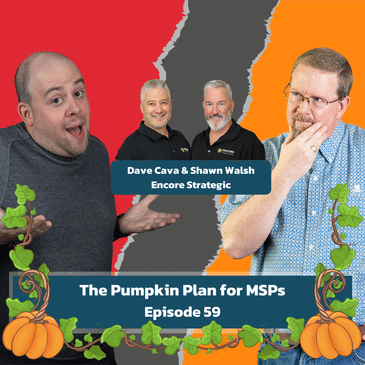
Should do? And if you stick around at the end, we'll see if Eric does this at the end. We should do that clip from Ferris Bueller. He is like, you're still here. Go home. It's over. That'd be good. That'd be good. I wish we talked about that off camera so it made more sense. It was going to be more of a joke and surprise for everyone later, but Oh well, of editing. Yeah, good editing. Yeah, we have a guest, actually, we have multiple guests today. I love it when we have a guest. I always say that Mr. Shawn Walsh and not the owner of Kaba Restaurant. Mr. Dave Kaba, authors of the Pumpkin Plan for managed service providers. Hello gentlemen. How are you?
Shawn Walsh:
Excellent. How are you guys doing
Justin Esgar:
Today? Awesome, awesome. Thank you for being here. Love what you did with the background, Shawn. It's perfect. For those who don't know you two we'll do Dave first, then Shawn, Shawn, guys give each other, give each other, give everybody one minute. Tell us who you are and a little bit about yourself and then we'll jump right into what the book's about.
Dave Cava:
Dave Cava. I ran Proactive Technologies along with a partner from 2007 to 2019. We were a financial services focused MSP in New York City. Built it up to a $10 million company before we sold it. I was the COO slash cfo, went through some crazy wild, difficult personal things the following year or two, and then this guy next to me rescued me off the scrap heap and I joined Encore Strategic as a partner and I run our recruiting division and do some facilitation of peer groups as well.
Justin Esgar:
That's awesome. Shawn
Shawn Walsh:
And Shawn Walsh, recovering MSP had an MSP that we grew from the basement of our house to locations and four states sold it at the end of 2017. Spent about three weeks on the couch having panic attacks about what I was going to do next. I've always been involved in teaching. I've taught college, I've taught high school. I teach, I'm a SCUBA instructor part of the year in Aruba. So I said peer groups and consulting were a big part of what allowed our company to grow, and I felt that I could jump into that. I had gotten my MBA while, I built my company and put that to use. I called up my lawyer, he told him to register an LLC. He laughed at me. He said, you couldn't even stay retired 30 days, could you? I said, Nope, too many ideas bouncing around in this head. So I started out with the peer groups, we added the direct consulting, and then when Dave sold his company, he told me about his idea on recruiting and I said, Hey, this fits together perfect. Why don't you come join me? So he did. That is encore as it is today. Eric, I have to say I was surprised that wasn't your office because I A Ferris Bueller poster behind you just seemed completely appropriate.
Eric Anthony:
It does, and it is one of my favorite movies of all time. But yeah, I don't know. The studio at home is just a little more, I pimped out. I guess I'll just, I'll use kid language.
Justin Esgar:
I was going to use colorful, but
Shawn Walsh:
Okay. But the Ferris Fueler poster doesn't suck, so
Eric Anthony:
No,
Justin Esgar:
I would like to say, Shawn, as you're telling your story, I'm thinking about the fact that how much do you and I have in common, right? You mentioned you're an MSP, you were an MSP, you're in four eight. I currently run an MSP. I'm in four eight. You had panic attacks on the couch after you sold. I have panic attacks on the couch every other day. We're basically the same person at this point.
Eric Anthony:
Although you are in the minority, Justin,
Shawn Walsh:
Because there's three recovering MSPs here and then
Justin Esgar:
Me.
Shawn Walsh:
Yes. It's funny, Justin, the panic attacks actually started in all serious as about two weeks before we closed because I really hadn't, we were so wrapped up in due diligence, I really hadn't thought about what am I going to do next? And all of a sudden I started realizing it's going to be in two weeks. I'm going to have nothing to do here. And so I started saying, well, what do I want to do next? And I signed up for personality profiling certification tests. I signed up for my scuba instructor cert card and then just to be sure, I signed up to be an Uber driver. So I have two rides to by name, both five stars.
Justin Esgar:
You're a scuba. I was kind trying to make this more scuba like a scuba, scuba,
Shawn Walsh:
Scuba
Justin Esgar:
Move on from this. Well, thank you gentlemen, both for being here. For those who don't know, these two gentlemen wrote a very interesting book called The Pumpkin Can Plan for Managed Services Provider Forward by Mike Malowitz, which I think is an amazing poll. I have my connection to Mike through ACEs. He was our keynote speaker in Arizona. But real quick, how did you guys get to Mike?
Shawn Walsh:
So I was speaking on the ASCI tour, so one of the ASCI Road shows. I was asked to be one of the keynotes in that, and I had already started doing consulting. And when I first started looking around for materials to use for the consulting, I ran across Mike's Pumpkin Plan consultant group. Now that's not run by Mike, he has somebody that runs that for him. I would occasionally come in on a Zoom call or something like that, but I really hadn't known him one-to-one yet. And I hadn't been paying attention to the schedule for asking. And I got up on stage and lo and behold, I found out just beforehand that Mike was going to be the main keynote. And as I'm starting my talk the first day I'm on stage, he comes in and decides to sit down right in front of me and take in my talk.
I'm like, oh, no pressure here. So afterwards I went up, I introduced myself, explained to him that I was involved in his other group. And over the course of 10 shows, we got to be very friendly and got to know each other well. And at one point Mike told us that he was looking at opening up the pumpkin plan to do derivative books. He had already done that with Profit First, but nobody had written a derivative yet of Pumpkin Plan. And Mike had come out of the IT services space. And so he approached Dave and I and said, would you guys be interested in writing the first one? So we jumped on the chance and we wound up doing a licensing agreement with him and his team and they were very instrumental in helping us to understand the process. So Mike is very, very upfront that he works with a ghost writer, AJ Harper. And we met with her and she did a
Dave Cava:
Co-writer, co-writer,
Shawn Walsh:
Ghost writer, but she's the one kind of tapping the keys behind and putting the polish on it. And she did a great job of really sitting Dave and I down and giving us a very realistic education about what it takes to write a book. And I've read a lot of books about how to write a book and I will give a plug for AJ here. And her book was by far the most practical and the most relevant. It was no Sunshine bs. It was like, this is going to be hard work, it's going to take lots of passes, but if you do it right, you're going to come up with something that's got some meat to it and some value and not just a vanity project. And I think so far the feedback we've gotten on the book has been very positive. So I think we hopefully got some value out there for some folks, and that's the feedback we've been getting so far. But that's how we came to work with Mike and his team.
Justin Esgar:
That's awesome. I worked with a business coach for a while who was part of the Profit First training group, so I didn't work with Mike directly, it was actually because of her, this really awesome woman named Jennifer Dawn who I got to meet Mike and actually went to his office in Jersey and then eventually got him to speak at the conference. And at the time he was talking about, oh, he was talking about pumpkin plan at the time. And so he had come to ACEs, which is a group of Apple based MSPs and basically laid out. So I'm going to throw this one in. Dave. Dave, for those who don't know what pumpkin plan is, especially pumpkin plan for managed services, you want to maybe give everybody an overview on what that's all about?
Dave Cava:
Yeah, I want to take a half step back and deconstruct a line where Shawn said we jumped at it, there was a lot behind. We jumped at it. Shawn came to me and said, we've got this opportunity. It might be kind of cool. We've been talking about writing a book. And I said, gee, Shawn, that's a lot of money. If we spend it, it'll force us to actually write it. So that was like I swung a foot over my ass and kicked myself in the ass because I knew if we spent the money, we're actually going to write the book. So there was a lot of knowing what it would take to get things done. So we didn't just sit around for 10 years thinking about writing a book and everything.
Shawn Walsh:
Yeah, absolutely. And we had some deadlines because Askey said, okay, you're writing this book with Mike, we want to have you in there. And so we have the deadline of the show starting. So there was some good motivators there that we wouldn't have had otherwise. That's
Dave Cava:
Good. It's good to put yourself in a situation where you're forced to perform when that's what is needed for you to perform.
Shawn Walsh:
Failure was not an option.
Dave Cava:
Option. And I have another funny connection to Mike because Mike Mike's first company was a tech support company and he talks about it in the Pumpkin Plan and it was called ec and I knew ec, I started reading Pumpkin Plant. I was like, wait a second, I know this company. And I knew it after Mike had exited, I got to be friends with the owner who was Mike's original partner who Mike sold out to, and they were best friends in high school. And I never knew that was Mike's MSP until I read the book and I was like, I know this company, I know this guy, I know what they're up to and it's really funny. So there was a personal connection there that was kind interesting. But the reason the pumpkin plan is such a good fit for MSPs is because Ms. P is an entrepreneurial business that's usually bootstrapped it's services based.
And the whole idea behind the pumpkin plan is that in order to really succeed as an entrepreneur, you need to focus and figure out what you're best at, figure out who your best clients are and how you do what you're best at for your best clients. We call that the seed. Second step is to weed. That means you get rid of the clients that are not a good fit, the ones that are just, we call 'em cheap pain in the ass clients. But once you get to a certain level of maturity, it goes beyond the ones that are cheap and a pain in the ass and the ones that really just don't fit your sweet spot, they really aren't the right clients for you. Second half of weeding is just avoiding shiny objects. A lot of MSP owners will jump at any opportunity that comes at them because it's revenue, right? All revenue is good revenue and that's a big lie. Stop nodding your head
Justin Esgar:
For those who are listening and not watching on youtube.com/all things msp. As Dave is saying this, I'm turning bright red and waving my hands up in the air because I am a hundred percent guilty of all of this.
Dave Cava:
Well, I mean everything Shawn and I wrote from experience, you see three quarters of the things that we're telling people to do are things we got wrong before we got 'em. Right, exactly. I mean, I could tell you horror stories all day long about things we took on that we shouldn't have taken on and the chaos that ensued and how it slowed our company down and kept us from really meeting our full potential faster. So anyway, seed, right? Figure out what you're best at, who you're best at doing it for weed, get rid of bag clients, avoid shiny objects and feed, and that involves creating processes for your MSP and marketing around your strengths. So in a nutshell, that's the pumpkin plan for MSPs. And we go into a ton of more detail on those things and just condense seven steps down to three right there. And then we talk about a lot of the things that go into the day-to-day of running a really successful MSP. So it's about 15% content that's derived from the original pumpkin plan by Mike and about 85% things we learned in the business over the years, and some of it is the correct fundamentals of the MSP business and some of it is how to really run one with excellence. That's
Justin Esgar:
Awesome. And for those who have never read the original pumpkin plan, the reason it's called the pumpkin plan is the story that Mike tells in it is about pumpkin farmers trying to grow award-winning blue ribbon pumpkins. And the idea is that you start with this slew of pumpkins in your pumpkin field, you let Charlie Brown do his thing, and then you get rid of all the ones that aren't growing and you seed and water and feed the big one until it becomes the massive award-winning pumpkin, which there's your baseline for this. So I do want to jump in because I'm going to jump right to chapter six because anyone, if you're listening to this, go buy this book Amazon, I'm assuming. Yes. Amazon. Go buy this book on Amazon, buy it right now, pause and read it and then pick it up right from here. Ready? 1, 2, 3, go. Cool. So we're at chapter six because I'm going to jump right ahead for a second.
A ruthless inventory. Now this is why I want to talk about chapter six for a second. I was talking to a consultant friend yesterday and they were telling me that they were hurting a little bit, they weren't making their numbers there. There were clients who weren't paying and all these things and there was rules and whatever. And I said to him, I said, listen, I'm going to be nice. I'm going to be a New Yorker to you. You are too nice. And he is like, that's the meanest thing anyone has ever told me. And I was like, you need to be more ruthless. And I mean that from two perspectives. One from looking at your clients and getting rid of the ones who are not paying you on time or figuring out what that problem is and cutting off all bullshit clients and also internally, which you guys talk about in the book as well, which is like stop doubling up and tripling up on tools and call every vendor you have and ask for a discount and do all these things. Because what caught me was the ruthless part. I was like, you have to be ruthless as an entrepreneur, which is I think really hard for a lot of MSP owners, right? Because not to generalize a lot, ofm SP owners are introvert, they're a little bit more quiet, they want to be a little bit nicer. Not everyone has that brash New York attitude that I'm so well known for, but you have to be ruthless. Can you get in you to get in a little on this one here,
Shawn Walsh:
An example of exactly what you're talking about is the other day I'm combing through Reddit and I come across a post in the MP form and this person is saying, Hey, does anybody have any recommendations for this tool that does this? Because I just went and talked to this prospect and they'll sign up with us, but only if we change our tools and we do this and we bring in this other tool that they like, that'll bring this in and I just want to scream at them, stop. You sell to the people who will do business your way. You can't customize your entire business model. For every client that says, I want something different, it's not scalable and you have to be selling to the people who want to buy what you have. And if they don't want to buy what you have, then they're not a fit for you. And that's just an example of one of the clients that you have to be willing to say no to. One of the people that I quote in the book a lot is Michael Porter from Harvard Business School who's considered kind of the modern father of business strategy and porter's, one of Porter's quotes is that you don't have a strategy until you can tell somebody no. So you can't please everybody. And that's a big problem that we see with the people we work with.
Dave Cava:
There's a couple of very common issues with MSPs and MSP owners, and again, Shawn and I example one and one a that we came from the engineering side. We didn't go into the business as business people. So if you're graduating from Harvard or business school or Wharton and you're used to looking at spreadsheets and planning out your profit knowing exactly how you make money, you have a plan, you go execute it and we just fix it down the road, we figure out, hey, I guess I should be running this like a business. I have all these problems that derive from bad decisions I've made or the fact that I'm not making enough money or whatever, I think I need to figure out the business side of this and it's the tail wagging the dog. So most of us look at our business and we're not data-driven, we're not even analyzing what's working well and what isn't.
So if you have two thirds of your clients that are pushing your business forward and one third that's pulling it backwards, can you imagine how it's going to take off if you lop off that third that the clients you're losing money on that are taking a disproportionate amount of everybody's time that aren't paying their bills, it's not like those clients are helping the business a little, they're actually taking it backwards and in order to get that jet fuel going forward, you just got to lose them and the data will tell the story. Yeah, you got to extract the numbers
Shawn Walsh:
And not only that, but you got to extract the right numbers. And one of the things that we typically do when we go into a client for the first time is we want to start going through the agreements. We don't want to just see for the company, we want to see profitability client by client and you need to know that you need to know it down to a decimal point or two. We go into these businesses and we say, what's your profitability? And they go, well, I think it's somewhere around maybe. And I go, stop. So you don't know what it is. We had one place, we went through the client list, client by client and determined the agreement, gross profitability of each client and almost 50% of the clients, they were losing money on almost 50% some to the tune of thousands of dollars a month. I said, by God, you can fire half your client base and be more profitable tomorrow and do half the work.
Justin Esgar:
Wait, can I jump in? Was that just because the number of tickets that client was submitting or was it some of the cost
Shawn Walsh:
Way too many hours and they had just pulled a number out of the sky and said, here's your monthly fee. It wasn't based on anything other than them just sticking their finger in the air and taking test. The pricing made no sense. It wasn't based on anything logically. And then like I said, we started doing the math and it was insane and that's kind of a drastic example, but the other ones aren't that far off.
Justin Esgar:
You know what, Eric? This is why I hate when we have guests, because we have guests on this podcast and I sit here and I'm like, I have such a headache from this because I need to hire these guys. This is to hurt so bad and as the only MSSP still on this call, I need to get out of this business really.
Eric Anthony:
Well, you can just
Shawn Walsh:
Turn this into a sales call if you
Justin Esgar:
Want. I mean
Eric Anthony:
As MSPs, so many are focused on the day to day because traditionally it's such a firefighting job and that's how we start out. So that's how we continue to run until somebody shows us the light. And my light was again a number and that number was my MRR. Back in the days I had Autotask sitting on a screen 24 7 in the office that would show me what my MRR was and if it was not going up consistently, I knew I had a problem. And that was what clued me into numbers matter and tracking things matter. And I completely agree, by the way, with the tracking every contract's profitability because I know I did this. I went through and I did a weeding even this was before the pumpkin plan because I've been out for a while, but I think it was four customers out of 30 that I was again legit losing money on and probably another five or six that were so close to zero that it didn't matter if they were there or not.
Sponsor Ad:
Move bot is the simplest, fastest data migration and moving tool there is supporting over 30 storage and email platforms today. Move data like a pro at atm, SP link forward slash move bot. Today's podcast sponsor is Super Ops Elevate your IT managed service provider business with Super Ops, the all-in-one platform that integrates RMM and PSA powered by AI driven insights and automation. Super Ops helps you stay ahead, streamline operations and boost efficiency. Are you ready for operational excellence? Find out more at ATP link slash Super Ops.
Dave Cava:
Lemme tell you that it's a very common thing for MSPs to chase the whale account and then they discount things to try and get the whale account and the whale account wants them to discount things. They think the big company can work over the small company and it turns out that they're spending a third half of their man hours on an account that they're actually losing money or barely making money on. I saw this just the other day. I'm in the same social media groups as everyone else with all the MSP owners and somebody posted and said, I've got a chance to get a really big account. It's 120 users, my normal user rate is 1 25, I'm thinking discount at 30%, blah, blah, blah. And I said, and I know this from experience, not just from reading, bigger accounts tend to take more time per user, not less. And what you're going to do is take all the time and energy of your business and put it into something. Are you telling me your margins are 50%? So you can afford to give away 30 if your margins are 15%? It means that once you give away 30% of it, they're negative 15%. The math does not work. But we're not wired to think in that way. That goes along and say,
Justin Esgar:
Because seen that before all someone has that. It's like I want to give this account, I want to give them a discount. And I'm always like, don't, if they want to work with you, they'll pay your price. That really is what it comes down to. You should not be offering a discount. The only time I ever offer a discount is if it's a nonprofit and at which point it's rare. It's a rare occasion that I'll do it. Maybe I want to support the nonprofit on the other side or whatever it is, but I will never offer a discount out of the gate. I will just take items off the list this way the profit margin kind of stays or the hourly kind of stays the same and say, okay, fine, if you don't want to pay our price, you're not going to get backup or DNS filter or whatever. Take my cog out of it and I could adjust accordingly and remove the few pennies off the total or whatever. But to
Dave Cava:
You do need to hire us.
Justin Esgar:
Yeah, I know that's a whole other thing.
Shawn Walsh:
One of the big problems that we see with MSPs is they really don't think about the difference between cashflow and profit because they obviously are not the same thing and they steal a big account and they see all that cash, but they don't calculate how much do I get to keep at the end? So that's one of the things that we have to look at. I mean, Dave had a company that he was working with that went through, and Dave correct me if I'm wrong, but I think they were around 3 million in revenue and one client was worth a million dollars a year and they finally realized they were losing money on it and they did what most of us shuttered to do and they fired a million dollar client the most profitable year. The next year
Dave Cava:
They had they're $3.2 million company in Texas that had one big co-managed IT account that was just tremendously noisy and difficult consuming the owner's time. So it was over a third of their revenue, it was like 40% of their revenue and they fired the account that was 40% of their revenue and their revenue the next. So their revenue went from 3.2 to a run rate of 1.9. By the end of the following year it was back up to 2.3, but their bottom line had doubled with less revenue. Just
Shawn Walsh:
People need to realize it's top line for vanity, bottom line for sanity. The top line number doesn't mean crap. It doesn't matter how much you bring in, it only matters how much you get to keep.
Justin Esgar:
Okay, so two parts of this is that. One, it's hilarious that you say this because years ago I was talking to a consultant and I was kind of new in the game and I was like, Hey, how much do you make? And they were like, I make 1.2 million top line. I was like, how much of that is profit? He's like, profit doesn't matter. And I'm not a technologist, right? I'm a business student, not of warden. I went to the University of Rhode Island, thank you. And I was like, I don't think that's the right answer, man. I think profit matters. So
Shawn Walsh:
You're a student of the obvious.
Justin Esgar:
But then you guys have been talking and of course we're having this phone call today. A couple of weeks ago on the podcast, you guys may have heard Adam Boris from Vista Business Group and he offered a free valuation for everyone. And so they did a valuation of my company and I got to say I thought I was doing really well and looking at the valuation, I'm like, what? Because after they did all the math and the EBITDA and they didn't even take into consideration the clients, they just looked at the contracts and just my valuation was way lower than I thought it was. So my profitability is way lower than I thought it was. And it got me thinking, and I call it my president is a true story guys. I'm like an hour ago I'll show you the slack. I call my president. I was like, Hey, I don't know why, but our PAX eight bill for this year is like this much and our PAX eight income, according to our billing software is about a hundred dollars more than what it cost us. I was like, something's wrong. And all of this has been sitting on me and now we're having a call with you and now I really want to have a panic.
Shawn Walsh:
What you're describing there is one of the key reasons why we are so adamant that you have to have a budget. Because if you have a budget and you predict exactly what your revenue should be each month and exactly what your expenses should be and that you should have exactly this much profit, if you hit the numbers every month, you can go down that list and you go, whoa, that number's off what happened? I mean, we found a company that was paying a vendor a couple of thousand dollars a month for two years that they had no idea that they were paying. And when you go through and you do what we call a zero based budget where you start with zero at every category on your p and l and you go, okay, do I need this? If I need it, is there some way to get it for free?
If I can't get it for free, can I get it for less? When you go through and you do that, every dollar you discover goes right to the bottom line. It's not a percentage. The whole dollar goes right there in your pocket. And I have in doing a zero based budget with companies that have never done it and never analyzed their expenses, we have found as much as 10, 12%, which for some companies is their entire profit. It's scary how much money we find doing zero based budgets and once somebody to do it, they do it.
Justin Esgar:
This is that ruthlessness. One of the things that I've been pushing on my team, as everyone who's listening knows, we moved to Halo and Halo has a bunch of other features of things that we're still paying for. So we're finally getting the billing module working cool. We're getting FreshBooks out, we're not paying for that anymore. We're already paying Halo for it. So right now we're paying double. Same with Typeform. And we actually this week, and I'm really happy that my team did this, A repair shop uses a different product than the rest of the consultative team. They're in a different ticketing system. And so it took us six weeks and I was like, I'd rather spend time than money and say, okay, I'm already paying my team. How can we take the repair tickets and move it into Halo? And they did it. They turned it on yesterday with a whopping success. And guess what? There's another $150 a month, $180 a month, I'm not paying for this other ticketing service. And this is what I, especially when
Shawn Walsh:
That time is a one time investment.
Justin Esgar:
And that's what I was talking also going back to the ruthless system, what I was talking to my friend about yesterday is that you need to go through and look at everything. I need to call our file share in the cloud company and say, get me a better deal because we're paying them a lot of money and I need better profit. Those kinds of things are the things that the owners of MSPs should be doing. But as we've kind of all discussed, and we all know this, too many of us are in the day-to-day. Too many of us are putting out fires. Too many of us are technical. We don't think about this kind of stuff. And that's really why everybody who's listening should pick up this book right now on Amazon and read it cover to cover. Don't just skip to chapter six like some people I know.
Dave Cava:
Lemme go back to your PAX eight story for a minute. I tell people until you get to the point where your company has a real CFO, which is probably around $10 million, most MSPs don't have a CFO. The owner is the CFO. And it really is one of the most important jobs, if not the most important job in the company. It's the how do we make money? How does every decision we make affect the bottom line? Oh, why don't these lines line up on the p and l? Why are we only billing a hundred dollars more than our expense when we should be making whatever percentage somebody's got to watch the ship, right? And so I tell the story in the book of one MSPI work with that went from in business for 20 years and he went from $4,800 a month in MRR to over 18,000 in a year.
Never thought he could do it, went 20 years without changing. And $18,000 a month in MR doesn't sound like a lot, but for a guy that's never had an MRR, he has stability in his business now and something to add on. And he's kept it going from there. But there was another guy in that group who had about $18,000 a year in recurring revenue and in one year got it to 36. And I said, you doubled your MRR in a year. And for a small company that's no small feat, how did you do it? And he told me that about half of it was just going through his contracts in his billing and figuring out the things that he wasn't billing for, that he should have been all along, which is insane to me that that could go on for year upon year, upon year upon year and he's leaving, he was leaving 50% of whatever it came out to at the end, 25% of his company's revenue on the table. It's a difference between making money or losing money or going from a $50,000 a year salary to a hundred thousand dollars a year salary. I mean it's crazy, but it's like you said, we're so focused on attendance, emergency, got to keep the team happy, got to keep the clients happy. What's going on with the business? Maybe I'll worry about that at the end of the month, somebody's service and if he
Eric Anthony:
Wasn't going into debt, then all of that is profit.
Shawn Walsh:
Well, we just did this with an MSP that we're working with and they went around, they went through the list of clients, figured out who wasn't profitable, figured out where they needed to get to be at the right amount of profit. And he went around to each client and met with them out of 10 clients, and I would say more than half of them, their bill doubled. He went around and they were out of the 10, only two said no, and those were two that really fit the pain in the ass category. And we had told them, you should just fire those ones. So they self-selected out and all the other rate were like, yeah, we were kind of wondering when you were going to raise your prices way. We knew you were way too cheap, but we weren't going to sell Pat tell you to raise 'em. So a hundred percent increase on several contracts and now they're headed to have their most profitable year ever.
Justin Esgar:
That's awesome. Well, Dave, you brought something up about empowering your team and talking to your staff, but we don't actually have time to talk about this. I love where we went with this and I'm sorry we didn't get to talk a little bit more. Ladies, gentlemen, Dave Cava, Shawn Walsh, get the book, the Pumpkin Plan for Managed Service Providers, A roadmap to MSP, prosperity, I can't say that word, it's available on Amazon. We'll have a link in the show notes. It's $16 for paperback on Amazon, at least according to my Amazon. Invest the $16 so you can make more profit on the bottom line. Increase your rates, be ruthless. Dave, Shawn, thank you so much for being here. It was a pleasure. And I think that's everything. Eric, any final words?
Eric Anthony:
Yes, I do actually, because I can do this as the podcast producer, we are going to give away five copies of this book to the first five people who comment to the YouTube video after we post this podcast. So comment on the YouTube video and we will select the first five and we will get you the pumpkin plan for MSPs.
Justin Esgar:
That's awesome. And if you need that address,
Shawn Walsh:
We appreciate that.
Justin Esgar:
And if you need that address at youtube.com/at all things msp, follow us at facebook.com/group/all things MSP like and subscribe on all of your favorite platforms. I mean, you're already listening to us. Just leave a review, tell us you love us, tell us you love Dave and Shawn. I don't care. Just give us something, engage with the group, talk to everybody there. There's so much happening there and from Eric and I thank you so much for listening. Bye.
Sponsor Ad:
Thanks for listening and don't forget to subscribe to us on your favorite podcast platform. You can also follow us on Facebook, but better yet, go ahead and join the Facebook group. You can also follow us on Instagram if that's your thing. And make sure you subscribe to our YouTube channel at all things MSP to us in all of our video glory. And last, but certainly not least, if LinkedIn is your thing, you can follow us there as well. And a special thank you to our premier sponsors Super Ops Move Bot goes into Easy DA and Comtech. And we also want to thank our vendor sponsors. The All Things MSP podcast is a biz POW LLC production.