


Listen to "All Things MSP" on Your IT Podcasts!
[00:00:00] If you're struggling with the complexity of Microsoft 365 deployment, management and automation, it's time to check out CoreView. Created by MSPs for MSPs like you, they help you with the end-to-end Microsoft 365 administration from the moment you set up a new tenant.
[00:00:25] Work with things like unified visibility and control of all your tenants from a single UI to powerful no-code automation engine, baseline tenant configurations, drift remediation and much more. You can supercharge your productivity and do even the most time consuming tasks with just one click.
[00:00:44] Work effortlessly and deliver best practices to your customers today with CoreView. To learn more, visit atmsp.link forward slash core view. I wanted to talk today about summer Skunkwork projects. Okay. Because this is a good time to do it. So you know what Skunkworks is, right? Yeah. Yeah.
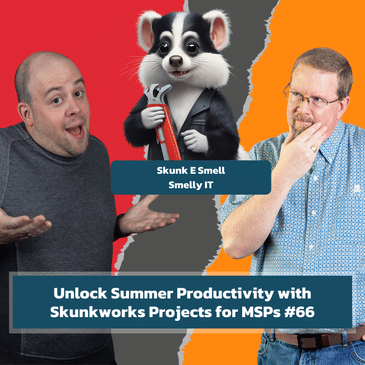
[00:01:07] So I think it's a good thing when companies are slower because summertime is typically slower to use this time to have an internal Skunkworks project inside your company to help bolster your business.
[00:01:28] And you don't have to take it as far as like here's the credit card, go fix everything you find that's broken. But it's a good way for companies to creatively think together as a team on problems of each other.
[00:01:41] We've done this at Virtua like two, three years ago. So we can talk about that if you want because I like summer Skunkwork projects. Okay. And you know it's kind of like what Google does, right? Where they give their employees what is it 15%, 20% or 20%. 80, 20, yeah.
[00:02:00] It's the 80, 20 rule for them. But that's mandated. That's different. It's similar but different, correct. Similar but different just like us. And another similar but different thing you could do is you could do like a hackathon. Yeah.
[00:02:16] That's another type of this creative creation opportunity type of motion that also goes really far to making your employees feel heard and involved. Right. Data migrations are complex and irritating. Making days of frustration from setup to cut over. Movebot was built from the ground up to fix that.
[00:02:48] Movebot is the simplest, fastest tool for moving files and emails that there is fully hosted with no infrastructure, no virtual machines, none of that craziness. Sign up, connect, scan, and you'll be moving data in minutes. Move data like a pro at atmsp.link forward slash movebot.
[00:03:08] What's up everybody? Welcome to the All Things MSP podcast. My name is Justin Esker with me always my good friend podcast producer, extraordinaire and the man who tells me what I'm supposed to be doing. Mr. Eric Anthony. Eric, what's up buddy?
[00:03:20] Not telling you what you're doing and obviously, you know, we're going to have a great episode today because of that. You're not my real dad. I love you dad. Yeah, we have a great episode talking about some stuff today.
[00:03:33] I want to talk about some summer projects that MSPs can do to help both of their business, but let's just jump right into it with From The Group. So here's the catch. We don't have a post from the group this week because we're recording this a little
[00:03:57] earlier than we normally do. And we just recorded one like three days ago and there hasn't been enough time for people to post in between because it was the weekend. So maybe when we record next time, depending on where this goes out,
[00:04:10] but also you'll have pre-heard it and then you will have posted in the group. And if you don't know what we're talking about, go over to facebook.com. Slash groups slash all things MSP, not the way my web browser keeps filling in
[00:04:22] all thing MSP and I can never get to our group. All things MSP and post what's going on. Once you've heard the rest of this episode, I want to know what you're working on this summer posting in there and
[00:04:35] we'll talk about it on the next From The Group. So this has been an awesome segment. From The Group. You know, but this this happens, right? Like it's summer, a lot of people are at PAX 8 beyond. You know, as we're recording this.
[00:04:53] I was going to wear a Buzz Lightyear costume today. You know, I still think they should call it PAX 9. Like the event should be called PAX 9 because it's beyond PAX 8. Anyway, it is summer. Yes. And and and it is a slower time. I do.
[00:05:11] I mean, speaking of math problems, I'm going to throw you off because I always do this. You know that math equation that turned the internet to like a the turn into like the internet when a buzz was like eight divided by eight
[00:05:21] divided by two parentheses, two times two equals either equal one or equal 16 depending on which calculator you have it. So when we're recording this, WWDC was yesterday and Apple announced their big announcement was that they're bringing iPad, they're bringing calculator to the iPad,
[00:05:38] which I think was so stupid. But they have math notes. The math notes thing is cool where you can like write equations out. And so I have some friends who have the bait, they already downloaded the beta day one because they're those kind of people.
[00:05:52] And we were playing with it yesterday and we were trying to figure out if the iPad math notes would say that the answer is 16 or one. And the answer the iPad gives is 16 and the iPad is wrong. But whatever. So my math tips for the day.
[00:06:08] Can I tell you how many times I've tried to use the calculator on the iPad and it's not there? It will be in September. It's annoying. I like the fact that now my, I have like an older 12.9 inch iPad. Now it's just basically a big iPhone.
[00:06:26] But I digress. Let's talk about summertime. I have this on my desk. All right, for those of you who don't see what he's saying, Erica's holding up a calculator that was made in 1972. I didn't say you were made in 1972. I said the calculator.
[00:06:45] I was made earlier than that, but we digress. And this is actually, so this is a Casio FX 451. You just dig in your grave. It is probably from the late 1980s by the way. And this is, it is not the exact calculator because that one is long gone.
[00:07:05] But this is the calculator that I used to use. It folds up kind of, it's cool. It's got a membrane keyboard on one side. It's all scientific engineering. E and this would go right in the jacket pocket of my members only jacket because it was the late 1980s.
[00:07:22] I have no notes. Perfect. 10 out of 10. No notes. So we wanted to talk about things to do this summer other than play on calculators. Summertime is typically slower for a lot of MSPs.
[00:07:36] Unless of course you're an MSP that takes care of schools at which point this summertime is always horrible for you. But for the most part, for the most part, right? A lot of companies are a little more loosey-goosey with their PTO policies.
[00:07:48] A lot of people take vacation because kids are out of school, things like that. And so the summertime, typically if I look back on my numbers like August is always traditionally the worst month for me year every year for the last 16 years, right?
[00:08:01] So a couple of years ago I did this and I was actually just talking to someone earlier today about they should do this in their company. And I want to talk about doing a Skunkworks project.
[00:08:12] I want to get into a little bit what Skunkworks is and why you should do it. But the summertime is the best time to do it because instead of your team like lounging around because there's no one needing their password reset,
[00:08:24] this is a good thing to engage them in to help better your company, right? So Skunkworks originally was a lot... I'm going to paraphrase the Wikipedia because I know most of it off the internet.
[00:08:38] But Skunkworks was essentially a breakout company from Lockheed Martin back in like the what? Like the 30s, I think. And they basically, because Lockheed Martin had a file of very specific guidelines and needed to get stuff and there was so much bureaucracy to get things done.
[00:08:56] And it was at the time it was like World War One, it was like a bill of World War One, I think, right? And they needed to get things done faster.
[00:09:02] And so they took a group of engineers and they propped up a tent outside of the Lockheed Martin building and basically invented some of the greatest airplanes that we've had in our military ever since, including the SR-71 Blackbird and F-117 Nighthawk and the F-22 Raptor.
[00:09:22] They all came from this idea from this tent. The reason it's called Skunkworks is there was a... What is it? Like in the 50s, there was a cartoon that was drawn about it. They used to be called Skunkworks.
[00:09:36] And but the thing is because they were melting plastic so often to like make models and such, the smell had permeated outwards. And so someone drew a cartoon about them and called them Skunkworks and they adopted that instead.
[00:09:49] And so now their logo is like a skunk, like a Peppy Little Pee Peppy Little Pee. Sounds better anyway. It does sound better, yeah. And by the way, I think back then it was probably still just Lockheed. They made it its own term.
[00:10:08] So here, the term Skunkworks comes from the Satirica Company. I mean the company. Oh yeah, oh, it's Lockheed, yeah. Because they didn't merge with Martin Marietta until much later. Oh right, it was just Lockheed. Which was immensely popular from the in the comic.
[00:10:21] The Skunkworks was a dilapidated factory located on the remote outskirts of Dogpatch and then blah, blah, blah. And something about grinding skunks and the smell, I don't know, whatever. If any of this stuff that I'm telling you is wrong, I look forward to your tweets and emails.
[00:10:35] Anyway, so the point that I want to bring up with this is in a business sense, a Skunkworks project. And I'm going to read this right from Google because their words are better than mine. A group within an organization given a high degree of autonomy
[00:10:54] and unhampered by bureaucracy with the task of working on advanced or secret projects. Replace the word advanced or secret projects with things you need to get done in your company to move your ass forward. Yes, but in a creative way.
[00:11:11] Like that's part of the point here is to think outside the box. That's why they went outside the building and were in a tent. Exactly. It does. There is so much bureaucracy. I mean, most MSPs, let's face it, don't have a lot of bureaucracy.
[00:11:25] So you're really doing it for the creative reasons here. But working in larger companies, you know, you obviously, anybody who's done that knows that that bureaucracy can really weigh you down and get in the way of any of that creativity happening.
[00:11:42] So yes, first of all, you need to get it outside the box. Then you need to get creative. And that brings about ideas to solve problems that you may not have even known you had,
[00:11:55] but it definitely will bring about the creative ideas that will solve them in a way that may be cheaper, maybe faster, maybe better, whatever it is. Now I'm going down the rabbit hole of the six million dollar man. I saw that coming.
[00:12:07] We did this a couple years ago, Rorychua, when I first learned about Skunk Works. I think I was listening to Masters of Scale, which is a great podcast by Reid Hoffman, if anyone wants to listen to something else other than the two of us.
[00:12:22] And it like I started thinking more and more about it. It was like it was like an itch that I had to scratch my brain. And so what I did was that year I broke my company up.
[00:12:33] We had, I think six people work first at the time and we broke up without me. I didn't get involved with it. I broke the team up into three teams of two and I matched higher titled people to lower titled people.
[00:12:44] So like our president was titled with our with our intern and our director of technology was with one of our junior consultants and things like that. And I gave them a budget. I said, I said, I said, here's the rules.
[00:12:57] The rules that we have here are figure out something that is not working or that you think you can do better or faster, make, you know, stronger, whatever six million dollar man. If it's less than a thousand dollars total over the course of one calendar year.
[00:13:13] So like basically a hundred dollars a month or so. Use the credit card and fix it. If it's going to be more than a thousand dollars, let's have a conversation about it. But like I gave my team a little bit of autonomy to get things done.
[00:13:27] And it was like it was really was minute things that moved mountains. Yeah. It actually I think was the reason we ended up building fresh books time tracker because the app was missing. They fresh books in Zendesk used to have an app that went away, whatever.
[00:13:49] And one of the things that the team one of the team to come up with was like, this doesn't exist anymore. What do we do? So they designed a concept around it and then we ended up building it.
[00:13:58] It costs us more than a thousand, but we've ended up building it and selling it. But then there were even smaller ones like are so long ago. I don't remember, but I'm pretty sure some of them are like some of the forms
[00:14:09] we had were like, you know, they weren't standardized across a thing. So like they spent and they spent a couple of bucks and they got a VA to go through all the forms, like a one off VA to go through all the forms, things like that.
[00:14:21] These like little pieces that just like move the needle hard for us. So I was just talking to somebody else earlier today about doing this skunk work and there they were I was fruitful conversation with a person. They worked for a very large company.
[00:14:38] And I kind of was like, do skunk works to like have all the other teams provide insight for your team, right? And build off of that. This way you get buying from people and make it feel like they're part of it and things like that. Which is cool.
[00:14:53] So a lot of different ways you can play this. If you're more than if you're more than two or three people, this works. If you're a single person, you're skunk working every day. Right? Yes, but you're missing some elements, right?
[00:15:07] Like one of the things you mentioned was you pair somebody who is like a higher level with somebody at a lower level. Quite often the other thing that works like that is pairing people from different departments, like putting a developer with somebody from sales
[00:15:22] because it's that two different points of view or three or four that create the ideas that people wouldn't come up with on their own because they never see it from somebody else's point of view. Right. Mixing those. Yeah. Mixing those points of view really do matter because
[00:15:44] this is funny because I talk about the same thing about ACE. Not to bring it up again, but I do say the same thing about ACEs where like, you know, we have someone who comes who only does residential one person residential and then I got someone
[00:15:55] who comes who's got a 20 person team only does, you know, 50 person businesses are better. And guess what? They can learn from one another. It's a weird concept, but they can act on their own. So I think I think Skunk Works are a great summertime
[00:16:11] project because of the lull and because you can have you can have those days where to work on these creative projects to help help move the needle. Right. Another example, this is one you brought up earlier when we were talking pre-show is like doing like a hackathon. Right.
[00:16:32] Try to I mean, I don't know. I look at hackathons as like try to break something. I don't know if that's necessarily the route you want to go with it. Well, sometimes in breaking things, you find out things that you didn't know
[00:16:46] and or, you know, in the case of a lot of our a lot of MSPs have created their own scripts in their RMM tool. Right. So creating things like that, you can actually use the hackathon methodology to do that type of scripting or workflows
[00:17:04] and stuff that gets coded. And if you're not watching YouTube, I just used air quotes for that. There's so many different ways to do this. I think hackathon is probably limited to a more technical problem. And, you know, so the Skunk Works is probably a little bit better
[00:17:25] if you're trying to actually go after business improvement gains. Right. And it's similar to what Google does, right? In terms of their 80 20 rule that we were talking about again, pre show. And it's giving your people the creativity in the room
[00:17:44] to come up with these things that they normally wouldn't come up with because they're so busy doing the day to day. You give them that opportunity to kind of get out of their own body, get out of their own role and think about other roles.
[00:17:58] And how they all, you know, work together in the business. You're going to get ideas that you wouldn't get just day to day when everybody's doing their normal grind. That 80 20 rule from Google is an interesting one because that's it's kind of I haven't checked the Google rules recently,
[00:18:16] but a while ago, usually mandated as part of their contract, like you are to work on 20 percent of your time on something personal. And that's how Gmail came about. And that's how like a lot, I mean, a lot of stuff that Google
[00:18:29] has built and now has since taken down. All of those things came about from those personal things. Another way of looking at it, especially when you're talking about learning from other roles is and this is a little off
[00:18:44] killed or from from Skunk Works or Hackathon, but Zappos pre Amazon. Tony Shuei, who was the owner of the time, no matter who you were, what position you were, when you started off, you started doing you started in customer service. You started by answering the phones
[00:19:04] because they were so bred on a culture of customer service that he wanted everyone to. So if you were this new CFO, guess what? I welcome to Zappos. How can I help you? You know what I mean? It really shines a light when you.
[00:19:26] To quote Big Hero Six, look at it from a different angle, which by the way is a great movie. Yes. And and desperately needs a sequel. Hashtag Disney give Big Hero Six a sequel. Can you imagine if they made a sequel
[00:19:43] because they just heard our one episode about Skunk Works? And they were like, oh, we should make a sequel of that movie. But my point here is like there's a lot of different creative things you can do over the summertime to help move your business.
[00:19:56] You know, a couple of weeks ago, I talked about doing the audits. The audits are in no way, shape or form creative. Right? No. And so we're spending June doing the audits that way. I can get all of that technical debt out of my brain
[00:20:11] to like make room for the creative. Because like even last night, I was making dinner and I was texting with our friend, Steph Hilfer. And I. Steph was in a program from someone who was doing podcasts, right?
[00:20:28] So that her whole thing was like helping you build a podcast, whatever it is. And I had I just sent her a DM and I was like, OK, does this thing work? Like, did it work? She's still in it, but kind of not.
[00:20:38] And she was asking if I wanted to do it for ATMSP. And I was like, no. Because I was just wondering like I'm I'm always looking for how do I get new customers? Right? I'll get back to the score work.
[00:20:50] I was looking at how do I get new customers? Because our being these sources, the Apple Consultants Network and that led into a conversation about, you know, we'll kind of customer I'm looking about. Get you get because like I want I'm looking to get a whale.
[00:21:03] Like I'm in the market for whale of a very specific type of whale. Right? Not just any. And so the problem that I'm having right now is I can't even get to the creative parts of my brain because the audits are in the way. Right?
[00:21:19] So I'm trying to get through the audits to get to that creative part of it. So so July for me, so I'm bringing around, July for me is my like brain space, skunkworks time to start coming up with
[00:21:32] creative solutions to like solve some of these bigger problems that we have in our company, right? We need a better lead funnel. July is going to be my skunkworks time to like literally try anything. Right? Play play with all the sign up for all the AI
[00:21:51] that's on the internet and see which one works. All the AI, all the AI, ATI, oh, that's a new show we should do. Quick, grab that domain. Before this episode goes live, if you don't do it, what's going to happen is
[00:22:08] someone's going to hear this and then steal a domain from us. But like that that creative time, I think, is very important. Whether you call it a skunkworks project, whether you call it a hackathon. That creative time is very important for anyone as a business owner,
[00:22:27] especially if you have a team to come up with the ideas you need to move your company forward. Summertime is the time again, unless you're taking care of schools, is the time for MSPs to like put their stuff together and and
[00:22:47] compress it down and then light it on fire so that way you can take off for the back half of the year. I think I stalled enough for you to buy the domain. Did you get it? No, but you did give me enough time to look it up.
[00:23:00] And I looked up all things. I dot com as well as all things dot AI, both of which are already taken. So obviously great idea because somebody else already thought of it. Simple tutorials on using AI tools. All right, we'll figure it out.
[00:23:23] But yeah, I mean, that's that's kind of my take on it. That's what I wanted like summertime is the time to be creative. I know a lot like that's also kind of why we do summer Fridays. It's a little bit
[00:23:36] giving somebody a day off, give them a little extra relaxation for a weekend this way they come back because like when you have a day off from work, at least maybe this is just me.
[00:23:46] Any days that I have days off from work, which are few and far between anyway. All I'm coming up with is like new ideas for work. Right. You know, you give yourself
[00:23:58] you go get a massage for an hour, you come out of there with your head full of ideas that you want to do stuff. It's a lot better than like doom scrolling tick tock, which I do every night.
[00:24:09] And in an attempt to buy some sort of like Gameboy knockoff device that's full of that's fully loaded with a bunch of games on it. For those who don't know, it's how winning YouTube.com slash at all things. That must be
[00:24:25] so, you know, it's interesting you brought up the fact that this month you're doing the audits well and the audits can actually be a source of ideas for the Skunk Works program. So what you can do because one of the things is a lot of your employees
[00:24:40] may have a hard time picking what needs to be worked on. Right. So if you're doing the audit first, you can create a list of all the things that need to be worked on. You can then give them that list and they can choose from it
[00:24:55] rather than wasting time trying to figure out an idea on their own. They're already working on something that you know is going to move the needle in the business because you've already found it during the audit. Right. It's it's weird to say that that's it's not weird.
[00:25:11] It's true that is 100 percent true and it's actually already happening because like as we audited one thing, we found some other pieces where like this is good long term dev concepts. So we just shifted them out of our audit into something else for what would be
[00:25:27] Skunk Works Skunkie July. That's what we call it. Fourth, the fourth of Skunk. Oh, we should make hashtag fourth of Skunk. We're going to make that a thing. But yeah, I mean, these these are all just a bunch of different
[00:25:46] methodologies for you and ideas for you as the MSP owner to like come up with ways of being more creative in your business, right? Because so many of us. So many of us look at a problem. We just look at trying to be problem solvers, right?
[00:26:02] There's something broken. We're going to fix it. There's something not working. We're in and this is a little bit beyond that. This is a mask you to extend that creativity muscle to. Work on something that will help you in your business,
[00:26:15] whether that's designing a tool that we've talked about this before, right? The 80 20 rule of like switching tools, like you probably don't need those 20 percent of the bells and whistles. But like maybe this is the time that you really want to get one of those.
[00:26:28] Don't switch tools, build it or find someone to build it. Be creative about that solution, right? Or find something new in a tool that you're already using so that you can leverage more out of that tool. Exactly, right? Every PSA has integrations with 10,000 things.
[00:26:45] What's something that you're not what's one of those integrations you don't have turned on that may do you something in your business? Like we were just I was talking to my I was talking about Dev team the other
[00:26:54] day because they were asking me what the integration for domotes, right? I think that's yeah. And I was like, oh, this is what it does. And they were like, oh, this would be so great to do. The promise that it's very domo is very expensive, in my opinion.
[00:27:09] And I'm like, yeah, we totally should do this, right? So we started playing a little bit with it to see how how we can make it work and something like that. But like it's one of those things where like you give them
[00:27:19] like a little bit of a leash to let them run as far as they can. Within the confines of the playground, right? So you can go to the right because the common is up this playground is our PSA is Halo, right? What is Halo?
[00:27:33] And then I looked at it and I said, what is Halo not integrate with and what can we build? So a great example is we just found that there's finally an API for Ignite reseller.
[00:27:43] And now we're trying to find a way to build a Halo Ignite reseller connectivity component, you know, like that's something that would show up in a Skunkworks project or or in an audit of Show Me Everything That Doesn't Work, which then leads
[00:27:57] this, you know, I'm saying like all of these things, like one thing begets another begets another. Let me know how that works out. And then you have a perfect business and you don't need to listen to us anymore. Oh, but this this
[00:28:11] this crazy place we call MSP changes all the time. So no, we're in it for the long haul people. Yeah, I mean, the problem is that, you know, I think the bigger problem that all is like and I don't want this to
[00:28:24] dissuade anyone, but like you build something and then the the thing that you built that incorporates two pieces, you know, partner A changes the button from here to there or changes an API code. And now, you know what I mean? Like I can understand
[00:28:40] to play devil's advocate like I can understand why people don't want to do this at the same time, like it's fun and it's exciting and it helps your business. Right. And if they change something, you know, if you get punched,
[00:28:57] you you punch back, you don't just fall to the ground. You're not getting punched by Mike Tyson or your rewrite code. You're writing code. You're rewriting code. You're not getting violent. Right. It's not like my Tyson's being like, you need to change your code.
[00:29:10] You have AI for that. All things AI. All things dot AI. All things I would have been my choice. You know what we can do? Can we touch real quick on Web three domains? Can we talk about this or should we just cut this part right now?
[00:29:26] I think that's a great segue into another episode of All Things MSP. Fair enough. Check us out at facebook.com. Groups, all things MSP, YouTube.com. At all things MSP, follow us on all your favorite podcasting tools like this one
[00:29:39] that you're listening to us on in your car. If you like us, leave us a review. If you don't like us, leave us a review or block us on Facebook. One or the other, I don't care. That's Eric. I'm Justin. Bye.
[00:29:52] If you're running an MSP and ever feel like you're constantly putting out fires, I've got some exciting news that could change the game for you. It's the Eureka Growth Program brought to you by Gozintas Eureka Process,
[00:30:04] a sponsor of All Things MSP, and it's specifically crafted for MSPs at every growth stage. Imagine having a C suite of advisors right at your fingertips, guiding you through everything from hiring to handling mergers, boosting your service delivery, and even planning your exit strategy.
[00:30:23] That's what this program offers. And let me tell you, it's like having a powerhouse team behind you, making sure that you're always ready for the next big opportunity. So if you're looking to elevate your MSP game, check out the Eureka Growth Program.
[00:30:37] You can sign up for a call with the Eureka team or shoot them an email if you have questions. Go to atmsp.link forward slash Eureka to find out more. Thanks for listening and don't forget to subscribe to us on your favorite podcast platform.
[00:30:52] You can also follow us on Facebook, but better yet, go ahead and join the Facebook group. You can also follow us on Instagram if that's your thing and make sure you subscribe to our YouTube channel at All Things MSP to catch us in all of our video glory.
[00:31:08] And last but certainly not least, if LinkedIn is your thing, you can follow us there as well. And a special thank you to our premier sponsors, SuperOps, MoveBot, Gozinta, EasyDMark and Comtech. And we also want to thank our vendor sponsors.
[00:31:33] The All Things MSP podcast is a BizPow LLC production.