


Listen to "All Things MSP" on Your IT Podcasts!
Justin Esgar (00:07):
Dude. Okay, so I just got off the phone with a client who they're sending email and to somebody, somebody is replying and they see their original email in the reply text section with extra line breaks in it. I was like, oh, that's weird. Lemme take a look. So I start poking around and it's like a known issue. Microsoft uses different coding than everyone else. And so if you send the email, they're on Outlook. The clients are using Outlook on the Mac, both legacy and new. If you send it, if the recipient is using Gmail on the web and replies, it throws in extra lines. And I tested this, I did it like seven times and then I tested it using Mac mail on my computer and the lines didn't appear. And so I tell her, this is beyond all of us. It's something with Microsoft.
(01:08):
And she goes, well, it's not happening to anyone else. And I go, okay, let's take a look at someone else's computer. And I made it happen on someone else's computer. She goes, well, it doesn't happen for so-and-So I'm like, listen, you just may not have ever noticed you also don't know what the recipient is using. And she got mad at me and hung up. She's like, I guess thanks. And just hung up. And I was like, have a good Friday. So I emailed her boss, the person who's paying the bills to be like, this is like a thing. There's nothing you could do about it. Here's a couple of workarounds. But at the end of the day, Microsoft sucks.
Eric Anthony (01:54):
Picture this. Your MSP is thriving, hiring the right people, delivering top-notch service and growing faster than ever, and you are on vacation. That's the future with the Growth program. By goes into Eureka, whether you're just starting out or planning your perfect exit, this program is designed to guide you through every challenge. Imagine having a team of experts by your side helping you navigate mergers, fine tune operations, and build a business that stands the test of time ready to make this your reality. Shoot an email to support@goesinto.com today and let's grow your success story together.
Justin Esgar (02:33):
What's up everybody? Welcome to the All Things MSP podcast. I'm your host, drunkie Ster, and along with me is always my good friend and podcast producer Eric Anthony. Today's a weird day and I apologize in advance for anyone who's about to hear this. I'm coming in hot and heavy because I'm angry af it's been a week. And then I got this really stupid email, which we'll talk about in a minute. But first we got to talk about from the group.
(03:05):
So this week, the one that I want to pull out, it's not a question. Dave Provin, who's a friend of mine, decided to post and 80, an 80-year-old Glenn, Gary Glen Ross salesman is the best line I've heard in weeks. Thanks Justin. You're welcome, Dave. And anyone who didn't realize what we're talking about, we were referencing when Crouch happened, we were talking about the credit card machines, remember the whatever those things are called, the credit card liners. Yeah. The response that Ben Greer posts goes, that guy is funny is considering he's from New Jersey, is an inside joke to the fact that I was at Mac admins Penn State and I was with all of these guys, both Ben and Dave, and they kept making fun the fact that I'm from New Jersey and I would get angry and go, no, I'm from New York. And they're like, ah, we got you. We got you. So to you guys, I love you, but I hate you. And that's from the group. All right, let's get into the real bullshit for today. Buckle up buttercup. I got the dumbest of emails from a vendor who will not go named if you know.
Eric Anthony (04:14):
Yeah, because I guarantee you other people got this email because this was not an email that I believe was focused solely at you or it would not have come from the VP of sales.
Justin Esgar (04:27):
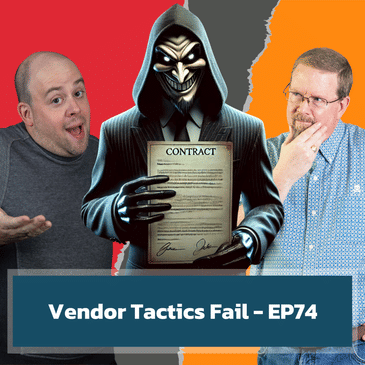
So when I got an email from a company who I used to be a partner with and truth be told, we haven't used them in quite some time, probably close to four to five years, we found other solutions that were cheaper. I find that this solution, whilst very good, I'm not going to lie, it's a good solution that has good training materials, that has good well for what it is, but it's expansive. And so for what we were doing, we didn't really need it and we had one or two clients on it in the very beginning. And so we haven't used them in four to five years. And I got an email that says, hi, I hope this email finds you well, it didn't. I am writing to inform you of an important update regarding your partnership with us that requires attention while we value our collaboration. The lack of recent engagement has led us to reassess our business relationship. Therefore, due to an activity over the past several months, we regretfully will be terminating our partnership agreement with you effective on this date. You have until so and so to notify if you want further review, blah, blah, blah, blah, blah. Now here's my thing.
(05:40):
I'm the customer. Why are you terminating with just because I haven't used you? What? There's no cost other than every now and then your sales person tries to call me and I go, I'm not using you right now. I'll call you when I need you because maybe I know what I'm doing with my business. So there's zero to no cost, and what harm is it that I'm in your database? Maybe one day in the future I'm going to have a client that needs your services. And you know what? This email scorned me so I don't care. And it's not like, is it because of money? Is it because my old partnership agreement was held to a different contract and I'm getting 20% off and now you only want to get 15% off? If that's the case, change the terms and conditions, but don't terminate my partnership with you because I haven't used you. Who the hell are you to tell me that we're no longer doing business? Because guess what? Now I'm definitely not doing business with you.
Eric Anthony (06:38):
And this is absolutely not the attitude to take when you have a commodity-based business because there are multiple other solutions out there. Now, like you said, there are a really good solution, but there are other really good solutions out there as well. There are also cheaper solutions out there. And so threatening somebody in this way, it's pure old school tactics and it's just not going to go over well, just like it didn't go over well with you.
Justin Esgar (07:13):
And when you said old school tactics, I immediately went back to the Glen Gary Glenn Ross thing, and I was like, this sounds like them. And
Eric Anthony (07:19):
The credit card imprinter an imprinter, that's what they're called. I've just remembered
Justin Esgar (07:23):
It imprinted. But yet, here's the thing, all the market is so saturated, and you and I were talking about this offline last week, the MSP market is so saturated between vendors, between podcasts, between coaches. Everyone who I know that's in marketing is like, Justin, help me get into marketing for MSPs. And I'm like, don't bother. You're adding to the commodity of it. You're not bringing anything. Don't get me wrong. They're my friends and I love them, but you're not bringing anything special that a very tall redhead has not already tried or some shit like that. So I apologize to our video editor. He's going to bleep me a lot today, now that I realize. But with such a plethora of vendors and solutions out there, the last thing you want to do as a vendor is piss off the customer because here I am, and granted, we're not talking about this company's name, but you damn well know that I have gone to all of my inside people and been like, Hey, this company sucks a butt, and they're not going to use you either because why would you burn a bridge for no reason?
Eric Anthony (08:43):
Right? And that's kind of the point here. And vendors do this a lot more often than I would like to see where they unnecessarily because this is absolutely unnecessarily aggravate their partners. And especially in this world where the power shift has shifted to the MSPs, it's maybe not very evident yet. It's probably closer to 50 50, but before it was more 75, 25 on the vendor advantage. The world has changed. We're dealing with ecosystems and not channels. Now we still call it a channel, but it's an ecosystem and we're all dependent on each other. And these type of strong arm tactics are just ridiculous at this point.
Justin Esgar (09:43):
I do want to point out that I understand the old going back to the, again, Larry again, Glen Ross example for a second. I understand the reason why you would do it back then because also when you did it back then, there was no recourse here. I could jump over to reddit.com/r/msp, which has 185,000 members, and I could easily put this company on blast.
Eric Anthony (10:11):
And that's why you don't do it,
Justin Esgar (10:13):
Right? And the thing is, they also clearly don't know who I am. Not that I'm anyone special, but I have a platform, whether it's this podcast or my conference or within the Apple community, you don't know who you're pissing off. And I as a very well-known, brash hype tree, new Yorker, take that real personally. I do. I don't know why. I don't know if it's because I'm a vindictive Jewish kid from Long Island or what my story is, but I also live by the phrase word is bond. And if you break that, I'm done with you. I give people trust out of the gate. This is a true story. This is just personally, I give people trust out of the gate, but if you break that trust, it takes decades to get it back. If it comes back at all, just this company just a hundred percent broke their trust with me.
Eric Anthony (11:09):
And you mentioned you have a platform, you have a voice, and you absolutely do, right? Because we have this podcast, you do a lot of other things as well outside of this, and that is significant, but I think it's also, it's the Reddit thing that you mentioned. It's the fact that everybody, no matter how big or small you are, has a voice that can be amplified through just some random viral algorithm on Facebook, LinkedIn, Twitter, Reddit, whatever it is. And companies today, especially larger ones or older ones don't understand social yet, which just amazes me still.
Justin Esgar (11:58):
I think the irony is also of what this company is for them not to understand the social media aspect considering what this company does. There is a weird tie in between the two, but it's like any company that fails at doing something, somebody's head ends up on a stake and there's always going to be the martyr that's going to play out or whatever it is. Sometimes in order for that to happen, you need someone to light the spark and this kind of email to somebody like me, definitely lights like the spark. No. I also happen to, earlier when I said I'm a vindictive person, I do happen to have self-control
Eric Anthony (12:50):
Most of the time.
Justin Esgar (12:51):
Most of the time. That's why I'm complaining about it here on the podcast, and I'm not posting it on Reddit or on the Facebook, facebook.com/group/all things msp, which has almost 6,000 members in it also. But I may actually, when this episode comes out, I may actually reply to this email with just a link to this episode, and if you do listen to this episode, person who sent me this email, you might want to reconsider what you send out there. Not that it was a nasty email, it's just that one, you never know how people are feeling, right? If I was in a different mood, maybe I wouldn't care as much, but at the same time, I don't know.
Eric Anthony (13:32):
Well, and here's the thing, right, because we discussed this pre-show a little bit, and what is the cost to them for carrying you as a non revenue generating partner?
Justin Esgar (13:48):
As
Eric Anthony (13:48):
Far as I know, there's none. Okay? And I've worked in the vendor side of things for a while. What it really does do, because you are a registered partner, there's emails that they can send you that they can't send to people who have opted out of things because you are a registered partner, they have a legal right to send you certain emails, and those emails can contain other things that may be of a marketing bend as long as they include actual information regarding your partnership. So to cut that off and remove that capability from the marketing team is also shortsighted because as a partner, legit, they can send you, Hey, this is a product update that you should know because you're a registered partner and that's not considered marketing material because it has material influence on your partnership. So yeah, extremely shortsighted in my opinion. And hopefully they'll realize it. It'd be interesting to find out if anybody else receive the same email. Obviously we're not going to out them because that's not what we do on this show. We will point out bad behavior on a vendor's part, but we will not
Justin Esgar (15:16):
Shame, shame, shame. Know your name, shame shame, know your name,
Eric Anthony (15:19):
But we won't call them out by name because I think that's fair.
Justin Esgar (15:25):
That's I'll bend to your rules. Otherwise I would just be No, it's fine. You're right. It's less about them and it's more about just there have been other vendors who have done things like this or made mistakes like this and they want to force. I think it's funny when vendors try to force the channel to go in their direction to try to do things to go in their direction. Microsoft did it when they moved everybody to CSP, there was that whole thing where they wanted everyone to, they said, if you don't buy yearly, it's going to be 20% more. And I remember when this happened, so many of my MSP friends were like, oh, we're just going to put everybody on yearly. And I was like, I'm going to just make my clients pay the 20% more and go monthly. Because here I am now currently in a situation where I have a client and their old MSP sold them licenses for Microsoft for a year, and they don't want to work or talk to that MSP at all. But here they are being billed for the rest of the year because until we can move their licenses and go monthly with us, the MSPs took, we're able to take advantage of that and try to get sticky, but then it made them look bad. Why is everyone got to be bad? What's the line from Wreck Ralph? Right? I am bad, but that is not bad. I am bad, but could be good or something like that.
Wreck it Ralph (16:59):
I'm bad. That's good. That will never be good. And that's not bad. There's no one I'd rather be than me.
Justin Esgar (17:14):
I watched it this weekend. I forget what the line is in the very beginning, if you remember, Lee, I look forward to your tweets and emails and tell me how wrong I am about
Eric Anthony (17:22):
Recognize. Well, but it goes back to that old school mentality that I was talking about before where these vendors believe that they have the advantage and that advantage has eroded over time. And if they don't recognize that they can cause themselves some problems. And Microsoft obviously caused themselves some problems with that new program. And now I think in the long run, they weren't stupid because they do exactly what I preach. If somebody wants the convenience of month to month billing and month to month contract, it should be offered at a premium because guess what? It's for the same reason that we'll pay $10 for a bag of potato chips at seven 11 versus paying $5 for the same bag of potato chips at the grocery store. And yes, I know the prices are probably a little off there.
Justin Esgar (18:20):
Hold on, hold on, hold on, hold on, hold on. What gold dipped bullshit potato chips you buy.
Eric Anthony (18:28):
I have expensive taste. What can I say?
Justin Esgar (18:30):
By the way, just in case anyone listening in Japan, my wife brings home when she goes to Japan, she brings home these chocolate covered potato chips from Japan. And yes, I can get chocolate covered potato chips in New Jersey, but not like bees. These are so good. They're $10 small box. But yeah, the convenience thing, I mean, I get it. I get it. I don't like it, but I get it. But when a vendor forces it, it's a different story. Here's another example. I have multiple vendors that do this where they enforce force high watermarks on certain levels of service. So one of my IDP vendors yearly contract, but it's the high watermark throughout the year. So if a client of mine picks up five freelancers and we move their IDP up by five, and those five freelancers leave within three months, they got to finish out the year with those five, which is why I'm trying to jump from them if into somebody else because why are you doing that?
Eric Anthony (19:46):
And it just doesn't work with the MSP model?
Justin Esgar (19:49):
No, it doesn't. The
Eric Anthony (19:50):
Problem because MSPs are frequently month to month, but even if they aren't, okay, so you have a situation where you have a yearly agreement with a vendor, you sign a yearly agreement with a client, but you sign yours with the client six months after you've signed it with the vendor. So now your renewal comes up with the vendor and you've got to sign for a whole nother year, but your client decides to leave after their year is up, which is only six months into the new renewal. That doesn't work for MSPs because now the MSP is stuck with those licenses for six more months because it doesn't align with their contract.
Justin Esgar (20:46):
I think the thing really is that MSP vendors, they need to stop trying to lock in one or multi-year contracts on MSPs. That's it. Bottom line period. Because the MSP model doesn't work that way. And yes, there are going to be people who will come and comment on this show. You can comment at your favorite podcasting tools with, well, I only do three year contracts. That's great. But even in a three year contract, you probably still have an out clause that your client can leave you or do something else or whatever it is. Or there might be adjustments being made. Maybe you picked up a 20 person client and covid happens and they dropped to a three person client. You don't want to lose them. You want to keep working with them, but you just lost 17 users. Things happen, even if you're on contract with clients, vendors do not follow that. I can't do it this way. youtube.com/add all things MSP and watch B be a dumb ass for a minute where they're not in line with BP vendors have to be on the same wave with MSPs or stop. And I get that a lot of vendors don't know how to differentiate their direct sales versus their channel sales, and they tend to use the same I metric, I guess the same sales technique, the same, whatever. You know where I'm going with this. Yeah,
Eric Anthony (22:31):
But see
Justin Esgar (22:31):
This and they shouldn't,
Eric Anthony (22:33):
This is solvable. Of course, there are MSPs out there who do annual contracts. They do two year contracts, they do three year contracts, and typically they offer discounts for those. I actually like to look at it a different way. I'm like, whatever you're going to charge for a three year contract is what you should want to make on that service. And then you charge a premium for two year, one year or month to month, and the vendors can do the same thing. And what I love about this is the fact that they just don't get the fact that they could make more money if they offered it month to month.
Justin Esgar (23:17):
They
Eric Anthony (23:17):
Don't need to lower the price for contracts. They need to raise the price for month to month. And by raising the price, it gives you installation against the changes because you're generating more profit per seat. It gives you the flexibility to hire people if you need to handle the complication of that billing. Although one would say with today's automation and billing, that's just not, but if you do, you have the profits now to pay for that. You have the profits to pay for whatever inconvenience costs or just
Justin Esgar (23:59):
Pizza parties,
Eric Anthony (24:01):
Pizza parties, whatever it takes, right? No, what I was trying to look for is because there is a value, especially to a vendor that's a larger company, there is a value for having longer contracts when it comes to investors, right? When you have longer term contracts, that is more valuable to your investors. But what is also valuable to investors is profit margin. So you can offset that value of the longer contracts with the higher profit margin from the month to month, and it just works out. But
Justin Esgar (24:38):
That's on the vendor side. I mean, there's a lot of MSPs who feel the same way. I need to have longer contracts. That brings me value to my business. I do believe that if you don't have any contracts, your business is worth zero. But having a contract, even if it's a month to month contract is better than, but if you're a single or two person, Ms. P, don't think that you need to do three year contracts to be valuable. You're a two person company, you're not getting funding unless you're doing something absolutely magical and electric, it's not worth it. But going back to the vendor side of things, at the end of the day, what it really comes down to is if you are a vendor and you have MSPs in the channel, don't be sending bullshit emails like this. Do not terminate agreements because we haven't used you because you know what?
(25:23):
We talked about this earlier. I'm on your email list. Maybe you release some new really awesome thing that, oh my God, I just got off the phone with a client and I want to, that's a perfect matchup. That's happened to me before. I've gotten off the phone with CSMs and account managers and all these people at vendors and stuff like that, and I go, you're right. Actually, a client asked me for something very similar because now I got this email that tells me you have terminated my friendship with you. That's basically what it was. I'm never going to come back ever again. So you can take this partnership agreement and you can shove it where the sun doesn't shine. That's it. That's all I got. I told you it was going to be a bad episode. I told you I was on Tilt. I told you I was mad. I'll be better. I'll be happier next time.
Eric Anthony (26:07):
A little bit of a rant maybe, but I don't think it was a bad episode.
Justin Esgar (26:11):
Tell us what you think. Check us out at facebook.com/group/all things msp. When this episode gets posted and you listen, I really want to know was I in a bad mood or did I rant or did you get this email from that same company? If you know, follow us at youtube.com/at all things msp. Check out us out on all of the podcasting tools and I mean all of them. I think we hit our 2000, 2000 subscriber in YouTube, so that's awesome. So whoever that was, if you got a screenshot of it, send it to us. We'll send you a little something. And yeah, that's it. Anything left to tell the kids at home?
Eric Anthony (26:48):
I would just say that if you guys have an experience where a vendor has acted poorly, I will say go ahead, post it in the Facebook group. Just please do me a favor, do not mention the name of the vendor because we would like to take all of the things that have happened to different members in this group and probably create another episode so that vendors become more aware of what really pisses you guys off. Because I'll tell you, I had another one this week where it's that typical, they're calling me from an area code where my mobile phone is from, even though I no longer live in that area code. And I'm like, I'm sorry. That is deceptive upon deceptive and I will not answer those phone calls.
Justin Esgar (27:42):
There you go. Stop picking up your phone people. It's not worth it. That's Eric. I'm Justin. This has been the All Things C podcast. Bye.
Coreview (27:51):
If you're struggling with the complexity of Microsoft 365 deployment, management and automation, it's time to check out coreview created by MSPs. For MSPs like you, they help you with the end-to-end, Microsoft 365 administration from the moment you set up a new tenant packed with things like unified visibility and control of all your tenants from a single UI to powerful, no code automation, engine, baseline tenant configurations, drift remediation, and much more, you can supercharge your productivity and do even the most time consuming tasks with just one click. Work effortlessly and deliver best practices to your customers today with coreview. To learn more, visit atmsp.link/coreview.
Eric Anthony (28:38):
Thanks for listening and don't forget to subscribe to us on your favorite podcast platform. You can also follow us on Facebook, but better yet, go ahead and join the Facebook group. You can also follow us on Instagram if that's your thing, and make sure you subscribe to our YouTube channel at all things MSP to catch us in all of our video glory. And last, but certainly not least, if LinkedIn is your thing, you can follow us there as well. And a special thank you to our premier sponsors Super Ops Move Bot goes into Easy DMAC and comtech, and we also want to thank our vendor sponsors. The All Things MSP podcast is a biz POW LLC production.