
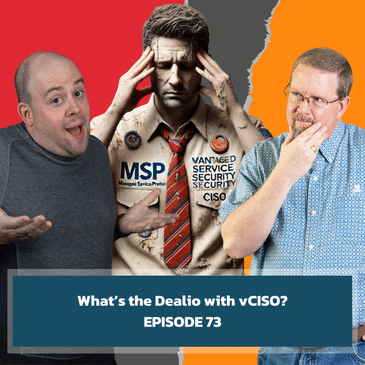


Listen to "All Things MSP" on Your IT Podcasts!
Justin Esgar (00:07):
You know what I was thinking about this morning? This is going to be super random. You don't see any 1996 Toyota CELs on the street anymore? Yeah,
Eric Anthony (00:17):
You mean the boxy
Justin Esgar (00:18):
Ones? It was narrow in the front, turned into a huge box in the back. Yeah.
Eric Anthony (00:23):
Yeah. Everybody listening,
Justin Esgar (00:25):
It just makes it to the cut, knows exactly what I'm talking about and you don't see them. I was driving my daughter to school and I saw it was a late nineties Mustang, and I was like, is that a Toyota trill? No, no. I was like, I definitely need try to throw this into the intro today.
Eric Anthony (00:46):
So you know what actually looked a lot like a Toyota CEL of that body shape was a Renault Alliance,
Justin Esgar (00:54):
Which never made it to the States, right?
Eric Anthony (00:56):
Which
Justin Esgar (00:57):
Oh really?
Eric Anthony (00:58):
It actually did because I owned one. Yes. So a MC American Motors Corporation, most famously known for the Jeep, also owned Renault over in France. And so they brought some over owned.
Justin Esgar (01:18):
I owned one. I love the French cars, like the Renault and the Chuan, the new ones. I think they're great. I think they have amazing body lines, and I wish they would bring them here because I'm tired of looking at SUVs. On the road side note, there's a really funny, I saw this on Instagram a couple of weeks ago and then it popped up in my TikTok last night. It's an older Mazda Miata with the big round in the grill, and the guy put a 360 cam off the front of it and has it driving. So it just looks like, it's like if you go to youtube.com/at all, things must be, it's really funny. And then he has, it has the headlights that open that pop up, so he has the headlights blinking and stuff like that, and it just looked like it's smiling. It's the funniest thing.
Eric Anthony (02:06):
Does he have the eyelashes on the
Justin Esgar (02:08):
Lights? I'll have to double check the video. I'll send it to you later. Where are you? Channel Channel with Channel Con, channel Pros. Channel, channel Con.
Eric Anthony (02:19):
See you. Channel con.
Justin Esgar (02:21):
We need better marketing.
Eric Anthony (02:26):
Well, there's, the
Justin Esgar (02:27):
Problem is they're all named channel. That's
Eric Anthony (02:28):
Part of the problem.
Justin Esgar (02:29):
You know who's going to win? Who's going to win? The person who starts calling it? Ah, channel Con. And then the next part goes Channel Con. Like the old Yellow Book trick,
SuperOps (02:45):
Elevate your IT managed service provider business with Super Ops. The All-in-one platform that integrates RMM and PSA powered by AI driven insights and automation. Super UPS helps you stay ahead, streamline and boost efficiency. Are you ready for operational excellence? Find out more at atsp link slash Super Ops.
Justin Esgar (03:08):
What's up everybody? Welcome to the All Things SB podcast. I'm your host Justin Escar. With me always is my good friend and traveling companion, Mr. Eric Anthony. Eric, you're not home. Clearly. You're at CompTIA Channel Con clearly got it right this time. What's going on, man? Where are you? What's going on at Channel Con?
Eric Anthony (03:28):
So Channel Con's been great. It's actually over as of today, and we've actually been staying next door in the Marriott because I'm a Marriott guy. We've had that discussion before and Kamala was actually here staying in this hotel the first day we were here. So there were secret service agents everywhere. But the thing that I thought was funny is that they didn't turn how sometimes in elevators, especially in cities, you have to scan your room key to be able to press the button to get to your floor. Yeah, that was not turned on while she was here, but then the day after she was here, it was turned on. So I don't know. I
Justin Esgar (04:10):
Wonder why. I wonder if that has something to do with just a quicker access to the certain floors or whatever. Also, I like that you call her Kamala, not Vice President Harris, as if you're friends with this person.
Eric Anthony (04:22):
Hey, hey, she's the VP and she deserves all the respect of the office, and that's as political as we're going to get on this show. But back to channel, lots of great content as a vendor. I would say there's a lot of things that I would like to see changed. Now, some of that's impossible because there's 174 vendors at this channel, which is huge. It's probably one of the biggest trade show floors you'll ever see in this space, which I like because everybody has the same size booth. It's kind of an equity effect across the board, but it's too much for MSPs to see everybody, how
Justin Esgar (05:08):
Many of them? Some things we'll take care of your Office 365 license related companies because I feel like 40%, yeah,
Eric Anthony (05:22):
There's quite a few. I don't know that it's 40% because 174 40% would be like 70, so probably not. But it's one of those things that a lot of companies, even if it's not their main focus, have added on to their stack. So some of the big players have it as well. So if you're counting all of those, yeah, it's a lot. But yeah, a lot of great content. I got to be on two panels while we're here. Awesome stuff. Got to talk about the MSP guidebook. If you haven't seen the MSP guidebook, it is a non gated piece of content that COMPT has put out. We had about 40 or 50 people contribute to that guidebook and it has stuff from vendor management to employees to how to figure out what should be in your stack, stuff like that. It's awesome. It's kind of great stuff.
Compliance Scorecard (06:15):
Are you confident your MSP clients are meeting their compliance requirements? With Compliance Scorecard, you can easily monitor, manage, and demonstrate compliance across all your clients with a single intuitive dashboard. Don't leave your clients compliance to chance. Visit ATP link slash compliance to get started and ensure your clients stay compliant with ease. That's ATP link slash compliance compliance made simple.
Justin Esgar (06:45):
Well, while you are away rocking the Rocking the channel, I thank
Eric Anthony (06:53):
You for holding down
Justin Esgar (06:54):
Fort. Even though you and I have different forts and everybody who listens to this show knows that
Eric Anthony (07:01):
We have a virtual fort fort, it's like couch cushions and a blanket. By the
Justin Esgar (07:06):
Way, that episode of community, if you've never seen this, there's great joke of community and they have an entire episode about the blanket versus the pillow forts, and it's one of the best episodes they've ever had. Side note. So yeah, I've been holding on the fort. We have been this week we signed up with this SaaS-based compliance program that's going to help us get SOC two compliance. For me, this ideal of getting compliant is going to be the differentiator. Talking about your vendors earlier, this is going to be the differentiator for us because there's not many Apple consultants who have so to compliance and have the stamp. There's plenty who may have used this particular piece of software or some of its competitors to get along the path line, but to get that actual stamp, which it's a weird thing to get because in all fairness, it's an accounting measure.
(08:01):
It's an accounting measure of data security in reality. And so what's cool about this part of software, and I don't want to mention it because I'm not giving anybody free praise other people who do the same thing here, but we integrate in with all of our tools and then it runs automated tests to find things. So one of the quickest things that I found, which was I thought was really, this is cool and also not cool, it uses an API key to call to our CloudFlare account and it detected who doesn't have MFA on their CloudFlare accounts. But the weird thing is it associated the API key with my login. So it looked at all of the domains or all of the workspaces, whatever they call it in CloudFlare that I am associated with. So I have a couple of clients that I'm associated with and it flagged their accounts as not having two FA, which whilst good for me to be, Hey Eric, you got to turn two FA on your CloudFlare account. Oh, okay, great.
(09:02):
It shouldn't affect our score because you're not part of our business or my client isn't part of my business. We're trying to get SOC two compliant for Virtua, right? So it's using the API key against my account that I have access to. So it's helping us a little bit, but also harming us in the same way. It's a really weird, weird system, but I do like it because it is allowing us to one, find holes in our system that we wouldn't normally find. So because we're going to talk about security here today, and this is helping us secure our systems, and then obviously there's the marketing aspect of being SOC two compliant or having a trust center that we can share with clients and show them what we've accomplished. And it was cool to see that within a week after integrating all of the tools that we use internally, that we have 24 controls in place, which I don't know if that's a lot or not because a friend of mine has the same system. He's got 110 and I'm like, what are you doing? I don't understand. Where are we different here? But it's actually a really interesting way because I'm trying to prove to clients that we are secure. Because I think going into what we're talking about today, which we're going to talk about fractional ciso, you got to eat your own dog food. You got to prove that you are secure to be able to tell clients that you can secure them.
Eric Anthony (10:30):
Well, it works on several different levels. It works from the risk level because there's so much more risk being the aggregator of all those services of all those businesses. But then also there's the marketing aspect of it. There's being able to show that you are secure. There's the whole liability aspect of you having something happen and people getting access to all of your clients. And then on top of that, there's just all around good advice that we've heard on airplanes for years and that has put your mask on first,
Justin Esgar (11:10):
Know what advice you were helping others.
Eric Anthony (11:16):
Well, it's top of mind. No, I
Justin Esgar (11:16):
Get it. Get it. Get you're right. The idea of doing these things, one thing that does get me is this particular software that we have doesn't work right with the Google Workspace Skim. It uses Skim for all of its integrations and it doesn't work right with the Google, it connects to Google Workspace. It recognizes Google Workspace, but we use one password and it will only connect to one password through RA or Okta rippling or one login. It doesn't work with the Google Workspace Skim. And I'm like, that's a massive missing hole because especially in the Apple world, because so many Apple consultants are Google based that they can crush on this. Correct? I do like this idea of us becoming compliant. It's something that I've thought about for a long time. I've thought about doing SOC two compliance and I've gone to SOC two compliant companies before.
(12:07):
However, it is massively expensive. It's a little intrusively expensive. I got quotes for not from this software, this is prior to the software. I got quotes that ranged from 35,000 to $50,000 a year. And you're supposed to do it yearly, right? Yeah. Because compliance is no one and done. So this particular software is cheaper than that. I don't want to get into their pricing. I don't want to leak any information. And then the audit is a separate price. So you can pay for this software as an MSP and pay, and you can probably make a deal pay yearly or quarterly or monthly, whatever you want to do or become a partner or something like that. And then you pay for the audit every year. And the audit once you have this stuff in place, because doing all the heavy work when you're paying somebody $50,000, they're doing the work then telling you to do what to do and then checking your work here, you're doing all of that preliminary stuff yourself and my team, what's really awesome is I got to say kudos to my team because we're still finishing up our audits that we started back in July or June, sorry, June right after ACEs, and we're still finishing off a couple last pieces.
(13:22):
And I was like, guys, guess what? I just found more audits.
(13:28):
And they're like, we're okay with this one because this one doesn't seem as bad as some of the other crap that we've just had to deal with. But it's also allowing us, yeah, it's risk management, it's compliance, it's security, and it's allowing us to have a leg up because let's get into this fractional CISO thing. I'm seeing this a lot more. A lot of MSPs are in their pitch decks, in their proposals are touting fractional ciso, and I'm calling their bluff on it because I refuse to believe that A, maybe I'm wrong, and I have been in the past, you can ask my wife, but I refuse to believe that a two to three person MSP has done the necessary certifications or classwork to become an actual CISO to be able to provide fractional ciso. We love to use the term fractional CTO because we know tech, we love to say fractional CT O because we know some of the security stuff. Even true story. I had a client who, the person who was in charge of it loved to call me to the other members on the team, the chief Chief information security officer. He used to call it chief sensitive data officer. And I was like, that's not a thing. And he's like, okay, chief Information security officer. And then he just changed it to chief security officer. And I'm like, I'm not Warf from Star Trek. Pick a thing and it would be cool, but it would be
Eric Anthony (15:03):
Cool.
Justin Esgar (15:04):
And the reason he was doing this was because they happened to use a particular cloud file share product that had a really cool security and governance program. And I used to just maintain their sensitive data for them. I would be the one who was reaching out to staff members being, hi, this document doesn't belong here. Can you delete it? Or can we scrub it or can we archive it? And I would stay on top of them by that stuff. And so I falsely had this title, which at the time, and this was four or five years ago at the time, I was like, oh, yeah, I'm a fractional ciso. Sure, whatever, blah, blah, blah. And I would tell people that I could do this when in reality, no.
Eric Anthony (15:45):
Yeah, well, it falls in line with what we've done in the industry in terms of virtual CIO, because virtual CIOs are basically in most, I'm not going to say all, but in a lot of MSP organizations are salespeople. They're literally just coming in and giving advice as to what the client needs to buy. And it's more sales driven than actual need driven in a lot of cases. And I think we run the risk of going the same direction with vcso. I think that there's a lot that MSPs can do for their clients in terms of security, but so many things we don't have a bar set for what that actually means and what certifications, like you said, are required in order to say, I'm a virtual CIO or I'm a virtual ciso, or I'm a virtual CTO. And I think as an industry, we need to get better at defining those things so that they become more trusted across the industry because clients don't know and it's the wild. I
Justin Esgar (16:59):
Think that's true. Now that I want to go off topic, but know me. I think that's true of so many things that we have in this. As much as we'd love to talk about stack or managing things, I think that the idea of an MSP is still too wild west in regards to that. We all, including me, love to tout crap about who we think we are when in reality we're not. As much as I love to say I'm a fractional CTO, I'm still being like, hi, did you reboot your computer today? Oh, I got a black screen. Reboot your computer. Oh, outlook's not working. Reboot your computer. So I'm still a level one tech in all reality.
Eric Anthony (17:41):
Well, because in the CEO role of a mid-size, MSP, you are still everything, right? And so that's just the way it goes. You are still help desk, but you're also the
Justin Esgar (17:58):
CTO. I wear many hats, but they all say virtual on them. Anyway, so let's go back to the They are very nice hats. They're
Eric Anthony (18:05):
Nice hats.
Justin Esgar (18:06):
Heritage I out the street,
Eric Anthony (18:08):
I have one.
Justin Esgar (18:09):
I have to order more of those. So let's get back to the CSO thing. So by the way, I upgraded my chat GBT to the teams plan, and then I lost all my old GBTs. So I'm trying to have chat GBT relearn me, which is a pain in the ass. So I did chat g BT 4.0, which is best for complex tasks versus 4.0 mini, which I don't know why chat G BT gives me options, but whatever. So when we were talking about CISO stuff, and I'm not the right, if you're listening, you know me well enough to know that I'm going to say I'm not really the right person to talk about this because I'm not a ciso. But here's, but chat GBT is because I told her this, but I did want to look further into because the idea of what that client used to call me, that idea of we're trying to secure our own stuff at Virtua and trying to become compliant, which is a lot of part of that security part of it.
(19:01):
Because again, SOC two compliance is about data security more than anything else. So I threw into Chad G medias and a, I want to be A-V-C-I-S-O, what training courses can I take? And actually, one of yours showed up, not A-T-M-S-P, but Comp T's, so I'll get to that one. So it gave me to use Coursera and edX. There's an introduction to cybersecurity from Coursera and Cyber Cybersecurity fundamentals of RIT from edX, edX, Coursera, simple to do, easy to follow. You can do that. You can get your ISC squared certified Information System security professional, so that's CCIS,
Eric Anthony (19:49):
C-I-S-S-P-S.
Justin Esgar (19:50):
And then you can get your certified information security manager, which is CI, which is offered by the isca. These guys, we have to stop with acronyms. This is ridiculous.
Eric Anthony (20:04):
So it's funny, my wife is traveling with me this week, and that was one of her comments as well, is we have way too many acronym,
Justin Esgar (20:13):
Too, acronym
Eric Anthony (20:14):
Ts everything and too many
Justin Esgar (20:16):
PLAs three letter acronym. And the last one that's on this list, and this is yours, COMPT Security plus certification, a beginner friendly certification that covers essential security concepts, network security compliance, and operational security. And you can get your compt security plus training is available online through platforms like LinkedIn Learning and Udemy. Thanks, Chad, JBT. But yeah, I mean that's the thing, because I specifically had said, what's easy training for small MSP? Let's say no more than three team members to do that can cover about 80%. And a lot of this really is, excuse me, understanding the foundations of cybersecurity, understanding risk management compliance. So understanding what the difference is between a SOC one, a SOC two, a SOC three, a SOC two, type one a, SOC two, type two, hipaa, ISO 27 0 0 1, ISO 9 0 0 1. Yeah, that's only five of the 47 compliance modules that I found. Understanding this is a big one, is understanding response and threat management. Knowing how to write an IRP is a major part, I think, of being a ciso. And then obviously there's securities. And then the best one that it came up with was soft skills communication and leadership, which we've talked about this before. Most IT people are introverts. Communication is a hard thing for them. You need to be able to get past that in order to be able to tell the people that you're a ciso, but
Eric Anthony (21:51):
Well, yeah, because most of the cybersecurity issues are soft because it's the people,
Justin Esgar (22:02):
Always
Eric Anthony (22:02):
The people. It's those weird fleshy things between, I was going to say acronym for you that cause all the problems. So that's why soft skills are so important in this is because all of those tools, all of those practices, all of those firewalls, all of the governance that you put in place aren't going to do any good unless the people actually follow them. And the only way they're going to follow them is, that's
Justin Esgar (22:33):
Actually one of the other things. Going back to what we were talking about earlier about the software that I found that we're using for SOC two, one of the first things that makes us do is write out all of these compliance policies, not just hr, but cybersecurity, cryptography, security, a bunch of others. And if you're not an admin admitted to the team, you're an employee of the team, in order to log in to do anything, you have to sign off on all of those documents. So what happens is we build all these documents, that means whoever's coming into our company, like our newest guy, Donovan for example, he's going to sign into this software and it's going to say, hi, Donovan, before you go any further, you need to look and read these policies and agree to them and basically sign off on them and then you can get into the software to do the things that you have been tasked to do because we're assigning people certain things to handle.
(23:30):
I think that makes it so much easier because that concept of signing off on a handbook that you should have in a business falls right into this. And it's the same thing with the security thing because then if someone says, well, I didn't know you can go, well, it's in the handbook and you read, yes, you did. Not to go to the hub.com on your work computer, even if it's off hours because you're working from home. Those are the kinds of things. And you're right, you can put enterprise threat level, risk management, firewall 7.0 in place with dual power supply and redundancy and backups and hot spares. It doesn't matter because jimbo's an idiot who
Eric Anthony (24:17):
Cares. Yes. And there's so much to it. And one of the things I want to point out, because being a VCSO sounds so formal, and so I think there's a lot of times when, because there's a lot of imposter syndrome in this industry that I know that because we've both suffered from it. And for those of you who feel that way about this, you don't have to be a vcso or a CISO to do the right things for your client. You can just simply take some of this training so that you have the knowledge, pick a framework so you have a framework that you're working from, work through it with your company and then start working through it with your clients. Doing what's best for your clients doesn't necessarily mean adhering to a title. It's just doing the right things by your clients and different clients are going to need different things. You're going to have doctor's offices who need hipaa. You're going to have retail establishments that need P-C-I-D-S-S. You're going to have federal contractors that need CMMC, and those are all different and have different requirements. However, most of them are based on the major frameworks, CIS, nist, et cetera. And so if you follow one of those, you're going to be most of the way there already. And so start there.
Justin Esgar (25:53):
I like that. You know what I'm saying? You were saying with you don't need the title. I think we can wrap this up with a line from clerks. Titles don't dictate behavior.
Eric Anthony (26:03):
That's true. That's true. And just because somebody says they're a vcso, better to have the actual training and the knowledge and the right tools, and then you can start marketing yourself as a vcso, but do the right things first and then get the title rather than just putting the title on your website and then start doing things because that'll get you in trouble. I mean, it's like, remember the lawsuit where the MSP said, we take care of all your it, and they didn't and the customer got breached, they got sued and they launched.
Justin Esgar (26:41):
Contracts are important. Go listen to our episode about get your training. There's a couple of other, I'm just going to throw out a couple other trainings just before we wrap up because there's some more. So we talked about the online course certification. There's some specialized training that chat, GBD pulled up for us. There's the SANS Institute offering a wide range of courses in cybersecurity such as MGT five 14, which I'm assuming is management, management five 14, security, strategic planning, policy and leadership. That sounds very cool. I would love to take that. Pluralsight has courses on intro to cybersecurity network, cyber network security fundamentals, and then of course there's industry webinars and workshops and things like that. And then here's some books. If you're a book person, the CISO handbook, a Practical Guide to Securing Your Company by Michael Gentile, and cybersecurity and Cyber are what everyone needs to know by PW Singer and Alan Friedman. There's so much out there.
(27:38):
I've talked about this, and actually I talk about this in my presentation about imposter syndrome from MAC admins, which is if you're not constantly learning and training and trying to find new things to learn, you're not going to make it in this industry. You can't rely on your laurels of being able to get licenses from PAX eight faster than the next person. That's not going to cut it. And if you're going to bring clients into a modern day architecture, you have to know and understand some of these core, and even if you don't know it, that's fine. Know someone who does. Right? So for example, I don't know nist, I mean, I know of it. I know some of the rules and I know some of the things because we're trying to learn it for the Max security compliance program, but reality, I'm not NIST certified.
(28:29):
I'm not capable of giving out a NIST score, but I've partnered with a cybersecurity firm that I got through tolos who is doing that for my clients, and they're giving us the NIST framework. This is actually really cool. One of my clients is going through a NIST assessment right now. When that NIST assessment is done, they're going to give us the framework of things we can do because agy, our mobile device management for Max has benchmarking tools built into it. So we can tell if a computer is in compliance or not. That whole thing is me being a CISO without me being a ciso, because even if I don't know it, I know enough to get myself in trouble, but I know enough to get the right people. I know enough to get the computers in compliance, and I know enough to be able to watch a thing that says, this computer is not in compliance, and I can go fix it because maybe somebody turned something on that they shouldn't or whatever. What being a CISO is because a person did something wrong. Like we said earlier, and I know enough about cybersecurity, so if you're thinking about adding vcso to your stack, learn about it, understand it. Pick a framework. I would say NIST 2.0, since I think CIS is being merged into it or something like that, right?
(29:43):
Okay. Pick a framework like that. Pick a framework for your own compliancy, whether that's going to be SOC two, ISO 27 0 1, NIST or CIS for yourself. Go through it yourself. Make my argument of being SOC two compliant, being a differentiator, a null argument, and go get it. There are ways to do it because you'll learn a lot about cybersecurity doing it yourself, and you can then turn that around on your clients and say, Hey, we've done it. We can get through it and we can teach you how to do it. Understand what an IRP is and how it's really written. Understand A-B-D-C-R, all those things that we require as MSPs from our vendors. I go to my cloud file share contacts, and I say, Hey, I want your SOC two report, B-D-C-R-I R-P-I-C-P-P-W-M-P-P-U-Q-P-Q-R-S-D, whatever it is.
Eric Anthony (30:39):
Okay? You're burying the Atlas again, stuff up.
Justin Esgar (30:42):
Now I need your Elmos. I need your cookie monsters. But those things, we should do that.
Eric Anthony (30:51):
And if all of that sounds too intimidating or you get into this and you start going, I don't really like this cybersecurity stuff, there are plenty of people to partner with out there. And speaking of getting in trouble, because you said something about getting in trouble earlier, I'm sure that Tim Golden is going to have some advice for us in terms of what we got wrong in this episode, and I just want to give him a shout out because Tim, obviously, compliance Scorecard is a sponsor of All Things MSP, but they're also a great resource when it comes to compliance and helping you maintain governance. In fact, we just did just an interview with Tim not that long ago, so check that out. And obviously check out Compliance Scorecard as well, because I know there's a lot of solutions out there right now and new ones showing up every day, but Tim and his crew really care about the community, and so that's one of the things you should definitely check out if you're more interested in the process and paperwork side of getting compliant and staying.
Justin Esgar (32:04):
Tim, thanks for sponsoring also. I look forward to your tweets and emails about everything I've gotten wrong in this episode. Eric, anything else before we sign off and you fly home?
Eric Anthony (32:16):
No. I just want to get out of this hotel room before the traffic gets bad because there's a former president coming into town.
Justin Esgar (32:23):
You say you want to leave, you don't need reasons. We're not becoming political. We've become awfully political the last couple episodes. We need to stop doing that. We're sorry. We'll try better next time. We'll do better next time. That's the line. We'll do another break. Well get home safe, my friend. For everyone who's listening, check us out. facebook.com/groups/all things msp. Sorry, we're recording this at a different time and my brain is in the right mode, so I have to think about things. facebook.com/group/all things msp. That's it. Check us out and watch how my brain just flipped out on me at youtube.com/at all things msp, follow us on all of your podcasting tools. We're now on iHeartRadio podcast. Check that out. That'd be kind of awesome. Leave a review somewhere. We just want to know that you're there. Please tell us, are you there? Is there anyone like Johnny Carson? Are you testing? Is this thing on anyone out there? That's Eric,
Eric Anthony (33:13):
Because if you don't, if you don't, we're going to have to turn this into an A SMR
Justin Esgar (33:16):
Channel. That's another TLAI don't need to get into. That's Eric. I'm Justin. Bye.
Compliance Scorecard (33:21):
Thanks for listening and don't forget to subscribe to us on your favorite podcast platform. You can also follow us on Facebook, but better yet, go ahead and join the Facebook group. You can also follow us on Instagram if that's your thing, and make sure you subscribe to our YouTube channel at all things MSP to catch us in all of our video glory. And last, but certainly not least, if LinkedIn is your thing, you can follow us there as well. And a special thank you to our premier sponsors Super Ops Move Bot goes into Easy DMAC and comtech, and we also want to thank our vendor sponsors. The All Things MSP podcast is a biz POW LLC production.