
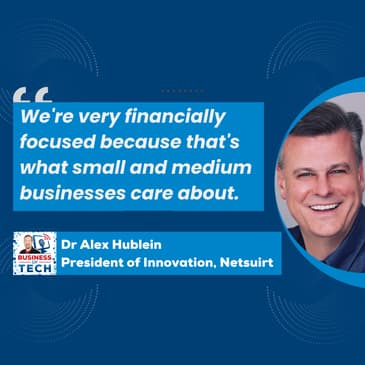
Dr. Alex Hubline, President of Culture and Innovation at Netsurit, discusses the transformative role of artificial intelligence (AI) in managed service providers (MSPs). He emphasizes the importance of a strong company culture that prioritizes both employee and customer dreams, which is exemplified through their unique "dreams program." This program aims to align the aspirations of the workforce with the goals of the customers, fostering a collaborative environment that drives innovation. Hubline believes that many companies fail to live up to their cultural values, but at Netseret, they actively work to integrate these values into their operations.
The conversation shifts to the concept of "innovation as a service," which Netseret offers through their subscription-based service called Innovate X. This service leverages advanced automation and AI technologies to help small and medium businesses innovate and improve productivity. Hubline explains that the cost of bespoke development has historically been prohibitive for these businesses, but advancements in AI are making it more accessible. By focusing on return on investment (ROI), Netseret ensures that their innovations deliver tangible financial benefits to their clients.
Hubline shares specific use cases of AI applications, such as a virtual sales assistant for a product distributor facing challenges in hiring and training sales personnel. This AI solution not only assists salespeople but also interacts directly with customers, providing complex product information and suggestive selling. Another example involves automating the classification of incoming records, significantly reducing the need for human intervention in a previously labor-intensive process. These examples illustrate how AI can eliminate repetitive tasks and enhance capabilities for businesses.
Finally, Hubline addresses the balance between innovation and organizational stability. He believes that fostering a culture of innovation can lead to more effective results without disrupting service delivery. By prioritizing use cases that align with business impact and maintaining a hyper-iterative development cycle, Netseret can quickly adapt to customer needs. This approach not only enhances productivity but also bridges the gap between technology and business, allowing for a more seamless integration of innovative solutions.
About Business of Tech: The daily MSP news and analysis podcast for managed service providers and IT services leaders. Host Dave Sobel covers AI for MSPs, MSP pricing and profitability, MSP M&A and private equity, vendor partner programs, MSP cybersecurity and liability, and MSP operations — and answers the question every story raises: Why do we care? Produced by MSP Radio.
💼 All Our Sponsors
MSP Radio is supported by our partners:
ABC Solutions · CometBackup · Firetail · Guardz · HaloPSA · LogMeIn · Mailprotector · Pax8 · Rythmz · ScalePad · TimeZest · Transit AI
Supporting the IT services community through insights, analysis, and transparency.
🚀 Join Business of Tech Plus
Get exclusive access to investigative reports, vendor analysis, leadership briefings, and more.
👉 https://businessof.tech/plus
🎧 Subscribe to the Business of Tech
Want the show on your favorite podcast app or prefer the written versions of each story?
📲 https://www.businessof.tech/subscribe
📰 Story Links & Sources
Looking for the links from today’s stories?
Every episode script — with full source links — is posted at:
🎙 Want to Be a Guest?
Pitch your story or appear on Business of Tech: Daily MSP News & IT Services Analysis
💬 https://www.podmatch.com/hostdetailpreview/businessoftech
🔗 Follow Business of Tech
LinkedIn: https://www.linkedin.com/company/28908079
YouTube: https://youtube.com/mspradio
Bluesky: https://bsky.app/profile/businessof.tech
Instagram: https://www.instagram.com/mspradio
TikTok: https://www.tiktok.com/@businessoftech
Facebook: https://www.facebook.com/mspradionews
Hosted by Simplecast, an AdsWizz company. See pcm.adswizz.com for information about our collection and use of personal data for advertising.
[00:00:02] One of the most popular questions I get, what are MSPs doing with AI? What are the things that make a difference? Well, I talked to somebody who's the president of Culture and Innovation at Netsurit. Dr. Alex Heublein joins me. You may know his company, their CEO has already been on the show on this bonus episode of The Business of Tech. This episode is supported by Flexpoint. Flexpoint offers a purpose-built payment solution from managed service providers, automating billing operations to enhance efficiency and cash flow.
[00:00:32] With features like accounts receivable automation, branded client portals and secure same-day payments, Flexpoint streamlines financial management. Integrations with accounting software such as QuickBooks and Xero, as well as professional services automation tools like ConnectWise and Autotask, ensure seamless data synchronization. Experience improved cash flow and client satisfaction with Flexpoint's comprehensive platform. Learn more at GetFlexpoint.com.
[00:01:05] Well, Alex, welcome to the show. Thanks for having me, Dave. Now I'm going to start with kind of the basic bit. So you work within a managed services provider, a sizable one with some global footprint, and you've got the title of President of Culture and Innovation. Okay, tell me what that means. Well, you know, it's interesting because, you know, one of the things we're really trying to do, there's two things we really believe in at Netsurit. One of them is our culture.
[00:01:31] So we've built a culture that is very, very focused on our people. It's very focused on our customers. But we also have this really neat thing called our Dreams Program. And our Dreams Program is really designed not only to help us as a company, but to help the people that work at Netsurit achieve their dreams and also ultimately to help our customers achieve their dreams.
[00:01:52] So it's a really neat thing. So culture is a big part of what we do. And it's not, you know, I've worked for a lot of companies in my life and a lot of companies, the culture is a bunch of platitudes that get put on some plaque in the lobby. And they may talk about them every once in a while in a company meeting. But most companies don't live up to those cultural elements, right? They talk about them. I think for a lot of companies, they're aspirational. But in reality, in a lot of companies, they're actually antithetical to the way they actually function.
[00:02:21] At Netsurit, one of the things that drew me to the company, and I think draws a lot of people to the company, is the fact that we've got this Dreams Program. We actually believe and live our values. So that's part of it. And then the other part of it is really about innovation. You know, if you go look at the global MSP space, there are a lot of MSPs. This is one of those markets that doesn't have tremendous barriers to entry. It's not like you're starting an airline and you've got to get a bunch of airplanes and airports and things like that.
[00:02:49] It's the kind of industry that is still relatively small in terms of the size of a lot of the providers. There are thousands of MSPs throughout the world. And so, you know, at some point you realize, wow, we have to distinguish ourselves. We have to be able to differentiate ourselves. And so one of the ways we do that at Netsurit is through innovation, not just innovation internally, but actually taking innovation to our customers. So that's kind of the mix there.
[00:03:16] Okay. Now, I want to get a little sense of, because that feels, when you describe it initially, is a very internally focused role. But there's also, when we talk about the innovation portion, that's an externally focused. Give me a little bit of sense of your balance between internal focus and external focus. Well, the cool thing about what we do is that we, so we do innovation as a service for our customers. So we have an offering called InnovateX. And InnovateX is fairly unique in the marketplace in that, A, it's what we call innovation as a service.
[00:03:46] We provide it as a subscription service. And we work with our customers with advanced automation and AI technologies to help them innovate, right? To help them do things more productively, to make them more efficient, but also to potentially give them capabilities that in the past they just haven't had. They haven't had the ability to go out and do it. And we're taking that down into the small and medium business market.
[00:04:09] And if you look at the small and medium business market, one of the challenges is that doing customer bespoke development around their specific business challenges has just been cost prohibitive for them over the last 20 years, let's call it. But with some of the new technologies that we have today, particularly artificial intelligence, it's lowering our cost basis. And that lets us come into that market at a price point that is significantly lower than it was even a year or two ago, right?
[00:04:38] So that's the external piece of it. The internal piece of it is how do we do digital transformation within our own business using the same types of technologies, the same types of tools to make ourselves more productive and more efficient and drive new capabilities into the marketplace. And the cool thing is it's very synergistic. So there are things that we will go build for customers. We'll say, wow, we can use this internally. In fact, that just happened a couple of days ago. I was on a demo of something we actually built for one of our customers. And we were just all dreaming up like there's 20 use cases inside of NetShure where we can use this technology.
[00:05:06] And vice versa, though, we'll develop things internally. And then we'll realize that they're actually much more generally and broadly applicable to our customer base. So it kind of works both ways. It's we take what we do internally and try to bring it to market. And we also take what we've done out in the marketplace and try to bring it internal. So it's a really nice virtuous cycle there. Now, the CEO of the organization, Arne Klepper, has been on this show before. And we talked a little bit about the way he leans into connecting to business outcomes.
[00:05:33] If you're thinking about this, about building innovation, I mean, in a way, if I'm oversimplifying, right, like the idea of good ideas as a service is kind of hard to do, right? Because how do you measure success in that? So I want to get a little bit of your framework. Like how do you work with customers to measure success, particularly if they're subscribing to good ideas? Well, and it's more than just good ideas, but I get kind of your question. So the way we do it is very simple. We base it on return on investment.
[00:06:03] So right up front in these engagements, we'll define two or three use cases that we'll work on over the course of a year. And we define the return on investment for those right up front. So if we say, hey, we're going to go build you an AI chatbot that's going to be able to cause you to not have to hire one salesperson next year. That salesperson is going to cost you $100,000. We're going to come in and build this thing for $50,000 over the course of the year. Right there, you've got a great return on investment. And we have a guarantee.
[00:06:31] We guarantee that we will produce a positive return on investment over the course of the year of the engagement. We're going to do it.
[00:06:40] We're going to do it. So it's very financially focused, right? We're going to focus it on return on investment.
[00:07:09] And we have that return on investment guarantee. We put all this stuff into a system. So we have an ideation platform that we use and we put all of the ideas that come through. We prioritize those ideas in terms of which ones are we going to tackle first and which ones have the highest return on investment. And then we define that return on investment right up front. So everyone's clear on the ultimate outcome. Because otherwise, it's just too easy to talk about cool stuff and go build cool stuff.
[00:07:34] If you don't have that financial return on investment, most of the CEOs of the small and medium businesses we work with, they don't care. Right? They're like, show me the money. And you brought it up first. So you broke the tech interview rule on AI. So I want to ask, because the number one question I get from listeners all the time is to understand some of the practical applications, right? Oftentimes when we hear about the use cases, people talk a lot about future possibilities with AI more than what's actually happening.
[00:08:03] Can you talk a little bit about some of the use cases that you're actually implementing with customers that apply artificial intelligence? Yeah, absolutely. So I think of two or three I can talk you through, right? So one of them is actually for a distributor of products. And these products, they have a lot of different products. They're very complex and they have very complex interplay between them. And so what these guys have found is that they found that in highly urban areas, they're having trouble hiring salespeople.
[00:08:33] Not only that, not only are they having trouble hiring them, they're expensive. They have very high turnover rates. And it takes them 12 to 18 months to train up these new salespeople to really get them effective. So one of the things we're building for them is a virtual sales assistant, right? That can be used by all the salespeople, but can actually be used directly by the consumers. And it's a B2B play.
[00:08:55] So directly by their customers, they can go into their website, interact with the chat bot that can answer very, very complex questions about the product line, about pricing, about discounts that are available today. And we're working on even future phases where it even gets into things like suggestive selling. Oh, you liked this one. We should also go look at this particular product, right? And so we're able to take all the information from the vendors that they are distributors for, take all that product information.
[00:09:23] Then we go out and do interviews with subject matter experts, right? What are those expert salespeople think? What are some of the tricks that they use and tips that they have for us and usage scenarios that they have for these products? Take that all, train the AI model to then be able to respond very effectively to the comments or to the questions that they're getting. So that's one use case as an example, right? A second one is something that we're doing for a company that has to do a lot of pattern matching.
[00:09:51] So they'll get basically requests in, or what's the best way of putting it? They'll sort of get records in, and they need to match those up with classifications of different people and different types of companies. But it turns out that really today, if you were to rewind a year, only a human could do this because the data coming in is very fuzzy. It's not ever in a standardized format.
[00:10:19] The names of the companies, the names of the people that are involved sometimes are misspelled. They're sometimes classified differently, et cetera. And then there's all kinds of rules about how they categorize and classify this information. So we're building an AI for them that allows them to do 90% of that classification without involving a human. The human really needs to just go back in and look at it and say, yeah, okay, that one looks right. That one looks right. Man, maybe this one's wrong. So that's eliminating a ton of just very repetitive, very difficult efforts. So we're seeing a couple of scenarios in general.
[00:10:49] One of them is how do we take a lot of the very error-prone, repetitive drudgery out of a lot of work? And then on the other side, it's really about giving them some new capabilities that they haven't had in the past to augment the people that they do have out in the field or their salespeople or their marketing people or what have you. So those are kind of two broad categories that we're seeing today. Now, those are great. And now, without giving away the secret sauce of how you built everything, give me a little bit of a sense of what are the core technologies that go into this. Is this generative AI?
[00:11:19] Is it analytic? Like, talk to me about, like, what the building blocks of the solutions are. Yeah, well, and it varies by customer. But we leverage a lot of the Microsoft Power Platform. That gives us sort of the automation engine that we have. And then we very much leverage large language models to be able to do this. And the cool part about that is that not only can we build workflows and automations with a standardized platform that a lot of small and medium businesses, they already own, right? They already have licenses for this stuff.
[00:11:48] They just don't know it. But the cool thing is that we can mix and match large language models based on the type of work that we're trying to do. Because large language models have an inferencing cost, right? You're going to be paying OpenAI or Google or whomever, Microsoft, to use those large language models. And it turns out that for a lot of tasks, you don't need, you know, O3 Pro from OpenAI that's super, super expensive on a per token basis.
[00:12:14] You can get by with something like GPT-40 Mini for a lot of the tasks involved. And we can do it within workflows. So it's not like we have to pick one large language model to base everything on. We can actually mix large language models at different steps in these workflows that we build. So that overall reduces the costs for our customers. And it really matches up both the price and the speed at which they can get these responses. So we optimize for that as well.
[00:12:41] Now, it feels like based on what you've just said, you're exactly the right person to ask a question about a premise that I've thought of recently. So we're all keeping an eye on what just happened with DeepSeek and the change to the market. And I think the most important thing that happened with DeepSeek was the move to commoditize the models. That what they've proven is, is that you can actually make those models significantly cheaper. And it may move as close to zero quickly as possible. And that, in theory, moves the value from the model development, the money you just talked about.
[00:13:10] It's very expensive to run these models. Well, it will move out of that and will move back into the productivity layer, the workflow layer you're just describing. Give me your reaction to that premise. Well, you know, I think you're right in general, right? For the same level of functionality as we have today, we're seeing the price and the costs on that drop exponentially. I think even Sam Altman had a blog post not too long ago that said, hey, guys, I know the new models cost a lot, but the older models, they're getting cheaper and cheaper every day, right?
[00:13:39] So I think you're going to see a counterbalance here. You're going to see scenarios where the current state-of-the-art AI is good enough. It can do the tasks that we want it to do. I think you'll see continued model development at least over the next two or three years. And the model development is just still an exponential growth curve.
[00:13:58] If you look at what we got from GPT-40 to GPT to OpenAI-01 to OpenAI-03, I mean, we've gone in a year, year and a half time from third-grade reasoning skills to PhD-level reasoning skills. And so I think that the model development will continue. You'll still see more and more powerful models. And you'll also see models that can do more than just respond with text.
[00:14:24] OpenAI recently came out with something that's in preview right now called Operator. And what Operator lets me do is actually manipulate computers and websites directly. So now I'm not going through a purely textual-based interface, and I'm not limited to interacting with a model with text back and forth or maybe some images or PDFs. Now I can have this thing go interact with actual live computers and go do things for me. So I think that model development will continue. I think the good news about DeepSeq is that you're right.
[00:14:54] It's starting to drive down the cost of the more what I'll call basic large language models. And it turns out for a lot of tasks, basic large language models are perfectly fine. Using more advanced models doesn't actually get you anything other than a slower response. So I think we're going to see that sort of sort itself out over the next, let's call it 18 months to three years. I think we'll still see the model development continue. I still think there's a lot of money to be made there. But at the same time, it's going to drive up usage.
[00:15:21] Because the lower the cost on these things, the more people will use them over a longer period of time. So we're really excited, actually. I was really excited about DeepSeq because that's going to drive down some of the costs of some of the projects we deliver. And that helps us go farther down market into the SMB space and make this even more affordable for our customers. Are there legal concerns that you're worried about on the foundational models themselves? It's still unclear whether or not these obeyed copyright laws, if the consumption of copyrighted materials.
[00:15:51] Are there legal concerns that you worry about in the use of these foundational large language models? We're not so much worried about the usage of them from a legal standpoint. If I were OpenAI or Microsoft or Google, I would probably be worried as those providers. We're simply using the technology that's out there in the market. So we don't have a lot of concerns. We don't go out and train these models on publicly available information or anything like that. So we're not involved in the training or the development of the models.
[00:16:20] What we're really doing is fine-tuning those models. We're doing a lot of prompt engineering. And then we use the models to actually write code for us in a lot of cases. So we write very, very little code. Compared to two years ago, the amount of code we have to write to develop these solutions has dropped off by an order of magnitude. And that's great because it lets us employ people who aren't necessarily coding experts, but they actually know more about the business.
[00:16:45] And so that reduces that classic gap you always have between the guys implementing the technology and the business people that are using it. That's always going to be a gap. You're never going to get around that completely. But the fact that we can actually employ people that are more business savvy, they don't have to be nearly as sort of coding savvy. That, I think, reduces that gap between what the business is looking for and what the technology providers are actually giving them. Gotcha.
[00:17:12] Now, as we move towards sort of like a last thought on this, I think you're exactly the right person to give me some sense on this. You know, one of the arguments against rapid innovation is that it disrupts organizational stability. So you're thinking both about culture and innovation at the same time. How do you balance the need for innovation while maintaining consistency, particularly around service delivery? Yeah, well, I mean, it is a tricky balance, right?
[00:17:35] And I think one of the things that we've seen and that I really believe in is that innovation is actually a function of culture, right? And if you go out and actually actively focus your efforts from a culture building standpoint on innovation and make that a priority within your culture, you actually get more innovative results out of it, right? So we don't see it as a, hey, let's go replace all the people in the organization or let's go get rid of all the salespeople or whatever roles.
[00:18:02] We really look at this as taking away a lot of the things that people hate to do. In fact, when I go in and talk to clients, one of the first things I ask them is, what do you hate to do? I'm like, what part of your job do you just, you can't stand doing it. If you could get rid of that part of your job, you'd be way happier. And you'd be amazed at the number of use cases we get. But the other thing that we really focus on, Dave, is we're very selective in the use cases that we try to develop for our customers. So we don't take everything.
[00:18:28] If somebody says, hey, I'd like to put a team of people on Mars, you know, we can't actually do that with generative AI and with the technologies we have. So that's why we go through these ideation sessions. We'll get 5, 6, 7, 10, 12 ideas out on the table. We'll prioritize those in terms of the business impact that the customer thinks they're going to have. And then we do a second level of prioritization to say, these are the ones that we can actually tackle and we can tackle them quickly.
[00:18:58] So our goal is to produce a minimum viable solution in the first 90 days of the engagement. And that's what small and medium businesses want to see. They don't want to wait 9 months or 12 months to see the results. And we have a very, very hyper iterative development cycle. So we sit down with our customers every week as we're developing these things. We show them what we're building. We get the course corrections. And iterative development isn't anything new.
[00:19:20] But the fact that we can make the changes that they're asking for so quickly, it gives it a whole new level of alignment between what the customer is looking for and what we're actually building for them. And we can do it very, very rapid. Dr. Alex Hublain is the president of Culture and Innovation at NetSarit, bringing over 30 years of experience in IT and business leadership.
[00:19:40] He's held senior executive roles at companies such as HP, Oracle, Red Hat, and Apptigent, where he was instrumental in developing cloud and SaaS-based solutions and fostering innovative cultures within global organizations. Alex, this has been fascinating. Thanks for joining me today. Thanks for having me, Dave.
[00:20:25] Thanks for having me. Thanks for having me. Thanks for having me. The Business of Tech is written and produced by me, Dave Sobel, under ethics guidelines posted at businessof.tech.
[00:20:54] If you've enjoyed the show, make sure you've subscribed or followed on your favorite platform. It's free and helps directly. Give us a review, too. If you want to support the show, visit patreon.com slash mspradio and you'll get access to content early. Or buy our Why Do We Care merch at businessof.tech. Have a question you want answered?
[00:21:17] We take listener questions, send them in, ideally as a voice memo or video to question at mspradio.com. I answer listener questions live on our Wednesday live show on YouTube and LinkedIn. If you've got a comment or a thought on a story, put it in the comments if you're on YouTube or reach out on LinkedIn if you're listening to the podcast. And if you want to advertise on the show, visit mspradio.com slash engage. Once again, thanks for listening and I will talk to you again on our next episode.
[00:21:50] Part of the MSP Radio Network.