
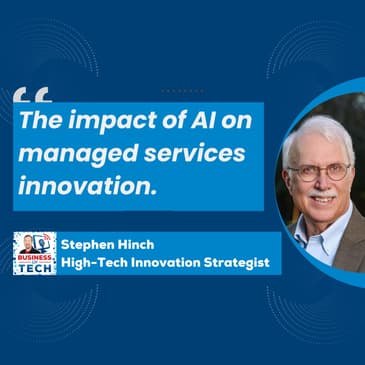
Stephen Hinch, an expert in managed services and author of "Winning Through Innovation," discusses the challenges and opportunities for innovation within the corporate business model, particularly in the managed services provider (MSP) sector. He highlights the "curse of the corporate business model," where large corporations prioritize predictable profits over disruptive innovation. This focus often stifles creativity and risk-taking, leading to a reliance on incremental improvements rather than groundbreaking advancements. Hinch emphasizes that while corporations can excel in incremental innovation, they struggle with disruptive changes that require longer-term investment and risk.
As the conversation shifts to the current landscape of managed services, Hinch notes that many MSPs are still small, often relying on vendors for innovation rather than developing it themselves. He points out that while there are around 40,000 MSPs in the U.S., a significant portion of them are not profitable. This situation creates a competitive environment where smaller MSPs must find innovative ways to attract customers and differentiate themselves from the larger, investor-backed companies that provide the tools they use.
The discussion then turns to the impact of artificial intelligence (AI) on the MSP market. Hinch believes that AI represents a disruptive technology that can enhance service delivery, particularly in automating tier-one support tasks. However, he cautions that MSPs should not expect to develop these AI solutions independently; instead, they should look to their vendors for advancements that can improve efficiency and service quality. He advises MSPs to engage with their suppliers about how AI can be integrated into their operations in practical and beneficial ways.
Finally, Hinch encourages MSPs to focus on foundational innovations and automation before diving into more complex applications of AI. He stresses the importance of maintaining consistent uptime and predictable performance while leveraging AI to enhance these core values. By asking the right questions and seeking sustainable innovations from their vendors, MSPs can position themselves to thrive in a rapidly evolving technological landscape, ensuring they do not fall victim to the pitfalls that have affected other industries in the past.
About Business of Tech: The daily MSP news and analysis podcast for managed service providers and IT services leaders. Host Dave Sobel covers AI for MSPs, MSP pricing and profitability, MSP M&A and private equity, vendor partner programs, MSP cybersecurity and liability, and MSP operations — and answers the question every story raises: Why do we care? Produced by MSP Radio.
💼 All Our Sponsors
MSP Radio is supported by our partners:
ABC Solutions · CometBackup · Firetail · Guardz · HaloPSA · LogMeIn · Mailprotector · Pax8 · Rythmz · ScalePad · TimeZest · Transit AI
Supporting the IT services community through insights, analysis, and transparency.
🚀 Join Business of Tech Plus
Get exclusive access to investigative reports, vendor analysis, leadership briefings, and more.
👉 https://businessof.tech/plus
🎧 Subscribe to the Business of Tech
Want the show on your favorite podcast app or prefer the written versions of each story?
📲 https://www.businessof.tech/subscribe
📰 Story Links & Sources
Looking for the links from today’s stories?
Every episode script — with full source links — is posted at:
🎙 Want to Be a Guest?
Pitch your story or appear on Business of Tech: Daily MSP News & IT Services Analysis
💬 https://www.podmatch.com/hostdetailpreview/businessoftech
🔗 Follow Business of Tech
LinkedIn: https://www.linkedin.com/company/28908079
YouTube: https://youtube.com/mspradio
Bluesky: https://bsky.app/profile/businessof.tech
Instagram: https://www.instagram.com/mspradio
TikTok: https://www.tiktok.com/@businessoftech
Facebook: https://www.facebook.com/mspradionews
Hosted by Simplecast, an AdsWizz company. See pcm.adswizz.com for information about our collection and use of personal data for advertising.
[00:00:02] I love it when I get a chance to talk to somebody who's an expert, an author, an innovator, and has operated a managed services provider. Stephen Hinch joins me. He's the author of a book about innovation, perspectives on how you leverage it, and he's got thoughts on the way AI may disrupt the MSP market on this bonus episode of The Business of Tech.
[00:00:24] This episode is supported by FlexPoint. Managing cash flow can be tough for managed service providers. FlexPoint's working capital solution is designed to bridge the gap between invoicing and payment, giving providers access to funds when they need them. With quick approvals and flexible terms, it helps cover expenses, invested growth, and maintain financial stability. Keep your operations running smoothly with FlexPoint. Visit getflexpoint.com slash MSP.
[00:00:53] MSP-radio to learn more. Select Heard It on the Business of Tech or MSP Radio. You'll get 10% off. Well, Steve, welcome to the show. Thank you, Dave. It's great to be here.
[00:01:08] Well, it's exciting to talk to a fellow veteran of MSP land because, you know, somebody who's got actual hands-on experience. And you've had a career, you know, you've been at, you were at HP and you were in leadership positions there. You then got the entrepreneurial bug and wanted to lead an organization and ran a Team Logic IT
[00:01:25] franchise. And now you've been spending your time advising both Team Logic and other firms within the MSP space. And you've got a book I wanted to ask you about. You've kind of put this all together in a book called Winning Through Innovation. And you describe the curse of the corporate business model. Tell me a little bit about the curse and what we're all fighting here.
[00:01:47] Yes. So a major corporation, multinational corporation typically, has to respond to the needs of their investors. And investors, particularly Wall Street investors, expect you to make predictable profits every month and every quarter.
[00:02:11] However, the problem with innovation is that innovative ideas, particularly really disruptive innovation ideas are going to take you down a new path. They're not something that's going to contribute to this month or this quarter's profits and revenues. They may not actually return any investment until a few years down the road.
[00:02:36] So corporate executives have to respond to these investors and they're trying to do everything they can to get that new innovation out, even maybe before it's ready because they want to generate revenues.
[00:02:54] So that's the first thing that corporate metrics don't really reward investment in new untried ideas that are going to take a while to pay back. Second thing is that managers don't see the rewards commensurate with the risk. Now, if you're in a startup company and you're very successful, you can become a multimillionaire pretty quickly.
[00:03:22] That doesn't happen very often, but it's a great inspiration. In the corporate world, if a manager leads a project that's successful in innovation, they may get a few hundred stock options. They may get a promotion. But if they're not successful, their career is permanently derailed. And so most managers don't see the reward being worth the risk.
[00:03:51] And usually in the corporate world, there's very little motivation to have to take that risk. You don't get penalized for not taking it. And the final thing, the third thing in this course of the corporate business model is that what I have found is that managers in the corporate world are not as –
[00:04:17] they don't like risk as much as somebody in the startup world. They don't mind doing incremental innovations that will return rewards pretty quickly, but any kind of disruptive innovation, that's not what they want to do. And if that kind of person that really liked that kind of thing was in the corporate world to begin with, they left and went to startups.
[00:04:43] So you can still be innovative in the corporate environment, but you just have to understand how to deal with those three obstacles to success. It's interesting to say, because you caveat that at the end by saying you can be successful in the corporate world with that approach if you understand those caveats. But there is a pretty strong implication in what you're saying that both large companies, publicly traded companies, investor-backed companies simply would struggle –
[00:05:13] I won't go so far as to say incapable of – but they would struggle to deliver new innovations. Is that a fair way of kind of framing that? Oh, that's absolutely true. Now, there are different kinds of innovation, and let's talk about – there are some kinds of innovation that corporations are really good at. Now, I classify innovation into four categories. It's either product innovation or process innovation, and it's either incremental innovation or disruptive innovation.
[00:05:43] Let's talk about those last two. Incremental innovation is the kind of thing where you add some new features to a product that you already sell to existing customers. There's an example of the automobile industry. We're talking about the gasoline-powered automobile industry here has been in the incremental innovation period for decades. The cars that they sell today sell to the same customers that bought them 10 or 20 years ago, but they're not the same cars.
[00:06:08] Improvements in anti-lock brakes, in driver safety, improvements in reliability make today's cars more attractive, and people are happy to trade in their old cars for the new cars. Disruptive innovation is where you bring out something entirely new to customers that were served by a less capable kind of alternative in the past.
[00:06:33] The example I use in my book, I use several examples, but this one I think everybody will resonate with. Back in the middle of the 20th century, the railroad industry switched from steam-powered locomotives to diesel-powered locomotives. Not a single manufacturer of steam-powered locomotives survived that transition because that was a disruptive innovation that they did not know how to deal with.
[00:06:59] So that's a bit about the different kinds of innovation. Corporations are good at incremental innovation because that usually returns investments pretty quickly, and you can do them at fairly low risk. Because the disruptive innovations take a lot more risk, they take a lot longer, and that's not what Wall Street wants to see you do. Gotcha.
[00:07:22] Now, I want to apply this to managed services for a moment here, and I actually want to sort of talk about the ecosystem that's developed here in terms of managed services. We're delivering managed services broadly in this form since the kind of advent of the remote monitoring and management tools, which dates back to the early 2000s, when it was smaller companies, like you've described, serving other smaller companies. But now, here we are, you and I are talking in 2025.
[00:07:47] We are significantly further into this, and we have larger companies that I could describe as very corporate because they've got investor money that are delivering the software tools for managed services providers. But the providers themselves remain kind of startups, right? Because they're services organizations, they take longer to get there. They are maturing, but they're certainly not driven in the traditional corporate world. Talk to me what you're seeing, you know, as somebody who's looking at this space still, advising.
[00:08:14] Like, what do you see as the tension going on around innovation between, like, the platform companies and the companies they serve? Okay. So, let's talk about the companies they serve first because you're right. Most of them, not all of them, but a goodly number of them are in the below $2 million a year revenue kind of scheme. They rely on the vendors to provide the innovation for them.
[00:08:44] They'll adopt the software that's got the latest capability for remote management or for mobile device management. And they're not going to be innovating on that side of things. Where the MSPs can be innovative is how do you go out and get customers?
[00:09:09] And how do you compete successfully against all the other MSPs that are out there? You know, I read something recently that, and you may know this better than me, there are something like 40,000 MSPs in the U.S., of which only about 8,000 of them have 80% of the business. So, there's a lot of small startup kind of people out there that still want to be successful. And it's a lot easier now.
[00:09:38] You know, 10 or 15 years ago, when I first bought my TeamLogic IT franchise, we had to invent some of this capability ourselves because the commercial capabilities that you buy were still fairly limited. Today, it's a lot different. And you can do everything from managed services to cybersecurity protection to tracking warranty status with commercially available products.
[00:10:08] And it's more a matter of figuring out which ones to use as opposed to, gee, this is something I can't do. I have to do it on my own. That's very rarely the case anymore. Okay. So, that's exactly the stage that I wanted to set because I think we're in agreement. The 40,000 number, I've heard that number. It's really difficult to know how many MSPs are out there. I've heard as low as 40. I've heard as high as 120,000. Like, it's different.
[00:10:32] But the number that I always leverage is roughly 30% of all MSPs, regardless of how many numbers you think. 30% of them are at break even or lose money that quarter. Now, obviously, that's not sustainable. So, that number is churning. But if we look at it and say, I always quip, one in three people that you might read online who say they're an MSB are not making money. And so, thus, your statement of, like, hey, a small subset of the ones that are profitable, that's important. Now, now that we've set this stage, you're exactly right.
[00:11:01] There's a lot of interesting commercial stuff. You can buy fully developed platforms. But we're kind of at a really interesting moment. And, you know, we're 10 minutes in, and I got to bring up AI, right? Because I look and say, that is a really disruptive technology for managed services providers. You can envision pretty easily, you know, an AI-powered agent that's able to do tier one support for users, do diagnostics, be able to provide insights. We can really automate away a lot of this.
[00:11:31] But I think by your statement, which I would agree with, I'm not expecting a lot of MSPs to build that technology themselves. I'm expecting that to get delivered. But by the definitions you've thrown out, a lot of the big companies are not going to be great at innovation. So, I really kind of want to get a sense of, like, hey, I feel like this is coming, but I'm looking to you, like, where would that be coming from in the market? And what should providers be looking for to make sure they don't get swept away by something they're not expecting?
[00:12:01] So, first of all, I'll say you are exactly right. I also feel like MSPs are not the ones that are going to be figuring out how to invent the AI applications to do all the tier one level support. That needs to be provided by the vendors that they're using.
[00:12:23] And yet more of the vendors these days are publicly funded and have investors that expect returns. But AI is a big buzzword these days. And if any of those suppliers aren't really promoting AI and saying we're building AI into our next version of RMM, their investors are going to be mad.
[00:12:49] So, at least now, while AI is a big buzzword, the investors are going to be looking at what are you doing to capitalize on this? And so, we're in a phase right now where I think disruptive innovation can happen because it's being pushed by the outside investors. Now, where AI ends up in two or three years, I don't know. I think it has promise.
[00:13:19] But I think back to, gosh, about maybe 20, 25 years ago when I was at HP and there was this big explosion about the Internet. And suddenly, there was tons of money coming in for people that wanted to do something around the Internet. And I sold a lot of equipment to startup companies that were trying to develop some technology around the Internet. And suddenly, it all collapsed.
[00:13:47] And where I had been selling $100 million a year in product to the Internet market, suddenly, I was selling nothing because the Internet was still valuable. But investors realized that they were putting far too much money into it. I think that we could be seeing something similar for AI right now. AI will survive and it will evolve.
[00:14:13] But I can't believe that the amount of money that investors are putting into that right now will be sustainable for very long. Well, I would agree with that. And so, again, if we're putting on our minds of advising the listeners here who are managed services providers, IT services companies, there have to be traits that we can look back to these historical trends and the writing that you've done.
[00:14:36] Like, what can we look at to help make sure that they are aligning themselves with vendors or innovations that will be sustainable so they don't end up like carcass, like the same way that those early companies from the Internet days got washed away? Well, and that's a good question. And I'm not sure I have a great answer for it.
[00:14:56] But let me tell you what I think is if you look back again to this Internet phase, there were companies that were getting into the Internet and you could go online and sign up for them. And they would give away free computers if you signed up to be on their website. That was not sustainable. But the investors had a lot of money.
[00:15:19] OK, give away 100 or 1,000 computers and hopefully you get more traffic to your website as a result. But that kind of thing is not sustainable. There were companies even then that were focusing on what needed to be done to promote the Internet and keep it moving in a more sustainable way. They weren't just taking tons of money to do anything that investors thought they might want to do.
[00:15:49] So, again, looking at the AI side of things here, the MSPs need to be asking the questions of their suppliers of how are you doing AI to help me as an MSP? And they need to be hearing answers that are solving questions that are really important to the MSP.
[00:16:16] And so if the RMM vendor is saying, you know, we're working on AI to provide fully automated first level support or maybe to do things like making sure that patches are updated on your servers and your workstations automatically without you having to decide to go in and do that.
[00:16:42] Those are the kind of things that MSPs should get excited about. But if you're hearing them, and I don't have a good example of stuff that is not really exciting to me, that how they're looking at AI to do something way blue sky kind of thing.
[00:17:03] AI is going to be saying, AI is going to be saying, AI is going to be replacing me with my disruptive innovation ideas. You're not going to be able to ask AI to invent the next new disruptive innovation. Maybe that'll happen in the future, but that's not there now.
[00:17:25] So the guidance that I would encourage MSPs to look for is to make sure that when they're talking to their vendors, that they're hearing stories about how AI is going to be incorporated that really make sense to them. Now, a lot of those thematic conversations tend to be around the idea of automation, right? We've even talked about the idea, like your example there, automating first level tasks. Now, this is an area where thematically we've heard this for a while, right?
[00:17:52] The whole premise of the managed services model has always been, hey, standardize and automate management. Now, with theory, we're supercharging a little bit. If we're advising MSPs here, where do you think they should be spending their time thinking about what's next from that innovation perspective? Where do they need to spend their time? So I think it's the old story of you've got to learn how to walk before you run.
[00:18:21] And you need to look at how you can apply AI in some lower risk areas that are more fundamental, the automation kind of stuff. Learn how to do that first before you look at more advanced ways to use AI. I think it's too easy to get involved in the hype. And, you know, you're absolutely right.
[00:18:51] We've sort of been using RMM tools to automate things for a long time, and we haven't called it AI. But it's a way, it's always been a way to reduce the amount of time that it takes a first-level technician to provide support to a customer. AI can maybe reduce that more. But I'm not sure that I'm ready to say AI is going to look at, you know,
[00:19:18] are we going to use AI to be our primary cybersecurity way to block threats? I don't think we're there yet. It's going to be more important. But you've still got to apply the human element to figure out what makes sense. Especially AI is not perfect by any means.
[00:19:42] And the more that you try to use AI in higher risk areas, the more likely you are to screw things up. I mean, look, I always quip that analysts like me are oftentimes directionally correct and wrong on our timelines. And I tend to think things happen a lot faster than they actually do, mostly because I can always find advanced cases where it is happening, but not necessarily larger. So I want to actually take a quick step back, putting AI just aside.
[00:20:11] And most MSPs would really argue that consistent uptime and predictable performance are really what they deliver, right? Like that's what they deliver. And so what's your response to those people that would say like, hey, that's my core value. So innovation actually is a distraction. I need to focus on consistency and predictable performance. I don't see them as separate.
[00:20:34] I mean, it can be because if those vendors are not providing AI in a way that solves those problems, then you've got a divergence. But I think, you know, AI is a way for, or can be a way for MSPs to provide an even more valuable way
[00:21:02] to support customers, keep things up all the time, and detect problems quickly. I mean, I remember, for example, I'm almost embarrassed to explain this when I had my own IT company, TeamLogic IT franchise, and we would monitor server performance at our clients.
[00:21:29] And in order to not get all sorts of alerts that meant nothing, the server would have to be offline for like 15 minutes before we did anything. And after 13 minutes, the customer would be calling us up and saying, our server's down. How come you haven't fixed it? That's the kind of thing that AI should be able to detect that and take action even better
[00:21:53] than we were when we relied more on the first-level technicians to get in there and fix the problem. Well, Stephen Hinch is a high-tech innovation strategist, award-winning author, and executive consultant with over three decades of experience at the forefront of technology and business leadership. He's held senior roles in R&D, marketing, and general management at Hewlett Packard and Agilent Technologies
[00:22:18] and served as president of TeamLogic IT in the San Francisco Bay Area with a legacy of driving transformational initiatives from surface-mount technology adoption to fiber-optic standards. He's now considered a trusted voice on innovation execution, especially for IT services providers and MSP. Steve, if people are interested in reaching out, learning more, or getting your book, what's the best way to do that?
[00:22:39] They can go to my website, www.stephen-w-hinch.com. Well, it's a great read. Thanks for joining me today, Steve. Thanks a lot, Dave. I appreciate your inviting me to be here. This episode is supported by Comet Backup. Whether you get hit with ransomware, hardware failure, or human error,
[00:23:06] there's nothing more heart-stopping than losing business-critical data. Backups are your final stand when a threat penetrates your layers of defense. That's where Comet Backup comes in. Comet is an all-in-one backup solution. Whether you need to protect computers, servers, virtual environments, emails, or databases, Comet Backup empowers you to manage backups on your terms. Visit CometBackup.com to start your free 30-day trial today. Get $100 free credit when you sign up with the promo code MSPRADIO.
[00:23:37] Start running backups in 15 minutes or less. Comet Backup, the backup solution that MSPs trust. The Business of Tech is written and produced by me, Dave Sobel, under ethics guidelines posted at businessof.tech. If you've enjoyed the show, make sure you've subscribed or followed on your favorite platform. It's free and helps directly. Give us a review, too.
[00:24:02] If you want to support the show, visit patreon.com slash MSPRADIO, and you'll get access to content early. Or buy our Why Do We Care merch at businessof.tech. Have a question you want answered? We take listener questions, send them in, ideally as a voice memo or video, to question at MSPRADIO.com. I answer listener questions live on our Wednesday live show on YouTube and LinkedIn.
[00:24:29] If you've got a comment or a thought on a story, put it in the comments if you're on YouTube, or reach out on LinkedIn if you're listening to the podcast. And if you want to advertise on the show, visit MSPRADIO.COM slash engage. Once again, thanks for listening, and I will talk to you again on our next episode. Part of the MSP Radio Network.