
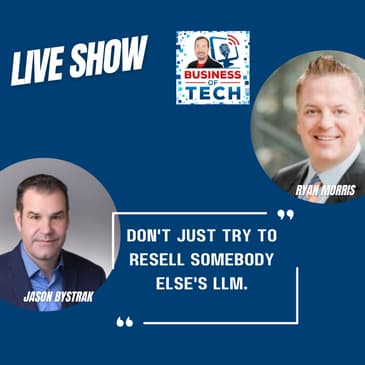
The discussion centers around the evolving landscape of artificial intelligence (AI) and its implications for businesses, particularly managed service providers (MSPs). With significant venture capital investments flooding into AI, many companies are emerging without sustainable business models, leading to concerns about market saturation and commoditization. The conversation highlights the importance of finding real product-market fit and the potential for consolidation in the industry as competition intensifies and computing costs decrease.
Jason Bystrak and Ryan Morris, both seasoned experts in the IT channel, share insights on how MSPs can navigate this changing environment. They emphasize the need for MSPs to focus on business outcomes and the integration of AI into their service offerings. By leveraging tools like Microsoft Copilot, MSPs can enhance productivity and create new revenue streams through data readiness and AI-driven solutions. The conversation also touches on the importance of training and educating clients to maximize the benefits of AI technologies.
As the discussion progresses, the speakers address the challenges faced by smaller MSPs in adapting to the rapid advancements in AI. They caution against relying solely on specific AI models, as the market is still evolving, and emphasize the need for MSPs to build applications that utilize AI effectively. The potential for automation in routine operations is highlighted as a key area for MSPs to explore, allowing them to streamline their processes and focus on higher-value services.
Ultimately, the conversation underscores the necessity for MSPs to rethink their strategies in light of AI advancements. By embracing customer success initiatives and restructuring their approach to service delivery, MSPs can position themselves for growth in a competitive landscape. The speakers encourage MSPs to innovate and adapt, ensuring they remain relevant and profitable as the AI market continues to evolve.
Forrester article: https://www.forrester.com/blogs/the-graphic-future-of-it-management/
About Business of Tech: The daily MSP news and analysis podcast for managed service providers and IT services leaders. Host Dave Sobel covers AI for MSPs, MSP pricing and profitability, MSP M&A and private equity, vendor partner programs, MSP cybersecurity and liability, and MSP operations — and answers the question every story raises: Why do we care? Produced by MSP Radio.
💼 All Our Sponsors
MSP Radio is supported by our partners:
ABC Solutions · CometBackup · Firetail · Guardz · HaloPSA · LogMeIn · Mailprotector · Pax8 · Rythmz · ScalePad · TimeZest · Transit AI
Supporting the IT services community through insights, analysis, and transparency.
🚀 Join Business of Tech Plus
Get exclusive access to investigative reports, vendor analysis, leadership briefings, and more.
👉 https://businessof.tech/plus
🎧 Subscribe to the Business of Tech
Want the show on your favorite podcast app or prefer the written versions of each story?
📲 https://www.businessof.tech/subscribe
📰 Story Links & Sources
Looking for the links from today’s stories?
Every episode script — with full source links — is posted at:
🎙 Want to Be a Guest?
Pitch your story or appear on Business of Tech: Daily MSP News & IT Services Analysis
💬 https://www.podmatch.com/hostdetailpreview/businessoftech
🔗 Follow Business of Tech
LinkedIn: https://www.linkedin.com/company/28908079
YouTube: https://youtube.com/mspradio
Bluesky: https://bsky.app/profile/businessof.tech
Instagram: https://www.instagram.com/mspradio
TikTok: https://www.tiktok.com/@businessoftech
Facebook: https://www.facebook.com/mspradionews
Hosted by Simplecast, an AdsWizz company. See pcm.adswizz.com for information about our collection and use of personal data for advertising.
[00:00:13] So we're going to talk AI, but we're going to talk about the costs of AI. With DeepSeq showing generative AI can be done cheaper and multiple models all coming out, do we have too many companies and models? What happens as the models commoditize and what does it mean for products and for MSPs? Jason Bystrak and Ryan Morris join me to hash it all out. Welcome to the Business of Tech Lounge, the live version of the Business of Tech podcast.
[00:00:41] It's Wednesday, March 12th, 2025 and I'm Dave Sobel. We'll take questions and comments throughout the show. Make sure to put them in chat if you've got one. Throw it up there, we will happily respond to it. Now I want to thank Sales Builder, our Patreon sponsor whose support makes this show possible. Focus on your IT sales workflow with the power of automation and visit them at salesbuilder.com. That's B-U-I-L-D-R dot com. A reminder, I'm keeping an eye on the chat. We'll watch for your questions.
[00:01:12] Jason Bystrak is the Senior Vice President of over two decades in the IT channel. He's led initiatives to support resellers and MSPs in transitioning to manage security services, contributing to significant growth in the company's modern security segment. Jason, welcome to the show. Hey Dave, thanks for having me today. Looking forward to this.
[00:01:35] I'm excited myself. Now Ryan Morris is the Principal Consultant at Morris Management Partners, bringing over 25 years of experience in sales, marketing and management within the B2B technology solutions industry. He's also my co-host on the Killing It podcast. Ryan, welcome back. Thank you very much. Glad to be here again. These are always great conversations. Well, in particular, you guys are willing to play on a topic that's been top of mind for me. And I want to talk a little bit about AI business models.
[00:02:05] Now for listeners, I want to lay down a little bit of some of the facts. I'm quoting from Casey Newton in his Platformer newsletter to give a couple of statistics here. In 2024, nearly $209 billion in venture capital went into AI, with OpenAI alone raising $6.6 billion and planning a $500 billion fund. Many of the market is flooded with companies that lack sustainable business models.
[00:02:31] And as we're seeing with DeepSeek's entry into the space, the models are rapidly commoditizing. As computing constraints are going to ease, the prices are going to drop, and competition will drive consolidation and failures. Many of these companies lack a market fit outside of coding and marketing. Most are just offering text boxes and APIs. And an industry moat of capital, not proprietary technology or defensible business models, is not sustainable.
[00:02:59] They're all gambling on superintelligence. But ultimately, what we're looking for is real product market fit. And, Jens, I want to sort of get your little take here first. You know, as we think about this middle layer between the cloud computing hyperscalers and the productivity software that's starting to be built on top of that, as this middle layer starts getting squeezed, are there elements of this that you're starting to worry about as it gets rolled out?
[00:03:28] Ryan, I'm going to throw it to you first to get some thoughts. Yeah. In fact, I will just say consolidation is the most inevitable industry force. All sectors will eventually deal with that, right? There once were hundreds of car companies. Then there were three. That is true in server mainframe technology. That's true in networking. That's true in cybersecurity. It will eventually come for all industry segments.
[00:03:53] But if you think logically about, you know, kind of the stack of technology, you know, from data center infrastructure through server storage networking to the OS layer, the data layer, the application. All this is doing from an AI modeling perspective is reorganizing and changing the way we access the data layer, right? It's not an application and it's not an operating system. It's that data layer in between.
[00:04:20] And while there are still multiple database providers out there in the world, Oracle, IBM, Microsoft, et cetera, right? There are still multiple of them, but there are radically fewer of those today than there used to be. I think that is absolutely inevitable for the AI models, but that doesn't mean that the models will become less valuable, just that you can't actually defend market share. Jason? I think Ryan's absolutely right.
[00:04:48] You know, where it's interesting is that you're really seeing a lot of the bigger classic technology players, whether it's the hyperscalers or companies like Microsoft and Google and even some fringe players that aren't necessarily in a typical channel environment. You know, they're making investments in these different AI companies, almost as if they're hedging their bets to see which technology, which delivery models are going to be most efficient to that.
[00:05:11] And you can see, you know, down the road where they're either going to work to use that investment to make a full acquisition and go deeper into that or possibly put somebody out of business, right? A lot of those larger companies have the capital to do that. So that's going to be interesting. And I think really where we should be watching is the evolution of how people are starting to use that data layer, as Ryan called it. You know, what are they doing to build out applications? You know, we spend a lot of time in the channel, I think, with our MSP partners talking about Microsoft.
[00:05:39] And I think it's a great place to start because Copilot, for example, is a tangible AI product that you can quickly build a use case for around productivity, for example. I think everybody's watching to see what are the next major use cases that they can help with their clients. Well, I would think you've actually probably got a pretty good sense of what products are moving in this space, living in the distribution layer.
[00:06:02] And I want to ask a little bit about it because I've reported on the show before that the information is reporting that Microsoft is actually kind of struggling to sell Copilot. They're giving away a lot of licenses. They're letting people seed it. But there's not a lot of people paying for it. And so, you know, it's being held up as a good classic use case. I get it, too. It feels like there might be something there. But where the rubber meets the road, is it happening? Where are you seeing, like, products actually being paid for and bought around generative AI?
[00:06:31] Well, I mean, if I think of Copilot, to use that example, Dave, and again, it's so channeled, familiar to us that it's an easy one to talk about. You know, we absolutely are seeing the paid subscriptions for Copilot like a hockey stick, right? It's not just doubling every month. It's, you know, it's going 5, 10, 15x every single month as far as new sales of that product goes, right? But you're right. It's not nearly at the penetration rate that they want compared to, say, something like Office 365, which is kind of the target, right? How much of that can you attach?
[00:07:01] So there's an awful lot of work to do. And I really think it comes down to the fact that, you know, if you think back a few years, we talked a lot about the channel partners focusing on business outcomes. And that was important to sell cloud. And it was. But more than ever, when it comes to AI, it's all about the business outcomes. So if you didn't develop those skills then, you really need to think about your approach in doing that. So as people start to learn that, I don't think we can train them quick enough.
[00:07:28] But as we're starting to train it, that's where we're seeing the adoption take place is that people are replicating that. But I do think it's much easier with a, call it a finished product, right? Like a co-pilot solution versus something that you're just starting with an API connection into an LL app, right? And trying to build up something yourself. So we're seeing a lot of partners start there. Gotcha. Yeah. Now, Ryan, I want to sort of get your thoughts on this too, as I've been thinking of this out. So if we think about these in layers, right?
[00:07:56] And we talk about that with the productivity layer and then this data layer piece. So it's going to get, it's getting compressed very, very quickly. Is there big risk that you're worried about as we think about solution providers in particular? You know, I always quip and say, like, I don't worry about the vendors. They're going to be fine. It's let's make sure that small and medium sized regional solution providers aren't swept up in something. Is there something going on with that pressure in the middle that they really need to be thinking about?
[00:08:24] Particularly as they lean into their customers with generative AI? You know, the only risk that I see is if you happen to use that API Jason mentioned and build a proprietary application that is exclusively linked to one LLM model versus the rest of them. And if that one doesn't turn out to be the market share winner, then you could get yourself in trouble.
[00:08:47] But other than that, the channel has been functionally locked out of the revenue stream associated with building the LLMs, right? Those are hyperscaler data centers, mega enterprise implementations with hundreds of thousands of units going into a single facility. You and I aren't selling any of that stuff from a reseller point of view. That's going direct from the vendor to those implementations.
[00:09:13] Right now, the channel is getting paid for services around how to use AI. Is your data ready for AI? Do you have acceptable use policies, etc.? But you'll notice none of that is actually tied to licenses of particular software. I think that's actually the blinking light of opportunity, right? And don't just try to resell somebody else's LLM, right?
[00:09:37] You'll notice that absolutely zero of the model providers have a channel resale license model. They don't have one. They don't intend to use one. That's not where you're going to make your money. If you want to make money in AI, it will be building an application that uses the platforms to accomplish a business outcome. As Jason is describing, right?
[00:10:02] Don't think you're going to get paid by Google or Microsoft or Grok or anyone else for reselling AI models. You need to figure out how to do something with that. That's literally the bridge between the use case that you're describing and the application layer. That integration and even if you're smart enough to do it in low-code development, that's a phenomenal opportunity for a channel player.
[00:10:32] Right now, I don't see any risk because they're already eliminated from the revenue stream. Now, interestingly, and Jason, I'm going to get a little bit of your take here because I would look at the channel opportunity, right? And I always get a little skeptical when I hear anybody go, there's a channel opportunity everywhere, right? Because that is being a little dismissive of the difficulty of pulling this out. And if we think about the hype cycle, we're only generally about two years in, maybe two and a half from where ChatGPT kind of showed everybody what generative AI can do.
[00:10:59] And many of the players that we talk about are not traditionally channel partners. Like if we think about both Anthropic and OpenAI, these are not companies that I think of as having channel programs. They have a developer ecosystem, sure, but they don't necessarily have a channel go-to market strategy. Jason, give us a real sense from your perspective. Like how much channel readiness is there here and how much is still being actually built out?
[00:11:26] Yeah, and I think it depends on how we define the channel too, Dave, right? Like, you know, we spend a lot of time like, you know, you, me, Ryan, and a lot of our friends in that MSP and bar ecosystem, right? But we always, for years we've been talking about these shadow channels, right? And, you know, there is a whole shadow channel of people that are more systems integrators that have a lot more experience in some of the customization of software and API development and connectivity in that. Yeah, we know they're out there, right?
[00:11:55] We hear about them, but they're not necessarily working like with companies like D&H and that because they have almost zero resale practice, right? So a lot of times we're in a finished goods or close to finished goods, let's say, type of product. So the motion that we see winning the most in a kind of our SMB and mid-market segments is really where people are starting and having a co-pilot conversation, focusing on some use cases, mostly around productivity, right? Within that, it's a fairly finished product.
[00:12:25] It's more about training than it is customization. But as soon as you start talking about that, it immediately leads to a data readiness discussion. That's a huge opportunity to monetize for MSPs and buyers to make profit off of, you know, really helping to take that data, put around a storage solution, de-dupe it, clean it out, segment it, right? You don't want your company payroll being served up in the co-pilot, for example.
[00:12:50] So we're seeing a lot of folks starting to sell a storage solution around that and then monetizing for services. And then the last mile of the solution, step three, is really around attaching an AIPC to optimize that. And furthermore, we're all familiar with the Windows Refresh Initiative going on right now for this year. Yeah, that's a great opportunity to upgrade into an AIPC. So again, start with co-pilot, monetize the license and get paid for training and implementation.
[00:13:16] You know, look at storage and data readiness, monetize that with services and product. And then lastly, again, monetize it with an AIPC. Before I drop the mic, I'll say there is a small set of partners that we work with that really are starting to sell AI infrastructure, right? So large server stores, your GPU configurations into very large enterprise. But most of what we see is that's more of a hyperscaler or service provider sale today, which isn't necessarily for the channel.
[00:13:45] But if you happen to play up in large financial institutions and things like that, that's an area that healthcare schools that we're starting to see some private AI infrastructure being deployed. Now, I got to ask about AIPCs because this is one of those areas where I'm seeing some conflicting data, right? I'm actually seeing that some of the AIPC data is showing that they aren't moving particularly quickly.
[00:14:08] Additionally, if I put the current overarching economic thought on this, there's consumer sentiment is showing significant slowdown. And the only reason I bring that up is I tend to worry about micro businesses and very small SMBs. And then if I layer on, by the way, ooh, tariffs, where Acer's already come out and said, like, look, expect 10% higher prices on everything right away.
[00:14:33] Are we really thinking it's going to be this gold rush of sales this year with a bunch of those henriots? Jason, give me a sense of the way you guys are looking at it. Let's not go tariffs. That's a different podcast, right? We'll talk about that later. But taking that aside, if you think about it, the AIPCs really started shipping. It's only been six months or less, right? Okay. I would say in the early launch, there was a lot of freeze and confusion around, am I doing a Windows refresh or an AIPC? Do I have to wait?
[00:15:02] So that slowed things down and we didn't see adoption. I would say that the first part of this calendar year, January or February, have been very strong. And we are starting to see the mix of PCs really start to move more into AI. It's still not the predominant sale, don't get me wrong, but we're definitely seeing that hockey stick growth start to take shape with those.
[00:15:22] And I think it's a bit future-proofing because a lot of those AI solutions right now are not necessarily using that type of power capacity yet, but they will as people do start to deploy some of this. So refresh now, if you can afford it, go with the full AIPC and that's going to future-proof your business. Gotcha. Now, Ryan, I want to ask you something that I've been thinking about as well. I'm pretty sure you've got an opinion on.
[00:15:49] One of the things I've been thinking about recently is particularly that divide between sort of consumer sentiment on products versus micro and SMB thought-on-sign. It's a blurry line, right? And one of the things in particular, one of the elements I've been looking at is when I look at it from a consumer perspective, there's a ton of hype around large language models, product like ChatGPT. But I think that there's a bit of an overestimated utility for consumers.
[00:16:17] There seems to be like there's some real clear use cases in mid-market, in enterprise organizations. Where are you starting to see conversations happen with MSPs around that SMB, particularly as we think a little bit about the micro business side, the one to five, and then we think about the five to 10 going through SMB. How much of this is hype and how much is really overestimation? You know, from a utility perspective, right now it's all hype.
[00:16:46] But Jason used the magic word there, future-proofing, right? Think back a couple of cycles in our industry. You remember the conversations we used to have about, hey, guys, do you know that there used to be a server computer that was the size of a house? And it was that big and it could only do very, very small and simple things when you were using it from an applications perspective.
[00:17:08] And then we went through the micro computer era and we put everything down into a single box and we put it on everybody's desktop and now in everybody's pocket. I will say I think that the evolution of the large language model or the AI infrastructure deployments will follow almost an identical path. It'll be a whole lot faster than what that evolution was.
[00:17:31] But DeepSeq is a very good example of you don't need 200,000 GPUs and you don't need $100 billion of capital. You can use smaller, less powerful chips to do less data analysis and create something that is directly functional. And eventually, to Jason's point again, that's going to be AI at the edge.
[00:17:56] You're going to be able to put custom implementations of local applications that are specific to me or my business's use case and run those things on an AI PC. The use case where we're starting to see that really take hold, I'll say two of them. Number one, industrial computing. Anywhere that you start to see the IoT implementations really take root.
[00:18:22] We've been talking for years about how there are hundreds of thousands of items or devices that have smart sensors associated with them. And to monitor and manage each of those things manually the way that an MSP always has, that's been functionally impossible to deal with that kind of quantity. But now in an AI world, we can really start to take control to identify patterns and manage them and max, right?
[00:18:48] So that's a place that we're starting to see some real traction going on in medium and small sized manufacturing. Just as an example, logistics and distribution, I think, is another place. The second main use case that we're seeing these things take place in is customer specific or vertical specific applications, right? Jason makes the point about Copilot is a finished application API into an LLM, okay?
[00:19:16] It's an application for general use in a productivity scenario. What if I could say, well, I run a tax prep, an accounting firm. Is there a way that I can get a specific application that leverages the publicly available LLMs for calculation purposes, but it's not going to just generally ask for answers?
[00:19:40] It will pose structured queries into that environment in a way that gives me meaningful results, right? If you've ever taken a day of training on how to write SQL queries into the database world, you realize there's literally a master's degree level training that's required to be a DBA and to use those tools effectively.
[00:20:03] Right now, we're asking the average Joe inside of an organization to write 1,500 word prompts into the LLM structured and with dependencies and limitations. They're not going to do that. But if you came to them and said, hey, I already did that thinking. I structured all of the queries and I wrapped it in a simple looking UI so that it just is point and click application layer stuff.
[00:20:30] Tax and financial prep is absolutely taking root. Law firms are taking root. Other professional services environments. We're really starting to see if you can design an application specific to the vertical and then just leverage the LLM as the resource in the data layer. You get paid a ton of licensing as well as implementation integration infrastructure. Now, for our listeners, throw in questions and comments.
[00:20:58] If you've got them in the chat, I will definitely pull them on stage. Now, Ryan, it's funny you bring that up because I was literally just reading a review of the new Apple Studio Pro or the Studio unit that just came out. And the tester noted that the processor could run the entire DeepSeq model on the new Studio all locally. I think what's interesting about this is that we may all be wrong just simply on timeframe.
[00:21:22] Right. Like many of these kinds of things, like analysts like me always say, I'm always faster on thinking it will get out into people's hands than it actually is. Which leads me to kind of where I wanted to go with our next portion of this conversation is kind of a little bit of the future of IT management. Forrester put out a really interesting graphic laying out the future of IT management. And what really resonated to me was this idea that AI is going to automate a lot of routine operations.
[00:21:48] You've kind of alluded to that a little bit with your example there, Ryan, thinking about it from a tax perspective. If we really think about the way that using this interface can actually automate away a good portion of routine operations, it does free up solution providers to be focused on that kind of stuff. But where is the real key points of leverage? Are we really positioned for that now or is this something that we're going to be building over the next three years? So, Jason, I'll sort of throw it to you with a question.
[00:22:17] Like, as you're thinking about the way, you know, MSPs and IT services companies are going to be building out automation, is this something that you're thinking about happening right now or is this a transition over the next 12 or 18 months? I think it's more the latter day, right? These things always take time for people to mature their business models and make investments in automation. But, you know, some of the low-hanging fruit that MSPs, I think, should start considering, and some of the good ones are just something basic like your help desk.
[00:22:47] You know, how do you use AI to create chatbots and things like that to automate it? Or use it in a knowledge base where, you know, the user can self-serve and probably get a quicker answer than having to contact somebody with a ticket or a phone call. So we're starting to see solutions like that. I think you'll see even a lot of the MSP tool and software companies that we all know, you know, focus on more automation around those ways to make it easier and train people. You know, I think there's also an evolution of managed services.
[00:23:14] You know, one of the use cases, like, you know, we spend a lot of time with, you know, folks trying to really sell AI hardware, right? Like, think about, you know, companies like HPE and Lenovo and companies like that. You know, they're really starting to bring these use cases and have discussions around things like computer vision, right? Video analytics and stuff. You know, something like predictive maintenance, like on, you know, manufacturing equipment or things like that. You know, anything that can connect to the network and be monitored like that, something that an MSP could conceivably do,
[00:23:43] even if it's just creating an alert that something has to be done, right? And alerting the customer to it. And that's bringing in a lot more, you know, ISVs into the discussion. So we talk, you know, I think I've heard Ryan Morris do a million presentations now where he used the term business outcome. More than ever, it's focused on what are you going to do to, you know, improve your business, whether it be the customer experience, your cost basis, your automation, things like that.
[00:24:09] And really, AI is the thing that starts to tie this stuff together a bit. I don't know that we saw huge success with IoT in the past, but now you're wrapping AI solution around it. Suddenly, it's a whole different conversation, as Ryan was pointing out. So, you know, long story short, you know, I think MSP should start to think about expanding what they manage and then looking at automation to drive efficiencies within that. But let's go win the business first and then automate. That's fair.
[00:24:37] Now, Ryan, I want to ask a little bit of historical perspective here, too, because I'm being a little critical. You and I met when you were doing a tour with Microsoft of Managed Services talking about automating away IT operations in 2005. I flew around as a vendor in 2012, 2013, talking about automating away IT operations.
[00:25:03] And I feel like, again, I'm singing a story of, hey, let's automate away. Now, it does feel like some of the capabilities are a little bit different, particularly with the ability for AI to write some code and scripting, which was always a piece different. But why do you think this might be different, Ryan, in terms of the conversations we've had previously about managed services? Absolutely. And in fact, so I will say first things first, think of the iceberg model, right?
[00:25:30] The things that we are presently monitoring and managing manually today will eventually get pressed down beneath the automation surface and will be replaced by new, more advanced and sophisticated responsibilities. The things that you can do point and click inside of an MSP tool today used to require very laborious manual implementation in 2005 and in 2015, right?
[00:25:59] So we continue to push more and more of that functionality down. The reason I think this is very, very interesting, and especially the article that you shared, if it's possible, we need to make sure we include that link to the Forrester information when you put this show out. Because I think every MSP ought to read this and see if it gives them an aha. One of the things I've been saying for years in the world of technology channel around implementation, customization, and managed services, right?
[00:26:28] Any of those categories. I've always said your moat fundamentally is your raw materials of basic intelligence and intellectual capability, right? The code word for that that we've always used is you can't be a dummy and succeed in the technology industry because it's hard, because it is complicated.
[00:26:50] And when you look at that in a practical implementation, that's because we use process definitions that inform workflows that lead to scripting, that create a very detailed list of activities inside of our software and management processes. This is thinking it in a completely different way.
[00:27:13] Moving from, think of it as moving from a command line interface in the operating system to the graphical user interface. When we look at IT systems management, we have always done the command line style in implementation, and we had to have all of those things because systems were intentionally not integrated, and you had to manually tie them together so that they could be monitored.
[00:27:40] As we move into what Forrester is describing as a graphical database approach, that is a visual picture of the network environment and everything associated with it, where you can point and click for very complicated applications. They use the magic word in there, and I know you caught this, Dave, and you knew it would trigger me as well. The digital twin, right?
[00:28:05] Like this is the IT version of a digital representation of physical assets in an environment where they can be automated, tracked, monitored, and managed, and then used to push commands back out to the physical world. I think this change from you got to be a rocket scientist in managing the complexities of IT systems into if you're good at customer service,
[00:28:32] and you can have a visual snapshot of everybody's IT environment, and you can point and click to make structural changes in the things that MSPs have always charged a lot of money to do, a lot of what we currently do is going to become a very old-fashioned commodity, and we will have very strenuous competitive threats from new style MSPs who say,
[00:28:57] I'm not here to do what they do using PSAs and RMMs and all of these things. I'm here to solve your problem with a visual interface. So either you can self-serve and do it yourself, or hey, let me do it for a fraction of the price because we're going to be focused on, as Jason said, moving out of IT into the OT, the operational technology world, moving into other items and devices and business processes.
[00:29:25] We will now manage all of your technology, not just the IT with ones and zeros. So for listeners who are catching this recording, the link we're talking about for the Forrester article will be in the show description, so you can catch it right there. For those watching it live, we actually threw the URL right up on screen, so you've got it there as well as I put it in the chat. Now, gents, as I sort of wrap this up, like if a MSP, we're talking right now, you know, March 2025,
[00:29:54] MSPs, regret most of them have a limited set of amount of time that they can spend looking at things. We've covered a couple of different things that they might want to spend some of their time on. What's kind of the number one piece of guidance that you're giving right now to providers of where they should spend their most time? Jason, I'll kind of throw it to you there. Like what's the one big thing for 2025 that you're telling them to spend time on? Well, first, I just had a flashback to 2005 with Ryan's closet full of orange ties,
[00:30:24] and I'm thinking about how far we've come. So, you know, kudos to Ryan. But what I would say, you know, that we're talking a lot with MSPs, you know, is when you're thinking about AI, I think there's two approaches, right? Number one is working on your business, right? And that's basically thinking about new products and services that you can take to market that are powered by AI. So if you're serving the SMB and mid-market today, I would really look at that co-pilot to data readiness to AIPC model,
[00:30:52] and I think there's a lot of services and product resale that can generate profit. The other side of the coin that MSPs should always be thinking about is, you know, and they're working in their business, which is what are they doing to drive down their operational and service delivery costs? And there's another way to automate with AI. So thinking about even using some of their own and drinking their own Kool-Aid to do things like the knowledge base piece, the chatbot piece, right, to create more automation within their business so that their people can do more, you know, with less investments.
[00:31:21] And if you do those two things, that's a lot, because one of the hardest things to do is go acquire brand new customers. You can execute on that vision we just talked about with your existing customer base. Sell them more and new solutions and optimize your own profitability with it on the back end. Ryan, what are you guiding MSPs on right now? You know, it's funny. Jason and I are very much of one brain on this stuff because my number one recommendation is to restructure the way
[00:31:49] that you engage and manage customer relationships so that you have more influence and control over additional product lines and service opportunities, right? To use an industry term, customer success as the way that we drive adoption of existing technology deployments. We drive expansion across new opportunities and new resources in the customer's environment. We manage the continuity and the life cycle of the technologies
[00:32:17] that customers are deploying. Customer success is not just a SaaS function. It is an essential relationship management function that if you do it correctly, it's going to lead to 80% of your net new dollar growth in your business performance as opposed to just let's make a thousand phone calls and prospect like crazy and try to win all of those dollars of growth. From net new customers. I'm going to say don't ever walk away
[00:32:46] from the land or the expand opportunity, but that requires a structurally different approach to how you do business. In the world that we've always grown up in, we had a sales team, we had a technical team, and then we had back office. Now what we need to have is a new customer acquisition team, an existing customer management team, and a professional services team that can deliver against all of the recommendations that we're making.
[00:33:16] It's a little re-swizzle from an org chart perspective for most MSPs, but the place where, if people are catching kind of the hint in here, the slight piece of blasphemy that I'm recommending is that you need to break the boundary of standardized recurring service contracts and get into variable SOW-based project implementations, or else somebody else is going to come in and get paid for those things by your customers.
[00:33:46] So don't just stick with your standardized stack and your three-year contracts and your automated services. Yes, please follow Jason's advice and optimize those things and let's make sure that they're as tight as possible. But at the same time, you'd better be looking for new streams of revenue because we can forecast a commoditization of anything that can be automated in MSP models. I hope you're getting paid for the smart guy stuff
[00:34:15] that cannot be automated because it's custom and it's professional service. I like being paid for smart guy stuff and I would be remiss if I didn't point out the best-in-class operators of IT services companies actually do have a mix of recurring revenue streams as well as those project services. Well, gents, I could go all day on this one, but I want to be respectful of both your time and the listener's time. Thank you both for joining me. This is going to be great fun. We'll have you both back soon enough.
[00:34:43] Now, I want to preview an interview that's dropping this weekend. Toby Mills, who's the founder and CEO of Entopy, joined me to talk about digital twin technologies, particularly as it applies in critical infrastructure. In this case, we were talking about major ports. He explains how these digital twins allow them to address operational efficiency by predicting vessel movements, and we talked specifically around some of the use cases here. Here's a preview of that interview.
[00:35:13] It's the idea of a micro model that you would build one specifically around particular tugboat actions, and that's a micro model, and then that is used in conjunction with the micro model for, say, water movement or sea movement or the micro model for the way a particular kind of ship moves. Am I understanding the concept right? Yeah, yeah, absolutely spot on. And I'll give you another use case because you've already kind of described that one, but this is kind of a really good example of it. So we were trying to predict,
[00:35:42] well, we are predicting traffic to another port, right? So this is road traffic. So this is a ferry port, slightly different. We're doing the same thing in an airport, so it's kind of agnostic. But okay, you're now trying to predict traffic across a road network, really complicated, loads of moving parts. And micro models here kind of comes into its own. So what we do is instead of trying to predict everything, we just look at a specific junction and we look to predict the probabilistic aspects
[00:36:11] of traffic at that specific junction. So traffic flow based on day, time, seasonality, and weather, okay? We ignore accidents. We ignore roadworks. We ignore anything else. We look at the smallest possible conceivable part of that operation and build a model around that. And then we build another model at another junction, another model at another junction. So you start to get like a sort of layer of small independent and interconnected models.
[00:36:39] These then feed into another layer, okay, of models that maybe predict to a specific point in the road. So let's say, okay, so we're talking about a port. So the port has an entrance. So now what we want to do is we want to sort of federate the outputs of lots of these small micro models and integrate them in a particular way so that we can start to inform traffic. Why would you do that rather than just predicting traffic to the port entrance?
[00:37:07] Well, now you can start to load in real-time information such as car accidents and roadworks, things that are less predictable. And then they, you know, they have their own profile and they integrate into the network. This was a fascinating conversation about the use of micro models, how he's applying different of the advanced generative AI models into various use cases. I know MSPs will enjoy learning about those various use cases. My Patreon supporters already have this. If you want to listen now,
[00:37:36] it'll drop on the weekend and the podcast feed. If you're interested, I really do encourage you to listen. Visit patreon.com slash mspradio to sign up right now. Now I want to thank Sales Builder, our Patreon sponsor, whose support makes this show possible. Focus on your IT sales workflow with the power of automation and visit them at salesbuilder.com. That's B-U-I-L-D-R dot com. And vendors, you too can get your name mentioned on the live show. It's a simple monthly subscription.
[00:38:06] Visit patreon.com slash mspradio to learn more. And listeners, you can support the show. Like, share, and follow on your favorite platforms. It really makes a difference. It is the number one thing you can support this show by doing. Or support directly on Patreon with our Give What You Want model. You set what you think the content is worth, and you get access to videos early. If you have a question and are listening to the recording,
[00:38:33] send it in at question at mspradio.com. Thanks for joining me for the Business of Tech Lounge, and I will see you next time. Part of the MSP Radio Network.