
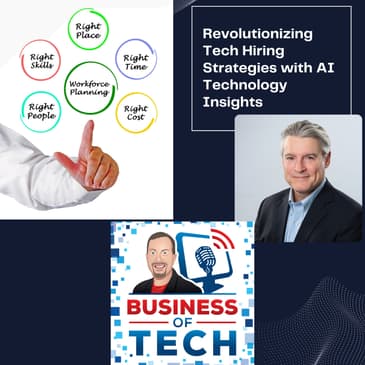
Dave Sobel is joined by Hugo Malan, an expert in building workforces with a mixed labor strategy. They discuss the concept of a mixed labor strategy, which involves using different forms of labor to create an optimal mix for specific circumstances. This strategy allows companies to adjust their cost structure and increase flexibility by incorporating permanent employees, temporary workers, and services from external firms. The discussion delves into the challenges faced by small businesses in balancing their workforce composition, especially in response to fluctuations in demand.
Malan emphasizes the importance of making strategic decisions when hiring, considering factors such as core skills that need to be preserved in-house and skills that can be outsourced. The conversation also touches on the impact of AI on the hiring process and workforce composition. While AI can streamline certain aspects of recruitment, Malan highlights the limitations of AI in making complex matches between candidates and job requirements. He emphasizes the continued need for human judgment and interaction in assessing candidates beyond their qualifications.
The episode takes a deeper dive into the issue of diversity in the tech industry, acknowledging the underrepresentation of certain groups, particularly women and veterans. Malan suggests practical steps that businesses, including small companies, can take to attract a more diverse workforce. These steps include creating affinity groups within the organization, implementing inclusive practices, and actively promoting diversity in job descriptions and recruitment efforts. By focusing on specific areas where they can make a meaningful impact, businesses can work towards building more diverse and high-performing teams.
As the conversation wraps up, Malan provides tactical insights for small businesses looking to enhance their diversity initiatives. He advises focusing on specific demographic groups that align with the company's location and business goals, rather than trying to create multiple affinity groups with limited resources. By taking practical steps to create a more inclusive and welcoming environment, businesses can attract a wider pool of talent and benefit from the diverse perspectives and ideas that contribute to high-performance teams.
Supported by: https://huntress.com/mspradio/
About Business of Tech: The daily MSP news and analysis podcast for managed service providers and IT services leaders. Host Dave Sobel covers AI for MSPs, MSP pricing and profitability, MSP M&A and private equity, vendor partner programs, MSP cybersecurity and liability, and MSP operations — and answers the question every story raises: Why do we care? Produced by MSP Radio.
💼 All Our Sponsors
MSP Radio is supported by our partners:
ABC Solutions · CometBackup · Firetail · HaloPSA · LogMeIn · Mailprotector · Pax8 · Rythmz · ScalePad · TimeZest · Transit AI
Supporting the IT services community through insights, analysis, and transparency.
🚀 Join Business of Tech Plus
Get exclusive access to investigative reports, vendor analysis, leadership briefings, and more.
👉 https://businessof.tech/plus
🎧 Subscribe to the Business of Tech
Want the show on your favorite podcast app or prefer the written versions of each story?
📲 https://www.businessof.tech/subscribe
📰 Story Links & Sources
Looking for the links from today’s stories?
Every episode script — with full source links — is posted at:
🎙 Want to Be a Guest?
Pitch your story or appear on Business of Tech: Daily MSP News & IT Services Analysis
💬 https://www.podmatch.com/hostdetailpreview/businessoftech
🔗 Follow Business of Tech
LinkedIn: https://www.linkedin.com/company/28908079
YouTube: https://youtube.com/mspradio
Bluesky: https://bsky.app/profile/businessof.tech
Instagram: https://www.instagram.com/mspradio
TikTok: https://www.tiktok.com/@businessoftech
Facebook: https://www.facebook.com/mspradionews
Hosted by Simplecast, an AdsWizz company. See pcm.adswizz.com for information about our collection and use of personal data for advertising.
[00:00:02] [SPEAKER_01]: Well, a recurring issue on the show is always about hiring.
[00:00:06] [SPEAKER_01]: What does it look like in the talent market and how do we do a better job hiring?
[00:00:10] [SPEAKER_01]: Hugo Malan joins me today.
[00:00:12] [SPEAKER_01]: He's an expert in their area and has been focused on building those workforces that
[00:00:18] [SPEAKER_01]: are mixed type and bringing together different collections.
[00:00:21] [SPEAKER_01]: Can you use temporary workers?
[00:00:23] [SPEAKER_01]: Can you use remote workers?
[00:00:24] [SPEAKER_01]: How does that all come together on this bonus episode of the Business of Tech?
[00:00:30] [SPEAKER_01]: Today's episode is supported by Huntress.
[00:00:33] [SPEAKER_01]: You want to focus on your clients and are always looking for ways to get more time.
[00:00:38] [SPEAKER_01]: Use Huntress' fully managed cybersecurity platform to fight off cyber threats.
[00:00:44] [SPEAKER_01]: Huntress is more than cybersecurity software for endpoints and identities.
[00:00:48] [SPEAKER_01]: It's a 24x7 security operations center.
[00:00:51] [SPEAKER_01]: It's security awareness training, community engagement, and dedicated partner support
[00:00:55] [SPEAKER_01]: with an average CSAT score of 99.3%.
[00:01:00] [SPEAKER_01]: Technology can only get you so far.
[00:01:03] [SPEAKER_01]: Human expertise is what's needed to truly elevate and protect small businesses.
[00:01:08] [SPEAKER_01]: And you get that with Huntress.
[00:01:10] [SPEAKER_01]: Secure your clients and help them thrive with the number one rated EDR for
[00:01:14] [SPEAKER_01]: SMBs on G2.
[00:01:16] [SPEAKER_01]: Visit huntress.com slash MSP radio to find out more.
[00:01:22] [SPEAKER_01]: Well, Hugo, thanks for joining me today.
[00:01:25] [SPEAKER_00]: That's my pleasure.
[00:01:27] [SPEAKER_00]: Thank you for inviting.
[00:01:28] [SPEAKER_01]: Well, I want to start right at the top because I want to make sure that listeners
[00:01:32] [SPEAKER_01]: understand what the idea of a mixed labor strategy is before we even dive into
[00:01:38] [SPEAKER_01]: how to be effective with it.
[00:01:39] [SPEAKER_01]: What is a mixed labor strategy?
[00:01:44] [SPEAKER_00]: A mixed labor strategy is using different forms of labor to ultimately
[00:01:51] [SPEAKER_00]: create the optimal mix for your particular set of circumstances.
[00:01:55] [SPEAKER_00]: In other words, you will have some folks that are permanent employees.
[00:01:59] [SPEAKER_00]: You might have other people that are temporary employees and you might even
[00:02:03] [SPEAKER_00]: have firms providing various kinds of services, putting people in your
[00:02:08] [SPEAKER_00]: building or at least at your disposal under SOWs of various kinds.
[00:02:13] [SPEAKER_00]: All that together gives you your labor mix.
[00:02:16] [SPEAKER_00]: And by adjusting the various ratios between these different kinds of
[00:02:21] [SPEAKER_00]: sources of labor, you can create a more fixed or a more flexible cost structure
[00:02:27] [SPEAKER_00]: and ultimately also increase the per unit cost or decrease the per unit cost,
[00:02:32] [SPEAKER_00]: especially as you start also looking at offshore resources.
[00:02:35] [SPEAKER_00]: So that in total is a mixed labor strategy.
[00:02:38] [SPEAKER_01]: Got it.
[00:02:39] [SPEAKER_01]: OK, cool.
[00:02:39] [SPEAKER_01]: So now that we've baselined it, it feels like there's a lot of different
[00:02:43] [SPEAKER_01]: levers that you have to figure out how to get right.
[00:02:46] [SPEAKER_01]: How do you know when something should be a full time employee,
[00:02:48] [SPEAKER_01]: when it should be a part time or a contractor, when you want to be
[00:02:51] [SPEAKER_01]: comfortable with remote?
[00:02:53] [SPEAKER_01]: You've done a lot of research on what works and what doesn't.
[00:02:56] [SPEAKER_01]: Give us a little bit of sense of what is the data tell us on how to build
[00:03:01] [SPEAKER_01]: good workforces?
[00:03:04] [SPEAKER_00]: Ultimately, it really comes down to a lot of judgment in common sense.
[00:03:09] [SPEAKER_00]: The data can only tell you so much.
[00:03:11] [SPEAKER_00]: Data will tell you what is the per hour cost of different kinds of labor.
[00:03:16] [SPEAKER_00]: It might also tell you what is the attrition rate, what is the cost of
[00:03:20] [SPEAKER_00]: acquisition of different kinds of labor.
[00:03:22] [SPEAKER_00]: So those are great data points to look at.
[00:03:24] [SPEAKER_00]: But you also want to ask more qualitative questions such as what are
[00:03:28] [SPEAKER_00]: the core skills that I really need to have in-house and preserve and protect
[00:03:33] [SPEAKER_00]: because they're part of my secret source, as it were?
[00:03:37] [SPEAKER_00]: And what are skills that are somewhat more transactional in nature
[00:03:40] [SPEAKER_00]: or that I might only need for a project?
[00:03:43] [SPEAKER_00]: And those are the sorts of skills you can often more effectively bring in
[00:03:47] [SPEAKER_00]: through a staffing agency or other source of temporary labor.
[00:03:51] [SPEAKER_01]: Got it.
[00:03:52] [SPEAKER_01]: Now, give me a little guidance because most of the...
[00:03:54] [SPEAKER_01]: A lot of my listeners are going to be companies that are smaller.
[00:03:58] [SPEAKER_01]: So small staff, five, 10, 20, 30 or 40.
[00:04:02] [SPEAKER_01]: How do they make sure to balance that when it feels like every
[00:04:08] [SPEAKER_01]: higher is such a critical component because it's such a significant
[00:04:12] [SPEAKER_01]: percentage of their labor force?
[00:04:14] [SPEAKER_01]: How do you assemble the right balance when it's so small?
[00:04:18] [SPEAKER_00]: I think you still ask those same questions.
[00:04:22] [SPEAKER_00]: What's particularly notable for small companies is they can be quite
[00:04:26] [SPEAKER_00]: vulnerable to fluctuations in demand.
[00:04:29] [SPEAKER_00]: A big company is somewhat more able to smooth out fluctuations
[00:04:34] [SPEAKER_00]: and demand across many different clients.
[00:04:36] [SPEAKER_00]: But if you're a small company of the sort of size that you described,
[00:04:40] [SPEAKER_00]: then one big change in client demand could radically alter your economic prospect.
[00:04:45] [SPEAKER_00]: You want to have the flexibility in your cost structure to respond to that.
[00:04:49] [SPEAKER_00]: If you've built in a lot of fixed rigid costs, makes it much harder.
[00:04:54] [SPEAKER_00]: So it's actually in some ways more advantageous for small companies
[00:04:57] [SPEAKER_00]: to use temporary labor.
[00:05:00] [SPEAKER_00]: An area where we've seen a real growth in the use of staffing
[00:05:03] [SPEAKER_00]: agencies, temporary labor and so on is actually in startup companies.
[00:05:08] [SPEAKER_00]: The startup companies are trying to grow and scale very rapidly,
[00:05:12] [SPEAKER_00]: but they also have to be really thoughtful about how they deploy their cost.
[00:05:16] [SPEAKER_00]: So for them to remain nimble and flexible, especially if they're
[00:05:20] [SPEAKER_00]: engaging with agencies that can still get in the kind of expertise they need.
[00:05:24] [SPEAKER_00]: So they're not in any way compromising on quality or on expertise,
[00:05:28] [SPEAKER_00]: but they're retaining a degree of flexibility.
[00:05:31] [SPEAKER_00]: That actually is definitely to the benefit of small startup companies.
[00:05:35] [SPEAKER_00]: And that's why we've seen significant demand from that segment.
[00:05:38] [SPEAKER_01]: Now, it's interesting.
[00:05:39] [SPEAKER_01]: I always talk about the fact that like likes to serve like so small companies
[00:05:42] [SPEAKER_01]: tend to serve other small companies, medium sized companies
[00:05:44] [SPEAKER_01]: tend to serve other medium sized companies.
[00:05:47] [SPEAKER_01]: And one of the areas that particularly we see in managed services
[00:05:50] [SPEAKER_01]: and IT services is that we are, of course, the supplier
[00:05:54] [SPEAKER_01]: of that expertise of technology to other small companies.
[00:05:58] [SPEAKER_01]: So they are, of course, outsourcing that, offloading it to companies
[00:06:03] [SPEAKER_01]: like managed services providers to do that.
[00:06:05] [SPEAKER_01]: So they can't then further outsource it down the road
[00:06:09] [SPEAKER_01]: because that is a core competency of doing that.
[00:06:12] [SPEAKER_01]: How do you look at keeping techniques to balance retention
[00:06:18] [SPEAKER_01]: and scale up in companies that really do need to focus
[00:06:22] [SPEAKER_01]: on keeping these highly skilled people engaged over time?
[00:06:30] [SPEAKER_00]: So one way to do that is to look at sourcing your labor through an SOW.
[00:06:36] [SPEAKER_00]: If you are looking to use a third party provider,
[00:06:39] [SPEAKER_00]: typically if you're social labor through an SOW,
[00:06:42] [SPEAKER_00]: you can tap into a talent pool that really resembles the talent pool
[00:06:46] [SPEAKER_00]: you draw on if you make permanent hires because it's typically
[00:06:50] [SPEAKER_00]: a longer term assignment.
[00:06:52] [SPEAKER_00]: It's also more often including full benefits,
[00:06:56] [SPEAKER_00]: vacation benefits and other healthcare benefits and so forth.
[00:07:00] [SPEAKER_00]: So it actually resembles from the candidate point of view
[00:07:03] [SPEAKER_00]: very closely a permanent position.
[00:07:06] [SPEAKER_00]: You just happen to have a different employer sending you your W2,
[00:07:10] [SPEAKER_00]: but to all intents and purposes, you're working long term
[00:07:13] [SPEAKER_00]: at the small company and the small company gets still
[00:07:17] [SPEAKER_00]: the benefit of having a more flexible labor arrangement.
[00:07:20] [SPEAKER_01]: Now I would be remiss these particularly now as we're talking about
[00:07:24] [SPEAKER_01]: an AI is starting to be something that we're all talking about.
[00:07:27] [SPEAKER_01]: Whether or not that's automation or that's doing better with data analytics,
[00:07:31] [SPEAKER_01]: how are you finding that AI is actually impacting
[00:07:36] [SPEAKER_01]: both the hiring process as well as the makeup of these workforces?
[00:07:42] [SPEAKER_00]: That's a really interesting question.
[00:07:43] [SPEAKER_00]: I think the answer is changing almost daily.
[00:07:47] [SPEAKER_00]: In some ways, the impact is very mundane,
[00:07:50] [SPEAKER_00]: but still a significant time saving if you're involved in large scale hiring.
[00:07:55] [SPEAKER_00]: So for example, reaching out to people with customized emails,
[00:07:59] [SPEAKER_00]: well, the AI is great at taking the first cut at that email.
[00:08:02] [SPEAKER_00]: Emerging that with a contact list and then reaching out
[00:08:05] [SPEAKER_00]: in a very personalized way, AI can be very good at that.
[00:08:09] [SPEAKER_00]: If you then incorporate some kind of a chatbot as your first line
[00:08:12] [SPEAKER_00]: of interface as long as it's a thoughtful sophisticated chatbot,
[00:08:15] [SPEAKER_00]: that can help screen out candidates and screen in candidates
[00:08:19] [SPEAKER_00]: that have the right skills through a handful of simple questions,
[00:08:23] [SPEAKER_00]: but it can feel very personal and conversational.
[00:08:27] [SPEAKER_00]: The holy grail of AI application in general,
[00:08:32] [SPEAKER_00]: in recruiting spaces for a long time,
[00:08:34] [SPEAKER_00]: been the AI would ingest a job description
[00:08:36] [SPEAKER_00]: and thoughtfully partured into skills and experiences
[00:08:39] [SPEAKER_00]: and other requirements.
[00:08:41] [SPEAKER_00]: At the same time, we would ingest a whole bunch of candidate profiles
[00:08:45] [SPEAKER_00]: and then it would start matching.
[00:08:47] [SPEAKER_00]: You could even conceive of watching recruiters making the match
[00:08:50] [SPEAKER_00]: and learning from how recruiters make matches
[00:08:52] [SPEAKER_00]: and eventually taking that over.
[00:08:55] [SPEAKER_00]: Frankly, we've not really seen that done successfully,
[00:08:57] [SPEAKER_00]: except in very specialized instances
[00:09:00] [SPEAKER_00]: where either the skills are extremely simplistic
[00:09:04] [SPEAKER_00]: or where the skills are extremely precisely structured.
[00:09:08] [SPEAKER_00]: If you're only looking for a set of very specific qualifications
[00:09:12] [SPEAKER_00]: that are very precise
[00:09:14] [SPEAKER_00]: and you don't care about things like long term career aspirations,
[00:09:18] [SPEAKER_00]: cultural fit or anything of that kind,
[00:09:20] [SPEAKER_00]: then the AI can do the job.
[00:09:22] [SPEAKER_00]: But for anything beyond that,
[00:09:24] [SPEAKER_00]: and that would be probably 98% of the roles
[00:09:27] [SPEAKER_00]: that are placed out there,
[00:09:29] [SPEAKER_00]: you still need a human to take that shortlist
[00:09:31] [SPEAKER_00]: and start having conversations in both directions
[00:09:34] [SPEAKER_00]: to really understand is this the right fit?
[00:09:36] [SPEAKER_00]: Is it the right next step for the candidate?
[00:09:38] [SPEAKER_00]: Does this truly meet the client's needs?
[00:09:41] [SPEAKER_00]: Which are typically well beyond what they wrote in the job description.
[00:09:44] [SPEAKER_01]: Well, especially because I would think in a services organization,
[00:09:47] [SPEAKER_01]: career aspirations, long term engagement,
[00:09:50] [SPEAKER_01]: those are such critical components about success
[00:09:53] [SPEAKER_01]: to building a team and building a culture
[00:09:55] [SPEAKER_01]: that if it can't really do that,
[00:09:57] [SPEAKER_01]: then it's probably not a great fit in a way that's encouraging
[00:10:00] [SPEAKER_01]: because one of my basic working promises has been
[00:10:03] [SPEAKER_01]: that I don't think we're going to be replaced by AI.
[00:10:05] [SPEAKER_01]: We're more likely to be replaced by humans
[00:10:08] [SPEAKER_01]: that know how to leverage AI.
[00:10:10] [SPEAKER_01]: So in a way, that's a little bit of an encouraging thought.
[00:10:14] [SPEAKER_01]: But I want to switch gears a little bit here.
[00:10:16] [SPEAKER_01]: And I want to actually talk about something
[00:10:18] [SPEAKER_01]: about under, talk about under representation.
[00:10:21] [SPEAKER_01]: Because I mean, and by the way,
[00:10:22] [SPEAKER_01]: I want to acknowledge two white guys talking to one another
[00:10:25] [SPEAKER_01]: about tech hiring is kind of endemic
[00:10:28] [SPEAKER_01]: of what we see in the technology field in large.
[00:10:33] [SPEAKER_01]: My show, we do a survey of tech leadership every quarter.
[00:10:36] [SPEAKER_01]: And what we find is this is heavily a white male dominated space.
[00:10:42] [SPEAKER_01]: And what I want to get your sort of insight into,
[00:10:44] [SPEAKER_01]: particularly as you think about workforce creation,
[00:10:47] [SPEAKER_01]: it feels for many owners very difficult for them
[00:10:52] [SPEAKER_01]: to widen the gap and to do a better job of hiring
[00:10:57] [SPEAKER_01]: to fill to create a much more diverse workforce.
[00:11:01] [SPEAKER_01]: How do you recommend that be done
[00:11:05] [SPEAKER_01]: in a thoughtful way that focuses on, you know,
[00:11:08] [SPEAKER_01]: kind of building the right team makeup
[00:11:10] [SPEAKER_01]: and at the same time making sure that we're getting
[00:11:12] [SPEAKER_01]: that diversity of the ideas that will create high performance teams?
[00:11:17] [SPEAKER_00]: It's a great question.
[00:11:18] [SPEAKER_00]: It's something that we really care passionately about at Kelly
[00:11:23] [SPEAKER_00]: because we are a large participant in the US labor force.
[00:11:28] [SPEAKER_00]: We feel it's very much the right thing for us to do to focus on these issues.
[00:11:32] [SPEAKER_00]: But we focus on it partly because we believe in it,
[00:11:36] [SPEAKER_00]: but also because we think it makes good business sense.
[00:11:40] [SPEAKER_00]: If you speak to the business leaders in very
[00:11:42] [SPEAKER_00]: they will tell you that one of their main challenges
[00:11:44] [SPEAKER_00]: is finding the talent to do what they need to do.
[00:11:48] [SPEAKER_00]: And often it is because they're overlooking large pools of talent.
[00:11:53] [SPEAKER_00]: So there's two or three obvious ones.
[00:11:56] [SPEAKER_00]: One is simply women.
[00:11:58] [SPEAKER_00]: If you're looking in science, for example,
[00:12:01] [SPEAKER_00]: there are more female life sciences graduates than men every year.
[00:12:05] [SPEAKER_00]: And if your hiring practices are not sufficiently inclusive
[00:12:09] [SPEAKER_00]: so that you're adequately accessing that talent pool,
[00:12:12] [SPEAKER_00]: you're really not doing your business any favor.
[00:12:16] [SPEAKER_00]: Veterans is another obvious talent pool to go after.
[00:12:19] [SPEAKER_00]: These are folks who have demonstrated, you know,
[00:12:22] [SPEAKER_00]: obviously all the great skills you learn in the military,
[00:12:25] [SPEAKER_00]: but from a technical perspective, very often also the ability
[00:12:28] [SPEAKER_00]: to execute very specific protocols very precisely,
[00:12:32] [SPEAKER_00]: sometimes under difficult circumstances.
[00:12:35] [SPEAKER_00]: So for example, in the telecom space where you might be working
[00:12:38] [SPEAKER_00]: in a very remote location addressing some cell phone tower issue
[00:12:42] [SPEAKER_00]: and you might be some feet off the ground even,
[00:12:45] [SPEAKER_00]: finding folks who can do that and still be technically precise
[00:12:49] [SPEAKER_00]: and meticulous is quite difficult.
[00:12:51] [SPEAKER_00]: Veterans are proven to be exceptionally well trained
[00:12:54] [SPEAKER_00]: and qualified for that sort of role.
[00:12:57] [SPEAKER_00]: So there are many instances like this where if you think about it
[00:13:01] [SPEAKER_00]: from a business perspective and what you're trying to achieve
[00:13:04] [SPEAKER_00]: and then you start thinking more broadly about the talent pools
[00:13:06] [SPEAKER_00]: that might help you get there, suddenly a world opens up
[00:13:10] [SPEAKER_00]: that previously were not accessing sufficiently thought from.
[00:13:14] [SPEAKER_01]: So let's make this really tactical.
[00:13:16] [SPEAKER_01]: We were talking to a lot of business owners,
[00:13:18] [SPEAKER_01]: particularly small businesses.
[00:13:20] [SPEAKER_01]: What are some of the things that they can do
[00:13:23] [SPEAKER_01]: to make sure that they are widening to address that pool
[00:13:26] [SPEAKER_01]: or strategically approaching those labor pools?
[00:13:29] [SPEAKER_01]: Give us some sort of tactical insights on the things that they can do
[00:13:33] [SPEAKER_01]: to do a better job of reaching out there.
[00:13:35] [SPEAKER_00]: The often a good place to start is with the folks who already work for you
[00:13:40] [SPEAKER_00]: who represent certain talent pools that you'd like to have more well represented
[00:13:45] [SPEAKER_00]: and start an affinity group for that particular group
[00:13:47] [SPEAKER_00]: of people inside your organization and ask them,
[00:13:49] [SPEAKER_00]: what can we do to make this a more friendly and inclusive environment for you?
[00:13:55] [SPEAKER_00]: And you'd be surprised at how much you learn
[00:13:57] [SPEAKER_00]: by just asking the folks who are already on your staff about that.
[00:14:00] [SPEAKER_00]: And then you start presenting those sorts of activities outside,
[00:14:05] [SPEAKER_00]: say, well, we do have affinity groups and they actually don't just talk.
[00:14:09] [SPEAKER_00]: They do practical things.
[00:14:11] [SPEAKER_00]: And there's a, for example,
[00:14:13] [SPEAKER_00]: there might be a buddy system for somebody that we hire from a particular group.
[00:14:16] [SPEAKER_00]: There might be networking opportunities across an organization.
[00:14:19] [SPEAKER_00]: So you do these sorts of very practical things that make you a more attractive employer.
[00:14:25] [SPEAKER_00]: And then, of course, during your recruiting process, you talk about that.
[00:14:29] [SPEAKER_00]: You advertise it and you put it in your job descriptions.
[00:14:32] [SPEAKER_00]: And before you know it,
[00:14:33] [SPEAKER_00]: there'll be significant increase in applicants from that particular pool.
[00:14:36] [SPEAKER_01]: So how does this strategy like that scale down?
[00:14:38] [SPEAKER_01]: So say we're talking about an organization that has, say, 25 people.
[00:14:42] [SPEAKER_01]: Is it still appropriate to do affinity groups or are there other techniques
[00:14:45] [SPEAKER_01]: you want to use as teams are smaller?
[00:14:50] [SPEAKER_00]: As teams are smaller, you may have to think a little bit more creatively.
[00:14:54] [SPEAKER_00]: If you're, let's take that specific example, if you're 25 people
[00:14:57] [SPEAKER_00]: and you start an affinity group, but you only have one or two people in the affinity group,
[00:15:03] [SPEAKER_00]: you might not get the kind of benefit that you'd normally have
[00:15:06] [SPEAKER_00]: if you have a larger population.
[00:15:08] [SPEAKER_00]: So at that scale, it's better to pick one or two areas and say,
[00:15:13] [SPEAKER_00]: for example, we are going to make ourselves particularly attractive
[00:15:16] [SPEAKER_00]: as an employer for women.
[00:15:19] [SPEAKER_00]: And we're going to take all the steps to do that.
[00:15:21] [SPEAKER_00]: So rather than try and cover the waterfront,
[00:15:24] [SPEAKER_00]: pick an area where you feel you could both get business benefit,
[00:15:28] [SPEAKER_00]: but also where you feel you could make an impact.
[00:15:30] [SPEAKER_00]: You could pick to be a employer of choice for African Americans.
[00:15:35] [SPEAKER_00]: And so then be very thoughtful about how you present yourself in that way.
[00:15:39] [SPEAKER_00]: If you think that makes business sense for you.
[00:15:41] [SPEAKER_00]: Often that's tied to the location that you're in.
[00:15:45] [SPEAKER_00]: And if you happen to be in a location where the demographic
[00:15:48] [SPEAKER_00]: leans in a certain direction, well, positioning yourself well
[00:15:52] [SPEAKER_00]: for that particular demographic is a great place to start.
[00:15:55] [SPEAKER_00]: But I wouldn't start by trying to create 20 affinity groups
[00:15:58] [SPEAKER_00]: if you have 25 employees.
[00:16:00] [SPEAKER_01]: Right. Makes sense.
[00:16:02] [SPEAKER_01]: So Hugo Milan is president of Kelly Science, Engineering, Technology
[00:16:05] [SPEAKER_01]: and Telcom, which is an operating segment of Kelly
[00:16:08] [SPEAKER_01]: that powers tomorrow's innovations with today's brightest talent.
[00:16:12] [SPEAKER_01]: He leads a team of workforce solution specialists
[00:16:14] [SPEAKER_01]: who partner with leading organizations to position them ahead
[00:16:17] [SPEAKER_01]: of industry trends that are shaping their talent needs.
[00:16:20] [SPEAKER_01]: Hugo, I really appreciate you joining me today.
[00:16:23] [SPEAKER_00]: My pleasure, Dave. Thanks for the conversation.
[00:16:27] [SPEAKER_01]: Looking to reach an audience of thousands of MSPs and IT service providers.
[00:16:32] [SPEAKER_01]: Put your ad right here on the business of tech
[00:16:35] [SPEAKER_01]: and be on the show that 64 percent of MSPs report having listened to
[00:16:40] [SPEAKER_01]: a recurring top 50 tech news podcast.
[00:16:43] [SPEAKER_01]: There are affordable options for you to reach our audience
[00:16:46] [SPEAKER_01]: when we can support any budget.
[00:16:48] [SPEAKER_01]: Podcast listeners are more engaged, have a higher level of brand
[00:16:53] [SPEAKER_01]: retention and are more willing to listen to ads here than any other avenues.
[00:16:59] [SPEAKER_01]: Want to know more?
[00:17:00] [SPEAKER_01]: There's information at mspradio.com
[00:17:03] [SPEAKER_01]: slash engage, including a button to book a time to talk.
[00:17:07] [SPEAKER_01]: I'm looking forward to that discussion.
[00:17:12] [SPEAKER_01]: The business of tech is written and produced by me, Dave Sobel,
[00:17:15] [SPEAKER_01]: under ethics guidelines posted at business of tech.
[00:17:20] [SPEAKER_01]: If you like the content, please make sure to hit that like button
[00:17:23] [SPEAKER_01]: and follow or subscribe.
[00:17:25] [SPEAKER_01]: It's free and easy and the best way to support the show and help us grow.
[00:17:30] [SPEAKER_01]: You can also check out our Patreon
[00:17:32] [SPEAKER_01]: where you can join the business of tech community at patreon.com
[00:17:36] [SPEAKER_01]: slash MSP radio or by our Why do we care?
[00:17:40] [SPEAKER_01]: Merge at business of tech.
[00:17:42] [SPEAKER_01]: Finally, if you're interested in advertising on the show,
[00:17:45] [SPEAKER_01]: visit mspradio.com slash engage.
[00:17:49] [SPEAKER_01]: Once again, thanks for listening to me and I will talk to you again
[00:17:53] [SPEAKER_01]: on our next episode of the business of tech.
[00:17:58] [SPEAKER_00]: Part of the MSP radio network.