
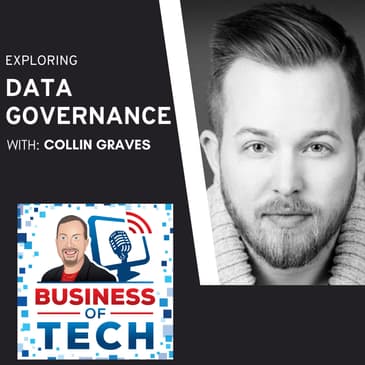
Host Dave Sobel sits down with Collin Graves, CEO of North Labs, to delve into the critical realm of data governance and analytics. Northlabs has positioned itself as a data operations partner, akin to a data Managed Service Provider (MSP), helping organizations design, implement, and operate their data capabilities. Collin explains that their approach encompasses a wide range of data projects, including internal and customer-facing analytics, Internet of Things (IoT) solutions, automation, and machine learning, all aimed at accelerating an organization's data capabilities through a structured methodology.
Collin outlines the three primary phases of Northlabs' project lifecycle: implement, operate, and innovate. The implementation phase focuses on assessing the current state of an organization’s data and identifying the initial business problems to solve. Collin emphasizes the importance of starting with a minimalist data infrastructure to build a solid foundation, akin to pouring concrete for a house. The second phase, operate, involves aligning people and processes with technology to ensure that teams are comfortable using data in their decision-making. Finally, the innovate phase allows organizations to explore advanced analytics capabilities, such as machine learning, once the foundational elements are in place.
A significant aspect of their discussion revolves around data governance, which Collin identifies as a crucial component of building trust in data systems. He highlights that many organizations overlook this area, often skipping it in favor of more immediate solutions. Collin stresses that effective data governance is not just about ensuring data quality at a single point in time but about creating mechanisms that maintain data integrity over the long term. Without this trust, organizations risk reverting to outdated methods, such as relying on cumbersome Excel spreadsheets, which undermines the entire data initiative.
As the conversation shifts towards the role of artificial intelligence (AI) in data analytics, Collin agrees with Dave's premise that solid data groundwork is essential for successful AI implementation. He likens the current AI landscape to the early days of cloud adoption, where organizations rushed to adopt new technologies without a solid foundation. Collin believes that organizations must focus on building a robust data infrastructure before fully leveraging AI capabilities. He also discusses the potential of generative AI to transform reporting and analytics, enabling users to query data in natural language and receive actionable insights without needing to become BI experts. This evolution in data interaction represents a significant opportunity for organizations to enhance their decision-making processes.
About Business of Tech: The daily MSP news and analysis podcast for managed service providers and IT services leaders. Host Dave Sobel covers AI for MSPs, MSP pricing and profitability, MSP M&A and private equity, vendor partner programs, MSP cybersecurity and liability, and MSP operations — and answers the question every story raises: Why do we care? Produced by MSP Radio.
💼 All Our Sponsors
MSP Radio is supported by our partners:
ABC Solutions · CometBackup · Firetail · Guardz · HaloPSA · LogMeIn · Mailprotector · Pax8 · Rythmz · ScalePad · TimeZest · Transit AI
Supporting the IT services community through insights, analysis, and transparency.
🚀 Join Business of Tech Plus
Get exclusive access to investigative reports, vendor analysis, leadership briefings, and more.
👉 https://businessof.tech/plus
🎧 Subscribe to the Business of Tech
Want the show on your favorite podcast app or prefer the written versions of each story?
📲 https://www.businessof.tech/subscribe
📰 Story Links & Sources
Looking for the links from today’s stories?
Every episode script — with full source links — is posted at:
🎙 Want to Be a Guest?
Pitch your story or appear on Business of Tech: Daily MSP News & IT Services Analysis
💬 https://www.podmatch.com/hostdetailpreview/businessoftech
🔗 Follow Business of Tech
LinkedIn: https://www.linkedin.com/company/28908079
YouTube: https://youtube.com/mspradio
Bluesky: https://bsky.app/profile/businessof.tech
Instagram: https://www.instagram.com/mspradio
TikTok: https://www.tiktok.com/@businessoftech
Facebook: https://www.facebook.com/mspradionews
Hosted by Simplecast, an AdsWizz company. See pcm.adswizz.com for information about our collection and use of personal data for advertising.
[00:00:02] Well, we have been talking a lot of data and data governance. I think it's a key area of opportunity. And I had the opportunity to sit down with someone who focuses entirely on data and in fact, pivoted his organization to do that. Collin Graves joins me today on this bonus episode of the Business of Tech.
[00:00:22] Collin Graves Well, Collin, thanks for joining me today.
[00:00:24] Collin Graves It's a pleasure to be here, Dave.
[00:00:26] Collin Graves So I want to talk first off a little bit about what North Labs does to understand because you came to my attention because you guys specialize in the business of tech.
[00:00:33] Collin Graves Tell me what North Labs does so that I can guide, you know, we'll go from there about data. But I want to hear about what you guys have been up to.
[00:00:40] Dave Kuntz Absolutely. Yeah. So if I know your audience is primarily focused toward the MSP model, think of us like a data operations partner, almost a data MSP. So we help organizations design, implement, and operate their data capabilities, whether that's internal analytics, customer facing analytics,
[00:01:02] internet of things, internet of things, automation, machine learning, the list goes on and on. So really, it's about providing an entire program to organizations as opposed to just singular resources who sort of build to the best of their abilities. We have a very repeatable methodology we follow to help organizations accelerate their data capabilities.
[00:01:27] Dave Kuntz Now, obviously, you're not going to give me a secret sauce, but give me a sense of what that looks like working with customers. I would think it's got some elements of data governance and probably a lot of auditing and assessment. Like, kind of walk me through what that looks like.
[00:01:40] Dave Kuntz Yeah, there's three primary phases. I mean, you hit the nail on the head. A lot of folks come to you and just say, well, if I just had BI capabilities, all of my problems would be solved. And they're not thinking about how that's really the tip of the iceberg required in building a repeatable program that continues to deliver value. So we have three core phases of our implementation, or I guess our project lifecycle.
[00:02:06] Dave Kuntz The first is implement. And that's sort of what you alluded to. We're assessing where you are. We're identifying the business value or the business problem that needs to be initially solved with data. Everybody kind of understands where they want the last domino to fall. It's complete utopia. Everything's automated. My data is super clean and trustworthy and everyone raves about it.
[00:02:30] Dave Kuntz They don't really understand the first domino to flick over to cause that chain reaction to happen. And so we're standing up typically minimalist data infrastructure at first. We don't try and overbuild because let's face it, we're in the cloud. The cloud is very flexible. It's very nimble.
[00:02:50] Dave Kuntz If somebody wants to eventually have a Formula One car, that's great. Maybe they can start with a scooter and build that muscle memory from there, get through that change management process.
[00:03:03] Dave Kuntz So the implementation is really, let's create the structure and the foundation of the house. And you'll hear me reference that probably several times on this call. My team is completely sick of it.
[00:03:15] Dave Kuntz But it's an analogy that I think about all the time is when I'm building a home, regardless of the square footage, the number of rooms, how many stories it has, the most critical element is making sure that concrete is poured and that rebar is laid so it can support the weight of the home for the long haul. So that's really phase one. Phase two gets into operate, which is how do we get the people and the process to align with the technology?
[00:03:45] Dave Kuntz Harkening back to that golden triangle of MBA lore, people process technology. Really getting people used to utilizing this information, using it in their decision making, and opening up new opportunities to expand their data capabilities. And then the third is innovate. A lot of organizations come to us saying, I want to leverage machine learning or generative AI or forecasting, whatever the case may be.
[00:04:13] Dave Kuntz Harkening back to that.
[00:04:17] Dave Kuntz Harkening back to that.
[00:04:29] Dave Kuntz Harkening back to that.
[00:04:42] Dave Kuntz Harkening back to that.
[00:04:51] Dave Kuntz Harkening back to that.
[00:05:07] Dave Kuntz Harkening back to that.
[00:05:09] How much of this is about like putting together that policy and having ways of managing it?
[00:05:14] Like, what does that look like from a data governance?
[00:05:16] And how much is it data governance?
[00:05:18] Data governance is a huge piece, but it's often it.
[00:05:21] Let's face it, Dave, right?
[00:05:22] Maybe the folks who are listening to this get really excited about data governance because
[00:05:27] they're IT professionals.
[00:05:28] Customers don't get super excited about data governance and left to their own devices.
[00:05:34] Oftentimes, that chapter of the book gets skipped, right?
[00:05:37] We want to sort of let's skip ahead to chapter seven.
[00:05:40] Oh, who's this character?
[00:05:41] I've never even heard of them.
[00:05:42] And why did he just die?
[00:05:44] There must have been something I missed.
[00:05:46] The data governance piece, right?
[00:05:48] If you talk about account structures, if you talk about the flow of data within those systems,
[00:05:55] and if you talk about the access controls, really, it's about solidifying the data quality
[00:06:02] within an organization.
[00:06:03] And when most people hear the term data quality, they think, okay, does this field in this database
[00:06:09] say the right thing?
[00:06:11] That's a correct assumption about what data quality or data governance is.
[00:06:16] But really, it's about how do I create a mechanism that causes this data to be updated and trustworthy
[00:06:24] over time?
[00:06:25] Because when you're implementing data capabilities, you really have one shot, which is why we like
[00:06:32] to start with that crawling as opposed to running.
[00:06:36] Because customers have their way of doing things, sometimes outdated, sometimes very inefficient.
[00:06:42] But the worst thing that can happen is you implement new systems and the governance and the controls
[00:06:49] and the quality aren't up to snuff.
[00:06:52] And Dave takes a look and he goes, yeah, I don't trust it.
[00:06:55] I'm going to go back to using this 17 gigabyte Excel spreadsheet I have stored locally on my computer
[00:07:02] and you're not going to convince me otherwise.
[00:07:05] The mission has failed at that point.
[00:07:07] So data governance is a core tenant of creating that trust within these systems.
[00:07:16] And that's what we talk about a ton at North Labs is if you don't have trust or if you lose trust
[00:07:23] within your data program, you might as well scrap it.
[00:07:26] It's over.
[00:07:26] Okay.
[00:07:26] Because it's going to be really hard for people to come back.
[00:07:29] Interesting.
[00:07:30] Now, the other dynamic that I would think is really important here is we talk about data quality
[00:07:35] and getting to a level of, we use phrases like funliness and organization.
[00:07:40] That feels like an unattainable goal, right?
[00:07:44] The idea of having perfect data is probably unattainable.
[00:07:50] And by the way, even if we manage to get there for one fleeting moment, the moment users do anything,
[00:07:57] there's probably, it's no longer perfect.
[00:08:00] Like, how much do we, should we think about this in terms of perfection?
[00:08:05] But what, and like, how do we think about where we're actually trying to get to from a data
[00:08:11] cleanliness?
[00:08:12] And I'm putting that in air quotes, you know, for listeners.
[00:08:15] It's a great question.
[00:08:16] And something I get asked about a lot.
[00:08:18] The thought by a lot of people is, well, I can't have a data program until my data
[00:08:26] cleanliness is achieved.
[00:08:27] That is an impossible goal, like you talked about.
[00:08:32] If you think about an average manufacturing organization, for example, we work a lot in
[00:08:37] asset intensive industries.
[00:08:39] So manufacturing, industrial, supply chain, oil and gas, et cetera.
[00:08:43] The average number of systems in an average company over the last eight years has nearly
[00:08:52] doubled from right around 60 or 65 to more than 130 systems.
[00:08:58] 130 systems.
[00:09:00] And we think that it's a plausible goal to go ahead and make all of those systems clean.
[00:09:07] Never going to happen.
[00:09:09] The way that I suggest doing things is even if you do have 130 systems, God bless you.
[00:09:15] There are probably two or three that are the nucleus of your organization, your ERP, your
[00:09:22] CRM, your manufacturing execution system, your invoicing and accounting and financial systems,
[00:09:29] whatever that might be.
[00:09:31] If you start with those, even in an imperfect state, the nice thing is while you're taking
[00:09:37] that crawl approach, it can almost serve as a litmus test for those internal systems.
[00:09:45] Before it's rolled out to the entire organization, you can get to cooking a little bit, look at
[00:09:52] the data that gets output by these data capabilities and go, that doesn't smell quite right.
[00:09:57] Seems like there's a little bit of drift.
[00:09:58] Now we have a pointed area to attack within our core systems from a data management and
[00:10:06] data cleanliness perspective.
[00:10:09] And we can go and that becomes a much easier conversation.
[00:10:13] Okay, this subset of this system isn't quite right.
[00:10:18] Let's put some time and attention into that, get it up to snuff, and then we'll put alerts
[00:10:25] or guardrails in place in the future.
[00:10:27] So if there is drift, we're informed about it and can do something about it.
[00:10:34] But that's really the, I guess, the core push that we make within customer accounts is like,
[00:10:41] if you think that you're going to have 130 pristine systems or 15 pristine systems, you're
[00:10:49] out of your skull.
[00:10:50] But if you need clean areas of certain systems, now that becomes a lot smaller bite of the
[00:10:56] elephant.
[00:10:57] Gotcha.
[00:10:58] Okay, that's a good way of framing it.
[00:10:59] So we've managed to go like 10 more than 10 minutes without mentioning AI.
[00:11:04] So kudos to us for getting there.
[00:11:06] Yes.
[00:11:06] But I want to, but I need to introduce it because I want, I want you to react to a premise
[00:11:10] and give me a sense of where my thinking is right or wrong.
[00:11:14] So it's been my working premise is, as we look at organizations considering the way they're
[00:11:20] going to use AI and roll it out, that doing the data work is a prerequisite for success
[00:11:28] with AI.
[00:11:29] That if as an organization, you spend your time, again, not focusing on perfection, but having
[00:11:36] the systems and processes that you've just talked about in place, you will end up in
[00:11:40] a place of much higher ROI and better outcomes in your AI projects.
[00:11:48] React to that premise for me.
[00:11:50] I think you're spot on.
[00:11:52] And unfortunately, it's a bit contrary, your thought as to what the marketplace, what we
[00:12:00] hear from the marketplace today.
[00:12:01] There are two factors here for us to consider, and this goes back to building the foundation
[00:12:06] of the house I've talked about.
[00:12:08] Gen AI right now, or AI in general, is that second story game room that you've always wanted.
[00:12:14] And now you're building a house and you can finally get it.
[00:12:17] You can build that room to the nines, but if you build it on top of the sod in your backyard,
[00:12:24] are you actually ever really going to be able to experience the value it brings to you?
[00:12:28] The answer is no, or maybe for a few hours before the house collapses.
[00:12:33] Now we've got other problems.
[00:12:34] So there are really two elements in play that I'm seeing with Gen AI.
[00:12:39] First of all, for clarification, I think it's a game changer.
[00:12:43] I absolutely do.
[00:12:44] But we're going to see two core factors in play over the next five years.
[00:12:49] The first is the sort of hype cycle, same as we saw with the cloud.
[00:12:54] You'll remember, I'm an old greyhound at this track.
[00:12:58] I remember the rush to cloud in 2010, 2012, as I'm sure you do, where people said,
[00:13:04] I don't care the state.
[00:13:05] I don't care the underlying technology.
[00:13:08] Just move it to the cloud.
[00:13:09] And that was a mistake.
[00:13:11] And it took people a while to sort of claw that back and go, okay, we weren't ready.
[00:13:18] The second piece is everyone and their aunt right now claims to be Gen AI capable.
[00:13:25] And I know that your audience is, there's a lot of Microsoft presence.
[00:13:30] So you see the advent of tools like Copilot coming into existence.
[00:13:36] Copilot is amazing.
[00:13:37] But you can't base your strategic initiatives just on Copilot because all you're doing is
[00:13:46] assembling a silo for that Gen AI.
[00:13:49] If we're talking about organization-wide strategy for Gen AI as being the factor of acceleration
[00:13:57] or the factor of growth for organizations over the next decade, that foundation of the house
[00:14:03] has to be solid.
[00:14:04] Otherwise, you're going to have competing Gen AI systems in place across Copilot and across
[00:14:11] your CRM's fancy features and your accounting system's fancy features, none of which share
[00:14:19] common context, none of which share common playbooks or runbooks or standard operating procedures.
[00:14:25] And so you're going to run the risk of different systems telling you different things.
[00:14:31] And that's a huge problem because that doesn't happen in the human realm today.
[00:14:37] Maybe a little bit, but you can address it.
[00:14:39] Hey, Dave, this is the way we do things over here, right?
[00:14:42] That foundation of the house, building that core large language model that belongs to your
[00:14:48] organization is going to be key.
[00:14:51] So I think we're going to continue to see acceleration toward the Copilots and some of these done-for-you
[00:14:57] ready-made systems.
[00:14:58] I do think there's a bit of a ceiling for people to bonk their heads against.
[00:15:04] And they'll sort of take a step back and go, okay, how do we make sure that we're solid
[00:15:09] in our foundational base and then really start attacking core strategic initiatives?
[00:15:16] It's the same thing for building analytics capabilities.
[00:15:19] It all ties back to that structure, that foundation.
[00:15:25] Interesting.
[00:15:25] The other thing that I get a sense of, and you're an analytics guy, so I'd like to get
[00:15:29] a sense of this, is I've been thinking a lot about the idea of solving the reporting.
[00:15:35] What I mean by this is oftentimes reporting systems fall into one of two camps, right?
[00:15:40] Either you produce a whole bunch of pre-canned reports for customers that give them supposedly
[00:15:46] 80% of what they're looking for and they're good and then always get mad about it.
[00:15:51] Or you end up trying to build a report builder and you give them infinite capacity for report
[00:15:57] building.
[00:15:58] Again, 80% of the time the customer won't actually use it and it's too complicated and then you
[00:16:04] end up trying to build a report builder or you bolt our BI on this.
[00:16:07] It feels like one of the biggest data applications of generative AI will be the ability to just
[00:16:14] simply ask the data set for information and get it back.
[00:16:19] Is that a fair assessment and are customers seeing that now in the field?
[00:16:24] That is unequivocally.
[00:16:27] Other than documentation building and other middle of the fairway use cases for Gen AI, what
[00:16:35] you just described, that natural language querying is absolutely the number one use case we're
[00:16:43] seeing with customers.
[00:16:44] This idea that, okay, foundation is bored.
[00:16:47] This large language model understands how my data is related.
[00:16:52] And now, you know, we've been talking about this idea of self-service analytics for 10 dang
[00:16:58] years now and everyone said, well, self-service analytics means you can build reports.
[00:17:04] That's not what it means, Dave, because your tier three user in procurement doesn't want to become
[00:17:11] a BI developer, doesn't want to drag and drop dashboard elements into a fancy visual for herself.
[00:17:20] She wants to say, I don't see this question answered anywhere and it would really help me with my job.
[00:17:28] Can I have almost like a Google search interface of my data that can return to me natural language
[00:17:35] answers that can return to me pre-built dashboards that I can then say, yep, save this for later because
[00:17:42] I'm going to need it.
[00:17:43] And can it add in a bit of forecasting element into that question, right?
[00:17:50] Accounts receivable over the last 12 months.
[00:17:53] Cool.
[00:17:53] Here's what it looks like today.
[00:17:55] Here's what the data predicts it will look like 90 days from now.
[00:17:59] That's a game changer for business users who don't want to or don't have the time to become
[00:18:07] BI experts.
[00:18:08] No one has time for that.
[00:18:10] Yeah, nobody wants to, but we've just identified the key opportunity here that I think we'll
[00:18:15] all be exploring.
[00:18:16] Colin Graves is the CEO of North Labs, a leading cloud data analytics firm that's helped over
[00:18:21] a thousand companies enhance their data strategies.
[00:18:24] With a background in NATO special operations, Colin combines elite military leadership with
[00:18:29] innovative data security and analytics expertise, empowering organizations to navigate the complexities
[00:18:34] today's digital landscape.
[00:18:36] Colin, this has been fascinating.
[00:18:37] I appreciate you joining me today.
[00:18:38] Such a pleasure, Dave.
[00:18:40] Really appreciate it.
[00:18:42] Looking to reach an audience of thousands of MSPs and IT service providers?
[00:18:47] Put your ad right here on the business of tech and be on the show that 64% of MSPs report
[00:18:54] having listened to.
[00:18:55] A recurring top 50 tech news podcast.
[00:18:58] There are affordable options for you to reach our audience and we can support any budget.
[00:19:03] Podcast listeners are more engaged, have a higher level of brand retention and are more willing
[00:19:10] to listen to ads here than any other avenues.
[00:19:14] Want to know more?
[00:19:15] There's information at MSP radio.com slash engage, including a button to book a time to talk.
[00:19:22] I'm looking forward to that discussion.
[00:19:28] The business of tech is written and produced by me, Dave Sobel under ethics guidelines posted at
[00:19:34] business of dot tech.
[00:19:35] If you like the content, please make sure to hit that like button and follow or subscribe.
[00:19:40] It's free and easy and the best way to support the show and help us grow.
[00:19:45] You can also check out our Patreon where you can join the business of tech community at
[00:19:50] patreon.com slash MSP radio or buy our why do we care merch at business of dot tech.
[00:19:58] Finally, if you're interested in advertising on the show, visit MSP radio dot com slash engage.
[00:20:05] Once again, thanks for listening to me.
[00:20:08] I will talk to you again on our next episode of the business of tech.
[00:20:14] Part of the MSP radio network.