
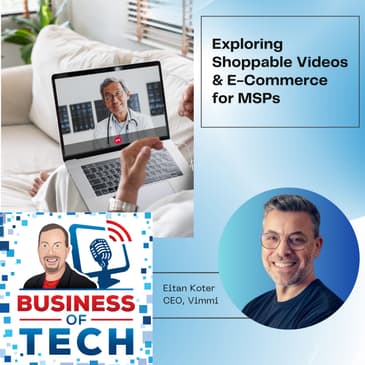
In this episode of The Business of Tech, host Dave Sobel engages in a thought-provoking discussion with Eitan Koter, CEO of Vimmi, about the evolving landscape of e-commerce and the rise of shoppable video. Koder emphasizes the necessity for managed services providers and IT services companies to adapt to the changing market by integrating e-commerce solutions that allow customers to purchase directly online. He highlights the growing trend of social commerce, driven by platforms like TikTok, which is reshaping how consumers interact with brands and make purchasing decisions.
Koter explains that shoppable videos are designed to facilitate impulse purchases by embedding buy buttons directly within video content. This innovative approach not only enhances the shopping experience but also addresses the challenges businesses face in acquiring new customers amid rising advertising costs. By leveraging social media platforms where consumers spend significant time, brands can effectively showcase their products and drive conversions through engaging video content.
The conversation also delves into the application of shoppable videos in the B2B sector. Koter notes that while B2B transactions often involve longer sales cycles, video can play a crucial role in guiding potential buyers through the decision-making process. He points out that many B2B purchases are now happening online, and integrating video content with interactive elements can streamline the buying experience, making it easier for decision-makers to engage with products and services.
As the episode concludes, Koter reflects on the generational shifts in purchasing behavior, emphasizing that the current landscape is influenced more by competition and technological advancements than by age demographics. He encourages businesses to embrace authenticity and emotional connections in their marketing strategies, suggesting that a deeper understanding of customer sentiments can lead to more effective engagement. This episode offers valuable insights for businesses looking to navigate the future of e-commerce and enhance their sales strategies through innovative video content.
About Business of Tech: The daily MSP news and analysis podcast for managed service providers and IT services leaders. Host Dave Sobel covers AI for MSPs, MSP pricing and profitability, MSP M&A and private equity, vendor partner programs, MSP cybersecurity and liability, and MSP operations — and answers the question every story raises: Why do we care? Produced by MSP Radio.
💼 All Our Sponsors
MSP Radio is supported by our partners:
ABC Solutions · CometBackup · Firetail · Guardz · HaloPSA · LogMeIn · Mailprotector · Pax8 · Rythmz · ScalePad · TimeZest · Transit AI
Supporting the IT services community through insights, analysis, and transparency.
🚀 Join Business of Tech Plus
Get exclusive access to investigative reports, vendor analysis, leadership briefings, and more.
👉 https://businessof.tech/plus
🎧 Subscribe to the Business of Tech
Want the show on your favorite podcast app or prefer the written versions of each story?
📲 https://www.businessof.tech/subscribe
📰 Story Links & Sources
Looking for the links from today’s stories?
Every episode script — with full source links — is posted at:
🎙 Want to Be a Guest?
Pitch your story or appear on Business of Tech: Daily MSP News & IT Services Analysis
💬 https://www.podmatch.com/hostdetailpreview/businessoftech
🔗 Follow Business of Tech
LinkedIn: https://www.linkedin.com/company/28908079
YouTube: https://youtube.com/mspradio
Bluesky: https://bsky.app/profile/businessof.tech
Instagram: https://www.instagram.com/mspradio
TikTok: https://www.tiktok.com/@businessoftech
Facebook: https://www.facebook.com/mspradionews
Hosted by Simplecast, an AdsWizz company. See pcm.adswizz.com for information about our collection and use of personal data for advertising.
[00:00:02] I think e-commerce is a must-have for managed services providers and IT services companies to sell online. I think your customers need to be able to buy from you directly. And I think now it's video enhanced. So let's talk to somebody who specializes in that. Eitan Koter joins me. He is the CEO of Vimy and they focus on solutions for video to help drive sales on this bonus episode of the Business of Tech.
[00:00:30] Today's episode is supported by Huntress. You want to focus on your clients and are always looking for ways to get more time. Use Huntress' fully managed cybersecurity platform to fight off cyber threats. Huntress is more than cybersecurity software for endpoints and identities. It's a 24 by 7 security operations center. It's security awareness training, community engagement, and dedicated partner support with an average CSAT score of 99.3% of the data.
[00:01:00] Technology can only get you so far. Human expertise is what's needed to truly elevate and protect small businesses. And you get that with Huntress. Secure your clients and help them thrive with the number one rated EDR for S&Bs on G2. Visit Huntress.com slash MSP radio to find out more.
[00:01:23] Eitan Koter.com slash MSP radio to find out more.
[00:01:44] Great. So, I mean, I always like to discuss about what is the mega trend that is happening and how technology is helping to support it. So, the big trend is that online businesses are having a lot of difficulties these days to acquire new customers to their own website.
[00:02:01] They're amazing brand.com, right? Cost of advertising is soaring on Facebook and Instagram, obviously Amazon. And so, it's very, very difficult to acquire new customers.
[00:02:13] And what's the solution for them is what is known also, and this is the biggest trend is social commerce, right? So, social commerce is going to explode. It's going to like double in the next few years.
[00:02:26] It's going to be like, I mean, it's projected that 2030 social commerce is $6.2 trillion, right? Worldwide. It's massive. And online businesses, primarily brands, retailers are happy to share revenues with TikTok and with Instagram and Facebook with other partners in order to position their products and their offerings where shoppers are spending most of their time on social media networks, right?
[00:02:51] So, and this is obviously triggered quite aggressively by TikTok in the US and TikTok shops specifically. We have the TikTokification effect, right? This endless scrolling kind of effect. And so, think about it. You scroll on your feed and it can be TikTok, Instagram Reads or YouTube Shorts.
[00:03:09] And from that to time, it can be an organic video, not promoted, not sponsored. Some seller or a host promoting a specific product. That video can be a live event, what we call a live shopping event, or it can be a pre-recorded event, pre-edited event, a video that has been there to describe some kind of a product, functionalities, pricing,
[00:03:36] with the primary idea, not to get attention or awareness to a brand, but to create conversion.
[00:03:43] So, we talk about that last step of the buying cycle where people like to have that impulse purchase type of experience. So, you see video, you like the product, maybe it resonates something you thought about purchasing. There is a buy now button on that video player.
[00:04:00] And that video player can be on social media, but also on the customer website. And when you click on this buy now, you redirect it to a checkout page to immediately check out and purchase this product.
[00:04:11] So, that's the whole idea of shoppable videos, making videos shoppable, enable those checkout experiences within the video experience itself.
[00:04:20] Okay. Now, I get it. Makes perfect sense to me, but it sounds very consumed, right? And particularly because most people will immediately think TikTok and they're thinking, you know, the immediate reaction is, oh, it's teenagers. Oh, and by the way, that's consumed.
[00:04:34] There's got to be some thinking about the way this works in particularly B2B sales. Can you give me some insights into the way this is being applied for businesses trying to sell to other businesses?
[00:04:44] Of course. So, it definitely applies to D2C, but also to B2B. Think about the way that people are consuming on the B2B side.
[00:04:53] Like, there is one type of transaction, which is kind of a longer term, three to six months, probably like a committee procurement type of thing.
[00:05:02] And the idea is to provide a lot of value using video in the various steps of the sales cycle.
[00:05:08] And at the last part, trying to use video, like video calls or video conference calls and integrate those interactive buttons, right, inside those video players just to enable checkout.
[00:05:20] On a B2B, a lot of the purchases are also happening online.
[00:05:24] Like, if you're buying a SaaS kind of a solution, it's a B2B transaction.
[00:05:27] So, like on the lower end, these long tail solutions, up to $100 a month or even $1,000 a month, it's one person that has a budget, probably it's on the IT side, operation, R&D, whatever.
[00:05:39] And they need some kind of a technology or a platform.
[00:05:41] They do their research.
[00:05:43] They find what they do.
[00:05:44] And suddenly they see a video, right, inside, for example, YouTube, showcasing a new functionality of that SaaS platform.
[00:05:52] And then they say, okay, if you buy now in the next five minutes, we'll give you additional 10% discount.
[00:05:58] For example, just buy now.
[00:05:59] So, like in YouTube and in TikTok and in Instagram and Facebook, obviously in Pinterest and Twitch and all the platforms, there is the ability to integrate those links with a coupon code or redirect to where you want them to be redirected to.
[00:06:13] So, you click on the video.
[00:06:14] You've been redirected to a landing page.
[00:06:17] That landing page is the product page itself where you can execute the complete checkout.
[00:06:22] We know the share of transaction on the B2B side, which are happening online, is absolutely soaring, right?
[00:06:29] I don't know exactly at the top of my head the percentage of the total B2B transaction.
[00:06:34] But according to any report, it's going to hit like 70%, 80% of all B2B transactions are going to be online.
[00:06:41] So, how do you entice?
[00:06:42] How do you convince those committees?
[00:06:44] How do you move them in the sales funnel?
[00:06:47] Just another step forward.
[00:06:48] Video is a very, very powerful way to do that.
[00:06:51] And that video that actually triggers action, that is kind of an interactive video, which is the future of e-commerce and those online transactions.
[00:06:59] Now, I'm going to say, like, I'm a big believer in what you're talking about.
[00:07:02] And I think the future of services sales is e-commerce.
[00:07:06] But I think I'm probably in the minority for our community and managed services who's talking this way.
[00:07:12] Most of us will give me objections like, this is a very consultative sale.
[00:07:16] This is a very personalized sale.
[00:07:18] I need to talk with them.
[00:07:20] We customize everything.
[00:07:21] Give me your sense of the way sales, particularly when we're talking about prices that go above that, you know, $2,000, $3,000, $4,000 a month in services.
[00:07:33] Like, how do you think that works in an e-commerce style engagement?
[00:07:38] Yes, that's an excellent question.
[00:07:40] And I always like to say that, you know, I started in sale.
[00:07:44] I've been doing this for 25 years.
[00:07:45] You know, those B2B sales.
[00:07:47] You need to meet the customer 10 times.
[00:07:49] And I've been doing this all over the world in a variety of companies, big ones and startups and also NASDAQ traded company that I manage.
[00:07:56] So what we see now is a complete, like, very radical and fast change in the way purchasing teams and executives are researching for information and buying services, products, and digital products, you know, physical and digital products.
[00:08:14] According to the latest reports that I saw, 85% of the sales process is done by the buyers without even talking to any of the suppliers.
[00:08:25] Right?
[00:08:25] 85% of them.
[00:08:27] Okay.
[00:08:27] So how they select?
[00:08:29] They talk to their community, to their friends, trying to shortlist a few relevant providers.
[00:08:34] There is so much information out there so they can make small decisions, not waste time on Zoom calls, which is, like, totally different than, like, two decades ago.
[00:08:44] Right?
[00:08:44] Anything moved by the sales representative.
[00:08:47] Right?
[00:08:48] So 85% of our process is done by the buyers themselves.
[00:08:52] They do their own research.
[00:08:54] Maybe they go online, open, do more research.
[00:08:57] Like, there are so many platforms today to find out and get some references about different providers.
[00:09:04] And then they make a decision probably to talk to one or two of those suppliers.
[00:09:09] And there is a 95%, according to the report, 95% probability that the first provider that that buyer reach out to, they're going to close business and do the business together.
[00:09:23] Right?
[00:09:23] Right?
[00:09:23] So the whole sales cycle has completely changed.
[00:09:27] The way that, you know, those sellers who told you it's consultative, we need to provide information, do that on the marketing side with content production and just put content out there online.
[00:09:40] Buyers know how to find it and make sure that you are ready when they reach out to you just to fine tune your proposals because they've done most of the work and they probably have a few last questions.
[00:09:52] So the whole sales cycle has completely changed.
[00:09:54] We see this also in like big, large transactions.
[00:09:57] Of course, RFPs are a completely different process.
[00:09:59] But talking to all these ongoing purchases that are just completely changed, it's mostly content driven and just, you know, hitting or discussing with the buyers in the very, very, very last step of the buying cycle.
[00:10:15] Is this generational?
[00:10:17] Is this generational?
[00:10:17] Like, talk to me about what's happening because it's, is it due to the digital native nature of new business owners?
[00:10:23] Is this something we only see in, say, Gen Z or millennial buyers or even like, you know, give me a little sense of what's going on when you think about it from the perspective of generation.
[00:10:35] So, yes.
[00:10:36] So I want to talk also about generation.
[00:10:39] But before that, I don't think it's related to generation.
[00:10:42] It's related to over competition, like in almost every category, mostly driven by AI.
[00:10:49] It's much less costly, both from dollar point of view, but also from time to launch new services, new products and new solutions.
[00:10:59] So you'll find a lot of alternatives out there.
[00:11:02] And there is no time for the buyer just to talk to all of them.
[00:11:05] Right.
[00:11:06] We used to have like when we, you know, like two decades ago, even one decade ago, you launched a product.
[00:11:12] That product could sustain two or three years of solid, good.
[00:11:17] We called it cash cow, say, right?
[00:11:19] Remember that?
[00:11:20] There is no cash cows today because every new product is just, you need to replace it every six months because it's getting outdated.
[00:11:27] There is a new alternatives out there, cheaper, faster, smarter.
[00:11:31] So you need to move fast, be agile, continuously innovate.
[00:11:34] So this is what happened in terms of the way that competitive scenarios are being structured these days and are very, very complex.
[00:11:44] It's not the features or winning the business.
[00:11:47] It's probably the relationship building, the way you innovate the product, price the product.
[00:11:53] It's like there are very, very specific parameters.
[00:11:56] In terms of the generations, yes, Gen Zs are becoming very, very active, both on direct to consumers, but also on B2B.
[00:12:04] They are very close to be like third of D2C total purchasing power already.
[00:12:10] Okay.
[00:12:10] And also they are very strong.
[00:12:12] I think 50% on the B2B committees already have these type of Gen Zs.
[00:12:19] And they, again, they don't like, you know, the overproduced marketing collaterals.
[00:12:26] And they are like very focused straight to the point.
[00:12:29] They don't have a lot of time and it's a new way of working with them.
[00:12:33] I know a lot of people in our generation that feel like dinosaurs, right?
[00:12:39] Talking the new language of how business transactions are being performed these days.
[00:12:44] And it will continue to get more and more focused on this type of this transaction.
[00:12:52] Gen Z is going to be very, very powerful in the future of purchasing, of course.
[00:12:57] Now, many of the providers that I look at, I go to their websites on a very regular basis.
[00:13:02] And they're very much that classic OTS website, right?
[00:13:05] Very simple, couple of pages, contact us page.
[00:13:09] Talk me through like what you think an ideal B2B services website would contain to enable all of this capability.
[00:13:20] Yeah, so it's the million dollar question, right?
[00:13:23] And I always say, you know, it's better to be different than to be better.
[00:13:30] It's anyone is, any provider has its own strength and weaknesses, obviously, right?
[00:13:36] And there are such a minor differences between various providers.
[00:13:41] And it's sometimes very, very difficult to select what's working or what's not.
[00:13:45] I think for any company, also in the same IT services kind of managed services, let's say type of solutions,
[00:13:54] they are serving the same customer type.
[00:13:56] They are providing the same solutions and services.
[00:14:02] But customer sentiments to each one of those companies is totally different.
[00:14:06] I'm talking about the psychological level, the emotional level, right?
[00:14:10] A lot of companies don't know why customers are buying from them, right?
[00:14:15] They don't know.
[00:14:16] They will give you like the very easiest, yeah, the proposal was amazing.
[00:14:19] I've included another 5%.
[00:14:20] It's not that, right?
[00:14:22] There are like hidden agendas that there's the unofficial layer, which is on the emotional layer that they need to figure out and understand.
[00:14:30] This is like very fundamental.
[00:14:32] So you can do this through surveys.
[00:14:33] You can do it through questioning.
[00:14:35] You can do it through, you know, analyzing your customer support tickets, ticketing system or whatever other areas of analytics that you can just gather and try to figure out first what's the sentiment, what people think about your organization.
[00:14:50] Once you have these highlights, then you need to put it forward in the website itself.
[00:14:55] I think that websites are saying, hey, we are the best in this and we have, you know, 24-7 and our managed services software is such amazing.
[00:15:05] We troubleshoot within and we have these 9.99, you know, 5.9s.
[00:15:10] And I don't think this makes any sense, right?
[00:15:12] This was very, very good probably 10, 15 years ago.
[00:15:16] Today, I think be bold in your marketing.
[00:15:20] Don't be afraid to be bold in the way you describe what you do.
[00:15:25] Again, once you understand that fundamental mode of what customers think about you and who you are, what's differentiating you?
[00:15:33] What's the founder's story?
[00:15:35] There is a lot of attention now on founder-led content and founder-led growth, executive-led content.
[00:15:42] Put your executive out there.
[00:15:44] Create content.
[00:15:45] Create video content, right?
[00:15:47] This is what we're here for.
[00:15:48] So all these things are like really, really differentiating.
[00:15:52] So you differentiate on a personal level.
[00:15:55] You know, marketing is moving from one-to-many to one-to-one.
[00:15:58] So we had like one-to-many, then communities, but the future of marketing is one-on-one.
[00:16:03] And there is a way to do that through technology and through analytics, through understanding what needs to be delivered.
[00:16:09] And what is the messaging that you are trying to use?
[00:16:13] So go deeper, go to the emotional level.
[00:16:16] Put your leaders out there.
[00:16:19] Okay.
[00:16:20] The role of an executive and of a CEO is also to create content and put himself in front of a camera.
[00:16:27] Yeah.
[00:16:28] And this should be part of a job description of any executive.
[00:16:32] It doesn't matter if he's engineering, customer support, sales, whatever.
[00:16:36] However, right, this creates like a really dramatic impact on customers.
[00:16:41] Think about a scenario that they see what's happening in the life of this company.
[00:16:44] So do executive sharing two videos, 30 seconds video, right, in a structured way.
[00:16:49] It's a huge different differentiator from your competition.
[00:16:53] So go there, differentiate both by these levels and authenticity wins, right?
[00:16:59] Be authentic.
[00:17:00] Go much, much deeper into those emotional connections.
[00:17:04] Be authentic.
[00:17:05] These are the things that are winning today in marketing.
[00:17:09] Iancoder is the co-founder and CEO of Vimy, a leading shoppable video SaaS platform that enhances e-commerce through interactive and engaging video content.
[00:17:18] With over two decades of experience in startups and public companies, including a NASDAQ IPO,
[00:17:23] Iancoder is a recognized expert in digital marketing, social commerce, and video commerce strategies.
[00:17:28] This has been fascinating.
[00:17:29] I think you've given people a lot to ponder and some next steps.
[00:17:32] Thanks for joining me today.
[00:17:33] If people are interested, how can they reach out for more?
[00:17:36] Yeah.
[00:17:36] So go to our website.
[00:17:37] It's vimy.net, V-I-M-M-I dot net.
[00:17:41] And I'm very active also on LinkedIn.
[00:17:43] I post daily.
[00:17:44] So again, follow me on LinkedIn.
[00:17:46] It's Eitan Kotter.
[00:17:47] It's E-I-T-A-N-K-O-T-E-R.
[00:17:51] Thank you, David.
[00:17:52] We'll catch you there.
[00:17:52] Thanks for joining me.
[00:17:53] Thank you so much.
[00:17:56] Looking to reach an audience of thousands of MSPs and IT service providers?
[00:18:01] Put your ad right here on The Business of Tech.
[00:18:04] And be on the show that 64% of MSPs report having listened to.
[00:18:09] A recurring top 50 tech news podcast.
[00:18:12] There are affordable options for you to reach our audience.
[00:18:16] And we can support any budget.
[00:18:18] Podcast listeners are more engaged, have a higher level of brand retention, and are more willing to listen to ads here than any other avenues.
[00:18:27] Want to know more?
[00:18:29] There's information at mspradio.com slash engage, including a button to book a time to talk.
[00:18:36] I'm looking forward to that discussion.
[00:18:41] The Business of Tech is written and produced by me, Dave Sobel, under ethics guidelines, posted at businessof.tech.
[00:18:49] If you like the content, please make sure to hit that like button and follow or subscribe.
[00:18:54] It's free and easy and the best way to support the show and help us grow.
[00:18:59] You can also check out our Patreon, where you can join the Business of Tech community at patreon.com slash mspradio.
[00:19:07] Or buy our Why Do We Care merch at businessof.tech.
[00:19:12] Finally, if you're interested in advertising on this show, visit mspradio.com slash engage.
[00:19:19] Once again, thanks for listening to me.
[00:19:21] And I will talk to you again on our next episode of The Business of Tech.
[00:19:28] Part of the MSP Radio Network.
[00:19:30] I'll talk to you again on our next episode of the Business of Tech.
[00:19:30] I was on our next episode of Business of Tech.
[00:19:31] Most of theango guys nhất don't see you again on our next episode of 2022.
[00:19:31] Maybe even at the bottom of the 스트�atroff at actions you and make sure you can subscribe to a new device other than what's going on here and when you see them.
[00:19:31] You can still you notice more money on the military training, even if you hear from different situations,
[00:19:32] just like this.
[00:19:32] Thank you.