
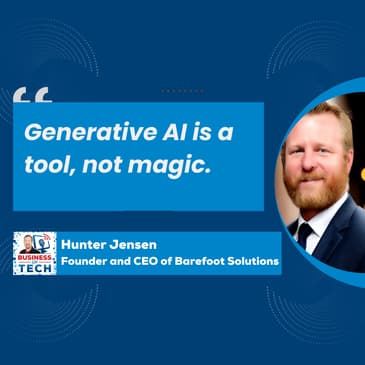
Hunter Jensen, the founder and CEO of Barefoot Solutions, discusses the evolving landscape of artificial intelligence (AI) and its practical applications in business. Barefoot Solutions, a custom software development firm, has been at the forefront of technology innovations for over 20 years, adapting to trends from web development to machine learning and generative AI. Jensen emphasizes the importance of understanding specific use cases for AI, particularly in enhancing employee productivity and streamlining workflows. He highlights that while generative AI is currently a hot topic, traditional machine learning applications remain powerful tools for businesses.
Jensen shares insights into how generative AI can transform existing information into various formats, making it particularly useful for tasks like document generation and data querying. He points out that many organizations struggle with outdated data systems and governance, which can hinder their ability to leverage AI effectively. By focusing on employee workflows and increasing efficiency, businesses can grow without necessarily hiring more staff, thus driving revenue and reducing costs.
The conversation also delves into the importance of data governance and preparation for organizations looking to implement AI solutions. Jensen stresses that foundational data work is crucial for successful AI deployment, as poor data quality can lead to ineffective outcomes. He advocates for a strategic approach to data access, ensuring that employees have the right tools and permissions to utilize AI effectively while maintaining data security.
Looking to the future, Jensen predicts a trend toward specialization among AI models, as companies seek to differentiate themselves in a competitive market. He believes that while the current landscape may seem saturated, the demand for specialized AI solutions will grow, leading to more tailored applications for various industries. As the technology continues to evolve, Jensen is optimistic about the potential for AI to drive significant advancements in business operations and decision-making.
About Business of Tech: The daily MSP news and analysis podcast for managed service providers and IT services leaders. Host Dave Sobel covers AI for MSPs, MSP pricing and profitability, MSP M&A and private equity, vendor partner programs, MSP cybersecurity and liability, and MSP operations — and answers the question every story raises: Why do we care? Produced by MSP Radio.
💼 All Our Sponsors
MSP Radio is supported by our partners:
ABC Solutions · CometBackup · Firetail · Guardz · HaloPSA · LogMeIn · Mailprotector · Pax8 · Rythmz · ScalePad · TimeZest · Transit AI
Supporting the IT services community through insights, analysis, and transparency.
🚀 Join Business of Tech Plus
Get exclusive access to investigative reports, vendor analysis, leadership briefings, and more.
👉 https://businessof.tech/plus
🎧 Subscribe to the Business of Tech
Want the show on your favorite podcast app or prefer the written versions of each story?
📲 https://www.businessof.tech/subscribe
📰 Story Links & Sources
Looking for the links from today’s stories?
Every episode script — with full source links — is posted at:
🎙 Want to Be a Guest?
Pitch your story or appear on Business of Tech: Daily MSP News & IT Services Analysis
💬 https://www.podmatch.com/hostdetailpreview/businessoftech
🔗 Follow Business of Tech
LinkedIn: https://www.linkedin.com/company/28908079
YouTube: https://youtube.com/mspradio
Bluesky: https://bsky.app/profile/businessof.tech
Instagram: https://www.instagram.com/mspradio
TikTok: https://www.tiktok.com/@businessoftech
Facebook: https://www.facebook.com/mspradionews
Hosted by Simplecast, an AdsWizz company. See pcm.adswizz.com for information about our collection and use of personal data for advertising.
[00:00:01] You know we're looking for ways to deploy with customers, so let's talk with a software development group that is actually delivering AI solutions right now. Hunter Jensen with Barefoot Solutions joins me on this bonus episode as we talk about various use cases, the way he finds opportunity, and where the preparation needs to be in this bonus episode of the Business of Tech.
[00:00:51] We'll see you next time. That's flexpoint.com slash MSP dash radio. Well, Hunter, welcome to the show. Thanks for having me, Dave. So let's start with the basics to give people who are listening a good sense of who Barefoot is.
[00:01:17] Tell me a little bit about the firm and where your size and what you're focusing on. Yeah, so Barefoot Solutions, we're a custom software development shop at our very core. You know, we've been at this for 20 years, so we've kind of ridden the wave of new technology innovations from web to mobile to IoT and med device and into blockchain and into machine learning and generative AI and all the rest of it.
[00:01:43] We're a little unique in that we're a smaller firm, kind of a boutique agency to a certain extent, but we're owned. We sold a controlling interest about five years ago to a very large consultancy with 1,500 engineers. So we've got massive horsepower through the collection of companies that we're a part of here at Barefoot. Oh, interesting. Okay, got it. So give me a little sense of your firm. Like how many people in rough revenue kind of size in your org?
[00:02:13] Yeah, so we've got about a dozen in-house people. We've got a small business, and then at any given point in time, we've got about 30 or 40 folks at my parent company that are engaged on one of our projects. So that kind of scales up and down. And we're sub $10 million in revenue, hopefully not for very much longer, but that's where we are right now.
[00:02:41] We're a small business and custom software development shop. Awesome. Now you're exactly kind of in the sweet spot of what I would think would be really doing interesting work, particularly around AI right now. Obviously, we're all talking about it, but the real struggle has been to understand specific use cases and where it's more useful, which is why I thought I wanted to talk to you. Give me a little sense of what are some of the more valuable use cases and what you're doing with AI. And I'm intentionally being broad on the definition there for customers.
[00:03:11] What are they asking for? Yeah, so for, you know, we did our first machine learning project like eight or nine years ago, right? That's been around for a long time, a lot longer than that even. And so I, with all the noise right now, I don't want people to lose sight of the fact that using neural networks and machine learning to predict anything that you have data on is still an incredibly powerful use case.
[00:03:36] When I speak at events, I like to pose this question to business owners, which is what would it be valuable if you could predict? And I get some of the most off the wall kind of ideas when I when I ask that very specific question. So don't sleep on machine learning just because generative AI is so exciting. With that being said, generative AI is incredibly exciting right now. And that's where most of my conversations are happening.
[00:04:02] But I take a very practical approach to AI. It is not magic. It is a tool. It is a new technology that's allowing us. It's giving us capabilities that we didn't have before, but it's still, you know, a tool. And the question I always like to ask is, what is the ROI? If we deploy, this is not a toy. This is not a proof of concept. This is not for tinkering. This is for production.
[00:04:28] And we need to be calculating the return on investment before we do any of the work to make sure that it's there. With that being said, you know, one of the things that generative AI is allowing us to do that we couldn't before is programmatically understand and generate documents. And that's not sexy.
[00:04:49] But there are so many workflows right now that have humans moving content around, pushing paper, moving documents, pulling fields from there and putting in there. I'm an engineer. I remember when that when grabbing a field off of a scanned PDF file was an absolute nightmare and it would take like 100 hours to do. And now we can do it so absolutely effortlessly.
[00:05:16] And when you combine, you know, a large language model with a rag database, the sky's the limit with some of the stuff that you can do. So that's where we're seeing a lot of the activity right now. We're seeing it in I generate commercial property appraisals and I want to bring in my other appraisals to help me generate this new one. Right. I submit proposals to the government for grants and awards and contracts and all the rest of it.
[00:05:46] And I want to use my proprietary data to do that. I want a chat bot that knows all of my H.R. policies and my benefits packages so that my employees can have access 24 seven to figure out if their dental plan covers Invisalign without having to like bother an H.R. person for it. So where I really like generative A.R. right now is an employee productivity.
[00:06:14] I think that is the number one thing that we should be focusing on when looking at how to deploy this into a business. It has a lot of benefits. You know, it majorly increases the bottom line. It's also less scary than letting a bot run loose and hallucinate in front of your customers, which, you know, has happened and will continue to happen, although much less.
[00:06:36] So I really like focusing on your employee workflows and how can we increase increase their output. Right. If you used to be able to generate two proposals in a month, like how do we make that three or four? Because that directly drives revenue. Or how do we just make you faster and more efficient? Because that directly impacts costs. One of the things I like to really talk about is growing without hiring.
[00:07:04] Right. How can we grow this company without just like hiring a bunch more bodies to do the work? And my answer is using this technology to increase productivity and efficiency without having to hire. Now, if I'm hearing this right, I want to kind of reflect this back to make sure I'm getting it right. One of the things that generative A.R. in particular is doing is what I might term is transform information. It takes information that already exists and then reforms it into various formats.
[00:07:31] So the idea of like you just talk about like a proposal. Well, we know how to make a proposal. We now need to reformat it into four or five variations of that or address it for this customer situation. But we're transforming something that we've got into various iterative properties. That's why we hear a lot of this conversation in marketing. Am I hearing your thinking on like kind of the generic version of the use case correctly? Yeah, I think that's right. Yeah. You know, it's it's transforming. But but it's a little bit more than that, too.
[00:08:01] You know, by using RAC databases like right like vector databases, it also makes searching and compiling a bunch of documents into a single concise answer or a single paragraph. So, yeah, that's transforming. But it's not it's not one to one. Right. It's end to one. It's many to one.
[00:08:23] And it enables us to kind of index written words in a way that was never possible before. Right. In a way that our brains can't even have that amount of compute power that we have now with a combination of an LLM and a vector database. And it's so that I think the other use case that I'm intrigued by is is what I call the reporting problem.
[00:08:47] Like typically up till now, when we provide users with systems, we provide one of two ways to get access to it. Either we give them pre canned reports where they can pull a bunch of stuff we've defined out of it, or we give them a very complicated report builder that most of them will build one or two reports and never actually be able to take advantage of.
[00:09:05] And what it sounds like the other really big key areas is we can just bolt on a way where with natural language you can query your data set, whatever that is for a customer, and get back answers out of that without having to build all the reporting. Is that another fair way of looking at the use case? Absolutely. That's a fantastic way of looking at the use case.
[00:09:26] I can't tell you how many, you know, reporting modules we've built for the different SaaS platforms over the years for our clients where they very carefully define every field that needs to be in a particular report. And then six months from now realize that they need a completely different report, they come back, they have to pay us to build them another report. Or you're using Power BI or Looker or whatever, and you need a PhD to figure out how to, you know, make all this reports work.
[00:09:52] But what really empowers your employees, your team, is to just say, I just want to see what these numbers are very specifically because I'm working on something right now. It's not a report I'm even necessarily going to need on a weekly or monthly basis. I just want it right now. And I want to be able to access it easily.
[00:10:12] And when you have a platform that's already connected to all your data sources and a large language model that makes it accessible, you don't need a report builder. You just need to ask for what you need. Then it becomes so powerful and so accessible. Right. I just need a quick question to answer. Did our revenue go up in this category between February and March? Because I have a theory and I want to see if it did.
[00:10:39] All of that is now very accessible and not just to like C-levels, right? Like anybody trying to operate in the business can now have visibility and generate the data that they need without needing to know SQL or, you know, create Power BI reports, right? They just ask for it like they would ask their Power BI guy if he were there. Here's what I need today. Now, I would think there's a bunch of work and preparation that you need to do with a customer to be ready for that.
[00:11:08] So let's just use that example you just talked about. If we're rather than having to teach everyone how to use Power BI, we can give an interface that's natural language to any employee. I'm sure we don't want to give every employee access to every bit of data. So there's probably some prep work. Talk to me a little bit about what you find are the best prepared customers and how did they get there to be ready to do this? Yeah.
[00:11:33] And this is unfortunately a problem almost every time we show up, which is that there's foundational data work that you need to do to get your organization in a place where you can leverage tools like this. That has been I've found that to be true in most, if not nearly all of the cases of late. Now, I think the tide is changing on that. People are realizing that. But things like data governance, right?
[00:12:03] Because it's garbage in, garbage out. If you're allowing garbage to get stored in your infrastructure, then the LLMs are going to spit it out. And that's not going to be very valuable. So having like strict data governance about how data gets written into your data stores and how it gets updated and how often it gets updated. These are all things that are really important to think about.
[00:12:26] And then there's also the matter of, you know, somebody's got a 10 year old, you know, database that they haven't bothered updating and sitting on an on premise server that only has two ports open and, you know, kind of modernizing businesses that have been around for a while. Because, you know, those types of situations get tricky if they're not on cloud or if they're using really outdated systems.
[00:12:52] So now the tools that I normally use that have connectors for all the good, you know, modern systems, I don't have a connector for this one. And so so getting your your data infrastructure modern and clean is is like the most important thing to get an organization ready. Some are lights out at this and I and I have seen folks that are very excellent because they're data driven organizations. So they've been working on their data for years.
[00:13:20] They're ready to rock right there. They're ready to go plug in these tools and make it accessible. Now, another part you mentioned is what are we making accessible to who? Right. And the way that I think about that is use cases have. They're associated data.
[00:13:42] And I don't govern that at the data level, but rather what use cases are we making available to who? Right. Everyone gets access to the HR bot. Only these people get access to the sales, you know, and revenue and expense reporting bot. Right. And so because it gets really hard if you're trying to do this at the data layer, you know, field by field or table by table.
[00:14:12] But rather, this is what this use case can do. This bot can do. This model can do. And if you have access to that, you have access to the underlying data behind that. That's generally how I think about it. And what we like to do is sync up with their single sign on, whether that be G Suite or Microsoft 365 or what have you, and allow them to manage roles and access through all of that infrastructure. Right.
[00:14:41] Rather than having some other password that you have to remember and some admin panel where you have to set specific roles and permissions for this particular user. If you sync it with a single sign on, organizations already have IT teams that know how to do that. And so it can be managed in the same way that a lot of their other systems are managed. And so that's where we like to put the switches and the levers in terms of who gets access to what. But it is, you have to really think it through.
[00:15:09] There has to be a strategy and a plan and you have to execute. You can't just give, you know, let all your folks have access to all of the proprietary data. There are some companies that would do that. I do that here probably. But for most, that's not the case. So I'm sure you've got some kind of methodology or approach the way you think about that. Is there some best practices or guidance or framework that you think about when you're thinking and talking about data governance in this case?
[00:15:40] Yeah. You know, I mean, the primary thing that I think about, you know, not to repeat myself, but is about the where is it coming from? Where does it originate? How is it being added into our data infrastructure? Like really auditing the sources, because once it gets into your pipelines, it tends to stay clean if you have good, nice pipelines.
[00:16:06] But it really, you know, if you've got some random contact form on some landing page that you put up, you know, three years ago and it doesn't validate the email address before it comes in, that's a problem. And it's not a cleanup problem. I mean, it is a cleanup problem, but that doesn't solve the problem. You have to fix it at the source, right? You have to be validating your data before it's allowed in.
[00:16:30] And there is, you know, depending on what technology you're using, you know, enforcing those rules in two different places, right? The code that's inputting it in, but you also need to enforce it at the database layer, at the data layer, right? If you have your own database, you need to be, even if code is telling you, hey, I want to put this in here. If it doesn't conform to your structure, you send back an error message and say that doesn't work, right?
[00:17:01] And that creates a little bit of friction, but a little bit of friction is much better than bad data, which kind of ruins the party, right? And so putting that type of governance in place is really important and often overlooked.
[00:17:19] But if you're going to be leveraging LLMs and your proprietary data, which is the right way to do this, then you need to deploy these data governance tactics at an organizational level. Okay. Now, I want to get a sense of how you're thinking about the future a little bit. And I'm going to say like, so we've put it, we've talked a lot about the data. Let's talk a little bit about the LLMs because it feels like we're moving to a world where both they're incredibly capable, but they're also very commoditized.
[00:17:48] We can talk about DeepSeat coming in and already showing that it can be done a lot cheaper. There is definitely a lack of differentiation between the models as they continue to advance. They're getting closer and closer to one another. And at some point, we're going to see a little bit of a skew toward, you know, expensive and potentially very cheap. But also, most of these providers are really struggling to make any money, right?
[00:18:10] So if we're building businesses on top of that, it's always a little bit risky when we have a layer that isn't making any money that's hurtling toward commoditization. How are you thinking about the future of the models as you're starting to think about the way they're going to be running over the next, you know, two years, three years for customers?
[00:18:33] Yeah, it's a bit. It's a race to the bottom right now, which for us as consumers of it is great. But like you said, for the health of the sector, that's not going to work long term. I think we have at least another year of this, though, before the you know, that really hits the fan. And I think what we're going to start finding is deep, deep specialization.
[00:19:02] For instance, we know that Claude writes the best code or we know that Mistral is the best with health care and medical information. Right. Like I think that it's going to start to verticalize a little bit. Right. Right. Right now that these LLMs are trying to be the everything LLMs, which is great and they're incredibly powerful.
[00:19:28] But I think we're going to start to see the real serious specializations like, you know, it's something that not a lot of people know, actually, is OpenAI has a whole EDU program with special models and all the rest of it just for educational institutions. Right. And Claude doesn't have that. Right. Right. And so if I'm an educational institution, I'm I'm I'm going to open AI right now because they're they're advanced in my vertical.
[00:19:54] They understand how my business, my organization works and that's valuable. And so I do think that we're going to see areas of expertise for these foundational models. And they're going to become so ubiquitous that they are going to make money. They're going to make a lot of money because everything's going to run on them. And it, you know, deep seek aside, which.
[00:20:22] I'm skeptical of it's it's going to cost a ton of money to build a foundational model for the foreseeable future. I just I just think it is. And for that reason, I don't think we're going to have a ton of new entrants. You know, it's like we've got our group that have that are neck and neck and every release is slightly better on this benchmark. And, you know, I mean, they're really competing at this point very well.
[00:20:50] And so, you know, I just I don't think a lot more are going to enter. And I think they're all going to find their place in the in the overall ecosystem. But we're you know, everything we build at Barefoot right now has an LLM as part of it. Literally everything. And so as we kind of at the application layer are building on top of this stuff, it's going to start to be pretty profitable. And also.
[00:21:20] It's not just the training that is expensive, you know, it's the inference, it's using it right still requires a server that costs a thousand bucks a month to run. And if I just want to run a basic LLM and make it available to some users. But that's going way down, too.
[00:21:39] And so, you know, every model is like it's either a really big, massive model or it's an incredibly efficient one compared to the efficiency of previous models. So, like I was talking to some energy, you know, oil and gas guys in Houston a few months ago. And, you know, they were like showing me the projections of energy consumption. And it was an exponential graph just going up.
[00:22:06] And I said, I don't think the analyst that made this understands the competing forces against it. I know that it feels that way right now because we're spinning up data centers and give us all the energy. And tech companies are talking about spinning up their own nuclear power plants and it's wild. But there's competing forces at play here. Very, very smart people are actively working on making it cheaper and less compute intensive.
[00:22:35] Such that over time, it's not it's not going to be that kind of a curve and it's going to start going the other way. So that's a long winded explanation of why I think not only is usage going to be incredibly more prevalent in the entire software world, but also their costs are going to be going down. This is as high as they'll be right. That's just like math. That's how this works as the technology gets better. Moore's law.
[00:23:02] There's like a new Moore's law for this for these types of chips. But we'll see that. So I see more usage. I see less cost. I see dollar signs for the foundational models. And that's why companies are pouring hundreds of billions of dollars into these things. It's a it's a long game and they know that and it's competitive. But at the end of the day, when you own the infrastructure, you know, this is cloud computing all over again. Right.
[00:23:28] Like when you own the foundational infrastructure of what will be, you know, I haven't seen anybody call it this yet. I'm sure somebody is calling it like Web 4.0 or whatever we're going to call it. But like when you own the infrastructure, you profit. But that's a long game. And that's what they're all doing right now, which I think is brilliant. Just the same way NVIDIA is owning the hardware and everything's getting built on top of it. They're they're playing the same game.
[00:23:55] Hunter Jensen is the founder and CEO of Barefoot Solutions, a digital agency specializing in software development. Over 20 years of experience in development, he's led Barefoot to become a leader in custom software, IoT, medical devices, blockchain and AI driven solutions. Hunter, I learned a ton. If people are interested in reaching out and learning more, what's the best way to do that? Yeah, absolutely. My website is barefoot solutions dot com. You can send me a message directly and I promise I will respond to Hunter at barefoot solutions dot com.
[00:24:24] Also hit me up on LinkedIn. I'm pretty active there. And I love talking about this stuff. You don't need to be like a potential client of mine for us to have a conversation. So just if you're thinking about it and want to get my take on something, please reach out. This episode is supported by Comet Backup. As IT providers, we've all been there. The phone rings. Your largest client is absolutely panicked. They need you to restore their data as soon as possible. That's where Comet Backup comes in.
[00:24:53] Comet is an all in one backup solution designed specifically for IT professionals. Whether you need to protect computers, servers, virtual environments, emails or databases, Comet Backup empowers you to manage backups on your terms. You choose where the data is stored. Backup to local on-prem storage or any of the leading cloud providers. Visit CometBackup.com to start your free 30-day trial today. Get $100 free credit when you sign up with the promo code MSPRADIO. Comet Backup.
[00:25:23] The backup solution that MSPs trust. The Business of Tech is written and produced by me, Dave Sobel, under ethics guidelines posted at businessof.tech. If you've enjoyed the show, make sure you've subscribed or followed on your favorite platform. It's free and helps directly. Give us a review, too. If you want to support the show, visit patreon.com slash MSPRADIO, and you'll get access to content early.
[00:25:51] Or buy our Why Do We Care merch at businessof.tech. Have a question you want answered? We take listener questions, send them in, ideally as a voice memo or video to question, at MSPRADIO.com. I answer listener questions live on our Wednesday live show on YouTube and LinkedIn. If you've got a comment or a thought on a story, put it in the comments if you're on YouTube, or reach out on LinkedIn if you're listening to the podcast.
[00:26:18] And if you want to advertise on the show, visit MSPRADIO.com slash engage. Once again, thanks for listening, and I will talk to you again on our next episode. Part of the MSP Radio Network.