
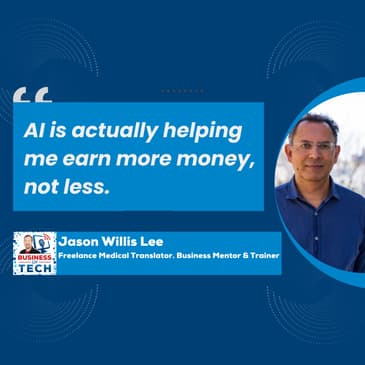
Jason Willis Lee, a specialized medical translator, discusses the impact of AI on the translation industry, particularly in the medical field. With a background in medicine and extensive experience in translating clinical trials, medical reports, and academic research, he has witnessed firsthand the disruption caused by AI technologies. While machine translation tools like Google Translate and DeepL have improved significantly, they still struggle with nuances and specialized terminology, which are crucial in medical translation. As a result, Willis Lee emphasizes the importance of human oversight in the translation process, particularly through post-editing of machine-generated content.
The conversation delves into the evolving landscape of the translation industry, where generalist translators are increasingly being squeezed out due to the rise of AI. Willis Lee notes that many translators are facing reduced income and job opportunities, particularly those who do not specialize in niche areas. He advocates for the necessity of niching down to survive in this changing environment, suggesting that specialized translators in fields like medical translation and linguistic validation will have better prospects than generalists.
Willis Lee also shares insights into his own career trajectory, highlighting the importance of investing in professional development and adapting to industry changes. He discusses the shift from high-volume, low-cost translation work to low-volume, high-value projects, encouraging aspiring translators to specialize early in their careers. He believes that those who can effectively leverage AI tools while maintaining a human touch will thrive, as they can offer a hybrid service that combines efficiency with quality.
Finally, he reflects on the opportunities that AI presents, arguing that it can enhance productivity and create new revenue streams for translators. By diversifying their services and exploring areas like consulting, affiliate marketing, and podcasting, translators can adapt to the changing landscape and find success. Willis Lee's perspective underscores the importance of resilience and innovation in navigating the challenges posed by AI in the translation industry.
About Business of Tech: The daily MSP news and analysis podcast for managed service providers and IT services leaders. Host Dave Sobel covers AI for MSPs, MSP pricing and profitability, MSP M&A and private equity, vendor partner programs, MSP cybersecurity and liability, and MSP operations — and answers the question every story raises: Why do we care? Produced by MSP Radio.
💼 All Our Sponsors
MSP Radio is supported by our partners:
ABC Solutions · CometBackup · Firetail · Guardz · HaloPSA · LogMeIn · Mailprotector · Pax8 · Rythmz · ScalePad · TimeZest · Transit AI
Supporting the IT services community through insights, analysis, and transparency.
🚀 Join Business of Tech Plus
Get exclusive access to investigative reports, vendor analysis, leadership briefings, and more.
👉 https://businessof.tech/plus
🎧 Subscribe to the Business of Tech
Want the show on your favorite podcast app or prefer the written versions of each story?
📲 https://www.businessof.tech/subscribe
📰 Story Links & Sources
Looking for the links from today’s stories?
Every episode script — with full source links — is posted at:
🎙 Want to Be a Guest?
Pitch your story or appear on Business of Tech: Daily MSP News & IT Services Analysis
💬 https://www.podmatch.com/hostdetailpreview/businessoftech
🔗 Follow Business of Tech
LinkedIn: https://www.linkedin.com/company/28908079
YouTube: https://youtube.com/mspradio
Bluesky: https://bsky.app/profile/businessof.tech
Instagram: https://www.instagram.com/mspradio
TikTok: https://www.tiktok.com/@businessoftech
Facebook: https://www.facebook.com/mspradionews
Hosted by Simplecast, an AdsWizz company. See pcm.adswizz.com for information about our collection and use of personal data for advertising.
[00:00:02] With all my talk about AI and AI disruption, what happens to the industries that are being disrupted? Jason Willis Lee is a translator, and that's a space that you can immediately sense might be disrupted by AI. It is, and he's had to do some interesting things to pivot his business, and there's a number of lessons we can learn as IT service providers on this bonus episode of The Business of Tech.
[00:00:25] Are your customers getting the most from their Microsoft 365 Business Premium subscriptions? Are you delivering maximum value while ensuring best-in-class margins? Nerdio's new modern work features let you streamline the management of Microsoft technologies like Azure Virtual Desktop, Windows 365, Intune, and Defender. Reduce the need for multiple tools, consolidate your vendor stack, and deliver greater value to your customers.
[00:00:51] Help your customers maximize their investments, free up your team for strategic tasks, and drive meaningful business outcomes. With Nerdio Manager for MSP, a single flexible platform with mix-and-match plans ensures a flexible, perfect fit for you and your customers. Deliver solutions that achieve real business impact. Visit GetNerdio.com to find out more. Well, Jason, welcome to the show.
[00:01:19] Thank you, Dave. Thank you for having me. It's very kind of you. Now, I'm really interested to talk to you because you're in a space that seems really interesting to me because it comes from deep expertise, both in language and in industry expertise, as you've combined the two, in languages and in medical translation.
[00:01:38] And it feels like one of those spaces that's going to be incredibly disruptive. So particularly by AI as we're talking about it. So before we dive into that, give me a little bit of a sense, particularly for my listeners, like what is it that you do as a specialized medical translator? Yeah, so I translate from French and Spanish, Dave, into English. I am a medical translator. I trained as a doctor up until year four before I left clinical medicine.
[00:02:06] I work in three micro niches, clinical trials, medical reports and research articles for academic publications. And now I've diversified because I could see the winds of AI blow and I've diversified into coaching. And I help other colleagues choose a micro niche, niche down, leverage AI for better productivity, work smarter, not harder working.
[00:02:30] And I'm trying to get into a new space called linguistic validation, Dave. That's where all the questionnaires are translated into the different languages. There's cognitive debriefing, there's physician reviews, there's QA. So it's a bit of a rigmarole of a process, but it's a more affluent area. It's an area that's more resistant to AI, so we can future-proof our careers. And I'm working with a couple of linguistic validation consultants. We're sponsoring events. We're getting on podcasts.
[00:02:56] We're doing our stuff and we're surviving this massive disruption that is AI. Well, so let's dive right in then to the disruption piece. I want to hear a little bit about to understand, because one of the tensions that I always hear is that it's good at basics, but it's not very good at getting the subtleties of language translation, particularly in languages where the unspoken is important.
[00:03:25] But it also, talking to a translator like you, it's like, okay, you're acknowledging that there is translation. How good is translation? We're talking in early 2025. How good is the translation and where are they falling down from a broad translation perspective? So they're very good, Dave. So compared to 10 years ago, the machines, the big machines, Google Translate, DeepL, are very, very good. And now we have all of these other tools. We have, I use Claude.
[00:03:53] I use a professional version of ChatTBT. Where they lack, I think, is nuance and in the niches. It's in the specialist niches such as law and such as medicine. Yeah. Gotcha. Now, what I would think then is one argument might be that a good value of a translator would then be to be looking at the machine translation and adjusting for nuance, and that would theoretically accelerate the workload.
[00:04:19] But at the same time, that's not necessarily as interesting a work, potentially, in that you are reviewing it. Talk to me a little bit about how you're addressing putting the human in to get that nuance for the customer. Yeah. So a lot of the work is editing now. It's post-editing and machine translation, PEMT. We've had that on the market for years. Now it's kind of a given that you will be adding the human aspect to the machine. So a lot of my work is editing machine-generated output.
[00:04:48] I think the human is essential, Dave, because you just have to have this hybrid customer service. And that's how the customer gets the quality. It's having the combination of the machine. So you can still make money. You can still leverage these tools to give you a rough idea of what it is. But you have to have the human oversight. I think that's the important thing. Okay. Now let's be realistic about the impact here, too, because one argument would be, oh, we can do lots more translation now because of the speed.
[00:05:18] But the other portion could be, well, actually, we need less translators because of the speed. Talk to me a little bit about what's happening in your space in terms of where on that spectrum things are actually falling out. So I think that's true. A lot of translators and interpreters, because there are tools doing interpreters work as well, simultaneous and consecutive interpreting, a lot of translators are being squeezed out. That's for sure. That's the trend of the industry.
[00:05:45] A colleague told me six-figure business has gone down to mid-five just this week, just on Monday. So a couple of days ago. Where I see the things coming, it's difficult to predict because there are institutions, there are freelance translators. I'm very connected to the freelance, the solopreneur world. I'm a small business owner by myself. So it's difficult to predict the future of these massive changes.
[00:06:12] But certainly the generalists are being squeezed out. Where I think there is still scope to survive is in my field. So Medtran, medical translation and linguistic validation is a micro niche within Medtran. The legal translators, we have art history translators. We have financial translators. So if you're not niched down, I mean, if you think you can get away with not niching down, think again. You have to have a micro niche. And that's one of the first things I teach. I have a lead magnet saying how to niche down.
[00:06:41] So I think what we're going to see is the death of the generalist translator or interpreter, Dave. And the niche specialists will step up and win the game. Now, that's interesting. And I want to get to the niche portion in a second. But I actually want to ask a little bit more about the generalist. Because in theory, if I think about this from a career perspective, my guess, and I want you to correct me, is that you kind of come up through the field a little bit as a generalist and specialize over time.
[00:07:09] If that's true, and I want you to validate for me, then this would be directly impactful to a career arc for translations and interpreters. Am I right? And then on top of that, what do you think is going to happen to the ability to have that career arc for individuals? I think that's true. I mean, just thinking about my own career, I did start in various fields. I was doing finance. I was doing annual accounts at tax time.
[00:07:38] I would have these same documents every year, year after year. I would say more than generalism, you start your career high volume, low unit price. And you kind of graduate to the right to low volume, high unit price. Does that make sense? So you sell lower volume at a higher price. And you gradually do specialize as well. I mean, I came from medicine. I came from a clinical research background. But I didn't immediately fall into that niche.
[00:08:05] I had to gradually earn my spurs and work my way up. So I think the quicker people specialize, the better for their career arc. I do recommend people start in-house. If you can get a job with the European institution or the World Bank or the IMF, there are places in Washington that employ in-house teams close to where you are based. That's great. And you can gradually branch out and start your own business. But, you know, LSPs, language service providers, agencies, they're having a tough time.
[00:08:35] I was talking to a professional owner of a pro association. He was telling me LSP membership is down. We will be doing an episode on that, hopefully, on my show. And these are the trends, Dave. It's just, you know, tech is – the changes are so vast and they're so sudden and they're so impactful that you really have to – you know, people are scrambling. People are scrambling. They don't know how to manage this. And I'm in the same boat as everyone else. I mean, I'm in a strong niche.
[00:09:04] I'm trying to micro-niche down further into linguistic validation and get into consulting, getting into affiliate marketing, podcasting, these other revenue streams. And, you know, more or less, I'm surviving. But I'm at the top end of a very sort of wide, wide spectrum. It's interesting times, Dave. Now, there's an interesting parallel to my own industry in that one of the things that happens is those, service providers that do specialize, that go down to a very specific niche, do exactly the same kind of thing that you've talked about.
[00:09:32] And what's interesting to me to hear the parallels is either you are making a bet on the fact that freelancers and smaller organizations are probably going to be able to be very nimble. You'll be able to take on more projects and be able to carve out a work where the larger ones don't. Talk to me a little bit about the way you've thought about the bet you're placing on the future of your industry because you have made a specific bet. Talk to me through that decision and what the bet is. Yeah, the gamble is, I suppose, investing in my own career.
[00:10:01] And I probably invested, you know, we're talking a mid five-figure sum, so 15 to 20K. Over the last three years, I've invested heavily in my own professional development. I changed the sea in which I'm swimming. I felt that I was swimming in a smaller sea and I was getting a lot of resistance from the current. So I changed the sea, I've changed the events I'm going to. I'm going to more entrepreneurial events. So in January, I was at a Podfest event in Orlando over in the States.
[00:10:29] That's the first time I crossed the pond for an entrepreneurs event. There was 1,800 people at that event. So you can imagine I've never been to an event with more than 300 people. So that was a big change for me. I'm at a change of season in my life. I'm leaving my 40s. I'll be 50 in just a few months' time. So it's that kind of, you know, if you're not going to make a bet and gamble on your career and your life, when is it going to be? I'm at a stage where I can do that. My kids are finishing their teens.
[00:10:57] But I think it is you do have to look at your professional development from, you know, what is the value perspective here? You have to be adding value to the customer. Otherwise, there can't be an exchange of money. There's an exchange of money when there is a value exchange. I have a lot of calls with people, and I can see the cogs turning. They're thinking about, you know, the transformation I can give them. But it's tough to get them over the line. I had a call just today, and I could feel that she was reluctant and reticent.
[00:11:24] And, you know, even painting the future, and this is the specific change I can give you from A to B. It's very difficult to get people to make a positive change, Dave. It's very ingrained in our consciousness to resist people selling to us, to resist investing in ourselves. And I think that's something – it's very interesting getting into the creative industry space, the personal development space, because I'm trying to apply, replicate what I've applied to myself, to other people. And you're getting into personal psychology.
[00:11:53] You're getting into fears. You're really getting in very intimate, up close and personal, Dave, with people. Yeah, it's interesting. Everything you've just said parallels my own industry incredibly well, which is interesting to find those impacts where the parallel continues. So I want to get a little bit of a sense of are there areas with the technology that are opening up areas that you couldn't ever deliver before? And what do those look like?
[00:12:18] Because I would – it feels like this is an area where, you know, either speed delivery or the ability to comprehend different kind of ideas that maybe beyond what a single human could do now applied in a single human, open up new spaces. Is that true, or is it more just more of the – you know, just faster of the same? I think it is a productivity tool. Eventually, it is the ability to crank up more volume in less time.
[00:12:46] So there is a possible increased lucrative nature of work if you can. You know, I'm finding that AI is actually helping me earn more money, not less. So I just don't subscribe to this attitude of, well, AI is taking your work. And that's a very simplistic way of looking at it and not adapting to the times. And some people do think like that. Many people have left the industry and have gone back to employment. That's something I wouldn't do myself after 20 years.
[00:13:13] I think, Dave, it's ultimately a question of diversifying. You have to look at other sources of income. You have to provide a holistic service. I've looked at copywriting. I've looked at affiliate marketing. I've looked at podcasting. These are all revenue streams if you do them seriously. They're all time and money ventures. You have to put time and money behind it to get a return. But I've seen an interesting trend for myself.
[00:13:39] By making a ruckus in the entrepreneurial space and consulting, I actually get more service provision requests. So I get more people trying to get onto my service provision diary, almost fighting among themselves. And that's fun. You feel you're in demand and you can pick and choose your suitors. And you have a lot of girlfriends who want to take you out. And that's a wonderful place to be in if you're any man.
[00:14:05] Well, you have exactly highlighted the value of analyzing the impact and change and making adjustments in your plan. I am particularly interested to check in with you as you go over time. Jason Willis-Lee is a certified medical translator with over 25 years of experience specializing in Spanish, English and French English translations for clinical trials, medical reports and academic research. He's got a background in medicine, including over three years at the Bristol Medical School and extensive hospital standing.
[00:14:32] He's bringing his unique understanding of medical terminology and high standards to the life sciences industry. Jason, I've learned a lot. Thanks for joining me today. Thank you so much for having me, Dave. My pleasure. The Business of Tech is written and produced by me, Dave Sobel, under ethics guidelines posted at businessof.tech. If you've enjoyed the show, make sure you've subscribed or followed on your favorite platform. It's free and helps directly. Give us a review, too.
[00:15:01] If you want to support the show, visit patreon.com slash mspradio and you'll get access to content early. Or buy our Why Do We Care merch at businessof.tech. Have a question you want answered? We take listener questions, send them in, ideally as a voice memo or video. To question at mspradio.com. I answer listener questions live on our Wednesday live show on YouTube and LinkedIn.
[00:15:27] If you've got a comment or a thought on a story, put it in the comments if you're on YouTube or reach out on LinkedIn if you're listening to the podcast. And if you want to advertise on the show, visit mspradio.com slash engage. Once again, thanks for listening. And I will talk to you again on our next episode. Part of the MSP Radio Network.