
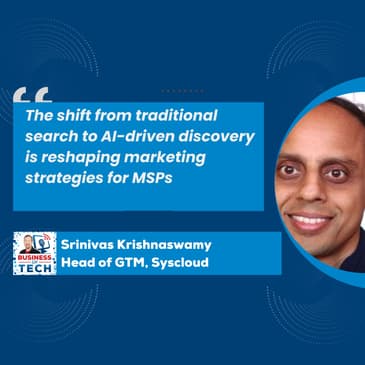
Srinivas Krishnaswamy, author of "Inbound Marketing in the Age of GPTs," discusses the transformative impact of AI on customer search behaviors and marketing strategies for Managed Service Providers (MSPs). He emphasizes that traditional methods, particularly reliance on Google for information discovery, are evolving. With the rise of generative AI tools like ChatGPT, customers are increasingly turning to these platforms for tailored responses, which necessitates a shift in how MSPs approach their marketing efforts.
Krishnaswamy highlights the importance of understanding the changing dynamics of search. While Google continues to dominate, the volume of searches is increasing, and the landscape is becoming more complex. He points out that MSPs must adapt to this new reality by optimizing their online presence not just for Google, but also for AI-driven platforms. This includes implementing schema markup on websites to enhance discoverability and ensuring that content is relevant and valuable to potential customers.
The conversation also delves into the significance of community-based marketing. Krishnaswamy advises MSPs to identify where their target customers congregate, whether online or at industry events, and to engage with them authentically. By providing valuable insights and solutions to their problems, MSPs can build credibility and authority in their niche. This approach not only helps in generating leads but also positions MSPs as trusted partners in their customers' decision-making processes.
Finally, the discussion touches on the potential pitfalls of over-automation in marketing. While AI tools can streamline content creation, Krishnaswamy warns against relying solely on them without human oversight. Instead, he encourages MSPs to use AI as a tool for brainstorming and generating ideas, while ensuring that the final content reflects their unique voice and expertise. By balancing technology with genuine engagement, MSPs can effectively navigate the evolving marketing landscape.
About Business of Tech: The daily MSP news and analysis podcast for managed service providers and IT services leaders. Host Dave Sobel covers AI for MSPs, MSP pricing and profitability, MSP M&A and private equity, vendor partner programs, MSP cybersecurity and liability, and MSP operations — and answers the question every story raises: Why do we care? Produced by MSP Radio.
💼 All Our Sponsors
MSP Radio is supported by our partners:
ABC Solutions · CometBackup · Firetail · Guardz · HaloPSA · LogMeIn · Mailprotector · Pax8 · Rythmz · ScalePad · TimeZest · Transit AI
Supporting the IT services community through insights, analysis, and transparency.
🚀 Join Business of Tech Plus
Get exclusive access to investigative reports, vendor analysis, leadership briefings, and more.
👉 https://businessof.tech/plus
🎧 Subscribe to the Business of Tech
Want the show on your favorite podcast app or prefer the written versions of each story?
📲 https://www.businessof.tech/subscribe
📰 Story Links & Sources
Looking for the links from today’s stories?
Every episode script — with full source links — is posted at:
🎙 Want to Be a Guest?
Pitch your story or appear on Business of Tech: Daily MSP News & IT Services Analysis
💬 https://www.podmatch.com/hostdetailpreview/businessoftech
🔗 Follow Business of Tech
LinkedIn: https://www.linkedin.com/company/28908079
YouTube: https://youtube.com/mspradio
Bluesky: https://bsky.app/profile/businessof.tech
Instagram: https://www.instagram.com/mspradio
TikTok: https://www.tiktok.com/@businessoftech
Facebook: https://www.facebook.com/mspradionews
Hosted by Simplecast, an AdsWizz company. See pcm.adswizz.com for information about our collection and use of personal data for advertising.
[00:00:00] This episode is a special presentation of a sponsored webinar I hosted, brought to you in partnership with SysCloud. I had a genuinely interesting conversation with Srinivas Krishnaswamy, author of Inbound Marketing in the Age of GPTs. We explored how AI is changing the way customers search, what that means for how MSPs need to market themselves online.
[00:00:22] He brought some sharp insights about what actually works right now, from optimizing your website for AI discovery to building credibility in all the right places. If you're rethinking your marketing strategy or wondering why your referrals aren't cutting it anymore, this one's for you. This is a bonus episode of the Business of Tech.
[00:00:42] Hi, I'm Dave Sobel, host of the Business of Tech podcast and your host today for this webinar sponsored by SysCloud.
[00:01:09] I'm joined by Srinivas Krishnaswamy, who goes by Srini to discuss his new book, Inbound Marketing in the Age of GPTs. Srini, thanks for joining me today. Good morning, Dave. How are you? Thank you for having me. I am super excited to talk to you because I think it's worth just sort of diving in. This is an area that I think MSPs are starting to think about. So let's set the stage a little bit. Why did you write this book now?
[00:01:37] Well, I mean, I've been in sales and marketing for over a quarter of a century now. I'm very old. And every day my routine started with Google and ended with Google and Google in between. Always had like multiple Google search tabs open. I really was the go to place to search for information. And since 2024, my habits have changed dramatically.
[00:02:01] Ever since ChatGBT burst into the scene, I think in the very first five days they brought in 5 million users. That was in late 2023. Things have changed for me and for millions of others in terms of how we discover answers to questions that we have. It's not necessarily Google first anymore. We, I in fact, end up using ChatGBT more than Google.
[00:02:28] But that may not be the case if you look at the worldwide population that are online. But nevertheless, you know, I see a fundamental shift in how information discovery happens. And that has a direct impact on how marketing can happen. And so this directly impacts all kinds of businesses, including MSPs. That's why I wrote this book. Well, and I think it's worth then talking. You said there right there about Google's declining search dominance.
[00:02:57] But there's actually a little bit of tension there, right? Because the search isn't just that they're declining in dominance because we're also seeing more searches. There's some kind of interesting subtleties there. Say a little bit more about what's going on with the dynamic around Google. I think you brought up a valid point. I mean, people are already talking about Google's demise, but I think it's premature. Google is well and thriving as far as what I know.
[00:03:24] Now, if you, I think we have lots of conflicting data points and announcements and PR happening from both sides. Like for example, Gartner came up with a statistic or estimate that by 2026, there's going to be a 25% reduction in search volume. While that is in a sense true, it's actually not true in the larger sense.
[00:03:51] And the reason being, if you look at the trend in terms of searches, every year the volume of search is going up as you rightly said. And as per Google's recent announcement, they are recording about 5 trillion searches every year. That's a lot of searches. Now, why do you think searches are growing year after year? I think there are common sense reasons. First of all, you know, we as a human race, we build more complex stuff.
[00:04:21] We evolve, we build more products, we build new technologies. And as you can see everywhere, you know, things are becoming more complex to deal with. So as a result of that complexity, which keeps increasing every year, we end up searching for more information and more answers. Now, if you just compare, you know, the search trends vis-a-vis Google versus ChatGPT and where they stand with each other.
[00:04:48] You know, on a daily basis, if you were to divide the 5 trillion yearly searches that Google has by 365, you should get roughly about 14 billion searches on a daily basis on Google. And if you look at ChatGPT, where it stands, in fact, there is a slide where we have compared all of this. You will see ChatGPT, you know, somewhere trending towards 40 million on a daily basis.
[00:05:16] That order of magnitude more than ChatGPT. ChatGPT. Now, in the larger context, what is happening is ChatGPT was nowhere in the picture till end of 2023. All of a sudden, it's not just ChatGPT, it's cloud, perplexity and a whole bunch of other generative AI chatbots have started to dominate or dominate the wavelengths in terms of the media, right?
[00:05:44] And in terms of impacting user habits. Now, that is where, you know, I see this as a glimpse of the future and what it, you know, tells us as marketers and as business owners, MSP business owners, to really look at what is happening at this larger trend and prepare yourself for a future where a lot of this information discovery will happen, you know, on, you know, generative AI chatbots.
[00:06:13] So that's the carnival. Gotcha. But there's a, there's a kind of challenge typically with MSP lead generation that I think is worth talking about, right? Because MSPs rely a lot on referrals now. And, and, you know, I like to get your sense of that reliance on referrals. Is that diminishing? What's happening in terms of, of kind of their reliance on traditional methods as it impacts this kind of new thinking that, you know, the chatbots are going to make a difference?
[00:06:44] See, I mean, referrals will continue to play a role. And I mean, that's not going to be impacted whether you have, you know, a chatbots or not. If you have done a great job with your customers and you kind of, you know, expect your customers to refer you to, you know, other, other customers and that, that cycle keeps happening. But I am talking about business owners, MSP business owners who really want to scale their operations. There are people who are happy with what they have.
[00:07:13] They probably, it's, it's a lifestyle business, a small team. They have their set of customers. They get steady referrals and they're happy with the status quo. But, you know, we, we always have a more ambitious folks who like to grow. They really want to, you know, build strength, add more people, acquire more customers and do it on a consistent basis. So that is where the problem starts creeping in.
[00:07:40] If you were to just rely on the old school methods that I'm not saying that they are no longer valid, but what is happening is the rug is pulled right under your feet. Right now, if you think you are going to get leads because you are ranking for certain keywords on Google alone. And if that is your only, you know, marketing strategy or content strategy, you will be disappointed very soon because things are changing really fast on that side.
[00:08:09] So that is the reason why I think if you're an MSP, that's a little more ambitious and want to see a steady stream of, you know, funnel, leaves into the funnel, then you really need to think about the future. Gotcha. Now let's, let's balance that a little bit because you've given some thought into the difference of what search is really good for. And now what this new AI prompt paradigm is for, help me, you know, frame that a little bit for me.
[00:08:38] There's there's certain things then the traditional search is going to be really great at. And what's the difference with what the prompting is going to be really good for? That's a, that's a great question, right? See, you know, there are, if you were to really break down the types of searches that people typically have, it falls into one of the three buckets.
[00:08:58] First one is informational. I'm searching for information. For example, what are some of the options available for me to secure my mobile devices that my employees might be using on the field? So that's, that's the search. Obviously, if you are in group, normally have a shorter search phrase, maybe you will type the entire sentence, whatever I just said in chat GPT to get an answer.
[00:09:23] In these scenarios, you know, generative AI chatbots really do a terrific job in responding to you. The reason they are able to do that is because you can give it a lot more context in your prompts. You, you don't have to just restrict it to, you know, the, the question that I said.
[00:09:44] In fact, you can even provide context. For example, I am a business, let's say I am a nonprofit business and I have people on the field carrying tablets. They are going from place to place, you know, collecting donations and they have these tablets that will allow them to register the donor information and collect payments. Let's come up with this hypothetical example.
[00:10:10] So if I were to add this context to this, to the prompt in chat GPT, I will get a, you know, really tailor-made response. Now I can't expect that kind of a response with Google search. So there is a fundamental, you know, difference in the way GPT works vis-a-vis Google search. And in the context of informational searches, like the example that I gave you, GPT will win hands down in terms of the quality of content, right?
[00:10:40] Or the response. Or the response. But then there are other types. For example, if you go to the next slide, you also have navigational searches and transactional searches. Now, there is a difference between the two. What are navigational searches? So these are, for example, when you know where you want to go, for example, log into this particular application, log in for ABC app, right? So you already know where you want to go.
[00:11:09] And in this case, it's kind of, you know, pointless to expect, you know, 10 paragraph response. You just need the URL that will allow you to, you know, get there. Similarly, transactional intent, right? These are, you know, e-commerce purchase related intent, right? Where you are really looking at buying something of value.
[00:11:29] And so these are two types of searches where, you know, GPT hasn't really solved it very well because of the nature or the interface that they have built. But I am guessing, given a few more quarters, they will start going after these types of, you know, interactions as well. It's just a question of figuring it out in terms of how do you really bake it into the conversation model that they have built. That's number one.
[00:11:59] And at the end of the day, I also think market forces will force them to make money eventually, right? Now they have pulled in billions and billions and dollars of investments. At some point in time, you'll have to start making money. So the money lies in the transactional search terms, which results in a sale, right? Closer to the bottom of the funnel. So that is where the difference is right now. Gotcha. Okay. So that makes sense to me.
[00:12:29] But I think the other piece that we want to lay are on top of this is the idea of sort of the community based marketing portion, right? Because you're talking about the positioning for search, but it also feels like the other component of this is the fact that you've got to drive from the various communities, particularly because content requires that external validation. Tell me a little bit more about how that factors in.
[00:12:54] Actually, I mean, this is the core of what I have written in my book also. So here's the thesis.
[00:13:04] The thing is, when you are an MSP trying to scale your sales and marketing, I think the first thing that you need to be doing is to identify or clearly define your customer base in terms of their profile, a persona, and then really understand what are all these sources of information that they rely on.
[00:13:30] And that could be the YouTube videos or channels they listen to, the podcast they listen to, the influences they value, the communities where they participate actively in learning from each other. And also the marketplaces where they're looking at the marketplaces where they're looking at the marketplaces where they get information about solutions that they are looking to purchase for their own use, so on and so forth.
[00:13:55] So you really need to understand where your customers are consuming information and see if you can insert yourself in those conversations and content. Now, I can give you an example, right? If you, let's say, you are an MSP targeting nonprofit organizations.
[00:14:16] Now, nonprofit organizations, obviously, they have a well-defined persona in terms of what their expectations are and what their constraints are. Now, if you take any nonprofit organization, they probably, if they are looking for a technology solution, they probably attend an event called N10, Nonprofit Technology Enterprise Network, right? So if you are an MSP and you want to be in front of them, you have to be there at the event.
[00:14:46] Now, being there at the event means possibly you set up a booth or sponsored something there and possibly even have a speaker slot. That's even better. Similarly, you need to know where they are congregating online. How do you know that? You ask your customers, you know, talk to them and find out where do you really interact with your peers and be there and see how you can insert yourself there.
[00:15:14] You need to know who are all the influencers that they listen to, what podcasts that they are listening to and really see if there are opportunities to collaborate with those influencers, sponsor content, write content that will get published or picked up by those publishers. And really insert yourself, as I pointed out, in all of these places so that you are kind of, you know, resonating or you kind of, you know, showing up wherever they go.
[00:15:40] I think that's the core of the AI-based inbound marketing. I'll tell you why that is the case. Obviously, whatever I just said is no rocket science and, you know, marketers have been doing this. Why is this important in the AI era? That is the million dollar question. Now, again, let's take the case of Google versus ChatGPD, right? So two contenders.
[00:16:07] Now, in the case of Google, what does Google promote in the first page? Google prefers, Google has, you know, millions of ranking signals. I don't know if it's millions, but it's definitely more than one. Now, some of the key factors that decide or help a content rank include your domain rating or domain authority. Essentially, you're standing in the market.
[00:16:37] It also kind of, you know, they also look at what is your track record, how long you have been in business, how frequently you publish content. There are so many factors that go into determining what shows up in the first page in addition to the content really addressing the search intent. So that is the basic of how Google works. But the problem with this approach is it's always not the best content that shows up.
[00:17:04] Because of multiple factors playing a role, let's say an obscure blogger has written an in-depth, you know, tear down of a particular product or compared to different products that's of interest to your customer. They may not even show up because a prominent publisher or a set of prominent publishers with very high domain authority and a lot of traction will probably occupy the first page on Google search results.
[00:17:32] And this particular blogger will be pushed to the fifth or the sixth page. Now, keep that aside. Let's take a look at how people interact with GPT and why this blogger can suddenly gain prominence. Now, when you ask a question to GPT, let's say, give me, you know, reasons as to why I should choose tool A versus tool B. Let's say that is the prompt that I'm giving in GPT.
[00:17:59] And GPT, you know, spit the response without any citation. Now, let's say if I'm a little more adventurous and curious, I can start asking GPT. Okay, why did you say this is better than this? What are the reasons? Give me citations. And I can keep quizzing it. What are the strengths? What are the weaknesses of one versus the other? And at some point in time, if you're forcing chat GPT prompts to get you those citations,
[00:18:27] it has to look far beyond the first page of the, you know, Google search results. It has to go deep into the, you know, the crawl history that it already has generated and go fetch the most relevant citations that will substantiate its conclusions about what is good and what is bad and why.
[00:18:48] And this is how you kind of, you know, make sure that by being present in those places where GPT and other similar tools are fetching information and synthesizing that in their response, you at least have the chance of being cited. And I think that is the first challenge that you can, you know, crack if you follow this approach.
[00:19:13] And that is why presence in the community is critical in the age of AI. So that makes sense to me. Now, before I move on, I want to make sure our listeners know that if you're watching this and dive in, you want to put some questions in the Q&A box. We will have a question and answer session at the end of this. So we are taking your questions now. Put them in the Q&A portion. You said something, and I just want to make sure that I heard it correctly, particularly because I think this is important for those that are listening.
[00:19:41] You mentioned about making sure that they're going to the places where the customer would be. And what you mean specifically by that is thinking like your customer and engaging in those particular communities, say Reddit, QuickBooks forums, LinkedIn groups. Like it's not thinking about where they would go themselves as an MSP, right, or the conferences and events they go to. It's about thinking like your customers. Can you say just a little bit more about that strategy? Yeah.
[00:20:09] So, see, the problem is if you're an MSP, you can maybe go to the ASCII group, right? They conduct a lot of workshops which are very, very useful. It really helps you grow your business, understand the market, understand how to price. They give you a lot of marketing resources and so on and so forth.
[00:20:32] So, every such niche group in the MSP business, they have formed strong communities that support each other, help each other and share their experiences. Similarly, if you go to the Reddit MSP forum, I mean, it's loaded with insights. I can spend literally three days reading it and I'll still not be done, right? The challenge is how much time you're going to spend where. I think that's the million dollar question once more, right?
[00:21:03] Because MSPs by themselves, they are juggling, they're wearing multiple hats. You might be, you know, providing customer support and then you'll switch to invoicing and, you know, you'll have to deal with vendors. You'll have to deal with the distributor, online distributor. So, there are so many challenges that kind of, you know, pulls them in different, different directions. You need to also, what I am saying is, take a step back. Look at where your customers are going, right? And be there.
[00:21:33] What does it mean? Like, for example, if your customer is, as you rightly pointed out, Intuit Connect. Intuit Connect brings together QuickBooks users, also MailChimp users. Now, these two user groups predominantly come from the small and medium-sized business community. And if you're an MSP targeting the SMB business, you need to see what is that intersection that you have with this community in this particular conference.
[00:22:02] And really, you know, accentuate that and play it up. Similarly, if you have a Jira implementation expertise or management expertise, And then you need to be at Teams, right? Which is the conference that Atlassian, you know, organizes every year. So, you have to really know where your customers are. What are the pain points that they are trying to solve?
[00:22:29] At the end of the day, this is something that I have emphasized in my book as well. Nobody is going to say when they find a problem in a small business, They are not going to say, find me an MSP to solve this problem. They will never say that, right? They will talk about, okay, I have this problem when securing my inboxes. We have been a target of phishing attacks and I need to solve this problem.
[00:22:58] So, when they ask this question, where do they find the answers or where do they post these questions? So, you need to know those places and try to solve their problem there through your content. Now, what I want to also do is there's a technical component here too, right? Because AI consumes website content differently than humans do and differently than the traditional SEO consumption of content for traditional Google search.
[00:23:28] How do MSPs need to think about optimizing their website content in order to make sure that they're more adaptable and ready for this chatbot era? This was more than 10 years ago, I think. Probably older than that. A bunch of companies, internet companies, including Google, came up with this standard called schema.org. Now, the schema implementation has become extremely critical in the context of AI crawlers.
[00:23:58] So, what is schema? Schema is essentially, you know, describing what content is there clearly for crawlers to really understand and make sense of it and help them build their knowledge graph. So, a simple thing that you can do as an MSP is to add schema to your website pages. Different pages have different schema formats. It's all published online, available free of cost. I mean, it's an open source, you know, publicly available resource.
[00:24:27] And in fact, we have a QR code that you can scan if you're an MSP and copy-paste all the schema types that you will need to implement on your website. All you have to do is customize it by adding your details. And if you actually buy my book also, you will have instructions on how to use WordPress, which is possibly the most likely tool that you might be hosting your website on. But I have to also caution you.
[00:24:55] Just because you have a website, you're not going to tag. Just because you have a schema.org implemented on your page, you're not going to show up in the responses from ChatGBT. These are all hygiene factors. Basic stuff that you need to implement. And assuming the quality of content really resonates, really you present your point of view, you present something of value, something unique,
[00:25:25] and directly address the needs and wants of your customers. And that's the fundamental principle of marketing. You're not going to rank anywhere. Whether you have schema, super-duper SEO expert, it really doesn't matter. So it boils down to the content and the value that you can deliver. But then, of course, in order for you to be successful, assuming you have all the insights, you need to implement basic technical SEO and schema.org.
[00:25:55] Now, there's some basic elements, though, that are missing from websites now that people need to be working on, right? Tell me a little bit more about what the MSPs need to be investing in to add those elements, particularly now for this new AI era. Yes, good question. So I think, I mean, these are expectations that site visitors have. They have had this expectation before.
[00:26:24] It hasn't changed because AI has come into the picture. What are these expectations? First of all, your website should really communicate what you are doing. Because I see, right, especially with MSPs, they tend to use very esoteric jargons, you know, manage services to deliver great value. I mean, they're very, really, really generic. It can mean anything to anybody.
[00:26:51] Those kinds of messages really, you know, it's a turnoff. In the context of information overload and when people are searching for different solutions to solve their problem, and they have to solve a lot of those problems, you need to make sure that the website copy itself is really talking to your audience. And in my book, you will find plenty of examples of the right way of doing it in terms of website copy
[00:27:20] and talking to the audience the right way. So that's the basic. Get your copy straight. Think about your customer, what their persona is, and write to their persona. Solve their problems. So that's number one. Number two, you need to have or make it easy for somebody to reach out to you. It could just be a telephone number that's prominently available. Don't worry it in some contact us page which is not even visible. So these are all basic stuff
[00:27:49] that I'm sure a lot of other marketing folks talk about and I don't have anything new to add. All I am saying is the website becomes the one of the gateways for you to bring in opportunities to you. That is inbound marketing, the concept of inbound marketing. And once those people come to you for the content that you have created which is valuable that solves their problem,
[00:28:19] you make it easy for them to reach out to you, make it less threatening for them to work with you, see what you can offer upfront which really doesn't take too much time and effort. So these are all basics and nothing to do with AI here. What I am saying in my book is in the in a world where a lot of this information gathering happens outside of Google in addition to Google, make sure that
[00:28:48] you are present everywhere so that you are also one among the many contenders. That's number one. Number two, and when you are a contender, make sure that at every step in the customer journey, you have something of value to add because that itself again, every step in a customer journey is a loaded topic. I am sure we can do a deep dive on that because at every step the customer's expectation on what they are
[00:29:17] looking to solve is different and you need to kind of, you know, separate yourself from the crowd through the content and how easy it is for the customer to find you at the place where they are looking for. So that is the bottom line here. Gotcha. For viewers, we're going to be coming up on that Q&A session here soon to make sure to put any questions you've got in the Q&A box. We will be getting to that in just a couple of moments because I know I can do questions all day long. Sreena, I want to ask a little bit
[00:29:47] as you think about this particular context you've mentioned of that inbound marketing, is there kind of a great example that resonates for you of somebody who's really doing this well or a technique that's really working well that's worth highlighting? Syscloud.com. Okay. I'll not mention this. We are not an MSP but we are we work with a lot of MSPs. We have invested a lot of time and effort in building content that really solves problems. So we created an entire
[00:30:17] data protection center just for the uninitiated. Syscloud is a platform that packs up critical SAS application. Now what we found out is every SAS application has different challenges when it comes to data retention and data protection. and each one is complicated. There are so many intricacies there and if you are not careful you can easily lose your data and there's no way to recover it.
[00:30:46] So we created this data protection center which really addresses these questions. For example you will find articles write how to recover your data from Google Drive, how to restore your data to we have covered these topics across SAS applications and put all of them together with detailed instructions steps and options including third party
[00:31:16] tools that you can use to make it happen. So this is a great example of solving the problem and we are finding that most of the leads come to us because they read the content and they want to try the product and see how it's going to solve their data protection challenges. Similarly on the MSP side, in the book I would urge you to buy the book and look at several great examples of
[00:31:45] MSPs who have done a phenomenal job in identifying customer pain points and turning that into content opportunities. So we're going to go ahead and put that QR code up on screen if you can get a copy of the book. You can go ahead and download and get the access to buy the book right from this QR code. Now, Srini, for my listeners, we're about to take some Q&A, so make sure that those go in there and put them into the Q&A box. My last question to you here
[00:32:15] is I want to get a little bit of your perspective. Is there a risk of over automating here or particularly as you think about platforms like LinkedIn and stuff like that, is there a real risk of automation overload? Yes. Again, if you're talking about over automation because of the way people are using GPT, yes, there is a risk. At the end of the day, again, going back to fundamental principles of marketing, right? If I tell GPT, okay, if all the marketers are telling we need to have a blog post, we need to
[00:32:45] have a data protection center like what SysCloud has done and so on and so forth, and if they start using GPT and saying, okay, fine, I am an MSP, build out these 100 articles on these topics and then just copy paste it and publish it, I think you're going nowhere with that because at the end of the day, GPT is a great tool assuming you are able to interact with it, give it input, give it context and really deliver something of
[00:33:14] value that reflects your persona, your mind and your expertise. So that is a great way to sabotage your marketing effort. That is by automating content generation and without any oversight, right? So that's number one. Number two, as opposed to talking about the pitfalls, a great way to use GPT would be to, instead of just asking GPT to write content
[00:33:44] for you, you can brainstorm with GPT to understand what are all the topics that might be of interest to your audience. And it will come up with some really creative article ideas that solves certain pain points that you might not have thought about. That's a great way to use GPT. It can flush out the content outline. It can also do a lot of other things that can help you generate more content. For example, it can analyze 5,000 support tickets to find
[00:34:14] 10 common problems that your customers are facing. And you take that and write an article about it and maybe do a webinar on it. That's a great value that you get out of GPT. You're not going to manually sit through 5,000 tickets to get this insight. Similarly, you can copy-paste a bunch of Reddit posts from your customers into GPT and ask for, okay, fine, so what are all these problems that our customers are facing? So that again gives you a lot of ideas on how
[00:34:43] to use that knowledge which otherwise is difficult to consume and parse as a human being and let GPT deal with that volume and use GPT to extract insights and then package the insights in various forms. It could be a podcast idea, it could be an interview with Dave Sobel, or it could be anything else that really gets you in front of your audience going back to the community angle. So you need to use GPT to generate all of the content ideas that fits
[00:35:13] into the consumption pattern of your audience across various publishers and various data sources. So that is the real value that I see with GPT. So Shreem, I think it's worth tying this all together because you've got a bit of a high-level view of pulling this as a community driven marketing strategy. Talk me through kind of the whole process then, just at a high level so we can get a sense of what community driven marketing really looks like. Yeah, so again as I
[00:35:42] mentioned community driven marketing is to really answer questions at the right place or be present at the right place through your insights, content, video, audio, or whatever form it takes. And that's a journey. Now, why is it a journey? Because any decision that anybody takes about buying a service of value, especially in the B2B context of an MSP, they don't wake up
[00:36:12] one fine morning, call up an MSP nearby, and then issue a purchase order. They have to go through that journey. What does the journey look like? I think this visual explains it. Again, this is not something that I invented. The marketing professors have done this to death. Essentially, you have at the beginning, there is a recognition of what the problem is. That's typically driven by internal considerations. Suddenly, a bunch of your
[00:36:42] employees have fallen prey to a phishing attack. That makes you up and now you have a problem to solve. It could be that you went to an event and people are discussing about a ransomware attack that really crippled another MSP business or another business. depending on where you are interacting. Now, you have a problem to solve. When you start researching the problem, where do you start? If I had done
[00:37:12] my homework as an MSB, I will know where my customers are researching. It could be GPT, it could be Google search, it could be a question in the Reddit forum. Do I have a plan in place to show myself up unobtrusively in all of these places? That is the game here. Now, the situation moves from understanding that there is a problem to looking at options,
[00:37:42] let's say. When you are looking at options, am I present in the marketplace where my customers are looking at options for IT service companies or MSPs? Do I have good ratings? Do I have recent ratings? How many customers have rated me in the last six months? So, these are all the challenges that you have to solve. Again, going to the next step, when I do a deep dive, do I have detailed competitor
[00:38:11] analysis that I have done? One solution versus other solution? And MSPs can find different angles. For example, if somebody is going to implement a cybersecurity solution and they are very good at in that space and they are vendor agnostic, they can write an in-depth article comparing solution A versus solution B and that surfaces to the customer. And guess what? When you have such a complex solution, you need a guide to help you with the implementation. Who wrote the article?
[00:38:40] The expert, MSP. And that's how you build credibility. So, all I'm saying is when you are present in every place your customer consumes content throughout the decision making process, then you not only find yourself cited by GPTs, you will also be ranking in Google and customers will naturally discover you. I think if you need to make that mental shift from I just want to write content and rank,
[00:39:10] I somehow will hire an SEO expert who is going to wave a magic wand and make it happen, that's not going to happen. It's about solving customer problems wherever they are consuming content. Now, admittedly, if there was a magic wand, all the MSPs would buy it. We're all looking for that. Now, throw those questions into Q&A. Srinya, I think we're ready to take some Q&A from the audience. What do you say? Brilliant. I'm all for it. Let's go. All right, Srinya, let's dive into those questions. I've got a first one here
[00:39:40] from our listener. Let's go ahead and put it up. Colleen asks, so how can small MSP, compete with the larger players in building authority for AI search? I think that's a great question. I think the benefit of generative AI is the fact that you're not tied to the constraints of search ranking factors where you had all these large brands and reputed players garnering all the attention because of the sheer authority that
[00:40:10] they wield in terms of ranking signals. I spoke about it during the webinar as well. when it comes to a small MSP, as long as you can consistently promote your brand. Like for example, what is the consistent message that I want to give out about SysCloud that I want to repeat it everywhere I go, wherever I speak, whatever I write, is SysCloud offers a single pane of glass to secure all critical SaaS applications. I literally memorized it and I keep repeating it
[00:40:40] wherever I can. if you could do that for your brand, again, going back to all the pointers that I gave about following the decision-making process and being present in all the community touch points wherever your target audience are, that's how you create your presence or in a way quote-unquote authority for generative AI search bots. Gotcha. Well, that'll make a big difference if people are investing that way. So let's go ahead and
[00:41:09] pull up our next question here. So Joe asks, if Google's dominance is decline, where should MSPs be focusing their marketing efforts now? Well, I mean, as we saw in the webinar, right, Google will be the 800-pound guerrilla in the room. You cannot ignore Google and you need to play nice with Google and do whatever they recommend in terms of user friendliness, the depth of the content, the breadth of the
[00:41:39] content, the value that you're delivering through whatever you're publishing online. So that part remains. But what is happening is you're not constrained in the sense it's just not Google alone. That's going to become more and more prominent. Already, I'm sure most MSPs know this, you can run Facebook ads and Facebook is a closed ecosystem. You can't really, Facebook posts don't show up in Google search results. Similarly, YouTube is
[00:42:09] its own universe. There are these social media sites that have already demonstrated to businesses that there is life beyond Google and you need to spread your investments, marketing investments and brand building across all of these platforms. We just have a new kid in the blog and that's the chat GPT and other similar chat bots and you got to start investing in them because they have the potential to eventually become a
[00:42:39] critical or a big challenger to Google in the long run. By the way, Google is also investing heavily in Generative AI and we all know that. It has consistently started pushing in AI summaries. We call them zero-click results, which really doesn't result in too many clicks, although they give citations and links on the side panel and so on and so forth. But the world is moving towards that direction and you are to be there. Makes perfect sense.
[00:43:08] I think you've highlighted something really important there is you need to prepare yourself for that zero-click world to make sure your information is showing up in those AI overviews or the consumption as we see it going forward. I think we have one more question here. I want to make sure that we address. Holly asks, how do I get reviews if most of my clients either aren't online or they don't like filling out forms? That's a great question.
[00:43:38] See, I think reviews should be a part of the process and not something that you wake up and do one fine day and forget all about it. How do you make it a part of the process? You need to be watchful of customers that really like your product or like your service. So if you're an MSB and you're catering to let's say 50 customers in the Los Angeles area, I'm assuming at least 10 of them really want to work with you and really value you as a partner that's offering valuable
[00:44:08] services. And these are customers who keep renewing the subscriptions year after year and they keep buying more and more and hopefully they are also growing. So they are kind of long term customers. The first step would be to really have some kind of scheduled engagements or interactions with these loyal customers and actively seek their help so that they can help you spread your word, your brand to the
[00:44:38] world. And how can they do that? They can either refer their customer, refer their peers in the network that they have, or the best thing that they can do for you would be to leave a nice recommendation online in any of the market places where your potential prospects are evaluating options for MSPs. So you need to be part of the process. That's what I mean. And useful for MSPs to help them. That's exactly a place that they can actually have their technical expertise and help them out. Now we got one more that got thrown into the chat and I
[00:45:08] didn't want to miss it. So Ahmed here asks, where can I find these SMB communities that you're talking about and how are the best ways to engage without sounding too salesy? Yeah, I think again, all these questions are great. So I keep repeating that. So SMBs, right? I mean, when you talk about small and medium-sized business, that's a broad brush and we use it to simplify the context and
[00:45:36] maybe make sure that whatever we are doing gets to the right audience. These are MSPs who might be interested in selling to small and medium-sized businesses. But now when it comes to where can I find the SMB community that is relevant to my MSP business, I would be a little more nuanced in how I define the SMB community. I think that definition will make a big difference. For example, if I were to predominantly serve,
[00:46:06] let's say, healthcare providers, physicians, doctor offices, clinics, and so on and so forth, let's say in the Los Angeles area, there are several ways to approach small and medium-sized businesses who are operating in this industry. An obvious way would be to just approach the Chamber of Commerce and see what kind of events that they are doing. But should I start there or should I make a list of
[00:46:35] all the physician associations in Los Angeles area? Maybe there is an association for dentists, there is an association for cardiologists, there could be community health centers, so on and so forth. So I would rather refine it, refine my search filter criteria to a community or association that's native to your location, number one, where you have a direct mapping between all
[00:47:05] the capabilities that you have and what they are looking for, possibly. Now, how do you, that's the first step, right? How do you then make sure that you're not salesy? I think the key thing is, once again, going back to the community approach, which I spoke about at length during the webinar, and that is, you need to know what the pain points are, and I'm sure you know it already, because you have been serving your customers for years. Now, you need to talk about those, you need to talk about
[00:47:35] customers' challenges. It's not about, okay, here are the 10 things that I offer and these are the rates. I mean, you're not going to get to the bottom of the funnel before helping the customer through the journey. How will you help the customer through the journey? Help the customer recognize the problem. So you're going to go meet a bunch of physicians or local hospitals, and the first thing that you're going to talk about shouldn't be what,
[00:48:05] these are the services I have. Instead, you can talk about physician offices are especially vulnerable to ransomware attacks. In the LA area alone, there was X, Y, Z, billion dollars worth of money that was held in ransom or paid out or whatever that stat is. You got to really resonate with the audience in terms of the problems that they are either facing already or about to face. And once you do that, you kind of demonstrate
[00:48:34] your authority on how you, maybe you can bring up a case study. Maybe one of the physicians or the hospital that is a part of wherever you are attending, the group or the association could vouch for what you have done. Maybe they can come on stage and talk about how they started working with you to solve the problem, educate their employees on how to be careful about phishing emails and so on and so forth. So that is how you build credibility. And of course, last
[00:49:04] but not the least, also offer something that is non-threatening. And there is this concept called the zone of resistance. People are not very receptive to sales pitches. So you have to really overcome that. How do you overcome that? By giving them something that is risk-free, that's easy to digest, that really makes them comfortable doing it as opposed to expecting a large commitment right up front. So you got to kind of take bite-sized approach
[00:49:35] prepare the ground before you start selling. So that's my recommendation. Well, you said something really insightful that I want to highlight for listeners there. The fact that you're helping and anytime you're investing in helping someone, that's not salesy. If you're just taking the time to listen, to invest, and give good help, that's not salesmanship. Srinivas, I've learned a ton over the course of this conversation. If you're watching the recording of this, either on YouTube or on the podcast feed, go ahead and look in the description below. All the links
[00:50:04] we mentioned will be available within that. I really want to thank you, Srinivasan, for joining me and giving some of these great insights to listeners and talking about your book. We'll make sure that all those links are available. What's the best way to reach you if people are interested in getting in touch? Yes, syscloud.com is the website for my company. You can go contact us. If you want to reach me, it's Srinivasan. I'm sure you'll find that in the YouTube description. It's a complicated name. So Srinivasan at syscloudsoftware.com is my email ID. Feel free to message me. Awesome. Well,
[00:50:34] Srinivasan, thank you so much for joining me today. This has been a great conversation. Thanks a lot, Dave. I really enjoyed talking to you. The
[00:51:04] Business of Tech is written and produced by me, Dave Sobel, under ethics guidelines posted at businessof.tech. If you've enjoyed the show, make sure you've subscribed or followed on your favorite platform. It's free and helps directly. Give us a review, too. If you want to support the show, visit patreon.com slash MSP radio and you'll get access to content early. Or buy our Why Do We Care merch at businessof.tech. Have a question you
[00:51:34] want answered? We take listener questions, send them in, ideally as a voice memo or video to question at mspradio.com. I answer listener questions live on our Wednesday live show on YouTube and LinkedIn. If you've got a comment or a thought on a story, put it in the comments if you're on YouTube or reach out on LinkedIn if you're listening to the podcast. And if you want to advertise on the show, visit mspradio.com slash engage. Once again, thanks for listening and I will talk to you again on our
[00:52:04] next episode. part of the MSP radio network.