
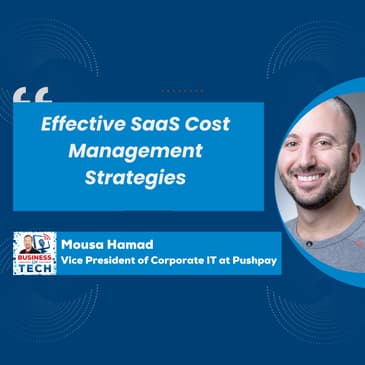
Mousa Hamad, an expert in procurement and vendor management, shares insights from his extensive career in IT operations and business transformation. He emphasizes the importance of being customer-oriented and empathetic, drawing from his experiences on the front lines of IT. Hamad recounts a significant project where he tackled SaaS cost management by consolidating contracts and implementing a platform called Zylo, which streamlined the process and improved contract hygiene. This initiative not only saved costs but also enhanced his role within the organization, showcasing the value of effective vendor management.
Hamad discusses the alignment of procurement with organizational goals such as speed, innovation, and security. He highlights the necessity of building intentional processes that involve key stakeholders like InfoSec and legal teams early in the procurement process. By doing so, organizations can avoid unnecessary delays and ensure that purchases align with budgetary constraints. He stresses that having the right tools and processes in place is crucial for managing vendor relationships effectively and achieving operational efficiency.
The conversation also delves into measuring the success of procurement processes. Hamad explains how tracking the time taken for approvals and vendor engagements can lead to significant improvements in efficiency. By establishing key performance indicators (KPIs) and engaging vendors well in advance of contract renewals, organizations can negotiate better terms and reduce costs. This proactive approach not only enhances speed but also ensures that companies are getting the best value from their vendor relationships.
Finally, Hamad reflects on the challenges of managing rapid team growth and maintaining operational consistency across diverse teams and cultures. He advocates for a people-first approach, emphasizing the importance of communication and empathy in IT leadership. By fostering a culture that values understanding and support, organizations can navigate the complexities of growth while ensuring that both employees and customers feel valued. Ahmad's insights provide a roadmap for IT leaders looking to balance operational demands with a commitment to people-centric practices.
About Business of Tech: The daily MSP news and analysis podcast for managed service providers and IT services leaders. Host Dave Sobel covers AI for MSPs, MSP pricing and profitability, MSP M&A and private equity, vendor partner programs, MSP cybersecurity and liability, and MSP operations — and answers the question every story raises: Why do we care? Produced by MSP Radio.
💼 All Our Sponsors
MSP Radio is supported by our partners:
ABC Solutions · CometBackup · Firetail · Guardz · HaloPSA · LogMeIn · Mailprotector · Pax8 · Rythmz · ScalePad · TimeZest · Transit AI
Supporting the IT services community through insights, analysis, and transparency.
🚀 Join Business of Tech Plus
Get exclusive access to investigative reports, vendor analysis, leadership briefings, and more.
👉 https://businessof.tech/plus
🎧 Subscribe to the Business of Tech
Want the show on your favorite podcast app or prefer the written versions of each story?
📲 https://www.businessof.tech/subscribe
📰 Story Links & Sources
Looking for the links from today’s stories?
Every episode script — with full source links — is posted at:
🎙 Want to Be a Guest?
Pitch your story or appear on Business of Tech: Daily MSP News & IT Services Analysis
💬 https://www.podmatch.com/hostdetailpreview/businessoftech
🔗 Follow Business of Tech
LinkedIn: https://www.linkedin.com/company/28908079
YouTube: https://youtube.com/mspradio
Bluesky: https://bsky.app/profile/businessof.tech
Instagram: https://www.instagram.com/mspradio
TikTok: https://www.tiktok.com/@businessoftech
Facebook: https://www.facebook.com/mspradionews
Hosted by Simplecast, an AdsWizz company. See pcm.adswizz.com for information about our collection and use of personal data for advertising.
[00:00:02] One of the things we talk about in managed services all the time is vendor management. It's procurement in the corporate IT side and I figured we could learn a little bit something from somebody who's an expert in that. Mousa Hamad joins me today. He's got deep experience in building cost management and procurement organizations in this bonus episode of the Business of Tech.
[00:00:22] With every new breach and threat that I cover, it's clear that cybersecurity isn't a luxury anymore. It's a necessity. That's where Huntress comes in. Their fully managed cybersecurity platform is built for every kind of business, not just the 1%.
[00:00:38] Huntress seamlessly integrates their products and threat hunting team. Their EDR, ITDR, SIM, and security awareness training solutions are purposely built for their elite 24x7 Security Operations Center to stop threats before anyone else even spots them. This potent combination of purpose-built cybersecurity and threat hunting expertise is one of the many reasons why G2 users have voted Huntress the number one rated EDR for growing businesses.
[00:01:07] To see what people-powered cybersecurity looks like, visit Huntress.com slash MSP Radio. Mousa, thanks for joining me today. Thanks so much for having me, Dave. I'm looking forward to the conversation. Now, you've had a bit of an interesting career journey. You started on the help desk of organizations before moving all the way up to Vice President Operations. Give me a little bit of sense of what lessons from the frontline still shape your approach to business transformation.
[00:01:37] Yeah, that's a great question. I think probably the biggest overriding lesson from the front lines that shapes things today would be being customer-oriented, putting the customer first, and being empathetic towards their journey and the way they use our technology. And doing a good job of storytelling for our customers on why we're doing changes, why we're doing the things that we do or why things run the way that they do.
[00:02:04] Now, let's make that concrete. You've done a lot of digital business transformation projects. Give me a really good example of a particularly successful project. Like what was broken and how you worked through the process to make it better? Yeah. Lately, over the last seven years now, so much in the IT space internally within companies has been centered around SaaS cost management because there's just so much SaaS sprawl and proliferation.
[00:02:30] I think one of the things that I would point to would be my first foray into this, which was starting a new job and within weeks having a SaaS contract auto-renew that we didn't want to auto-renew and realizing that we had poor hygiene around understanding when our contracts expired and all of that.
[00:02:51] So what we did is we, I say we, I set out over the course of a whole month and combed through emails and Google drives and all the different repositories and places that these contracts might exist and aggregated them into one place. From there, I recognized that we didn't have anything in-house. Some folks had floated the idea of using Salesforce reporting or something like that to kind of manage alerting on renewals.
[00:03:17] But that wasn't really meeting the need because it wasn't also capturing any new spend, rogue spend that was coming into the business or going out of the business rather. So we set out to find a platform that could help. We found a SaaS platform to manage our SaaS and that platform was called Zylo. And we rolled that out, got all of our contracts into it, got all the alerting set up, established KPIs on 90 days vendor engagement,
[00:03:44] and also hooked into our ERP so we were able to see any new spend that folks were doing that we weren't across. And so a great example of that story I like to tell is when a couple folks on the sales team went out and got Evernote so that they could make notes and do stuff with their prospects. And we're just sitting there like, guys, that's what Salesforce is for, right? So we were able to go and claw that back and get rid of Evernote and redirect them towards Salesforce.
[00:04:10] But that project, the month of doing all the discovery and then the months that followed of implementing Zylo, was probably one of the most impactful, successful projects that I've done. And it opened up for me this whole other avenue and area that I could have oversight and kind of enhance my profile within the business in terms of not just being the IT guy anymore. Now, all of a sudden, you've also got some expertise in contract management and contract hygiene as well.
[00:04:37] Now, in the managed services world, we call this vendor management too because you've got to help customers do all of this. But procurement is more than just managing cost. How do you align procurement with the overall organization's goals like speed, innovation, and, of course, security? Yeah, it's velocity. So to your point, speed, when the business wants to buy something, they want to do it quickly.
[00:05:02] How we aligned it and did that is we built out a very intentional process and included those elements like InfoSec and legal and did it in a way that made sense so that we weren't having these other departments burn cycles on work that wasn't needed. And so a great example of that is you'd have John Doe, the sales guy, wants to buy this tool. And we take it and we look at it.
[00:05:29] We don't unleash legal and InfoSec on it until it's been vetted on the front end from a budget standpoint and a stakeholder standpoint. And so I think finding the right tool and solution to do this and building out a really good process because you can go get the best tool tomorrow. But if you don't have a well-mapped out process and a strong implementation, it's not going to matter. So talking to your business stakeholders, laying out a really good process that makes sense, and then finding the right tool to support that process.
[00:05:57] Because as much as some people might cringe at this, there are certain functions in a business that you just can't do manually, right? You can't be running through Confluence pages and Google checklists and this and that. You need something that automates, does alerting, does reporting, and things of that nature. Now, how do you measure that process? So for us in a past life where we've done that, we started by manually tracking.
[00:06:24] And so you identify a point at which the process starts and then you kind of pinpoint, okay, this approval spent this amount of time with IT. It spent this amount of time with finance. And you look at it overall end to end. And to be honest with you, a place that I was working, we were into 60 and 70 days that it would take from the minute a review started until it ended.
[00:06:48] Once we identified the process, built it out manually, we then understood what we needed. And that's when we went and got the tool to help support that. So the identification of that process supported the purchasing of the tool and the implementation of the tool where we saw our times go down from 60 to 70 days down to like less than three weeks. And so, of course, business leaders are going to be asking, how do I link that back to ROI? So how are you walking them through that process of showing them the return on investment?
[00:07:19] Yeah, I think, oh, in terms of going out and buying the tool and doing all of that and making the time investment, I think the ROI is measured in a couple of different ways. The first one is the speed, but which agreements move through. The second one is the amount of savings that having a good concrete process creates.
[00:07:41] So one of the KPIs that we put into place is that we engaged vendors 90 days prior to the notification period of cancellation. And what that allows you to do is a couple of things. First, I always laugh when business leaders tell me, you got to threaten them that we're going to leave or if we don't get the right price. And it's like, guys, they know we're like a week away. We obviously are not going to be able to do this.
[00:08:04] But by having that long lead time, we're able to actually meaningfully have a conversation and actually make a determination on whether or not we are willing to leave this vendor. And so that's a really big one that allows us to save money, not only on negotiating the renewal, but also we are then able to look at the hygiene of the licensing. And a lot of times that's going to reduce costs because we'll find that utilization is not as high as what we're licensed for.
[00:08:32] And it gives us an opportunity to shop against other vendors and see where the value is. And so the two big things are the speed to purchase and the amount of cost savings that we're able to realize. Now, over your career, you've worked through mergers, integrations and a bunch of those major change moments. Like what's your first move when you step in to a post M&A IT environment? Ask a lot of questions, right?
[00:09:01] Like there's going to be particularly a lot of times when we've done acquisitions, they've been fast growing companies that are early to mid stage. At least that's been my experience. And so you've got a culture and a business that's not really as intentional. They're just getting the tools that they need to move quickly so that they can deliver value. So the first thing is to ask a lot of questions. The second thing is to get a mapping of the tool stack.
[00:09:27] And then the third is to align the spend that supports that tool stack so that we can understand where we're spending our money and where we're getting value. Now, I know one of the things that's a big philosophy for you is the idea of people first. But in technology, we often reward technical brilliance over people skills. So how do you really invest in making a people first culture and making it real when deadlines and outages are the measure of success in IT?
[00:09:55] Yeah, I think attitude reflects leadership there. And so for me, it's, you know, anytime there's an opportunity when we talk about being people first, I think in this context, it's about communicating. People just want to understand what is happening and why it's happening. And then they'll usually be OK with whatever is going on. I find that you get more grace, you catch more flies with honey than you do vinegar, right?
[00:10:23] And I think you get more grace from people when you lean in with communication, empathy and kindness. And if I set that tone as the vice president and I, you know, that's the culture that we build that hopefully trickles down. I'll be honest. It is hard balancing it from a leadership perspective, because when you have that frontline individual contributor in IT and you've got the person that's in the business that feels like they're not being supported, there's a friction and a tension there.
[00:10:50] And you have to be really careful to not give the appearance of taking sides and that mindset that the customer is always right kind of, you know, disenfranchises the people within the IT team. And so you have to balance that. And so much of that comes back to communication and being willing to understand and meet people where they are in terms of what their concerns are.
[00:11:10] Being heard, I think, you know, as I sit here and I talk through this for a lot of folks, being people first is just willing, being willing to give them an ear so that they can vent whatever frustration they've got. And then we can move on to a resolution. Do you have a particular example that's come into mind of that conflict and how you work it through? You know, the easiest example is would be interaction between tier one or tier two help desk tech and the and a staffer.
[00:11:40] And it's just as simple as, you know, this is one that plays out so often. Right. You've got the user that's just complaining about their computer. It's too slow. They don't feel like they're getting the level of support. They don't feel like IT really understands what's going on or thinks it's that big of a deal. And so that scenario has played out countless times over my career. And the resolution there is do the reading, right?
[00:12:03] Read the ticket, understand the audit trail, know what's been done so that you can see what the IT individual has done to try to support this person. But also put yourself in the shoes of the person performing a job function. So I had an individual whose sole focus was to do customer webinars and they were having issues with their audio drivers and their video drivers. Right. And in our tech, countless cycles were burned trying to do this, do that.
[00:12:29] And I finally I finally said to this individual, I said, look, this computer is just a few months away from refresh anyway. You have the latitude here to just say, hey, you know what, user, I'm going to go ahead and just fast track your your new machine because it's clear that this is a core function of your job that you're missing. And we want to make sure you're supported.
[00:12:48] The big thing there is to have that message come from the frontline IT person and not from me, because then it doesn't seem like I'm stepping on toes or superseding their judgment and the way they approach things. Some argue that scaling teams quickly leads to that inevitable inefficiency and culture dilution. You know, it's harder to manage more people when you've got got smaller bits, but you've done it multiple times.
[00:13:13] So what's the case and how do you successfully manage rapid team growth when the common wisdom is grow slow to go far? Yes. OK. Well, common wisdom is great, but business doesn't always follow common wisdom. Right. And there's times where you just you have to grow to keep up with the speed of the business. And the way we do that is we don't sacrifice speed for perfection.
[00:13:39] And when you think about that, you grow quickly, but you find those points. It's kind of like climbing a mountain. Right. You find those points where you can stop and do that. Taking stock, check your equipment. You know, this is the documentation. This is the pulling everyone together and understanding what's changed over the last three months of rapid growth. And so the way to do it and the way to rationalize it is you move quick because that's what the business needs.
[00:14:04] But organically and internally, you find those times in those moments where you can take that slowdown period to assess where you're at. Make sure that everything you've done over the last three months is what's really driving the business forward and then go from there. And again, I mean, the case for it is always going to be the business needs what it needs in order to drive revenue. Our job as as IT leaders often joke, we're overhead. But overhead is meant to drive the business.
[00:14:32] And if we if we do that correctly, then we contribute to the revenue that comes in. And that's the business case. And that's one of the things that I tell a lot of the staff that I've been a part of these teams that have experienced that rapid growth because it's painful for them. But just reminding them that the business is here to make money. And it's our job to enable that in a way that is kind and empathetic to our users, but also balances what the entity itself needs.
[00:14:58] Now, as we wrap up our time here, I want to ask you've managed a lot of really large, particularly construction projects across multiple continents. Like how do you maintain operational consistency, particularly around process and delivery when navigating time zones, geographic and cultural diversity? Yeah, that's a great that's a really great question. And it comes down to finding the right core team to manage the projects. And that allows you to maintain consistency.
[00:15:27] And so while it was difficult to do this, regardless of where the construction project was happening. And so in this case, it was in Auckland, New Zealand. We had the same team in the United States running that from afar. And then we had our boots on the ground. As far as navigating the cultural differences, you can't create consistency there. And it was so funny because it was even down to the terminology that the construction professionals used in New Zealand versus the United States. And in that scenario, it was on us to learn.
[00:15:57] Right. We're not going to expect an entire slew of contractors in Auckland, New Zealand to learn our vernacular. It's on us to adapt to support them completing the project. At the end of the day, though, you know, vernacular aside, a couple of the nuances having to calculate conversion rates and taxes being done differently. Certainly. A construction project is a construction project is a construction project.
[00:16:22] And so I think if you hold on to the core tenets of what you're trying to accomplish, whether it be a $1.5 million build out of a new office or rolling out of, you know, a new network stack so that you can support the connectivity of an office. If you hold on to the core fundamental of what you're trying to accomplish and you adapt to those slight nuanced cultural differences, you usually end up experiencing success. That always comes down to the people.
[00:16:51] Musa Ahmad is a people first technology leader and served as vice president of corporate IT and procurement at Pushpay with a track record of operational excellence and strategic IT leadership across SaaS and enterprise environments. He brings over 15 years of experience spending IT operations, procurement, site reliability and executive leadership with previous roles, including at Ziff Davis and Vulcan. Musa, this has been fascinating. Thanks for joining me today. If people are interested in reaching out and learning more, what's the best way to do so? LinkedIn is definitely going to be the best way.
[00:17:20] Feel free to drop me a message. I'm always happy to talk about this stuff. It's something I'm very passionate about in terms of delivering people first while also giving businesses what they need to drive forward. Well, thanks for your time today. Thank you. The Business of Tech is written and produced by me, Dave Sobel, under ethics guidelines posted at businessof.tech. If you've enjoyed the show, make sure you've subscribed or followed on your favorite platform.
[00:17:49] It's free and helps directly. Give us a review, too. If you want to support the show, visit patreon.com slash MSP radio and you'll get access to content early. Or buy our Why Do We Care merch at businessof.tech. Have a question you want answered? We take listener questions, send them in, ideally as a voice memo or video to question at MSP radio.com. I answer listener questions live on our Wednesday live show on YouTube and LinkedIn.
[00:18:20] If you've got a comment or a thought on a story, put it in the comments if you're on YouTube or reach out on LinkedIn if you're listening to the podcast. And if you want to advertise on the show, visit MSP radio.com slash engage. Once again, thanks for listening and I will talk to you again on our next episode. Part of the MSP radio network.