
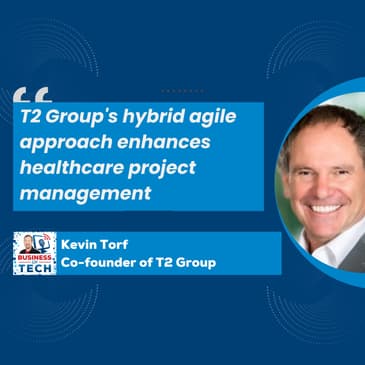
Kevin Torf, co-founder and managing partner of T2 Group, discusses the unique approach his organization takes in delivering technology solutions to the healthcare industry. T2 Group focuses on providing a comprehensive set of services, including professional consulting, managed services, contact center operations, resource management, and software development. With a team of around 100 employees, T2 Group has established long-term relationships with major healthcare providers across the United States, emphasizing the importance of understanding both technology and the business aspects of healthcare.
Torf highlights the significance of building teams with a diverse skill set that includes not only technical expertise but also business acumen and healthcare specialization. He explains that T2 Group employs a flat organizational structure that fosters collaboration and agility, allowing them to adapt to the unique needs of each project. This approach contrasts with traditional project management methods, which can be more hierarchical and rigid. By utilizing a hybrid agile methodology, T2 Group can effectively balance the need for flexibility with the compliance demands inherent in the healthcare sector.
The conversation delves into the challenges of implementing technology in a conservative and risk-averse environment like healthcare. Torf acknowledges that while many healthcare organizations recognize the potential of technology, they often face financial constraints and the need for careful planning and governance. He emphasizes the importance of patience and gradual cultural shifts within organizations to embrace new methodologies and technologies, which can ultimately lead to improved patient experiences and operational efficiencies.
Torf also discusses how T2 Group ties its projects to business outcomes, helping clients navigate the complexities of funding and resource allocation in healthcare. By understanding the financial structures of different healthcare institutions, T2 Group can tailor its solutions to meet specific operational needs. This strategic alignment not only enhances the effectiveness of technology implementations but also supports the overall mission of healthcare organizations to provide better patient care.
About Business of Tech: The daily MSP news and analysis podcast for managed service providers and IT services leaders. Host Dave Sobel covers AI for MSPs, MSP pricing and profitability, MSP M&A and private equity, vendor partner programs, MSP cybersecurity and liability, and MSP operations — and answers the question every story raises: Why do we care? Produced by MSP Radio.
💼 All Our Sponsors
MSP Radio is supported by our partners:
ABC Solutions · CometBackup · Firetail · Guardz · HaloPSA · LogMeIn · Mailprotector · Pax8 · Rythmz · ScalePad · TimeZest · Transit AI
Supporting the IT services community through insights, analysis, and transparency.
🚀 Join Business of Tech Plus
Get exclusive access to investigative reports, vendor analysis, leadership briefings, and more.
👉 https://businessof.tech/plus
🎧 Subscribe to the Business of Tech
Want the show on your favorite podcast app or prefer the written versions of each story?
📲 https://www.businessof.tech/subscribe
📰 Story Links & Sources
Looking for the links from today’s stories?
Every episode script — with full source links — is posted at:
🎙 Want to Be a Guest?
Pitch your story or appear on Business of Tech: Daily MSP News & IT Services Analysis
💬 https://www.podmatch.com/hostdetailpreview/businessoftech
🔗 Follow Business of Tech
LinkedIn: https://www.linkedin.com/company/28908079
YouTube: https://youtube.com/mspradio
Bluesky: https://bsky.app/profile/businessof.tech
Instagram: https://www.instagram.com/mspradio
TikTok: https://www.tiktok.com/@businessoftech
Facebook: https://www.facebook.com/mspradionews
Hosted by Simplecast, an AdsWizz company. See pcm.adswizz.com for information about our collection and use of personal data for advertising.
[00:00:02] The idea of bringing business acumen and business skills to project teams is an area that continues to fascinate me. And I had a feeling that the T2 Group, led by Kevin Torf, might give me some insights on how he builds teams, particularly because they've got a unique approach called hybrid agile that Kevin's even written a book about that approaches the way they deliver their services. I talked to Kevin on this bonus episode of the Business of Tech.
[00:00:30] This episode is supported by Comet Backup. Whether you get hit with ransomware, hardware failure, or human error, there's nothing more heart-stopping than losing business-critical data. Backups are your final stand when a threat penetrates your layers of defense. That's where Comet Backup comes in. Comet is an all-in-one backup solution. Whether you need to protect computers, servers, virtual environments, emails, or databases, Comet Backup empowers you to manage backups on your terms.
[00:00:57] Visit CometBackup.com to start your free 30-day trial today. Get $100 free credit when you sign up with the promo code MSPRADIO. Start running backups in 15 minutes or less. Comet Backup, the backup solution that MSPs trust. Well, Kevin, welcome to the show. Thank you for inviting me. Thank you for being part of it and looking forward to the conversation.
[00:01:24] Well, I'm always excited to talk to leaders like you that run technology organizations, particularly when they've got specializations. And I think it would be beneficial to the audience. Give me a little sense of what the T2 group does and who you're focused on and what kind of solutions you're focused on delivering. We predominantly focus in the healthcare industry and even healthcare, we can take down to more of the provider side of the healthcare industry.
[00:01:54] These are hospitals, clinics, which are providing patient services. We have four companies within the T2 group, T2 Tech, which is our professional consulting services and some of our managed services. T2 Flex, which is our contact center, which helps facilitate complex scheduling on behalf of our providers.
[00:02:18] We have T2 Talent, which helps us with our resource management and planning for our clients. And then we have T2 Ignite, which is our software development arm. Gotcha. So you're doing a bunch of different services all under the same umbrella. Now, I know my listeners always like to get a sense. Can you be a little bit of size in the organization, revenue, however you describe, you know, it's kind of the size of your org. How do you describe that? Yeah, no, we have about 100 employees today.
[00:02:49] And, you know, we're very fortunate that we have some very large clients. Most of our engagements are high-end engagements. So these are projects that are multi-year initiatives, clients that we've had for several years. And we're very fortunate. We work with some of the leading providers in the United States from Geisinger on the East Coast to Sharp Children's Hospital on the West Coast.
[00:03:18] And very much high-end, complex, future-driven services. Now, your use of the word high-end is exactly kind of where I wanted to start the conversation, because I want to understand a little bit about the way that you position T2. You position yourself much more than a project shop. You're positioning yourselves as the advisors and strategists.
[00:03:42] How do you focus on delivering a message and earning that level of trust and engagement with the leadership of these healthcare organizations? I think we try and bring a complete set of services. And, you know, when I look at technology, it's about how you utilize technology and the value technology delivers for our clients. And in order to do that, you need to understand the business.
[00:04:10] So I think something that I believe differentiates us from some of our peers is we really understand healthcare. We understand how healthcare organizations have to regulate how they financially support themselves, how revenues generated, and where technology can be utilized to help fulfill some of those initiatives.
[00:04:36] And it's that combination of really bringing that together, which I believe brings a lot of value to our clients. I would think so. Now, I would also think that you've had to make very intentional choices about the kinds of humans that you employ. You know, that you can't have only technical skills. You've probably got some combination of business analyst skills, vertical specialization, healthcare specialization.
[00:05:03] Talk me through kind of the way the teams are set up so that you can bring the right expertise to bear. Yes. You know, we have the breakdown as you normally would where you have your subject matter experts, which would be, you know, experts in that particular field that we are focusing or working on.
[00:05:24] So there's project managers, which help facilitate, coordinate and organize the implementation of these efforts and the management of them. Then there's the strategists who look at the bigger picture of how this fits within the business framework. So these resources, you know, aren't very different to the resources I'm sure everyone else brings. I'd say what makes us unique is the way we implement and manage.
[00:05:53] We use a very agile approach. It's a very flat structure. It's very team driven. And we build our skill sets based on our clients needs where we work together as a partner.
[00:06:08] And it takes away a lot of that decision making and hierarchical structure, which is very typical of many other type of project engagements to a very flat structure. So it's interesting to me that I always find that people who are experts in their field, like you always assume a level of expertise than everyone else.
[00:06:33] I would argue that your organization probably is more unique than you think in its hiring, in its build up alone, as well as its approach, because a lot of technology solution providers are very heavily technology focused without the business acumen. So before we get into the agile technique, which I definitely want to know a little bit more, give me the breakdown of kind of a typical project team in terms of like, again, the humans and the skills they bring to bear on that, so that I can get a sense of who those humans are. I'll give you an example of a project I'm working on today.
[00:07:03] We optimize in the intake of patients for a healthcare facility. So we will have a person that's leading the strategy, which in this case is myself.
[00:07:17] Part of this project isn't about just helping our client achieve and deliver on these applications, but it's also trying to build the governance and how the decisions are made and how the projects execute it. So for that, we'll have what I refer to as a scrum master. This would be a project program leader that will help govern this. I'll have another resource that will help with the mechanics.
[00:07:46] We change in a lot of the way in which they manage the efforts and their tasks. We move in from a typical project management platform to a more versatile agile platform. We're using JIRA as a tool to help facilitate that. So we'll have someone that is preparing all those stories and helping facilitate the coordination of putting the data into the tool set.
[00:08:16] Then we'll have a subject matter expert that really understands patient workflows. And, you know, this particular client, all four of those resources were needed. But, you know, every engagement is unique for us. Every engagement is slightly different. So we will plan and accommodate and build the required skills needed in order to be successful.
[00:08:42] Now, I actually want to understand a little bit more about your technique, too, because, by the way, you're so focused on this. You've written a book on it called Getting the Job Done. But, you know, one of the things there is you emphasize this idea of a hybrid agile methodology. Talk to me about that, like how that approach works. Like what's hybrid about it? What are you borrowing from agile? Like what makes that approach unique?
[00:09:03] So typical project management is very, you know, has been around for hundreds of years and it was very structured and it still is very structured and still very valuable today in the fact that you have a charter or you have a very defined scope of work. You have very detailed plans with, you know, timelines as to what you need to accomplish and how long it's going to take you to achieve it.
[00:09:32] Agile really tells you only plan for what you need to plan for and don't over plan because by the time you implement a lot of these initiatives, more than likely your business needs have changed or the world's changed. So it's only do what you need to do when you need to do it. So it's very incremental in its approach.
[00:09:53] Well, you know, in truth, unfortunately or fortunately, whichever way you look at it, a healthcare system, you know, has financial obligations. They have needs. They have requirements to deliver certain things by certain times. They have a lot of coordination. They have a lot of dependencies. So you can't just throw typical project management out. You still need budgeting. You still need governance.
[00:10:19] And you still need to set a date and a timeline, which is what your objectives are. You know, agile really says, well, just get on with the work and get started. So while we refer to this as a hybrid approach, we like to execute in a very agile way. So the day to day discussions and collaboration and coordination is done within an agile framework.
[00:10:44] But this is still managed within a larger typical project management arrangement. And that's where the hybrid approach comes in. It makes sense. So how do you strike the balance then between project agility and the rigid compliance demands of healthcare? It's hard. It's not easy. I wish I had the answer. I try.
[00:11:10] And, you know, it takes time for an organization to mature. You know, we use the model. It's a model from Tuckman. Tuckman talks about, you know, how to norm, storm and, you know, perform and how you go through the different stages of maturity.
[00:11:30] And, you know, when we start off on these engagements, it's sometimes there's a cultural shock from managers that and stakeholders and sponsors that are very typical to doing things in a way that, you know, allowed them to be in those positions for many, many years. And we ought to break that down slowly. Now, we mustn't forget what their obligations and responsibilities are.
[00:11:56] So there's a lot of coordination that's required, but you need a lot of patience as well. This takes time. It doesn't happen overnight. Yeah, I would think that that's also balanced with the element of overcoming the conservative pace of change that tends to be in healthcare. And I think that perhaps is a nice, a polite way of saying it, right? Conservative, yeah. How do you push technology innovation in such a conservative, careful environment?
[00:12:26] Well, you know, most healthcare organizations know of technology, you know, more so than they maybe use it. They just maybe can't afford it or it takes a lot of time to implement because of the governance and process that's required. When you implement a new project, there's, you know, there's a lot of risk associated with a lot of these initiatives. So you need a lot of checks and balances.
[00:12:52] You need to validate and test a lot of testing in order to make sure that you're going to really minimize disruption. You also, in most cases, not all cases, but in most cases, don't have the benefit of any, you know, hours that you can work within. I mean, because technically, you know, healthcare organizations, if you're talking a hospital, for example, is 24 by 7.
[00:13:20] And you can't just say, all right, I'm going to bring down the systems for a few hours or a few days. I mean, there are times that you have to do that. So with all of those constraints, you know, it's a ramification from that has been healthcares are very conservative, rightfully so. They don't want the risk. They need to think things through very carefully before they do it.
[00:13:49] And the cost of these to implement these applications is very, very expensive. So it's finding those balances and, you know, the leading organizations that have been able to get through that have been very successful. There's some very well-run healthcare facilities. And there's some, unfortunately, that still do struggle. Now, give me a little bit of the indicator then of how you're tying this back to their business.
[00:14:17] I would assume some of your most successful projects are tied to the business outcomes that you're able to deliver. Talk me through a little bit about how you're working through that and show them the benefits. Well, you know, a lot of healthcare, depending on how the healthcare institution is funded, whether it's a nonprofit, whether it's through foundations, whether they are Medicare, Medi-Cal, might determine what their funds available are.
[00:14:42] So, as an example, some healthcare facilities might have more capital versus more operational expenses. Some might have more operational expenses, ability to fund operational expenses versus capital. So, as an example, in a data center, your typical data center, you know, was very capital intensive. You went out and bought a lot of equipment. You had to refresh it every few years as technology changed.
[00:15:11] That's very capital driven. You know, with the cloud today, a lot of those services have now become operational. So, you know, people think, oh, we should all go to the cloud. And, you know, that's the future. And yes, in many cases it is. But when, you know, the way you asked the question about, well, what does the business need?
[00:15:32] You know, some healthcare facilities would rather lay out the capital because it might be better financially structured for them. And therefore, the cloud doesn't have as many advantages as more than a facility that was able to increase their operational spend. So, here the business can play into the technology decisions without just saying, well, what's the best technology? What's the best way of doing this?
[00:16:00] So, I would think then you've probably got a framework to think about avoiding those big mistakes. How do you help clients make sure they don't stumble down the wrong path? Well, sometimes they unfortunately have to stumble to realize they've stumbled. Isn't that the rule in life?
[00:16:19] No, you know, we work in a very good – we're very fortunate to work with a very good number of clients who are always looking to do what's right and what's going to be the best and how to advance the patient experience. So, I would say it's the answer to your question.
[00:16:43] It's getting easier because for healthcare systems to be financially viable and to profit – I mean, profit in the framework, they are nonprofits – but to be able to utilize the funds and resources to do more things, they have to find a way to be more efficient. And technology definitely is becoming one of those tools. Well, that seems to be the theme that goes through all of these client deployments is finding those efficiencies.
[00:17:11] Kevin Torf is the co-founder and managing partner of T2 Group, a veteran IT executive with over 40 years of experience leading complex infrastructure deployments globally. He's known for his hybrid agile project management methodology, and Kevin advises top U.S. hospital systems on strategic technology planning and execution. Kevin, if people are interested in learning more, what's the best way to get in touch? Kevin Torf is the T2 Group.
[00:17:37] T-2-G-R-O-U-P dot U.S. And they'll find out a lot about the company. If they want more information, they can fill out some forms on the website. There's also the ability for them to download my book where they can get a free copy of it. And it will talk to a lot of our methodology and our approach to what I believe has been one of the reasons we've been able to be successful.
[00:18:08] Well, that is a great resource to get access to. Kevin, thanks for joining me today. No, my pleasure. Thank you for the conversation. And thank you for being part of it. The Business of Tech is written and produced by me, Dave Sobel, under ethics guidelines posted at businessof.tech. If you've enjoyed the show, make sure you've subscribed or followed on your favorite platform. It's free and helps directly. Give us a review, too.
[00:18:36] If you want to support the show, visit patreon.com slash MSP radio and you'll get access to content early. Or buy our Why Do We Care merch at businessof.tech. Have a question you want answered? We take listener questions, send them in, ideally as a voice memo or video to question at mspradio.com. I answer listener questions live on our Wednesday live show on YouTube and LinkedIn.
[00:19:03] If you've got a comment or a thought on a story, put it in the comments if you're on YouTube or reach out on LinkedIn if you're listening to the podcast. And if you want to advertise on the show, visit mspradio.com slash engage. Once again, thanks for listening and I will talk to you again on our next episode. Part of the MSP Radio Network.