
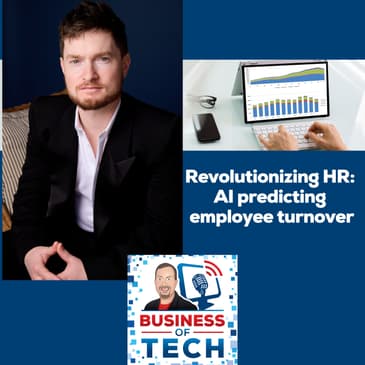
Tyler Hochman, CEO of FORE Enterprise, discusses their AI workforce analytics platform that predicts employee turnover before employees themselves are aware of their intentions to leave. The technology utilizes a combination of external and internal data sources to create predictive models on both aggregate and individual levels. External data sources include census information, demographics, and economic trends, while internal data encompasses employee performance metrics like utilization and schedule adherence.
Hochman highlights the importance of data organization and structuring for effective data analytics, emphasizing that manual data structuring can be cost-effective for small-scale operations. However, as organizations grow beyond a certain size, automation becomes more efficient. The discussion also delves into the privacy considerations surrounding employee data collection, with Hochman emphasizing the need to respect employees' existing understanding of performance tracking metrics.
The conversation shifts to actionable insights derived from the predictive analytics, with Hochman identifying key factors that indicate employee turnover. For highly utilized employees, burnout, competitor risk, and upward mobility within the organization are significant predictors. In contrast, low-utilized employees may leave due to factors such as team composition, communication issues, and skills mismatch. Hochman stresses the importance of targeted intervention strategies tailored to the specific reasons driving employee turnover.
In conclusion, Hochman underscores the value of leveraging AI and machine learning techniques in data analytics pipelines to handle large volumes of data efficiently. By streamlining data acquisition, structuring, and analysis processes, organizations can gain valuable insights to optimize workforce retention strategies. The episode provides practical insights into utilizing data analytics to forecast employee turnover and implement targeted interventions for improved employee retention.
Supported by: https://trinitycyber.com/msp4/
About Business of Tech: The daily MSP news and analysis podcast for managed service providers and IT services leaders. Host Dave Sobel covers AI for MSPs, MSP pricing and profitability, MSP M&A and private equity, vendor partner programs, MSP cybersecurity and liability, and MSP operations — and answers the question every story raises: Why do we care? Produced by MSP Radio.
💼 All Our Sponsors
MSP Radio is supported by our partners:
ABC Solutions · CometBackup · Firetail · Guardz · HaloPSA · LogMeIn · Mailprotector · Pax8 · Rythmz · ScalePad · TimeZest · Transit AI
Supporting the IT services community through insights, analysis, and transparency.
🚀 Join Business of Tech Plus
Get exclusive access to investigative reports, vendor analysis, leadership briefings, and more.
👉 https://businessof.tech/plus
🎧 Subscribe to the Business of Tech
Want the show on your favorite podcast app or prefer the written versions of each story?
📲 https://www.businessof.tech/subscribe
📰 Story Links & Sources
Looking for the links from today’s stories?
Every episode script — with full source links — is posted at:
🎙 Want to Be a Guest?
Pitch your story or appear on Business of Tech: Daily MSP News & IT Services Analysis
💬 https://www.podmatch.com/hostdetailpreview/businessoftech
🔗 Follow Business of Tech
LinkedIn: https://www.linkedin.com/company/28908079
YouTube: https://youtube.com/mspradio
Bluesky: https://bsky.app/profile/businessof.tech
Instagram: https://www.instagram.com/mspradio
TikTok: https://www.tiktok.com/@businessoftech
Facebook: https://www.facebook.com/mspradionews
Hosted by Simplecast, an AdsWizz company. See pcm.adswizz.com for information about our collection and use of personal data for advertising.
[00:00:02] What if you could know your people were going to leave before even they knew they were going to leave? Tyler Hochman joins me today. They've got a technology that specifically focuses on that, using data, analytics, a little bit of artificial intelligence, on this bonus episode of the
[00:00:20] Business of Tech. Trinity Cyber offers MSPs a revolutionary new capability to grow your business and improve your margins. Trinity Cyber is the solution to an industry overly dependent on detective controls and over-optimized for incident response. It's time to go from reactive
[00:00:39] to proactive defense. Here's what Wayne Porter, owner of MSP Allegheny Computer Services has to say. With previous advanced threat protection software or intrusion prevention systems, our only options were block and alert. But with Trinity, we can remove, we can modify,
[00:00:58] we can replace. And that's really what makes Trinity so unique. Help your customers improve security, save time, and enjoy a higher service level. Visit trinitycyber.com slash MSP4 to learn about their discounted MSP pricing options. Well, Tyler, thanks for joining me today. Thank you for having me.
[00:01:20] All right, we're going to start with an overview of this because you've got a technology that's predicting employee turnover. Tell me a little bit about how that works. Yeah, so you have to look at the workforce labor market holistically to draw the picture.
[00:01:39] We take into account a variety of external and internal data sources in order to create an amalgamation of data that can then be used to predict both on an aggregate basis and an individual basis whether or not people will stay or leave in a business.
[00:01:59] Okay, tell me what kind of data are you using to do the predictions? Yeah, it's a great question. So on the aggregate basis, on the external side, we use a variety of different data sources, everything from census
[00:02:13] information based on demographics, based on regions, all the way down to macroeconomic trends, microeconomic trends. There's about 17 data sources that we draw from externally. And then we couple that. And so we can actually make predictions solely externally,
[00:02:32] which is kind of cool. We've gotten there, but we haven't necessarily commercialized the product where you can give a name and see their likelihood of turning over solely based on an external
[00:02:45] digital footprint. We haven't gotten to that point yet. Right now, we would be more on a company by company basis, we can predict externally. But if you couple that with internal data... And this is data that we're very cautious about privacy. So this is data that every employee
[00:03:01] knows is being collected, everything from your utilization to your schedule adherence, the basis of what forms your job performance. We can use that coupled with our external data to then determine your likelihood of staying or leaving at your business.
[00:03:16] Okay, I got a bunch of questions there. Because one of the things that has been interesting to track in the AI space is that in order for data to be usable, there's oftentimes
[00:03:26] a lot of requirement for the end customer to do a bunch of data cleanup or data organization or data management. How much is that true for your product? And tell me a little bit about what that looks like? Yeah, that's a fantastic question. So when we started
[00:03:41] for, we actually didn't realize what you just pointed out. So it's a very good point. And so since then, since we've been in operation, we've actually built products, a little bit upstream that allow us to do that structuring automatically.
[00:03:58] So we built an AI data pipeline that can ingest in all these variety of data sources. On the internal side, everything from your sales force to your Asana, to your JIRA, all these different ways that you track ADP, all these different ways you're tracking your employee workforce's
[00:04:18] performance. And as you pointed out, it's not structured very well. It's a problem that a lot of businesses have is in order to make the analytics operatable, you have to first make the data well-structured. So we had to develop a solution that structures that data and then
[00:04:36] feeds it into our own pipeline, which then we generate the analytics on top of. Tell me a little bit about what you learned in that process. And the reason I'm so interested
[00:04:43] in here is I've made the basic idea forth is that even without AI, there is real value in helping businesses get their data organized for it to be useful just from a data analytics
[00:04:56] perspective. Layer on AI, we're probably going to accelerate that. But even if that doesn't pan out either as quickly or as aggressively as we think, there's value here. What did you learn in working with customers about that data organization that's useful across organizations?
[00:05:13] Yeah, it's a great point. I think that thesis is entirely true. I do not think that you inherently need AI to make data structuring, especially in a small scale, manageable. It is unnecessary.
[00:05:30] And I actually think that is a good point you're bringing up and kind of AI holistically, which is where I believe AI is best applied is when scale is necessary.
[00:05:41] If once you have a problem where the throughput is too much for your system to be able to handle it, then you employ AI to make that easier. So on a small scale, 100%, there's a ton of value
[00:05:54] in just learning how and being consulted on how to actually manually structure this data. I mean, that's where everyone starts. And especially if you have a small enough dataset, it's actually from a cost perspective, more cost effective to do it manually than it is
[00:06:08] to do it automated. Now, once your company goes, I would say beyond 50 employees, it becomes more cost effective to automate that solution. But there's definitely a sliding scale in between. Gotcha. Well, listeners, he just highlighted where the opportunity is. Let's
[00:06:25] remember that. So then, Tyler, as you're thinking about this, talk to me about the privacy. So if you brought it up, and that was my second other thought besides going like, hey, we can make some
[00:06:34] money here on the data bit. Wait a second, we've also got to make sure that we handle employee privacy concerns really well. Talk to me about like, the process for thinking that through and what you ended up doing to solve it. Yeah, it's another good question. So,
[00:06:50] there's a whole range of the way employers look at employees from a privacy standpoint. You have everything from very large hedge funds, as an extreme example, that track your mood, and they
[00:07:04] read your emails and your text messages. And it's very involved. And then you go all the way to small businesses that don't... It's all qualitative. They don't necessarily have the means to be kind of reading your text messages or engaging in some of those data practices.
[00:07:21] And so what we wanted to do was create a solution that didn't put any new imposition on employees from what was already... They were already okay with being tracked. And what that means is that, as an employee, you understand that your performance, as an example, is always going
[00:07:38] to be tracked. They're going to know from a utilization perspective, did you do or not do your job? How much did you do your job? How much did you not do your job? They're going to know from
[00:07:48] a schedule perspective, what time did you clock in? What time did you clock out? Those are understood parts of data collection. And I should say, the majority understand that these are commonly tracked. And so we built our whole internal solution based on those types of KPIs that
[00:08:05] everyone already knows are being tracked. So tell me a little bit about what you're finding in that. And also, to get a sense of the trends and what we can learn from the predictive
[00:08:17] nature of that. Are there particular things you look for in employees that you know are going to predict turnover? Tell me about what you're finding there. Yeah, it's actually really cool. I mean, so
[00:08:28] I know I'm biased. But one of the ones we see the most is utilization being a U-shaped term, which perfectly works well with it being called utilization. In the sense that under... So you have this really interesting thing where underutilized employees are likely to turn over.
[00:08:47] And that's for a variety of reasons. Things like the job wasn't right for them. They weren't able to adapt on board with enough... The skills didn't match the onboarding process. The onboarding process wasn't right for them. Their initial team structure wasn't right for them. There's
[00:09:02] a whole bunch of reasons at the very beginning that an employee that isn't performing very well isn't going to work. Then you have this really nice like you. And so in the middle range, the perfectly middle utilized employees, they actually don't leave very often.
[00:09:15] Your 40% to your 70% utilized employees, that's your sweet spot. Those employees perform pretty well. The job is right for them. The team composition is working for them. The communication structure is working for them. They're great. And then you have the tail end on the right side of
[00:09:34] that U-shaped curve and you have highly utilized employees. And those employees are fantastic from the perspective that they are really good at their job. And from a turnover perspective, they are super high risk of leaving. So you actually... Once you get past that 90%
[00:09:48] utilization range, they are almost... They are as high or even higher risk of leaving than the employees who the job wasn't right for in the beginning, which we found is pretty shocking. It's a couple of things. It's the burnout risk. It's now you're being approached by competitors.
[00:10:04] And so now you're more attractive in a competitive landscape. There's a couple reasons on both those tail ends, but the curve is really interesting. Now that's fascinating, particularly in an industry like managed services where we're
[00:10:15] always looking at tech utilization and making sure that our people are optimized and automate as much as possible. And to hear that the perfect place from a retention perspective is probably a little lower than our best in class metrics, that's an interesting dynamic.
[00:10:32] What are you doing with organizations to help them there? Is this about predicting and just pointing out the problem or is there more... How do you help them adjust here? Yes, it's another good question. So we identified a gap in the market where when
[00:10:47] employers would bring in solutions to retain employees more effectively, there was never end-to-end tracking of how those retention solutions actually performed. So not only do we predict whether or not employees are going to stay or leave in a business,
[00:11:03] we actually also created an algorithmic way to track the effectiveness of intervention solutions and then prescribe intervention solutions, particularly to the right type of person. And so as I explained on that curve, the two reasons that the low utilization and high utilization
[00:11:21] are going to leave are very different than the reason someone who's highly utilized is going to leave is also very different. And so you need to understand... But we can actually tell that
[00:11:29] from the data. We can tell, is this person at risk of burnout? Is this person at risk of being poached by a competitor? And as a result of that, you need targeted intervention strategies that
[00:11:39] correlate with the reason they're going to leave. And that's a common mistake that I think a lot of people make is they say, okay, someone's going to leave. Let's throw the playbook at them. Let's
[00:11:48] throw the kitchen sink at them. Let's give more money. Let's give more time off. Let's give more time with their family. A lot of times when you do that, you actually overwhelm the employee. You make them feel like you don't actually understand them, that the reason that they're
[00:12:00] going to leave is so true. And so what you need to do is very effectively target that intervention strategy for retention to the actual cause of why the employee is leaving. Interesting. Okay. Is there a bit of a top three list of those reasons that are easily identified
[00:12:17] that you can manage organizationally? Yeah. The top three are burnout. Are you talking about on a highly utilized employee or a low utilized employee? I'd be interested in both. Let's start with highly utilized. Yeah. So the top three on a highly utilized employee are burnout,
[00:12:36] competitor risk, and upward mobility within the organization. Gotcha. And then how different does it look for the low end there, the low utilization? Yeah. I wouldn't even call it a top. There's a lot of reasons that it doesn't work. You got team
[00:12:51] composition, communication skills and dialogue, a lack of skills matching up to the job description, an inability to onboard effectively, an inability to train effectively. There's a good amount of ones that the low utilized employees. And a lot of times,
[00:13:09] turnover isn't bad. And that's actually something that I also want to point out is that you want some turnover. You want a natural organic churn in an organization. You just want to optimize it. You want to be able to forecast and predict around what that
[00:13:24] turnover is going to be. And so if you're losing some low utilized employees because the job wasn't right for them, it's actually probably a good thing. You don't want to keep those guys anyway. But you just want to make sure you can forecast and optimize for it.
[00:13:37] So you've been doing this a bunch. Is there some broad stroke, actionable insights you can offer for people that are trying to leverage data better in their organizations that you've seen? Because here's a very specific version of it. What can we share that's actionable to make people's data
[00:13:55] more useful? Oh, what a good question. I kind of get back to what I was saying earlier. I think data and actionable insights around data are most effectively applied when an organization has too
[00:14:15] much... The bandwidth isn't enough for the throughput. And so where I would go to are areas of where that's present across the data pipeline. And so we can actually come in a couple different... I imagine the data pipeline is in three steps, right? There's data acquisition,
[00:14:34] data structuring and streamlining, and then data analytics. I would say applying ML or AI techniques within that pipeline is most effective when there's too much data to be processed manually. And that ironically doesn't actually... People always
[00:14:53] assume that means the analytics phase. Sometimes it doesn't. Sometimes you can... Once you streamline and clean the data, it's very obvious what you should do. You don't need a sophisticated model. You can just see, oh... In the crudest example, you could say,
[00:15:10] oh, I'm losing a bunch of money right now. Right? Like, oh, this isn't actually... This strategy isn't working for me. I never could understand it because I couldn't clean the data
[00:15:18] and streamline the data properly. But once I did, and I just finally got all my data sources in one place, the output is consistent. It's so easy to see. I don't need an analytic to do that.
[00:15:27] And vice versa, right? Even with good, clean data at scale when there's so much of it, you now need an analytic because it's too much to manually ingest. Gotcha. Well, this has given us a ton of actionable stuff. Tyler Hockman is the CEO
[00:15:41] of Thor Enterprise, an AI workforce analytics platform that can predict which employees plan to leave their jobs even before they know. He holds a BS in management science and engineering from Stanford with a focus on data science and finance. He's founded multiple consumer and B2B
[00:15:56] apps and companies such as TH Analytics, Vela, Modern OneMore, and more. Tyler, thanks for joining me today. Yeah, thank you for having me. The Business of Tech is written and produced by me, Dave Sobel, under ethics guidelines posted at
[00:16:12] businessof.tech. If you like the content, please make sure to hit that like button and follow or subscribe. It's free and easy and the best way to support the show and help us grow. You can also
[00:16:25] check out our Patreon where you can join the Business of Tech community at patreon.com slash MSP radio or buy our Why Do We Care merch at businessof.tech. Finally, if you're interested in advertising on the show, visit mspradio.com slash engage. Once again, thanks for listening
[00:16:45] to me. I will talk to you again on our next episode of the Business of Tech. Part of the MSP radio network