
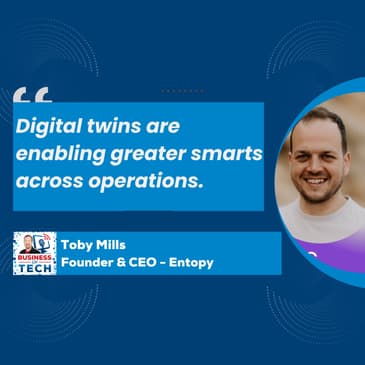
Toby Mills, the founder and CEO of Entopy, discusses the transformative role of digital twins in port operations, emphasizing their ability to create digital replicas of real-world systems. These digital twins enable ports to model complex logistics, predict vessel arrival times, and manage resources effectively. By simulating various scenarios, ports can enhance operational efficiency, reduce congestion, and ultimately save significant costs associated with missed port calls and delays.
Mills explains that the use of digital twins is particularly crucial in the context of large vessels, which require precise navigation and coordination with pilots and tugboats. The complexity of managing these operations is compounded by the dynamic nature of port logistics, where factors such as weather and resource availability can impact vessel movements. Digital twins help mitigate these challenges by providing real-time data and predictive analytics, allowing ports to optimize their operations and improve service delivery.
The conversation also delves into the integration of artificial intelligence, particularly large language models, with digital twin technology. Mills describes how these AI models can serve as intuitive interfaces for users, enabling them to query data and generate insights without needing extensive technical knowledge. This capability not only enhances user experience but also streamlines the reporting process, allowing for more dynamic and responsive decision-making in port management.
Ultimately, the discussion highlights the significant potential of digital twins and AI in revolutionizing critical infrastructure sectors, particularly in transportation. By leveraging these technologies, ports can achieve greater operational excellence, meet climate objectives, and adapt to the evolving demands of global logistics. Mills' insights underscore the importance of innovation in enhancing the efficiency and effectiveness of port operations.
About Business of Tech: The daily MSP news and analysis podcast for managed service providers and IT services leaders. Host Dave Sobel covers AI for MSPs, MSP pricing and profitability, MSP M&A and private equity, vendor partner programs, MSP cybersecurity and liability, and MSP operations — and answers the question every story raises: Why do we care? Produced by MSP Radio.
💼 All Our Sponsors
MSP Radio is supported by our partners:
ABC Solutions · CometBackup · Firetail · Guardz · HaloPSA · LogMeIn · Mailprotector · Pax8 · Rythmz · ScalePad · TimeZest · Transit AI
Supporting the IT services community through insights, analysis, and transparency.
🚀 Join Business of Tech Plus
Get exclusive access to investigative reports, vendor analysis, leadership briefings, and more.
👉 https://businessof.tech/plus
🎧 Subscribe to the Business of Tech
Want the show on your favorite podcast app or prefer the written versions of each story?
📲 https://www.businessof.tech/subscribe
📰 Story Links & Sources
Looking for the links from today’s stories?
Every episode script — with full source links — is posted at:
🎙 Want to Be a Guest?
Pitch your story or appear on Business of Tech: Daily MSP News & IT Services Analysis
💬 https://www.podmatch.com/hostdetailpreview/businessoftech
🔗 Follow Business of Tech
LinkedIn: https://www.linkedin.com/company/28908079
YouTube: https://youtube.com/mspradio
Bluesky: https://bsky.app/profile/businessof.tech
Instagram: https://www.instagram.com/mspradio
TikTok: https://www.tiktok.com/@businessoftech
Facebook: https://www.facebook.com/mspradionews
Hosted by Simplecast, an AdsWizz company. See pcm.adswizz.com for information about our collection and use of personal data for advertising.
[00:00:02] Digital Twins. It's one of those concepts that I wonder about what the actual use cases are. So when somebody pitched me that there was the idea of talking about what they're using in ports, I was intrigued. So I had on Toby Mills, who talks me through exactly how digital twins are being used in ports, what they means, and the impact of micromodal AI on the space on this bonus episode of the Business of Tech.
[00:00:28] This episode is supported by Syncro. Syncro, the integrated remote monitoring and management and professional services automation platform, is designed for mid-sized and growing managed service providers. Its latest innovations include an AI-powered smart ticket management system with automatic ticket classifications, guided resolution steps using pre-approved scripts, and a natural language smart search function. These tools streamline ticket handling and improve response times.
[00:00:57] Discover more at Synchromsp.com. Well, Toby, welcome to the show. Toby Mills- Nice. Thanks, Dave. Yeah, thanks for having me on. Toby Mills- So I'm excited to talk to you because in particular, the piece I wanted to start with is digital twins. My co-host over on the Killing It podcast is constantly telling me I don't know enough about digital twins. And I want to get a little bit of the state of play of where we're at with their use and what use cases are kind of most
[00:01:28] resonating right now in the field. Toby Mills- Okay, so I think but I'm gonna say this, I think we're at a really, really exciting time. Toby Mills- I think it's a technology that's been spoken about for some time. It's a technology that exists. I often say it's hiding in plain sight. We see digital twins, we use digital twins all of the time. Toby Mills- We just don't necessarily know or call them a digital twin. So they're there, they exist, the technology is real.
[00:01:53] Toby Mills- But what we're starting to see is this kind of need not specifically for digital twin, but the capabilities of digital twin. Okay, so, you know, just just for the audience, you know, a digital twin replica in really simple terms, digital replica of a real world thing process or system.
[00:02:15] Toby Mills- So you're thinking, you know, intangible world, you know, things like Uber, I class that as a digital twin. It's you've got cars moving around feeding information to the, to the application, people can interact with that model. But it's a model of a real world system. And it's, it's got that kind of two way connection, people are interacting with it, data is coming back. And we're familiar with that. And if you think about the capability of what that's enabling people to do.
[00:02:44] Toby Mills- It's enabling them to have much greater smarts across whatever that landscape is. Now, I think kind of what's happened is large language models have hit the kind of mainstream. People have seen this new technology, this new wonderful technology, and they've made this jump. They've sort of seen what's in a chat bot, you know, on the web, and they've made the jump as to, oh my God, this, this could start to answer questions across the real world.
[00:03:14] Toby Mills- So it's a real landscape of my operation across my business. And of course, it can't, there's a barrier there. And that barrier is being able to fully digitize and model the real world environment that you want to ask questions of, and then have the LLM be able to access that. Toby Mills- And so if you kind of start thinking about what I've just said in terms of what a digital twin is and what it can do, and then you start to combine that with this capability that we're now starting to see, which is a completely new interface.
[00:03:44] Toby Mills- It's an incredibly exciting time, I think, the digital twin. And the sort of use cases that we're starting to see through come through, you know, around operational excellence, being able to predict and model and simulate certain scenarios to aid with planning, with risk management, with meeting our sort of, you know, climate objectives.
[00:04:08] Toby Mills- There's a real kind of perfect storm starting to build and starting to curate in this space. Toby Mills- Now, I'm going to get to AI in a second, but I want to actually, because you've got some interesting practical use cases. Toby Mills- Entity solutions are actually already in major US ports, particularly focused on the idea of digital twin. Can you talk to me about what that use case is and how it's being used?
[00:04:34] Toby Mills- Yeah, for sure. So, so we focus on critical infrastructure. That's, that's our sort of domain. And a big part of critical infrastructure is transportation systems, and then you get to kind of ports and airports. So when you start looking at these, we can start to really kind of color this in now, right? So ports, are obviously logistics hubs.
[00:04:56] Toby Mills- Vessels, vessels, and vessels cooling to these ports. Some of these vessels are enormous. And, you know, some of the MegaMax vessels are 400 meters in length, they can weigh up to 280,000 tons. Toby Mills- A really cool way of visualizing that is if you do a lap of one of these boats, you run a kilometer. So that kind of gives you an idea of the scale. These things are absolutely enormous.
[00:05:18] Toby Mills- So the operation of getting these vessels in to a port is quite complicated. And you can't just have these vessels, you know, pull up like a car next to next to the side of the road, they have to have to be assisted. And this creates a kind of ecosystem.
[00:05:35] Toby Mills- To help with that, to manage that operation. And so when a boat arrives, pilots get on board these boats, these are specially trained maritime pilots that understand the waterways for that specific port. Toby Mills- And they help to navigate the last sort of 10-15 miles of its journey of its voyage. And they're assisted by tugboats. And these are much smaller, you know, tugboats that literally pull and push the boat around.
[00:06:03] Toby Mills- And then of course it, it, it, it births alongside a, alongside a terminal. And then obviously the entire operation sort of repeats on the way out. Okay. So if you can imagine the complexity in that operation, that's a, that's the real world description. Well, what happens is I think it's sort of 55, 60% hit rates in terms of the boats arriving to where they're supposed to be on time. Right. So that's dynamic straight away. You're into the world of
[00:06:33] Toby Mills- Kind of a very, very dynamic operation before the boats even arrive. When's it going to arrive, you know, and so on. And then you, and then because of the amount of actors within that ecosystem, there are, there is a very, very high risk of constraints emerging.
[00:06:54] Toby Mills- So not enough tugs being available, not enough pilots being available, births not being available. So in this particular case, digital twin can help to essentially model that entire ecosystem, predict elements of that ecosystem.
[00:07:13] Toby Mills- So resource constraints, vessel arrival times, you know, pilotage movement durations, resource utilization, birth utilization, and so on. And it can start to feed intelligence to the real world to help them mitigate those constraints. And the real problem that we're solving is sort of twofold. The first one is what we call skipped vessel calls. Okay. So, so one of the big challenges faced by ports is that when a vessel turns up,
[00:07:42] it arrives ready to, to, to, to birth at its destination birth. There's often what we sort of refer to generally as port congestion. And this is exactly what I've said, you know, that the port is not ready to accommodate that, that vessel. So the vessel has two choices. It can either drop anchor and wait, or it can skip the port, or it can skip the port. So it goes to another port.
[00:08:10] And so in either case, it's either costing the vessel money, the shipping line money, or the port money. And that happens a lot. One of the ports we're working with had something, you know, 50 to 100 port calls missed. And that costs tens of millions in terms of lost revenue. So we're talking big, big numbers here.
[00:08:34] And the second opportunity is that this idea of vessels arriving at the optimal time, you know, relative to the resources that, that, that, that are required to help it assist it to birth. And there's a real opportunity given the length of some of the voyages, these vessels go on to optimize speeds,
[00:08:57] right relative or, or, you know, in reaction, I suppose, or in, you know, proactively adjust speeds based on what we think the environment's going to look like. And this is a notion called smart steaming. And it's something that sort of evaded the port community for quite some time. In 2008 financial crisis, one of the shipping lines had this crazy idea to save money of just sailing slower.
[00:09:24] Right. And, and, and they did something called slow steaming, which is really crude. I mean, I'm, I'm going at this really, really high level, right. But they did something called slow steaming. So this is just, we slow down. And, and remarkably, if you, so vessels are sort of optimally steaming around that they're typically steaming it around sort of 16, 17, 18 knots when, when they're in open water. If you reduce the speed that they're steaming at by say five knots,
[00:09:51] that can equate to like a $90,000 per day saving in fuel. So again, monumental numbers, huge opportunity. Where does digital twin play a role? Well, it brings all of these moving parts together into a single model, provides predictability and the ability to simulate scenarios within it. And it helps to address some of these problems. Sorry, I've kind of gone quite deep into that straight away, but hopefully that gives some, some color.
[00:10:18] Yeah. No, it makes a ton of sense. And for those that fly, it's similar kind of thing that pilots will oftentimes about the fact that they speed up or slow down, depending on the needs, it's more expensive to go faster. It's a little cheaper to go slower. And that's some of the, some of the pieces of that. So I'm going to then ask, okay, you brought it up and I'm curious the impact of large language models. That makes perfect sense from the simulation side. Now you've got this new tool set in large language models. How are they applying to this system that you've built?
[00:10:46] Okay. So, so a digital twin, the digital, I'm going to dial that. Sorry. A digital twin is an umbrella term that umbrellas so many different technologies, but the central component to it all is this thing called ontology. Okay. And, and ontology is essentially a model. It's a way of modeling data in a way that's reflective of the real world.
[00:11:12] Now, of course, digital twins are typically associated with simulation and things like this, but we've, we've used that concept. It's this ability to put data together in a way that reflects the real world. To enable a concept we call AI micro models, which is traditional AI. But essentially what we're doing is we're looking at an environment like this, breaking it down into really small component parts.
[00:11:37] And we're deploying very small AI models to specific parts of that operation and they're predicting aspects. So, you know, traditional AI, you know, um, um, kind of statistical modeling, I suppose. Right. So these are really small models predicting lots of bits integrated with real time data. So you have this huge, wonderful, um, structured set of data. Some of it's probabilistic, some of it's deterministic, it's updating and moving around dynamically all of the time.
[00:12:07] We then have the challenge of putting interfaces on top of that. Okay. So you put an interface, you put a dashboard up, um, and you say, okay, well, here's, here's dashboard. These are the metrics that it shows. Obviously the user doesn't really care about all of that wonderful stuff that we've just described underneath it. They just are looking at the insights. And then what happens is a user looks at this and it, what we found quite regularly is people start to say, well, hang on.
[00:12:35] I, I, I've never really thought about looking at the business this, this way. Um, can it do this? Can we extend it to look at this? Can we integrate this insight? Can we start to, to, to build a trend around this particular dynamic? So it's a continuous DevOps process, right? The, the, the amount of requests that are coming through to us, it's pretty continual.
[00:12:59] So when we saw this large language model technology, um, moving around, we, we, we set up a, a mini team here and we said, right. The ambition with this technology is a, to provide a more intuitive interface to the user, to be able to interact with the data in the way that I've just described.
[00:13:18] So be able to go and call on some of these small micro models to get a prediction about the future, to be able to go and understand how a particular aspect of their operation is performing through a chatbot.
[00:13:30] But the other thing that we find particularly interesting is the ability for these language models, these large language models to actually start to act as ways to mitigate the ongoing DevOps requirement on us. So if you have a capability where you can have this model produce artifacts.
[00:13:57] So for example, I want to understand this particular dynamic within my organization. So it's a trend analysis. I want a chart built. Okay. Mr. Language model, can you go off and build me a chart that looks at this specific aspect of my operation? How about I want to monitor this particular, um, vessel that's arriving, or I want to understand what's happening in this particular airport terminal. Or I want to look at this road traffic dynamic.
[00:14:23] You can actually get the, um, you can actually get these models to essentially run tasks in the background. This is what we're calling kind of AI agents. You can sort of get these things to run off and, and look at the twin and monitor it and monitor aspects of, of, of, of your operational environment. And, and, and almost alert on, on certain aspects of it.
[00:14:43] So we see the large language model to answer your question directly as a very, very intuitive interface that helps us as much as it helps the customer. Does that make sense? It does. And I'm going to follow up that because I want to make sure I understand the micro models as well is the idea. And I'm probably oversimplifying, but I want to reflect back to make sure I'm understanding is the idea.
[00:15:05] Like you brought up like the fact that the tugboats work, like is a micro is the idea of a micro model that you would build one specifically around particular tugboat actions. And that's a micro model. And then that is used in conjunction with the micro model for say water movement or sea movement or the micro model for the way a particular kind of ship moves. Am I understanding the concept, right? Yeah. Yeah, absolutely. Spot on. I'll give you another use case because you've already kind of described that one, but this is kind of a really good example of it.
[00:15:35] So we were trying to predict, well, we are predicting traffic to another port, right? So this is road traffic. So this is a ferry port, slightly different. We're doing the same thing at an airport. So it's kind of agnostic. But OK, you're now trying to predict traffic across a road network. Really complicated. Loads of moving parts. Micro models here kind of comes into its own.
[00:15:57] So what we do is instead of trying to predict everything, we just look at a specific junction and we look to predict the probabilistic aspects of traffic at that specific junction. So traffic flow based on day, time, seasonality and weather. OK, we ignore accidents. We ignore roadworks. We ignore anything else. We look at the smallest possible conceivable part of that operation and build a model around that.
[00:16:24] And then we build another model at another junction, another model at another junction. So you start to get like a sort of layer of small independent and interconnected models. These then feed into another layer. OK, of models that maybe predict to a specific point in the road. So let's say, OK, so we're talking about a port. So the port has an entrance.
[00:16:45] So now what we want to do is we want to sort of federate the outputs of lots of these small micro models and integrate them in a particular way so that we can start to inform traffic. Why would you do that rather than just predicting traffic to the to the port entrance? Well, now you can start to load in real time information such as car accidents and roadworks, things that are less predictable. And then they, you know, they have their own profile and they integrate into the network as well.
[00:17:13] So it's basically it's just the principle is really simple. Look at something, break it down to the smallest possible individual components and then focus at building building models around those specific components and then integrate. OK, got it. Now, the other thing I wanted to follow up on is a little bit is your use of chat bots, because it sounds like I would oversimplify again to say it sounds like you're solving the reporting problem.
[00:17:36] Like typically in, you know, if I think about the way that we used to do things, you either expose some kind of query engine where people would have to build reports to get information or you would pre can a bunch of reports and then users would push back on that because it wouldn't do enough or would require customization. And the chat bot allows you to have an interface for users to query in open ended ways, depending on their needs at the time. Give me a sensory reaction. Am I understanding the use against the data? Yeah, exactly.
[00:18:06] Exactly right. So I put it in. Three modes at the moment, and I can probably talk about the fourth mode that and this is this is early because we're using this kind of second generation of language models in this guy. So this this is a genetic AI. This is the AI agent and finding use cases for them. OK, so mode number one is chat bot. So I want to go on and I want to ask a question. I can't be bothered to open up a dashboard or something like that.
[00:18:34] I want to know where is this particular boat or does this particular boat have any alerts to it or what is the traffic predicted for tomorrow? Something like that. OK, so these are pretty cool things to be able to ask a chat bot, but you can ask it. Next stage is what we would call deep analysis. So this is this is where I now want to start putting forward a scenario or I want it to analyze a trend or I want it to produce me a an artifact to chart on a particular aspect.
[00:19:04] So I'll give you a couple of examples. I'm now going to punch in to this to this interface. I'm going to say, right, I'm a row. I'm a roll on roll off ferry port. I have two vessel. I have vessels on regular routes, let's just say next week. I've got two. But two of those vessels are out for what we call a refit. So they're going through a refurbishment cycle. What's the impact going to be on congestion next week?
[00:19:31] Based on historical data and what the LLM can do is it can go. It can look at all of the historical information. It can understand what. OK, let's look at the tap analysis. When was the last time we had taps that fit this sort of profile? What was and it's coming back and saying, OK, there's going to be a 20 to 30 percent increase in this particular type of traffic management. And these are your traffic volumes. This is what we expect it's going to be. And you're sitting there like, whoa, this is this is like next level. OK, now that's super interesting.
[00:20:01] How about the relationship between traffic and holidays? Can you can you go and do that? So now it goes off and searches the web. It looks at the proprietary data that's in the twin, puts them all together, builds you a nice chart. So that's kind of deep analysis. And you can go deeper and deeper and deeper. And that's obviously using reasoning agents. OK, and then the third camp is is what I'm calling monitoring. And this is basically where you say, right, I've got this entire twin that I'm looking at.
[00:20:31] And there's maybe, you know. I don't know. There's all sorts of things happening. I've got this particular dashboard which shows me the things I'm really interested in that I need to know from an operational standpoint. But maybe I want to monitor something. Maybe I just want this to just run a background task. So how much money am I losing? Or every time a tap happens, can you just have a little look at what the traffic was doing just beforehand? And this sort of stuff.
[00:20:58] So this is where you actually get it to go off and run a task. And, you know, obviously there's different things that are going on there. Right. So we have an LLM that interfaces with a twin. There's lots of little models. We're calling them tools that it can interact with. The LLM basically becomes the orchestrator. So you give it a question. It understands the context. It knows which tools to go and call on.
[00:21:24] The three different modes that I've just described, the user selects which mode they want to be in. And so we're not giving the LLM the kind of ability to decide which mode because there's a bunch of reasons we've done that. But, yeah, that's how we're using it. So hopefully that kind of makes sense. But that capability plus structured proprietary data is basically what I'm talking about. When you talk about AI digital twin, it's really quite powerful.
[00:21:54] And that's the value. So that's why I appreciate it. Toby Mills is the founder and CEO of Entopy, a software company specializing in AI-enabled digital twin technology. Entopy focuses on critical infrastructure sectors implementing solutions that enhance operational and commercial performance. Notably, the company's technology is currently utilized in major UK ports to improve the decision-making process. Toby, I've learned a ton. Thanks for joining me today. My pleasure. Thank you so much for having me on.
[00:22:22] The Business of Tech is written and produced by me, Dave Sobel, under ethics guidelines posted at businessof.tech. If you've enjoyed the show, make sure you've subscribed or followed on your favorite platform. It's free and helps directly. Give us a review, too. If you want to support the show, visit patreon.com slash MSPRadio, and you'll get access to content early. Or buy our Why Do We Care merch at businessof.tech.
[00:22:51] Have a question you want answered? We take listener questions, send them in, ideally as a voice memo or video, to question at MSPRadio.com. I answer listener questions live on our Wednesday live show on YouTube and LinkedIn. If you've got a comment or a thought on a story, put it in the comments if you're on YouTube, or reach out on LinkedIn if you're listening to the podcast. And if you want to advertise on the show, visit MSPRadio.com slash engage.
[00:23:18] Once again, thanks for listening, and I will talk to you again on our next episode. Part of the MSP Radio Network.