
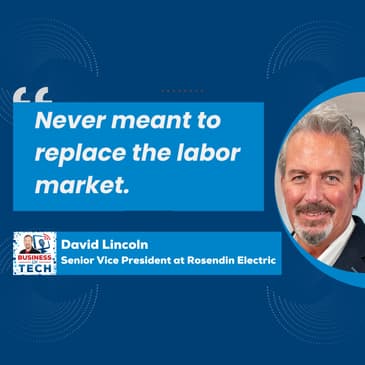
David Lincoln from Rosendin discusses the development of an innovative autonomous robot designed for solar panel installations. The robot, which features a robotic arm mounted on a track-mounted chassis, was conceived to address the labor-intensive and physically demanding nature of installing heavy photovoltaic (PV) modules. The idea originated after Lincoln observed robotic arms in a PV module manufacturing facility, leading to a collaboration with an R&D team to create a prototype that could operate autonomously, significantly reducing the need for human labor while enhancing safety and efficiency on solar farms.
The autonomous robot operates alongside two carriers that transport the solar panels, allowing for a streamlined installation process. As one carrier is emptied, the robot can switch to the other, ensuring a continuous workflow. This system not only reduces the number of workers needed on-site—from a typical crew of four to just two—but also minimizes the physical strain on workers who would otherwise have to lift and transport heavy modules. The robot's design incorporates safety features such as emergency stop buttons and sensors to prevent accidents, making it a valuable addition to the workforce rather than a replacement.
Lincoln emphasizes that the goal of the robot is to complement human workers rather than replace them. The technology allows for a more efficient installation process, which can lead to significant time and cost savings on large-scale solar projects. The robots are designed to operate in remote locations, where labor can be scarce, and their autonomous capabilities help mitigate logistical challenges associated with transporting workers to and from job sites.
Looking ahead, Lincoln envisions further applications for the technology, including potential partnerships with major manufacturers to mass-produce the robots for broader use in the industry. The team is also exploring additional functionalities, such as integrating ground-penetrating radar or mowing capabilities into the carriers. By continuously refining the technology and seeking new opportunities, Rosendin aims to remain at the forefront of innovation in the renewable energy sector.
About Business of Tech: The daily MSP news and analysis podcast for managed service providers and IT services leaders. Host Dave Sobel covers AI for MSPs, MSP pricing and profitability, MSP M&A and private equity, vendor partner programs, MSP cybersecurity and liability, and MSP operations — and answers the question every story raises: Why do we care? Produced by MSP Radio.
💼 All Our Sponsors
MSP Radio is supported by our partners:
ABC Solutions · CometBackup · Firetail · Guardz · HaloPSA · LogMeIn · Mailprotector · Pax8 · Rythmz · ScalePad · TimeZest · Transit AI
Supporting the IT services community through insights, analysis, and transparency.
🚀 Join Business of Tech Plus
Get exclusive access to investigative reports, vendor analysis, leadership briefings, and more.
👉 https://businessof.tech/plus
🎧 Subscribe to the Business of Tech
Want the show on your favorite podcast app or prefer the written versions of each story?
📲 https://www.businessof.tech/subscribe
📰 Story Links & Sources
Looking for the links from today’s stories?
Every episode script — with full source links — is posted at:
🎙 Want to Be a Guest?
Pitch your story or appear on Business of Tech: Daily MSP News & IT Services Analysis
💬 https://www.podmatch.com/hostdetailpreview/businessoftech
🔗 Follow Business of Tech
LinkedIn: https://www.linkedin.com/company/28908079
YouTube: https://youtube.com/mspradio
Bluesky: https://bsky.app/profile/businessof.tech
Instagram: https://www.instagram.com/mspradio
TikTok: https://www.tiktok.com/@businessoftech
Facebook: https://www.facebook.com/mspradionews
Hosted by Simplecast, an AdsWizz company. See pcm.adswizz.com for information about our collection and use of personal data for advertising.
[00:00:02] Sometimes it's all about a cool tech. How about autonomous robots that do solar panel installations? Well, they got my attention, so I had the opportunity to talk with David Lincoln, who is with Rosiden, who's developed this prototype robot, to talk a little bit about how it came together, what they learned over the course of development, and where they see the technology going on this bonus episode of the Business of Tech.
[00:00:26] Today's episode is supported by Huntress. Most cybersecurity solutions are built from massive enterprises with big budgets, not Huntress. They're the fully managed cybersecurity platform built for all businesses, not just the 1%. Huntress purposely builds security solutions like EDR, ITDR, SIM, and security awareness training to equip their team of elite threat hunters to handle the heavy lifting of security for you.
[00:00:52] When threat actors strike, Huntress' 24x7 Global Socks shuts them down before they're even on anyone else's radar. But they do more than just chase alerts, they lead the charge in industry research and knowledge, bringing expert protection and peace of mind. That's why users on G2 rate their EDR number one for growing businesses. To see how their expert threat hunting team gets the job done, visit Huntress.com slash MSP Radio.
[00:01:23] Well, David, welcome to the show.
[00:01:52] We're a large EPC for engineering procurement and construction as part of a third of our business is in the renewable industry. And we have some extremely large utility scale solar farms that we built. And one in particular is like 15 square miles, if you can imagine. And you can imagine. There's millions and millions of these PV modules that get installed out there.
[00:02:18] And they're getting from 89 to 100 pounds each. That's the weight of these. So you have two guys picking these modules up and carrying them. Back in 2019, I went to visit a PV module manufacturing facility. And I saw these robotic arms picking up the modules and moving them from place to place and things like that.
[00:02:43] And when I got back to my hotel room, I started thinking, you know, and I was like, I wonder if I could mount one of those robotic arms on the back of like a mini excavator, you know, it's got the backhoe on the back of it and have somebody operate it and drive it. I sketched it out on a napkin, kind of what I wanted it to look like. I gave it to our R&D team here.
[00:03:06] And they said, well, it's never been done before. But, you know, we're a bunch of MacGyvers over here and let's see what we can do and come up with, see if we can find some companies out there. So we found a company out in Long Island, New York, and they had a track mounted piece of equipment that was used for road work.
[00:03:26] And we started from that concept there and it just kept evolving meeting after meeting with all of our R&D folks and their R&D folks. And next thing you know, instead of having an individual ride on like a mini excavator, we actually made it autonomous.
[00:03:45] So it would run by itself. And then we went one step further and said, well, let's have a carrier that kind of follows it autonomously and carries the modules on it. So it took us about 18 months to develop the prototype that we have. And we have this this robot with this arm on a track mounted robot. And then it has a carrier that's track mounted. It's a diesel hybrid. Both of them are.
[00:04:15] And the idea was to have the one robot with the arm and then have two carriers, one on each side of it that would travel autonomously up and down these rows. And as one of the carriers got emptied with the modules, the robot would spin, start to empty the other one, and it would go left to right, dropping off the modules where you had two tradesmen out there installing the modules.
[00:04:40] And it was based on when one carrier got empty, the other one got filled and vice versa. And they would just complement until the row was completed. And then they all three would leave and go start another one. We would download GPS, KMZ files, all of that into it. That's kind of how it got started.
[00:05:01] And then it was, you know, what are the actual benefits just from a labor standpoint of, you know, the time motion studies that we did on. Now, I'm really curious because there's a big shift when you go from building a piece of hardware that humans can run to building an autonomous piece. Because the first is hardware, and you've got a small software component, of course, to it to move hydraulics and those kinds of things.
[00:05:26] But going to an autonomous system is a significant shift in software. And you have to think about a lot of different things. How did that shift work, and how did you bound it so that it didn't spin out of control to things that might be completely out of scope? Yeah, well, the company that we hired to help us build this prototype was ULC out of Long Island.
[00:05:49] And they already had a jump start with autonomous vehicles to the point where some of the engineers at that company, I think, even worked on the helicopter that was in Mars, you know, on the – remember that news report way back when? So they had some very smart people down there that helped with the autonomous portion of that. So they already had a head start. So that was really good for us.
[00:06:13] And then it was just us, again, a collaboration between everybody and our operations people, our field people, what they wanted to see, how they wanted to use it. And, you know, there's an umbilical cord that you can attach to it that has a game controller on it so you can set it into place and then remove that from it. And, like I said, you have all the source codes that are downloaded in there.
[00:06:38] And, you know, you're constantly tweaking the software to get it so it knows where the panels actually go, how to set them and all of that. So, yeah, so it was, again, 18 months worth of work, but we had a really good prototype working out there in the field. Now, how does it balance against human workers? Are they working with human workers? Are they replacing? How do you balance safety in that situation? Yeah, so it was never meant to replace the labor market, right, or whatever.
[00:07:08] It was always meant to complement because a lot of these utility-scale solar farms are being built, you know, pretty much in the middle of nowhere where people have to travel 50 to 100 miles to get to these. And we always wanted it to complement the workforce. So we would typically have a three- to four-person crew that would install these modules. With the robot, we're down to a two-person crew that's installing the robots.
[00:07:37] So right away, you have the time savings just on that alone. And you have the safety aspect, again, of picking up these heavy modules. So now you've really mitigated, if you will, the amount of time that it takes for a four- or three- to four-person crew to install modules to a two-person crew, right? And when you look at that, just that labor savings alone, you start to shrink the overall schedule for the module installations.
[00:08:09] Then we take it one step further. If you ever saw these big utility-scale solar farms, when we lay out the modules, they're going down the rows. About every 50 feet, we drop off a panel. As it comes off the truck, we unload it. We have to bring them down. Well, here we have these micro lay-down yards. So now there's a time savings where we don't have to spread these panels out. You can imagine over 15 square miles, as an example, they're all centrally located in these micro lay-down yards at the end of rows.
[00:08:38] And so that became another big labor savings component of it that we took into consideration. So every time we do this, we find a little more savings here, a little more there, things that we may not have thought about. Equipment, maybe I don't need the forklifts as often out there. So all these things came into play.
[00:08:58] And we've got a very, very good response out of all of our tradespeople that are working out there, let alone just from lifting up all these modules. Now, as I think about the labor force here, you've got to be thinking about other situations that make a lot of sense for robotics. Are there particular criteria you've identified that make these scenarios make the most sense?
[00:09:24] Well, I mean, there are companies out there obviously using robotics for different things. A lot of them are being used for QA, QC performances that are working throughout buildings at the end of a shift or even at night in a data center. You know, they've got multiple cameras on them. So they're running the data and then they're downloading it in real time. And someone gets to see and do QA, QC checks along those lines. I mean, for us, especially on the renewable side, we say, well, what else can we do with these?
[00:09:52] You know, it's kind of almost like a Chinese laundry list, right? Or menu, if you will. Well, can I use the carriers, the module carriers, for example, if they're not being used, can I attach a ground penetrating radar to that carrier and set up a grid pattern for it, download the files and have it go back and forth across these things? And we have that data.
[00:10:17] Can I set up these big mowers onto it and also set up a grid pattern where it's mowing the grass? So constantly looking into what else can we use these for other than just the module installation. So that would be like phase two and phase three as we move along. Gotcha.
[00:10:37] And are there particular limitations that you've been thinking about in terms of what the robots can and can't do, like scenarios that they're not good at that you've already identified that are going to lean more into the humans? No, we're trying to figure out. The next step for us would be so that the robot can pick up the module, place it within a half inch of where it has to be, and then it releases. And the two trades people out there will put it into place and lock it in.
[00:11:07] And we're trying to work with other module manufacturers and racking manufacturers to see if there's a component or a way that we can do an add-on to that robot so when it sets the module that there's potential, you know, where it screws it into place already all in one shot. Or if there's something that we can do to snap the module in all in one shot. So, again, we're a bunch of MacGyvers, as I said, out here. So we're always looking for ways to try and improve that.
[00:11:36] And that would probably be the next logical step for us to see if we can do it all in one motion and put that into play. Now, I'm curious about the teams, too, because as I think about the scenarios that this makes sense, it doesn't sound like you're replacing what I might call unskilled labor. In fact, the people you specifically said they're tradespeople. Talk about the kind of skills required, both before robotics in this case, as well as what are the skills now on the roles.
[00:12:04] So if you think about the module installation, it's like those tradespeople there, they can be just coming into the trades, right? And that's where they're going to start. They're going to start. They're getting into renewables. They're going to start. That's probably where they'll start is doing the installation of the module. So you don't need to have a four- or five-year degree in order to be able to do that. And we'll take those individuals that have that four- and five-year degree, say they're coming through an apprenticeship program in the union,
[00:12:31] we put them on more highly skilled aspects of the project, of the wire installation and things like that. So we try to take certain individuals on one side for the modules and other individuals for a highly skilled aspect of the construction project as a whole. And then, you know, I wanted to mention one other thing you mentioned about the safety aspect of it is that each two-person team that's on each side of the robot going down the road,
[00:13:01] you also have an emergency EPO button. So if anything were to go wrong, they hit that EPO button, powers off the robot altogether. And then there's also lasers on the robot and LIDAR that if somebody were to walk in front of it by accident, you know, one of the trace people, it will stop automatically until it's clear.
[00:13:25] So there's a lot of safety components, if you will, built into the robot and the carrier itself too. Interesting. Now, the other thing that would be of note here is that this is, particularly robotics, is an area that is moving reasonably rapidly. There's a lot of different technologies. How are you ensuring that all the robotic systems here remain cutting edge? I don't think they need to be bleeding edge, but how are you remaining in that position of cutting edge and that they don't become obsolete shortly after deployment?
[00:13:53] Yeah, I mean, you know, we built a very, very robust robot. I've been telling everybody, we built a Rolls-Royce and we probably don't need a Rolls-Royce. We probably need more of like a Chevy out there to do it. And when we first had these prototypes brought down to the project site, you know, we tried to break them. That's what we wanted to do, right? But they're very, very well engineered with NEMA 4X, you know, stainless containers around them.
[00:14:22] And we had to tweak some certain things like that. But most of it is readily available parts, if you will. And that's what we wanted to make sure that we could get. We don't want to do anything too crazy where, you know, it was harder to get parts for it or it was going to change quicker.
[00:14:43] I mean, that's one of the reasons why we did a diesel hybrid electric, both units, so that these things could literally run 20 hours a day. So really, there's not too many things that would become obsolete on it. If it's anything else, it's going to be software. AI is probably going to come into play on these things. When we first launched these out in the field, we had Wi-Fi.
[00:15:10] So we had to make sure we had Wi-Fi enough to get the GPS and all that. Now Starlink has come into play. That will probably be the next for us to make sure that we're linked up with Starlink since we are in the middle of these remote locations, especially down in Texas. Gotcha. Well, I think you even answered my next question of what you think is next. So what's kind of your wish list of technologies that would make these robots even more useful out in the field?
[00:15:38] Well, I think for us, you have to go back, you know, back in, I don't know, 1920 when we first started thinking about this. It was never intended for us to build these robots and just use Verosaden. It was never our intention.
[00:15:55] Our intention was to build these and possibly find a manufacturer like a Caterpillar or a John Deere or a JCB, somebody like that, that could then take these and maybe use some of their components, track-mounted components that they have, and take the IP, everything that we have, kind of value engineer it, and maybe get it from the Rolls-Royce down to the Chevy, and for lack of a better term, mass-produce these.
[00:16:24] Because we always envisioned these containers that had three units in them, the robot and the two module carriers in a container, like a shipping container, and multiple containers being dropped off at sites. Then the next phase was us, well, if we had a manufacturer that, say, bought these from us, the IP and everything, mass-produced these, then we said, well, maybe we'd get them in a rental pool with like a Sunbelt or a United Rentals that would pick these up
[00:16:53] and then rent them out to other EPCs or other general contractors that are doing solar module installations. That's our big vision. That still is our goal today, is to try to find somebody to purchase the prototypes that we have and get them out in the market. Because we know what we're really good at. We want to stay in our lane, and our lane is not manufacturing these robots. Gotcha. David, I've learned a ton. Thanks for joining me today.
[00:17:23] If people are interested in learning more, how can they do so? They can email me at dlincoln at rosadin.com. It would probably be the easiest way to get in touch with me. Awesome. Well, thanks for the conversation. Yeah. Same here, Dave. Thank you. I appreciate it. Are you and your clients tired of the time-consuming ticket tennis of coordinating meetings and help desk calls?
[00:17:48] Wouldn't it be better to automate this process with a tool that connects directly to ConnectWise Manage or Autotask? TimeZest offers scheduling automation that gives you complete control of your schedule and eliminates the hassle of calendar ping pong. As the only service designed specifically for MSPs, it integrates into your workflow and makes scheduling appointments easy on you and your clients.
[00:18:15] Plus, you can try TimeZest for free. Visit TimeZest.com slash MSPRadio and use the code MSPRadio to get 10% off your first year of TimeZest. The Business of Tech is written and produced by me, Dave Sobel, under ethics guidelines posted at businessof.tech. If you've enjoyed the show, make sure you've subscribed or followed on your favorite platform.
[00:18:44] It's free and helps directly. Give us a review, too. If you want to support the show, visit Patreon.com slash MSPRadio and you'll get access to content early. Or buy our Why Do We Care merch at businessof.tech. Have a question you want answered? We take listener questions, send them in, ideally as a voice memo or video to question at MSPRadio.com.
[00:19:10] I answer listener questions live on our Wednesday live show on YouTube and LinkedIn. If you've got a comment or a thought on a story, put it in the comments if you're on YouTube or reach out on LinkedIn if you're listening to the podcast. And if you want to advertise on the show, visit MSPRadio.com slash engage. Once again, thanks for listening and I will talk to you again on our next episode. Part of the MSP Radio Network.