
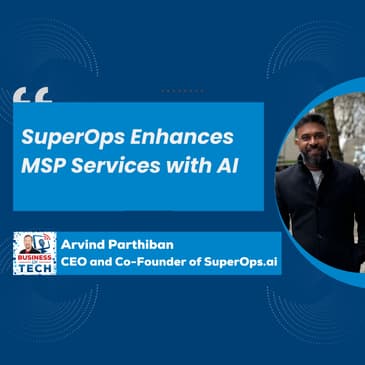
Arvind Parthiban, CEO of Super Ops, discusses the company's growth strategy following a recent $25 million Series C funding round. With a focus on artificial intelligence (AI), Super Ops aims to enhance its platform for managed service providers (MSPs) by developing innovative features that streamline IT management. Parthiban emphasizes the importance of being close to customers, revealing plans to relocate the leadership team to the U.S. and expand into European markets. The company is committed to building a strong presence in the MSP sector, leveraging AI to transform service delivery.
Parthiban differentiates Super Ops' approach to AI from competitors by viewing it as a foundational element rather than a mere feature. He argues that while many companies are integrating AI functionalities, true differentiation lies in how these technologies are applied to solve real-world problems for MSPs. Super Ops has invested in a dedicated AI team in New Zealand, focusing on creating meaningful tools that enhance operational efficiency and service quality for its users.
The conversation also touches on the challenges of data access for AI development. Parthiban acknowledges that while Super Ops has a growing customer base, competitors with larger datasets may have an advantage. However, he believes that the company can still leverage its existing data and partnerships to create valuable AI-driven insights and automation tools. He asserts that the focus should not solely be on data volume but also on the quality and applicability of the AI solutions being developed.
Finally, Parthiban addresses concerns regarding Super Ops' marketing strategies, which some MSPs have described as aggressive. He defends the company's approach, likening it to common practices in the tech industry, while also expressing a desire to build trust within the MSP community. He clarifies that while the company is not currently monetizing its AI features, it plans to ensure that MSPs see tangible value before implementing any pricing changes. This strategy reflects a commitment to fostering long-term relationships with customers as the industry evolves.
About Business of Tech: The daily MSP news and analysis podcast for managed service providers and IT services leaders. Host Dave Sobel covers AI for MSPs, MSP pricing and profitability, MSP M&A and private equity, vendor partner programs, MSP cybersecurity and liability, and MSP operations — and answers the question every story raises: Why do we care? Produced by MSP Radio.
💼 All Our Sponsors
MSP Radio is supported by our partners:
ABC Solutions · CometBackup · Firetail · Guardz · HaloPSA · LogMeIn · Mailprotector · Pax8 · Rythmz · ScalePad · TimeZest · Transit AI
Supporting the IT services community through insights, analysis, and transparency.
🚀 Join Business of Tech Plus
Get exclusive access to investigative reports, vendor analysis, leadership briefings, and more.
👉 https://businessof.tech/plus
🎧 Subscribe to the Business of Tech
Want the show on your favorite podcast app or prefer the written versions of each story?
📲 https://www.businessof.tech/subscribe
📰 Story Links & Sources
Looking for the links from today’s stories?
Every episode script — with full source links — is posted at:
🎙 Want to Be a Guest?
Pitch your story or appear on Business of Tech: Daily MSP News & IT Services Analysis
💬 https://www.podmatch.com/hostdetailpreview/businessoftech
🔗 Follow Business of Tech
LinkedIn: https://www.linkedin.com/company/28908079
YouTube: https://youtube.com/mspradio
Bluesky: https://bsky.app/profile/businessof.tech
Instagram: https://www.instagram.com/mspradio
TikTok: https://www.tiktok.com/@businessoftech
Facebook: https://www.facebook.com/mspradionews
Hosted by Simplecast, an AdsWizz company. See pcm.adswizz.com for information about our collection and use of personal data for advertising.
[00:00:02] I really do enjoy sitting down and talking to the leaders of the various MSP platform companies to discuss their strategy. I had the chance to sit down with Arvind Parthiban, the CEO of SuperOps, and we talked about their strategy, their recent investment round, marketing strategies, and the upcoming changes on this bonus episode of the Business of Tech.
[00:00:27] Are your customers getting the most from their Microsoft 365 Business Premium subscriptions? Are you delivering maximum value while ensuring best-in-class margins? Nerdio's new modern work features let you streamline the management of Microsoft technologies like Azure Virtual Desktop, Windows 365, Intune, and Defender. Reduce the need for multiple tools, consolidate your vendor stack, and deliver greater value to your customer.
[00:00:52] Help your customers maximize their investments, free up your team for strategic tasks, and drive meaningful business outcomes. With Nerdio Manager for MSP, a single flexible platform with mix-and-match plans ensures a flexible perfect fit for you and your customers. Deliver solutions that achieve real business impact. Visit GetNerdio.com to find out more. Well Arvind, thanks for joining me today.
[00:01:22] Oh, it's a pleasure. Looking forward to our conversation today. I am too. And you know, SuperOps is a newer entrant into the space, and that's relative because you've been doing this for a number of years now. But in a space that has some established players that are 20, 25 years old, you know, that certainly makes a difference. And you've done close a recent Series C round for $25 million. Talk to me a little bit about what your plans are for scaling SuperOps and the intention of utilizing that investment. Absolutely.
[00:01:51] So we have been in the industry for almost four to five years right now. And initially we did enter the market. We had some initial traction. We really got good traction from our initial customers. Most of our customers are in the US. But what's happening right now in the world, I think, goes without saying. Everyone are talking about AI and how AI is going to revolutionize every industry, not just MSP industry.
[00:02:18] I think the first place where I would want to double down on our investment is to invest in AI on how it can help evolve this industry, help transform this industry. So we did create an office in Christchurch in New Zealand. We have a team of AI who is just focused on investing on how to build more functionalities and features and products for the MSPs. So we're going to double down on investment in AI.
[00:02:48] That's my first area. The other is we would want to be much closer to the customer. We did open an office in US recently, and we would want to. I'm moving to US by the way. I'm moving to Bay Area next month, and we're going to move the entire leadership to US and we want to move our make sure that we are officially headquartered, not just on paper, but we are a headquartered, a US headquartered company and double down on expanding in the Europe and UK market.
[00:03:17] Next year, we want to open an office in UK and Europe as well. So doubling down on our presence in the local markets, sales and leadership offices around the globe. Well, congratulations on the upcoming move. I know that's always an exciting time. Now, you've led with AI since founding, though. That's something that you've talked about. And it's not, you know, it's fair to say that your competitors are not sleeping on AI, having both, you know, having several of them made announcements on that.
[00:03:46] Tell me a little bit more. What is how do you differentiate super ops use of AI in the marketplace? So everyone not talking about AI, like we are basically in the content overload of everyone talking about this is how AI is. This is how it's going to evolve. Everybody has an opinion, but I would probably take my stand. I think AI has become table stakes now.
[00:04:11] The reason why we renamed you super ops dot AI to super ops dot commerce before we did have bring in industry first features like intelligent alerting and a lot of automations and things like that. Today, what I'm saying is bringing in table stake features like ticket summarization or integrating with chat GPT or open AI. These are not features or differentiator.
[00:04:34] These are these are table stakes that you must provide as a SaaS software vendor with like giving some insights from your report or from your platform. This is not a moat. I would say the moat is there, right? Rather, we would want to think on first principles like I'll give you an example of how I look at AI. In the past, when we used to listen to music, I mean, the same to music in gramophone was normal.
[00:05:01] Then we moved to tape recorder cassettes and then we moved to iPod and then now we are listening it through Spotify, right? So everybody loves music. That's what the end outcome is. Technology changed over a period of time from gramophone to now Spotify. That's exactly how I look at AI. Everything we do and a result for us is to provide great service to our client and IT infrastructure has to be managed. How can we provide that from first principles?
[00:05:29] Is AI going to help me deliver that in a much better way? That's how we are looking at AI. And we have invested heavily where every single problem statement MSPs are going through. We are thinking with the AI hat and we are working. And there are some interesting news which we will be announcing soon on what we are going to build with agentic AI, predictive intelligence. These are some things which we are building and we'll bring it to the market soon.
[00:05:54] Now, one of the things that anybody talking about AI will talk about is the fact that the data is super important. And if I just look at this from a from a raw market positioning, right, there are two or three or two or three companies that are kind of leading the space right now in terms of market share. Super ops has been moving up the up the charts, but you're not in the top five right now in terms of MSP platforms.
[00:06:17] And I'm just using that to talk about the size of your customer base and thus also the size of the data set in order to put together really good, you know, intelligence that AI and machine learning can leverage. You've got to have the back end data set to do that. How are you thinking about that? Because your competitors would make a pretty good argument of, hey, we've got the data to be able to leverage from an automation perspective. And you are not in that position right now.
[00:06:46] So how are you thinking about the data required to build that AI automation story that you're talking about? That's a brilliant question, right? Like, so it's one part is data. That's what I would say. And again, what what happened to the AI recently is it's actually reset the race. It's not just big companies. It's it's you have to understand that data is also expensive.
[00:07:11] Like if I have to open that level of usage for all my customers to use say we have almost 1500 customers now. It's a it's a significant set of data. But for modeling, if I have, let's say, 100,000 customers and if I open it, the cost and in a day it will just explode. It's an AI is not cheap, right? We all know that it's the consumption of data is going to be really, really high.
[00:07:37] Even the big companies are worried about opening everything for all their customers. It's a restrictive usage. There is there is pros and cons in both these approach. So what we are trying to do is in certain places where you need to train the models, where you need to have the access for data there. It is important. You need a lot of customers to test it, but not all AI features need that training model.
[00:08:05] It's automation, that insight, that predictive intelligence and data to model the training. So that part, we do have a significant customer database like almost 1500 customers. And we are using our competitors. We also integrate with a lot of our vendors who help us in testing these kind of things. So I would say that's not just the edge case for us to fail in AI. It goes beyond just the data in this world. Okay.
[00:08:35] So talk to me that a little bit beyond the data. What do you think the most important elements that you're working on that allow you to be successful in the market leveraging this stuff? So first thing first is we are the only pure SaaS, pure play SaaS company, which has an entire platform built ground up where information flows seamless within the product.
[00:08:58] Like you can see all the vendors, either they have been an on-prem product, their architecture is then moved to cloud. It's not completely integrated, right? Like, so we have built from ground up even the smallest features, whether it's project management, IT documentation, RMM, PSA and network monitoring. All this has been built from day one thinking with AI as a differentiator where the information flows very, very seamless.
[00:09:23] So the first advantage we have is if I want to give some context for a technician on the ticket page, I can actually grab the information from IT documentation or RMM where within the ticket page I'll be able to provide that information. Right. But imagine a competitor which is integrated, a PSA is a different tool and RMM is a different tool. The PSA can't pull information that easily from RMM. It's our little legacy vendors.
[00:09:49] They can't have that information flow with the on-prem product. Right. So this is first advantage what SuperOps has. We are the only vendor who has the entire platform on SaaS enabled for AI. And the second part is we are not trying to monetize AI now. We would want to figure out what difference can we bring with AI. Every single feature is now being reinvented with AI.
[00:10:17] We are not even trying to make noise saying that, hey, we are an AI first company. We wanted to wait it out because the whole world was talking about AI for the last one year. We were talking about AI before the ChatGPT days and we changed our name and we purposefully didn't talk about AI because when we say we are bringing in AI, there is significant meaningful functionalities which are available in the product, not just integrating the ChatGPT and bringing in.
[00:10:44] So we are working on few interesting things on predictive intelligence. I'll talk about one feature which you are planning to launch, right? We call it the Pathfinder functionality. So today, let's take an MSP. In MSP, there are three personas. One is the owner, other is a technician, other is an admin. Each have different challenges to navigate and use the product in their career.
[00:11:08] One wants to make sure that I get enough information to respond to the client's request and fix the problems of the client request. Other wants to manage the tool and make sure that they get enough information to make the company efficient or the technician efficient. That is the second goal. The company owner's goal is to get to profitability. How can I make more money? Right?
[00:11:31] In each of these states, we have a co-pilot kind of a Monica AI functionality of Supraps, which guides each persona and different stages. You can talk to it. It's a two way thing. Like it will tell you which client is important, which client is actually draining your money. How can you be more profitable? How can it, it helps each persona. If you are a technician, it will tell you this is how you can actually respond to a ticket, get information from past tickets.
[00:11:59] So it is like, if you've seen Iron Man movie, it's like Jarvis where you can actually talk to Jarvis and respond to ticket. So we have created that and we are launching it, right? Like, so this is the kind of efficiency we bring. This is just the smallest feature I'm talking about. We are building predictive intelligence. We are building agentic AIs. And those are things which I would want to announce soon. Okay. Well, I look forward to those announcements. Now you mentioned it earlier. I'm going to come back to the statement about monetization, but I also wanted to hear a little bit more about talking about getting closer to your customers.
[00:12:28] And in particular, I want to get an opportunity to hear from you because, you know, MSPs, I spent a lot of time listening to them, particularly in their online discussions. And one of the recurring themes I've seen is some concerns about your marketing strategies described as kind of, they describe it as aggressive. Yeah. And that's left to some pushback. Talk to me about how you're addressing those perceptions and what you're doing to build trust within the MSP community. I agree.
[00:12:57] See, I come from a world of IT, right? Like I used to be in the ITSM space. All my life, I built ITSM products. Like, so first time when I flew a blimp on top of Salesforce Tower, Mark Benioff, who's like kind of the father of SaaS, right? Like literally he tweeted saying that that's an, it's like his own medicine. He did that to Siebel, no software campaign, right?
[00:13:23] This is a very common practice in the software industry where he started it. And then when he did it to him, he was actually very happy about it. He basically wanted to acquire Freshworks back then. Like, so in my world, this is normal when Mac did it to PC. When Mac versus PC is a common campaign. And it's the one of the best part of America where you can openly talk about competitors, openly say that why we are better, right? This is the freedom of speech and freedom of doing business.
[00:13:51] Because this is what is great about us. So I came from that same school of thought where when Datto got acquired by Casaya, I expressed my displeasure saying that one great company is being brought down, right? Like, so that was the campaign. I wanted to bring that campaign. But I understand it was not, it was okay. I would not say it was not taken well in Reddit alone.
[00:14:21] It was not taken well, but when we went to events and when we, we got close to around 700 signups from that campaign, it's massive. Like we got so many appreciations from customers. In fact, as a matter of fact, one of the investors who invested in this round told me it's because of that campaign we got. So personally, I think this campaign was a great hit for me, but I think it's a great hit.
[00:14:43] I would urge to MSPs to think about it, free speech, having an opinion and telling what I think about it is fairly normal. And marketing our product and telling this is what is good and bad with competitors. And again, if somebody does that to me, I will be open and accepted. But to your point, what am I going to do to be closer to customers? I'll be a little bit more careful in the tone and probably the timing of the campaign. But I'm not, I'm a marketer by heart.
[00:15:12] I am a CEO who's a marketer and I like doing these kinds of things. And it's my thing. I would want to be aggressive in marketing. I would want to bring some color to the market in the way we do marketing. That's, that's my personality. And I would be doing more such campaigns, but not, which would be like, not like how it, it will not be about competitors or vendors. It will be much more aggressive for sure, but it will be testful.
[00:15:41] But fair and it'd be, it'd be entirely hypocritical of me to, to throw shade on someone talking about adding color to the industry. At the same time, you know, there's a balance and I want to understand your thinking on that. The other piece that I wanted to ask, but you said something that was really interesting to me about the fact that you're not looking to specifically monetize AI.
[00:15:58] Like right now, that's an interesting thought, particularly because the other comment that I've been tracking that has been discussed about super ops is you're, you're looking at some price increases and you know, the, there's a question about what the value proposition. So I'm kind of curious to think about, like, talk to me about the way you're thinking about super ops value proposition on one hand, you're saying, I'm not going to monetize AI. And then at the same time, you're also looking at price increases.
[00:16:25] Now talk to me about the value of the, the platforms value proposition. Absolutely. So the, even if you see the price increase, we did a six months back, we did, we did last after every vendor increase the price. We were, even now I would say we are one of the most affordable players in the market, right? Like we are making sure that we provide more functionalities for the cost you pay. So that is point number one.
[00:16:50] The second point, which I would say is I don't want to hurry to go and try to make money out of AI. I think there is a long way to go on what we want to build an AI. Is it going to help MSPs make more money or is it going to help MSPs to become efficient? I think they should first adopt the efficient, see the value, then pay us for the AI. We will, we are okay to take the cost, the infrastructure cost till MSPs are getting used to it. This is a big change.
[00:17:19] Like this is a change for everyone, including me. Every, every industry is getting disrupted. I would not want to put a price before they try and say, hey, is this only for the, uh, uh, uh, large MSPs? I am a small MS and we do our business in SMB mid market. And we would want them to use the product first, use the AI functionality, adopt it. And if they see value, then I'm not saying I'm not going to charge for AI at all. I will definitely charge for it, but I would want them to get used to it.
[00:17:47] First change is a very tough thing. Let everybody get used to it. And then probably we would say, this is the right price and nobody knows the right answer. They have to be very honest. SaaS pricing is going to move away from a usage based to outcome based. Like how we are going to price is something which everybody are trying to figure out from HubSpot to Zendesk. Everybody are thinking, how should we price moving forward? Like nobody is going to say it's tech based anymore. It's going to be outcome based.
[00:18:12] So I would want to rather focus on is this feature really going to add value to MSPs first, then think about pricing. And, uh, that would be my approach. Gotcha. That's a, that's a very fair approach. And as you're thinking about this, you're spending a lot of time thinking about the future. And as we sort of wrap up our time here, this is a time of disruption. You've brought it up. And how are you thinking about, I want to say the next five years, but I think it's fair to sort of say, like, how are you thinking about the next 24 and 36 months?
[00:18:42] Uh, of timeframe. Like, how are you thinking about the disruption and what's to come over the timeframe you can predict? So I, I would definitely see two kinds of depression, uh, uh, disruption in the market, right? The, uh, this is what I told my engineers in the company, right? Uh, we have seen tools like, uh, cursor, lovable, all these tools, which have come to the market and everybody got scared saying that, Hey, is this tool going to replace an engineer?
[00:19:10] Uh, I told to my engineers, no, the tool is not going to replace an engineer. The tool is going to make your engineer better. Uh, literally I said a smart engineer will be much more productive. Uh, the time taken to do a code, uh, for two days, it's now reduced to maybe half a day. If you know how to prompt, get the right, uh, and you'll be able to, same goes to the content writers.
[00:19:34] Uh, people who used to write content for a week on a white paper can actually write it in half a day based on not just completely giving it to chat GPT to write it, but getting the information. What kind of information, how to draft it, like the prompts you give, right? That's exactly how the world is changing. And even the MSP world is like that, right? Like how can I get efficient? My job is to deliver great, uh, infrastructure, IT infrastructure and manage the IT infrastructure for the client. Should I do everything?
[00:20:01] Are there some grunt work which can be, uh, which can be passed on to AI? I'll give you a simple example, right? Like ticket dispatcher. I saw one of the MSPs where, uh, he has almost a hundred, uh, technicians. There are three people whose job is reading all the email and assigning to the technicians, filling the categories and things like that. AI can do it. Like they can do better job. Like this is, this is, we call it agent decay, right? This, this is a dispatcher. Like, uh, people can do much more meaningful job.
[00:20:30] AI can take your grunt work. So this is, this first level of change will happen now. Uh, the way, uh, MSPs are going to monetize from IT is also going to change. We were doing business with break fix model. We were in the retainer model. I would say that will also be question. Uh, probably the model will evolve. How can MSP make more money with AI? This is something which I predict will happen.
[00:20:56] And the tools have to adopt to that new model of doing business with MSPs. So simplest answer would be, AI will bring in more money to the MSPs. The tools should support AI to get more money and make them much more efficient. These are the two problem statements. And if any, every tool does this, they also evolve with the MSP. If not, all the old tools will be left behind. Arvind Parthaman is the CEO and co-founder of super ops dot a,
[00:21:24] Azure ops dot com, an AI powered IT management platform for managed services providers. A serial entrepreneur, he previously founded Zargit, which was acquired by Freshworks. We later served as senior director of marketing. Arvind, thank you for coming on and be willing to mix it up and answer my questions. Thank you so much for having me on this podcast and looking forward to furthermore in this series. Thank you so much, Dave.
[00:21:49] The business of tech is written and produced by me, Dave Sobel under ethics guidelines posted at businessof.tech. If you've enjoyed the show, make sure you've subscribed or followed on your favorite platform. It's free and helps directly. Give us a review too. If you want to support the show, visit patreon.com slash MSP radio, and you'll get access to content early or buy our why do we care merch at businessof.tech.
[00:22:18] Have a question you want answered? We take listener questions, send them in, ideally as a voice memo or video to question at MSP radio.com. I answer listener questions live on our Wednesday live show on YouTube and LinkedIn. If you've got a comment or a thought on a story, put it in the comments. If you're on YouTube, reach out on LinkedIn. If you're listening to the podcast and if you want to advertise on the show, visit MSP radio.com slash engage.
[00:22:45] Once again, thanks for listening and I will talk to you again on our next episode. Part of the MSP radio network.