
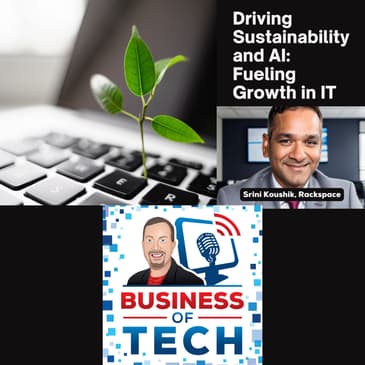
Srini Koushik, President of Technology and Sustainability at Rackspace, discusses the changing landscape of sustainability and AI in the IT services market. Srini highlights the importance of incorporating sustainability into services in a more holistic manner, considering factors such as climate change, income inequality, and equitable AI implementation. He emphasizes the need for conscious consumer choices and selecting vendors who prioritize sustainability in their operations.
The conversation shifts to AI, with Srini outlining Rackspace's approach to responsible AI implementation through the Foundry for AI initiative. He stresses the importance of AI being symbiotic with human beings, secure, and sustainable. Srini explains how Rackspace aims to leverage its expertise in managing production workloads to help customers implement AI solutions that meet these criteria. The discussion delves into the role of partnerships in delivering AI solutions tailored to specific organizational needs.
Srini explores the potential for AI to address technical debt in organizations and drive productivity improvements. He underscores the importance of training both AI models and human users to maximize the benefits of AI tools like Microsoft Copilot. Srini envisions a future where AI enhances critical thinking skills and frees up time for individuals to focus on higher-level tasks. The episode concludes with a reflection on the evolving opportunities in the IT services market and the transformative potential of AI for businesses.
Supported by:
https://www.huntress.com/mspradio/
http://skykick.com/mspradio/
About Business of Tech: The daily MSP news and analysis podcast for managed service providers and IT services leaders. Host Dave Sobel covers AI for MSPs, MSP pricing and profitability, MSP M&A and private equity, vendor partner programs, MSP cybersecurity and liability, and MSP operations — and answers the question every story raises: Why do we care? Produced by MSP Radio.
💼 All Our Sponsors
MSP Radio is supported by our partners:
ABC Solutions · CometBackup · Firetail · Guardz · HaloPSA · LogMeIn · Mailprotector · Pax8 · Rythmz · ScalePad · TimeZest · Transit AI
Supporting the IT services community through insights, analysis, and transparency.
🚀 Join Business of Tech Plus
Get exclusive access to investigative reports, vendor analysis, leadership briefings, and more.
👉 https://businessof.tech/plus
🎧 Subscribe to the Business of Tech
Want the show on your favorite podcast app or prefer the written versions of each story?
📲 https://www.businessof.tech/subscribe
📰 Story Links & Sources
Looking for the links from today’s stories?
Every episode script — with full source links — is posted at:
🎙 Want to Be a Guest?
Pitch your story or appear on Business of Tech: Daily MSP News & IT Services Analysis
💬 https://www.podmatch.com/hostdetailpreview/businessoftech
🔗 Follow Business of Tech
LinkedIn: https://www.linkedin.com/company/28908079
YouTube: https://youtube.com/mspradio
Bluesky: https://bsky.app/profile/businessof.tech
Instagram: https://www.instagram.com/mspradio
TikTok: https://www.tiktok.com/@businessoftech
Facebook: https://www.facebook.com/mspradionews
Hosted by Simplecast, an AdsWizz company. See pcm.adswizz.com for information about our collection and use of personal data for advertising.
[00:00:02] [SPEAKER_00]: Let's hit a couple of items. Can we talk to Sustainability? Has the market changed for it?
[00:00:07] [SPEAKER_00]: What is Rackspace think about AI and how are they implementing it? Where is the market going?
[00:00:12] [SPEAKER_00]: Srini Koushik joins me today. He is President of Technology and Sustainability for Rackspace on this bonus episode of the Business of Tech.
[00:00:22] [SPEAKER_00]: Well, there's many breaches and security concerns as I report in this show. It should be obvious that cybersecurity is not just about technology
[00:00:30] [SPEAKER_00]: but also the human expertise needed to interpret and respond to complex threats.
[00:00:36] [SPEAKER_00]: Huntress is focused on elevating SMBs and MSPs around the world. Huntress has a suite of fully managed cybersecurity solutions powered by a 24x7 human-led sock dedicated to continuous monitoring, expert investigation, and rapid response.
[00:00:52] [SPEAKER_00]: And the proof is the execution. Huntress is the number one rated EDR 4F SMBs on G2.
[00:01:01] [SPEAKER_00]: Want to know more about the platform? Visit huntress.com slash MSP Radio to learn more.
[00:01:10] [SPEAKER_00]: The Shereel, thanks for joining me today.
[00:01:14] [SPEAKER_01]: Oh, this is a pleasure. Why can't it say it's something that I've been looking forward to this entire week?
[00:01:21] [SPEAKER_00]: So I'm going to start with the one that made maybe a surprise to my listener because I want to talk a little bit of sustainability first. Now, I, I just going to give you my picture here is this, I've been previously burned by green IT and some of the early initiatives that didn't take off in like the odds, you know, and sort of early 2010s, but you've been really focused on the idea of incorporating sustainability into services.
[00:01:46] [SPEAKER_00]: Tell me about like what's different about this moment and what you think those services look like now.
[00:01:53] [SPEAKER_01]: Yeah, well, I think first of all, you know, what's different about this moment is where we are as a community and as a world.
[00:02:03] [SPEAKER_01]: I can, if you kind of think about it. Get no politics or any of those things, but we're in a place where the climate around us is changing and not debating the through causes are any of those things. The climate is changing.
[00:02:16] [SPEAKER_01]: We're seeing a lot more losses that come from like in these major events that are happening, you know, from a climate standpoint.
[00:02:25] [SPEAKER_01]: And if you look at the economics side of things, in community quality is much bigger today than it ever was before right and and it'll be.
[00:02:36] [SPEAKER_01]: It's a, so in community qualities and all one and then as you get into the AI space, how do you prevent bias? The equitable side of things is critical.
[00:02:46] [SPEAKER_01]: So it's one of these points in time where all three of these things are important.
[00:02:52] [SPEAKER_01]: And so the sustainability view that we take today that is different than the green IT and others is first of all, in order for us to continue to thrive with all of the new tech that's coming up.
[00:03:03] [SPEAKER_01]: We've got to be a lot more conscious about how we consume energy and what we use it for.
[00:03:10] [SPEAKER_01]: So there's the green component of it. You also have to make sure that as we go through this AI revolution, we don't repeat what we did when we went through the cloud and and internet revolution, which is.
[00:03:23] [SPEAKER_01]: The have has a lot more.
[00:03:25] [SPEAKER_01]: The have nots are left behind and you have other social and economic problems that are coming up.
[00:03:31] [SPEAKER_01]: And then as I mentioned with the AI, how do you do it in an equitable way so that the benefits of the AI are available to the masses and not just the handful of people get.
[00:03:42] [SPEAKER_01]: So sustainability is a lot more holistic these days and and you have a lot more tools to be able to go hand.
[00:03:49] [SPEAKER_00]: Now you spend a lot of time working with with partners and service providers that are delivering it. I want to want to think of that thing.
[00:03:56] [SPEAKER_00]: Do you think sustainability is around them implementing sustainability or is it about choosing vendors to do it? Because for example, I'll use racks for x-base, great example right big data centers lots of people lots of compute reads.
[00:04:09] [SPEAKER_00]: It's incredibly obvious to me why energy consumption for a large for a company like RaxBase would make perfect sense.
[00:04:17] [SPEAKER_00]: But as I think about most consumers and I'm using consumer in the business sense as well, if they make smart and choices about their providers particularly if they've done a lot of cloud and you moved all that out.
[00:04:31] [SPEAKER_00]: It would be more about making good choices. Like what's the framework that providers should be thinking about when they're applying sustainability for themselves and their customers?
[00:04:42] [SPEAKER_01]: Yeah, so at a very high level, you know, I tend to tell people that it is really no different than how you handle your personal work right.
[00:04:52] [SPEAKER_01]: So if you look around the, you make conscious choices right where you get your energy from or what technology you choose to implement right so all the bulbs in here or LED bulbs the switches are set up so that when I walk out of the room it shuts off and things like that.
[00:05:09] [SPEAKER_01]: So that is about being a conscious consumer right so no matter if you're partner or a consumer getting this you absolutely have to make those choices.
[00:05:19] [SPEAKER_01]: And once you do that, who you choose to buy from matters as well? Was this kind of what you've been talking about right it doesn't look when the one advantage of having scale whether you're a hyper scalar like AWS or as your or someone like us is you have to scale to be able to locate the
[00:05:38] [SPEAKER_01]: Centers and services, places be able to procure clean power and other types of things. So it's about I think the framework that you end up using is bulk like enough you have to make personal choices that are absolutely you know smarter choices that you do.
[00:05:53] [SPEAKER_01]: And then who you buy from matters and what's also evolving very rapidly right now is the underlying governance and compliance that is being expected right so with with SEC with the work that.
[00:06:08] [SPEAKER_01]: Europe is done and driven.
[00:06:11] [SPEAKER_01]: There's going to be a lot more focus on reporting scope three emissions so if you are somebody that is you know whether you're a reseller like you're an MSP any of those things.
[00:06:23] [SPEAKER_01]: You've got to worry about scope one and scope do which is what you use to do your business but also scope three where you procure your services from and help green are they.
[00:06:34] [SPEAKER_01]: So for us that's that framework the greenhouse gas emissions framework scope one scope tunes scope three also gives us a good framework for implementing sustain it.
[00:06:46] [SPEAKER_00]: Gotcha now no modern you know current interview would be remiss if I didn't bring up AI you'd already mentioned the magic to letters here.
[00:06:54] [SPEAKER_00]: Give me a sense of the way you're thinking about an organization like Rax space and how you play an AI because again if I put my analyst hat on right we're spending a lot of time thinking about open AI AWS Google Microsoft big players that are focusing on models.
[00:07:13] [SPEAKER_00]: And then we're thinking a lot about the way it's integrated in products how is an organization like Rax space thinking about AI and the offerings and the kind of implementation so you're going to do.
[00:07:25] [SPEAKER_01]: So about a year ago we launched what's called the fondly free AI by Rax space fair is very happy coincidence of that acronym because the our view of AI is any implementation of AI has to do.
[00:07:43] [SPEAKER_01]: I'd say three things right number one it really has to be symbiotic with human beings meaning if you build AI that replaces human beings right or.
[00:07:56] [SPEAKER_01]: And you know doesn't allow them to grow then you may have a really nice technology but what about the human beings right taking what what happens in community quality how do you kind of deal with that.
[00:08:08] [SPEAKER_01]: I think first of all so number one it has to be symbiotic with human beings number two it absolutely has to be secure right and and secure and private is is very important.
[00:08:20] [SPEAKER_01]: And it guides some of the choices you make because you mentioned several large language model providers and several providers.
[00:08:28] [SPEAKER_01]: One of the key things you have to be able to do is.
[00:08:32] [SPEAKER_01]: You have to be able to figure out how they use your data what they use it for and other because again if you're going to be using prompts and they're going to use that data to train their models and you're using proprietary data or personal data.
[00:08:50] [SPEAKER_01]: There's been a breach of trust there that that you've actually done that so the secure component of it is the second one and the third piece we've talked about earlier is if you're going to do something that symbiotic and secure.
[00:09:02] [SPEAKER_01]: You have to be able to do it in a sustainable way meaning if I'm going to implement an AI that can.
[00:09:13] [SPEAKER_01]: Right code what happens to the developer how do we actually help them at the go forward that's important because if you don't do that.
[00:09:22] [SPEAKER_01]: It's not a sustainable model if you don't if you do that and you spend a lot of energy and waste a lot of energy doing that piece then it's not going to be green from that.
[00:09:32] [SPEAKER_01]: So the three Ss that we talked about symbiotic, secure and sustainable is what we call responsibility.
[00:09:40] [SPEAKER_01]: Right and for us as RAC space we felt like we're known for in the market is we manage and run production workloads we've done that for 25 plus years like we know how these systems run in production.
[00:09:57] [SPEAKER_01]: And we're trying to bring that expertise to customers to say let us implement those AI solutions that are responsible in these and meet these three criteria that I just talked about that's that's kind of what we did.
[00:10:13] [SPEAKER_00]: Gotcha so where's the like where do you think as in an partnership right you're doing some of the work and part and solution providers MSPs are doing some of that talk to me about where you're envisioning.
[00:10:25] [SPEAKER_00]: How who's doing what when we're having AI conversations with customers.
[00:10:31] [SPEAKER_01]: Yeah so first of all I think there are multiple ways in which you can configure and set up AI so for for any organization to get the best benefit out of AI they've got to go beyond the generic and go to something more specific meaning what.
[00:10:50] [SPEAKER_01]: We've got some phenomenal tools like chat GPT and Claude and everything else that are out there that are trained on the wealth of the world information.
[00:10:59] [SPEAKER_01]: I tend to think of them as Swiss Army nerds they can do everything because they're trained on everything.
[00:11:06] [SPEAKER_01]: Well most businesses don't need everything in fact some of those things like when you go after and look at every that are the data there that could be a distraction.
[00:11:16] [SPEAKER_01]: What people need are tools that solve a specific purpose and so AI that's getting implemented in organizations today is trained on their data.
[00:11:26] [SPEAKER_01]: And is designed to do something very specific in fact like we keep telling our customers the best way to think about AI.
[00:11:34] [SPEAKER_01]: This is think about it as an employee or think about it as a coworker because what you're doing is you're training an AI on your press the processes your data and procedures and embedding it into your day to day work.
[00:11:47] [SPEAKER_01]: It doesn't mean that there's no place for generic tools there's always a place for generic tools in the organization but most organizations start to see the benefit of AI when they take their knowledge that they've built and built it and get it to run within your enterprise.
[00:12:07] [SPEAKER_01]: So the way we approach the market is we absolutely one of the key things about x-rays as model is we partner right we're not one of these large bohemants right so we can't do everything and we don't want to do everything.
[00:12:22] [SPEAKER_01]: There are things that we do very well and we want to focus on that but the best solutions you bring to the market are the ones you partner with pop.
[00:12:29] [SPEAKER_01]: So there's partnerships with man as solutions providers when you actually come in and incorporate that as part of the solution.
[00:12:37] [SPEAKER_01]: There's partnerships with large language model providers right you know where like whether it's antoptic or or you know that.
[00:12:44] [SPEAKER_01]: Model gardens like hugging face and others but when you pull these AI solutions together we feel like we're in a good place where there's there's a few things that we do and we do very well.
[00:12:57] [SPEAKER_01]: And our model was always built on open innovation and open partnerships so that really fits in because I don't think there's any one company that can do all.
[00:13:08] [SPEAKER_01]: There's going to be company that tried to do everything but in this space you know having that partnership mindset and building it that ways what what's going to make it work.
[00:13:17] [SPEAKER_00]: Now I want to ask a little bit because it had been my thought most organizations are going to and I mean that because most organizations are small organizations.
[00:13:26] [SPEAKER_00]: You know most organizations are going to take a product and they're going to probably connect it to the data and then they're going to go.
[00:13:33] [SPEAKER_00]: Like are you envisioning it's so that might be like and I'm using them as an example but that might be like Microsoft co pilot plus your data.
[00:13:41] [SPEAKER_00]: Now ends up being the typical implementation for most you're going to use you know graphic design tools that you're going to combine with your data set and and your brain and you're going to use it like is that the vision or or you because you mentioned a little bit more like it's not like a little bit more customization or am I getting it right.
[00:13:58] [SPEAKER_01]: Now you I think you're you're at the absolutely right I think most small to medium sized organizations are going to get a tremendous amount of benefit.
[00:14:07] [SPEAKER_01]: Of implementing tools such as a Microsoft co pilot.
[00:14:10] [SPEAKER_01]: In fact one of our biggest part is one of our biggest part is going to help drive the productivity and efficiency of an organization.
[00:14:22] [SPEAKER_01]: However you had the answer great which is in order to do that it can't be what comes out straight from that it has to be trained on your data.
[00:14:32] [SPEAKER_01]: And in addition to that you have to spend the time training your people on how we use co pilot right and it's it's I keep telling people that like the one thing that we don't get completely right with AI as we spend a lot of time training the model.
[00:14:48] [SPEAKER_01]: But with the data we don't spend a lot of time training the human and how to work with AI right and and you absolutely have to be able to do that because I can give you this this absolutely powerful tool but if I can't change like in it if.
[00:15:03] [SPEAKER_01]: This happens all the time we give it if we give us such a powerful tool to someone and they're used to doing something a specific way and they try to use the tool and they go this is not helping me.
[00:15:13] [SPEAKER_01]: It's like now it'll help you if you change the way you work right if you were writing an article a certain way for the last 20 years and now I give you.
[00:15:22] [SPEAKER_01]: Co pilot or chat GPT don't try to do it the same way you did here's how you can change how you write an article put your bullet points together.
[00:15:31] [SPEAKER_01]: You know ask it to go do that don't take the first answer it gives you that take it and then do these prompts other than so by the time you're done with the whole thing you have a better article with the higher quality while better research.
[00:15:44] [SPEAKER_01]: But it took you 20% of the time it took the right it's still yours.
[00:15:49] [SPEAKER_01]: It's not plagiarized it's still yours, but it's a collaboration between you and this co worker that we've actually put in place so it's not just about training the AI but with our data it's about training the human beings has helped change their approach so that they can drive that productivity.
[00:16:06] [SPEAKER_00]: And there's tons of opportunity in that training.
[00:16:09] [SPEAKER_00]: We've talked about sustainability and AI but I actually want to take a quick step back and give you the chance to tell me what might be important.
[00:16:16] [SPEAKER_00]: When you're looking at the current IT services market and where you're guiding partners to spend their time what do you see is the biggest opportunities for growth.
[00:16:28] [SPEAKER_01]: Well I think first of all you know the well if I just take IT and software development as an example like we were talking earlier at a business CEO for a very long period of my career.
[00:16:42] [SPEAKER_01]: Right one of the challenges that most CIOs have is that they have a lot of technical debt one thing about technology keeps changing and it keeps evolving and you know what what gets put in stays in and doesn't get updated and then.
[00:16:58] [SPEAKER_01]: Every new thing you have to upgrade to the latest release and others that takes time.
[00:17:03] [SPEAKER_01]: We've tried we have CIOs that tried to do this for many, many years and like have always had what we call tech debt in that environment.
[00:17:13] [SPEAKER_01]: If you kind of rethink how you can use AI you can use AI to address the tech debt why why does tech debt exist you don't have the budget you don't have the people you don't have the time.
[00:17:25] [SPEAKER_01]: Well AI can solve all of those things but in order to do that you actually have to be able to change the way you manage and drive IT.
[00:17:34] [SPEAKER_01]: So the opportunities with AI exist I just use that as an example like it take it and apply to any domain whether it's HR or marketing or any space within this.
[00:17:48] [SPEAKER_01]: A lot of reasons why AI is is still in my opinion just at the start because everybody has seen what it can do with chat to you, but they yet haven't figured out how to translate that into using it within their workplace.
[00:18:03] [SPEAKER_01]: And when that happens all of the promises that you've heard about starts to happen and our job as fair and back space and others is to kind of help more and more customers get to that point so that they.
[00:18:18] [SPEAKER_01]: Here's another analogy I somebody asked me about AI and how I think about it and say like look at 200 years ago or 500 years ago when you had to navigate to someplace you use this extent look at the stars to figure out how to navigate.
[00:18:32] [SPEAKER_01]: Then you had a hypothesis and then you had people like myself like you were old when we had to travel the one place.
[00:18:40] [SPEAKER_01]: Like I went out and got triptics from triptlite right that one away GPS came in all that stuff all the way down to now self driving cars where you put the destination it takes it towards destination.
[00:18:52] [SPEAKER_01]: The reality is the driver or the passenger really the need for it did not go away what you choose to spend your time on really actually then math because you start to free up time and that's kind of what AI is going to do that's one part of it that we really have to figure out.
[00:19:09] [SPEAKER_01]: The product of the improvements you're going to get what is it that what's that next level of Mazlos hierarchy for human beings ready to get that's one part of it.
[00:19:19] [SPEAKER_01]: But the second piece which is equally important is as we get there.
[00:19:24] [SPEAKER_01]: You have to be able to get organizations and individuals ready to have the critical thinking and just extending that analogy I gave you for a second.
[00:19:34] [SPEAKER_01]: I can get into a car in Columbus for high on and I say take me to Cleveland and it will take me to Cleveland.
[00:19:40] [SPEAKER_01]: But out of Columbus if this car is headed to the south then I should be asking myself, wait a second Cleveland is to the north, why is it taking me south right that critical thinking is important because as generative AI and everything takes over.
[00:19:54] [SPEAKER_01]: You start relying on it too much it can and will lead you to the wrong place.
[00:19:59] [SPEAKER_01]: So these two things that I mentioned like number one how do you make sure that you still have that problem solving and critical thinking capabilities and what do you do with that productive time that comes out like in a set of implementing AI are opportunities that are still in front of us and.
[00:20:20] [SPEAKER_01]: And I think that's why I'm going to be a good example of the fact that I have one of those half full guys like I'm excited about it.
[00:20:27] [SPEAKER_00]: You're leaving us with a lot to chew on because I do agree with you I think that's where the value is.
[00:20:32] [SPEAKER_00]: Trinity Kusheck is the president of technology and sustainability at RAC space experience spanning leadership roles at IBM Magellan health and NTT innovation institute.
[00:20:41] [SPEAKER_00]: He brings insights into technical strategy hybrid cloud innovation and sustainable IT practices and he calls himself a techie.
[00:20:48] [SPEAKER_00]: Thanks for joining me today. She needs to be great.
[00:20:53] [SPEAKER_01]: Exxon Dave, thank you so much. It's a pleasure.
[00:20:58] [SPEAKER_00]: Are you an MSP navigating the evolving landscape of Microsoft 365 and Copilot?
[00:21:03] [SPEAKER_00]: Skykick is here to help you identify ideal clients for Copilot and mitigate risks for your customers enabling Copilot in their business.
[00:21:12] [SPEAKER_00]: As MSP is you all know it's not as simple as just turning it on in eight steps.
[00:21:16] [SPEAKER_00]: Skykick automation will help you identify which customers ideal candidates for Copilot instead of right the standards to ensure their data is safe or for Copilot is enabled.
[00:21:27] [SPEAKER_00]: Embrace this AI revolution offer advanced automation improve efficiency and reduce manual workload with Skykick's tailored solutions educate your clients on the benefits and adapt your services to include enhanced security measures.
[00:21:40] [SPEAKER_00]: Don't just adapt to change, lead it.
[00:21:43] [SPEAKER_00]: Elevate your MSP business with Skykick and Microsoft's Copilot. Visit Skykick.com slash MSP radio to learn more and start transforming your services today.
[00:22:12] [SPEAKER_00]: You can also check out our Patreon where you can join the business of tech community at patreon.com slash MSP radio or buy our why do we care merge at business of dot tech.
[00:22:26] [SPEAKER_00]: Finally, if you're interested in advertising on the show visit MSPradio.com slash engage once again. Thanks for listening to me.
[00:22:35] [SPEAKER_00]: I will talk to you again on our next episode of the Business of Tech.
[00:22:41] [SPEAKER_01]: Part of the MSP radio network.