
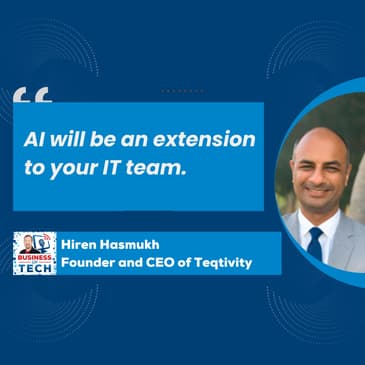
Hiren Hasmukh, CEO of Teqtivity, discusses the evolution of his company from its origins as TeQube, a smart locker solution, to a comprehensive IT asset management (ITAM) provider. The initial focus was on helping engineers access devices for app development without the hassle of traditional IT processes. As the company grew, it pivoted towards software solutions that enable organizations to manage their entire IT fleet, including laptops, desktops, and mobile devices, while ensuring compliance and cost savings.
Teqtivity's ITAM solution is designed to cater to a wide range of clients, from startups to large enterprises, allowing them to track the lifecycle of their assets from procurement to end-of-life. The company differentiates itself in a mature market through a unique pricing model that charges based on active users rather than the number of assets managed. This approach, combined with customizable software tailored to each client's specific needs, positions Teqtivity as a flexible and user-friendly option in the ITAM landscape.
Hasmukh also reflects on a significant data breach that impacted one of their customers, emphasizing the lessons learned regarding security posture and the importance of ongoing training and testing. Following the incident, Teqtivity implemented more rigorous security measures, including regular penetration testing and the integration of advanced security tools like CrowdStrike to protect their infrastructure and customer data.
Looking to the future, Hasmukh shares insights on the role of artificial intelligence in IT asset management, suggesting that AI will serve as an extension of IT teams rather than a replacement. By automating routine tasks, AI can free up IT professionals to focus on more critical security issues. Teqtivity aims to incorporate AI into its roadmap, enhancing its offerings and helping clients achieve greater organizational efficiency and accuracy in asset management.
💼 All Our Sponsors
MSP Radio is supported by our partners:
ABC Solutions · CometBackup · Firetail · HaloPSA · LogMeIn · Mailprotector · Pax8 · Rythmz · ScalePad · TimeZest · Transit AI
Supporting the IT services community through insights, analysis, and transparency.
🚀 Join Business of Tech Plus
Get exclusive access to investigative reports, vendor analysis, leadership briefings, and more.
👉 https://businessof.tech/plus
🎧 Subscribe to the Business of Tech
Want the show on your favorite podcast app or prefer the written versions of each story?
📲 https://www.businessof.tech/subscribe
📰 Story Links & Sources
Looking for the links from today’s stories?
Every episode script — with full source links — is posted at:
🎙 Want to Be a Guest?
Pitch your story or appear on Business of Tech: Daily 10-Minute IT Services Insights:
💬 https://www.podmatch.com/hostdetailpreview/businessoftech
🔗 Follow Business of Tech
LinkedIn: https://www.linkedin.com/company/28908079
YouTube: https://youtube.com/mspradio
Bluesky: https://bsky.app/profile/businessof.tech
Instagram: https://www.instagram.com/mspradio
TikTok: https://www.tiktok.com/@businessoftech
Facebook: https://www.facebook.com/mspradionews
Hosted by Simplecast, an AdsWizz company. See pcm.adswizz.com for information about our collection and use of personal data for advertising.
[00:00:02] Sometimes we think we've heard all the solutions. I found another one. Teqtivity is out there. They're an IT asset management provider and Hiren Hasmukh joins me. He's the CEO. As we talk about their strategy, how they came from their data breach, what they learned from it and what they think AI is coming in the future, this bonus episode of the Business of Tech.
[00:00:23] This episode is supported by Synchro. Synchro, the integrated remote monitoring and management and professional services automation platform, is designed for mid-sized and growing managed service providers. Its latest innovations include an AI-powered smart ticket management system with automatic ticket classifications, guided resolution steps using pre-approved scripts, and a natural language smart search function. These tools streamline ticket handling and improve response times.
[00:00:51] Discover more at SynchroMSP.com. Well, Hiren, welcome to the show. Yeah, thanks for having me, Dave. Now, let's dive right in with what Teqtivity does because, you know, it started as TQube and then you moved into IT asset management as a solution provider. Walk me through a little bit of the journey so I can get context of what your firm came from and what it does now.
[00:01:19] Right, yeah. So we started out, as you mentioned, as TechCube, it's a smart locker solution. The idea of it was to provide a way for essentially engineers was the first use case to be able to just take out phones for development as they're working on their apps, working on updates.
[00:01:38] When you're working in an enterprise company and you have millions of people using your app, you need to have various phones and phone models available for testing purposes. So we saw a use case for, you know, a locker where engineers could essentially just take out a phone when they needed it instead of having to go to the IT desk, wait in line, you know, get a ticket open and just, you know, spend an hour or two just trying to get a phone and a device.
[00:02:05] This was just an immediate, you know, pick up drop off when you're done with it. And part of the solution was also having a back end portal that allowed management and IT and the team to review, you know, who's taking what device, what devices do we have in the lockers. And that actually, as we started looking more into the software and the cloud side of things, we started building more features into it.
[00:02:27] And it kind of grew into the full ITAM solution and ended up, you know, we ended up pivoting the focus from the hardware into the software side of things. Gotcha. That makes sense. So tell me a little bit about what the ITAM solution, like what it's focused on, what it does and how you position it in the market.
[00:02:45] Yeah. So essentially that's, it's helping our customers, helping organizations manage all of their IT fleet, you know, their laptops, desktops, phones, tablets, and pretty much anything that you have equipment wise, whether it's in your storage rooms, you know, given to employees out there in the wild, maybe they're damaged at the repair shop. So tracking the full life cycle of your assets from procurement all the way down to end of life is, you know, the main function of our tool.
[00:03:14] But we also work with a lot of other integrations to help, you know, bridge the gap between other departments, whether it's HR, finance, security. That way everybody's kind of working together with the end goal of, you know, staying organized, staying compliant, saving money for the company. Gotcha. So are you, are you focused on enterprises, mid-market, managed services providers? Like, like where are you focused?
[00:03:41] Everybody. The unique thing about our software is that we can work from, you know, startups all the way to enterprise level companies. We have some that are, you know, new companies that have been around for a year or two versus some that have been around for, you know, a couple of decades. And we know with thousands of employees, you know, tracking their assets. So there really isn't a restriction on who we can work with in terms of company size or even their industry. Now, this is obviously a space that has some level of maturity, right?
[00:04:10] You're not the first player in the space. Talk to me a little bit about how you think about it, positioning yourself differently and what you're trying to carve out as your own unique space. Yeah, there's a couple of things that we could say we are different compared to our competitors. The first is our unique pricing model. We charge based on how many people are actually using the tool. A lot of companies in this space will also charge by how many assets you're managing. So if you have a thousand laptops you're tracking, you're also paying on top of the subscription fee for those thousand laptops.
[00:04:41] We offer unlimited assets, unlimited users, basically paying a monthly subscription for the people who are getting value out of the tool. And then the second part of that is we actually customize our software based on our customer. Big thing we see is every IT department works a little differently. They have their own philosophy on ITEM and how they should manage their fleet.
[00:05:05] So we did a one-hour software to restrict an IT team or a customer in terms of how they could do it in the software. So from the beginning, we'll work with our customers in terms of building in their workflows, their integrations, and then over time adding in new features that they can request from us to grow their solution. Gotcha. So give me a little bit of sense. I'm sure you've got like an example customer that's kind of ideal.
[00:05:32] Everybody likes to talk to me about your great use case study that's the ideal example. Ideal example, I would say a company that has around 5,000 to 6,000 employees. At that point, you're looking at maybe 7,000 or 8,000 assets that they're wanting to track. They have a pretty good tech stack internally in terms of their MDM solution, the security tools, their HR tools. They're pretty mature in terms of what they have.
[00:06:02] So giving us the ability to integrate with all of those tools and then provide that reporting and additional functionality to get them what they need. Gotcha. Now, one of the things I do want to ask about, because I get a sense that you learned a lot from this, is in the early days and as you're working through this, Techivity faced a data breach and it affected one of your customers. Talk to me about how that occurred and what you learned from the experience. Yeah, it was a pretty bad time for us.
[00:06:30] It's not something I would wish upon anybody, to be honest. As a small company, being bootstrapped as well, it was a big impact for us. The actual breach occurred because an attacker was able to exploit a hold in terms of getting into a backup directory and was able to, you know, exfiltrate some data from there.
[00:06:57] It wasn't to production servers or to any of our production customers, but it was a backup of one of our customers that the threat actor was able to gain access to. We did learn a lot from it in terms of our security posture. You know, we made multiple changes in terms of training our team, some of the process that we have in place, and what we needed to do going forward to ensure that we are safe and secure with our customers' data.
[00:07:25] Gotcha. Tell me a little bit about the lessons. I mean, obviously, the incident itself, expensive, difficult to deal with, but I'm more interested in understanding kind of the long-term strategy change and what you did around that. Can you give a little bit more about what you did in terms of the way you approach things now? Yeah, in terms of the way we started approaching things, you know, even more pen testing and network testing, AWS testing, just to making sure that there aren't any holes anywhere.
[00:07:50] So we have a team that does that manually for us every quarter, an external team that will come in and look at it. We implemented CrowdStrike throughout the entire company. So all of the endpoints, whether they're the employees' devices or the way to the servers that we have, and that, you know, really helps a lot in terms of getting the daily reports and updates to ensure that we are, you know, completely secure and patched up. Now, the other thing you brought up, and I was really curious about it, is you've leaned into bootstrapping, right?
[00:08:20] You brought it up right there. So that's a particular choice, and you've had some interest from VCs. You've chosen to keep everything bootstrapped. Talk to me a little bit about that decision and, you know, what drives it and how it's impacting your strategy. Yeah, the decision to stay bootstrapped is a couple of reasons behind it. So just the flexibility of being able to, you know, run the company myself with whatever we need to do.
[00:08:50] We're not, you know, having to deal with another group of people that we have to keep happy, right, in terms of revenue and the goals that we have to meet. Like, I feel like there'd be less stress just, you know, bootstrapping it and, you know, just at the end of the day, like essentially answering to myself in terms of the final success, right? Also, I don't think we're ready to a place where I'd want to go out and get funding.
[00:09:17] Even though we have some pretty big clients on our name, on our portfolio, we're still at a place where I still want to grow at least like three, four times more before I actually want to go out and either get some funding or bring on additional partners, you know, whatever the case would be in the future. So I'll ask just a simple question. Why? What's the motivation behind that? Getting the revenue up is one thing.
[00:09:45] I think we're not at a point right now where the revenue is high enough to where we, you know, we'd be able to get as much funding as we would want to. Okay. So I want to pivot that a little bit to get a little bit of your thinking about where this is all going, particularly because there's a lot of argument that with the rise of cloud computing and virtualization, the idea of traditional IT asset management is trending towards obsolete, if not obsolete. Now, talk to me about how you'd respond to that perspective.
[00:10:14] And why do you think it's a crucial piece of end customer business? Yeah. I would say it's still a crucial piece to any IT department to, you know, manage your hardware, your physical hardware, what you have. A lot of breaches are occurring because the actual computer that's being used and the employee. Now, you have your servers, you have your data centers and your other infrastructure,
[00:10:41] but where we come in to help our customers is the actual endpoint that the employee is using. It's still going to need to be tracked. You know, who has it? Where is it? If it's been lost or stolen, we need to make sure that it's locked, for example. And, you know, there's no replacement for some of the features that we're providing from other tools or, you know, methodologies that could come out.
[00:11:04] Well, I'm going to push back a little bit and sort of say, like, if you buy into an idea of zero trust security to its kind of logical conclusion, the idea there is that every transaction is being audited and checked for, you know, levels of access, as well as you can put in lines, you know, barriers for minimum standards around that. And you could thus go to the extreme of being very casual about the devices themselves and be much more focused on the transactions.
[00:11:30] I would think that in that kind of world, the idea of managing the devices is less important than managing those barriers. Again, how do you envision IT management and IT asset management moving in a zero trust world? Yeah, zero trust definitely is important. We utilize zero trust as well ourselves. The issue we'll run into, though, is, you know, you can implement the zero trust.
[00:11:59] We've got all of the software set up, you know, the networks. But who's actually managing that in terms of, you know, the response, the incident response if something does occur? Right. One thing we noticed is that organizations have so many tools that they're using, whether it's security, IT, HR, they just there's a there's a multiple number of tools that you're using internally. And so you're having to manually like look at reports from different places. Right.
[00:12:30] A tool like ours will actually consolidate everything into one to where, OK, you know what, if there is an issue in the network or the device, it's easily recognizable and you can actually upon it quickly versus having to look at, you know, six or seven tools to figure out what you need to do or what's happening within your environment. Gotcha. Gotcha. Well, we've managed to go deep into this conversation without mentioning AI, but I feel obligated to do so because apparently I'm legally required in all my interviews to do so.
[00:12:58] So give me a little bit of a sense of the way that you're thinking about artificial intelligence in the world of IT asset management. Yeah. I mean, we know that AI is heavily trending. There's a focus in every industry towards AI. Right.
[00:13:15] In terms of IT asset management and, you know, managing your fleet and your IT organization, for us, we feel it's AI would be an extension to your IT team versus, you know, replacing. From a lot of use cases, from a lot of our customer, what we see is you still need that human touch, that human element in a lot of, you know, pieces of the pie,
[00:13:38] whether it's in procurement, managing your devices, even through security, that, you know, you still need some kind of human element there to make decisions. But the AI can help drive some of those decisions based on, you know, looking at historical data that's coming out of the tool. So give me a little bit. You're leaning more into the idea of automation or data reporting. Like, where do you think the biggest gain is going to be in terms of where you spend your time? Automation, for sure.
[00:14:06] If we can use AI to save time in an IT department, they can focus on some of the bigger things, some of the more, you know, heavily security-related aspects or, you know, things of that nature versus the day-to-day operations of assigning devices and seeing where they're at. If an AI tool can help you take care of those items, then we can focus on the, you know, the bigger pieces. And how much of a timeline do you think around this? Are you thinking about this in the next three months?
[00:14:36] Features are going to be flying out, or is this more aspirational over the next 18 months or even years away? What are you thinking about it? For us, it's something we're definitely looking at our roadmap for this year. Okay. Gotcha. So that makes a ton of sense. Now, as I think about this, like, where do you find that the biggest impact for customers, the real value ends up being in terms of approaching IT asset management the best? Where are they giving you the information and feedback back that they value most? Two things.
[00:15:06] Just being organized. That's one of the biggest things, right? A lot of companies will use Google Spreadsheets or they have Excel files that are floating around that has all of their data and their inventory. The fact that you can get a tool and just become organized and have your inventory accuracy just jump up. We've recently onboarded a customer where they stated to us that prior to using our tool, they were at like 13% accuracy.
[00:15:35] A month later, they were at close to 95% accuracy in terms of their inventory. So staying organized and then that leads into helping with the costs. Because if you know, you know what you have, you don't have to buy more computers. You don't have to buy more phones or tablets because you're organized with your current inventory. So, yeah, those are the two biggest things we're hearing. Sometimes it's best when the value is just the most simple thing. Yes.
[00:16:03] Hiran Hasmuk is the founder and CEO of TechQuivity, an IT asset management solutions provider with over two decades of experience in the tech sector. Hiran has been at the forefront of developing innovative ITAM strategies for businesses navigating complexities of digital transformation. Hiran, thanks for joining me. How can people reach out if they're interested in learning more? Yes, they can learn more at techtivity.com on our website or they can reach out to us on LinkedIn. Awesome. Well, thanks for joining me today. Awesome. Thank you for having me.
[00:16:32] The Business of Tech is written and produced by me, Dave Sobel, under ethics guidelines posted at businessof.tech. If you've enjoyed the show, make sure you've subscribed or followed on your favorite platform. It's free and helps directly. Give us a review, too. If you want to support the show, visit patreon.com slash MSPRadio and you'll get access to content early. Or buy our Why Do We Care merch at businessof.tech.
[00:17:01] Have a question you want answered? We take listener questions, send them in, ideally as a voice memo or video to question at MSPRadio.com. I answer listener questions live on our Wednesday live show on YouTube and LinkedIn. If you've got a comment or a thought on a story, put it in the comments if you're on YouTube or reach out on LinkedIn if you're listening to the podcast. And if you want to advertise on the show, visit MSPRadio.com slash engage.
[00:17:29] Once again, thanks for listening and I will talk to you again on our next episode. Part of the MSP Radio Network.