
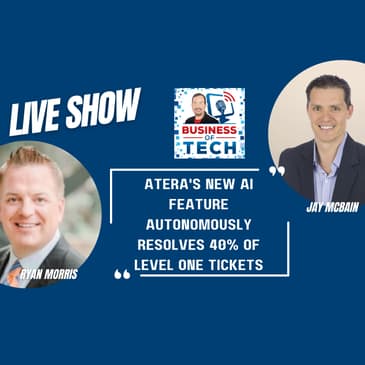
Two powerhouse experts, Ryan Morris and Jay McBain, join host Dave Sobel to discuss the emerging landscape of agentic AI, exploring the balance between hype and reality. They delve into the implications of AI technologies, particularly in the context of IT service providers and managed services. The conversation highlights the recent launch of Atera's autopilot feature, which claims to autonomously handle a significant portion of level one support tickets, raising questions about market readiness and the potential impact on traditional roles within the industry.
Morris and McBain emphasize the need for managed service providers to adapt to this rapidly evolving environment. They identify two distinct mindsets among providers: those who feel threatened by AI and those who are eager to embrace its potential. The discussion underscores the importance of understanding business processes and implementing data governance policies to ensure responsible AI deployment. As AI tools become more integrated into workflows, the experts stress the necessity for providers to focus on higher-level tasks and strategic growth rather than getting bogged down in routine operations.
The conversation also touches on the role of industry associations in supporting IT service providers during this transition. Sobel prompts the experts to consider what these organizations should prioritize, such as community building, training, and lobbying efforts. Morris and McBain argue that associations must evolve to remain relevant, focusing on delivering tangible value to their members rather than merely fostering a sense of community. They highlight the need for associations to measure their effectiveness based on the success and growth of their members.
Finally, the experts discuss the potential for new business models to emerge in the agentic AI landscape. They suggest that the shift towards consumption-based pricing models will require providers to rethink their strategies and focus on driving customer adoption and utilization of AI technologies. As the industry navigates this transformative period, the insights shared by Morris and McBain provide a roadmap for IT service providers to thrive in an increasingly automated world.
About Business of Tech: The daily MSP news and analysis podcast for managed service providers and IT services leaders. Host Dave Sobel covers AI for MSPs, MSP pricing and profitability, MSP M&A and private equity, vendor partner programs, MSP cybersecurity and liability, and MSP operations — and answers the question every story raises: Why do we care? Produced by MSP Radio.
💼 All Our Sponsors
MSP Radio is supported by our partners:
ABC Solutions · CometBackup · Firetail · Guardz · HaloPSA · LogMeIn · Mailprotector · Pax8 · Rythmz · ScalePad · TimeZest · Transit AI
Supporting the IT services community through insights, analysis, and transparency.
🚀 Join Business of Tech Plus
Get exclusive access to investigative reports, vendor analysis, leadership briefings, and more.
👉 https://businessof.tech/plus
🎧 Subscribe to the Business of Tech
Want the show on your favorite podcast app or prefer the written versions of each story?
📲 https://www.businessof.tech/subscribe
📰 Story Links & Sources
Looking for the links from today’s stories?
Every episode script — with full source links — is posted at:
🎙 Want to Be a Guest?
Pitch your story or appear on Business of Tech: Daily MSP News & IT Services Analysis
💬 https://www.podmatch.com/hostdetailpreview/businessoftech
🔗 Follow Business of Tech
LinkedIn: https://www.linkedin.com/company/28908079
YouTube: https://youtube.com/mspradio
Bluesky: https://bsky.app/profile/businessof.tech
Instagram: https://www.instagram.com/mspradio
TikTok: https://www.tiktok.com/@businessoftech
Facebook: https://www.facebook.com/mspradionews
Hosted by Simplecast, an AdsWizz company. See pcm.adswizz.com for information about our collection and use of personal data for advertising.
[00:00:14] Two powerhouse experts join me today, Ryan Morris and Jay McBain, as we discuss agentic AI. How much is hype and how much is real? How do you prepare for it? We'll discuss some pricing models considering what's new and what's old amidst the discussion of marketplaces and subscriptions. Plus, we'll dive into the association landscape. GTIA has a new CEO, so it's a good time to discuss what role do these organizations need to play and what's held them back from meaningful growth.
[00:00:45] Welcome to the Business of Tech Lounge, the live version of the Business of Tech Podcast. It's Wednesday, May 28th, 2025, and I'm Dave Sobel. I'll take questions and comments throughout the show, so make sure to put them in chat. If you have a question, we'll happily respond to it.
[00:01:01] Now, I want to thank Sales Builder, our Patreon sponsor whose support makes this show possible. Focus on your IT sales workflow with the power of automation and visit them at salesbuilder.com. That's B-U-I-L-D-R dot com. A reminder, I'm keeping an eye on the chat. We'll take your questions in real time.
[00:01:20] Jay McBain serves as the Chief Analyst for Channels, Partnerships, and Ecosystems at Canalys. With a career spanning nearly three decades, including roles at IBM, Lenovo, and Forrester, Jay is recognized as a leading authority on channel ecosystems and has been named Channel Influencer of the Year by Channel Partners Magazine. Jay, welcome back to the show. Thank you so much for having me. I'm excited about this conversation.
[00:01:45] Me too. And joining us today as well is Ryan Morris, who's the Principal Consultant at Morris Management Partners with over 25 years of experience in B2B technology sales, marketing, and channel strategy. He specializes in building profitable multi-tier channel solutions and has been instrumental in developing business models for solution providers, managed services, and cloud markets. He's also my co-host on the Killing It podcast. Ryan, welcome back to the live show. Thank you very much, sir. Glad to be here.
[00:02:14] Now, I'm going to throw this out right in the thick of things because literally as we were talking about several days ago, Atera launched their new autopilot feature. And they claim it handles up to 40% of level one tickets autonomously. With end-to-end tier one resolution of tickets like password resets and restarts without any technician intervention and direct end-user interactions under strict pre-configured guardrails.
[00:02:41] This goes from theoretical to in-market right away. And I immediately think of this and say, I'm not sure the market is ready for it to go that far. Jay, give me a quick sense of your looking out there where we're at with Adjentic. How much of this is real and how much is still hype? Well, I think we're seeing it as very real. This is a major era shift in our industry. We went through 20 years of client server.
[00:03:11] You know, starting in August 12th, 1981, we went through 20 years in cloud, really starting with SaaS in 1999. You know, when our neighbors and friends who are not tech people saw ChatGPT in about March of 2023 and asked us if we just lit up Skynet. This is the start of a 20-year era. And this is going to be a very large era as well. Six to seven trillion dollars of build-out of AI. Adjentic being the first three to five years. And this is the conversation we're having on every one of our roles.
[00:03:41] Every person in the world who's working, you know, having a co-pilot, having an agent, having, you know, this ability, you know, to handle. And it doesn't matter if you're a lawyer or an accountant. It doesn't matter what vocation you're in. You know, number one, can it make you a better person at deploying your role? Or, you know, can handle a lot of maybe the level one stuff that you spend maybe too much time on and allow you to move up to level two or level three. Absolutely real.
[00:04:11] Okay. But are we ready for it, right? Because we've started throwing products out into the market. And, you know, I just reported, I was pulling together the show that drops later this afternoon for the business of tech. And I reported on a bunch of lawyers the increasing number of cases where they're misciting precedent and cases based on AI generation.
[00:04:32] And, Brian, I'm going to ask you here, like, I think about all of the IT solution providers that likely do not have data governance policies internally, nor probably do not have any kind of AI accountability process. What are you seeing in the thinking of managed services providers in their readiness to do actual deployments, much less with customers, but in their own works? You know, I think I see two different groups of people that are aware of and actively responding to the agentic phenomenon.
[00:05:02] On one side, you have people who look at it and feel threatened and say, that's going to take away my job, my opportunity. It's going to commoditize my business model. And I don't want anybody else to know that that stuff is possible. That's a very defensive mindset. And it's not something that should be characteristic of people who actually do technology for a living.
[00:05:25] On the other side, I see people who are moving too quickly into the application of these things without maintaining, well, A, didn't establish the policies as you've described. B, don't actively maintain the human in the loop. And then C, they are not ready yet to refocus on, well, if this can take away 40% of my workload, what else should I be doing? What additional things could I find? I don't know about you.
[00:05:54] I don't know anybody who ends their day and says, no, I had too much time today. I didn't have enough work to do. Everything was easy. We're all busy. We're all overwhelmed. And the agentic phenomenon is going to take, ideally, the bottom 40% of busy work and tactical things off of our plate so that we can focus on other things. What really is required for that to be successful, however, it's not a question of just buying a tool and applying it to your own business.
[00:06:24] It's a question of understanding at the root level. It's a question of understanding at the root level, the step-by-step flow and the logic behind the business process that you are automating or augmenting. Right? If you don't understand the business process, you don't know if you skipped a critical step. You don't know if the content is actually verified and you aren't ready to deploy that thing in the real world.
[00:06:49] This is not a phenomenon that will be focused on most effectively by the most advanced technology professionals. This is business process, workflow, procedure, like step-by-step-by-step. Do you know how you do what you do? And then you can responsibly add technology to take the busy work off of your table. Now, Jay, you brought up the sort of Skynet analogy, right? Which is always fun, right?
[00:07:17] It's fun to pull back to the Terminator movies and we all like doing it. But I have a feeling this is a little less Skynet and a little more like bad process movie, which is like not one we'd actually make or none of us would actually watch it. But I'm thinking about your statements about the conversion from on-prem to the cloud. And I'm trying to look at the parallels here. And I feel like there's elements that, yes, there's a big shift going on. But I feel like the risk of conversion here is a lot higher,
[00:07:46] particularly because we have this undefined accountability bit. In preparation for this for listeners, we were discussing in an email beforehand, Rich Freeman recently covered on Channelholic. He did some dive into here and Jason Radler, who's the CISO at an IT provider, Insight, claims that this agentic AI trend scares him more than anything in years. There's an established kind of guy like, Jay, what are the parallels that you've been looking at in that cloud conversion that are similar?
[00:08:16] And what are the things that we should really be thinking about? Because this feels like people are more scared than before. Yeah, I mean, everything is an evolution. When you ask a question like, are we ready? It's kind of a binary, a yes or no answer. The fact is, the cloud over the last 20, 25 years, it's been an evolution. You know, if you try to compare Salesforce.com from 1999 and the tool you'd be staring at to the company who made an $8 billion acquisition yesterday,
[00:08:45] now the same goes for the hyperscalers. The same thing goes for that PC from 1981. You know, you look at it go every two years. When you're asked if you're ready, you know, this is a 20-year question of evolution. To go back to the lawyer example, I remember as my daughter was going through law school, it was surprising when version 3.5 of ChatGPT passed the bar exam. Albeit, it passed in the bottom 10 percentile.
[00:09:09] A few months later, the next update of ChatGPT passed the bar exam in the next top 10 percentile. It jumped pretty significantly. Now it's at a Harvard-class lawyer writing the bar exam. Well, the next update a few months later writes the bar exam and can measure and can grade the bar exam. Within a year, this thing kind of stepped into the game and started running the game.
[00:09:37] And so when we look at every example, and to answer the question, back to your initial solving for customer IT issues, when I ran a call center at IBM, every phone call that came into the call center cost us $35 on average. You know, a two-minute password reset or a two-hour full reboot of the system was both kind of average $35.
[00:10:02] If agent force or a copilot or there's some agentic model with one of the PSA or RMM companies, they can do that for $2. I'm going to probably run a pilot almost immediately and take a subset of the calls and measure the customers. And if they're as delighted with that outcome from an agent or a robot as they are from a human,
[00:10:25] and one cost me $35 and one cost me $2, you can imagine I'm going to expand that pilot pretty quickly. Well, I mean, I agree 100% there, but I kind of have to follow on with the obvious question is, on one hand, you're sort of saying like, hey, this is a long evolution over time. But at the same time, it's not a long time to say in a 18-month period, the bot goes from not passing to barely passing to pretty well passing the law exam.
[00:10:54] And we went from, we did go from zero agentic to, no, there's actual MSP platform tools now that are actively closing tickets. And that, yes, I get it, are we ready is not really a binary question. But it kind of is here that we went from not having it to having it. And the compression time happens so much faster that it almost makes it irrelevant to think that, like, well, as an evolution, yeah, over such a short period of time,
[00:11:22] that it essentially is a light switch for a lot of these providers. I'm kind of uncomfortable with the idea of saying, well, we're on a 20-year journey. Okay, we are, and a lot of stuff is going to happen. But wow, a lot happened in the first 18 months. And so I'm a little- Why don't you ask the question differently? Okay. How many of the 341,000 companies in the world that have a managed services contract or more
[00:11:47] are going to be able to build a $1 million business in 2026 around agentic AI? So that's not, are we ready? That's what percentage of people within the 10 million people in our space are able and have the tools, have the processes, have everything to go and make this happen in the short term. Now we're dealing with a baseline. And then how quickly is that baseline going to grow?
[00:12:16] And how does, you know, all boats rise as we go from there? Okay, I've got an answer. And then I'm going to ask what Ryan's take on that is, because I actually have an answer to that. And I can say, because over the 25 years or so that we've been looking at managed service provider, we have some good data on their performance. And I can tell you using leveraging service leadership view of the world, I know that roughly 30% of the market is break even or losing money. They can't do it, right? So I can immediately take out 30% of the market is not capable of doing it.
[00:12:46] I also know that roughly 19 to 20% of the market is performing at a best in class level. And the rest in the middle is to a sort of average performance. So just from that, I know that even the look that the group that I'm looking at is either in that 20% of the market that is executing well at best in class level, or the theoretical startup that could come out of nowhere and do that. So I know already that it's not bigger than the 20% of the market.
[00:13:14] And I would suspect it's probably a significantly lower portion of that. Ryan, I bet you've got a thought on how capable the channel is of doing this. Yeah. And you know what? I will borrow a stock market philosophy that all of us are probably wise to pay attention to whenever we're looking at the emerging technologies. Past performance does not indicate future success. Just because that's what those numbers looked like in the past does not necessarily mean
[00:13:44] that the pecking order or the stack rank of performance will remain consistent. In fact, what we see is that in times of disruptive technologies coming into the mainstream, the market leaders and the stack rank of performance will change at roughly 80% of the population, right? Meaning eight of the top 10 will change. 80% of the top 100 will change.
[00:14:11] 80,000 of the top 100,000 companies will cycle as a result of either do I have the willingness to try something new, look silly doing it incorrectly, and then get better at it as I go? Or am I content? Or am I convinced that that's just not the right way things have always been? My reaction to what Jay was saying, if you look at the last 18 months and the progress
[00:14:40] that we've seen in the capabilities of these tools, that only in my mind seems outrageous progress because we're comparing it to yesterday. We're comparing it to the 20 years that it took to get us from client server into full cloud adoption. It took us a long time because all we had frame of reference was the past.
[00:15:03] But if we're looking at the future, I think that last 18 months will become very commonplace when we start to understand what the capabilities actually are, right? We're not going to be just making incremental progress. We're going to be redesigning fundamental new business models using tools that literally didn't exist 18 months ago. Now, does that mean that our channel is ready?
[00:15:31] I would argue that we are not and not because we're not smart enough, not because we're not technically capable. I think fundamentally it boils down to the fear of obsolescence, the dinosaur factor, right? People are looking around going, I built this business model. I want to cling to it and preserve it for as long as possible. And that prevents me opportunity cost wise from focusing on emerging or new opportunities.
[00:16:01] It's literally the operating system that runs the disruptive innovation philosophy. Market leaders are comfortable. They're happy. They're eagerly focused on extending their existing franchise. New startups who have no market share, who have no run rate of revenue are going to come in and try really interesting things and eight out of 10 times crash and burn.
[00:16:26] But those 20% that land, they're going to reinvent the market at a clip we are not familiar with. Okay. Well, I have the best opportunity that you've given me the transition because I have two analysts who love talking about new disruptive business models here. And I would say, Jay, you've been covering a ton of stuff around marketplaces and subscriptions. Ryan, you're highlighting here out the fact that we could be seeing these new emerging experimental models.
[00:16:53] Okay, guys, tell me a little bit then about where your thinking is around some of the disruption that we might see, particularly if we were putting on our hat of that new startup player. Like what is the potential competition to the space that you're thinking about? Jay, I'm sure you've got an idea here. Yeah. I just, to cap off on the last one though, remember you can't easily just segment the market by good, better, best. You know, the best are going to get it.
[00:17:22] The good are not going to get it. Guess what? If you're only a hundred or $200,000 away from jumping out of that bottom 30% and now you're profitable and you can reset yourself. By the way, agentic AI can do that. You know, you can go into your tool set with ConnectWise, Kaseya, Enable, Ninja, Halo, Synchro, Atira through 25 different tools that are going to be introducing these models to make your people more efficient, to make you more efficient and effective in your sales, marketing, invoicing,
[00:17:52] billing, service tickets. That might be the leap to get out of that struggle and start leaning into future. Now, here's the answer to your question. And this is what concerns me the most about this agentic phase that we're coming into for the next three to five years is that there's a huge bifurcation in the market. Enterprises will have a very direct relationship with the hyperscalers, with open AI, with Anthropic,
[00:18:18] with NVIDIA and the tech stack directly. And working with seven partners around them and SIs and other types of things. About 90% of the audience here is focusing on SMB up through maybe the low end of mid-market. And most of that market, if not almost all of it, is going to see agentic AI through SaaS.
[00:18:42] That restaurant that you might be managing is going to see agentic AI through Toast or Square or Clover, whatever platform they've invested in to run their company. Kind of like their version of ConnectWise or Kaseya. The legal office, the dentist, they're going to see this through the applications that they run their business on. And that's how they're going to see agentic AI. So here's the rub. In the 25 years that Ryan talked about as we've got better cloud capabilities,
[00:19:12] the managed services industry missed SaaS. SaaS was built. $420 billion industry was built direct. Salesforce is 99% direct at $40 billion. There was no resale, which linked to really no wraparound services. And to this day, managed service providers have really never carved off any of the $5 to $6 that every dollar of SaaS generates in services or could generate.
[00:19:40] And if the customers in this segment only see agentic AI through SaaS, which by the way is 78% bought by line of business, bought by marketers, bought by sales, bought by operations, HR, finance, we could miss the first three to five years of agentic AI as well. Now, Ryan, as I'm going to tee it up to you, I'm going to say like, look, I'm with you.
[00:20:06] I will observe that my aggregate numbers do not say anything about individual performance. So you're exactly right that somebody in the middle who's like a good could easily become best and such like that. However, I'm going to say like the data is reasonably consistent about performance of the aggregate market over time. And so while I can't predict individual behaviors doing that, your question initially that kicked it off was, well, how many are there?
[00:20:32] And get a pretty good guess of how many there's going to be based on the long track record of aggregate performance. Now, to listeners, that is not an indication of your potential success here. Jay's highlighting exactly the right bit. But Ryan, I'm sure you've been giving some thought to like, hey, where is that potential new business model for service providers in an agentic world? Absolutely. And in fact, I will take it one step further.
[00:21:00] I agree that the managed services marketplace missed the fundamental change of migrating up the technology stack out of the infrastructure beyond the data into the actual application. We missed that and we have not actually established a beachhead, an effective, credible presence in the market to be not only the administrators of those applications,
[00:21:25] but the designers and the leverage agents that cause customers to get better value from those applications. We've missed that and that absolutely has to be addressed if you're going to succeed in the agentic model. It's exactly what I said in the beginning. If all you are is good at technology, you're going to be told what the procedure is by the really smart guys who are involved in the workflow and process design.
[00:21:53] And those are the ones that are going to be controlling the budget with all of those line of business decision makers that Jay mentioned. The second thing that we're going to have to pay attention to is the underlying change in the financial model, especially the impact on cash flow, right? The agentic model, as opposed to the managed services model, is consumption based. It is not driven by fixed fee over an extended period of time on a contractual agreement.
[00:22:22] That's what we're all comfortable with. That's why we became MSPs to begin with. We like revenue certainty and the contracts that allow us to make business decisions into the future. This technology will be paid for on a consumption basis.
[00:22:39] And the only influence you can have on customer consumption is if you are the one that's not only specifying the application, but then driving adoption and utilization and measuring meaningful progress and value as a result of having used that technology. We have to rise up the stack of technology into the application space.
[00:23:02] And we have to make sure that we have the adopt and expand function for our existing customers. It's not, Jay and I have been saying this same thing, I think, in one form or another for about 20 years. When you move to contract consumption pricing, a three-year contract is not 36 months of guaranteed revenue. That is 36 opportunities for a customer to say, actually, you know what?
[00:23:30] I don't see the value and I'm not stuck on sunk cost. So I think I'm just going to cancel this thing or significantly scale back my consumption. That's going to murder your business model if you don't have direct influence on customer adoption and consumption. Okay. I know we could go on these topics for another full hour, but I've got another area that I got to ask you two about because I've been giving a lot of thought to it recently.
[00:23:57] I put out an editorial after GTIA announced their new CEO. Congratulations, Stan Wensley. He's now leading that organization. And I've been thinking a lot about the future of associations and that vendor neutral space that providers exchange ideas just like this. There's a number of players out there. GTIA, of course, now quoting about 2,000 members. That's member organizations. They would claim a different number for individuals as part of the organizations. That includes vendors.
[00:24:26] When I go look at the NSITSP, the National Society of IT Service Providers, they are claiming about 1,000. ASCII's got somewhere in the 1,500 to 2,000 range. I'm seeing a trend in numbers here. I had two questions for you guys that I really wanted to focus on. The first one is, what do you think the right role for these organizations is? Is it focusing on lobbying?
[00:24:52] Is it focusing on a community? And I'm just putting that in quotes, like a vague community, get everyone together. Is there a training bit to that? Like, what do you think are the elements of a successful organization focused on being an industry trade organization for us? I'll pause. Anybody want to dive in there particularly? Jay, you're smiling. I can go first. Okay. I, about eight or nine years ago, famously wrote an open letter to CompTIA at the time.
[00:25:21] And everything we just talked about, about SaaS and line of business, which was a cloud problem at the time, is now an AI problem, was kind of built out in that letter and kind of pushing the board of CompTIA to lean in on where these companies were going and this AI era that we're at. But the competition for associations, and I published a list of 67 of them in our industry that serve MSPs, that serve the broader VAR community. And they have competition.
[00:25:51] They've always had competition among each other. And you mentioned a few of them there with the membership types. But the fact is, is the world has kind of blown up on them in terms of how an association is used. The psychology of now a millennial aged buyer or millennial age MSP being the majority in terms of how they look at their jobs, how they look at their companies and where they get their information.
[00:26:18] There are 15 different spheres of influence, 14 of which are competing with associations. It's over my shoulder here. And I publish a list of 1,000 watering holes, places where you can get that camaraderie, the tribal kind of community feel. Rub shoulders at 352 events or listen to the 121 podcasts or go and listen to the 106 magazines.
[00:26:44] So the associations, which industry associations going back 100 years, have always kind of had this contained audience. And that's kind of blown up with social media and everything else. Distributors kind of face the same problem. You know, they were kind of the owners of the 75,000 VARs below them. But vendors can jump over them now and get directly to them in 1,000 different places. So they're competing, you know, the education, the community feel, the certifications and the competencies.
[00:27:12] All the different things that they bring to the market, maybe with the exception of lobbying, is what is highly competitive today, not just with other associations, but pretty much with everyone. And they're in this world that with a, you know, kind of a new younger generation doesn't hold to that industry association membership. Maybe the way that your parents or grandparents did. Don't we? It's never positive when you're throwing it all the way to the grandparents.
[00:27:43] Brian, I know this is something that you've been thinking about, too. You know, give me your sense of like the role of industry associations kind of in the modern agentic world. Absolutely. First things first, Dan Wensley. Congratulations, sir. Brother from another mother that I've known for more than nearly 30 years now, which makes me feel really old. But I remember the days when we were the young channel kids standing in the back of the room and saying, I wonder if the old guys up there on stage actually get what's going on.
[00:28:13] And what I would argue is that now that we have the opportunity to be that generation, if you're modeling the role of associations based on what they have done in the past, you are already dead in the water. Because if you take Jay's list of these are all of the associations around just our niche industry. The reality is, if you're a member of one, I guarantee you're a member of more than one because that's a personality style.
[00:28:40] That's a participation mode that you have in the industry. If you took all of those things and added them up, I would argue collectively and globally to the extent that any of these organizations operate outside of the US.
[00:28:57] I would argue it's less than 30,000 collective total population out of an industry that is, depending on how you slice it, five, seven, 900,000 organizations that do channel businesses. If all you are is 30 out of 900, you are doing it wrong. And that is something that we all have to embrace. But that's an exciting opportunity, right? What should they be doing?
[00:29:25] I would argue there's two things. Number one, fundamentally reorient from a place to gather and talk and commiserate to a place where you go to grow. Where you learn to do business more effectively, where you learn skills as an individual contributor, where you can get definitive, legitimate best practice on how you can actually make your business more successful, depending on what your definition of success is.
[00:29:55] The second thing that they're going to do is to reorient the metrics of success away from the vendor community and into the partner community. Okay. I've often advocated a principle that I call enlightened self-interest. If I am a technology vendor and my job description is sell as much of my stuff as I possibly can, and 70 odd percent of that stuff goes to, through, and with channel partners,
[00:30:23] then the definition of my success is how I can make sure that those partners are having a good experience and actually being profitable. Because if they don't like to be in business with the vendors, and if they're not making money as a result of being in business with the vendors, by definition, they cannot and will not sell more of your stuff. It needs to be in business of the partner members.
[00:30:50] And it needs to be funded by the vendor community whose best interest is actually being served. It's not, it's, I don't, I personally think that the association model as a nonprofit is an inaccurate way to feel about the impact. Yeah, that's their legal or tax status, but their function is not to just get together and kumbaya in a not-for-profit model.
[00:31:16] They ought to be obsessively focused on driving growth and profit performance for the entire industry through the mechanism of getting hundreds of thousands of solution providers of all models, of all geographies, to join, to participate, and to actually succeed. If you don't do that, you know, I mean, I guess it's fun hanging out in the lobby bar and pressing the flesh with your friends from the last 30 years.
[00:31:45] Sure, let's do that. But that's not something anybody's going to be willing to pay for going forward. Well, right. And as one who's sort of gotten off the plane model of all this is I don't need to fly around to spend time with people I like. Now, Jay, I want to press a little bit on the number side because as sort of we wrapped to the last bit. And by the way, listeners, if we've been engrossing you and you've still got a question, throw it in chat and I will throw it up on the screen.
[00:32:09] But Jay, it's interesting that you bring up the idea of all of these communities and all of these spaces and all of the distributors. But when I think about a couple of the lists, I actually know that there is where the action is. So, for example, I know a little bit about the podcast list, right? And yes, there's tons of podcasts, but they're not all the same in terms of reach and listener list. When I look at the online communities, right? Like some highly engaged with lots of communication, others far less so, right?
[00:32:39] There are certain, I mean, there are vendor communities that are much bigger and larger. There's some vendors that are smaller. What's interesting to me when I look at this kind of association space is I would kind of argue that there isn't a breakout, right? That there, as opposed to those other lists where I can go, yeah, here's like the five that are the best. Even all the way back to your original, like there's a list of all the people out there, but actually there's 100 super connectors, right? You can get to a top list.
[00:33:05] In the association space, I'm actually kind of struggling to say there's a breakout set of stars here. And so my last sort of thought for the two of you is like, is this a question of like, are there certain things holding them back from growth? Or is this just there is an upper limit of growth for this kind of organization in the current landscape? Yeah. It's a great question and it brings it full circle to the AI conversation we're having as well.
[00:33:33] You know, the only way that Ryan and myself remain gainfully employed is not collecting the thousand things. You know, ChatGPT or Claude or Gemini is going to be really good at telling you, you know, every podcast in this space. But at some point, a small cyber vendor in Boston trying to go after this ideal partner profile is going to come ask us and say, no, I can't go to 352 events. I just don't have that many socks to give out.
[00:34:01] But which 10 should I do in the next 12 months? You know, I know there's hundreds of podcasts and the Joe Rogan effect. And I know all this stuff's going on and 12% of people are absolutely plugged in and this is the way they're influenced. But listen, I can't do hundreds of things. What are the 10 for my particular point in space that's going to be the most effective? So this is where the AI at this point in time is not smart enough to get to that level of granularity.
[00:34:31] Understand Dan Wensley, where he fits in that super connector. Understand his coaching tree. You know, somebody like Rob Ray, who has his own coaching tree now, and some of those people have there. It's the Shanahan coaching tree. And if you go back 30 years like I do with Ryan, you understand in this industry that Dan Wensley is the absolute best person that GTIA could have hired. He's the guy that understands this sideways, upwards, the system underneath.
[00:34:54] And when you say what's the upper limit, the fact is, is understanding people's psychology, their behaviors, how they're going to consume information, how they're going to think about where to take their business next. And like Ryan said, where to roll up their sleeves, get together with their peers, not drinking at the hotel lobby bar, but literally focusing on what am I going to do tomorrow at 8 a.m. to build that next million dollars of profitable business.
[00:35:20] So service leadership throws me in the upper quadrant of their results next year. And that's where we are now. And they're going to be competing with tens of thousands of other organizations across for that attention economy. And, you know, how whatever their upper limit is and whatever the top market share is in that space, you know, can be a very incredibly successful and powerful organization in our industry.
[00:35:48] So Ryan, we're going to ask you to bring us home a little bit on this. As you're thinking about like the kind of the growth, you've outlined like the kind of things that they need to be thinking about. Are there measurements there? Is there a way that they can measure? Because it isn't just about growing, right? It isn't just about collecting as many members as possible. You have to be effective on that. So like, is there a connection there that's holding them back or something that they need to unlock to really make that growth happen? That's a really good point, right?
[00:36:17] I forget the formal name for it. But the phenomenon is that whenever a metric becomes a target, it ceases to be valuable as a measurement. If the number of participants is the only thing that you're measuring, you're not going to be able to serve them effectively. Yes, I think there are hundreds of thousands of partners who literally don't even know who GTIA is. They do this for a living.
[00:36:43] They are out there anxiously engaged in the business model of being a solution provider. And they've never even heard, well, A, those four initials or B, the predecessor to it from the CompTIA days, right? That continues to amaze me. And that's not a question of we want more partners, which is one of the factors they're going to have to pay attention to. It is, number one, do we do anything that is relevant and significant for that audience?
[00:37:10] Can we show them substance and measurable effect as a result of being a member? In other words, I did these activities as a member of that organization, and it caused this outcome in my business performance metrics. If you can't classify like that, nobody's going to take it seriously. The second thing is always going to be a question of funding, which some of these associations have plenty of and others do not.
[00:37:37] But it's going to be your appetite for growth that is directly correlated to how much money you have to build an organization and to fund that stuff. The final element that they're going to have to pay attention to is the non-metric one. It's what I will refer to as the vibe. The vibe is either this is a place where people who succeed want to be or it's not. And that is lightning in a bottle that's difficult to manufacture.
[00:38:06] It has to be the byproduct of people not employed by you who say when you're not in the room, man, I put my time and my money into that organization and it paid back. I'm thrilled with the return on investment that I got. I think all of you ought to do it as well.
[00:38:25] That groundswell of endorsement is what's going to cause it, but has to be backed up by the money to drive the marketing and recruiting engine and then expand that catalog of actual substance and value that they deliver. It's not enough to just say, let's observe emerging technologies. That GPT is really good at figuring out what's emerging and how do people feel about that stuff? It's not enough to say what's happening.
[00:38:54] It's not enough to say why does that affect you? It has to go to the level of specifically here is how you do something about it or else you're going to risk getting left behind. Yeah. And we have to wrap it all up with the idea of like community for community's sake is not enough to really do this. The community has to produce something that delivers the value back to its members.
[00:39:19] And too often it's easy to fall into this idea of like, I'm just going to, it's just a great community. We're all just hanging out and learning. That doesn't actually just always happen. And it has to be intentional. And you have to make sure you're doing it in a way where even those high level people that are still involved have a reason to continue to be involved. And that over time is difficult. Well, I can do this all day with you guys, but I want to be respectful of your time. I know listeners may have some additional questions.
[00:39:49] Jay, what's the best way for people to get in touch with you if they're interested in reaching out? I think I'm absolutely everywhere, but a quick LinkedIn message will get to me. Well, that's the best way. And Ryan, if people are looking to get in touch with you, what's the best way to do so? I am striving to be everywhere, but I am most effectively found on LinkedIn these days, right? So find me out there. That's my handle on LinkedIn. Love to have a conversation. Well, gents, I thank you both for joining me today.
[00:40:16] This was a great panel mixing it up, and I look forward to having you both back again soon. Now, for listeners, I want to preview an interview that's dropping this weekend. Kevin Torff is the co-founder of the T2 Group, and he and I had a conversation that delved into their unique hybrid agile methodology that bridges traditional project management with agile, specifically tailored for the healthcare industry.
[00:40:40] He shared some insights on how this approach not only enhances project execution, but it also aligns technology solutions with the complex needs of healthcare and ultimately drives efficiency and improved patient outcomes. Here's a preview of that interview.
[00:40:57] Before we get into the agile technique, which I definitely want to know a little bit more, give me the breakdown of kind of a typical project team in terms of, again, the humans and the skills they bring to bear on that so that I can get a sense of who those humans are. I'll give you an example of a project I'm working on today. We're optimizing the intake of patients for a healthcare facility. So we will have a person that's leading the strategy, which in this case is myself.
[00:41:28] Part of this project isn't about just helping our clients achieve and deliver on these applications, but it's also trying to build the governance and how the decisions are made and how the projects executed. So for that, we'll have what I refer to as a scrum master. This would be a project program leader that will help govern this. I'll have another resource that will help with the mechanics.
[00:41:58] We change in a lot of the way in which they manage the efforts and their tasks. We're moving from a typical project management platform to a more versatile agile platform. We're using JIRA as a tool to help facilitate that. So we'll have someone that is preparing all those stories and helping facilitate the coordination of putting the data into the tool set.
[00:42:28] Then we'll have a subject matter expert that really understands patient workflows. And, you know, this particular client, all four of those resources were needed. But, you know, every engagement is unique for us. Every engagement is slightly different. So we will plan and accommodate and build the required skills needed in order to be successful. It's interesting to me.
[00:42:54] We always talk about the idea of bringing business analysts into the story. Kevin's done that exactly. And it's interesting to learn from peers who really execute on the ideas. Kevin even has written a book on the topic. Now, my Patreons already have this interview. Now, if you want to get access early, it's a benefit of supporting the show. Visit patreon.com slash MSB Radio to sign up and get early access to the video. It'll drop on the YouTube channel and podcast feed this weekend.
[00:43:21] Now, I want to thank Sales Builder, our Patreon sponsor, whose support makes this show possible. Focus on your IT sales workflow with the power of automation and visit them at salesbuilder.com. That's B-U-I-L-D-R dot com. Vendors, you too can get your name mentioned on the live show. It's a simple monthly subscription. Visit patreon.com slash MSB Radio to learn more. And listeners, here's how you can support the show. Like, share, and follow on your favorite platforms.
[00:43:50] Or support directly on Patreon with our give what you want model. You set what you think the content is worth and you get access to videos early. If you have a question and are listening to the recording, send it in at question at MSB Radio dot com. Thanks for joining me for the Business of Tech Lounge. And I will see you next time.
[00:44:24] We'll see you next time. Thank you.