
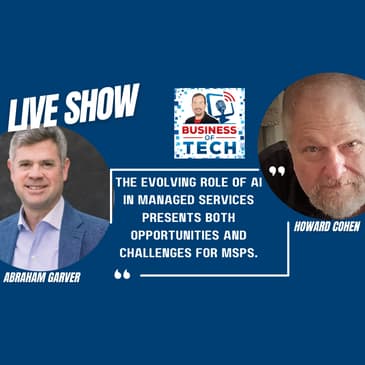
This episode features a deep dive into the evolving landscape of managed services, focusing on the insights of industry experts Howard M. Cohen and Abraham Garver. The discussion centers around the significant shift towards service-oriented models within the managed service provider (MSP) sector, highlighting the importance of artificial intelligence (AI) and the ecosystems that are driving growth. Cohen emphasizes the three main categories of services that are currently profitable for MSPs: managed services, project services, and the emerging field of AI-driven solutions.
Cohen and Garver explore the challenges MSPs face in integrating AI into their offerings. While some MSPs are beginning to adopt AI technologies, many are still grappling with how to effectively implement these tools. Garver notes that the financial metrics of MSPs, such as EBITDA, remain largely unchanged despite the incremental benefits AI may provide. The conversation also touches on the potential commoditization of certain services, particularly in help desk operations, as AI technologies become more prevalent.
The experts discuss the competitive landscape, particularly how larger, private equity-backed MSPs may have an advantage in leveraging AI due to their resources. Smaller MSPs may struggle to keep pace, leading to a potential widening of the gap between them and larger players. Cohen argues that AI could serve as a great equalizer for smaller MSPs if they can effectively automate processes and reduce reliance on human resources.
Finally, the episode highlights the importance of peer groups and community support for MSPs looking to grow and adapt in this changing environment. Both Cohen and Garver agree that engaging with trusted peer networks can provide invaluable insights and strategies for navigating the complexities of the managed services market. The conversation concludes with a preview of an upcoming interview focused on practical applications of AI in enhancing productivity and streamlining workflows.
About Business of Tech: The daily MSP news and analysis podcast for managed service providers and IT services leaders. Host Dave Sobel covers AI for MSPs, MSP pricing and profitability, MSP M&A and private equity, vendor partner programs, MSP cybersecurity and liability, and MSP operations — and answers the question every story raises: Why do we care? Produced by MSP Radio.
💼 All Our Sponsors
MSP Radio is supported by our partners:
ABC Solutions · CometBackup · Firetail · Guardz · HaloPSA · LogMeIn · Mailprotector · Pax8 · Rythmz · ScalePad · TimeZest · Transit AI
Supporting the IT services community through insights, analysis, and transparency.
🚀 Join Business of Tech Plus
Get exclusive access to investigative reports, vendor analysis, leadership briefings, and more.
👉 https://businessof.tech/plus
🎧 Subscribe to the Business of Tech
Want the show on your favorite podcast app or prefer the written versions of each story?
📲 https://www.businessof.tech/subscribe
📰 Story Links & Sources
Looking for the links from today’s stories?
Every episode script — with full source links — is posted at:
🎙 Want to Be a Guest?
Pitch your story or appear on Business of Tech: Daily MSP News & IT Services Analysis
💬 https://www.podmatch.com/hostdetailpreview/businessoftech
🔗 Follow Business of Tech
LinkedIn: https://www.linkedin.com/company/28908079
YouTube: https://youtube.com/mspradio
Bluesky: https://bsky.app/profile/businessof.tech
Instagram: https://www.instagram.com/mspradio
TikTok: https://www.tiktok.com/@businessoftech
Facebook: https://www.facebook.com/mspradionews
Hosted by Simplecast, an AdsWizz company. See pcm.adswizz.com for information about our collection and use of personal data for advertising.
[00:00:13] This week we're diving in deep into the evolving world of the delivery of managed services with two of the most insightful voices in the space. Joining me today are Howard M. Cohen, who's a veteran industry analyst and channel commentator, and Abraham Garver, the Managing Director at Focus Investment Banking, one of the leading M&A advisors for MSPs. Together, we'll explore where the real value is being created from services and AI to the ecosystems fueling the next wave of the world.
[00:00:44] Welcome to the Business of Tech Lounge, the live version of the Business of Tech podcast. It's Wednesday, April 23rd, 2025, and I'm Dave Sobel. We'll be taking questions and comments throughout the show, so make sure to put them in chat. If you have a question, we will happily respond to it.
[00:01:02] Now, I want to thank Sales Builder, our Patreon sponsor whose support makes this show possible. Focus on your IT sales workflow with the power of automation and visit them at SalesBuilder.com. That's B-U-I-L-D-R dot com. Now, reminder, I'm keeping an eye on the chat. We'll take those questions throughout the show.
[00:01:22] Now, Howard M. Cohen is a seasoned IT executive with over 35 years of experience. As a freelance writer and the senior resultant, he provides insightful commentary on the IT channel, contributing to platforms like Insight and Redmond Channel Partner. He is a frequent speaker at events including Microsoft Inspire and CompTIA ChannelCon, sharing his deep knowledge on topics like cloud computing and the growth of AI. Howard, welcome back to the live show.
[00:01:49] Hello, Dave. I just want to remind you it's now GTIA ChannelCon. That is true. You know what? These notes keep having to get caught up. And Abraham Garver is the managing director and MSP team leader at Focus Investment Banking. With over 150 M&A transactions involving MSPs, MSSPs, and IT services firms, he's played a pivotal role in shaping the managed services landscape.
[00:02:13] His expertise is frequently sought at industry events like IT Nation Connect and MSSP Alert Live, and he contributes to publications such as Forbes and Channel Ede. Abraham, welcome to the live show. Dave, it's great to be here. Guys, I am super excited to mix it up with you guys because I've got two very differing perspectives that I think we can bring together to deliver some really interesting insights.
[00:02:37] And, Howard, I'm going to start it off here because one of the things that you and I have talked about leading up to this is the industry's pivot to services. And we were teasing that our good friend Jay McBain at Canalys is even acknowledging the shift in his discussions. Now, I want to get a little bit of your sense on where you think the most profitable and strategically important services MSPs are offering and how that's impacting the delivery from your perspective. Yeah, there's really not just one.
[00:03:06] I think there are probably three categories that we have to look at. Of course, managed services. Everybody wants to call themselves an MSP or they want to specialize and become a managed security services provider, MSSP. But that's one piece. Another piece is project services where they are installing, implementing, integrating and managing networks.
[00:03:34] It's interesting that a lot of the people who are doing projects don't want to do managed services. And a lot of the people, almost I think most of the people who are MSPs today, look at projects as something that has a beginning and an end. And then they have to start all over again. So you don't see that. More recently, and this happens all the time, I think everybody who's in our channel adheres to Microsoft's theory of the big bet.
[00:04:04] And the current big bet, of course, is artificial intelligence. Right now, at this point, I think everybody's just trying to figure out how they sell it, what they sell, how they provide it to customers. I think it's still a mystery to a lot of them. I think a few experts are emerging. I'd like to think that. But I think we're very early in that curve. Yeah, I think that too.
[00:04:28] And that's the conversation I've been having with a number of different interviewees when I have them on the show is talking about things like data governance and the preparation and getting things done. But I actually spoke to an IMCP group last week. And the feedback I was getting was that there was still a bit of a gap and that Microsoft was talking about Copilot, but they're not exactly sure how to deploy that because the data is not ready. But Abram, I think you bring an interesting perspective because when we talk AI, we're talking about kind of leading edge things. But you're involved in a lot in the transactions.
[00:04:58] And I was curious to know from your perspective, when you put your valuation lens on, we often talk about product versus services. But let's dive into the services themselves. Are there particular recurring services or specific lines within that like cybersecurity or compliance that are getting a more significant premium in the deals than other types of service offerings? Not at all.
[00:05:50] I think it's a four or five hour call. I think it's a four or five hour call and management call with a buyer and getting into really excruciating detail about what's going on with the business. And the voiceover had three different on a slide, three different pieces of AI that were contributing to making the business more efficient.
[00:06:11] But the big picture is the EBITDA, kind of the cash flow, the profits of the business are still the profits of the business. The revenue is still the revenue of the business. Trends in revenue, trends in EBITDA. There might be some incremental benefit. But there's so much other noise of, gosh, just over the past year, inflation noise.
[00:06:39] If you look at labor inflation and everything else to be able to carve out, hey, here's what's happening from AI. Good luck. Good luck. Yeah. By the way, I'll throw it in there. I'm going to keep this conversation going. And if you've got a question, throw it in chat. Abraham, I'm going to follow up a little bit there because I think you said something that maybe is the unlock that I need to focus on. But is the commoditization of certain types of services that we might see over time?
[00:07:06] So, for example, if I wave my magic wand, some portions of help desk may get commoditized by the use of chatbots and AI. Is the way that's going to get expressed in value simply just their EBITDA, their profitability around that? Or do you project this might change that buyers may start looking and saying these kinds of services are more valuable than these other ones? As we think about it, there's no question that this is going to benefit the larger MSPs.
[00:07:36] So our private equity backed or PE backed MSP platforms that have been growing for the past three, four or five years. As you think about spending a percentage of your revenue, those bigger MSPs can really, from an aggregate dollar amount, really be relatively large.
[00:07:58] How much they can set aside to invest in AI and really just automating tasks in a way that the smaller MSP, the same percentage of their revenue is minuscule. And there's not an ability to really affect the automate and kind of get into the same. So I see over time it being really difficult to be a smaller MSP relative to the benefits.
[00:08:28] And I think we may talk about some of the larger platforms in this conversation, like a new charter being able to benefit from AI in ways that somebody that's the local MSP may be at a competitive disadvantage. Yeah. And I'm definitely going to come to that in just a second, but to put a pin in that bit, because in a way, Howard, I want to get your take here a little bit, because I know you and I can rant about the AI hype for a very long period of time.
[00:08:58] But how much substance is here? And some MSPs, so I'll interview, say the team from NetSueret, right, has been on my show recently, and they're talking about doing full rollouts of chatbots for customers. And then I talk to other groups of MSPs, particularly on the longer tail as they move smaller, and they're confused and they're saying even their customers aren't even interested in buying. Like, give me a sense of, in your conversations and analysis, like, how much is this substance and how much is this noise? Right now, it's all noise. Okay.
[00:09:29] I'll tell you, I disagree with Abraham to an important extent in that I see AI and eventually what comes out of AI, most predominantly AI ops, as being a great leveler for smaller MSPs. Okay.
[00:09:46] You know, if you think back, we've always looked for automation to reduce our dependence on human resources because they're the most expensive resources SMBs, you know, smaller MSPs have. That's just going to go on steroids now. We're going to see the hockey stick on that, where you can automate so much. You talked about, you know, virtual tech support telecom agents.
[00:10:15] You know, that's very, very popular and they're very conversational. There have been some failures that were kind of spectacular but not well reported. But I think that right now, MSPs have no clue as to what they really want to do with AI and customers see most of what they're being told as toys. We'll have it write emails for you.
[00:10:43] We'll have it make pretty pictures for you. Nice music. I mean, that's not what businesses invest in technology for. On the other hand, you have some partners who are more on the systems integrator side of the business than the MSP part. They're focused more on how do we integrate AI technologies into applications?
[00:11:09] Because AI is not going to be the foundation of any application. It's going to be an enabler of new functionality. I tell people all the time that, you know, today's technology can give you black or white, whereas AI can now add shades of gray. You can have an answer that's somewhere in the middle that is opinionated.
[00:11:34] That, you know, with now, especially with the development of reasoning in AI, you know, we're seeing much more of a subjective approach to decision making than technology's ever been able to provide before. So if we look at those developers who are integrating AI into their application development where it makes sense, where it really adds value, I think they're going to be the leaders going ahead.
[00:12:01] And I think the MSPs are probably going to make a whole lot more out of AI augmenting what they can do in managing their customers' networks using AI. And, yeah, I think there will be a magic balance between human resources and AI resources. But if we shift the skill sets, as a lot of people say we will, then that may not be so painful.
[00:12:30] Of course, if we don't, right now, we may just solve the skill set. Well, I think this is worthy of a follow-up, Howard, because at the same time, you know, the thing that I've been thinking about a lot is we're almost comparing AI agents to perfection, right? And we're sort of saying, like, hey, any failure on an AI chatbot is, you know, a spectacular failure and a colossal. But having employed engineers who I enjoyed working with and are highly respected, they make mistakes too, right?
[00:12:58] And sometimes those can be highly spectacular human errors. I feel like, you know, I agree with you on the automation, like for, say, the next 12 months, right? I think, like, that's probably where some of the biggest value would be for an MSP operation.
[00:13:14] But I don't think it's a particularly large stretch to say that we can deliver as an MSP, you can deliver significantly better customer service, in some cases, by actually giving customers access to a bot that is trained, that is instantly available and can do tier one level diagnostics. Like, am I overthinking how fast this would happen? Is this somewhere where you think directionally we're heading?
[00:13:41] Give me a little bit of your sense of how much that tier one power might get impacted. I think that the challenge is in all of the focus that OpenAI and Google and Anthropic and all the other AI developers are putting in is to make the AI seem much more human-like. To make it much more conversational.
[00:14:07] That's where they're running into problems because, yes, I've had engineers who make me wish I didn't get up this morning. And I've threatened more lives than I care to think about. But when an AI right now makes a mistake, it can be tremendous beyond what I think most people are capable of because they still do hallucinate.
[00:14:32] Many of them, if they cannot come up with an answer, they are driven to come up with an answer. So they'll make one up. That's happening widely. And some of those things they make up are very dangerous. So you see a lot of work going into muting that and bringing that down. But I think that the majority of it is that people aren't exposing customers just to chatbots. They're exposing them to AI personalities.
[00:15:00] And they're working hard to make them more lively, more engaging personalities. And that's where I think they're tripping over themselves. I think it's too early. I think we need to learn a lot more about how machines learn.
[00:15:17] Because if you listen to anybody, there was a great, great segment on 60 Minutes recently where one of the foremost, a Nobel Prize winning AI developer said that, you know, we're still learning how these things learn. Well, if he's learning how these things learn, then everybody's learning how these things learn. So it's early. And we're going to make mistakes. I don't think it's going to slow anything down.
[00:15:43] But I do think that your typical MSP, I mean, I've spoken to editors at major publications who are completely clueless about AI. They're still talking about having it write your briefs for you and having it write your emails for you. And that's just, I mean, to say that that's the tip of the iceberg is understated. That's nothing compared to what we can really accomplish, especially now when you see things emerging like MCP and A to A.
[00:16:13] You know, we're now finding technologies that are getting these agents to talk to each other, work together. Satya Nadella is right. This is going to change the way we relate to applications. You know, it's not going to be a classic monolithic application anymore. It's going to be an agent that does this for me who can call that agent and have them do that for me. And they do it very autonomously. I just tell them what needs to be accomplished. They go out and do it.
[00:16:42] So there's a lot of development still. You know, people keep talking about how fast this is happening. And they're right. It's happening too fast. We do need to throttle back, do more study, do more homework, learn more on our side before we push things out into the market the way we are. Well, I think I don't disagree.
[00:17:05] I will say that this is my father's old advice of measure twice, cut once really resonates for me. And I will sort of help. I don't necessarily think we all have to rush. I mean, we need to move at the pace that you can make good decisions on. But, Abram, I want to actually ask you, because you mentioned New Charter earlier. And it's the piece that kind of fits into this conversation here. Because I found it really notable when New Charter made a whole acquisition around bringing on AI expertise.
[00:17:34] And as somebody who spends a lot of time thinking about the deals and thinking about the value of this, what are they actually buying in terms of value when an organization like New Charter buys an AI-focused firm for MSPs? What are they buying in terms of value?
[00:17:53] I think they're a pure strategic buyer in that they can take something that a business that's just a standalone MSP in one geography versus New Charter that has exceptional MSPs and call it 25 different footprint in 25 different geographies.
[00:18:19] As the strategic buyer, it can pay one time for some expertise and then roll it out into each one of those markets in a very eloquent way and benefit each of the different pieces, kind of help its organic growth, help its... That's really interesting about NetSurf, by the way. I'm going to go back and listen to that conversation.
[00:18:45] I think it can be helpful from not only helping your customers and potentially new organic revenue, but also, as I was just saying in that management presentation yesterday, three different buckets of ways that costs can be reduced. So the potential gain here, even if New Charter mispriced, I'm not familiar with the acquisition that they made.
[00:19:14] Even if they mispriced it, being able to roll it out 25 times is just a home run. Gotcha. Gotcha. Now, for listeners, if you're watching, go ahead and throw those questions and comments into chat. I will definitely bring it up for my experts here. But, Aira, I'm going to follow up here a little bit because I'm going to... And then I want to get this from Howard as well. But as you think about this, I want to give me a little bit of the sense of kind of the build versus buy math for someone who's looking at it.
[00:19:44] Particularly, you're someone who brokers these deals all the time. If you're a business owner, if you're looking at kind of adding that level of expertise, walk me through kind of the framework for thinking about build versus buy from a deal-making perspective as I need this new talent. As it relates to AI, I want to see the ConnectWises of the world. I think that's the place with deep pocket private equity software.
[00:20:13] I want money invested and spent there. That in that same conceptually, it's very similar to that what I just described with New Charter. I can roll it out to 25. Sure. With ConnectWise, I can roll it out to 20,000. I can roll it out to 30,000.
[00:20:32] So I think I would discourage people from going, taking mortgages on their house to figure out in a small MSP how they can make themselves more efficient, super efficient, and rather look to providers that are... That's all they do. ...you know, and kind of bring in-house technology that others are investing in.
[00:20:57] And Howard, you know, to your point that you were making earlier, I just... I really think that the small MSP, it's got a lot of things that are on its plate. And it may have a CTO in it, and it may have an expert who can be good at AI. But I'm going to tell you what, there's a list of 150 other things that it's got to be an expert at to keep that MSP floating.
[00:21:26] Not, you know, things like the rent, the re-signing the leases. I hear you, but you know what? The fund bill and everything else. One of the things we've been saying to MSPs forever is don't try to be the jack of all trades. Pick one or two things to focus on. I'm an answer. Yeah, I agree. Right now what's going to happen is that some of them are going to realize that what they focused on is now starting to go into life.
[00:21:53] And they need something else to focus on, and AI is very popular. I'll also point out to you, you mentioned ConnectWise. ConnectWise, today, you can get a virtual tech support agent from ConnectWise. They have partnered with Crush Bank, who was one of the first providers of virtual tech support.
[00:22:14] They're a team of guys who spent 40 years as MSPs, who then turned around and developed their own virtual tech support agent, and they're offering it through ConnectWise. So I think, you know, when you come down to build versus buy, ConnectWise right now is in the buy camp. That doesn't mean that they may decide later on to, you know, to build their own. But I think even that will take a buy of some other company that's in the business and already has the expertise. Sure, sure.
[00:22:44] Yeah. Now, it's interesting you bring up that level of expertise, because I want to throw in another kind of twist on this for two different things I knew I wanted to ask the two of you about. First, Abram, I really am dying to get your perspective on these proliferation of these M&A-centric events. As we talk about expertise and thoughts, I've been really thinking about, like, why these have all been popping up.
[00:23:07] You know, I'm trying to wonder, like, are investors essentially trying to manufacture the next group of MSPs to buy? Because you've talked about the fact that there might be a shortage of these $3 million plus a year EBITDA MSPs. Is the thinking here that they're going to invest some money and help grow them? Like, why are we seeing these events pop up? I love that you gave me this question ahead of time. And, you know, I had I really put two, three days of thought into this.
[00:23:36] And there are organizations like the 20. There I'm going to say, you know, that there's an incredible number of conferences. And I hear this in in some boardrooms, people saying, what are the you know, I get this question a lot. What are the conferences that we should be going to? Which ones have you gone to? Which are, you know, kind of what do we do?
[00:24:03] There's this proliferation of MSP conferences. And you really have to pull the camera back and say each person that's asking that question. One of them, for instance, was an executive search recruiter in the MSP space. I think each of us needs to ask ourselves, well, what is our objective? If the objective is to grow the value of your MSP,
[00:24:30] then hands down, and this is really, again, thank you for giving me this question. Hands down, peer groups, M&A peer groups greatly outshine getting conference connections when it comes to being able to increase the value of your MSP. And I'll give you some examples.
[00:24:53] 67% of our most successful MSP, M&A platforms, and we've done 12 between 2020 and 2024. 67% of them were in peer groups. IT Nation Evolve is, you know, one of the premier groups. Premier groups, and they have 25, at this point, private equity-backed MSP platforms.
[00:25:20] And what these, what they do, you know, that's so incredible being in a peer group, it's really a high trust community if you think about it. You're in a group with 12 people sharing things about your family, things about your business, about your employees. Generally not in competitive. You're not, you won't have someone in your peer group that's in your same market,
[00:25:49] but you'll have peers of similar size MSPs. That, as opposed to, like, in meeting somebody in a crowded ballroom at a conference and saying, hey, let's merge together, let's bundle together and go try to get a higher multiple. The, that intentional high trust community of a peer group is really absolutely where you want to be
[00:26:17] to wind up with an asset that someone like myself and our team can bring to market. And institutional investors, when given the choice, once it's explained to them, hey, there are these things called peer groups, that MSPs have been fortunate to be members of for, you know, for decades at this point. Or they're MSPs that have just said, you know, no, I'm not going to do the, I'm not going to do a peer group. I'm, I can do all this on my own.
[00:26:46] I'm, you know, I don't want to have a boss. I'm blah, blah, blah, blah, blah. Like, there's no question in the world that if you're, want to, there are things you can do to increase your value. There are things relationally, building your relational, your relational equity by being part of a peer group that are just second to none.
[00:27:10] I've seen, I mean, we've put people in, and past performance is not indicative of future success. We've put people in airplanes and all sorts of other stuff as a result of, you know, just wealth that's generated because of these relationships is unbelievable. I think Integris is case in point. It just recapitalized. We helped it with its first recapitalization.
[00:27:39] It just went through its second recapitalization. Its EBITDA went from 2.5 of EBITDA, four plus years later to in the 30 range over 10X. And it was because of that incredible, Rashad's incredible relationship equity and Arlen Sorensen's incredible relationship equity that these, you know, peer groups,
[00:28:04] no question, if you have one hour of time or, and it can be spent going to, you know, in multiple spending that going to random conferences versus peer groups, pick peer groups all day long. Well, fair enough. And they can come, if they want randomness, they can come on my show or listen to my podcast for a little bit of randomness. So I'll definitely say like, but Howard, I think this is related a little bit because Abraham observed the like proliferation of conferences.
[00:28:33] And one of the things you and I were talking about leading up to this was a bit of the waves of MSP enablers, like the ecosystem around. And we're seeing, you've observed that you're seeing some shifts in the kinds of companies that are supporting. Give me a little bit of your thought on what's happening in that ecosystem of support around MSPs. Well, first of all, let me agree with Abraham totally that peer groups- Come on, I want a disagreement. I'm sorry.
[00:29:02] Once in a while, I do agree with people. Okay. It's a bad habit. I'm trying to get out of it. But peer groups have absolutely, are absolutely far more valuable. I mean, if you look at the shows, they've become very little more than social events or boondoggles where people go to get drunk and have a good time and attend sessions. But the shows, just like the industry for a long time, has suffered from what I refer to as the dilettante effect.
[00:29:33] You know, you have people who have positioned themselves as consultants or coaches or trainers. They're offering to teach MSPs how to run their business, how to market their business, how to train their salespeople, how to advertise, how to build relationships. They're trying to teach them all kinds of things.
[00:29:57] What's interesting is that if you look into their history, very few of them have ever spent any time or very little time in the industry. They have never worked in the channel. They have never been an IS or an MSP or, you know, I'm sorry, an SI. They've never done what we do.
[00:30:20] On the other hand, what you're seeing today are people who've been doing it for years now, basically selling off their MSP and spending more time focused on helping others build theirs. And that's been fascinating to watch. People who've come out of major organizations like Microsoft and started organizations that will help them.
[00:30:44] I'm featuring some of those in my channel and read in my column in Redmond Channel Partner and also in my newsletter, Tech Channel Results. I just think that if an MSP is sitting out there wondering how to do anything, pick whatever it is, there is somebody out there who has done it, who has been there, done that, burnt the T-shirt. And I think they need to really focus on finding those folks. The good news is they're out there.
[00:31:14] The better news is just follow my column and you'll find them. Well, that is almost the perfect segue, guys. I know I could keep going with you for all day long on this, but I think you've given me tons and our listeners a ton to think about. Howard, I'm going to throw it to you. How can people get in touch if they want to sign up for your newsletter? Howard, what's the best way to do that? What are the ways to get in touch with you to get signed up? Sure.
[00:31:40] The best way to reach me is my email, hmc at howardmcohen.com. Kept it simple. The other way you can reach me is to follow my newsletter, which is techchannelresults.blog. Yeah, just that simple. And I hope you will. It's my effort to have an ongoing conversation with the channel. Well, and I know I will have you back because you're always a great, great fun to mix it up here on the live show.
[00:32:08] And Abram, if people are interested in getting in touch, what's the best way to do that? Email would be great. Abraham.garver.garr.v as in Victor, er at focusbankers.com. Or feel free to contact me just through LinkedIn where we are here today. Awesome. Well, guys, I appreciate both of you joining me today. Willing to mix it up a little bit here on some fun topics. And I'm looking forward to having you both back on the live show in the future. Thanks, Dave. Thanks, Dave.
[00:32:36] Now, I want to tease an interview that I am dropping on the weekend. I spoke with Hunter Jensen, who's the CEO of Barefoot Solutions. And we talked about practical applications for AI and machine learning and how to enhance employee productivity and streamline workflows. He shares how their focus on building businesses that can leverage generative AI to transform existing data into actionable insights, ultimately driving efficiency and growth without the need for additional hiring.
[00:33:06] Here's a preview of that interview. Yeah. And this is, unfortunately, a problem almost every time we show up, which is that there's foundational data work that you need to do to get your organization in a place where you can leverage tools like this. I've found that to be true in most, if not nearly all of the cases of late. Now, I think the tide is changing on that. People are realizing that.
[00:33:35] But things like data governance, right? Because it's garbage in, garbage out. If you're allowing garbage to get stored in your infrastructure, then the LLMs are going to spit it out. And that's not going to be very valuable. So having strict data governance about how data gets written into your data stores and how it gets updated and how often it gets updated, these are all things that are really important to think about.
[00:33:59] And then there's also the matter of somebody's got a 10-year-old database that they haven't bothered updating and sitting on an on-premise server that only has two ports open and kind of modernizing businesses that have been around for a while. Because those types of situations get tricky if they're not on cloud or if they're using really outdated systems.
[00:34:24] So now the tools that I normally use that have connectors for all the good modern systems, I don't have a connector for this one. So getting your data infrastructure modern and clean is the most important thing to get an organization ready. Some are lights out at this. And I have seen folks that are very excellent because they're data-driven organizations. So they've been working on their data for years. That data work is truly key.
[00:34:54] And Hunter gave a lot of key insights on how you do that and how you deliver that. Now, my Patreons already have this interview now. If you want to get access early, that's a benefit of supporting the show. Visit patreon.com, Slamish MSP Radio to sign up and get access now. The interview will drop on the YouTube channel and podcast feed this weekend. Now, I want to thank Sales Builder, our Patreon sponsor whose support makes this show possible.
[00:35:21] Focus on your IT sales workflow with the power of automation and visit them at salesbuilder.com. That's B-U-I-L-D-R dot com. And vendors, you too can get your name mentioned on the live show. It's a simple monthly subscription. Visit patreon.com slash MSP Radio to learn more. Get your logo mentioned on the show. And listeners, here's how you can support the show. The number one thing you can do is like, share, and follow on your favorite platforms.
[00:35:49] Makes a huge difference. We're measured on views in terms of the way that the algorithms feed us up. And that is by far the number one thing you can do to help us out. If you want to get access to those videos early, you can support directly on Patreon with our Give What You Want model. You set what you think the content is worth and you get access to those interviews early. If you're listening to the recording and have a question, send it in at question at MSP Radio dot com.
[00:36:17] Thanks for joining me today for the Business of Tech Lounge. And I will see you next time. Bye. Bye. Bye. Bye. Bye. Bye.