
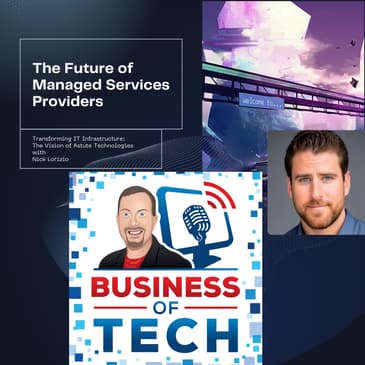
In this bonus episode of The Business of Tech, host Dave interviews Nick Lorizio, founder of Astute Technologists, a new managed services provider. Nick shares his journey from a business management and leadership major to the world of MSPs. He highlights the importance of human expertise in cybersecurity and discusses the role of managed services in small businesses. Tune in for insights into the evolving landscape of managed services with a fresh perspective from a young entrepreneur.
Supported by:
https://huntress.com/mspradio/
https://coreview.com/msp/
About Business of Tech: The daily MSP news and analysis podcast for managed service providers and IT services leaders. Host Dave Sobel covers AI for MSPs, MSP pricing and profitability, MSP M&A and private equity, vendor partner programs, MSP cybersecurity and liability, and MSP operations — and answers the question every story raises: Why do we care? Produced by MSP Radio.
💼 All Our Sponsors
MSP Radio is supported by our partners:
ABC Solutions · CometBackup · Firetail · Guardz · HaloPSA · LogMeIn · Mailprotector · Pax8 · Rythmz · ScalePad · TimeZest · Transit AI
Supporting the IT services community through insights, analysis, and transparency.
🚀 Join Business of Tech Plus
Get exclusive access to investigative reports, vendor analysis, leadership briefings, and more.
👉 https://businessof.tech/plus
🎧 Subscribe to the Business of Tech
Want the show on your favorite podcast app or prefer the written versions of each story?
📲 https://www.businessof.tech/subscribe
📰 Story Links & Sources
Looking for the links from today’s stories?
Every episode script — with full source links — is posted at:
🎙 Want to Be a Guest?
Pitch your story or appear on Business of Tech: Daily MSP News & IT Services Analysis
💬 https://www.podmatch.com/hostdetailpreview/businessoftech
🔗 Follow Business of Tech
LinkedIn: https://www.linkedin.com/company/28908079
YouTube: https://youtube.com/mspradio
Bluesky: https://bsky.app/profile/businessof.tech
Instagram: https://www.instagram.com/mspradio
TikTok: https://www.tiktok.com/@businessoftech
Facebook: https://www.facebook.com/mspradionews
Hosted by Simplecast, an AdsWizz company. See pcm.adswizz.com for information about our collection and use of personal data for advertising.
[00:00:00] I have this working theory that there's a young generation of new managed services providers
[00:00:07] out there.
[00:00:08] And let's talk to one.
[00:00:09] Nick Larizio is the founder of a Stu technologist and he joins me today to talk on this bonus
[00:00:15] episode of The Business of Tech.
[00:00:19] Today's episode is supported by Huntress.
[00:00:22] You want to focus on your clients and are always looking for ways to get more time.
[00:00:27] Who's Huntress's fully managed cyber security platform to fight off cyber threats?
[00:00:33] Huntress is more than cyber security software for endpoints and identities.
[00:00:37] It's a 24x7 security operation center.
[00:00:40] It's security awareness training, community engagement and dedicated partner support with
[00:00:45] an average CSAT score of 99.3%.
[00:00:49] Technology can only get you so far.
[00:00:52] Human expertise is what's needed to truly elevate and protect small businesses and you
[00:00:57] get that with Huntress.
[00:01:00] Secure your clients and help them thrive with the number one rated EDR for SMBs on G2.
[00:01:05] Visit huntress.com slash MSP Radio to find out more.
[00:01:11] Well Nick, thanks for joining me today.
[00:01:14] Thank you so much for having me, Dave.
[00:01:16] It's a pleasure to be here.
[00:01:17] I'm really excited about the show and the opportunity to speak to your audience and talk a little
[00:01:21] bit about myself and also learn a little bit more about you and your background as well.
[00:01:26] Well, it's exciting to talk to somebody who has come up through the MSPR.
[00:01:31] Tell me a little bit about your career that led you to where you're at now.
[00:01:37] Absolutely.
[00:01:38] So coming out of school I was a business management leadership major and then I also
[00:01:42] double-majored in management information systems.
[00:01:45] Like many coming out of college, you don't know what to do.
[00:01:49] I partnered up with a small IT shop knowing very little about what an MSP is.
[00:01:56] And how they play in this space and so on.
[00:01:59] But it was pitched to me as a great way to cut my teeth, work with multiple vendors, figure
[00:02:04] out what I like, and then go on from there and explore different things.
[00:02:08] So I worked for a small family owned MSP that served us primarily the greater Boston area.
[00:02:15] And then from there I went to thrive which was a merger of two largest MSPs in the Boston
[00:02:24] area.
[00:02:25] I worked at IT and thrive networks which was, thrive was actually started by a 27 year
[00:02:29] old which was kind of inspiring to me.
[00:02:32] As a younger guy, barely had the three years at a small MSP and then I wanted to kind
[00:02:37] of jump ship and have a bigger experience.
[00:02:40] So I went to the private equity back space where we were growing through acquisition
[00:02:44] which is very common today roughly four to five companies per year were coming into the
[00:02:49] thrive household if you will.
[00:02:53] And it was a really exciting, I learned a ton of material, a lot of things were happening
[00:02:57] really quickly.
[00:02:58] I got to come in and kind of talk to these orders that would stay on for 12 months or
[00:03:03] so work with them directly on integrating their portfolio of accounts to the thrive system
[00:03:10] if you will or on platform products and services.
[00:03:13] So if they were kind of leveraging one tool or if they were using let's say minecast and
[00:03:20] we wanted to switch them to Alpriver, something like that.
[00:03:23] So we would kind of streamline from an operational standpoint and get everybody on the same page.
[00:03:29] That was great experience I learned a lot.
[00:03:31] It's a lot of work working in the private equity world and it moves really fast and you're
[00:03:35] going to work long hours.
[00:03:38] And it definitely from there I saw the benefit of being an owner because these owners
[00:03:43] would come in and stay on for 12 months and then go buy boats or new houses and things
[00:03:48] like that.
[00:03:49] So I said to myself, hey if I really want to make it I'm going to have to be an owner
[00:03:53] someday and I'm going to have to own something.
[00:03:55] And that inspired me too.
[00:03:58] And it was during the pandemic so we were all remote.
[00:04:01] I got ahead.
[00:04:02] You know I was a young guy and I had a book of business at the time of 100 accounts.
[00:04:08] I converted most of the vast majority of them over to on platform products and services
[00:04:14] if you will.
[00:04:15] And I busted my butt.
[00:04:17] And whenever I got a chance of free time, I saw that as an opportunity to work on publishing
[00:04:23] my book, marketing myself and doing my personal brand and continuing to grow as a professional
[00:04:30] both inside as well as outside of work.
[00:04:33] That's where the idea of a suit technologist was born.
[00:04:37] And I kind of started with a website, started with a few blog posts and published my book
[00:04:44] and went from there.
[00:04:45] And then I actually went back to Enterprise.
[00:04:48] I went to work for Experian, the largest credit bureau out of the three.
[00:04:53] And I kind of focused on stopping and preventing fraud and coming up with new strategies and
[00:05:00] ways of doing that because of how closely related that is to cybersecurity which I'm
[00:05:04] excited to talk more about with you.
[00:05:07] Well, what's the core idea behind the suit technologist?
[00:05:11] What's the why of what you're doing?
[00:05:14] Well, I saw a number of problems with legacy MSPs that are 20 to 30 years old and that's
[00:05:20] why a lot of them are selling, right?
[00:05:21] A lot of them kind of spun up as you know around the dot com boom and haven't really changed
[00:05:26] their service model set.
[00:05:27] Right, it's still a lot of, especially when you're at that 20 to 30 person.
[00:05:32] It's still a lot of break fix.
[00:05:33] Still do hourly billing.
[00:05:35] They do that.
[00:05:36] Right.
[00:05:37] It's a very kind of old model.
[00:05:39] I saw a number of challenges.
[00:05:41] First being there's not really an aggregator or a good one that I could find.
[00:05:45] They took the 20,000 MSPs and kind of pulled them together.
[00:05:49] It's still a lot of like channel sales.
[00:05:51] You know, if you Google most MSPs, you already even see many Google reviews, right?
[00:05:55] It's a lot of word of mouth, a lot of long term contracts, a lot of long term business
[00:05:59] deals.
[00:06:00] So I saw that as a first issue.
[00:06:02] Second, I saw a lot of like the gig economy exploding, right?
[00:06:08] Services like Uber where I could go to a fiber dot com and contract out maybe even overseas
[00:06:14] a network engineer at an hourly rate.
[00:06:16] So I saw that those opportunities were there for people who are in purchasing power to
[00:06:22] kind of outsource and leverage other places to get IT assistance.
[00:06:27] So I saw, I noticed those two things.
[00:06:30] And then I noticed a third major problem, which is all of these MSPs now who started
[00:06:36] as help desk for maybe they're augmenting a company that doesn't have an in-house or
[00:06:42] they're doing a function of the IT for a larger organization.
[00:06:45] Right?
[00:06:46] So I saw that a lot of these help desk essentially who became and they went to the cloud, who
[00:06:53] went to when managed services became big, which was the start of a SaaS model.
[00:06:59] Right?
[00:07:00] So they went through all of these changes over this 20 to 30 year period and now they're
[00:07:06] all trying to be security companies.
[00:07:08] And I saw that as a major problem with a lot of AI now automating things like the
[00:07:16] password reset or where's my Faye, where's my file or imaging of computers at the factory
[00:07:22] as opposed to having to send somebody on site.
[00:07:25] So I noticed a tremendous amount of change happened really rapidly and I said now is
[00:07:30] a great time to start a new and build a new service model.
[00:07:34] So it sounds like embedded in that is kind of you think the premise that an MSP, a traditional
[00:07:39] infrastructure post MSP can't really make the lead to security.
[00:07:44] How do you think about your thinking there?
[00:07:47] Well, I think when a large portion of your time as an engineer is focused on troubleshooting,
[00:07:55] servicing kind of on premise hardware.
[00:08:00] Maybe you have a private cloud and you're trying to compete with AWS, Azure, Google, Oracle.
[00:08:08] You're trying to compete with these massive players.
[00:08:10] A lot of them have become resellers but the ones that do have their private clouds, that's
[00:08:13] a huge threat to their business.
[00:08:16] So I can really see them kind of struggling and if they're not engaged in M&A, where
[00:08:23] they're able to buy in and modernize and then they're really, I don't see them surviving
[00:08:29] this next few years here especially with the acceleration of AI adoption.
[00:08:34] So I see myself as a new player having a massive competitive edge today just like when these
[00:08:39] companies started in the .com boom, I see the same thing with the AI boom happening
[00:08:43] right at this very second.
[00:08:45] I had a level to playing the fuel.
[00:08:47] So give me your insights then and how you see this all coming together like what is your
[00:08:51] version of the future of cybersecurity, IT infrastructure, software development and sprinkling
[00:08:58] a little AI on top of that?
[00:09:00] Like how did these come together?
[00:09:01] Where do you think this is going?
[00:09:03] Well, I still see your IT partner as a critical aspect of your business.
[00:09:08] You want to trust that person and know him intimately or her intimately.
[00:09:14] Really it's going to that person, it's leveraging them not for the help desk.
[00:09:19] It's having a business conversation saying let's put a budget together, let's look over
[00:09:24] the next three, five, seven years and what's that going to look like?
[00:09:27] And how do I reallocate my funds where things like help desk is being automated right
[00:09:33] in network support is things like auto config where you can take a fortinet and go to
[00:09:40] a Cisco Marockie and use auto deploy and take those configurations now with AI and replicate
[00:09:46] them to a new device because that's old end of life.
[00:09:49] Whenever it is that drives the sale, since so many of those functions where you're not
[00:09:54] going to get the four hours of high ticket labor for that work, you need to show that value
[00:10:00] somewhere else.
[00:10:01] That's really where I see cybersecurity services coming in where you used to pitch cloud
[00:10:06] or disaster recovery.
[00:10:08] I see that really taking over as a trusted partner, a trusted instance of AI that might
[00:10:14] be not publicly accessible.
[00:10:18] So I see things like that having a lot more value today and the other thing is moving away
[00:10:24] from that hourly billing where you can charge like maybe a success fee or one time set
[00:10:30] up for yourself and that nature.
[00:10:32] But we have to get to a SaaS model, we have to get away from those kind of legacy practices
[00:10:38] or you will not survive as an MSP in my opinion.
[00:10:42] So when it's due to those into work with a customer, how are you positioning and offering
[00:10:47] your service?
[00:10:49] Per user pricing, flat fee, sure things go up over time just like an insurance bill,
[00:10:56] I think right now we're at $200 a month per user.
[00:11:01] So I don't even expect when I talk to a decision maker, sometimes it's a technical
[00:11:07] effect and you know this but typically the decision maker is in control of the finance
[00:11:13] budget.
[00:11:14] It's a CFO, it's a director of operations, COO, perhaps you're sitting in front of a board
[00:11:22] that's rare, maybe it's a CEO that's also rare.
[00:11:26] But they have a big stake in the game, they probably own some of the business or they're
[00:11:30] in control of the budget.
[00:11:31] That person I don't always expect them to be the post technical, I don't expect them
[00:11:36] to, you're right, I want to come in and have a business conversation with that person.
[00:11:40] It says, how do we get to a SaaS model?
[00:11:42] Perhaps we look at your IT expenditures over the last three, four or five years and let's
[00:11:48] break that on into a monthly but from experience I've seen and I'm lean, right?
[00:11:54] I don't have a massive bench right now but I've seen the per user price and go anywhere
[00:11:59] especially in my area from two to three other bucks per seat per month.
[00:12:04] And I think that's very reasonable and I don't expect the buyer to have all of this intimate
[00:12:10] knowledge of what's happening behind the scenes.
[00:12:12] I just want to give them a very simple structure that's easy to understand and replicable
[00:12:18] to go mass market because that's where I want to take it eventually.
[00:12:21] Now tell me a little bit about what you put in your book, digitalization, the need
[00:12:25] normal of the post pandemic world.
[00:12:27] What's your premise for what the digital world and digital digitalization looks like
[00:12:34] in this post pandemic world?
[00:12:36] Well, lots changed right?
[00:12:40] And they say that six years of innovation occurred in the matter of 12 months which is very
[00:12:45] accurate.
[00:12:47] And the world changed overnight right?
[00:12:49] And just like a hundred years ago in the Spanish Bluehead and unfortunately a lot of people
[00:12:54] lost their lives.
[00:12:55] The similar thing, we had a hundred year fluke event occur.
[00:13:01] And I think it put a lot of us into survival mode.
[00:13:04] We were working long hours and particularly in the IT space things were very good, right?
[00:13:09] Business was booming and people and folks that might have still had an on-premise server
[00:13:15] or software applications that sat in an office.
[00:13:19] Now we're forced to access them from anywhere.
[00:13:22] Access their files from anywhere, work from anywhere, otherwise they would risk being sick.
[00:13:28] And the reality is if you did not have those systems in place at that time, you need
[00:13:32] them in place today going forward to prepare for an event like that, right?
[00:13:37] Otherwise you're putting yourself at extreme business risk and we saw first hand how many
[00:13:41] people had to close up shop or were forced to sell, right?
[00:13:45] And a lot of small MSPs even could not sustain with those big one-time projects.
[00:13:52] All those projects went on hold.
[00:13:54] The ones that did survive and thrive if you will, they were able to sustain with that
[00:14:01] SaaS model.
[00:14:02] Sure, some had to go to collections and some customers got behind on their payments and
[00:14:08] they were going to close up anyway and they've got stuck in business, right?
[00:14:12] So really what I see happening is the SaaS model continuing to dominate, right?
[00:14:18] I see the acceleration of services like cybersecurity now that mass cloud adoption has occurred, right?
[00:14:25] The ones that didn't adopt cloud probably aren't still around.
[00:14:28] So all of these things have happened and now it's like what's next?
[00:14:32] So that's the big focus on cybersecurity.
[00:14:35] It's the big focus on targeting financial institutions which I dedicated a whole chapter
[00:14:39] to in my book which is really their ones that are going to make the decision at the end of
[00:14:43] the day and for their portfolio on what their technology decision and partner looks like.
[00:14:50] So it's working with them closely, it's working with the financial institutions, the people
[00:14:53] with the budget control and it's focusing on the SaaS model, focusing on cybersecurity services,
[00:15:02] leveraging a trusted partner as well.
[00:15:06] Let me throw what that conversion for one of your customers to move them to a SaaS model.
[00:15:10] Tell me what that looks like.
[00:15:12] Sure, so I have no problem and I hope people feel comfortable with me and looking at the
[00:15:19] current technology budget and oftentimes you'll ask that question and still the person
[00:15:25] doesn't really have a great understanding of what it looks like because things break
[00:15:30] and they have a lot of hardware, legacy hardware and it's not necessarily always a predictable
[00:15:36] business model which people in finance as we know love to predictable.
[00:15:42] So how do we go from where you are now to getting to that predictable monthly fee and really
[00:15:49] committing to a 36 month term or a four year term as opposed to this kind of beat up your
[00:15:56] IT vendor and it's kind of this tension relationship.
[00:16:01] Let's work together, let's find an over that works well and let's plan on doing this long
[00:16:06] term so that it's a mutually beneficial agreement and not necessarily such a tense one because
[00:16:13] nobody likes to have an unexpected server or cloud server fail or right now it's always
[00:16:22] ransomware attack happens and it's too late your systems are compromised, you didn't
[00:16:28] be proactive in that approach and put something implemented ahead of time.
[00:16:32] So that's a big conversation today and hopefully you can develop that sense of trust with the
[00:16:37] buyer to get them to pull back the books on that.
[00:16:41] And where are you at with the way you're thinking about and implementing AI in your processes
[00:16:47] or organizations and with your customers?
[00:16:50] Well, a big challenge that I'm facing now and this is something I'd really like to get
[00:16:53] to you know you look at companies like ConnectWiz right they started out as an MSP and then
[00:16:58] they spun out into a software company selling to the 20,000 MSPs across the United States
[00:17:05] which is a which is a prime example.
[00:17:07] That's really where you want to be right with your background in SolarWinds you can
[00:17:10] understand that you have a lot of power when you have some intellectual property and you
[00:17:15] have the keys to the software right so you give up a lot of that control when you partner
[00:17:20] with a lot of the RMM solutions out there today.
[00:17:22] So I want to bring that in house as soon as possible right leveraging the services revenue
[00:17:28] to kind of focus on that RDD budget a little bit and get that developed very quickly
[00:17:32] because I'll quite frankly a lot of the conversations that I have with the what the big players
[00:17:38] in the RMM space and you know there's still servicing a lot of that break fix.
[00:17:46] You know a big thing that I would say to depend a good picture here is not one RMM I could
[00:17:52] find integrates with Azure AD so I can't go in and say okay it's named your RMM tool
[00:18:00] I'm not going to pick a bully but not one of them in tie into the Azure Tannum and pull
[00:18:07] over all the user data and information without having some type of server somewhere right
[00:18:13] and for a long time that's that was the bread and butter of an MSP it was selling these
[00:18:18] big high ticket $20,000 SME servers whatever it is right so it's selling those and then
[00:18:24] it's layering the management on top of it.
[00:18:26] Now we have a bigger challenge which is okay we need to layer the management right because
[00:18:31] at the end of the day where brokers were brokering Microsoft or brokering or brokering the
[00:18:35] technology or layering our servers on top of it all the RMM tools monitoring and managing
[00:18:42] solutions are not necessarily meeting the standard of where the market has gone I would
[00:18:47] say and we really need to get there quite quickly how I would say so that's a major challenge
[00:18:54] that we're looking to solve and working on right now which is okay let's tie in and
[00:18:58] let's hook into an Azure AD environment where they maybe have all SaaS apps and still
[00:19:04] provide their party vendor management still provide a level of service where we're okay you
[00:19:09] need a new user great where are they are they at home are they in the office where are
[00:19:13] they will ship it to them it'll be image at the factory have our logo on it there you go so
[00:19:19] it's not you know I'm not looking to grab those big high ticket hardware sales anymore I'm
[00:19:25] looking to leverage and ensure we do provide that we do offer that but as we know it's a highly
[00:19:31] competitive space and hardware is not the most probable so I'm not I'm not looking at that
[00:19:36] is my bread and butter I'm saying okay let's leverage a 365 let's layer services administration
[00:19:42] services on top of it and then package package that deal certainly an interesting interesting
[00:19:48] vision in the future Nithalorezi is the founder of a stupe technologist and he's known for his
[00:19:53] expertise in cybersecurity IT infrastructure and software development with a focus on AI
[00:19:58] and IoT integration he's the author of digitalization the new normal of the post pandemic world
[00:20:04] which explores how technology is reshaping our world next thanks for joining me today
[00:20:10] thank you so much for having me David it's a pleasure and I hope we stay in touch
[00:20:15] today's episode is supported by core view your customers need your Microsoft 365 expertise
[00:20:22] and core view has the only m365 management platform design for MSPs manage hundreds of tenants
[00:20:29] automated manual tasks and monitor compliance all while intelligently comparing to the baseline
[00:20:35] with a no-code control approach core view revolutionizes your Microsoft 365 administration
[00:20:41] this powerful platform enables automatic reporting and remediation ensuring optimal performance
[00:20:46] and security the best part you achieve this high level of service without the need for a large
[00:20:52] workforce allowing you to focus on growing your business through efficiency want to know more
[00:20:59] visit corview.com slash msp and find out more
[00:21:05] the business of tech is written by me Dave Sobel under ethics guidelines posted at businessof.tech
[00:21:12] this episode was edited and produced by picture this video if you like the content please make
[00:21:18] sure to hit that like button and follow and subscribe it's the free and easy way to support
[00:21:24] the show and help us grow you can also check out our patreon where you can join the business of tech
[00:21:30] community at patreon.com slash msp radio or buy our why do we care merch at businessof.tech
[00:21:39] finally if you're interested in advertising on the show visit mspradio.com slash engage
[00:21:46] thanks for listening today and i will talk to you again on the next episode of the business of tech
[00:21:54] msp radio network