
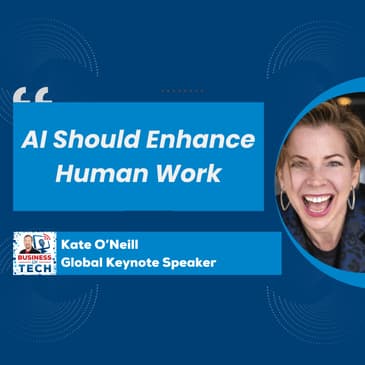
Kate O'Neill discusses the impact of AI and automation on business and human flourishing in her latest book, "What Matters Next." She introduces the concept of a now-next continuum, which helps leaders navigate the uncertainty of the future by connecting past knowledge with present realities and future possibilities. This framework aims to empower decision-makers to make coherent choices amidst the chaos of rapid technological advancement and cultural acceleration.
O'Neill emphasizes the importance of viewing AI not merely as a tool for automation but as a means of augmenting human capabilities. She acknowledges the fears surrounding automation but argues that many applications of AI can enhance efficiency and effectiveness in the workplace. By shifting the focus from job elimination to task augmentation, organizations can leverage AI to improve workflows and foster a more human-centric approach to work.
An example O'Neill shares involves a utility company in Latin America that successfully implemented conversational AI to enhance customer service. Rather than solely focusing on cost-cutting, the company aimed to improve customer satisfaction metrics. By allowing human operators to access information quickly through AI, they were able to provide better service while also upskilling employees for new roles within the organization.
Finally, O'Neill highlights the significance of data in decision-making, framing it as a representation of human interactions and relationships. She advocates for a human-centric approach to data collection and analysis, ensuring that organizations use data to make smarter, more empathetic decisions. By aligning technology with meaningful human outcomes, businesses can navigate the complexities of the modern landscape while prioritizing the well-being of their customers and employees.
About Business of Tech: The daily MSP news and analysis podcast for managed service providers and IT services leaders. Host Dave Sobel covers AI for MSPs, MSP pricing and profitability, MSP M&A and private equity, vendor partner programs, MSP cybersecurity and liability, and MSP operations — and answers the question every story raises: Why do we care? Produced by MSP Radio.
💼 All Our Sponsors
MSP Radio is supported by our partners:
ABC Solutions · CometBackup · Firetail · Guardz · HaloPSA · LogMeIn · Mailprotector · Pax8 · Rythmz · ScalePad · TimeZest · Transit AI
Supporting the IT services community through insights, analysis, and transparency.
🚀 Join Business of Tech Plus
Get exclusive access to investigative reports, vendor analysis, leadership briefings, and more.
👉 https://businessof.tech/plus
🎧 Subscribe to the Business of Tech
Want the show on your favorite podcast app or prefer the written versions of each story?
📲 https://www.businessof.tech/subscribe
📰 Story Links & Sources
Looking for the links from today’s stories?
Every episode script — with full source links — is posted at:
🎙 Want to Be a Guest?
Pitch your story or appear on Business of Tech: Daily MSP News & IT Services Analysis
💬 https://www.podmatch.com/hostdetailpreview/businessoftech
🔗 Follow Business of Tech
LinkedIn: https://www.linkedin.com/company/28908079
YouTube: https://youtube.com/mspradio
Bluesky: https://bsky.app/profile/businessof.tech
Instagram: https://www.instagram.com/mspradio
TikTok: https://www.tiktok.com/@businessoftech
Facebook: https://www.facebook.com/mspradionews
Hosted by Simplecast, an AdsWizz company. See pcm.adswizz.com for information about our collection and use of personal data for advertising.
[00:00:02] We've been talking about automation with AI. What's the impact? Kate O'Neill has a new book that we dive into that gives frameworks and thinking on it, and she's got some thoughts on intelligence on top of data. We dive into all of that on this bonus episode of The Business of Tech. This episode is supported by Flexpoint. Flexpoint offers a purpose-built payment solution from managed service providers automating billing operations to enhance efficiency and cash flow.
[00:00:30] With features like accounts receivable automation, branded client portals, and secure same-day payments, Flexpoint streamlines financial management. Integrations with accounting software such as QuickBooks and Xero, as well as professional services automation tools like ConnectWise and Autotask, ensure seamless data synchronization. Experience improved cash flow and client satisfaction with Flexpoint's comprehensive
[00:00:54] platform. Learn more at getflexpoint.com slash MSP-radio. Well, Kate, welcome to the show. Well, thanks, Dave. Now, I love talking about kind of frameworks and the way to think about positioning. And I'm going to start there because your book, What Matters Next, introduces this really powerful idea of a now-next continuum. Talk to me a little bit of the inspiration for the framework and how you
[00:01:25] see it helping leaders think about coherent decisions amidst all the chaos that we're all dealing with these days. Yeah, thanks. It's an important model for me because I kept hearing over the last few years increasingly how uncertain the future felt to everyone. In fact, I'll still ask a keynote audience to this day. Who feels like the future is uncertain? And nearly every hand goes up. And that, I think, is just a factor of this feeling of acceleration that's in culture around us.
[00:01:54] You know, everything feels like it's going faster. We have less and less of a handle on where it's going and how we can control it. So this now-next continuum is an effort to pull that together into a cohesive understanding of what it is we know about the past and what's knowable about the present and what we can anticipate and partially predict about the future so that it feels less, you know,
[00:02:21] murky and uncertain and actually starts to feel like, ah, there's some trajectories here. There's some through lines from what we know to what we might possibly anticipate is coming so that we can make better decisions going into the future. Now, the other thing that's interesting about your books is a real optimism about aligning AI with the idea of humans flourishing. But, you know, many leaders
[00:02:45] face a lot of pressure to deal automation around AI. Give me a little bit about your thinking about the way these forces come together. Is AI about augmentation? Is it about automation? How do you think about this? Yeah, I think the overall discussion is easy to get very bogged down in the fear and the paranoia of it. And by no means do I mean to suggest that there isn't worry, there isn't room to be worried about,
[00:03:13] you know, automation that's done without consideration of the human consequences or AI that doesn't take any consideration, the downstream effects. I mean, that's very much at the heart of why I wrote this book. I want to make sure we're considering all of those things. At the same time, I think that many of the applications of automation and AI and many of the recently emerging and now sort of part of our
[00:03:38] daily lives tools and technologies, they have a lot of really powerful augmentation, as you say, the word you use there, augmentation capabilities for our work. Most of what we are, most of us are going to experience is going to be that our work shifts a bit, that we change the way we work, that we're going to be more efficient, more effective, that we're going to have maybe slightly different workflows and the people that we pass work back and forth between are going to be
[00:04:07] different or we're going to have, you know, different types of approval processes or that sort of thing. It isn't necessarily the case that we're automating away jobs in every instance. Where we do, we need to be very thoughtful about that. But I think that discussion needs to be, you know, sort of broken into those different considerations and approached with care and thoughtfulness. Now, it feels like you've probably got a really good use case you think about as an example of success
[00:04:37] right there. Well, give me a little bit of insight into an example that really resonates for you of the the right balance. Yeah, I worked with a utility company in Latin America on automation of their customer service function. And, you know, some of it was some of the thinking at the executive level was maybe we can cut costs, maybe we can even eliminate some of the headcount there. But that wasn't their primary
[00:05:02] focus. Their primary focus was how do we move the needle on our customer support metrics, metrics on the satisfaction metrics? How do we make sure that time to response is better, that we can, you know, improve our net promoter score, you know, all these kind of holistic metrics were really driving that conversation. So they were able to do things like implement conversational AI where the existing human operators within the call center could very quickly retrieve the information
[00:05:30] that they needed to be able to service the incoming call. And this is after, of course, the call has been escalated from a conversational AI chatbot on the front of a website or something like that where a customer might have been able to self-serve their own need, like if it's just a forgotten password or something like that. That's going to be something that a customer is probably going to have the greatest satisfaction from handling themselves and not having to interact with an operator of any kind. But once it does
[00:05:59] escalate to an operator, now they've got a whole history that they can bring with them, now they've got a lot of context, now they've got the rules and operations and the conversational AI can augment that process to make it easier, to make it easier for the operator to solve the problem, but also bring a very human kind of warmth and empathy to the interaction. So it's all best of all worlds in those cases. And in the cases where they did trim some of the headcount, they actually in complement to that upskilled
[00:06:29] many of those operators into supervisory roles or into other parts of the organization. Now this feels like it would also really align with the way that you've written in the book about using AI, you know, that the competitive advantage is not AI for AI's sake, but the idea of enhancing human potential. Now at scale in an organization like you talked about, it makes perfect sense where like, oh, we're going to use conversational AI to at scale handle communications with our customers.
[00:06:58] But many small customers kind of lean into the, well, we're small, we're personalized, we can put people right on the phone. That's some of our competitive differentiation. How do organizations kind of balance that difference between scale and automation versus personalized? How do you think about it in the context of a smaller org? Yeah, I think it's probably in some ways the same where you want to be thinking not about replacing
[00:07:25] the actual person who's doing the job, but about thinking about which tasks are overburdened by the manualness of them in a sense, right? Like which tasks could we augment by bringing AI or by bringing agentic AI or generative AI or any of these kinds of tools into the operation. And how do we make people more effective? How do we make people able to bring more of their humanness
[00:07:52] to the interaction, more creativity, more context awareness, more emotional intelligence, you know, more of their good judgment kind of skills to the interaction, as opposed to, you know, trying to find some kind of generic average that we water everything down to. I think that is very much not the goal for almost any organization. It's really about trying to figure out how do we take what
[00:08:18] works very, very well and then differentiate the pieces that could actually be served more by automation and by augmented AI. I think it's, you know, one of the pieces I'll spell out here even more clearly is that one of the pieces I think we've gotten wrong for the last few years is that when we talk about the future of work, we often conflate the idea of the future of work and the future of jobs together with the future of tasks and the future of productivity. And all of those things are very
[00:08:47] different from one another. And if we stop and break those out and really think about them in a more disciplined way and think about how that applies inside of our organizations, even an organization as small as mine, it makes a big difference to be able to think about I'm not trying to automate people away. I have human researchers that I work with yet I use perplexity and Claude and all of these generative AI tools every single day, all the time. It's just the very different type of
[00:09:15] workflow now where I feel more productive going into my meetings with my human research team, being able to say, I'm not going to waste your time with this low level stuff. I've got, I'm briefed, I'm up to speed, but where you add tremendous value with your incredible PhD level research is that you are able to come and bring me like really, really rigorous studies and, you know, anecdotes and examples from industry, you know, those kinds of things that are going to be much,
[00:09:44] much harder for me to generate with generative AI. And we have such an amazing rapport of being able to brainstorm with one another and get a lot of value out of those interactions. So there's an awful lot in every organization, every workflow that's going to make no sense to try to automate away in terms of the human value, but there's going to be an awful lot of human value that can be supported by AI and technology. Now, what you just said there is super interesting and insightful to talk
[00:10:13] about that differentiation between people and roles and tasks and work and, and all of that. It feels like you've also spent a lot of time thinking about this. Is there a particular framework that you apply to, to make help organizations through this? Like, how do you put that into context? So business leaders can think in those terms? Yeah, it's a good question. I don't know if I have a tool or a model that is, that is specific to this. It's just that the disambiguation between those terms is one that I've
[00:10:43] been talking about for years now. But it's the clearest way I can, I can think to break it down actually relates to a model that I did introduce in my book, Tech Humanist back in 2018, which is the human centric digital transformation canvas. And that's a mouthful, but where it actually boils down is that what it starts with is this articulation of strategic organizational purpose.
[00:11:09] And so getting at that very core understanding of what it is you do as an organization, what you're trying to do at scale, articulated in as crisp a statement as you can possibly get, like three to five words, no more. And then when you've done that, when you've articulated it that way, then you kind of go back and think about all of the ways you've articulated values and goals and, you know, your annual goals, your quarterly goals, your priorities, the resource allocation that you
[00:11:35] have across those priorities. When you think about all those things, it's almost like, you know, weighing your, or balancing your checkbook. Like, did you actually make it all make sense together? Can you, you know, make, make that purpose help articulate those priorities and focus areas and that sort of thing. Then you think about culture experience and brand as those come to life inside and outside the organization. And how are you making sure that you are actually dimensionalizing
[00:12:02] those considerations in those particular ways. And only after you've done that baseline work, do you actually think about data and data modeling? Like, how do you model this, this organization that you're describing in purpose and in these terms, how do you model that in data? What kind of data can you capture from across the organization that tells you whether you've been effective at capturing the right kind of, you know, efficiency and leads, or whether you're, you know, generating
[00:12:29] the right kind of inquiries, or whether you're converting the right type of customer base or whatever. Then you think about technology, you think about what technology can you bring to the mix that's going to help you accelerate and amplify the purpose orientation of the company. So I think when we, when we start with that purpose orientation and work our way through that model, we're in a much better place to be able to be disciplined in our thinking about the difference between what work
[00:12:56] looks like, the composition of work, what jobs we need to contribute to the, the workflows within that process, what the, the opportunity of tasks to be fulfilled, jobs to be done in a sense within that workflow. And then the productivity, like, well, how can we measure productivity and what's that going to look like in different discrete ways across the organization? Now you brought up data and this was sort of where I was going to go with the last bit of our time
[00:13:23] was the, your book talks about transforming intelligence gathering systems. Now that feels like intelligence has a specific definition in your model and it evolves beyond just data collection. And so how do you frame that definition of what intelligence means in the model? I think it's really important to remember that data represents people in almost every case and where it doesn't directly represent people. It's only one degree removed. Like if you're measuring something like
[00:13:53] the, uh, the wear and tear on a, uh, a piece of machinery in a manufacturing facility, yes, that's not people, but it's only a degree removed from the downstream product that serves people or from the people who interact with that machine. So I think in every case, it's usually best to think about the people that generate the data, the, whose, whose, uh, relationships and preferences, uh, and communications and interactions have
[00:14:22] generated this data. Um, and then we can make better decisions about how we use that data, what that data informs within the organization. When we think about, about collecting that data and making ourselves smarter and more agile as an organization, how we can make smarter decisions across the organization because of the data we collect, it just benefits us to think a little bit about the fact that this is customer data, it's employee data, it's human data that we're using to make these decisions. And I think
[00:14:50] just that reminder helps us connect just that little bit to that human centricity and brings us back to making better decisions. Well, and that's the outcome that we're looking for because if we can help people with data and make better decisions, we've done a big service to our customers. Kate O'Neill is a globally respected strategist, keynote speaker, and author specializing in the intersection of technology, business, and the human experience. Her latest book, What Matters Next? A Leader's Guide to
[00:15:18] Making Human-Friendly Decisions in a World That's Moving Too Fast offers a Forward-Thinking Framework for Leaders Navigating Complexity, Uncertainty, and Digital Transformation. Through her firm, KO Insights, she advises top organizations including the United Nations, Google, Zoom, and Yale on building systems that align innovation with meaningful human outcomes. Kate, I've learned a ton today. Thank you for joining me. If people are interested in reaching out and learning more, what's the best way to do so?
[00:15:43] On my website, koinsights.com, and they can find me on just about any social media platform as Kate O'Neill as well. Well, this has been fantastic. Thanks for joining me today. Thank you, Dave. I appreciate being here. This episode is supported by Comet Backup. Are you seeking a fast, secure, and flexible backup solution? Comet Backup empowers you to manage all your backups from a simple centralized platform.
[00:16:08] Protect Windows, Linux, and macOS, as well as Hyper-V, VMware, Synology, Microsoft 365, and more. Manage backups on your terms. You choose where the data is stored. With on-prem storage and direct to cloud with industry leading integrations like AWS and Microsoft Azure. Experience streamlined data protection and disaster recovery tailored to your needs. Visit cometbackup.com to start your free 30-day
[00:16:35] trial today. Get $100 free credit when you sign up with the promo code MSPRADIO. Start running backups in 15 minutes or less with Comet Backup. The Business of Tech is written and produced by me, Dave Sobel, under ethics guidelines posted at businessof.tech. If you've enjoyed the show, make sure you've subscribed or followed on your favorite platform. It's free and helps directly.
[00:17:01] Give us a review too. If you want to support the show, visit patreon.com slash MSPRADIO and you'll get access to content early. Or buy our Why Do We Care merch at businessof.tech. Have a question you want answered? We take listener questions, send them in, ideally as a voice memo or video to question at MSPRADIO.COM. I answer listener questions live on our Wednesday live show on YouTube and LinkedIn.
[00:17:29] If you've got a comment or a thought on a story, put it in the comments if you're on YouTube or reach out on LinkedIn if you're listening to the podcast. And if you want to advertise on the show, visit MSPRADIO.COM slash engage. Once again, thanks for listening and I will talk to you again on our next episode. Part of the MSP Radio Network. Part of the MSP Radio Network.