
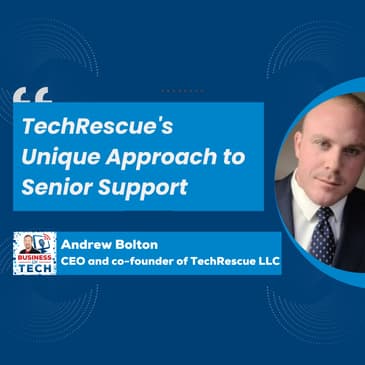
Andrew Bolton, CEO and co-founder of TechRescue, has developed a unique approach to delivering technical services specifically tailored for seniors. With a growing client base of nearly 1,000 seniors on a monthly subscription model, Bolton's company focuses on providing empathetic and personalized tech support. Unlike traditional managed service providers, TechRescue positions itself as a "tech therapist," emphasizing the importance of human connection and understanding in every interaction. This approach is particularly vital when dealing with a demographic that may not be as tech-savvy, as Bolton highlights the evolving nature of senior users who are increasingly engaged with technology.
The inspiration for TechRescue stemmed from Bolton's personal experiences with his family, particularly his grandmother's struggles with technology. Recognizing a gap in the market for services that cater to seniors, he and his team have created a supportive environment where every call is treated as a priority. The company employs individuals with backgrounds in sociology and psychology rather than traditional tech support roles, ensuring that empathy and communication are at the forefront of their service. This human-centric approach has proven effective, as Bolton notes that most calls are not about complex tech issues but rather simple, everyday problems that seniors encounter.
TechRescue operates on a subscription model, offering services at $50 per month or $400 annually. The company has established metrics to maintain profitability while ensuring quality service. Bolton explains that they have a structured process for handling calls, aiming to resolve issues efficiently while still allowing for personal interaction. By focusing on the emotional and psychological aspects of tech support, TechRescue has carved out a niche that resonates with both seniors and their families, who often seek assistance for their elderly relatives.
Looking ahead, Bolton envisions expanding TechRescue's reach, potentially into international markets. However, he acknowledges that the biggest challenge lies in finding the right personnel who can deliver the empathetic service that defines their brand. As the company continues to grow, it remains committed to its mission of providing accessible and compassionate tech support to seniors, reinforcing the idea that technology should enhance, rather than complicate, their lives.
About Business of Tech: The daily MSP news and analysis podcast for managed service providers and IT services leaders. Host Dave Sobel covers AI for MSPs, MSP pricing and profitability, MSP M&A and private equity, vendor partner programs, MSP cybersecurity and liability, and MSP operations — and answers the question every story raises: Why do we care? Produced by MSP Radio.
💼 All Our Sponsors
MSP Radio is supported by our partners:
ABC Solutions · CometBackup · Firetail · Guardz · HaloPSA · LogMeIn · Mailprotector · Pax8 · Rythmz · ScalePad · TimeZest · Transit AI
Supporting the IT services community through insights, analysis, and transparency.
🚀 Join Business of Tech Plus
Get exclusive access to investigative reports, vendor analysis, leadership briefings, and more.
👉 https://businessof.tech/plus
🎧 Subscribe to the Business of Tech
Want the show on your favorite podcast app or prefer the written versions of each story?
📲 https://www.businessof.tech/subscribe
📰 Story Links & Sources
Looking for the links from today’s stories?
Every episode script — with full source links — is posted at:
🎙 Want to Be a Guest?
Pitch your story or appear on Business of Tech: Daily MSP News & IT Services Analysis
💬 https://www.podmatch.com/hostdetailpreview/businessoftech
🔗 Follow Business of Tech
LinkedIn: https://www.linkedin.com/company/28908079
YouTube: https://youtube.com/mspradio
Bluesky: https://bsky.app/profile/businessof.tech
Instagram: https://www.instagram.com/mspradio
TikTok: https://www.tiktok.com/@businessoftech
Facebook: https://www.facebook.com/mspradionews
Hosted by Simplecast, an AdsWizz company. See pcm.adswizz.com for information about our collection and use of personal data for advertising.
[00:00:02] Every MSP I know is going to want the answer to this question. How do you do residential? More importantly, how do you deliver technical services to seniors? Most of us who have been doing this for a long time think you can't make any money there, but Andrew Bolton, who's the CEO and co-founder of TechRescue, he's figured out the way and he has thousands seniors already paying him every month on a monthly recurring basis on this bonus episode of The Business of Tech.
[00:00:28] This episode is supported by Synchro. Synchro, the integrated remote monitoring and management and professional services automation platform, is designed for mid-sized and growing managed service providers. Its latest innovations include an AI-powered smart ticket management system with automatic ticket classifications, guided resolution steps using pre-approved scripts, and a natural language smart search function. These tools streamline ticket handling and improve response times.
[00:00:57] Discover more at SynchroMSP.com. Well, Andrew, welcome to the show. Hey, thank you for having me, Mr. Sobel. Well, I am... I am... I am Mr. Sobel. Tell you what, well, I am Dave, my father is Mr. Sobel, at least still, that's the quip that I go to. Now, I am super excited to have you on because you're running a really unique approach to delivery of IT services.
[00:01:24] I could call you a managed services provider, but I think that's actually doing a little bit of disservice to the way that you've positioned it as a services org to a particular demographic. You're focused... While you're focused on small businesses, your specialization is actually seniors and delivering technical support to seniors. Tell me a little bit about how that came together and what the focus is.
[00:01:49] This actually came about when Facebook was invented. My grandmother was very big on genealogy when she retired. And the introduction to social media allowed her to not have to go to the Library of Congress, not look at obituaries, not do the hard work per se.
[00:02:08] Anyway, with social media, we have put basically everything about us online. So she was able to create this massive genealogy book that extends like something like over 300 pages.
[00:02:24] And something like, I don't know, like maybe like 100 or 200 of us in our family from the Bromwells, Bartleys, Cassidy's, Langdon's, Fulton's, we all have these books that my grandmother made and social media was her thing. And she would get, you know, she would get frustrated. She would, you know, trying to like or upload or ask or request. She, we would be, my mother and I were being tasked to do these things all the time.
[00:02:54] And one night my father comes into the kitchen and says, how do you forward an email? And my mother and I look at each other and go, what do you mean? How do you forward an email? And he goes, nevermind. He gets frustrated and walks away. And I call out to him. I'm like, dad, I'll be right there. Hold on. And I grab my coffee and I go, when I come back and she goes, there has to be something. I'm like, I know, right? There's like, there has to be something. And we pulled out our phones and sure enough, there was nothing there.
[00:03:21] And then she gave me that wonderful motherly answer. And she goes, how would you do it? And I went, give me a minute. And next thing you know, the white, the white mark, you know, the whiteboard markers came out and there's a running joke in our family is that everything and everything has to be erasable because you never know when spontaneity would happen. And, you know, we're writing things on the glass table, on windows, on stainless steel appliances.
[00:03:47] This goes back to my grad school days at Harvard where, you know, you're writing something, you're writing a paper, you're doing a problem and you're trying to come up with, you know, the statistical balance between, you know, the opposing views. And you're sitting there and it just serendipity happens and you need something to write. Well, everything is writable in our house. So that's the running joke.
[00:04:08] And that's how tech rescue was born is that we, it hit us like a freight train that there was nothing out there that really services our clientele. And really actually from what we've learned in the past two months from our two year inception is that we're not even really a managed service provider or a customer support helpline.
[00:04:33] What we really are is almost in a way tech therapists. So what I mean by that is in our standard operating procedure and how we recruit people to work for us is that on the second page of the standard operating procedure is in big red letters. Every call is somebody's most important person. And every call that when we have our training video, every call is a hot call, every call.
[00:05:01] So what is a hot call? Angry, confused, jaded, irritated, or just annoyed or desperate, or what we call wandering grandpa. You know, somebody who's just wandering off. I don't want to recruit people that have great call skills. I want to recruit people that have great empathy skills because there's a difference. We're getting into the detail and I want to take a quick step out of it. I know every single listener here is so relating to this.
[00:05:27] I mean, I can tell my, like, I've had this debate with my own parents and I even had that moment of like, I'm sure I can fix this. And I never could figure it out. Right. I always looked at it and I said, I can't figure out a way for this to be profitable. I've run my own business. I knew my per unit costs. I knew my delivery. I knew my build of it. I knew the way I was going to build out a stack. Like I felt all of that. And there's this prevailing thought that this is too hard. Residential alone is hard, right? The idea of we're going to go into residential and help those environments.
[00:05:56] You've gone one level harder in my mind is what you're going for. Not only are you going residential, but I'm going to go for senior citizens, right? A group of people who historically, kindly perhaps are not tech savvy at the same level that the average residential user is. Right. I'm being incredibly generous with all those statements. I'm actually going to argue that with you. Well, so this is what, this is where I want. So help me understand. Like, first of all, I think it's worth baselining.
[00:06:23] Like, tell me a little bit about the size of the organization, but then tell me like, what's the unlock here? That's helping you figure out how to run it and actually make some money. So currently we have about 67 employees and outside partners and vendors. And currently we're just shy as of today, just a couple numbers shy of a thousand end users right now. So we are growing. Now, is this Facebook numbers? Absolutely not.
[00:06:51] Are we on target? Actually, we're ahead of target based off of my board of directors. You know, their initial, you know, flow through processes are, you know, we're ahead of schedule, which is fantastic, especially in the economy that we're possibly facing now. Sure. We offer two, we offer two subscription models. We offer a $50 a month and a $400 a year annual subscription.
[00:07:14] Now, where you're thinking about in terms of the profitability aspect is we have certain call, we have certain call time metrics. So let's say, for example, within the first 15 minutes, I need to establish the root cause and automatically a step-by-step solution. When we gain access to your phone, tablet or laptop, if you have Wi-Fi or data connection, I can get to you. If you can get to me, I can get to you. Period. End of discussion. Sure.
[00:07:42] Within those metrics, I have within a certain, let's say within an hour, I know where our profitability margins are and I know where our red zones are. So we have our standard operating procedures to establish the problem, root cause and a solution. And if it goes past that, there are steps in place to bring it back. If it escalates past that, a project manager steps into place and it circles it back to the original problem. And then we move forward.
[00:08:07] If we can't move forward within a certain timeframe, we then are looking at a one to seven ratio in terms of our buyback timeframe. So we call it the grandpa, roaming grandpa. So for everyone that gets lost in the weeds, we need seven calls to go within a certain timeframe to stay within the daily profit margins.
[00:08:27] Now, everything else in terms of the profitability, we don't have any operating costs whatsoever, except for our call center, our legal aspects, our sales team, marketing team, and basically our salaries. So we don't have an office, as you can see, I'm working out of my United States home. I also travel abroad. So I can do this remotely. And that costs a lot of costs.
[00:08:55] Currently, that almost gets into the, so you're implying that there's not a big investment in tech stack, which also like, it like makes me think you're using some technology for remote control. Yes. But I would think the one thing that you're not doing, which makes me sort of, again, scratch my head is, is I think you're not leaning into standardized software stack for the end users. You're probably not imposing any rules on them on what they have to run. You're not including any software to no security software. So you're not actually protecting them, right?
[00:09:23] For they don't have to have a user could have no buy antivirus. They can have no backups. Like, this is where all of us who've done this a long time are going, yeah, how do you handle a ransomware incident? Or how do you handle these bits that because you've done none of the lockdown, like, how do you handle that? So we have a third party that we use that costs us per minute to fix the problem. So we have a process for that as well.
[00:09:50] And I would say one out of 32 calls right now are ransomware, malware, spyware, things like that. Most of our calls, and this is where I was going to argue with you, is our senior citizens. And I just wrote an article on our LinkedIn page not too long ago. We are. This is not grandma and grandpa of early 2000s. No, no, no, no, no, no, no, no, no, no. Now, in 2024, almost 20% of the GDP for the holiday seasons was purchased by seniors in 65 or older.
[00:10:19] 89% of all seniors in America, which consists of just shy of about 90 million registered Americans 65 and older, have smart technology. Every single one of them has a smartphone. Every single one of them has about a smartwatch. They have the earbuds. They are purchasing more of the technology and the systems that go into it, such as new laptops.
[00:10:42] The past three months, we've just hired a video game analyst to write the standard operating procedures for Fortnite, Star Wars, The Old Republic, Fortnite, Call of Duty. We've been getting calls about dating, Tinder, Bumble, Facebook dating. We are getting a very, very different senior citizen. We have a very active senior citizen.
[00:11:09] So we're not getting the type of calls that you normally would get. We're getting, how do I change, excuse me, how do I change my skins on my character? How do I send WhatsApp videos? I pull calls and somebody, a client of ours, a customer of ours was meeting with a Tinder date.
[00:11:40] And apparently the conversation, I'm assuming based off the conversation and the questions that they were asking, I'm assuming the conversation went well and they were looking to share a video file. Now, legally, there's a lot of things we can and can't do, that being one of them, but we can help them share and show them how to share a video of... Any video generically, right? Any video, any video. Right, right.
[00:12:06] So once we did that and we explained it and showed it, they were very happy and they said, okay, fantastic. And the call ended and I went, that one's going to be with me for a while. Sure, that one will linger. One of the other things that you're really focused into is a human-centric approach, right? And part of my, you know, the other answer that might jump to mind for most of us is, oh, there's got to be some really interesting automation that's driving this down.
[00:12:35] How are you integrating process or automation or something to manage this at a level that helps you deliver to the... And you clearly know your metrics. Like, how are you building the automation in to deliver this or are you not? We don't have automation. Okay. We don't have chatbots. We don't have robots. We don't have anything. We have real call centers that are open. Our call center in the Carolina is open 24 hours a day. It's HIPAA compliant.
[00:13:00] So what we're slowly been doing is working with some of our partners in the medical field, in medical insurance companies, that 14% of all senior citizens in America do not have access to a line of doctor abilities whatsoever. That means Meals on Wheels, the Sisters of St. Mary, the Visiting Sisters of St. Mary, telehealth. They have access to nothing.
[00:13:25] So if we're able to help them with their laptop and then explain to them, hey, we can also do this, this, and this. We can help you sign up to your insurance company. We can help you sign up and find a localized doctor. We even can get you an Uber to and from your doctor's office. We are becoming slowly.
[00:13:44] It feels like we're morphing into a tech and personal support company than rather just tech support because at the end of the day, what we're finding is with chatbots, with mazes, with AI conversations that you're getting in terms of sales calls, people are negatively responding and they are craving human connection. This, somebody calls, you get a flat tire, you call AAA.
[00:14:12] You don't need to have the chatbots, you know, press one for this, two for that. No, you want to talk to somebody. You're in the middle of the road. You have, you don't have any of the tools with you. You don't even maybe have a spare tire with you. I want to get home. I need to get to where I'm going. I want somebody to help. And what we're finding and as we're quickly growing is that this is resonating so much. And it's silly to say, but we're going back to basics, just human connection. What a concept.
[00:14:41] Yeah, I mean, I'm intrigued to understand how you're balancing because it's clear you've already thrown out a couple of interesting metrics and you understand your call times and how that's done. But at the same time, exactly what you just described is leaving the door open for those very personal conversations, right? I'm sure that the people calling in want to have a longer conversation about context or their family or what they're trying to accomplish or their medical needs.
[00:15:05] At the same time, you're focused on making sure that calls hit at a regularity and a speed that keeps it within bounds. Now, you know, I know you're not trying to get a call off the line in 60 seconds, but at the same time, I know you're probably conscious of the fact that going 45 minutes is probably too long for the call. Talk to me about how you're using kind of metrics and process to achieve what you're trying to get there. So in the call center, we use HubSpot as our CRM system.
[00:15:33] Now a person calls in, hi, Mr. Sobel, thank you for calling Tech Rescue. How can I help you today? Well, right off the bat, you're 10 degrees cooler because somebody addressed you by your name, not can I have your name, your telephone number, your account information. Uh-uh. That's off the bat. So right off the bat, if you're a customer, if you're a client of ours, you call in, we will have that information pulled up for you. And that will automatically take about, on average, about three to four minutes off the clock right off the bat. Okay.
[00:16:01] Second, our call center's internal system has a countdown clock. So as the call is going down, there are certain things that come up in terms of their stance, the check marks, the bookmark, where we are in the process of the call. And the great thing about Samantha, who's my project manager over in the Carolinas, is she is very good at instructing people and getting the right people to sit in the chairs that we need.
[00:16:29] So we have people that are not fully in a tech background because we've provided that information for them on how to do it and are third-tier partners who can help us with that. But what we look for are sociology degree majors, psychology degree majors, somebody with maybe counseling degrees or somebody with a counseling background.
[00:16:54] And this is a little bit of the secret to our sauce is that we're not addressing you for your problem. We're addressing you like you would be your mother or my grandmother or my mother. Dave, okay, slow down. What can we help you with? Okay, I see the problem. You see how that conversation goes a little bit differently? So as we're working through our problem, they're having a conversation with you and they're keeping an eye on the metrics. This is, let's say, 15 minutes.
[00:17:24] All right, we need to have, let's say for the argument's sake, for the first 15 minutes, we need to establish who it is, what the problem is, and how we can solve it. The next 15 minutes is the process of solving that problem. If we go past this point, now the clock really is starting with us. So I'd say the clock really starts at the 30-minute mark. From within that first five minutes, we're trying to find that solution that can get to it.
[00:17:49] Past that, another five minutes, now we're calling in our team leaders to make sure that we bring this back on topic. And if it's something that we haven't come across, like the video game aspect, we've told them, I'm sorry, we don't know how to help you with that. But if you please bear with us, we will get you that answer quickly. And I usually get the phone call and I listen to the call. I take my notes and I figure out how we can go solve that problem. And then I'm the one who personally will call you and I will walk you through how to get it done. And I will take over the controls.
[00:18:19] And once we've, we've never gone past two hours. So I will say that we've never gone past two hours. So there are metrics in place to make sure that we stay in the profitability margin. But the secret to my answer is how we handle the customer on a psychological and personal level. Because you don't want to be talked at. You want to talk to somebody. And when we're having a conversation, that moves a lot smoother than it would be just talking at you instead of with you.
[00:18:49] Now, interestingly, I'll also highlight what you said that I think is important is you're also not hiring technical people necessarily. You specifically called out the fact that you're not hiring tier one help desk engineers to put them on. You're hiring a different kind of person. But that leads into my sort of next bit, right, is I'd like to understand a little bit about your approach to kind of software and software deployment for these users. Obviously, there's an element of apparently they could have anything.
[00:19:18] Or are you giving them guidance? Or are you looking at standardized stacks? Like, how are you trying to guide to, like, we know, hey, home users ought to be doing backups. Like, are you even thinking about adding that on as an add-on? Like, how are you thinking about the software stack of your end users? Well, that's a little bit of the beauty of what we do. We're not looking to compete with Geek Squad, with any of the bigger players because that's not what we do. We handle the simple stuff.
[00:19:48] So that's the secret sauce. We handle the simple stuff. If you're calling about defragmentation, we are not the service for you in general because chances are you already know what defragging is. And you really don't need our service. You probably have something else out there. If you're calling about transferring, well, now with modern, if you look at a modern, you know, MacBook Pro, you have no idea where you slide a CD because you can't do it.
[00:20:16] So if you're looking to upload a CD to a MacBook, we're probably the people for you. But we're going to tell you that you need an extension to be able to do what you need to do. But on that call, we can get you. We can take over. We can get you to Amazon. We can show you what you need. Help you purchase it in Prime in two days. Call us back in Prime in two days and we will help you do exactly what it is that you need to do. We are the grandkids on the phone. We are grandkids.
[00:20:46] Our original slogan besides 24-hour support was as easy as calling your grandkids. That was the original slogan because that was the original standpoint. In terms of what makes us special is who we're targeting. We're not targeting businesses that need complex solutions, that need immediate disaster relief protection. We're not doing that. That's not who we go after.
[00:21:13] Who we go after are and who we, I wouldn't say go after, but who we welcome to come and experience us and try us out are the people who are looking for simple solutions. For example, we don't market to senior citizens. We market to you, the son of an elderly parent that is tired of getting up from the chair, watching whatever it is that you're doing to help her look through whether it's Ancestry.com, Amazon. How do I get this to go to your niece?
[00:21:43] We're the ones that you call for that. We allow you to buy back your sense of sanity and we allow you to buy back your time. I want to wrap this up by asking a little bit about how you're thinking about the future. You're managing 1,000 people right now. Have you thought about how you're going to scale to 100,000 people? How does the business grow?
[00:22:04] Well, the beautiful thing is actually we were expanding into Europe this year until everything in our economy and the tariffs happened. But what makes it so unique is that we've already spoken to call centers in Tel Aviv as well as Spain. And what we look at is the price per minute per English, Spanish, French, German, and we're basically following the U.S. dollar.
[00:22:35] And where we can grow and scale is the type of caliber of person that we're looking for, which for our purposes is a little difficult. And I wrote an article not too long ago and was recently on a podcast about this in terms of the new generation coming into the workforce, doesn't want to work, is entitled, is argumentative.
[00:23:03] And a little bit disrespectful on the phone. I've listened to the interview calls. So where our problem is, is not the technical aspect of it. It's finding the right people that can handle this particular job. That's the only issue that I have in terms of expansion.
[00:23:18] In terms of the tech stack and the expansion of it, that's easy enough to do because HubSpot and our partners that we utilize for their software for our services, they're focusing on their capabilities and expansion. We're just a third-party end user that is utilizing these services as a benefit to our customers. So where we're going to have the biggest hiccup is finding the right candidates to be able to handle the work that we do.
[00:23:49] Staffing is always the theme around here. Andrew Bolton is the CEO and co-founder of Tech Rescue LLC, a company dedicated to providing 24 by 7 live human-based tech support, particularly catering to seniors. With a background in sales, especially in SaaS and Internet-based platforms, he emphasizes empathy and personalized service in the tech support industry. Andrew, this has been fascinating. Thanks for joining me today. Thank you for having me.
[00:24:13] The Business of Tech is written and produced by me, Dave Sobel, under ethics guidelines posted at businessof.tech. If you've enjoyed the show, make sure you've subscribed or followed on your favorite platform. It's free and helps directly. Give us a review, too. If you want to support the show, visit patreon.com slash mspradio and you'll get access to content early. Or buy our Why Do We Care merch at businessof.tech.
[00:24:41] Have a question you want answered? We take listener questions, send them in, ideally as a voice memo or video to question at mspradio.com. I answer listener questions live on our Wednesday live show on YouTube and LinkedIn. If you've got a comment or a thought on a story, put it in the comments if you're on YouTube or reach out on LinkedIn if you're listening to the podcast. And if you want to advertise on the show, visit mspradio.com slash engage.
[00:25:09] Once again, thanks for listening and I will talk to you again on our next episode. Part of the MSP Radio Network.