
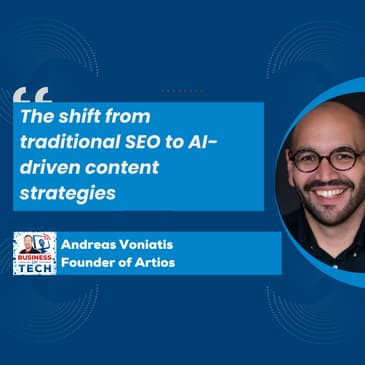
Andreas Voniatis, founder of Arteos and author of "Data-Driven SEO with Python," is revolutionizing the SEO landscape by integrating data science and AI into organic growth strategies. He emphasizes the need for businesses, particularly in the B2B and technology sectors, to move beyond traditional SEO practices that often rely on guesswork. Instead, Fanatis advocates for a math-driven approach that leverages data to ensure that companies can achieve exponential growth in their online visibility and traffic.
As the conversation unfolds, Voniatis discusses the significant shift in user behavior from traditional search engines, which typically present a list of links, to AI-driven interactions that provide summarized answers. This evolution poses a challenge for businesses, as they must adapt to a landscape where AI can solve problems directly, potentially bypassing the need for human expertise. Voniatis argues that to remain relevant, companies must prepare for a future where AI not only recommends content but also understands the nuances of their offerings.
The discussion also highlights the importance of creating unique, data-rich content that stands out in an increasingly crowded digital space. Voniatis explains that simply producing high-quality content is no longer sufficient; businesses must ensure their content correlates with AI's understanding of truth and relevance. By focusing on proprietary insights and addressing the specific needs of target audiences, companies can differentiate themselves from competitors who rely on generic SEO strategies.
Finally, Voniatis outlines key metrics for measuring success in this new SEO paradigm. He emphasizes the importance of tracking both traffic sources and brand searches to gauge the effectiveness of SEO efforts. By blending data science with creative content strategies, businesses can not only improve their search rankings but also enhance their overall brand visibility and engagement in the digital marketplace.
About Business of Tech: The daily MSP news and analysis podcast for managed service providers and IT services leaders. Host Dave Sobel covers AI for MSPs, MSP pricing and profitability, MSP M&A and private equity, vendor partner programs, MSP cybersecurity and liability, and MSP operations — and answers the question every story raises: Why do we care? Produced by MSP Radio.
💼 All Our Sponsors
MSP Radio is supported by our partners:
ABC Solutions · CometBackup · Firetail · Guardz · HaloPSA · LogMeIn · Mailprotector · Pax8 · Rythmz · ScalePad · TimeZest · Transit AI
Supporting the IT services community through insights, analysis, and transparency.
🚀 Join Business of Tech Plus
Get exclusive access to investigative reports, vendor analysis, leadership briefings, and more.
👉 https://businessof.tech/plus
🎧 Subscribe to the Business of Tech
Want the show on your favorite podcast app or prefer the written versions of each story?
📲 https://www.businessof.tech/subscribe
📰 Story Links & Sources
Looking for the links from today’s stories?
Every episode script — with full source links — is posted at:
🎙 Want to Be a Guest?
Pitch your story or appear on Business of Tech: Daily MSP News & IT Services Analysis
💬 https://www.podmatch.com/hostdetailpreview/businessoftech
🔗 Follow Business of Tech
LinkedIn: https://www.linkedin.com/company/28908079
YouTube: https://youtube.com/mspradio
Bluesky: https://bsky.app/profile/businessof.tech
Instagram: https://www.instagram.com/mspradio
TikTok: https://www.tiktok.com/@businessoftech
Facebook: https://www.facebook.com/mspradionews
Hosted by Simplecast, an AdsWizz company. See pcm.adswizz.com for information about our collection and use of personal data for advertising.
[00:00:02] Let's dive into the evolving world of SEO beyond keywords and backlinks with somebody who's actually looking to rewrite the rules. Andreas Voniatis is the founder of Arteos and the author of Data-Driven SEO with Python. He helps B2B and technology companies unlock exponential organic growth, not with guesswork, but with math, AI and some guarantees. If you're a provider still relying and thinking about legacy SEO, this is the conversation that might change how you view organic strategy entirely.
[00:00:32] On this bonus episode of the Business of Tech.
[00:01:02] When threat actors strike, Huntress' 24x7 Global Sock shuts them down before they're even on anyone else's radar. But they do more than just chase alerts, they lead the charge in industry research and knowledge, bringing expert protection and peace of mind. That's why users on G2 rate their EDR number one for growing businesses. To see how their expert threat hunting team gets the job done, visit Huntress.com slash MSP Radio.
[00:01:33] Well, Andreas, welcome to the show. Thank you. Thank you for having me. I look forward to sharing my experiences that will help MSPs. Well, I am intrigued to learn a little bit more because you come from a space that I freely admit I have kind of a bias against because there's always a lot of quackery, witchery and hand-waving, and that's the SEO space.
[00:01:56] But you focused on building an AI-driven, math-heavy approach to SEO. Tell me about that approach and what makes it different. Well, yeah, so I totally agree with you. There is a lot of quackery within that space, which is unfortunate. Why data science? Well, search engines and AI are founded on data science.
[00:02:21] You know, they're founded on making judgments about what information is useful. And so if you're going to succeed in this space, you need to operate on a level at the same level as the technology. Because if you're not, then you really are resorting to quackery in order to succeed.
[00:02:44] Now, one of the things that I'm intrigued to understand, though, is because it feels like we're in a real inflection point for content on the web. Because, you know, in a traditional world, putting aside, like, you know, disparaging comments about that, the idea behind a search engine is that it goes out, it collects and searches and indexes all the content on the web. And then when you make a search, it's offering you a bunch of stuff and different links.
[00:03:08] And so what has happened traditionally is that we're trying to get to that we're the on that first list of things that comes up on a search engine. But now if you move this towards AI, where the idea is if we're interacting with chatbots or we're interacting with AI overviews or whatever version of it is, we're actually now trying to be the single answer.
[00:03:30] And in fact, there's a real problem here in that by getting sucked in by the chatbot, you actually aren't necessarily getting any traffic. You're just necessarily becoming the answer and are crossing your fingers and hoping that the user takes the next step. Talk to me a little bit about the way you're seeing this move. As somebody who's thought about, you know, using AI and answering to the algorithms,
[00:03:54] talk to me about where we're going with search, and I'm putting that in quotes, in an AI era. Yeah. So at the moment, behavior has shifted from 10 blue links to getting a summarized answer. And in terms of where it's moving forward, we're going to get into agentic search,
[00:04:18] where we will have AI agents that we don't even prompt or search within. We simply give them a blueprint or a document that they can train off and learn what it is we want and what we're looking for. So that in the background, they're working, scouring the net and other sources for what it is that we want.
[00:04:44] And then they give us a heads up or a holler when they find it. So that's the future. So in order to prepare for the future, everybody, in my opinion, if they want to remain relevant and get business or something else from AI, they need to start preparing. That is to get recommended by AI when people do search, which is today, but also for tomorrow,
[00:05:12] for AI to recommend you, even though your target audiences weren't actually interacting with an AI. Now, I'm struggling a little bit to understand the leap to get the AI to recommend you, when in some cases, the AI is simply solving the problem, right? So, for example, if I'm talking to an AI, I'm an end customer and I'm talking to an AI and I say, hey, I'm having this technical problem with my environment.
[00:05:42] There's nothing stopping the AI from just solving the problem, right? And if I'm an MSP, IT services company that is in the business of selling the solution to the customer, and the bot just solves it and I'm giving out my expertise to it, it feels like it's breaking the value of that. Talk to me a little bit of the way you're envisioning this marketing flow working in that future. Yeah, so look, I think AI is the 95% solution.
[00:06:12] It's doing away with activities previously done humanly that were probably quite repetitive and cognitive to a degree. Like, for example, if we're talking about, take a very basic example, writing copy. Well, I think AI can give you that 95% solution to help you overcome writer's block,
[00:06:39] but it can never substitute for someone who is actually an expert and highly skilled at delivering copy. That lands where every word and syllable is fighting for its life in its sentence, sentence by sentence by sentence. That is real top notch, highly excellent, you know, landing page copy that really, you know,
[00:07:06] on a neuroscience level connects with your buyer and gets them to buy and really like you as a company. AI won't be able to do that. But if you can't afford a copywriter and you desperately need something that goes on your website or your brochure, then absolutely, you know, it is a 95% solution. So I personally, I don't see AI as a threat.
[00:07:33] I see it as an opportunity and it just releases humans or people to do much more creative and higher level tasks. We'll be right back after this message. Welcome to Comet Backups Club of No Excuses. Behind every smooth running business is an everyday IT hero who refused to settle, who didn't give up because finger pointing doesn't get a company up and running again. Excuses don't restore data.
[00:08:00] When everything's on the line, Comet's powerful backup and recovery solutions put you in control. Fast, secure and easy to use, Comet protects your client's critical data so you're always ready for the unexpected. When disaster strikes, be the hero your business needs. With Comet Backup, you're not just saving the data, you're saving the day. Comet Backup, be the hero. Visit cometbackup.com today to start your free trial. Get $100 free credit when you sign up with the promo code MSPRADIO.
[00:08:29] Because heroes don't wait, they prepare. And we're back. So I get that. But first off, 95% is a pretty great success rate, right? And if it comes at a much lower level than a human, well, you know, I know where I'm going to put my money. And so this is the thought. And the other piece is, talk to me about the way you're thinking about this. Because you kind of describe this perfection achievement of a human writer.
[00:08:56] And by the way, like as somebody who writes, I'm a believer in the fact that like, you know, if I'm writing the next great novel, every word needs to matter. But if I'm thinking about this from like kind of marketing and a customer acquisition perspective, 95% is pretty good. And I could create thousands of 95% good enough versions that are individually targeted, almost down to the individual human level, which a human could never do, right? I don't need the perfect copy.
[00:09:23] I need thousands of copies that's pretty good to get each match to humans. Talk to me about like the way you envision this changing and the way to be efficient using the tools that's the right balance. Okay. So if we bring it to a search context, yes, you absolutely could write copy that converts using AI and you can absolutely scale it.
[00:09:49] However, if you want to be recommended by AI and you want to succeed in SEO, that is not going to cut it. Because the problem is, is that whilst you have that technology, so do all of your competitors. Okay. And the only thing that achieves other than increasing your ability to convert on many different products or conversations
[00:10:14] that those pages of content cover, from a search technology perspective, the thing is, is that it's going to see high volumes of that type of copy from you and all of your competitors. So, you know, that's really, but for an AI, it's non-value adding because everybody is saying the same thing, especially when it's AI driven.
[00:10:42] And what AI and search tech is looking for is it's looking for something the world hasn't seen before. Okay. And you cannot get that as an output of an AI prompt. Why? Because AI gives you a summary, which is highly diluted.
[00:11:04] And that summary is the product of being trained on primary data found on the pages of major publishers and community forums like Google's doing it with Reddit. Grok is doing it with X.
[00:11:24] You know, Perplexity and ChatGPT, they have media deals, you know, The Atlantic and all these other premium publishers, Associated Press and everything. So the thing is, the only way you're going to stand out is if your content is data driven and the data has to be highly correlated and modeled on the same data sources as AI in order to pass their fact-checking algorithms
[00:11:53] so that you're seen as a trusted provider of information versus the usual SEO playbook of writing, you know, what is ransomware recovery or ransomware attack? You know, chances are your customers already know what that is.
[00:12:13] So, you know, what will we find with SEO consultants is they try to turn their clients or their companies into the Wikipedia of what it is they sell. But it's, you know, and that worked pretty well in the last 15 years. Now in the age of AI with, you know, rising energy costs and a shortage of semiconductor chips, you have to do a lot more with a lot less.
[00:12:43] So what does this look like? Make it concrete for me and kind of like an example to understand how this might work. Yeah, so how this might work is if you're not doing it the way we do it, which is to cruel all of these online communities and then filter for conversations that are talking about, for example, ransomware recovery.
[00:13:08] OK, and then you filter down further for decision makers, because obviously we're selling to target buyers. We're not selling to students, for example. Then you put a study together based on that topic that you're creating content for. And you want to make sure your insights are going to correlate highly with AI when it comes across that content. So you have to minimize the margin of error.
[00:13:35] And then you, based on that output, you get a writer on it. And so the AI informs the data used to inform the writer. It does not do the writing, if that makes sense. And so you create a report that is data rich and that is what's going to succeed in AI. If you haven't got the infrastructure that we have, which took years to build, then the way you can do that is you can run surveys such as you've got companies like Gallup, for example.
[00:14:05] You can create surveys of, say, your target buyers getting their opinions on the challenges and the opportunities of, well, not so much opportunities, but ransomware attacks, you know, and how they overcome them. That is one way to do it. But that would be a way to do it in order to succeed in the AI search age. So is the idea that we're trying to surveying the end customer, you know, and you're doing it at some kind of data scale,
[00:14:34] but the general principle is that we're surveying the end customers to understand what questions they need answered and then making sure that we're delivering content to that? Because thematically, that feels like a thing we've been doing consistently all the time. And I'm trying to make sure I understand the idea. Yeah, that's absolutely right. But not every company will do that because there's quite a price tag attached to that.
[00:14:58] But effectively, instead of filling the internet with articles on what is ransomware and things like that, if you're putting out content reports that speak to the buyer on what, you know, so that they can learn from other CTOs, for example, or InfoSec officers, you know, what were the challenges, you know, what was the ransomware attack?
[00:15:28] You know, what was your experiences? You know, your target buyers want to learn off other people that have been in your situation. The internet was created to inform. It wasn't initially created to sell. So we have to remember that, you know, we need to be putting out content that adds value in a proprietary way. Because if it's not proprietary, there's no reason for journalists to cover you.
[00:15:55] There's no reason for people to backlink to your content or visit your website if they could get it elsewhere. How will you stand out as a signal among the noise for AI if you're just like everybody else? So I'm curious because, like, traditionalists might argue that ultimately this is just right, great content. That it isn't anything more challenging than just, like, right, good stuff and it will get found. Talk to me a little bit about what's missing in that.
[00:16:24] Well, what's missing is great content that highly correlates with AI's models. Okay. Expand a little bit more because I would think, you know, if I'm taking a really broad idea of this, the AI models just are out there kind of sucking up everything, right? They're just consuming everything. So consuming everything means I will get consumed in that and thus good content stands out. There's some subtlety there that I'm trying to understand. Yeah.
[00:16:54] So I think there's two things. There's a correlation to truth, okay? So if you're modeling the same data sources as AI, you're correlating to their worldview, which is why AI loves you. Okay. There's also information gain in that you're telling the world something that it didn't know before by the Internet. There's also the fact that you're audience-driven rather than keyword-driven because you're now creating content that's targeted towards an audience,
[00:17:21] whereas before with the best practice SEO playbook, which is to appeal to everybody, you know, students and whoever. Whereas using this approach, you're actually creating topics that are actively discussed by your target buyers as opposed to what SEMrush or Ahrefs tells you,
[00:17:45] which is just data based on whatever maximizes the revenue per click for Google Ads. So, I mean, and also the fourth principle, which probably, you know, the SEO playbook was gearing content for search engines,
[00:18:05] whereas with this approach, it's content that you would actively share and be proud to share on a social network like, you know, on your ex or LinkedIn, whereas nobody would share a guide on what is ransomware recovery on LinkedIn because it was purely made for SEO. And these are the four pillars that are the difference. I have more pillars, but I don't want to hog the show.
[00:18:33] So, as we sort of wrap up here and think about going forward, like how can people measure success here? Like you're very data-driven. What are the things they should be looking for in the way their content is performing in your mind to be successful? There's quite a few metrics. There's the strategic and there's the tactical level. So let's go tactical. You could be looking at your data sources, okay, your traffic referrers.
[00:18:59] So PR coverage you get and also LLM sources as well that are reported in analytics. Then there's the URL itself in terms of referrer traffic and search traffic it gets. And then you've got the more global level, which is, you know, if your SEO is doing its job, it's not only increasing traffic on the non-brand side,
[00:19:27] but also more importantly, the brand side. Because if you're increasing brand searches, no matter where it comes from, if more people are searching your brand name, you know you're winning in the short and the long term. Andreas Van Acius is the founder of Arteos and author of Data-Driven SEO with Python. He specializes in helping B2B and technology companies achieve breakthrough organic search results
[00:19:51] by blending data science, advanced mathematics, and proprietary AI to deliver guaranteed improvements in traffic and ROI. Andreas, thanks for joining me today. This has been very educational. Thank you. Thank you for having me. It's been an honor and a privilege. The Business of Tech is written and produced by me, Dave Sobel, under ethics guidelines posted at businessof.tech. If you've enjoyed the show, make sure you've subscribed or followed on your favorite platform.
[00:20:20] It's free and helps directly. Give us a review, too. If you want to support the show, visit patreon.com slash MSPRadio and you'll get access to content early. Or buy our Why Do We Care merch at businessof.tech. Have a question you want answered? We take listener questions, send them in, ideally as a voice memo or video to question at MSPRadio.com. I answer listener questions live on our Wednesday live show on YouTube and LinkedIn.
[00:20:50] If you've got a comment or a thought on a story, put it in the comments if you're on YouTube or reach out on LinkedIn if you're listening to the podcast. And if you want to advertise on the show, visit MSPRadio.com slash engage. Once again, thanks for listening and I will talk to you again on our next episode. Part of the MSP Radio Network.