
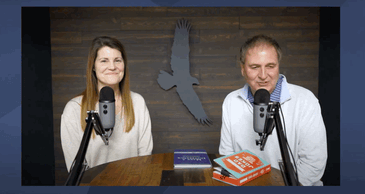
[00:00:07] Alright, welcome to Relationships. This is a podcast about relationships because little shifts make a big difference. I'm Melissa Hamburg-Jackson and I'm Larry Little. Yes, and today is a very special day. We are celebrating looking at, looking back at 25 years of Making a Difference. Wow. 25 years. Yeah, you know, 25 years. We started this thing when I was just a child. I mean, I remember a long time.
[00:00:36] I was so young and you used to babysit me and, you know, you were so nice to do that because clearly 25 years ago I was certainly just a young child, right? Yes, just a genius. Mom was born a genius. Right, 25 years ago and you're just 29. That's right. Just 29. I don't know how I did that, but it happened. It does happen. It does happen.
[00:01:01] But today we are really wanting to look at the Make a Difference, the profile, the concept, the book, all those things that you birthed and why you did it and the impact that it has made. So I want to take you back a little bit. It's been a journey, I'll tell you. Wow.
[00:01:21] Yes. First off, let's make sure we want people to be able to take the profile because there's some new nuances, some new things, some new pieces to it. And that is at thelittleprofile.com. Go take that if you've taken it already. Go back, take it again. You're going to see it has a different look. It looks updated. It's different animals, all those different things. So go do that. Make sure you do that.
[00:01:50] But let's... And before we even start, let me just say right now, all of that, that updated, that look, that's because we have an awesome team. Yes. And our team, you know, they work together. Robin, our producer, and also tech guru and her team did just a tremendous job. The Otis team, shout out to them. They all just did a great job of pulling this thing off and upgrading and updating. So truthfully, it's all on them.
[00:02:19] They did that. And I'm really deeply appreciative of that. Isn't it exciting to see where this team has taken the profile to you? And we want everybody to see it. We want them to see it. So let's talk about Make a Difference. Let's talk about, first off, where did that concept come from? Talk to us about, you know, why did you name it Make a Difference?
[00:02:44] Yeah, well, you know, years ago, I noticed that there was a gap. And I would watch and I would see people struggling. They were struggling personally. They were struggling even professionally. And I never will forget, you know, some guy came to me and he's like, he was a manager level in a company. And he said, you know, I have these, at that time, technically driven people.
[00:03:13] He said, I will promote them. And he said, when I get them in a job where they're leading others, leading teams, they fail. And then I end up losing a really good employee, you know, and I still, now I have two because they get frustrated and they leave or I have to move them back. They don't want to be moved back. So I began studying that and thinking about that. Then I saw in homes, I was like, people didn't understand how to talk to each other.
[00:03:38] So I basically just went to school theoretically and started researching, you know, what is it? And that make people misunderstand one another. What is it? Why do I connect with some people and I don't connect with others, right? What is that about? So I started looking at it personally and then professionally. And that's how I discovered that, hey, it's temperament. I won't go into all the details, but I started with way back with the temperament work that was done. And then I brought it forward.
[00:04:07] And I discovered that there was a huge gap in people understanding personalities, just a huge gap. They just didn't understand. And so through the years, as I've developed this thing and worked on it, I realized that I had to do a couple of things. One, I had to make it simple. The problem is that, you know, it's not that we don't have the science. We have the science behind it. It's that people don't understand the science and they don't have time to sit down and understand. We'll talk a little bit more about that later.
[00:04:35] So anyway, bottom line, I saw a need and I thought, let's try to figure out how to meet that need. Made it simple. You know, there are so many profiles out there, personality profiles, and they can be complex. And so you saw a need to make this simple so that people could quickly apply it. Yeah, I think there's something like 2,500 personality profiles out in the market area today. And I knew what would differentiate this.
[00:05:02] And so I really tried to make it as simple and as quick as possible because it's really not so much about the tool as it is about people being aware and doing something with the knowledge that they have. So I wanted to make it so they could use it quickly, so they could use it immediately. So that's how we got into the animals. We can talk about that, you know, in a bit. But you asked about make a difference. And the reason I chose make a difference is because I'm a simple guy and I truly did this for one reason.
[00:05:32] And my vision in life is to make a difference in as many people's lives as I can before I die. So how many, from your perspective, how many people have taken this profile in 25 years? You know what, Melissa, that's a shocker to me. I was shocked when Robin kind of helped us to research this and told us this last year. But I think it was the middle of last year, I think, Robin, something like that.
[00:05:58] At that point, we discovered that over a million people have taken that test. And, man, that's pretty cool, you know, pretty humbling, actually. Once again, incredible team that allowed that to happen, that allowed it to be so that so many people could have access to it, right? So you had this passion for truly helping people and had this passion for making something very applicable that people could quickly use it in their real life.
[00:06:27] Talk to us about, you know, how have you seen this used in people's personal life? Let's start there. You know, it always, it always amazes me when, and this happened recently, but when somebody comes up to me and says, hey, I just need you to know that, that just, that tool, that personality, and I read your book, and it really saved our marriage. And I've had, you know, I can't tell you how many times people have said that.
[00:06:57] Or, you know, it really helped me to understand my child and who she is and how to parent her. I was speaking one time, and, man, I'll never forget this. This elderly gentleman came up, and he said, he said, Dr. Little, we've been married, and I think it was 60-something years, 67 years, I can't remember the exact number, 60 in the 60s. I do remember that. And he said, I just want you to know, we're going to start using this.
[00:07:25] But he said, oh, how I wish we would have had it, you know, when we first got married. He said, you don't know. But he said, we're going to start using it right now. And I thought, somebody married 60-something years can still find value in it. It's worth doing, right? It's worth investing. And so those kinds of stories are what drive me. That's what keeps me going, to be honest with you. So what about in the workplace? How have you seen the profile used? So back to the story, the guy said, you know, we're losing the, you know, we're promoting technically driven people.
[00:07:55] So I knew there was an inverse correlation between many times people who are really high IQ, technical, that kind of, but they have low EQ. So the inverse is a lot of times the higher the IQ, the lower the EQ. So in the business world, I thought, let's make this so that we can help people learn a skill that will help them to be successful in leading teams and building relationships. And the good news is that it can be learned and it's not, it doesn't have to be just intuitive.
[00:08:23] So I started applying it to the workplace and how to build strong teams, how to do team building kinds of things. And it just kind of exploded at that point because people could grab it. We made it so that they could grab it quickly and they could use it immediately and they could remember it. That's a, that's a big piece. So we'll talk a little bit about that in a minute. But it, I think the secret to the success in the business world, we've used it literally across the world now.
[00:08:49] It's been, it's been used from New Zealand to the UK to Australia. And it's exciting to see that, to see that it does. Here's a learning I had from that, Melissa. I didn't know, like, I wasn't sure. I've even used it in India and in Kashmir. And I didn't know what the culture would do. Like what culture would do. And what I found, it didn't matter. The culture, the culture didn't matter. Like the principles behind it and undergar it worked regardless of the culture.
[00:09:19] So that was a cool thing. And so in the business world, we've seen it is, I think it's been successful because it's just practical, right? It's just people can put it to use and they see a difference in how do I lead my team? How do I communicate with my boss? How do I communicate with my peers? How do I have hard conversations with those on my team? How do I understand how they're trying to communicate to me? How do I understand them better? And I've seen, you know, just solid change in teams.
[00:09:46] And it's made a difference in the bottom line of companies. And it's been fun to watch that through the years. And the profile is in Spanish as well? Right. We had it translated into Spanish. We're very fortunate to do that. So that's a thrill to see that someone that, you know, doesn't speak our language can use it. And it's exciting to see the difference it will make it, you know, in that Hispanic community as well. So in 25 years, it looks a little different today.
[00:10:16] Tell us how it looks different. Well, 25 years, you know, we wanted to give it a facelift. We wanted to give it some things to update it. And our team did a beautiful job with new icons and new logos. And we upgraded the book. The book has some things in it. I put a new section in the book. And I'm really excited about it as we launch that 25th edition of the Make a Difference book. Just what I've learned through 25 years.
[00:10:44] Some are silly, you know, and some are kind of some truths. And then a nod to a dear friend. And I have a little nod to him in the book that I think is meaningful. At least it was meaningful to me. So those things are new and exciting about that. We also have a change in the logos. We changed the Much Loved Monkey to People Loving Parrot. That parrot is outgoing. And, you know, they love to talk. And they're showy. And, you know, why say showy? I mean, they're pretty.
[00:11:13] You know, they like to show their feathers. So that was fun. And we actually, we had purpose behind that. And that's in the book. You can check that out. But I'm really excited about those changes. I think our team helped to make this project better. I think they helped to make the book better. So the cover, talk about the cover of the book. Yeah. I had to fight for that cover a little bit, Melissa. I had to fight for that cover of their team because, you know, we had some people to help us. And you guys worked so hard.
[00:11:43] You led this team to do this. I so appreciate it. But, you know, and you, I think, resonate with it. I'm a sunset guy. And I love sunsets. So on the cover of the book, we have, some would argue that it's a sunrise. I'll argue that it's just what I argue for. No, it's a sunset. So I'm excited about that as we have the icons.
[00:12:07] And you can, you know, and you can even speak to that better than I can because you and your team, you did things I don't even understand about this color match and that color match. I don't know. But you guys, I think, put together a beautiful book. And I'm excited about it. This team did a fantastic job. You are going to want to see this. It is so different than the last make a difference. And also, there's a little leading thought in the animals on the cover. There is.
[00:12:36] And how they are aligned on the cover. So I don't know if we want to, you know, spoiler alert if we want to tell them. No, no, don't do it. Okay. They need to get the book. All right. It is 25 years of a personality pattern, you know, getting an opportunity. So how do they get the book? How do we do that? Yes. We want to make sure everybody knows the answer to that. So our new look, our 25th anniversary book will be out in May.
[00:13:06] Mark your calendars. Make sure you're looking through Amazon and our website as well. We're also going to talk about a couple of new things that are coming that we want you to be aware of in light of the book. So make sure you get that. Get your book. It'll be tremendous. That's awesome. So let's also talk about, you know, some of the pieces of the animals. Let's get back and look at and talk about, you know, you had specific thoughts on the animals.
[00:13:36] You know, I can see that clearly 25 years later. So talk us through that. Walk us through, you know, what animals did you choose and why? Well, you know, I wanted, first of all, to make this so that people could remember. So people are like, why did you choose silly animals? And I chose silly animals because of the white picket fence, right? So if I say to you, white picket fence, right now you're thinking about a white picket fence. You can't stop thinking about it.
[00:14:02] You can't say, no, I'm not going to think about a white picket fence because then you're thinking about a white picket fence. So that's, neurologically, that's because our brains are predispositioned for word pictures, for stories. And a word picture is a story. It's a story. So that's why it's harder to remember what color you are in the profile or what numbers or what letters or what. Those are hard because our brain can't recall.
[00:14:26] We can get there, but it just, by the time, many times by the time we get there, we've lost the in the moment ability to use the information. Two things. One is I didn't want to saturate people with too much information because some of the, you know, this is not a Myers-Briggs exhaustive, you know, deep down. People don't want that. Let me have something quick. Let me have something so that I can get handlebars around and use. So I used these word pictures.
[00:14:50] So I chose the animals so that people could connect with them quickly. So you have that, we started with the much-loved monkey, which is now the people-loving parrot. But still, you're going to get that vibe, what that is, that you see a picture of that in your mind. A competent camel, you see that picture in your mind. A leading lion, that's a word picture. A tranquil turtle tells a story. It's a word picture. So it gave people something to quickly connect with.
[00:15:20] Then they go back and we connect that to the principle. We connect that to, okay, here's what you need to do to connect to the parrot. Here's what you need to do to speak lion language. Here's what you need to do, you know, to understand turtle talk or how to talk to the camel. You know, one thing I love about your profile is that it is very simple. It is very easy to immediately begin to understand yourself and other people.
[00:15:46] And then at the same time, on the other end of things, you know, it has a depth of wisdom and knowledge to then take that and understand each other about communication or conflict. And so it's so robust. It's simple, easy to pick up on, easy to immediately use. And then, you know, just like in the book, there's so many pieces in the book that really help you understand others at such a deep level. Well, I'll tell you, that was the hardest part.
[00:16:16] I did a lot of research around it in terms of trying to, you know, complete, come up with a profile that was simple. You wouldn't believe how hard it is to take those concepts psychologically and of temperaments and how many do we really want to use as our primary temperaments, all those kinds of things. And then obviously, how do you combine a primary and secondary? What does that look like and why is that important?
[00:16:39] It took me a while to figure out how to take it and condense it because I think it was so important to make it so people could get their head around it quickly. So new things are coming with this opportunity, the launching of the new book, the new look. What else is coming? We are so excited. You know, we talk about at the top of the podcast, the relationships.
[00:17:06] We are standing up a brand new division within our company and maybe even one day a company in and of itself is my vision. But, you know, I'm the visionary, aren't I? But I can see it. Man, I can just see this. But it's an out-based opportunity for people to go in and have a consistent, sustainable reminder of how to connect with the important relationships in their lives.
[00:17:29] So if I go in and we use the little profile.com as kind of the foundation piece to get the data in and I want to know how to connect with the people at work that I work with. I have a coworker. She's driving me crazy. Or I have a boss. He's just, you know, I'm not connecting. I can't get him to hear me. Our app will help you and send you on a regular basis tips for dealing with these significant relationships.
[00:17:54] Maybe the significant relationship is your child or your spouse or your, you know, a relative or friend or what church member, whatever. That you put the data in, we're going to give you really simple, really small, really just shifts that you can make that will help you to connect that person in a more effective way.
[00:18:14] So this new opportunity is going to help you kind of walk through the process that you would if you were taking the test for yourself. You're going to be able to, first of all, take the test for yourself and, you know, kind of see where you are currently. But then also be able to look at other relationships so you can understand them and you can get feedback about that.
[00:18:42] You can get cliff notes. You can get little nuggets that help remind you of who this person is so that you can tailor and be mindful when you talk to them, when you interact with them. No, that's exactly right. And we use the same recipe that we used 25 years ago. We want to make it simple. It's not something that you're going to get saturated with this exhaustive amount of data. No, no, no. These are little shifts, just a little, just a, just a ping. Hey, try this.
[00:19:11] You know, hey, hey, you live with a lion? Look, don't forget, lions speak in, in big rocks. You know, don't oversize her. Hey, you have a turtle? Give them time. Maybe, remember, just a little tip. Just a little tip. Takes just a minute or two to read. If you shift that behavior a little bit, you're going to see incredible results. We've done enough research. We've seen it now and practically applied through the years. We know this is going to work and it's going to be able to help people on a deeper level and a broader scale than we've ever had the opportunity because of our team
[00:19:39] and because of your leadership and broadening the scope of people that we can touch. I'm so excited about it. It's going to be good. And so this is to come. It's coming. So be ready that this is going to come in force to really help people take these concepts to the next level and really give you that data that you need that can help you as you try to interact and try to understand people at such a stronger level. Relationships. That's right. Look out. It's coming.
[00:20:08] It is going to make a difference in your life. That's right. That's right. So many new opportunities of what is to come with the Make a Difference concepts. In thinking, the biggest impact, you've mentioned comments that people have made. You've mentioned seeing things change and adjust in teams and homes. If you put all that together, Larry, what would you say?
[00:20:37] How has this impacted you as you look back over 25 years? If you can just kind of summarize all that, what would you say? You know, it's really, really made me understand the importance. And I know this sounds cliche-ish, but it's so true. The importance of relationships. Relationships cannot be understated. I mean, in the professional world, we've worked with companies, Fortune 100. We've worked with startups with three people.
[00:21:07] It doesn't matter. Every single time, the difference maker there is the ability of people to understand and engage in successful relationships. That's the secret to the sauce. And through the years, I've just learned, and it's been validated over and over again, if you can become, not even an expert, but if you can become intentional about your relationships, and if you have just an understanding of how to understand the other person
[00:21:35] and how to move to where they are, to speak their language, to hear their language, I've seen profound changes in people's lives. And I've seen profound changes in teams and in companies. I'll tell you what's been the proof of this through 25 years. So many companies, and you know this way better than I do, as the partner and president of our company, you know this,
[00:21:59] but we have seen companies stay with us, not five, not 10, not 15, but 20 years. Companies stay with Eagle Center for Leadership because of the impact that they see on the relationships that we bring, that we coach, and that we offer these tools that are effective, and that we invest, and we walk with them. And we see them continue to stay with us, to continue to use our services,
[00:22:25] because we said, when we did this, you know, you and I decided that we're going to do this company. Never will we chase the dollar, right? We are going to create a company based on relationships. It sounds cliché-ish, but it's been the foundation of who we are. And so over 25 years, if I had to say, what is the one thing you've learned? I've learned about the importance of relationships. You can't underestimate it. Wow. What wisdom to hear.
[00:22:55] At all ages, all ages of our life, whether in our 20s, our 30s, our 40s, our 50s, our 60s, you know, relationships are the important piece of our life, and we can't forget that. That's right. And so Make a Difference has made such a tremendous difference in so many people's lives. Changed the trajectory of some of their relationships. It's strengthened. It's deepened relationships.
[00:23:19] And we're so thankful to you for what you have done to create such a concept, such a tool, such a resource to impact lives. So what a legacy that you have created. That means a lot. Thank you. So as we finish up today, we want to make sure that you are ready to access these new opportunities that you're preparing to get the book. You're going online to thelittleprofile.com. You're taking the profile.
[00:23:49] You can do that now. Please do that now. We're going to also continue this Q&A time. And so we want you, if you have a question, we want to hear what that question is. If you want to ask Larry a question about the Make a Difference, the concept, the impact that it's made, we would love to hear from you. So in our link notes in the show, you're going to see a link to click so that you can do that. Would love to hear your question. Love to use that in the near future. We're going to ask more questions.
[00:24:18] We need to know more about this. And so be ready. We're going to do that. We'll do it. We'll have a lot of fun talking together and would love to answer some questions for some folks anyway, that any way that we could help. It's been an incredible journey. And I would just say to wrap up the, you know, the thing that I've done the best in 25 years, the things that I've always been really good at, and that is surrounding myself with people who are a lot better than me and listening to them and learning from them.
[00:24:44] And I'm so thankful, so grateful for people like you who lead us, for people like Robin and who helps us and leads us. It's just been a, it's been a great journey together, hasn't it? And just so, so incredibly grateful. I would have never thought, you know, 25 years ago, we'd be sitting here having this discussion today. It's been an amazing journey. So, and shifting, we're going to shift just a little bit because, you know, Larry likes
[00:25:12] to tell jokes and that may be a hint of part of his personality and why he likes to tell jokes. But, you know, we would be remiss if he didn't tell a joke today. So, thank you because, see, we got all into this stuff and I almost forgot the most important part of the podcast and that is the dad joke. And that Robin is so excited about. I'd hate to disappoint Robin for me not to tell my dad joke. Are you ready? I'm so ready. All right.
[00:25:40] How can you tell the difference between a dog and a marine biologist? Mmm. Mmm. A dog and a marine biologist. Mmm. Mmm. I never know the answer to these jokes. You ready? Ready. One wags a tail and the other tags a whale. Wow. That's a good one. Hey, Larry. That is a real one.
[00:26:09] See, I came through, didn't I? All right, guys. You can hear more of those too on the next. Relationships. So, remember, relationships is the little shifts that make such a big difference. Thank you for watching and listening to us today. Go and make a difference. Thanks, guys. Thank you for tuning in to the Relationships Podcast with Dr. Larry Little and Melissa Jackson.
[00:26:37] We hope today's conversation inspired you to make meaningful shifts in your personal and professional relationships. We want to hear from you. If you have a question for the author, Dr. Larry Little, about personalities or relationships, send in your questions to the link in the show notes. Stay connected with us online at EagleCenterForLeadership.com and follow us at Eagle Center for Leadership on Facebook, Instagram, and LinkedIn for more insights, resources, and updates.
[00:27:04] Don't forget to subscribe to the relationships podcast so you never miss an episode. And if you found value in today's discussion, we'd love for you to leave us a review. You can also watch episodes on YouTube through the Eagle Center for Leadership channel. Until next time, keep choosing to make the little shifts that make a big difference.