
Artificial Intelligence is changing the way we work, communicate, solve problems, and make decisions. I’m a believer in AI and its potential. But as AI becomes more human-like, we need to make sure we don’t become less human.
The greatest risk may not be that AI becomes too relational. It may be that our relationships become too artificial. That’s why I believe the formula for success in the future is simple: AI + RI = Success. Artificial Intelligence combined with Relationship Intelligence can produce powerful results.
AI should support our relationships, not substitute for them. It can help us prepare, think, create, organize, and communicate more effectively. But it cannot replace the value of looking someone in the eye, truly listening, asking a sincere question, working through a disagreement, or simply being present. In fact, emerging research is raising this very issue: as we outsource more communication and interaction to AI, we risk outsourcing some of the moments when trust and connection are actually built.
That means we have to recognize when convenience becomes avoidance. It may be easier to send an AI-generated message than to have a difficult conversation. Easier to ask AI for an answer than to ask another person a thoughtful question. Easier to interact with technology than to navigate the messiness of real relationships.
But those uncomfortable human moments are where we develop empathy, emotional intelligence, communication skills, trust, and the ability to understand one another. As AI gets better, I believe those distinctly human relational skills will become more valuable, not less.
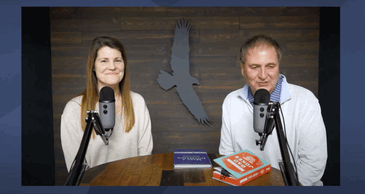
Take a minute to listen to this week’s Relationshifts podcast episode as we talk about how to shift from depending on AI alone to combining it with RI.
The people and organizations that thrive will not simply be those who know how to use the best technology. They will be the ones who combine the power of technology with the ability to connect, communicate, build trust, and genuinely care about people.
When we choose to shift from artificial connection only to adding intentional human connection, we will make a difference.
Larry
[00:00:08] Hey everybody, it is hot, hot, hot. We are in August and we are in August in Alabama and it's hot. It is so hot, Larry. We're kind of melting. Maybe the sweeter you are, the more you melt or sweat. I don't know, something like that. But it is so hot. It is hot. I'm Larry Little though. And I'm Melissa Hamburg-Jackson. And we are so glad you're with us. I'll take it. I'm okay. I like the heat. I especially appreciate it.
[00:00:38] On those cold, cold winter days that we have in Alabama where it gets down to 50, you know. Well, it's been a beautiful summer. It has been a beautiful summer. We've had so much rain. So normally at this point, the grass is yellow or brown, right? And it's green. No, it's green. So it's been good. Yeah, it's been great. We're glad you're with us. Yes. You know, we were talking about something today, Melissa, that every, I'm going to say 100% of people at least have some type of experience with, don't you think?
[00:01:07] You know, this piece, you have kind of this continuum, right? You've got people that are out there on the forefront of this. And they have a lot going on in this area. And they're using it as a resource and a tool. And you've got some that are, you know, a little skeptical. And they're figuring it out. And then you've got maybe some that I'm not going to delve into that area. So you've got a continuum of people.
[00:01:33] Yeah, I think you're right. We were sitting around the other day in our house and we had, you know, some friends over and we're just, we're hanging out, we're talking. And after dinner and somebody ask a question, you know, just, just random, you know, I wonder, I wonder when that song came out. I wonder what year that song wonder, you know, when it was, you know, when it first came out, what it goes, we're listening to, to, you know, not the radio anymore, streaming.
[00:02:00] And immediately everyone in the room grabbed their cell phone and started, you know, typing in to the question. And they were going to their AI source and they were typing in the question. When did this X, when did this song come out? It was a race. It was a race. Yes. It was a challenge. You know, 1972, 1980, because I guess it, I don't know, maybe it makes you feel smart. I don't know. This AI thing is what we're talking about today. You know, what do you do with that?
[00:02:28] It is kind of fun actually, but you can ask, you know, any, for any information and then you can ask the next question and get more information. So it is, it is, you know, kind of something you, you're drawn to. You're just drawn to it. It is. And here's an honest question for you. Have you ever asked somebody a question and then they answer it and then you fact check them on AI? Oh my goodness. We do this all the time. It's like a little game.
[00:02:57] It's like a fun game with my camel. Yes. Yes, absolutely. And I'm in the game because I can use AI. Now you're in the game. I like that. Yeah. You can get ready. That's what I want us to talk about today. Let's delve into this a little bit and see if we can talk about AI. Let's do. We know that it's here. It is upon us and it's wonderful and it's incredible. It changes life.
[00:03:25] It also changes lives and not so, for the not so good. I think it times. So it changes lives for the better. All that technology. But as it's come on the scene, we see in terms of relationships, it's really, it's really becoming an issue, I think. Well, you know, it is a tool and we get to determine how we use that tool.
[00:03:49] You know, sometimes we might use tools too much and we become reliant on a tool in place of, you know, engaging or having conversation. And so we want to kind of explore that today and see what does that look like? You know, it's very, very tempting. You know, have it, I use it. I know you do. I've named mine. It's kind of, you know, just makes it easy. I pick up my phone and I just say, hey, I call the name and, and I pick the voice. I want it to answer in. I pick the accent.
[00:04:17] You know, I'm like, I want a British Southern American accent, British from the South. Because I think when you speak in a British accent, you just sound smarter. I don't know. But, but you know what? It's there and, and I pick it up and I can actually have a conversation. Do you have conversations with your AI? Do you have AI? You know, I do. Yes. Yes. I have not gone to the length of naming or, you know, picking.
[00:04:44] So I'm, I'm just in a good generic place where I can, I can get information. Well, I think it's important to talk about because if we're not careful, AI will replace our relationships. And it's not that it's not a substitute for it. I think you're going to see some incredible damage done. It should support us. It should be a tool. Like you said, it's a tool.
[00:05:06] But when I think in, in, in data is going to show us that unfortunately we're, we're entering into a phase where we're misusing. You know, I don't think it's, you know, we use it for convenience, but it's turning into more than that. Yeah. Let's look at some stats and let's kind of process through that. So here's one from Pew Research Center that says one in 10 American adults use AI chat bots for emotional support. One in 10.
[00:05:35] And for those under 30. So let's think about that for, for kind of the younger group. So for those under 30, that number rises to one in five. So one in 10 for those 30 and under it's one in five. That's incredibly scary. And because of the word, the two words, emotional support, it's not just that they're using it,
[00:05:57] but they're using utilize one in five of our young adults are using that for emotional support that destroys everything about relationships in terms that we try to teach that we try to help it. It really steals from them what they need. We are made. We are created for relationships. We're created for connection and that fake connection. They think it's real. I think it's going to be devastating. I do. You know, and we're going to get into this. What does it provide?
[00:06:26] What is it that, you know, that, that those that are using that for support, what are they looking for? You know. And what's missing and what's missing and what they offer? That's the perfect question. What is it? What's in it? You know, you have five scratches in your head. What is it? But going back to our data, in their minds, they're alone. In their minds, I'm lonely. I want companionship.
[00:06:53] I want, but I don't want to risk. I don't want to invest. I don't want to work. All those things that it takes. So therefore, and really, you know, we all know the damage done. Loneliness causes us to do, you know, really difficult. I mean, really crazy things at times and it's damaging to our health. One piece of data says that, you know, when you're alone, you don't have social interactions. It's like smoking 15, 15 cigarettes a day.
[00:07:23] And it's just it. So it hurts us physically. Hurts us mentally, emotionally. And there's a, you know, I don't want to be involved in relationships and there's, I don't know how. I don't know how to do it. Here's from American Psychological Association that 93% of psychologists have said that using AI for companionship could negatively affect people's social skills. Yeah, thanks. So 93%.
[00:07:50] Here's another piece as we finish up some of our stats. Get this, okay? I'm going to read this and really want us to take this in. So in Q1 of 2026, okay? Americans spend over 705 million, that's an M, million total hours engaging with AI companion apps. Okay? 705 million total hours.
[00:08:19] That's twice as long as we spent on dating and social discovery apps. That was at 280 million hours. Look at that. Look what's happening. That's mind-boggling. AI is replacing now the dating apps. Wow. And trying to find that social. So I think there's some reasons for that. I think it's really, and I don't want us, as we talk about this today in this pod, I don't want us to go into all or none thinking.
[00:08:48] So we're not anti-AI. We are not. It is wonderful. I have it. I use it. I'm saying, let's don't go to all or none. I'm saying, let's find some boundaries. Let's find some ways to use it to help us and not allow it to take over who we are in our relationships. And so we're talking about, here's a concept that we want to process through.
[00:09:12] That AI plus RI is really the focus. That's exactly right, Melissa. What do we mean by AI and RI? So it's AI. We all know AI, artificial intelligence. But in order to have success in our life and our relationships, we have to add RI. And RI is relationship intelligence. And when you have both, then you have a successful relationship.
[00:09:37] In other words, we use AI to help us as a tool, but we have to understand and also do the work of RI. We have to understand what it means to have relational relationship. And what does that mean, relational intelligence? It means how to give and take in a relationship. And it means how to invest in and do the work.
[00:09:57] And what it means is realizing that humans are imperfect and you can't have this perfect person always ready who never has a bad day sitting on the computer who tells you exactly what you want to hear. Yes. And so, you know, thinking about these chatbots, things that I've been reading, it's been so interesting to talk about how the chatbot, which the AI, is, of course, tracking your conversation, adding to the conversation, learning about you.
[00:10:24] And it's doing it to kind of please you. And so it's set up to please you. So therefore, to say things, to reply in such a way that is not real.
[00:10:39] To provide something to you that becomes, it is artificial and something trying to please you all the time versus, you know, something that kind of gives you some truth or gives you some feedback in a way that makes you think or ponder.
[00:10:55] The science behind that, the reason it does that and the reason they, you know, they don't program these bots to confront you or to challenge you or is because scientifically, neurologically, they know that when they say things that make you go, oh, oh, and then no. And we all do it. Endorphins are released. We know that.
[00:11:18] And so if those endorphins are released, it's the same kind of endorphin, kind of, kind of, not a high, but a satisfaction that we get when we're addicted to something and we want to go back for more. Why do people, why are we addicted? Well, the science behind it is it makes us feel good. So we want more of that. We want those endorphins kick. It's a good, pleasant feeling. We need that. We cling to that. We want that. So we go, even if it's false.
[00:11:45] So this is they're feeding our addiction cycle, lack of a better way to put it. And that's why it's so dangerous. We have to realize that, you know, AI is programmed to get us addicted to why is that? So that we'll go back and use it again. Why is that? So they can sell more of them. So they can sell the advertising behind it. So they can sell more subscriptions. They know the more we use it, the more money. These people that produce the AI, we won't call their names. You know them all.
[00:12:15] But their motivation is simply money. It goes back to that. So we have to know that and guard ourselves against this temptation to become addicted. We need to use AI as a tool, not as a crutch. Even I know we all use it as a crutch. I mean, we have to be careful about that. When we start using it at one of the slippery slope, then it's going to begin to replace our relationships. And to use it as a tool keeps us in the driver's seat.
[00:12:44] You know, if it can be a tool and a resource, then I can use this and I can still think about, you know, how do I take this information and try and experiment in my relationship? You know, how can I use this to make me think more about conversations I want to have? Or how do I use this to help me understand that person and what, you know, framework they may be coming from and what they're motivated by? How can I use the information to make sure? That's right.
[00:13:13] I'm still in the game in the relationship. That's exactly it. And when we find ourselves isolating and having a relationship with an AI bot, we're on a slippery slope. Red flag. It's a red flag. Let me tell you, it's easy to do, especially these young people and even older adults who are looking for companionship. It's easy to do because you get no pushback. It studies your patterns. It studies what you like, who you are. It develops a profile of you.
[00:13:43] So then it begins speaking the language that resonates with you. And even though you're cognitively thinking, all right, I know this is a computer. You're emotionally thinking, but it feels so good. It feels so nice to have this. And, you know, I think it sets up all kind of problems. And, you know, when we're in a vulnerable place, we can be vulnerable being a teenager because we don't fit in or we don't feel like we fit in. We can be vulnerable in life.
[00:14:09] We've, you know, we've been, we've lost a partner. We've lost a spouse. We've lost a, there are so many things that in life can put us in a vulnerable place. And we need, we need companionship and we need empathy at those times.
[00:14:25] And so, you know, there is this place, this zone that we have to be mindful and we have to, we have to be aware so we can use it as a tool and not a replacement or not a crutch. You know, that kind of, you know, that kind of holds us up. You're just spot on it.
[00:14:44] And one thing to remember, I think, and really think it would be helpful is that AI and relationships, what makes relationships worth it is that the person that we're in a relationship with has a choice. Sometimes those choices hurt us. Sometimes they help us. Sometimes they, but they have a choice. They can choose how they respond to us. They can choose to confront us when we're off track or whatever. They can choose to challenge us. They can choose to respond.
[00:15:14] AI cannot choose. I mean, they can gather data and they can look at the data and respond with the data that we've given them, that we've given them about ourselves or about the situation, but they're not choosing. They're not literally choosing. It's just spitting back the information that it has. And we have to remember that, that relationships are all about choice. They're all about choosing to invest.
[00:15:38] And when we put ourselves in a position where we're engaging with this bot that is not cheating, it's just putting, it's just spitting out addictive information for us to get us addicted so that we will come back and get more information from it so that it can make more money for its creator. It really helps us, I think, to put it in perspective. And, you know, this AI piece, we want it to be a positive tool. We don't want it to be a tool that is impactful in our lives in a negative way. We don't want it to be a crutch.
[00:16:08] We don't want it to replace what we need to do the work around. That's right. How we need to, you know, be sharpened in our relationships and to be challenged so that we can grow as individuals and that we can have stronger relationships. Because relationships are hard work. It takes a lot of energy. It takes a lot of time. It takes a lot of intentionality. And it can be easy to kind of kick it in neutral and drift out of doing that hard work.
[00:16:38] Yeah, I think you're exactly right. And just remember this, you know, AI can describe things. They can tell you about things. They can talk about things. But they can't experience it. The AI can, it can't, it can't replicate authenticity. It looks like it feels like authenticity is really just information being spewed back at you. So if you keep it in that context. Yeah. So AI plus RI.
[00:17:07] So this relational intelligence, this ability to, you know, be aware. Be aware of yourself. Be aware of others. To be able to have this relational understanding of who that other person is and what the dynamic in your relationship is like. And how to take all those different facets and be able to use AI to make your relationship skills even a little stronger.
[00:17:37] 100% right. And to put it in context for us so we can kind of put some practicality around it. Let's look at the personalities and how they use, let's do the AI plus RI and let's kind of talk about what that means and how each personality can use that formula successfully. Let's do that. Let's start with the Lions. And we know that the Lions are all about speed. They're all about the shortcut, you know, making sure they can turn things around quickly.
[00:18:06] And they're going to be direct in those conversations that they have with people, you know. They're wanting to, you know, move fast. They want the other person to move fast. They want to be able to have conversation quickly. And we all know that that's not reality. That's not reality. But here's the thing. You know, they can, they love AI. That addictive part of AI for them is it's fast. It's direct. And guess what? I can say exactly what I want as a Lion.
[00:18:36] And I don't have to worry about hurting anybody's feelings. And I get it. I get the, you know, the, what I've asked or the information immediately. As soon as I hit enter, I hit the button, hit the area. So, so Lions look here, remember this AI is great. Use it to get your bullet points. Use it to get your information. But you can't substitute that for your relationships. You still have to do the work to turn on that filter between your brain and your mouth when you're in. So the RI piece for those, for those Lions is this. Look, use AI to get the information.
[00:19:06] Practice RI though to say from a relationship, I know I still have to turn that filter on in my head. I know that it takes longer. Somebody may need some time to process. I can't convince yourself that while you're, the AI is good for the information. The true authentic relationship, the RI piece is going to mean slow down, think about your words, bring that. And you can bring the information, you know, that you received into a relationship with a real person.
[00:19:35] But don't be drawn in to accomplishing the task from an AI perspective only. Bring the people in with you. Bring those, you know, slow down and bring the people in. Yeah, because people are not, they're not problems waiting for you to fix. We can see them that way. And when we do, our RI has gone down. It's decreased. So let's talk about the parrot. You know, the parrot loves entertainment.
[00:20:03] The parrot is the person that, you know, they love that high energy. They love to have their thoughts validated because, you know, they're getting that positive feedback from someone. They have that, just that energy that goes on and on and on. And so their view, you know, they're getting that return quickly. You know, they're getting that engagement quickly. And that's the positive thing for that parrot. You said the word positive.
[00:20:31] The parrots love it because it's quickly, it's energetic, they're getting it, and it's positive. It's eternally positive, the AI. So parrots, you have to be, you use the AI because it'll give you information and it'll be kind while it gives you the information. And that's fine. But realize the RI piece of this is people that you're in may not always have the energy that you want. They may not always be positive.
[00:20:56] And give yourself permission to let that be okay and know the importance of investing in those people, even on the surface when it looks like they're fatigued or they're tired or they're even negative. Do the work. Go and invest in that. Hold some of that. And you'll be so much better for it. You use AI for sure. It'll give you information you need and it'll be fine with that. But never forget the people, even when they're not positive, even when they're not energetic,
[00:21:22] are crucial to your success in life, investing in those relationships. Slow down, parrot, and invest in those around you. So the camel, the camel is that logic driven, you know, they don't like lots of emotion. They don't want to be in the drama of things. They want to be on the other side of that. They like that predictability. They want things to run smoothly and on even keel and be structured.
[00:21:50] And they value all that. It drives them. Yes, they do. And they have to be really careful because AI will give them practical, logical information that's not emotional. And a lot of it. And a lot of it. And they just love. They will find themselves going in a hole with AI because they'll give it all. All this information. It's incredible. And more. So remember, camels, look, first and foremost, please hear me.
[00:22:18] Don't measure your human relationships by the information you get from AI. For the love of all that's good and right, don't fact check those you love. Because when you do, you're setting yourself up for failure. Use AI. Go down that hole. Get that information. But realize you've got to come back out of that and invest in those around you. Allow them to have their own opinions, even if it's wrong in your opinion. Engage in conversation.
[00:22:45] Realize that some of those around you in relationships need emotion. And don't be afraid of that. Allow that to happen. Choose. What we talk about choosing. Choose, right? To shift out of that logical mindset into that more emotional, accepting, compassionate mindset. That is so well said.
[00:23:08] That real urge that they have to measure their relationships and to have the scale, have the graph in their mind, have the chart that pops up, the spreadsheet. Yeah, they love it. Keeping up with the relationship. Really resist that urge. So then we have the turtle. And the turtle, they want things to be safe and clear. They don't like rejection.
[00:23:36] They're one-on-one driven and they really value those one-on-one relationships. They don't like the pressure. You know, when someone comes from an angle of pressuring them, it could be with a task or it could be about the relationship. Those are difficult moments for those turtles because they value peace. They want peace. They need peace. It's part of their DNA and how they're made. Yeah, they do. And they need time. They need time to process when people, you know, talk.
[00:24:03] So to them, AI is really helpful because they can take their time. They can respond as slowly as they want. They can have time to really think through and then, you know, engage with AI. So they've got to be really careful here not to isolate, not to polarize, not to go into their shell and just get lost in the plethora of AI. So turtles, look, you know, it's fine to go back into your shell, use AI to get your information. All of those is fine.
[00:24:33] But you've got to remember, engage. Come back out. Realize that people are in real time. And sometimes they need answers in real time from you. And that's okay. Learn to take that risk. Learn to engage in those relationships that are important to you because you have those relationships that are critical. AI will not make those stronger. AI will cause you to pull away from them and it will denigrate those relationships. So engage. Come back out.
[00:25:03] Take that risk. So here's the shift. Here's the shift we want to make sure we call back to. And that is the shift of using both. Using AI, which can be such a positive thing. It can give you tools and resources. But using AI and RI, that relationship intelligence, putting those two together. That's it. And really allowing that to grow, to grow you, grow your relationships. It's a shift from thinking AI is a real relationship.
[00:25:31] It's a shift from using only AI to adding RI to your equation. Make sure we got it. It's got to be both, right? AI plus RI. Both. It's not all or none. But don't forget to invest in those relationships with people who have a heart and have a mind and have a true emotion, true flesh and blood. Invest in those relationships. It matters. And you have to be intentional about it, Melissa.
[00:25:58] You have to be or we will slip into our addiction of AI. And that's deadly, I think, in the long run. So as we finish up today, really, we just want to be able to challenge ourselves, challenge others that you take that equation and you do something with it. You remember. You use it.
[00:26:20] When you are picking up that phone and you're asking the question or you're seeking information that you're reminded to that how you treat others, how you engage with them and how you connect with them. That's really the key. That's it. That's really important. So, Melissa, as we kind of close this thing out, I want you to know that because the most favorite part of our segment, we must do.
[00:26:45] And I want to remind you that I could have gone to AI for my dad joke of, you know, of the pod, but I did not. I did not, Melissa. This is not AI generated. Okay, everybody. It's not artificial. It's not artificial. It's real. It's a real dad joke. It's a book. Out of a real dad joke book. And so are you guys ready for this, Robin? You know, Robin gets so excited when I start this. She's just in her camel stuff. She's just so excited, jumping up and down and kind of carrying on.
[00:27:14] You are using that R-I so well. Yes. You are using it so well. Somehow it went away from me there for a moment. All right. Kind of stretching it a little bit. Robin, are you ready for mine? Yep. She's ready. Are you ready? I'm ready. All right. Here we go. What lies at the bottom of the ocean and twitches? What lies at the bottom of the ocean and twitches? A nervous wreck. Okay. Nervous wreck. All right.
[00:27:45] That's been good. See, I thought you would love it. That's been so good. Hey, guys. Thank you for joining us on this pod. And thank you for putting up with my dad joke. We do appreciate it. We do hope today you've gained some things that would help you in your relationships as you think about AI. We really appreciate you tuning in. And we look forward to being with you again in the near future as we make those little shifts that make a big difference in our relationships. Take care.
[00:28:14] Little shifts that make a big difference. Real ocean shifts. Little shifts that make a big difference. Thank you for tuning in to the Relationships Podcast with Dr. Larry Little and Melissa Hamburg-Jackson. We hope today's conversation inspired you to make meaningful shifts in your personal and professional relationships. We want to hear from you. If you have a question for the author, Dr. Larry Little, about personalities or relationships,
[00:28:43] send in your questions to the link in the show notes. Stay connected with us online at EagleCenterForLeadership.com and follow us at Eagle Center for Leadership on Facebook, Instagram, and LinkedIn for more insights, resources, and updates. Don't forget to subscribe to the Relationships Podcast so you never miss an episode. And if you found value in today's discussion, we'd love for you to leave us a review. You can also watch episodes on YouTube through the Eagle Center for Leadership channel.
[00:29:11] Until next time, keep choosing to make the little shifts that make a big difference. BigSt Let's get started.