
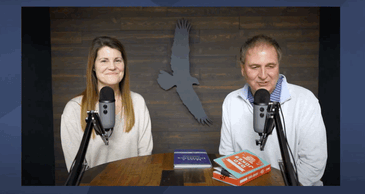
Father's Day is a great reminder that being a dad isn't about being perfect; it's about being present. A father's influence reaches far beyond what he may realize. The conversations, encouragement, life lessons, and everyday moments leave a lasting impact on his children long after they grow up.
Dads also bring something unique to the family. They often provide the fun, adventure, and yes, sometimes a little embarrassment along the way! Whether it's bad jokes, goofy stories, or creating memorable family moments, dads have a special way of making life a little more interesting.
One thing I've learned is that dads show love differently. Some encourage with words, others through acts of service, quality time, or simply being there when it matters most. The style doesn't matter nearly as much as the effort. Children don't need a perfect dad; they need one who is engaged and intentional.
This Father's Day, celebrate the dads who keep showing up. And be sure to check out our special Father's Day Relationshifts Podcast episode, packed with fun stories and a few practical ideas for dads.
Listen on Apple | Listen on Spotify | Watch on YouTube
When we shift from being on the sidelines to being engaged as dads, it will make a difference.
Larry
Happy Father’s Day to my 86-year-old Pops, who still knows how to have fun!
[00:00:08] Well, hello everybody. I'm Larry Little. And I'm Melissa Hamburg-Jackson. And you are listening to Relationships, the podcast. We're so glad you're here. And this is going to be a fun episode. It is going to be so much fun because it is time to celebrate and recognize or remember dads and the role that they have played in your life or dad figures. So this is going to be maybe just, you know, unfiltered. I don't know.
[00:00:38] Well, you know, it could be. Should we do a disclaimer or something before? Hey, you know, we're not responsible for the content that comes out of here because Larry could say anything. I think that's a great disclaimer. Maybe a little more. Keep going. Add a little bit or something. I do want to say, let me just get this out there to start with. Dads are, you know, they're great, but they pale in comparison to all the work that you moms do
[00:01:04] and how you guys do so many things, balance so many balls. And so first and foremost, you know, we understand that. At the offset of this pod, we understand it. We get it. And we're very appreciative of all the things that you do. We just kind of try to hang on. That's so thoughtful of you, Larry. I mean, you're just starting this so well. This is good stuff. I wanted to start strong.
[00:01:27] Hey, you know, as we talk about dads, we do realize that some may be listening who no longer have their dad, have lost their dad or have a estranged relationship, that kind of thing, or maybe never even knew their dad. So we want to be respectful of that. And so as we talk about this, you know, there may be a man in your life that's made a difference, that's impacted you in a certain way.
[00:01:50] And certainly as we talk about dads, we're referring to those significant male figures, you know, in your life. You know, also, you know, current dads, dads that, you know, have kids and they're figuring out the dad that they're going to be and what they want to look like as a dad. We've just got some good humorous pieces maybe today and some shifts that we want to be able to talk about as well.
[00:02:19] And just to set the record straight, I do have two adult children. My daughter is married and my son is not, but they're both in their 30s. And my daughter is married and her husband, I kind of count as one of my own as well. So I guess I have maybe three. So you have some history is what you're telling us. You've got some experience to bring to the table today. I like that. I do have some experiences.
[00:02:47] Well, I am dying to hear some stories also about your dad because I know Mr. Frank and Mr. Frank has always been such an incredible man as long as I've known him. And so he is just a unique fella. So my dad, yes, we'll call him Frank because that's his name.
[00:03:11] And he has always been full of, I grew up in a home full of love, full of joy. He loves to laugh. He loves even now he's 86. And most recently I, you know, looked on, they're in this wonderful facility of assisted living. And I look on, it came up on my phone. I think it was on Facebook or something. And there's my dad in the assisted living and in his wheelchair.
[00:03:40] And he has this wonderful, huge, big woman's hat on with sunglasses. And he's getting ready for the Kentucky Derby, I think they're having. And he was rolling around. They rolling him around. And he was, you know, wishing everybody good luck. So he still loves to have fun. That's what I grew up with. I grew up with that kind of fun. And so I'm going to, I'll tell you a quick story. And if you are listening and you don't hear the story, you'll know it's because they edited it out. Okay.
[00:04:07] So my dad, I grew up, you know, we had a small home. It wasn't, it wasn't just a little small, like a three bedroom kind of thing. And so my dad, he loved to, he loved to play jokes. He loved to laugh. He loved to, well, by this time I was actually in, in college. I was in college and, and I had a friend that, female friend, but just a friend.
[00:04:34] And she, she came home with me. I brought her home with me. And as you know, back then we did that. We just, you know, just friends would come in and we had a little pullout couch and she slept on the pullout couch. Which was about, I don't know, 20 steps from the bedroom that my mom and dad slept in. So my mom and dad, we all went to bed that night and we're laying there in the dark and my dad is in the bed. And he used to love to do this in the bed.
[00:05:04] So Melissa is looking at me like, I can't believe you're about to tell this story. So should I continue? So he's laying in the bed and she's in her on the couch. I'm in my bedroom, which is kind of between the two. So I can kind of, you know, I could hear everything that's going on. And my dad lays in the bed and starts passing gas. He starts passing gas so loud. I'm horrified. And then I hear this giggle.
[00:05:34] He's just giggling. He's just laughing his head off. And, you know, I'm going to, I'm going to give it, I'm going to give my friend credit. She just rolled with it. She laughed. But it was incredibly embarrassing. And now it's incredibly funny. I will say I've never done that to my children. But wow. Oh, my goodness. I'm trying to track your story. And I just, I don't know. The breaks just started coming on in my mind. You're like, stop, stop, stop. Oh, my goodness. That tells you about Frank.
[00:06:04] He loves to laugh. He loves to have a great time. And I grew up in a home with a lot of joy and love. Oh, my goodness. Now, you know, Mr. Frank, I've always known him to be a parrot. But, you know, just can strike up conversation. Was always, you know, he's always interested in other people. He is. And finding out about what's going on in, you know, their world. And wow, what a story that is. What a story that is. So. He loves to have fun. He loves everybody.
[00:06:32] And everybody loves him. So that's kind of how I grew up. What about you? Give us a little story. So if we're talking about personalities and, you know, our dad. So my dad was a lion camel. So, you know, he did like to have fun and he liked to cut up. Not so much like, you know, Mr. Frank. But it looks a little, just a little different.
[00:06:56] But, you know, he loved to have his toys and kind of, you know, play. He had a motorcycle. Wow. You know, he would love to ride motorcycles. And, you know, just I remember my dad being such an entrepreneur. He would try new things. He would do lots of different jobs. And so he was always doing something. Right.
[00:07:26] And as a lion would be, he would always be doing something, you know, a little risk taking, you know, motorcycle. You know, I would ride with him on the motorcycle. We'd go for spins and for rides. And, you know, I would just kind of like hold on really, really tight. And just for context, your dad's no longer with us. Right. He passed away a few years ago. Yes, he sure has. That's great. But, you know, he loved to make things happen. That's great. That's awesome. Mr. Frank Peer it.
[00:07:56] So they're in a lion. Yeah, that's exactly right. So, you know, the thing is we find ourselves for some reason as the years go on and, you know, you're, you know, of course you're only 29, so you're probably not quite there yet. Right. Not quite at all. Those of us that, as we continue to age, we find ourselves saying and doing, not what dad did in my story. I haven't done that. But other things that he says, oh my gosh, I find myself saying, you know, do you find yourself saying things like your dad said?
[00:08:25] You know, I'm a mom. So I, you know, I might hear them in my head. Maybe they don't really come out, but I know exactly what you're talking about. And I know those, those pieces that, you know, they just, they, they pop out. You know, you, you might end up saying some, I can't wait. I need to hear some of these other comments, especially since you've told that story. I need to hear some dadisms that Mr. Frank would say. That's right.
[00:08:55] Some dadisms. That's what we're talking about today. These dadisms that, you know, dads just do. And dads show love differently. We do. We're not, you know, we're just different. We're not like moms and we don't, we don't quite have that nurture ability. Generally speaking, I'm talking in generalities and everybody don't send me any emails, send them to Melissa Hamburg-Jackson. But, but generally speaking, we're not the nurturer. So we show love in different ways.
[00:09:22] And a lot of times that's through tasking or getting, you know, taking care of something. I'll tell you, I'll tell you one that I do. This is that I, I don't know why I do this, but now I do it. When I was growing up, my dad, and now I know it was because he loved, loved us. When I was, whenever I would leave and later on in life, my sister, when she was driving and she left, but my dad would always come out to the car, walk around the car. And check our tires. Every time I mean, he'd kick them. He'd look at him, he'd kick them.
[00:09:50] And I'm like, why are you checking my, well now with my daughter, Ren, when she went off school, my son landed, guess what I do? And I still do it to this day. If they come visit or they're going off for a trip, I'm checking the tires. That's so cool. I'm checking the tires. I'm checking the tires. Protective mode. I guess so. We're protected, yes. And what we're saying is, you know what? I love you. You know, that's what that really means. And you know that now. Giving attention to, protecting.
[00:10:17] You know, so, you know, as we think about, think about our dads and some of those dadisms, one does come to mind for me. And that is, and I'm sure you've heard this, because I think, you know, I wonder when did this one start? Like how, what year was it when this dadism started? And how does it, you know, it kind of, it keeps evolving and it, and, and I'm sure I'd be curious to see if you say, have said this one, but it's the one that money does not grow in trees. Oh yeah.
[00:10:47] Have you said that? Did you say that? I did. Especially when our kids were growing up. Oh yeah, what are you thinking? Money doesn't grow on trees. No, I do think I have said that one. I do think that I've taken that from my dad. I wonder where that started. I mean, it's got, it's got to be old. And why did we say it doesn't grow on trees? I mean, anyway, you know, we can look at dads today. There are, there are similarities. There are also differences.
[00:11:12] You know, research tells us that the modern dad spends nearly three times as many hours with his children as dads did in the 1960s. And, you know, I think that's, that's very interesting. So dads are being more intentional. The Pew Research says that there's been a 35% increase in dad presence in non-sport extracurricular activities, which is, which is really significant.
[00:11:38] I think dads are engaging and we see this, but when you ask adult children and you ask them, what do you remember? Many times it's not the great gifts or the, you know, extravagant things, but it's about the routines. It's about the experiences. And that's, you know, I think that's so important. I know we've talked about this before, but I'm, I'm learning and, and really try to practice that our kids really want experiences more than things.
[00:12:05] And, uh, it doesn't have to be expensive experiences, but just try to create those experiences and, uh, and that backs up. That's what they'll remember. That time is super, super important. So as we talk about some of the pieces to understand dads and understand those that may play that role or, or, you know, provide that relationship to you. Um, I want us to try to understand them at a deeper level today.
[00:12:33] So how do we understand how they love? How do we understand their personality? How do we understand who they are, how they're wired? What are some of those takeaways? So we can, we can recognize, you know, when, when they are providing that love and what it looks like. So you want to jump into that? Yeah, I want to jump in for just a minute because I think it's important to understand, um, that, that dads don't track and, and, uh, show and demonstrate.
[00:13:03] Love, um, you know, like, of course, like moms do. Um, I think it's important to, to know, to understand dad, you have to understand the motivation of his heart. You know, if you can see beyond the awkwardness, beyond the silliness, beyond the picking at, you know, the, the, the making jokes and kind of make, you know, that kind of thing, making fun, whatever is, is really a desire to say, I'm trying to connect with you.
[00:13:30] And sometimes dads just don't know how to connect. They're just not in their DNA. So they do things to try to build a connection, even if it's an awkward one. You know, that's such a great point. And, and I, I just appreciate you making that point because I even think about, um, you know, mine and my husband's relationship with our daughter and, and the role he plays as a father.
[00:13:52] And there was one time, you know, probably not too long ago where, you know, I, I was, I was trying to understand what was going on and, you know, I thought, well, I need to step in and help a little bit or something. And he finally was like, Hey, this is how dads do it. That, you know, that awkward, that picking, that joking, that is just part of it. And I was like, yes, you're right. You were completely right.
[00:14:22] And so, you know, it's so funny to me that the picking and the think about, you know, in, in 10 years, in 15 years, you know, those are the stories that you remember that to tell, you know, those are the, that our daughter will remember that she will joke about that with her friends or her, you know, one day if she has a family and children, those are the stories that are right now in the making.
[00:14:52] That's exactly right. That are some of the, the funny situations that are important to have. That's what she will remember. And, you know, it's not about getting it right. It's not about dads saying the right thing or doing the right things. It's about, they were there, they were present and, and they were trying to connect. And those stories will be retold over and over again. My dad is, you know, he's got a, a, a kind of a, an Irish type hair. So he was, you know, he's like we said, he's a parrot, but he's also very,
[00:15:21] very gregarious back in the day in terms of showing love and affection. Didn't he's very manly, but he didn't mind the emotion. He didn't mind showing the affection. So whenever I would leave the house, I would have to go give him a hug and a kiss. I mean, I'm talking, I'm not talking about as a child. Can you imagine a 16, 17 year old kid? I remember vividly, you know, I'd be going out on that night, going out with my friends or going on, come here, son, give me a hug, give me a kiss. I'm like, dad, it's a little embarrassing. My friends are standing here.
[00:15:49] And so fast forward till today, I go over to the place where they are, wonderful facility. And I would go. And when I go in and when I go visit them this week, you know, when I go over there, what will happen is when I leave, and probably many times when I come in, but certainly when I leave, he'll kiss me, he'll hug me and kiss me. And that's the way he shows love.
[00:16:13] He's not, maybe that may be atypical of some men, but all dads have their way and they really don't care if it's awkward or not. You know, he's like, I hate that you're embarrassed as a teenager. And you know what? I love that now. I can look back and guess what I do to my son. Of course, my daughter. You know what I do, right? I do the same thing. I hug them and kiss them because the influence dad had. Well, you know, dads earn that tone of dad, you know, like it has to be earned, right?
[00:16:43] That's so good. Yes. It has to be earned. I think dads teach some grit sometimes, right? Oh, man. Yes. Yes, absolutely. And by the way, studies show that that resilience that dads have, that may cause the children to roll their eyes. But that consistent love, however they show it, but that can in these ways, that consistent showing of that love is what builds that stamina and resistance and perseverance in children as adults.
[00:17:12] So it's important. It's important. It's the kind of making a diamond, right? The diamond in the rough. It is. You're just making that child. So let's talk about some shifts. So in dads, understanding your dad, you know, it's great to have the personality awareness to understand, you know, who your dad is or was or those significant relationships that you have in your life that you, you know, you have that tool.
[00:17:41] You have that resource to better understand who they are and how they're wired, but how dads react in general. But if we talk about making some shifts, these are shifts for us to understand so we can understand our dads better, right? Oh yeah, that's right. And it's just a different perspective as we shift into it. But I got to share with you before we go there. I have a dadism. You got to? Yeah, I got a dadism. Okay. I'm going to share with you. So when I was going to see if you can, if anybody, maybe Robin, our producer can help us.
[00:18:10] He's very smart. I need to know what this man. My dad says it. I say it. I don't know why I say it sometimes. But I kind of say it. So somebody will, you know, will say, how are you doing? Or something like that. And my dad would say, I'm hanging in there like a sick kitten to a hot rock. Does anybody know a sick kitten to a hot rock? And I find myself saying that with no idea what it means. You know, what do you think? I can't offer you anything. Nothing. I heard nothing. I heard crickets. Nothing at all.
[00:18:39] I've in fact never heard that one before. Have you ever heard this? This one is, how are you doing? I'm hanging in like a rusty fish hook. You've heard that. That's dad. Got that one. You got that one down. Well, okay. Back to our conversation. I don't know why. This stuff is just coming to my mind. I don't know. All right. So here's the shift. Yep. That fits this one so well. Love you, Dad. It's a shift from a cringy moment. Speaking of. I don't understand.
[00:19:05] You mean like when I brought the girl home and back to the first story. You've got such great stories. You've got great stories. So shift from those cringy moments to core memories. To know that, you know, these things produced, they produce memories that you'll forever tell. I'm sure your children know that story. Oh, do they ever know that story? Your whole family? They all know. No.
[00:19:29] Well, it is amazing, Melissa, that I'm married because my wife's name is Melanie. Okay. So when I was dating her, I dated another girl with another name like before that. And my dad. Two Melanies. No. Is that what it means? Her name was not Melanie. Okay. And so dad really liked this other girl. And before Melanie was on the scene, her mom was a schoolteacher. Okay. Her mom was a schoolteacher. Okay. And I can't remember.
[00:19:59] Her name, we'll call her name, you know, Rebecca or whatever. I don't know. So whenever I brought, not just Melanie, but if I dated anybody else, but specifically when Melanie and I started dating, I would bring her home and dad would say, oh yeah, your mom's a schoolteacher. And then he would say, well, come on in, Rebecca. And he would, he would just laugh. And Melanie would correct him, right? I didn't think, yes. Yeah. Mr. Little, this is Melanie. I didn't think it was that funny back then, but I kind of do now.
[00:20:29] You know, those parents, sometimes we struggle keeping our details straight. True. Core memories. You're building core memories, which are so important. Fun stuff. Fun memories. Core memories. Yes. Another shift that we want to think about is, you know, we, especially in your teenage years and preteens, you know, we thought dad overreacted. You know, he was too protective. Oh my goodness. Yes. He was too, you know, too over the top. Oh yeah. But really, really we shift that to he was paying attention. So I've got a story behind that because I, my dad was protective.
[00:20:59] I thought he was. And then I, I experienced he was, he was. He was. He just was. So, you know, I wasn't going to be able to date until I was 30 and I was the only girl and the baby. And then also my curfew was 10 o'clock when I was a senior in high school. And so I just, you know, of course everybody else's was so much later than that. You know, it was awkward when I had to go home at 10 o'clock. I thought that was so early, but I, now I get it right now. I understand. Yeah.
[00:21:29] So you're, so, you know, for your girl, the curfew is going to be 830. Me and Kelly, we're, we're going to be aligned and all that. Yeah. It's the way dads pay attention. Yeah. That's just, that's just the way they do it. And they do, I won't deny we overreact at times. Right. But it is out of protection. Maybe that was an overreaction 10 o'clock. Who knows? But he was paying attention in terms of showing his care and concern.
[00:21:55] And I think if we can get that mindset, it'll help us moving, moving forward. So what that really is. And, and then finally, you know, as we shift from, you know, the bad dad jokes and then that's fine. And, but instead of being embarrassed or caught up, just know that's dad connecting with us. Just know why. Just know the why behind the joke. I mean, you know, the jokes, well, they are funny. I mean, I know, you know, we have a, you know, a tradition here of doing those and everybody just, just loves them because they, they really are funny.
[00:22:25] But besides that, it's a way dads connect with their children. And that's where the dad joke comes from. I find this, this shift so interesting that the dad jokes would make it into the shift. I just think that was so interesting. You know, did you put that in there? Well, you know, I don't know. I think we ought to talk to our content team. I don't know. I just, uh, somebody, somebody, well, people clamor for the dad joke.
[00:22:50] And we're going to say today that we've made a decision and Melissa has asked and, and of course, what am I going to do? I said, sure. She wants to do the dad joke. I want to try. I just want to try. You know, I think I want a chance at this and it will be nothing like, like what you do, Larry, but it's to honor you. It is to honor you and your heart for jokes and your legacy that you create with these jokes. And so I have one. I'm ready.
[00:23:20] It's, you know, it's kind of a statement. Okay. So think about this. Okay. You're done. I'm ready. I don't tell dad jokes, but when I do, they are fully loaded. So maybe in light of the story you told, I don't know. I don't know. That worked out somehow in a weird way. I feel like we have made a cringy moment. I don't know. I love the quiet. I love like the crickets. I looked at Robin and she's over there just shaking her head.
[00:23:50] If you make Robin turn red, you've done a good job. So good job. So in light of your story and in light of Father's Day, we have a gift for you. What do you have? Oh my goodness. Yes. We have a gift for you. Wow. For those of you listening, it is a t-shirt, amazing t-shirt that says, it says dad jokes and it's got like a little computer thing. Like something's loading up and underneath it says loading. There you go. I love it.
[00:24:19] There you go. This could not be any better for our conversation today, for the story. Happy Father's Day. It was not planned. Happy Father's Day. Happy Father's Day. So many ways. Oh, my children might be embarrassed. I don't know. They should be. I love it. I will wear this. I will wear this with pride. I promise you. I love that. Thank you so much. Wow. How thoughtful. How thoughtful is that? And you did a great job on your joke. Well, thank you. Thank you.
[00:24:48] I'm going to create cringey moments. So thank you for joining us today. To all your dads, dad figures, the relationships that you have out there. Happy Father's Day to you. And thank you for all the roles that you play in people's lives. We do appreciate you. Thanks for being with us. We look forward to next time when we come together to talk about relationships, those little shifts that make a big difference. Take care. Little shifts that make a big difference. Real shifts.
[00:25:17] Little shifts that make a big difference. Thank you for tuning in to the RelationShifts with Dr. Larry Little and Melissa Jackson. We hope today's conversation inspired you to make meaningful shifts in your personal and professional relationships. We want to hear from you. If you have a question for the author, Dr. Larry Little, about personalities or relationships, send in your questions to the link in the show notes.
[00:25:45] Stay connected with us online at eaglecenterforleadership.com and follow us at Eagle Center for Leadership on Facebook, Instagram, and LinkedIn for more insights, resources, and updates. Don't forget to subscribe to the Relationships Podcast so you never miss an episode. And if you found value in today's discussion, we'd love for you to leave us a review. You can also watch episodes on YouTube through the Eagle Center for Leadership channel. Until next time, keep choosing to make the little shifts that make a big difference.