
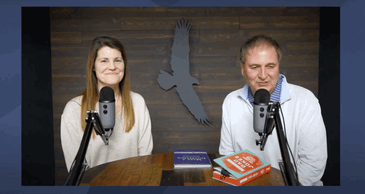
[00:00:07] Hey everybody, happy 2025. I'm Larry Little. And I'm Melissa Jackson. And welcome to Crossing the Line, a podcast where we talk about, what is it? Wait, just a minute, it's 2025. It is 2025. Happy New Year. We're doing things differently. You're right. Remember, we talked about it. We've taken last year. That's right. We are and we're excited about it. Guys, we are excited about what's happening in 2025. We have a new venture that we're standing up and we're so excited about it that we wanted to
[00:00:36] literally change the name of this podcast. So let's start today. Let's do it. So from now on, we're going to change the podcast from Crossing the Line. The new name is going to be Relationships. Now, that's kind of a weird word I know, but I want you to think about it for a minute. Relationships, not relationship, because we're going to be talking about relationships, right? But why relationships, Melissa? Yes, relationships being one word, because it takes little shifts in our relationships to make them
[00:01:06] better. That's right. We're going to give you tools, resources. We're going to encourage you. We're going to help you. We're going to show you. And we're going to use digital technology to do this. We're going to use apps. And we're so excited about content, podcasts. It's going to be so good to help you to shift your what? To shift your communication, to shift your behavior, to help your relationships be better, to shift your mind and your mindset. We're not going to just say, you need to go do that.
[00:01:36] Nope. We're going to show you. In fact, we're going to walk with you as you do that. I'm pretty excited about this. I am too. I am so excited because little shifts go a long way. Little shifts make a difference. And that is so good. So welcome to Relationships, a podcast where we talk about relationships and little shifts in your life that truly make a difference in the relationships with those you love, you care about, you work, you live with. This is going to be pretty cool.
[00:02:05] It is. It is. So we're headed that direction. You know, being a new year, we need to talk about too. Most of us make resolutions. We're trying new things. We're intentional. Our mind is in that direction too. Let's do some things different. And, you know, we've probably made some, made some goals, made some resolutions. And, you know, stats tell us we're not going to keep those most of the time.
[00:02:29] Yeah. I don't believe in resolution. Not at all. No, I don't believe in them. And I don't like them. So you didn't make any. I didn't make any. Not even try. I didn't even try. I didn't make a resolution at all because, and, and, you know, I kind of, I wrote about this on the, the, the email that we send out. Um, and it's called, you know, leaders, leadership moments for now. We may change that too. Right. Who knows what we're going to change.
[00:02:50] But anyway, I wrote about it because I just, every year, um, I see this over and over again, people make all these big resolutions. Right. And you were right. The data says, um, you're not going to keep, what do you have? Like 80% chance of not keeping that. Then if you get, that's, that's just, that's just in the first three months. People generally, you have an 80% chance of breaking your resolutions in the first three months. So you're not going to do it by the end of the year. You have like single digits.
[00:03:18] It's hard. It's hard. You know, I think there is a place for goals. There's a place for, you know, thinking about that, establishing that, trying to, to help, you know, give you, give you that direction. But, you know, the in and out, the daily discipline, you know, a goal, it doesn't, doesn't accomplish that. Right. I'm not anti-goal. A goal doesn't create that action, does it? Right. No. And I'm not anti-goal. I'm not. I get that. I'm totally aligned with you on that. Right.
[00:03:45] I'm just anti-resolutions because I think we sit around and we make these things. We really don't have a plan to follow through many times. We just sit. So what they are, are really good intentions. You know, we have good thoughts and good intentions and, and, and, you know, we just don't, we don't have the fortitude. We don't have the ability or the, the, the, what we need to follow through. The tools. The tools to follow through. The behavior. Right. So instead, let me give you an example.
[00:04:11] Can I have to walk down this track and then you can share what, what I, you know, what I do instead, like I think back about in 2024, what, you know, what didn't work so well for me, what, what happened in 2024 that I would like to do differently. Right. You know, what are some changes? True. But, but then I take that and I, and I try to put that into just a small relationships, into a small shift in my behavior.
[00:04:38] So for instance, I would like to have, but think back, I didn't, I don't think I always had the wisdom and decision making with others that I wanted. Now, why is that? Why is it just because I'm stupid? Well, I mean, maybe, but I hope there are other reasons, right? I mean, I hope that I could figure out how I can make better decisions.
[00:04:57] So I think about that and I think, so what I'm going to do in 2025 is I'm going to do little things, little shifts so that I can make better decisions so I can, can have more wisdom in my life. And, and I'm going to focus on that for the year and I'm going to focus on listening better. I'm going to focus on slowing down my, my decision making process.
[00:05:19] I'm going to focus on looking at the full picture before making decisions with just partial, you know, information or, I mean, all kinds of things that come to my mind that I can add to as the year goes along. And, and therefore it's more fluid. It's right. It's not a resolution that, well, he broke it. No, no, no. This is a fluid. These are some things I'm going to work on through the year. I'm going to work on my decision making. I'm going to work on having more wisdom in the relationships that I care about. How can I better nurture them?
[00:05:48] How can I better understand them? So you see what I'm saying? I mean, it sounds like you're using a word. Yeah. Yeah. So, so your word is wisdom. That's right. My word is wisdom. Okay. Yeah. And so you're going to let that word kind of steer you and try to come back to that to kind of create some accountability or in different situations are using wisdom. That's, that's a hundred percent. And take that word and kind of, kind of focus on that. Learn about that.
[00:06:17] And then, and then I don't beat myself up when it's February, when it's March. And I haven't, you know, like for instance, what I'm not going to do is say, I'm going to take a course. I'm going to take a course on wisdom in the first quarter. I'm going to take a course on decision making the second quarter. I'm not, I'm not doing any of that. I'm saying I'm going to look for ways to increase my wisdom. Well, I love that. So, you know, as we look for ways to increase things, let's jump into some pieces around our relationships.
[00:06:44] And what are some things, some pieces and some words that we think we need to focus on as we think about making shifts? Yeah, I think it's really important to, let's take just a sec to define what are we talking about here with relationships? I just use the word fluid. You know, all relationships are fluid. And we, we know this, we've studied this for years. You and I have really dedicated our lives to studying relationships, right? So we know they're fluid.
[00:07:12] We know it's not that, oh, I've solved this puzzle. And now, you know, I have a great relationship and I don't have to do anything else. No more investing. And as soon as you do that, your relationship starts to die, right? If you're not growing, you're dying. There's no such thing as being stagnant because if you're stagnant, the relationship is dying. Yeah, different seasons of relationships. Yeah. So what I think has happened is in the past, we think about that. People get overwhelmed trying to invest in relationships because they get all of this information. You got to do these things.
[00:07:41] You got to do that. You got to hear. And there's so much and it's so hard and they have to keep trying. They get overwhelmed and they just, they just give up or they just get, you know, I'm going to focus on other things. And so we thought as we, the reason that we're changing our name and moving into the venture is what if we could help you to have shifts that you could do much like I've talked about with the word, little things, just little things that you could do to help improve your relationship.
[00:08:11] Manageable things. Things that if you spend just a little bit of energy, if you have just a little bit of awareness, if you have just a little bit of desire, you can do something a little bit at a time. And then over time, you can look back and see how it compiled, how it built off of one little situation to the next. And then over time, you can see this wave, this difference, and you can feel like I could accomplish. I did.
[00:08:40] I did something that now I'm looking back and I can see the impact that it had on the relationship. That's 100% right. We know data tells us that incremental change is way more sustainable than mass change many, many times. Yeah, it comes to exercise. It comes to eating habits, whatever it may be, those little increments. Just the little increments. So we're applying that to our relationships.
[00:09:08] What small changes can we make that will help us in our relationships without it being overwhelming and everybody's busy and I don't have time to go, you know, I don't need, I can't go through this huge, you know, school. I can't go through, I don't, I don't have the time. It's course. It's a big course. It's masterclass. Yeah, I don't have time for masterclass. I'm trying to raise children, you know, or I'm trying to work and every spare minute I want to invest in my significant other or whatever. So, okay, we hear you. And I think we've got a pretty good solution.
[00:09:38] So what do you need to start this process? What do you need to start this incremental shift, if you will? Give us some tips. Give us something. And so our first thought was that, you know, we need to make sure that we're setting ourselves up to choose.
[00:09:58] We're making sure that we're giving ourselves a choice, that we're slowing down our mind enough to realize that, no, wait a minute, you know, I can choose to make little changes. That's right. You know, sometimes some of our personalities are so strong that, you know, it's all or none. We've got to make this change and it's got to happen quick and we need to see results and we need to take action and we need to see that the action's doing something and making something different.
[00:10:28] And so we forget sometimes that, you know, we need to slow down to make sure we're giving ourselves the permission to choose. And we're giving ourselves the energy and the thought process to really set ourselves up to actually make a choice. Not act or not act, but to give ourselves a choice.
[00:10:51] Yeah, this is important to me because this is where I think most people fail when they try to work on their relationships because they allow their feelings to drive their behavior. They get hurt in a relationship or they get angry in a relationship or they get fearful. They get frustrated. So they don't act. And or they wake up and they just don't feel like it. They've got other things going on. So therefore, so here's the deal.
[00:11:15] You need to think, and I truly believe this is true, think about relationships and investing in them much like you do if you want to lose weight or if you want to build muscle or if you want to exercise and just get healthy. Yeah. If I said, OK, I have a little workout routine, just from a personal point of view for a minute, roughly five days a week, just a little easy thing that I do, but I do it.
[00:11:43] If I depended on my feelings to dictate how often I got up in the morning and worked out and did get on my elliptical and do my pushups and things. If I if I if I said, I'm only going to do that when I feel like it. It wouldn't be five days a week. It might be five days a year. I mean, nobody feels like going and pushing, doing pushups and getting on a lift. Nobody feel I don't feel like doing that.
[00:12:08] But I choose to do it because I've made a conscious choice to get it to just try to stay as healthy as I can be. Right. Or just in the not as healthy as I can be. I'm sure I could be healthier, but to do this to remain relatively healthy. Right. But it's a choice. It's not about feeling. Oh, I feel like I feel so. No, no, no. I'm choosing. So in relationships, there is a choice to shift your behavior. It's a choice. I don't care how you feel. I don't care if you feel like it. No, no, no.
[00:12:38] Are you going to choose to shift your behavior or not? That bottom line. Are you going to choose to use different communication styles or not? Yeah. And so the word is choice. It's choice. And so for some of us, it means just acknowledging that I'm going to give myself a choice. For some others, it's slowing down to put some energy behind the choice. Yep. You know, for some, it's I'm not going to jump to action.
[00:13:03] I'm going to just take some time and reflect on the choices I'm going to make. So there's little nuances, little edges to choice. But we want you to be aware. Are you giving yourself? Are you taking the time to make sure you're making the opportunities to have a choice? Are you choosing? And it's a cognitive thing. Are you choosing? All right. So let's say, yes, I want to shift my relationship. What's next? I want to shift.
[00:13:32] I know I need to, and I'm going to choose to. What's next? Capability. So we're going to say our second word here is capability. And I think that's so important because I can choose to do it. But if I don't have the skill, if I don't have the tools, if I don't, I'll give you a here. Let's go back to exercise for a minute. All right. I'm going to choose to exercise. I want to get on the elliptical every morning. I want to get on the mat every morning. I want to get, you know, use the ball. I want to do these things.
[00:14:01] So I get ready and I choose and I get up and I'm choosing, but I have no elliptical. I have no equipment. I have no mat. I have no, you know, I may have the best intentions. I want to do it. I'm choosing to do it. But if I'm not, if I don't have the capability, if I don't, if I don't have the school, the tools, if I don't have the skills, if I don't understand what kind of exercise should I do? What is best for me? What fits into my life? What fits into my life? What can I do? Where I am and my health. Thank you. Yeah.
[00:14:28] You know, for me, I know I'm not getting in a car and driving to a gym. It's just me. So I have to have the equipment in my house, just a little snippet. But I have to have that in order to be, I have to have that capability in order to be. So in relationships, we've got to have the capability and that what that means is we got to have the skill. We got to know how to assess the people that we're in relationships with. How do they communicate? I got to know how to shift. I can't just say I want to, or I'm shifting in the wrong direction.
[00:14:55] It's important in relationships to shift in the right direction. And we want you to have the tools or the tool to start. You know, we don't want you to have a whole toolbox of all these different tools that can be overwhelming and you don't know which one to pick up first or which one to use. We want you to have a little tool. You've got to have it. Yes. We want you to have something. You know, it's kind of like, and for me, I need to get my mind set every morning.
[00:15:22] You know, I have something that I read every morning and it's a one pager and it is thought provoking for me and it gives me, it's a tool for me. It's not a book. I'm not reading a chapter. I'm not reading several pages. Wish I could do that. I don't have time at this season of my life, but the one little page helps me frame my mind so that I can do what I need to do to get myself in the place that I need to for my day.
[00:15:50] It's the little tools. So with the capability of recognizing and knowing I don't need all these tools, but I do need something. Yeah, that's exactly right. And that's a beautiful analogy because guess what? We're going to help. We're going to help you through relationships. We're going to give you some simple, not overwhelming, not a full toolbox. We're going to give you simple tools. That's right. We're going to provide some capability for you. That's right. It is our mission. Pretty excited about that. It's our purpose.
[00:16:20] It's our mission. It's what we feel like in this season of where we are, what we can do. And so the capability, we want you to think about that. You know, where am I? Where am I in my season of life? What makes sense? What's viable? And then we want to provide some of that capability, some of those tools and some of those resources. You know, Robin's going to hate this, our producer, but here's what we're going to say. Stay tuned. We're not telling you right now. That's right. It's coming. She's like, tell the people. There's more to come.
[00:16:50] We want you to be excited with us because it's going to be good. Oh, it's going to be so good. It is. So the capability is important. We're going to choose. That's right. We're going to put ourselves in a position to gain the skills, the tools, the capability. What's the last one? So our third C is commitment. Commitment. So let's talk about commitment because that can feel overwhelming at times too. Yeah, it really is. We can listen. I can choose. And man, I'm saying I'm going to do this.
[00:17:19] I can have the skill. I can have the tools. I can have whatever. But if I'm not committed to the process, what's going to happen is I'll start well, but I'll let things distract me. I'll start well. And in my analogy of exercise, I'll choose. I'll have the elliptical up there. I'll get up there for three or four days. But then as soon as something else comes along, I'm distracted. As soon as something gets in my way. Why is that? Because I haven't committed to do this.
[00:17:45] I've chosen over here, but my choice, I've chosen it, but it's a temporary choice. No, no, no. Commitment is the sealant. Commitment is the cement to your choice. I love how you're framing it there and what you're saying. We're not talking about commitment with no failure. We're not talking about commitment that I have to get it right all the time or it's not even worth it. We're talking about a commitment that gets reframed a little bit.
[00:18:14] A commitment that kind of comes into a place of looking at, I am going to get on a path here and I'm going to use it as like a lab. I'm going to go into the lab and I'm going to start experimenting and I'm going to start trying and I'm going to start, I'm going to be committed to something that I'm going to do a little bit and see and practice and try.
[00:18:42] And so commitment isn't a hard, fast word, right? That we would normally think about. I'm going to be committed. I'm going to do this. I'm going to, yes, I'm going to be committed and I'm going to be committed to learn and I'm going to be committed to fail. Well, that working through failure is so important. Now let's go all the way back to how we started this pot. We talked about why I don't like resolutions. I don't like resolutions because I think the commitment really shoots people in the foot because it's not there. It's not.
[00:19:10] So it's about being fluid, being able to fail. I, you know, gosh, go back. If I miss a day of exercise, I'm going to go back on the next day. I'm going to get up and try again. It's about being fluid. It's about any relationship saying I'm committed to this process of shifting. If I shift here and it doesn't work, I'm going to shift another direction or I'm going to shift here again. I'm going to continue. I'm committed to the process of shifting my behavior, my communication. My mindset in these relationships that are important to me.
[00:19:38] I'm committed to the process, to the fluidity of, of, of the ups and the downs. And I'm not going to let the down stop, man. We all are going to fail. Everybody fails. That's part of the process. So the commitment is I'm committed to what I fall. I'm going to get back up again. I'm committed. Permission. I'm going to give myself permission. I'm going to give myself permission to fail. All right. So tell us the three C's one more time. Yeah. So choice. We're going to make sure we're diving into that. We're thinking about it a little differently. And then our capability. We're going to walk with you in that.
[00:20:07] We're going to give you some, some capability. We're going to further your capability. We're going to help you in that area. And then commitment that we're going to come alongside of you. And we're going to learn about ups and downs and failures and trials and permission. And all the things that make up the ability to have some true shifts. So I very rarely do this, but here's what I'm going to do. Listen, you can, you can back me up on this or you can say you're crazy. But here's what I believe.
[00:20:38] If those that are listening to this pod, if those that we have contact with, if they truly get committed to relationships, if they truly say, I'm going to be a person that buys into relationships with those things we just talked about. If they do that, it will change their relationships in their life. It will change their relationships. It will help their relationships to be stronger. It will help their relationships to be more healthy.
[00:21:04] It will help them to, to be overall more, more, find more joy in their life. I can promise you if you work on this and learn to shift, it truly will make a difference in your life. And it will become an attitude or become, you know, a purpose of how you're choosing to, to live and operate and behave. And it'll impact all of your relationships, your children, your grandchildren, your spouse, your partner, those that you work with.
[00:21:34] It's going to impact all those relationships because one area. That area bleeds into other areas and those shifts begin to, to permeate in every area of your relationship. So I'm super excited about this. I am too. So as we land this plane, let's go back to what we talked about the word. And, and, you know, I said, I'm going to work on this, this wisdom. What if we challenged our listeners?
[00:22:00] What if we challenged them for their word and to think about in 2025, just think about relationships. Think about shifting your behavior. Think about shifting your communication, shifting your mindset. Think about what your word is going to be. That becomes their word. Yeah, I think. That becomes your word. So we want to challenge you. We want your word. We want you to consider. We'd love for you to think and allow your word to be relationships. Relationships.
[00:22:28] Relationships is the word that I'm going to use to guide me, not resolutions, but a word to give my attention to as I step into 2025. That's good stuff. I'm excited. I can't hardly wait. And, you know, I do know we're making a lot of changes. You know that, right? I love that. We're going to change. We're going to bring things to them that we've not brought before. But some things are worth keeping and some things we don't want to change because they're so good. What can that be?
[00:22:54] Well, you know, I just think it would be so sad to change the dad joke at the end of the podcast. I mean, everybody loves it. You love it. Robin loves it. You beg for more. Larry, please, please tell us a dad joke. So did that happen? It may not. I don't know. Maybe it did. I can't remember. All right. But I want to close with a dad joke today. Are you ready? I must do it. Okay. Are you guys ready? Here we go. All right. We're ready. First dad joke.
[00:23:24] Because we've been talking about getting off to a good start and having good things happen and you need that. So here you go. What do you get when you cross a four-leaf clover with poison ivy? What do you get when you cross a four-leaf clover with poison ivy? What is it? A rash of good luck. There it is. I love it. We'll take it. We'll take it. Hey, thank you guys for joining us.
[00:23:53] We are excited about this new year and we're excited about walking with you through the relationships in your life. We look forward to being together again. Thank you for listening. You go and make a difference in the lives of those you love, live with, and live. Thank you for tuning into the Relationships Podcast with Dr. Larry Little and Melissa Jackson. We hope today's conversation inspired you to make meaningful shifts in your personal and professional relationships.
[00:24:19] Stay connected with us online at EagleCenterForLeadership.com and follow us at Eagle Center for Leadership on Facebook, Instagram, and LinkedIn for more insights, resources, and updates. Don't forget to subscribe to the Relationships Podcast so you never miss an episode. And if you found value in today's discussion, we'd love for you to leave us a review. You can also watch episodes on YouTube through the Eagle Center for Leadership channel.
[00:24:45] Until next time, keep choosing to make the little shifts that make a big difference.