
Have you ever been in a conversation where, while the other person is talking, you’re already thinking about what you’re going to say? I have. We may call it listening, but sometimes we’re really just waiting for our turn to give an answer.
Recently, at our Eagle Kids Camp, I was reminded of something incredibly simple: Sometimes the best thing we can give someone isn’t an answer. It’s a question.
Our campers spent time learning about personalities, relationships, and what it means to Listen, Learn, and Lead. They were given room to be uncomfortable, make mistakes, try again, and discover some things for themselves. And that may be a lesson all of us need.
Listen. Listening opens the door. Before we can understand someone, we have to be willing to truly hear them.
Learn. Ask sincere questions. Be curious about what someone thinks, feels, or sees that you may be missing. A sincere question can uncover something that confidence alone may miss.
Lead. Leadership isn’t always about having the answer. Sometimes leadership means creating enough space for someone else to discover the answer, and then helping them take the next step.
This week, I want to challenge you to ask one more question before giving your answer.
“What do you think?”
“Tell me more.”
“What am I missing?”
Those simple questions can change a conversation and strengthen a relationship.
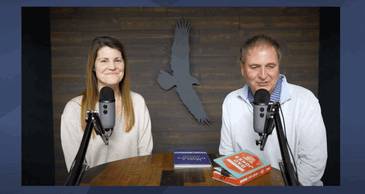
And if you want to hear this lesson from some people who may explain it better than I can, listen to our latest epsiode of the Relationshifts podcast and hear directly from the kids at Eagle Camp. I think you’ll enjoy what they have to say.
When we choose to shift from having the answer to asking the question, we will make a difference.
Larry
[00:00:08] Well, well, well, here we are. We are in it right in the middle of the Alabama heat in August. And Melissa, I'm Larry Little. Hey, I'm Melissa Hamburg-Jackson. And it sounds like you are just like feeling the sweat. Oh my goodness. Are you kidding me? Humidity, even as you speak? You know, we talked, we had this meeting yesterday with someone and she was over in London.
[00:00:32] And she popped on that Zoom screen and she had this sweatshirt on. I'm like, what in the world are we doing? And I had to call it out. I'm like, why are you wearing a sweatshirt in August? Because we're over here sweat dripping off. We're in the, not just the heat, the Alabama heat is this humid, wet... Yeah, we're up a notch. We're at that place where it's just extremely hot. Oh my goodness.
[00:00:58] You know, I went outside last night and it was probably eight o'clock. Yeah. And it is like I stepped into a heater. You know, it was just the humidity was so strong. Exactly. But... I was out last night doing a little work and around the yard. And I mean, I'm like sweat. It's just getting, it gets in your eyes. It comes, it's nice. It's good. It's a lot. It's a lot. Thank goodness for air conditioning. You know, and when we get to this place, it's always like bring on fall. Just bring it on. Bring it on. We're ready.
[00:01:28] But fall won't be here till probably like the end of October. So we've got a little more time. Global warming is a real thing in Alabama. That's what I'll say. Okay. Oh, all emails go to Melissa Jackson. You know, I think he wants to start off with a joke. I don't know. I felt it coming on, but I just needed to pause. Speaking of jokes... I get in trouble all the time, don't I? Let's just keep moving so you don't get in trouble. All right. Speaking of jokes today, or fun, not jokes necessarily. Speaking of, you know, that's,
[00:01:58] it's fun. We have had an Eagle Camp. Yes, we did. With some young leaders and it has been so much fun. It's been a lot of fun. This is our inaugural Eagle Camp and we had some, well, actually young ladies this time and a group of really sweet, special kids. We were able to invest in a bit and talk a little bit about leadership and man, it was a lot of fun.
[00:02:23] Yes. And I want to say I learned so much. These girls are so sharp. Yes, they are. We had a team of girls and you know, they are ready. They're ready to take on this next school year and it's going to be fun to see how things play out for them. You know, it's important. I think, you know, on a serious note that we, we talk about a lot of things academically. We talk about athletics. We, we talk about how, you know, we need to prepare
[00:02:49] our children, but one thing that really sometimes gets overlooked is, is how we, how we lead, how we, how we impact and influence others and, and what that looks like. And I think in today's world, Melissa, today's culture, I think we see from social media, from traditional media, we see such mixed signals around what leadership really is. What is it and what it's not. That's so true. And I think, you know, we all define leadership at times very differently.
[00:03:17] And so leadership looks different to different people. But, you know, as we begin, I think Robin put some details together here and I love her thoughts. She's such an incredible leader. And here is where we kind of want to kind of step into and begin talking about leadership because, you know, leadership with, with kids, if you think about, you know, they, they have their
[00:03:42] phones, they have their electronics and they have all this, this, this intense, these pieces of, of technology that can bring a lot of noise at times, you know? And so you can think of leadership as being kind of, you know, so, um, out there. So, you know, who has, who can have the loudest voice or, or who can, who can bring the, you know, the, the most knowledge to the table of what they have.
[00:04:10] But what if true leadership isn't about, you know, how, how you, you speak up or how you engage on the strong level. But what if leadership really is about how do you listen and how do you put your feet into other people's shoes? And that, that's exactly the direction that we, that we head when we do our, our Eagle camp with these girls. And it's about, it's about listening and then being open, being to learn.
[00:04:39] Um, and then, then it's about leading yourself and others in a different way. It's not about being the loudest. It's not about being the strongest. It's not about being the smartest. It's about learning these skills and they are skills, three things. How do we truly listen? How do we become a lifelong learner and how do we lead ourselves and lead others? It's not as easy as it sounds. You know, today we, as parents, you know, we work so hard to provide for our children
[00:05:09] and to make them comfortable and to, and to help them to, you know, I remember, um, one time Melissa, uh, my daughter, uh, this was years ago. She's grown very successful now. I'm so proud of her, um, up in New York and here in the South as well. She and her husband do a great job at all the things they're involved in. But at that time she was 14 years old and never will forget this. She's sitting at our dining at our, at our table at supper table.
[00:05:38] And we're all having dinner together. And she just kind of leans back and we're finishing up. She said, dad, summer was here. We're approaching summer as you know, school's getting out. She said, I've been thinking. And she, she said, I've been looking around. And she said, I don't, I don't see any reason, you know, I don't need to work. Why do I, you've been talking about, you know, getting a summer job. She said, I think I'll just stay here in this nice house. I think I'll just, you know, take off for the summer.
[00:06:06] I don't really want to work. I said, well, that's good. Um, tomorrow morning at eight o'clock we'll be having interviews. You'll be out. And she had a job the next day. It just hit me like a ton of bricks. What am I do? What are we doing here to, to say, we don't want you to be uncomfortable. We were trying so hard for our kids not to be uncomfortable, but you know what? Being uncomfortable is part of leadership. So we talked a little bit about that in our, in our camp time as well. It's okay to be uncomfortable.
[00:06:32] It's actually necessary. It's necessary so that we learn skills of how to deal with being uncomfortable, you know, how to create solutions, how to overcome that, what that looks like. So, so anything that we talk about today in my mind already, I'm thinking this applies to all of us. You know, our kids are going to teach us today. We're going to learn from them because we have a lot to learn as leaders and being uncomfortable. So let's give some stats. Well, it's important. Yeah. Because data always tells a story.
[00:07:02] It's not just Melissa and Larry saying that, you know, you ought to teach your kids about leadership. We've got data to. Yeah. Yeah. Let's remain teachable. And let's, let's hear from some of these stats. So this is a fun one just to kick us off. This is a really, really fun one because the national literacy trust states that 81% of children say they're good at listening and understanding another person's point of view. So let's kick it off with some confident stats. These are really confident. 81% of children.
[00:07:31] I believe my child was in that. 81%. So Robin, do you think your girls would say, Hey, we are, we are great. And she's like, yes, they think they are listening. They are great listening. I want to know what the moms would say if they were polled. Like what would that be? Well, I want to talk to the child that said, no, I'm not. I mean, I don't listen. That's right. I want to hear from them. That is so good.
[00:07:57] And, and, you know, as you think about social and emotional skills, listening, communication, teamwork, data says from an organization called CASEL, C-A-S-E-L. They did a survey research and said that children that had these skills of listening and learning and have an average of 11 percentile points higher academically on average. They score 11 points. That's it. That's huge in a percentile world.
[00:08:26] That's a powerful connection there. Very, very good. And here's another piece, you know, communication and collaboration. You know, this, you know, this through your work through, you know, being an adult, but those are the two most high ranked characteristics that are still valuable in the workplace. You know, it's, it's not technical skill. It's the communication, the ability to talk, the ability to listen, connect, the ability to collaborate, work as a team member.
[00:08:56] All those school projects that you did, you know, that these kids are doing to teach that skill. And there's some science behind this as well. You know, the frontal cortex of the brain we know is still developing well into the mid-20s. The brain is still working because think of the brain like a muscle and it's still growing. It's still developing. But, but data says when we work on these skills, it actually helps that frontal cortex to develop quicker, stronger, more effective.
[00:09:25] Think of it as you're working out that muscle with your children. And as that muscle, as you work on that, they actually gain the ability to think more rationally. In other words, they grow in those skills. Those skills can develop as we work on them, as we practice, as we fail and we learn. Yeah, there's so much interesting research out there about neural pathways and the ability to learn. And so active listening is a whole brain activity. Yep.
[00:09:50] So active listening, it involves engaging the brain's language, your ability to articulate, your ability to pay attention, retain attention, memory, your ability to make decisions. And so it's this whole total brain networking that's going on that is dealing with all this, the sensories and the receptors and, and all of that brain chemistry. It's holistic and it's important. So let's go back to our camp.
[00:10:16] I think we've, we've led our case, you know, the data says kids need to learn about leadership. They need to learn how to lead themselves. And that includes not just leading the traditional way we think of leadership, but it's about listening. It's about learning and it's about learning, leading them, leading themselves and leading others. So let's, let's drop into our Eagle camp. And on, on day one, we talked about how to, how to pay attention. We talked about how it's important not to interrupt.
[00:10:45] We had some activities we'll go into later. Day two, we focused on learning. We focused on how do we remain curious and what does that look like learning about ourselves and learning about others, learning to work together instead of judging, instead of making assumptions, instead of, of thinking we have, but to be a lifelong learner, regardless of our age. And then we learned on the last day about putting it all together to lead yourself and then lead others, even when you're uncomfortable. Don't wait till you're comfortable.
[00:11:14] And boy, they were uncomfortable on day three. That's going to be fun as we, as we kind of talk about that. So we have some audio clips. Is that right? Let's do it. Uh, this week I went to Eagle camp. It'd be like kind of learning, but I don't see a time of fun. If I were to explain what Eagle camp was to someone, um, me being a camel, it'd be a detailed summary. I would describe Eagle camp as fun, educational.
[00:11:44] And I would say it is very fun, like very fun. So we learned about, um, learn, lead and listen. Those were our three main words. My personality is, um, camel, though I have been lion and I have been some lion or turtle. It was either turtle or camel.
[00:12:09] And my mom being a camel, I kind of got some of the camel from her because one day I kind of noticed that. Cute. I was a parrot. I was a parrot. My personality type is a people loving parrot. My animal, I usually get like a kind of a kind response. The hardest personality for me to deal with is probably a camel. Cause that's like my exact opposite.
[00:12:33] If a lion and she usually does things her own way. She's kind of bossy. Probably a parrot cause they're like, I have a parrot sister and she likes to touch me. Me? I don't like being touched really. But for other people, if they're not a parrot, like if they're like a lion, turtle or camel, they would probably respond differently.
[00:13:04] The difference between a parrot and a camel is a parrot's very touchy feely, um, talkative, but a camel's kind of like wants to know everything, but it's very like kind of quiet and does not like to be touched. So these campers, they understand personality. How about that? Isn't that cool? I mean, these, these children are, are they, the first thing in camp was, you know, let's figure out who we are. And man, they, they got it.
[00:13:33] They do. And then they also know their mom. They know a little bit about their, their siblings to, you know, what, who they are, what their personality is forming to be. And so, you know, what they like and kind of, you know, what might be hard for them. Well, and, and it's so interesting. And we'll put a little context with this. Two of those that we heard were twins. They were, they were twin sisters who are by the way, opposites. And they know that. Yes. And they understand that.
[00:14:01] And so think about how that plays into their relationship and how, you know, they can have tolerance for each other or they understand each other's the next level or, you know, it helps them communicate better. So, and you said communicate better. I remember one day at camp, um, the, the, the, one of the twins and she's the camel was, she was trying to tell a story and she got, you know, kind of into the story.
[00:14:28] Then she, then she realized she stopped and she goes, okay, this, okay. Now my sister, she called her name. Now my sister is going to take over. She'll tell a better story. And so the parrot, the parrot, it was her twin sister jumped right in and, you know, animatedly told a story. So it's a great example of their learning at such a young age who they are, who others are, what those differences are like. Yeah.
[00:14:52] And, you know, we talked about how their personality is forming and, you know, their personality can change over the years and well into adulthood. But understanding these skills and these tools at such an early age, you know, I'd love to follow them to school and just, you know, kind of be a fly on the wall to see how does this impact the relationships that they have at school? What does it look like? But they know their stuff.
[00:15:17] Well, they're learning, um, you know, who they are, but also they're learning who others are and who are the most difficult types of personality. It's not that I don't like that person. It's that, oh, their, their personality may, may communicate a bit differently than mine. Yeah. And how do I understand them? How do I understand that better? Yeah. So that, you know, they're part of my team and me being able to, to lean into what they're good at and understand them at a deeper level.
[00:15:43] And then we had, uh, you know, so we were listening there. You heard, you heard the camel, you heard the parrot and then, and then you heard the, what was it? Um, a turtle, I think. Um, yeah, I'm thinking it's a turtle. So it was just, uh, it was amazing to me to hear the takeaways that they, that they had from that, that segment of camp. Okay. So we're on our second point of learn. So let's jump back in and let's hear from them about what is a leader.
[00:16:08] All right, let's do it. What it takes to be a leader is trust, being able to trust others. And you just, you can't be self-oriented. You gotta, you gotta also, um, focus on others needs. Like the right thing to do. Mm-hmm. How to learn from others, how to learn from yourself. They should like be courageous and have a willingness to be uncomfortable. Mm-hmm.
[00:16:35] If you're a leader, it's fine if you're just like a little uncomfortable because you might need to be uncomfortable to help other people. Mm-hmm. That's great. Anyone could be a leader. It's just a matter of whether or not you have a willingness to be a good leader. Mm-hmm. Mm-hmm. Like being good.
[00:16:54] What it looks like to be a leader at home is doing things without people asking you to do things, having integrity, maybe cleaning your room, making your bed, taking out the trash, cleaning the dishes, or, or hey, maybe even cleaning your parents' room. Hey! Can you have a leader who is kind of making sure my sister doesn't do anything wrong?
[00:17:20] Umm, if you were to be a leader at home, it would look like taking responsibility for things, um, doing things without, um, without expecting anything in return. There's a word for that, but I can't remember it. and like being super good at home. To be a leader is also good to be selfless.
[00:17:47] So like you're not always thinking about yourself. You're also thinking about the good and well-being of other people. Anybody can be a leader no matter if they're big or small, young or old, anybody. As long as you try. Love it. I love it. Anybody can be a leader as long as you try, Melissa. I love that feedback. I do too.
[00:18:13] Was that rewarding to you to kind of hear them talk about some things that you had taught them at Eagle Camp around leadership? Hey, our team taught them and they taught us. And I love this ongoing thought of them taking responsibility and not being about themselves. I mean, I just heard that over and over again. I did too. It was very rewarding to know that what we were talking about at Camp Stuck. They could kind of say some of that back.
[00:18:40] Of course, my favorite clip there was, you know, what does it mean to be a leader? It's like making sure my sister does the right thing. I love that. Keeping them on track. Keeping them on track. But I love the ending there. It's just about trying. Yeah. And, you know, are you willing? Yeah. You heard words like trust. You heard words like, you know, giving to others without wanting anything in return. Being selfless.
[00:19:03] Those are incredible values and concepts, competencies of what now they're beginning to understand what true leadership is. Right. And what it's not. Yeah. So let's head into our last point here where we're talking about leading and what is something that they've learned about being a leader? What is something that they can keep on practicing? What is their biggest takeaway? Let's listen to this. Something I think everybody needs to learn as a leader is how to listen.
[00:19:32] Because if you're a leader and you don't listen, that could be a bad leader, you would say. Maybe not. Maybe not interrupting as much because that seems to happen a lot at my school. If you're always talking and you don't like listen to anyone, then that'll make people feel unheard. And people don't like to feel unheard because that's just how people are.
[00:20:01] Yeah, like the animals, like how lions are more forward and taking risks. And while turtles are more shy and take a bit longer for them to do something. But then camels are more attention to take their, put almost all their attention to details. And things that would have worked better.
[00:20:24] Something that I learned that I feel like I can keep practicing is probably listening, I guess. Because sometimes I zone out while other people are talking to me. And then they get like annoyed or offended. So I think I could work a bit more on listening. Because it's helpful to other people.
[00:20:54] Because if we don't listen, something could happen, something could happen and get someone hurt. Or if you don't listen, you won't get something right that you had to get right. One thing that surprised me about my personality was that I'm a whole lot more camel than I thought I was. Maybe practice trying not to get annoyed with my sister. Because she copies me. And I can kind of understand now.
[00:21:23] Because like all she does is kind of do what makes her a part of something. Something I like to tell the leaders of the camp is just thank you for putting on Ego Camp. It was super fun. You did great on making it fun. And as fun as it could be. But also still with an element of learning.
[00:21:48] I would definitely want to tell them thank you for all the time and planning it took. And I do have the opportunity to actually go and do that. They did a really good job with the snack. The popcorn was amazing. And then the movements we did and the challenges, those were fun.
[00:22:15] The biggest takeaway that I took from camp is to be a leader. It doesn't matter how old you are. It just matters how good you are at it. You need trust. And you need to be able to listen. And you also need to be able to take risks to be a leader. Wow, Melissa, listen to that. We need to hire these kids. They're ready. Yes, they are.
[00:22:44] So many things we could unpack from their sweet little hearts and minds. Goodness gracious. It was so rewarding to hear that and to think, you know, the investment we made, they actually remember it. Maybe it's going to pay off and help them as they walk through this next year in school. And who knows beyond that? Well, I love that. They realize that no matter their age, no matter anyone's age, that you can lead.
[00:23:11] You can invest in people and be mindful of others and create that environment to take a risk and to listen to others. They said that, take a risk. And, you know, we did create some challenges for them to help them to experience what it was like, to struggle just a little bit and work through that and overcome obstacles in different ways by having to listen and that kind of thing. They understood the correlation between that and what we were trying to teach them. I love that. I love that they drew those. Of course, you know, then again, there were the snacks.
[00:23:41] You know, sometimes that's just always the best thing. I mean, we had some snacks. It's just the food. It's just the food. Some things never change. Some things never change. I love that. I really appreciate our team. They just did an outstanding job of putting this together and putting the time and energy and effort into it. So thank you to all who made that happen. And thanks to our campers. What a great group of first year eaglets. So what can we take away from these kids? What can we learn?
[00:24:10] Let's make a shift here. Let's think about a shift that could take a little bit of attention and could maybe help us and how we lead each other. So here is the shift. Shift from having the answer to asking the question. Shift from having the answers to asking questions. I know that you have a question for me that you would like to ask as we wrap this thing up.
[00:24:38] And I know that it's something that you've been wanting and waiting patiently for. And you go ahead. You can just ask me and I want to hear what you're thinking, Melissa. What would you like to ask me to do at this segment of the podcast? Well, I must draw back to the why of this. And it is a sincere question. Can it cover information that confidence alone will miss?
[00:25:08] Take it away, Larry. Oh, that's great. All right. In confidence and through, I know that internally you're thinking and asking and wanting the dad joke. Do you see that in me? I do. I'm listening to you, Melissa. I'm learning from you. I didn't say anything. Let's hear it. Let's hear it. Well, look, we had an awesome time with our little campers. Yes. And they were amazing, amazing children.
[00:25:37] We also have some other children that we think they're children. Yours is called Maymay and mine's called Honeybear. Oh, puppy dogs. And we have these little puppy dogs, these little golden doodles, little miniature and micro. And they get golden doodles and I'll be doggone if they don't just become part of the family. Oh. You know? Yeah. They're just part of the family. Yeah, they're practically people. They think they are. That's what someone says.
[00:26:04] I would just like to say that I'm about to step into deep water here, but if I could get treated like Honeybear does in our home, I would be like the man. I mean, I would have, you know, whenever I come in the door, Honeybear immediately runs to her bed, rolls over and waits for her expected tummy rub. And she gets it every time. So we love her. That's why today I'm going to end with a dog joke.
[00:26:34] Okay. Let's hear it. Are you ready? Let's hear it. All right. Here we go. What do you call a dog that can do magic? What do you call a dog that can do magic? I have no idea. A labracadabra door. Ah, that's cute. That is so cute. There you go. Well, all right. So I guess when you come home today, you're expecting to be scratched behind the ear. Look, I can just assure you my wife will say, yeah, she's waiting to do that.
[00:27:04] She may be waiting for me to do something, but it won't be that. That's for sure. Hey, guys, thank you so much for being with us. I hope it's been a little fun pod for you today. We take a just kind of a little stroll down our Eagle Camp, and that was a lot of fun. Melissa, thank you for all you did to make that happen. We're going to look forward to our next time that we're together, and thank you for being a part of relationships where those little shifts can make a big difference. Take care.
[00:27:34] Little shifts that make a big difference. Real ocean shifts. Little shifts that make a big difference. Thank you for tuning in to the Relationships Podcast with Dr. Larry Little and Melissa Jackson. We hope today's conversation inspired you to make meaningful shifts in your personal and professional relationships. We want to hear from you. If you have a question for the author, Dr. Larry Little, about personalities or relationships,
[00:28:04] send in your questions to the link in the show notes. Stay connected with us online at EagleCenterForLeadership.com and follow us at Eagle Center for Leadership on Facebook, Instagram, and LinkedIn for more insights, resources, and updates. Don't forget to subscribe to the Relationships Podcast so you never miss an episode. And if you found value in today's discussion, we'd love for you to leave us a review. You can also watch episodes on YouTube through the Eagle Center for Leadership channel.
[00:28:32] Until next time, keep choosing to make the little shifts that make a big difference.