
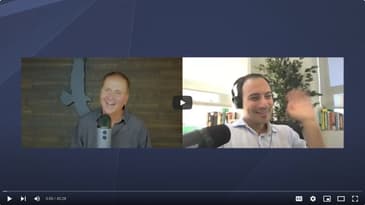
There seems to be an inverse correlation between humility and success. In other words, the more notoriety and success someone gains, the less humble and approachable they become. This is not true with Mosheh Oinounou. Mosheh has found great success in the news reporting world. He is an Emmy, Murrow and Webby Award-winning Executive Producer and has led teams at Fox News, Bloomberg TV, CNBC ad CBS News. He was the youngest ever executive producer of the CBS evening news. Recently Mosheh has founded a ground breaking news podcast that reaches millions of listeners.
Mosheh is different than most. Through his journey he has learned valuable lessons on life, relationships and priorities. I had the opportunity to interview Mosheh recently on our CTL podcast. He shared his journey with humility and authenticity. I came away from the interview truly impressed with this leader who chose to be vulnerable and has a desire to speak truth into the lives of others.
Take a minute and listen to the part 1 of this intriguing conversation with one of leading news reporters in the country. Mosheh’s style is refreshing and enjoyable. Choose to walk with humility and authenticity and you will make a difference.
[00:00:09] Hey everybody, this is Larry Little and you're listening to Crossing the Line, a podcast where we talk with leaders about the moments in their lives where they cross that line from leading with their head to leading with their hearts and then from leading with their hearts
[00:00:22] to leading with their heads. Today we have a great example of crossing the line with an incredible leader whose name is Moshe Oinounou. Now that name might not sound familiar to you but I'll tell you this, you have seen his work.
[00:00:35] Moshe has worked behind the scenes in the news industry for years. He worked at Fox News, you've seen his work there. He's worked on Bloomberg TV. He worked on CBS and developed and ran the CBS News Streaming News Channel and ran the Washington
[00:00:51] coverage for CBS show called This Morning. He has been a political reporter just an incredible experience. Then in 2020 or so he launched and for the first time he came out from behind the camera to in front of the camera and he launched Mo News.
[00:01:12] It's a podcast, it's a news stream, it's a website and it's an amazing journey is what it is. Now I could tell you about Moshe, all the awards, I just couldn't name them all. He's just so brilliant.
[00:01:25] He's won all these awards but what he's learned through his journey is what's really rewarding and that's what I want you to hear through this podcast. He is a master storyteller, you're going to enjoy hearing his journey but he really comes
[00:01:38] at the end of the day to tell you what is important in his life and what he's learned through his incredible journey of being able to talk to and be around presidents and celebrities and world leaders and all those things but truly finding purpose later in his career.
[00:01:57] I'm excited about this podcast. You're going to enjoy it. I'm excited about this podcast and I'm going to be talking about this podcast, I'm going to be talking about the most important thing in the world for you. So, I'll be quiet so you can.
[00:02:21] Let's jump into the interview with Moshe Wanunu right now. Well, now I can't believe I'm doing this but I am talking to the Moshe Wanunu. I can't believe it. He's here. He is in person on screen. He's a great job.
[00:02:38] You're built an amazing company but more importantly and we have a personal connection and you know, so I know a little bit about you and how you lead and how you lead your team and I'm just impressed with you.
[00:02:49] So, I'm excited today that we get to hang out a little bit and we get to talk about Moshe and we get to learn about how you got to where you are today. Well, I appreciate that.
[00:02:59] It's a welcome break from the 24-7 news cycle as we get to dive into some other things. See what the latest is right now, Larry. I'm taking a break from the news for once, at least the next hour. I love it. Break time. I love that.
[00:03:13] And those on the podcast they'll hear and have heard in the introduction and then they'll hear more at the end and man, I hope everybody listening will jump on to your news program because it is incredible. But let's talk about you for a minute.
[00:03:28] So Moshe, let's go back and I want to know about who you were as a child and where did you grow up and what was the day in the life of Moshe like when he was six, seven, eight years old?
[00:03:42] Well, first things first, with a name like Moshe Wanunu, the first question you ask as a child is like, what's our story? Because starting in kindergarten, the teacher is calling the role and there's always that pause after they're like Miller, Nelson.
[00:03:59] And then there's the pause because my last name Wanunu begins with an O and so my father's originally from Marrakesh, Morocco. He's born and raised in Morocco, would eventually as a teenager, his family would move to Israel.
[00:04:14] He was a commando there in the military and then eventually comes to the US to work a bit meets my mom. And they end up sticking around and having a couple of sons. I'm their eldest. And so I grew up, my mother is American, my father's an immigrant.
[00:04:31] So first generation, at least on one side. And from a very young age, my dad was initially in construction. Then he was a cabinet maker, had a cabinet shop. And so I grew up, you know, a lot basically every school break,
[00:04:46] every school vacation odd days here and there. I was in my dad's cabinet shop. And so starting from a very young age, you know, my mother worked with my father. She did the bookkeeping for the, for the business.
[00:05:00] My father, you know, ran the cabinet shop, had some folks with him. And, you know, Bill, you know, a lot of home stuff, home renovations, kitchens, you know, libraries, that sort of thing. And so that was always a key part of my upbringing was it was the family
[00:05:18] business, family, everybody. So, so, Moes, would you say that you're a carpenter? I mean, do you have those skills? Did you get those skills from your dad? I've just got to ask. On a scale, if we're grading on a scale, Larry, yes.
[00:05:32] If we're comparing me to my father, absolutely not. You would tell you the same. In fact, still, you know, I'm 41 years old now and he's like, listen, I think I need to come over to New York and reteach you a few things.
[00:05:45] I heard, I heard from your brother that you still don't know how to do a couple of these things and we need to retrain you. So on a scale of most, you know, people in America, yes,
[00:05:56] I could do much more in the house than the average, than the average guy. But compared to my father and my father was very, very skilled. And you started, how were you when you started working with him in the shop?
[00:06:08] I'm just, you know, when I could walk, you know, and, you know, he'd give us tasks as a young age like sanding and sweeping the shop and, you know, various things. But that's, you know, going on with him to deliveries, to installations.
[00:06:26] And so that was a key part of my upbringing. At the same time, I was always, and this is from my parents too, fascinated by, I became one of the first books I loved as like a four-year-old was the World Atlas.
[00:06:43] And I'd go through it and start just testing myself, memorizing world capitals and then drawing flags. And already, you know, you mentioned age six. I'm, I want to be a weatherman. Like I want to be a TV meteorologist. I've decided that in kindergarten.
[00:06:58] There was a show, I grew up in suburban Chicago and Chicago is the home of WGN. And I think WGN for the most part now is pretty national. And there was a show in the mornings called the Bozo Show. If some people might remember that. I do remember.
[00:07:15] And ultimately, I was probably the only six-year-old more interested in getting a tour of the weather set in the new studio at age six than the Bozo Show. My father ends up getting a connection to one of the anchors at WGN
[00:07:29] and ends up getting us an invite to go watch the nine o'clock news. And I am in kindergarten, going into first grade, the weatherman at the time, it actually hit me really hard. His name was Jim Ramsey. He died last year.
[00:07:43] And I found out he passed away and like I was in tears at 40 years old. And I met the man once when I was seven years old. But he had such an impact. He took time with me. He printed out the weather maps.
[00:07:56] He showed me this is the high pressure system. This is the low pressure system. You know, he was quizzing me on geographical knowledge that I may have picked up because he found out that this kid is obsessed with geography.
[00:08:05] And I then like brought the weather maps into my first grade teach my classroom and she's like, this is great. I've never had a kid do this before. And so it, you know, he took time and it just it reinforced my interest in it.
[00:08:20] And so I'm one of those kids that suddenly at, you know, an elementary school, I knew what I wanted to be and I was going to pursue it. So back back up at seven years old, he made an impact and he invested in you.
[00:08:33] Yeah. He, you know, answered questions, showed you gave him. And at 40, it's still it's still with you. It hit me hard. It hit me hard. I like it because, you know, it's, you know this, like it's so rare to have people.
[00:08:51] I mean, you remember and it might be on one hand. Maybe if you're lucky two hands, the people who make an impact on your life, the mentors in your life, and they could be somebody who's your boss for years.
[00:09:02] They could be a teacher or in this case, it could be somebody who I spent a couple of hours with in 1989. But it was it was impactful. And, you know, at the same time, I'll say this, like,
[00:09:18] you know, my my mother's mom and father, my grandparents on that side, you know, would when I go to visit, like they embraced my fascination with maps. There's a store. There's a Rand McNally store in Chicago. My grandmother took me to.
[00:09:36] And so I just became obsessed with all that stuff to the point that my father likes to tell the story about how we lived in an apartment above a basket of Robbins in outside Chicago. And, you know, he'd give us a couple quarters at the time
[00:09:51] to go buy an ice cream cone downstairs and I would come back with a copy of the Chicago Tribune instead of an ice cream cone. Well, who is this kid? Amazing. So you had a love for that kind of thing from,
[00:10:03] I guess, as early as you can remember. Yeah, you know, it's one of those things where just my parents weren't imposing it on me by any stretch of the imagination. I discovered it and I locked in. Well, did you ever I'm going to just ask a random question
[00:10:18] and we'll get back to your timeline. But did you have you ever been able to be the weatherman? Have you ever been able to give the weather in front of a green screen or whatever? Not in the traditional sense, but I will say that, you know,
[00:10:30] in a various roles in news, you know, in my role at CBS Evening News, I ran the CBS Evening News, the national broadcast. So, you know, we're putting out the news to 350 million Americans, six or seven million are watching every night.
[00:10:44] You know, this is the show that Walter Cronkite once anchored, the Dan Rather once anchored. And so in that role, I am sort of the executive producer weatherman, because I'm like, all right, we're sending the whole team down to cover the hurricane on the shore.
[00:10:56] We're devoting the half an hour to that, you know, working with the meteorologists. And so in a traditional sense, me doing it in front of a green screen. No, but me working with, you know, some of the best weather people in the business, covering various natural disasters.
[00:11:12] I've been able, I've been very lucky to be able to fulfill the dream that the six year old in me once imagined. You got to lead behind the scenes. You got to be the guy behind the scenes. That's amazing. And let me tell you so much.
[00:11:27] I mean, people don't even know the number of people, the individuals, the risk taking, the planning that's involved. When you turn on the TV set and you see one of those reporters with the wind blowing against them, holding the microphone, trying to hold their hat down.
[00:11:40] They're like, let me tell you what's happening out here. The number of people that go into that and the amount of planning that's required, you know, I would sit there with a meteorology team being like, we're going to do the whole show.
[00:11:52] Where are we going to be able to get a satellite signal? What is the category three or category four? What buildings in that area can we be in that we think will hold up in the storm
[00:12:03] and not be too close to the eye, but not be so far away that you don't actually see anything? I mean, the dance that's required there to be able to tell the story of, you know, I'm bringing up Hurricanes is one example. Right. Is pretty remarkable.
[00:12:18] And, you know, we'd literally sit there with Google Maps and then be like, OK, then we go to building plans or like, OK, it appears that that Marriott was built in the mid 90s. We think that that construction will hold up. You know, it's a job.
[00:12:31] Yeah, you never think about that. You know, you just see the see the person in front of the camera. And that's a. And by the way, you pick something a couple blocks away. The roof is going to collapse on them.
[00:12:40] And then, by the way, that puts your people in danger. And number two, you're not going to get on TV that day. That's right. That's right. Wow. OK. Back to back to most eight year old. Who are you? Let's move up just a bit.
[00:12:53] You're working in your in your dad and mom's working in the shop. You love in the behind the scenes, weather things and the news things already, you're passionate about that. But who were you as we go up to junior high now?
[00:13:05] You're a young teenage preteen, young teenager, 12, 13, something like that. Who's most at that stage of his life? Mosh is continued to be very interested in news. This conversation of my mom told me about apparently and we'll take you back to fourth grade where I came home from school
[00:13:24] and was very disappointed in my classmates for not being interested in the news at nine years old. What what fourth graders not interested? She's like, she's like, don't worry, you'll find your people, you're, you know, ahead of your time by junior high, very into national politics, international headlines.
[00:13:45] I remember as early as fifth grade, it was the Clinton election in 92. I remember staying up super late. I didn't have a TV in my room. I had a radio listening to the Bill Clinton and Al Gore address the country when they won the election in November 92.
[00:14:04] So what would I have been 10 years old? And so, you know, just very into current events, very into, you know, some form of being a journalist. I tried. I wanted to start a newspaper in my middle school. They didn't have a newspaper available to me.
[00:14:23] I tried to make any class project like something news related. So I did get into political debate. I remember doing debates in junior high. And so I just remember being very engaged in that stuff and obsessively watching the news when I came home from school, especially watching everything.
[00:14:40] I was watching a lot of television. The Internet's still not a thing, Larry, right? When I'm in junior high. So spent a lot of time, you know, I remember in the library looking at encyclopedias and and from a very young age, my only interest was nonfiction books.
[00:14:57] I was always annoyed if any any class even, you know, in middle school or junior high would require me to read fiction. I'm like, oh, this is a waste of time because it hasn't happened. It's not real. It has no relevance.
[00:15:12] All right. So so I'm going to go ahead and say this and you can correct me. But it sounds to me like most is kind of headed down the track of being a bit geekish in terms of staying in the library and studying. Yes, yes or no? Yes.
[00:15:25] Yes. Yes. I mean, I aspire, you know, like, listen, I never really competed in many school sports. I also, you know, I didn't really go to a weight camp, summer camp and engage in those activities. I was in the cabinet shop.
[00:15:39] So it was, you know, I'm in the cabinet shop working, working for the family business. You know, I had an interest in sports. So I remember listening to, you know, Cubs games on the radio as we awaited about 100 years for them to win that World Series in 2016.
[00:15:58] Little did I know that it was 20 years away. But we did have the Chicago Bulls at that time growing up in the 90 Chicago. You didn't have Michael Jordan, which is very exciting. So it was very interested in sports, very interested in news, interested in the world.
[00:16:10] But yeah, definitely on the on the spectrum of jock to geek, definitely much closer to geek there, Larry. So there you are. And now you're headed into, you know, you're loving what you do. You're loving your sports, loving news, loving, you know, the world politics
[00:16:25] and the scene. But now you're in high school. How does it, how does that look? What do you look like and who are you in high school? So I would say that a couple of the most impactful teachers to me
[00:16:41] in my entire education were a couple of the teachers I had in high school. There's a couple of teachers who taught AP government and AP comparative government. Dan Larson, Andrew Kanine. And I remember their names because I've been in touch with them ever since
[00:16:57] and they did like a national show to prep kids for AP. Fat, like really smart teachers who didn't try to bring anything down. They treated you like adults. And that's where I mean, I still remember they were talking about this guy
[00:17:13] who was rising up in Russia named Vladimir Putin in the late 90s. And I remember learning about him in high school. I'm in high school from 96 to 2000. And just very much just invested in that stuff. Incidentally, I was always sort of inspired to by what was happening
[00:17:28] in pop culture and fell in love with a TV show named West Wing. West Wing was on air at that time. And so I'm watching that show and I'm like, I got to go to Washington. I got to be involved in this stuff.
[00:17:38] Maybe I want to get into politics. Maybe journalism isn't for me, but it's something in that in that space. There was a club called Mollie United Nations. And I think it's pretty widespread. A lot of hundreds of thousands of high schools probably have it across the country.
[00:17:52] So Mollie United Nations allows kids to play the role of a country in the U.N. and they have conferences. And so like we had a Mollie UN team and we'd go to a conference at the University of Chicago or Harvard or USC.
[00:18:06] And I play the role of Russia on the Security Council, or I'm given. I think my first one was Somalia. I'm I'm the ambassador of Somalia and we have to deal with the resolution to the Civil War in Somalia or whatever.
[00:18:19] And so, you know, this is this is something I like to do with my time in high school was be on the Mollie UN team and prepare opening statements and resolutions playing the role of various countries around the world.
[00:18:34] Wow. And so that ultimately, you know, probably was my one of my favorite activities in high school. I was also the editor of the High School newspaper. So I had had a teacher there, Carol Joe DeGro, who taught me the basics of reporting.
[00:18:48] And I remember being frustrated that I had to just cover things inside the school and I remember, you know, going out and being like, there's this thing happening down the road. And I think it's an interesting story that students should care about.
[00:18:57] So I was already trying to bring kind of metro coverage, city coverage into the into the high school newspaper. And, you know, I in so in high school, I mean, listen, I I remember trying to try and soccer team my freshman year.
[00:19:11] I rode the bench the entire time. Larry, I think they let me in for the last game of the season for a couple minutes. But so, you know, like dabbling in what I thought I could also do,
[00:19:22] but ultimately realizing my strength slide in the in the Mollie UN stuff, that the government stuff, the journalism stuff. You're still ahead of your time. I mean, in those areas and serving as editor of your high school newspaper,
[00:19:34] wanting to look out instead of just in, I mean, all of those show signs. If you continuing to pursue your passion, so you're still doing it, you're still pursuing that passion. One question about about that from the high school year era.
[00:19:47] What was one of the if you had to think back through a struggle? What was one of the things you struggled with in those days, you think? I mean, to be honest with you, the academics I had fine, the student activities I had fine.
[00:19:59] I think socially is where I struggled. I mean, I listen, I had several close friends, but I think where I struggled is probably struggled many kids have in high school, which is, you know, the various clicks that existed and not being in the coolest click,
[00:20:15] right? Not being invited to the parties. And that is where actually I think about kids today with social media because I'm pre-social media. I'm frankly the internet circle late 90s. If people recall like you had to literally, you know, hey, mom, no phone calls for the next hour.
[00:20:31] I'm getting on the internet, right? You got to switch over to the internet line on AOL. And so, you know, I knew that there were all these social activities. Kids are talking about it on Monday,
[00:20:43] but I didn't have to watch it live on social media like kids have to do today. But, you know, still it was a struggle, right? It's still a struggle to like be interested in certain things, but not be completely able to find your niche or find enough people
[00:20:57] interested in that stuff. In the high school setting where, frankly, the metrics for who's cool, what's cool didn't necessarily align with who I was at that point in my life. Yeah, can be a very cruel, difficult time. And I think you're very wise to articulate that.
[00:21:13] You know, in today's society, social media has been, you know, it's incredibly wonderful, but it's incredibly devastating to to teenagers who were still forming, you know, cognitively and emotionally. And, man, the exposure, the vulnerability that they now have to have to endure. I don't know most yet.
[00:21:35] It was hard. I know when you were in any of it. It's always been hard. It's always been hard, right? But at least 25 years ago, I'd be like, well, that part of it, that party probably terrible. Right. Whatever they're doing probably sucks.
[00:21:49] I'm much happier renting a movie from Blockbuster on my Saturday night. Now, unfortunately, the kids on Snapchat or TikTok or whatever, we're like, oh, that's what they're doing. Yeah. In the moment you're seeing what's going on. Well, that that, you know, those are hard times.
[00:22:05] You continue to pursue your passion now. You've graduated talk talk us through your college. Kind of who were you in the college days? So I mentioned my interest. I mentioned West Wing and so ultimately Washington felt like the place I needed to be.
[00:22:21] So I ended up going to college at George Washington University. And so you have a bunch of colleges in DC. GW happens to actually be located five blocks from the White House and three blocks from the State Department, very much in the center.
[00:22:36] And that's what GW will sell you on is like where the center of the action. While Georgetown has more of the prestige GW, we're the doers. You know, our kids, you know, you're going to have three internships by the time you're a sophomore. Right.
[00:22:50] And so I get to campus and like, oh my God, I'm in the center of the action. And I there's a whole bunch of students here that are interested in the same things I am, they're also watching West Wing. They're also interested in journalism.
[00:23:04] They also want to go intern on Capitol Hill. This is the place for me. And it was a whole discussion with my family about where I was going to go to college because certainly that's a private university in DC.
[00:23:15] I'd take out a bunch of loans, do work study, write some scholarship essays to figure out how to be able to afford that. Because otherwise, you know, I could have gone to a state school in the Midwest, which would have been much more affordable, but
[00:23:28] literally University of Illinois in the middle of the farm fields. Right. And so I go to Washington, immediately fall in love with the place. I'm my first dormitory actually is across the street from the Watergate building like literally looking at where the break in was at the Watergate.
[00:23:46] It was a it was a former Howard Johnson hotel that the university had bought as a dorm and so I'm there. I am, you know, already involved in the campus newspaper. But in the campus newspaper, when you're three bucks from the State Department, you're covering national issues.
[00:24:02] You know, you're able to get a press pass to go to the White House. You're like, oh my God, this is remarkable. So immediately I'm in love. I'm debating, you know, am I going into politics? My first internship is the beginning of my sophomore year.
[00:24:16] I am 19 years old. It is a Tuesday in September, September 11th, 2001. I'm the first day of my internship for Senator Dick Durbin, who by the way, still a senator from Illinois. I get there bright and early. I'm working under a communications director named Robert Gibbs.
[00:24:33] Robert Gibbs would go on to be Obama's White House press secretary. And I get there. I'm in a suit and tie. I'm there bright and early watching TV, watching suddenly the events unfold. My father reminded me as we record this a couple days since the anniversary of 9-11.
[00:24:49] Right. And he always likes to remind me. He's like, remember when you called me on 9-11 and you're like, somebody accidentally flew into a building and I told you, no, no, no. That was on purpose. He always likes to remind me. He's like, remember how new you were?
[00:25:02] I was like, I know, I know, I know. So it's watching. And then suddenly, you know, you see the headlines of the plane going to the Pentagon and I'm like, where on Capitol Hill here? Suddenly sirens are going off in the building and they're like,
[00:25:15] they're going to evacuate all of the initially they're going to evacuate the US Capitol and then they said, we got to evacuate all the office buildings here. At that time, more planes were in the air. We didn't know what would come of the plane in Pennsylvania.
[00:25:26] And so we evacuate in my first day of my internship is 9-11. Wow. And I I remarkably I think back at it. I'm like, I can't believe I did this. I then get on the subway on the metro in DC to go back to campus
[00:25:42] of all days to take public transportation. I didn't want I was like, I'm going to take the subway back to campus now in retrospect, there's a dumbest thing I've ever done in my life. But you know, you didn't know any better. Like we were still kind of.
[00:25:54] Processing what was happening. Get back to campus. My mom still has a print out of the AOL instant message chat that I sent her because the phone lines were down, the landlines were down, the cell phones
[00:26:03] were down and so I send her a chat saying, I'm back on in my dorm. I'm OK. And then the first call that comes through Larry is like late morning. I'm watching CNN in the dorm with my roommate is the campus newspaper being like, where are you?
[00:26:17] You know, this is a big news story. Come to the newspaper office like we're reporting on this. I was like, oh, you're a reporter. You got to go reporter. Where are the instincts that would never happen to me ever again? But it does happen 9-11.
[00:26:30] But that's the point of being a student, right? So get get to the campus newspaper still have like my first story that I put out at one o'clock where we walk to how far we can go to the
[00:26:41] White House. I run in, believe it or not, Helen Thomas Helen Thomas, for those who don't know, was a reporter, a White House reporter for almost 50 years for a wire agency that existed for many years called UPI.
[00:26:55] She used to sit in the front row of the White House press briefing and ask questions. I run into her on 9-11. I have a quote from her in my first story on 9-11 for the campus newspaper
[00:27:06] saying, I think something like she says something like this is this feels like Pearl Harbor. She would know she was alive for that. So anyway, I'm covering 9-11 and it's a very bizarre thing to say and journalists will understand. I don't want to be anywhere else.
[00:27:24] Like I am in the center of it. I have a front row seat to history here. And that was it. You were locked in. You had you had, I won't say stumbled, but you found yourself into one
[00:27:36] of the greatest and most impactful news stories in the history of our country. And you were at Episenter County. You were right there. Yeah. And remarkably, I finished my internship that fall on Capitol Hill. There are the anthraxon envelopes that fall. Oh, yeah.
[00:27:53] The sniper shooting was that we were going through rumors every weekend on campus saying, we think there's gonna be another attack this weekend. So all the kids would go home for the weekend. I mean, Larry, to think back to that time period.
[00:28:06] And again, no social media at that time. You know, like text messaging was still not a thing yet till 0203 really. And that's still when you're paying 15 cents, 20 cents a text message if you recall those days and it just wild to think about.
[00:28:20] But I remember being frustrated on Capitol Hill with what I saw happening with politics, how divisive things were happening. I remember there the debates over creating the Department of Homeland Security, etc. And I was like, listen, I think I'd rather be
[00:28:33] a referee, I'd rather be a journalist than be one, be on one of the teams. Hmm. You know, you were you were seeing that back then and probably had no idea how bad it could get and you know where we are today.
[00:28:46] No, because I don't know if we're ready to go to 2008, but I was the Fox News reporter covering the John McCain campaign. What I thought was the craziest, most divisive campaign I had seen Sarah Palin, Barack Obama, etc. The stock market collapsed in September of of 08.
[00:29:03] And we called it like, oh, my God, things are getting so divisive and the Tea Party is rising up, etc. We had no idea. No, I did. The glory days, like how how nice things could be. I mean, by the way, we're talking about 9-11 here,
[00:29:17] the fact that Republicans and Democrats could stand next to each other and resolve things. Can you imagine? Can you imagine today a terror stack happening? How many minutes would it take before the finger pointing would begin being like, who didn't get bin Laden? Who didn't? Whatever.
[00:29:31] Oh, you know, like today, George W. Bush would be accusing Bill Clinton of like, well, you let it happen. I've only been president for nine months. You guys let him do it. Like just imagine our today's politics in a situation like that.
[00:29:44] Yeah, I hate to even think about it. I hate to say this, but you are 100 percent right. All right, but back up a minute. So so you are, you know, one to ten your college days were of what for you? Fifteen. Yeah, 15. You are loving it.
[00:29:58] And so you get through that, graduate. What happens next? So I end up on the editor of the college paper. I end up getting a fellowship to do a free master's degree at GW. They give it to five students every year. Well, congratulations.
[00:30:14] The president of the university hands it to a handful of people. You have a role in the university. I wasn't really thinking about a secondary degree, but applied for this program like why not? Right, you know, we've got a master's.
[00:30:24] Great. So I ended up getting a master's in international relations. But I'm so eager to already get into the business. So I end up starting. I do an internship at Fox News. I end up getting a basically three day a week job working for Chris Wallace at Fox
[00:30:40] News Sunday. So actually, I think it was four days. Thursday, Friday, Saturday, Sunday, I was working for Chris Wallace at Fox News. And it is his researcher on the Sunday show. And this is still the time period when like the internet still isn't quite where you make news.
[00:30:56] There's still no social media. And so politicians 20 years ago, if they wanted to make a big piece of news, they made it on a Sunday show and meet the press this week on Fox News Sunday. And Chris Wallace, son of Mike Wallace,
[00:31:12] is still around now over at CNN after doing almost 20 years at Fox. He was so he was a remarkable boss to have as a first boss because he's so detail oriented and he also genuinely believes in being a nonpartisan arbiter of the truth. And I'm his researcher.
[00:31:32] So whether at the time we have Mitch McConnell on or Condoleezza Rice on or Dick Cheney on or Howard Dean or John Kerry, whoever it was. OK, what does the other side say about this? What are they saying about this? What's the truth?
[00:31:45] Is there any hypocrisy in their past when they're now claiming this? When the other side did that, what were they saying about it? And it really made me an incredible researcher, you know, and still we're digging
[00:31:57] around and I'm calling like I remember calling libraries in the Midwest to try to fax me documents because there's still not enough stuff available online. And there he's my boss. Meanwhile, I'm getting my master's in international relations.
[00:32:10] And I'm like dabbling with the idea of going into the government at working for the State Department or Pentagon. You know, I think especially for all of us who went through 9-11, especially in Washington, you know, there's a you want to serve your country in some way.
[00:32:26] And so I end up starting in a program that would have taken me into this presidential management fellowship in the government where I would have been doing a circuit at the Pentagon or Office of Director of National Intelligence, etc. But I found so much red tape
[00:32:42] in the government that by the time I finish my master's degree and I'm waiting for my security check and I'm waiting for this and I'm waiting for that, I'm like, effort, I'm going to just stay at Fox News. They're giving me a full time job.
[00:32:54] I'm really enjoying it. And so that was probably the last time I dabbled. But I end up spending two more years getting that master's and focusing in on the Middle East studies, focusing in on conflict resolution. I actually did a program in Cyprus
[00:33:07] in the summer of five Cyprus Island between Greece and Turkey. That's actually split because of a war there 50 years ago. And they had a group of American students in Middle East students. I was actually there with students from Iraq, post-Siddam, Syria, Lebanon.
[00:33:24] And we were working through the issues in the region as the next generation and how do we resolve conflict? And you know, the core thing you find and this is something that works across the board is if the resolution is good, no side will be completely happy.
[00:33:38] Right. That's just something you have to understand. So talk about your personal life a little bit most during this time. Are you dating? Are you single? What's going on there? Dating my job, Larry Little. I got to. I mean, listen, I'm dating. I'm going out.
[00:33:54] I have friends, you know, like I said, like, you know, have a great social. I end up building a really great social circle at GW. I mean, I have a couple of dozen friends from GW that 20 years later, we're still close, we're still on text threads.
[00:34:06] We still have a fantasy football league. You found your people, right? I found my people. I found my people. And and so, you know, I'm able to somehow work hard and play hard, as they say. So but nothing in terms of like
[00:34:23] prioritizing a committed, committed relationship, I think I'm going out. I'm enjoying myself. I'm meeting lots of people, but at that juncture of my life, it was work was number one. So your focus don't work. We might even say hyper focused because you are just in your.
[00:34:40] Well, I'll give you a sense. I'm doing my master's during the week. I'm working at Fox News Thursday through Sunday. My Sunday shift because it's a Sunday morning show, I get in at 3 30 in the morning. But don't tell anybody actually they knew because they saw me come in.
[00:34:53] But like I'm going out Saturday night till 1 a.m. sleeping two hours and then going to Fox at three in the morning. Unbelievable. So you literally could not sustain this kind of this kind of schedule. So what happens next?
[00:35:06] What's the next phase in your and now you're in your career phase? You're working career phase. What's the next? And that career phase continues. So I'm at Fox, I end up getting a role as a political reporter on the 2008 campaign.
[00:35:20] The networks have a role reporters called in beds, embedded reporters. And so I and what these embedded reporters do is they're literally a bunch of kids in their 20s and they give up their life and they get assigned a candidate typically.
[00:35:35] So I was assigned to Rudy Giuliani was my first candidate. Oh, people don't remember this. But in August of 2007, the two leading candidates for president. And this is a good reminder for folks right now of Rudy Giuliani and Hillary Clinton. Barack Obama was at 12 percent in the polls.
[00:35:50] John McCain was at 2 percent and we're thinking we were going to he was going to drop out. Both Hillary and Rudy were at 40 plus percent in their parties at that time. So I am like, oh man, Rudy Giuliani, he's the next nominee for president.
[00:36:02] I got assigned number one. I watched the collapse of Mayor Giuliani's campaign and cover that for four months. And so what I do is I travel wherever he goes. He goes to Iowa, I'm with him. He goes to New Hampshire. I'm with him.
[00:36:14] Turns out Rudy had a Florida strategy. He's like, I can't win those states. I'm going to win Florida because there's a bunch of ex-New Yorkers there. So I'm following the Giuliani campaign. Unlike the rest of my colleagues freezing their butts off in Iowa and New Hampshire.
[00:36:26] I'm spending the December and January in Florida with Rudy at Spring Training Base. Whatever he was up to at that time. That's great. He, of course, fails, drops out. I then get assigned John McCain as the nominee and I spent the next 10 months with
[00:36:41] John McCain and McCain famously had a very close relationship with the media. He'd invite us on to the point where we'd run out of questions. We'd be on the bus with him for four or five hours. What else you guys got?
[00:36:53] Literally nothing. You want to talk to my dad? Sure. You do that. Incredible. And so get this front row seat literally to the presidential campaign. Cover that, you know, we do 49 states, five countries, watch that unfold.
[00:37:12] Watch him go through the various machinations, watch the stock market collapse of 2008 and how you realize that 99 percent of politicians had no idea how to handle that. It was scary. If people of that era, if they knew the conversations that were happening in
[00:37:30] September and October of 2008, we're literally they're looking to Ben Bernanke and Hank Paulson like it's senior politicians like what are we doing here? Like how does this work? I don't actually understand what happened with Bear Stearns or Lehman Brothers or whatever.
[00:37:44] So you really I'd also reinforce to me that I need to really understand economics. I need to understand because ultimately politics is great in all, but like the fundamentals of our economy are what makes the world go round. So I end up covering that election.
[00:38:00] By the way, much more fun to cover a loser than a winner. Really? I'll tell you this. Yes, because the winners have it locked up. The losers when you start to see the finger pointing that go on like when you
[00:38:11] used to like watching McCain in the last six weeks is like all the finger pointing's happening. Why are we losing? What should we do? Sarah Palin wants to call Obama Muslim terrorist. McCain doesn't want to do that. Fox News is willing to do that alongside Sarah.
[00:38:27] That's upsetting John McCain. And then afterwards, the like the next morning, the McCain advisors being like, you want to know what was going on with Sarah Palin? She thought Africa was a country. Like just you see all of the stuff happening in front of you and everyone is
[00:38:44] trying to write their version of history, right? Because they all want to be blamed for it. And so that was fascinating to cover. I cover six months of Capitol Hill and then get my mentor, who's the Vice President, Fox, the time becomes the president of Bloomberg Television.
[00:38:58] And I end up the following year getting a job running international news coverage at Bloomberg TV, a business network in New York. OK, so now you have you're advancing and you're in your career. It's still kind of early, but you're advancing and you're running now
[00:39:12] an international opportunity at Bloomberg. So what's going on now with you? What's going on? Are you still are you still married to your work or things happening elsewhere? More than ever, I'm now I've moved to New York for work.
[00:39:32] It's the first of four moves I will make for work in terms of cities. I as an international editor, what do I have to do? I have to go to London. I have to go to Paris. I have to go to Hong Kong.
[00:39:43] I have to go to Brazil. Now a very exciting, very exciting situation for a 27 year old. Yes, yes. And but I'm you know, when I'm in the city, I'm in New York City. I've moved from D.C., which is like, you know,
[00:39:57] 500,000 people to New York, a city of nine million people. I'm 27. I'm in media. I'm meeting people and a medium like, oh, New York feels much more my speed. I couldn't I couldn't figure out where to get food after 9 30 p.m.
[00:40:11] In D.C. in New York, it's literally pick 150 different cuisines after 9 30 p.m. So you're loving it. You're in New York International Editor. Things are going great. You're going like 110 miles an hour. Yep, what happened? So do that for a couple of years, get some really remarkable opportunities.
[00:40:30] One of them, by the way, I was on the I led the team covering Fukushima and the nuclear disaster and the earthquake out of Japan. So spend spend a couple of weeks there as we were watching that unfold. And that's a whole separate conversation we can have about
[00:40:47] government crisis management and how people adapt. One of the amazing things, by the way, in that story is the Japanese people, their trust in their government is really something. I remember that they were partially evacuating Tokyo and you could see for 40 city blocks,
[00:41:05] people in line to get on the train. We're spending hours waiting to get on the train. And I was just imagining in the US, if New York City said we need to partially evacuate the city,
[00:41:13] there would not be 40 blocks of calm people sitting there quietly with their kids. No, it would be chaos. And so it was just remarkable to see a different culture in a time of crisis like that. Now I have that job.
[00:41:27] My boss actually who brought me from Fox to Bloomberg ends up becoming president CBS News and says, listen, want to come back to general news? Come over to CBS. We're launching a new morning show. So I meet with a guy named Chris Lict,
[00:41:41] who at the time was running Morning Show, developed Morning Show. You might know most recently is the guy who was president of CNN for a year, but that didn't work out. He says we're launching a new morning show.
[00:41:52] I'd like you to move back to Washington to run politics and government coverage for the CBS Morning Show. So I'm now leaving New York. I'm going to Washington. I'm like, yes, but it has to be temporary. I want to come back to New York.
[00:42:01] It goes, yes, just make the DC thing happen. I'll let you come back to New York. So I moved back to Washington and really for the first time as a senior producer there for the morning show, I'm building a team. I'm hiring a dozen people.
[00:42:14] We are completely throwing out the old culture. The previous CBS Morning Show was cooking segments and fashion segments and etc. And this is a hardcore news show based around Charlie Rose, Gail King and the Noro Donald. And I am managing how we're covering Washington.
[00:42:31] We're going to be the morning show of record as opposed to the today show or Good Morning America when it comes to politics. So so let me ask you this for just a minute. You followed a friend that you had built a relationship with.
[00:42:46] I mean, he brought you to Bloomberg and brought you to CNN. Talk a minute about the importance of that relationship and how it helped you in your career. I don't know where I'd be without it.
[00:42:58] You know, I think that it's one of the pieces of advice I give to any aspiring journalists, but frankly, anyone in any business, which is if someone takes a moment, it takes many moments to
[00:43:11] worry about you, to be concerned about you, to help develop you, embrace that relationship. And so also like the vision exercise of like, who do you want to be in five years? Find that person. And if you're lucky enough, maybe that person will have an interest in you.
[00:43:31] Because what I have found, unfortunately, in business is there are people that view the next generation is like, oh, this is my competition. I got to keep them down. Now, the good managers out there will embrace people around them. That might actually be their bosses one day.
[00:43:47] Good. And this is what I liked about this boss's name is David Rhodes. He's now running Sky News out of London. And, you know, he brought me along. He, you know, was an incredible mentor. And I trusted, you know, even the Bloomberg job wasn't the natural thing.
[00:44:07] I was interested in business news. I was generally interested in moving in New York at that exact moment. Now, I found that to be the right fit eventually. But you sort of take a leap of faith because you trust in that person.
[00:44:20] And so ultimately, the next natural step wasn't go back to Washington and help develop a morning show after doing business international news. And yet there was sort of a leap of faith there. And, you know, you know that
[00:44:35] businesses, you work for any business, they can drop you in a second. Right. They worry about the bottom line. It is what it is. And this is something that I would eventually learn in a few years when we get there. That ultimately, you're expendable.
[00:44:48] You know, if you got forbid went away tomorrow, they'd figure out a replacement for you next week. You know, that's right. That's a business work. But when you have individuals in those businesses, you know, individuals that you're lucky enough that will take that moment and
[00:45:01] treat you beyond just employee feel like they really want to invest in your success. You sometimes got to take that leap of faith and trust that maybe this next move will will work out because at least I'm with somebody or somebody's
[00:45:14] brought me there who is generally interested in my growth. Investing in you and as an advocate for you. Thank you for listening to part one of Dr. Larry Little's interview with Mosch Winunu. Be sure to check back as we join Larry and Mosch for part two.
[00:45:36] To learn more about our guest, you can find Mosch Winunu on Instagram or visit mo.news. You can support our work by subscribing or hitting that like button. To find more episodes, you can find across the line on iTunes, Spotify, or on our website in the show notes.
[00:45:55] If you're interested in being a guest on the podcast or want to learn more about us, contact the show through our website, eaglescenterforleadership.com. Until next time, thank you for tuning in.