
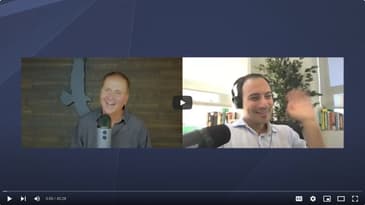
I introduced you to Mosheh Oinounou last week. He is an incredibly gifted and skilled news reporter who took the time to talk with me on our CTL podcast. Last week, we sent out Part One of the conversation. Today, we drop the rest of his story. Mosheh knew things were not where he needed them to be, both professionally and personally. He made a bold decision to do something about it. He started a new venture, an independent news agency and podcast called Mo News. It now has over a million viewers/listeners and is truly disrupting the news media arena.
Take a few minutes and listen to how Mosheh made the decision to start this venture. His authenticity and courage will inspire you.
[00:00:00] Welcome to Crossing the Line, a podcast brought to you by Eagle Center for Leadership's Dr. Larry Little. Thank you for listening today. In this episode, we are joining Larry for Part 2 of the interview with Mosheh Oinounou.
[00:00:23] If you are new, we invite you to subscribe and get notifications when new episodes are dropped. You can also watch this interview and other Crossing the Line episodes on YouTube by searching for the channel Eagle Center for Leadership.
[00:00:36] Now let's dive back in for Part 2 with Larry and Mosheh. So there you are because of that relationship in Washington again. Yeah. Okay, working on that show. What happens next? Uh, end up building a team, learn a lot, learn a lot about legacy companies, legacy
[00:01:00] culture fighting against the grain, what not to do, what to do. CBS is a very old school place, you know, the previous president like to use the term deep state to describe people in the government. At CBS we had a deep state.
[00:01:16] These are people, by the way, some of them hired literally who I would end up managing, hired by Walter Cronkite, who are still there, Larry Little. And so I'm finding like, well, you know, listen, for those of you unfamiliar, CBS
[00:01:29] has been in third place in the ratings behind ABC and NBC for three decades going back to the early 90s. And it's like, well, we got to take a different approach. We got to try things differently.
[00:01:38] And while some people like that rhetorically in practice, they don't love that. So I think what I discovered was the ability to manage wash and coverage for a network is incredible because you're on the horn with the White House
[00:01:55] press secretary, you're booking interviews with the president and first lady and secretary of state and secretary of defense, etc. Found myself several times at the White House. Got to introduce my mom to President Obama and Michelle Obama, managed an interview one day for CBS Sunday morning.
[00:02:12] We did a joint interview of Michelle and Barack Obama with Charlie Rose. And we were at the White House that day and they happened to also be doing an interview with Oprah. So literally I find myself in 2012, one day at the White House, we are
[00:02:25] prepping the blue room, which is one of the there's basically six rooms across the main floor of the White House. And we're doing the interview in the blue room off the balcony. Then we're going to walk down the steps, the whole thing, two rooms over.
[00:02:38] Oprah's preparing her interview with Gail and we're like hanging out. Oprah, Gail, Charlie Rose, all of us and we have the White House and we got catering there. Like this is remarkable. And so got to do some really cool things. Did you pinch yourself? Did you like it?
[00:02:55] What in the world are were you just all into it? I mean, were you just engrossed in? I have to say that day, I wish I would have pinched myself and taken more of a moment, but I think I was so stressed because someone had put
[00:03:04] in Charlie's driver's license number wrong with the White House security and we couldn't get him through the North Gate. And there's a whole thing. And he showed up late because he showed up late to stuff. And so anyway, I think I was more stressful as managing the whole
[00:03:16] thing and making sure he's ultimately President Obama tends to show up early. You find this out about certain people. We had done an interview earlier that year with President George W. Bush at his library opening in Dallas. And I remember I'd heard this and I didn't believe it,
[00:03:31] Bush shows up an hour early to stuff. And so Trump shows up late. Clinton shows up very late. They all have various scheduling things. And so, you know, I was more concerned at the White House with like, can Charlie get there on time when we have enough time?
[00:03:48] And then managing the theater of having them walk down the steps with five different cameras, making sure they're looking the right way. And inevitably they didn't. And then there was I remember them joking on the balcony like Charlie
[00:03:59] and President Obama being like, can you believe we have to listen to all these 20 year olds telling us what to do all the time? I love that behind the scenes, the things that nobody would ever know if they weren't in your shoes seeing that. That's that's amazing.
[00:04:14] Most OK, so walk us through what happens after this. All right. So then I realized I can't be in DC anymore. Deep State is eating me alive in DC. And I call New York and like, let me back up. I can't be down here anymore.
[00:04:29] And so I end up going back up to New York, working on the morning show. And then I'm given an opportunity. They want to launch a 24 hour channel in CBS, but because they didn't get into the cable game.
[00:04:39] So cable news for those, you know, just as a quick briefing here. CNN starts in 1980. And then in a matter of months in 1996, Fox News and MSNBC launch. Now, for many, many years, ABC and CBS were also interested in 24 hour news,
[00:04:53] but never really were able to figure out a successful way to do their own cable news network. So now we're in 2014 and CBS says we got to do a 24 hour channel. Most can you figure it out? Used to work in cable, your creative, etc.
[00:05:05] Can you figure this out? Said, OK, but we're not doing cable because cable is really expensive. Let's figure out digital streaming this thing. There's this thing called Roku Apple TV. And so they give me the opportunity to build a 24 hour channel,
[00:05:17] but we're going to build it in a new way digitally for people's phones. Now, mind you, video is still not great on phones in 2014, but we're building it for the future. So how do we take a network that already does 60 minutes
[00:05:28] in Sunday morning and a morning show and evening news and 48 hours and all the various shows and turn it into a 24 hour channel? How do we build that? And that's my task in 2014. And we launched something called CBSN, which is now CBS News Streaming,
[00:05:41] which we would eventually build into 24 hour channels for all the CBS stations and other CBS streaming Minneapolis, LA, San Francisco, Miami, as well as a national channel. And that becomes my task for a couple of years. So really leads me in this case.
[00:05:57] If I built a dozen person team in Washington, now I got to build a 100 person team in a world I'm not familiar with in the streaming space. My goodness. So you had that that objective, that goal. You had to build a team. Hundred people.
[00:06:14] And so you find yourself just I know you're just working from can to can't. But how did that feel when you saw that thing launch for the first time? When you saw a light on the floor and cried?
[00:06:28] But I remember like launch day, like is this thing going to work? I remember Leslie Moonfest, the head of the CBS Corporation, was like, just make it work. All right, like turn it on and make it work.
[00:06:43] And you have to you have to take a leap of faith, right? Because ultimately, you're very much it's like, you know, with the Bible story Tower of Babel, you're all speaking different languages. So the engineers speak a certain language. The journalists speak a certain language.
[00:06:58] You're all at the same table and you're trying to explain to the engineers how news works and like, oh, but there's going to be breaking news. And so we got to be able to break into that. Well, how does that work?
[00:07:06] And so you're sitting and having these negotiations and then you have to work against the deadline because you've now sold advertising space. So you got to be going. And I remember we were a few weeks late. So we were losing money from whoever the launch sponsor was.
[00:07:16] I think it was Microsoft at that time. And every week we're not on the air, we're losing money. And these businesses have a bottom line. These are publicly traded companies. Shareholders care about this stuff and it's like make it work. So I remember launch day, it gets on.
[00:07:29] And I remember we pre-tape the first hour. So we were supposed to be live at 9 a.m. We actually started at 8 a.m. Taped it and played that taped hour at 9 a.m. because we were so nervous about it actually working live at 9 a.m.
[00:07:42] And so we do that. And I just remember we get off, you know, we finished that show that first day and I remember seeing there like having tears of relief, tears of joy. Love it. But what an accomplishment and what trust they had in you.
[00:07:57] And I guess, you know, the one that you had the relationship with, he, you know, he knew he could trust you. You trusted him. You took a leap of faith. He trusted you. And I'll say it's a team sport. He was a team sport, Larry.
[00:08:09] There's a lot of incredible people. They wouldn't work without all the people I was working alongside. So I think we were able to put together a very smart creative group of people. Some I got the hire, some that were hired alongside me by by management.
[00:08:25] And we all were able to figure it out. And you birthed the CBS streaming 24 hour for the first the first program that did that amazing. That's so so what was left now? Now where are we and what's next? So now I'm managing that. I'm trying to grow that.
[00:08:43] I remember there was a couple of years later on 60 minutes, they did a story about Snapchat. They're like, there's this thing called Snapchat, but it's very much like 60 minutes is explaining Snapchat to your grandparents. And I was like, I remember one somebody asking me like,
[00:08:56] hey, are you guys going to air that on the streaming channel? Like that feels like that's really good content for your people streaming. Just keep in mind that our streaming audience was in their mid 30s or early 40s.
[00:09:04] The average network news viewer cable news viewer is in their mid 60s to late to early 70s. And I was like, I can't air your Snapchat story because it sounds like I'm explaining Snapchat to grandparents. Like it's not relevant like the way the story is done.
[00:09:18] And so immediately I'm like, we should do a 60 minutes for a younger generation. We're great storytellers here at CBS. How do we do that? So I pitched that and they give me a couple of network slots on prime time in August.
[00:09:30] I think we were up against American Ninja Warrior and the Bachelorette or something. And it was Monday nights in August on CBS. And we get to do some incredible stories. In fact, one of them is with a we do a feature.
[00:09:42] We go to Moscow and interview Alexei Navalny. He, by the way, is the one who's in prison now. This is before he was poised in the second time by Putin. And I remember in that story, he says, like, I might die by fighting for rights here in Russia.
[00:09:56] So we got to do some really incredible stories. We also went inside ISIS prisons in Northern Iraq. We got to do the most dangerous place in the world to be a journalist is Mexico. And so we, you know, got to feature some reporters that are going up
[00:10:11] against the cartels in Mexico. So I got to do some really incredible reporting there. And by the end of that year, so after a couple of years in streaming, I get a call from the boss and he's like, listen, I'll talk about another
[00:10:27] job for you. How do you feel about going back to the broadcast and running the CBS Evening News? And I have to say it's one of those things where I was loving being a digital, I was loving innovating, I was loving to going to the place
[00:10:47] where people are going next. And yet the Evening News, this August broadcast, the Evening News, by the way, started in 1948 as a 15 minute show. Cronkite would take it a half an hour. By the way, it was 15 minutes because that's all the news they thought they could have.
[00:11:03] You know, when they went to half an hour, they're like, how are you going to fill a half an hour of news in 1963? Well, there'd be an assassination of JFK, etc. They're like, we have no problem filling this half hour. And so I become, you know,
[00:11:20] I'm asked to do this and I feel like I have no choice. I got to do this. This is an opportunity. Can I innovate? Can I try something creative? Can I take the show an hour and make a half an hour on streaming?
[00:11:31] There was a bunch of ideas we had at that juncture. And so I'm asked to do that and I say yes. And so in early 2018, I take over the CBS Evening News. And I seem to have this luck, Larry, like I told you about my 9-11 story.
[00:11:45] The first day I take over the CBS Evening News is February 14th, 2018. It's the day of the Parkland School shooting. Goodness. Your first day. Welcome. Yes, welcome. And what people may be familiar with at CBS, we have, you know,
[00:12:06] during the day, there's a lot of game shows and soap operas. But when major news happens, you cut into that with what's called special reports. Yeah. And so on my first day, you know, I was like, all right,
[00:12:18] we're going to work on a half an hour show tonight. I'll be able to manage it, etc. They're like, there's a massive school shooting. You got to go up on TV. And so I'm breaking into the showcase showdown on Price is Right
[00:12:27] and we're live for five hours that day as the story is unfolding and doing that sort of coverage is a completely different muscle in your brain. How are you keeping this going? How are you assuming the audience is coming in minute by minute?
[00:12:39] So you're repeating things, but you don't want to repeat things in a way that will upset the audience is already there being like, why do they keep repeating things? So there is a dance that you do, so to speak, as you're covering breaking news,
[00:12:50] you're bringing information, you're seeing what the other guys have. Can you confirm that? Is that bad information? You know, I have been through a number of stories where they've named the wrong shooter. They've put the wrong name out there because sometimes they'll have
[00:13:04] a fake ID on them or a law enforcement officer will spell the name wrong. And so you're making calls in real time competitively because in the audience, like, why aren't they reporting this? I already heard that. Well, because we can't verify that.
[00:13:18] Well, well, you know, they're trying to cover something up. So you have all these things going through your head. You're trying to get resources down to, you know, that area of Florida. The reporter who's based on there, oh, they haven't been on vacation that week.
[00:13:28] Well, where are they on their vacation? One of the things you need to know in news, when you take a vacation, you actually have to typically at a network level if you're a certain you know, level, you are telling your boss exactly where you're at,
[00:13:39] what hotel you're at and what number is available to you because news is a lifestyle. It's not a normal job. I get now so so I can see that. But you got dropped in on your first day. All this happens.
[00:13:51] Tell me about the adrenaline rush that you experience when those kinds of things start happening. So there's an adrenaline rush. It's just, you know, some natural things kick in. You know, again, it's a team sport. News is so, you know, you have a lot of very smart
[00:14:08] experienced people around you to support you at the same time as a leader. They're looking to you to make decisions, the big decisions. Are we going up? Are we going down? Are we reporting this? Are we not reporting this? How long are we going for?
[00:14:21] And, you know, you have people who've been in the business for decades coming to you being like, can I get an extra 15 seconds to say this in my story because keep in mind when the show is a half an hour,
[00:14:31] take out commercials here at 21 minutes, take out the headlines at the top. You're at 19 minutes. You're telling people the world in 19 minutes. The average story is about a minute, 20 seconds. So you have literal reporters with dozens of Emmy awards coming to you saying, please give me 10 more seconds.
[00:14:45] Please give me 15 more seconds. You know, I want to be able to include this, that, the other thing. And that is, you know, it's a game of seconds. OK, if I give you 15 more seconds, then you have to promise reporter number three.
[00:14:57] When I tell you to stop, that you stop because if you go 10 more seconds, I've now lost that story. So you realize that as a leader, you have the adrenaline rush going. But just the you get to decision fatigue at some point
[00:15:13] because there's just so many decisions that are happening all day long. And you've got to be making calls, you know, at the speed of the news. So in 2018, you've you're now successfully stretching this segment to 30 minutes, this new opportunity that you have.
[00:15:29] Now I'll have to keep asking what's going on personally here with most. Well, it's interesting to bring that up because when I got the evening news job, it was the first time in my life where I said to myself,
[00:15:43] this doesn't feel as exciting as I thought it would be. Every promotion before that was very exciting, was interesting. And I get the evening news job like literally the biggest promotion I've ever got. Right? I'm the youngest even I'm the youngest EP they've ever had
[00:15:57] at CBS at 35 years old at the time. And I'm like, I thought this would feel better. Like I actually like I don't know if I love this job. And frankly, it doesn't excite me to have this promotion anymore. I have a sense of dread. I'm stressed out.
[00:16:14] It would turn out that about. When would that be? Eight months into the job, I go on the first date with a girl named Alex, who I meet on a dating app and. That was a game changer until then nothing. And they didn't have.
[00:16:36] You know, I dated but nothing in a real serious way. I never lived with a girl. Never got to even that stage. Right? Within two weeks of meeting Alex, I say, you know, this is it like we're together. We're not dating anybody else.
[00:16:48] Two weeks. You knew in two weeks. Two weeks. I take her to a colleague's wedding eight weeks in, which also includes like a trip to the Kennedy Center Honors, which CBS hosts, where she meets all of my colleagues.
[00:17:01] Ten weeks in, we take an international trip together to Thailand. It's one of those things where through all those years of dating, something felt different about this one in a very good way. And I'm finally for the first time feeling fulfillment personally
[00:17:21] in a much greater way than I felt professionally. Wow. And that occurred in 2018. Right. I get the biggest job of my life and it becomes the least fulfilling professionally for me. I love that most. I love it. So you fell in love, found purpose,
[00:17:38] found meaning on a personal level, even though you had the greatest opportunity of your life and you guys fall in love quickly and you date, then bring us up to date. Sorry, speaking of which, she just texted me. I wanted to make sure. Yes, please. Yeah.
[00:17:59] So is it good? Yeah, everything's good. You're asking, bring us up to date. 2018 you met her. You're in love. She gives you purpose. Bring us now into where we are. We would move in nine months later. I would propose a year and a half later.
[00:18:17] We were married two years later. And so from the point of meeting her to the wedding was two and a half years, the engagement was a year and a half. It just was great and is great and continues to be great. Professionally, though,
[00:18:33] even in these turns out to be the hardest job. Wait, wait, wait, Mo. Wait, you cannot, Mo, you cannot, you cannot go there. You got to say what, why did you look at your text? Tell us what's going on with Alex right now. Come on.
[00:18:46] Oh, Alex happens to be as we record this literally today, 39 weeks pregnant with our first child. And so we're in the zone now where every phone call and every text I'm looking at immediately to be like, do I need to be running to that right now?
[00:19:04] I think it appears we're OK at the moment. But yes, God willing, by the time this podcast airs, we will have a baby girl in our arms. So exciting. OK, now go back and tell us. Tell us what happened professionally. All right, that's the good news.
[00:19:22] Bad news. This is what happens professionally. So the evening news turns out to be the most difficult job of my life. And it also comes at a very difficult time at CBS because at that time, just a couple of months before I took over the evening news,
[00:19:33] was the beginning of the Me Too movement. And so there's the firing of Charlie Rose, the revelations about Charlie Rose. And then CBS is at the epicenter of it because Leslie Moonfest is being investigated. He would eventually be fired. They have 60 minutes was being investigated.
[00:19:47] He would eventually be fired. And so we have chaos happening internally at CBS. We have multiple law firms investigating us. Employees. It's just it is a time of a lot of internal strife at CBS. So there's the challenge of covering the news,
[00:20:02] which by the way is not easy during the Trump administration. Typical White Houses will put out one story a day. No president before him was tweeting all day long. And so ultimately on any given day, there's five or six stories coming out of the White House.
[00:20:14] We have to pick which ones. He happens to be making stories at 10 p.m. At 6 30 p.m. At 6 40 p.m. There's just no, no hour, no hours, you know, you have to be looking down at your phone all the time. It is exhaustive. It's exhausting. Sorry.
[00:20:29] It is exhausting. And so you have that the news during that time. And then, you know, you have the internal issues that happen at CBS. Remember our investigative team had to spend as opposed to investigating things in the world, the investigative team is being devoted internally at CBS
[00:20:45] to investigate what happened at CBS. So, you know, I'm making decisions like, are we putting a camera outside Leslie Moonves's house? The boss of the network, because there's a story about him being investigated, you know, for sexual misconduct in the LA Times.
[00:21:01] These are the types of issues I'm dealing with. On top of that, I got the deep state fighting any changes to the show, yada, yada, yada. And so it just becomes a lot. Yeah. So eventually there's management changes at CBS.
[00:21:13] And they want to take the show to Washington, go in different direction. I have now spent nine years there. And, you know, when you're in the media, you know, constantly there's media reporters that are covering things. So there's stories about CBS and Stryphus CBS
[00:21:29] and fights at CBS and leaks from CBS and the New York Post and Variety and Hollywood reporters. So you deal with external press covering things, meetings that you're having. You're wondering if there's external reporters on your conference calls. And all of that is going on.
[00:21:43] Meanwhile, I'm on cloud nine in my personal life and my professional life. I was like, this is the most, like I can't. Like you're trying to cover the news and you're trying to deal with the internal stress. And so ultimately new management comes on board
[00:21:56] and like, all right, I've done what I could do here. You guys are taking the show in a different direction. It's time for me to go. And in the summer of 2019, I leave CBS and I don't know where I'm going next. So there you are.
[00:22:15] You're without a job. Personal life is great. Professional life is empty at this point. And I'm somebody that attached significance and attached identity to my job. Yes. And it is one of the biggest struggles I would have
[00:22:35] was who am I if I don't have a title and a network? As so many people, Moshe, you found your validity, your identity, your value in your job. And you were incredibly successful for so many years and had the trajectory of just moving up, up, up, up,
[00:22:53] up and all of a sudden it stops. And you find yourself alone, professionally without that identity, without that significance. What happens? It takes a few months. I struggle, Larry. I have to figure out, well, what skills do I have?
[00:23:13] And I go on basically a lot of lunches and dinner in drinks with people across the industry. To figure out what it is I wanna do. I realized that through my career, I've picked up a lot of skills and contacts. But what am I gonna do with them?
[00:23:32] I need a break from news. This last experience was exhausting and emotionally just draining, basically draining. Actually for the first time in my life, I take a break from the news for a few months, like where I don't check in for a few days
[00:23:49] on headlines, which is remarkable for me. I haven't taken that break since I was in first grade. And I do that and realize, okay, maybe there's something to be done as far as consulting. I've done a lot of things. People could use my wisdom perhaps.
[00:24:07] And this is where I also find that I found an incredible partner because Alex is pushing me, like stop building stuff for other people, build something for yourself. That's what wisdom, good for Alex. Oh and visionary frankly, because I didn't, despite having this career,
[00:24:28] I didn't have the confidence to do it on my own. Well, why would somebody hire me? I need a name behind me. I need a three letter network name and a title for people to take me seriously. Why would they take me seriously? But she's like, try.
[00:24:42] And I deal with dealing with my own lack of confidence on things. Imposter syndrome is a real thing. Still dealing with it. And ultimately get a couple consulting gigs for those last few months of 2019 into early 2020, helping various media companies with some projects here and there
[00:25:10] in trying to make my way. And then COVID hits in February and March of 2020. And immediately companies are not hiring consultants anymore and I'm back on my butt and now I'm watching TV all day because the biggest story in the world is happening.
[00:25:25] And Larry for the first time in my life, I'm not in a newsroom for a major news story and I'm sort of freaking out. Oh, I can imagine. I'm like the rest of you. I'm like everyone else. This is how people have to consume information.
[00:25:38] They don't have 100 producers sending them emails and government officials answering their emails to get answers. I have to just sit and watch TV and wait for the next commercial break and hope they're gonna cover the thing. I'm curious. Mo, Mo, you were one of us.
[00:25:52] I was one of everybody else and I found out it totally sucks. It sucks to consume news that way. And so I did the only thing that I knew that made me feel okay, which is I gotta report this stuff.
[00:26:06] So friends and family are asking me questions about COVID and so I find myself like, where do I have friends and family? Well, about 500 of them follow me on Instagram. Let me start posting stories on Instagram. I'm like, listen, I just listened to Fauci.
[00:26:18] This is what he said. I just listened to whatever this is what he said. There's an interesting report out of the new, out of this European newspaper about what's happening in Italy, et cetera, et cetera. This is a case too where you marry the right person
[00:26:31] and they understand you and it will come in handy. So I'm doing it privately on my Instagram account. I was like, you gotta go public with this. Friends and family love what you're doing. Other people will get use out of what you're doing.
[00:26:43] I said, fine, let's open it up. I'm a private person, but sure. And suddenly I'm seeing thousands of people started to follow me on Instagram every day who wanna get COVID news. And I remember about eight weeks in to it.
[00:26:56] So we're in early May and a friend of mine texted me. He goes, you know, you're stuck now, Moj. Like, you can't stop doing this. Like, this is a thing. And I thought, I was always joking. This is the thing before the next thing.
[00:27:08] This is gonna just keep me busy until the next thing comes around. And like, no, no, you have discovered the thing. And by the summer of 2020, celebrities are starting to follow the account. And I remember like one day I was like asking my wife,
[00:27:19] I was like, Joe Jonas, like Jonas, the Jonas brothers are a thing, right? She's like, oh, what do you mean? I go, he started following me. He just promoted me to all of his, you know, millions of followers. And that's awesome.
[00:27:31] And I was like, oh my God, this is real. Like, there's people like, people have found this account. People are getting use out of this. And so suddenly through, you know, after a few months, I realized I have suddenly fallen in to my next thing. Wow.
[00:27:50] Just from that, I mean, you started doing it, friends and family. All of a sudden your wife who is incredibly wise says you gotta go public. Yeah. And you didn't even know how much you had to offer, did you? And all of a sudden you-
[00:28:05] No, I have imposter syndrome, Larry. Why are people following a little old me? This is the thing. For so many years in network news, I'm the guy behind the guy. I'm the guy behind the gal. I'm the executive producer. I'm not the person in front of the camera.
[00:28:17] I'm in the control room with a headset talking to that person, leading them to the next thing. But the audience isn't connecting with me, they're connecting with that person. And so for me to do this on this year, I was like what? They really like me?
[00:28:30] And then we have the next fight in our relationship, which is like you need to put your face out there. You need to be talking to them. Because I was just posting articles. And I was like, no, I can't be on camera. That's not my thing.
[00:28:42] Like, and she's like, people will connect with you. And so ultimately in the fall of 2020, I do that for the first time again at the urging. The urging of my then fiance. I love that. She was leading you well. So you do that.
[00:28:58] So how does that migrate into Mo News? So then we get to the point where enough people are following me, including the head of Instagram who invites me. Yeah, Adam Asari from the head of Instagram starts following me. I mean, it's incredible.
[00:29:13] I mean, we have like Condoleezza Rice and Sharon Stone and Ricky Martin, the number of people, Donnie Osmond. If you went through the assortment, the assortment of celebrities and notable people who follow this account now, it's incredible. So I get to the point in late 2020, early 2021
[00:29:34] where it's like, all right, if I'm devoting eight to 10 hours a day to this, I need to figure out if I can make this a business. So the launch and account on a website called Patreon which allows people to donate to you was actually started by musicians
[00:29:47] to get people to give donations. Find a few hundred people who want to donate to me. I was like, wow, okay, there's something here, right? We have an example. We have a proof of concept here. And then we get into 2021 where suddenly Facebook
[00:30:03] is getting into the newsletter game. They invite me to write a newsletter on their new platform along with a whole number of other creators. I start to get my first sponsorships from advertisers who are like, what do you charge for ads?
[00:30:14] I was like, I don't know what I charge for ads. What should I charge for ads? So that's 2021. And then I find, and you know this now that we're talking about a podcast here that I need to expand beyond social
[00:30:27] and one of the natural homes for what I do and where I feel I can distinguish myself is launching a podcast. So we do that, we start that in summer of 2022. And when we're doing that, I was like, well, I've always been posting on my Instagram account
[00:30:42] under my name, we need to come up with a name for this whole thing. And so spent a lot of time thinking about that and we keep it simple, Mo News. My name is Mo, my initials are Mo. Mo means more. It felt it worked on multiple levels.
[00:30:58] Let's go with it. And it did and it does and you are, and you have a partner on your podcast. Talk about that for a minute. Yeah, my co is Jill Wagner. We actually first worked together at CBS News. She was one of the reporters on the floor
[00:31:13] of the New York Stock Exchange. And you ever see those reporters at CBS and the networks, they have to do reports sometimes 100 a day for every station. So she's like, good morning, CBS Vegas. The MGM stock today is down up in the, okay. Good morning, CBS LA.
[00:31:30] Netflix stock is, you find a relevant story. Like, hey, good morning Seattle. Microsoft today is Starbucks today is doing X. So we ended up connecting to CBS. She would go on to another media company. She was leaving that and we connected in 2022.
[00:31:47] And I had guested on a podcast she had hosted at this other channel Cheddar. And we were figuring out, she was figuring out her next step. I wanted to get into podcasting. And so we decided to launch initially, again, we like to experiment.
[00:32:03] So proof of concept twice a week. We're gonna do a podcast starting in June of 22. Realize there's a growing audience for it. Take it daily. We took it daily. Sometimes we have six episodes a week now. And we've grown back and then she edits the newsletter.
[00:32:20] We do a daily newsletter as well, the Mo Newsletter. And so she's been a great partner to help build this out and make this real. So give us a little bit behind the scenes. So if you guys are doing a daily podcast,
[00:32:31] do you like get up at three o'clock in the morning? I mean, because I know it comes out very early cause I listen to it, it's amazing. But when do you record it? The night before late. So it's interesting because we'll see.
[00:32:43] She's a mom of two kids under five right now. And so she's up very early in the morning. So when we record later at night, she's like, Mo, I've been awake for like 16 hours by 8 p.m. like, so we typically will record at night.
[00:32:57] I'm typically right now, you know, pre-child right now, sometimes up till midnight, just after midnight. So if something happens late, I'll update. And hopefully it'll be seamless enough where you don't notice as a listener. And then we'll put it out every morning about 4.15 in the morning.
[00:33:15] Well, it's an amazing podcast. You guys do a tremendous job. But I gotta ask, Mo, you know, you're doing this. You're building something of your own, which is amazing. What's next for you? What are you thinking? Listen, most importantly right now,
[00:33:31] as we, you know, is being a good dad and being present for my family. That's priority number one. Like I told you that switch flips while I'm at the evening news, you know, I will never be as fulfilled as I wanna be professionally.
[00:33:50] And ultimately we know this comes down to family and the people and that is for me. And so priority number one right now is being present for my wife and being present for my future daughter. And, you know, being there for that baby
[00:34:04] while we figure out how to, we watch Mo News evolve from baby to toddler on the professional side. You know, what a journey though you have taken, you know, from a professional but now as a person, as a leader and coming full circle to say,
[00:34:21] I wanna be present for my family. This is what matters. And when you, when I'm fulfilled there and I'm a great husband and great dad and vest, you know what then I can pay attention professionally to what's the second priority or third priority but not the first.
[00:34:34] I'm so proud of you for that. Thank you. I mean, I realize now it makes you a better manager too. Right. It gives you greater understanding for what your employees may be going through. I mean, I was a very young manager of many people of various ages
[00:34:48] and, you know, I think I was very good at certain things. I think I was terrible at certain things and I learned over time and, you know, I wish I knew then what I know now and, you know, even watching my wife go through pregnancy
[00:35:06] and realizing everything that that involves and, you know, you know, I think that ultimately it's important to recognize where you can continue to grow. And this is always something I thought I did a good job at was recognizing that, you know, family comes first,
[00:35:34] your personal life comes first, that at the end of the day the news will always be there. That's right. At the end of the day, every vacation I took something huge always so it happened because something huge always happens. Like no matter what,
[00:35:44] no matter what something is always happening out there but probably for my first 10 years till my mid-30s, I wasn't even taking all my vacation time at work. Like I was devoted, devoted, devoted and then, you know, I would have a relatively,
[00:36:04] I wouldn't call it late in life, revelation. I mean, I'm happy I realized that when I did because there's certain people who by the way will do that till retirement, right? Right. That's it. They're married to that. You're right.
[00:36:15] And I think that switch flipped for me in my mid-30s. I'm so glad that's not who you are. You have grown into this incredible leader who understands relationships, who understands priorities and I could, man, I could talk with you all day. I wanna honor your time.
[00:36:30] I know you're incredibly busy. I wanna leave us with this thought. There are those though who are where you were 10, 15 years ago right now. There are those listening to this podcast who are saying, you know, I'm trying to figure this thing out.
[00:36:42] I'm trying to figure out who I am or what I am. What nuggets of advice would you leave us with as you think about those people who may be struggling to find their way? You know, it's interesting. I was listening to the podcast,
[00:36:57] How I Built This a couple of years ago and they had the founder of Tito's Vodka on and he, if memory serves me right, was working as in the energy industry. I think he was a driller fracking in Oklahoma, unfulfilled, et cetera.
[00:37:16] And one day, you know, he comes home and he puts a blank sheet of paper in front of him, draws a line down the middle and on one side makes a list of things he's good at. And on the other side,
[00:37:30] he makes a list of things that he loves. Somehow as he's making that list, he comes to creating a vodka company, right? And you know, people looking at me like, Texas vodka. I mean, people don't know that like, now you take for granted Tito's vodka.
[00:37:45] But like not so long ago, you don't think about vodka in Texas. It's not, you know, like vodka is from Russia. And I will say this as somebody who's, you know, become entrepreneurial at least the last couple of years, but has been very lucky in their career
[00:38:00] that they've gotten to do something they love. And I consider myself very fortunate that I've been able to make a career and something that I love because so many people cannot do that. But I think it's important as you're making your way
[00:38:14] and this is why I think it's important also in your 20s especially or your 30s, you know, frankly it doesn't matter. You know, I recall the story of like Julia Child and all these various people who sometimes into their 50s or 60s, they don't figure out, you know,
[00:38:29] it takes them a while to figure out what their passion about before we're really famous. But figure out what you like and what you don't like and why you like what you like and why you don't like what you don't like. And I think it's very important
[00:38:39] to do that self assessment, self analysis. You know, we live in an era now post COVID where it's sort of let everyone take that moment being like, does this actually fulfill me? Now, this is the consternation of employers
[00:38:51] who are like, I would like you to be a devoted employee and be obsessed with what you do here. And certainly, I think we're still dealing with the kind of post COVID issues but figure out what you're passionate about. That's important. Invest in yourself and in your education
[00:39:05] and in your skills. Try to become a master in a few things, you know, the Malcolm Gladwell thing. You know, what are you passionate about and what can you become great at? I tell this to journalists actually too. I actually tell all aspiring journalists,
[00:39:18] don't go to journalism school. Become an expert in a subject area. Really get to know psychology, really get to know history, really get to know, you know, economics or business. Become an expert in something. The storytelling and that we can work with you on that practically.
[00:39:37] So, you know, I think that's one element of it is, you know, your passions. Number two, find those mentors who's investing in you. And sometimes if it doesn't exist in your current business, look out there through the college alumni networks that are out there.
[00:39:50] Look out there like, you know, or frankly, again, find people who are doing things that you think are incredibly inspirational to you or play, you know, who do you wanna be? And find those people and reaching out to them.
[00:40:03] You know, we live in an era of social media. You'd be shocked at who might respond to you. Now, not all of them will respond but I would say that seeking out those mentors, seeking out people at companies or, you know, organizations that inspire you
[00:40:19] are kind of among the things. And then honestly do the homework. I've always been most impressed with the employees and what I tried to do as an employee was, you know, I know we live in the post COVID era but whether it's getting there early, staying there late,
[00:40:34] really doing your homework on things is one way, is one, you know, gets you in the third lane of the expressway to success because you'll run circles around the other people who frankly, you know, aren't taking that extra moment. Wow, Mo, great words, incredible words of wisdom
[00:40:49] from an incredible leader and I mean that. I'm excited for you. I'm so honored that you gave us this time and told us your story. I am excited about where Mo News is going and more importantly where you're going
[00:41:02] and where you're going as a dad and as a husband and that is amazing. You're on an amazing journey. Congratulations, I know you're excited about that baby girl and we look forward to hearing about it. Look forward to continuing to hear about Mo News
[00:41:17] but you are truly making a difference Moe and I wanna tell you that you're amazing, amazing guy. Thank you for being a bit vulnerable with us for sharing and for kind of walking us through how you got to where you are today
[00:41:30] and we look forward to hope maybe, maybe you can give us an update from time to time on what's going on with you because we sure appreciate you and we're gonna be following you but maybe we can have another conversation in the future.
[00:41:43] Thank you so much for being with us. Larry, thank you. I very much enjoyed this. I appreciate this conversation slash therapy session going down memory lane. And by the way, if anyone's interested in following us for nonpartisan verified news you can head over to Mo.News,
[00:42:00] a website developed by your daughter. Larry. Wow. And so I appreciate you both as a host here and as the father of an incredible entrepreneur in her own right. Thank you so much. I think she's special and I really appreciate those kind words.
[00:42:20] We look forward to talking again soon. Thank you. All right, great. Well, what a journey that we've been on and I hope that you have been able to hear all of the episodes. I hope that you were able to kind of hang in there
[00:42:40] and listen to the entire journey of Mo Schwannunu's life. It's really an incredible story as he talks about taking a leap of faith several times in the relationship that he developed with one of his mentors and one of his leaders
[00:42:54] and how that has helped him through his career. Just an incredible leader. He's really doing exciting work and launching Mo News. It's a news podcast that's nonpartisan and it's conversational and I really encourage you to check that out over on Instagram or your podcast,
[00:43:14] the way that you receive podcasts. Mo News, Mo left us with some nuggets of truth. He said, look, if you're really trying to figure out where you're going and what you wanna be or who you wanna be, he said discover your passion
[00:43:28] and then he said, make sure you find a mentor find somebody that you trust and they can walk with you and then he said, do your homework, become an expert. If you wanna focus on something, don't just say that, become the expert in that area.
[00:43:45] Those are great, great nuggets that I took away. I really enjoyed this journey and it really has maybe changed the way that I'm gonna listen to Mo because I just so respect what he's accomplished below the line but I truly respect what he is accomplishing above the line
[00:44:03] and being a new dad and being a husband to Alex's wife. So just a great interview, a great man. Thank you for taking the time. I hope that your time has been fulfilled as you've heard his journey. I hope it's helped you.
[00:44:19] We certainly appreciate you listening to Crossing the Line. Thank you for making a difference. This has been Crossing the Line with Dr. Larry Little. Thank you for joining us today. To learn more about our guest you can find Mo Shwannunu on Instagram or visit mo.news.
[00:44:42] You can support our work by subscribing or hitting that like button. To find more episodes, you can find Crossing the Line on iTunes, Spotify or on our website in the show notes. If you are interested in being a guest
[00:44:55] on the podcast or want to learn more about us, contact the show through our website, eaglecenterforleadership.com. Until next time, thank you for tuning in.